Years ago I would – amoung many others – criticise Tony Blair for being Dubya’s poodle. I remember a cartoon with Tonee coming out of a birthday cake for Dubya with Dubya proclaiming “Just what I wanted, a Kissassogram!”.
Tonee was in thrall to Israel like Starmer and I did criticise the Labour party at the time as being Likud Labour. So what is it with Starmer? He’s clearly a staunch Zionist – he’s admitted as much saying that he’s a Zionist without qualification, there’s an Israeli spy working in his office and he and the UK military are actively doing genocide for Israel.
I suppose that we can defer the decision whether he works for Israel or US while the effect is the same and that’s unlikely to change with the replacement assole. We can go with the working assumption that he’s a dual analingalist.
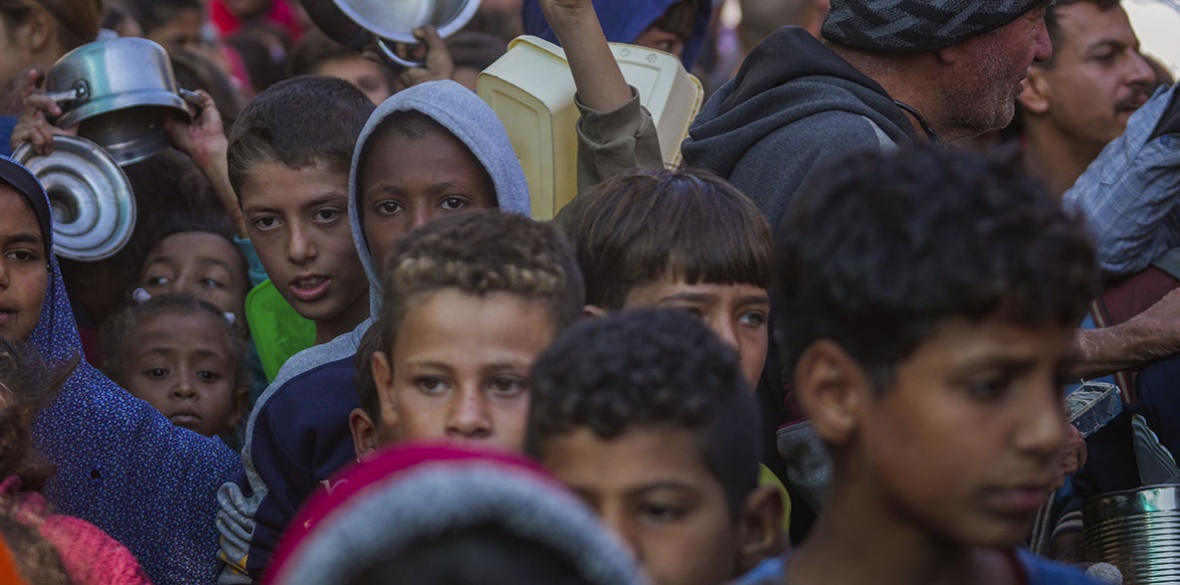
Palestinian children queue for donated food in Deir al-Balah, Gaza Strip, November 22, 2024
Fifty days of siege in northern Gaza sees young children deprived of food and medicine
AN ESTIMATED 130,000 children under 10 have been trapped for 50 days without access to food or medical aid in northern Gaza, a charity warned today.
According to Save the Children, the area is almost entirely inaccessible to aid workers, cutting Palestinians off from supplies despite warnings of famine.
Those in northern Gaza have been cut off from food, water and medical aid since October 6, when Israeli Defence Forces (IDF) declared the area a closed military zone.
Israel ignored pleas from the UN to halt its “blatant disregard for basic humanity” later that month.
The UN warned that the whole of North Gaza governorate was at risk of dying, but the IDF has repeatedly denied or impeded attempts by aid groups to access the area.
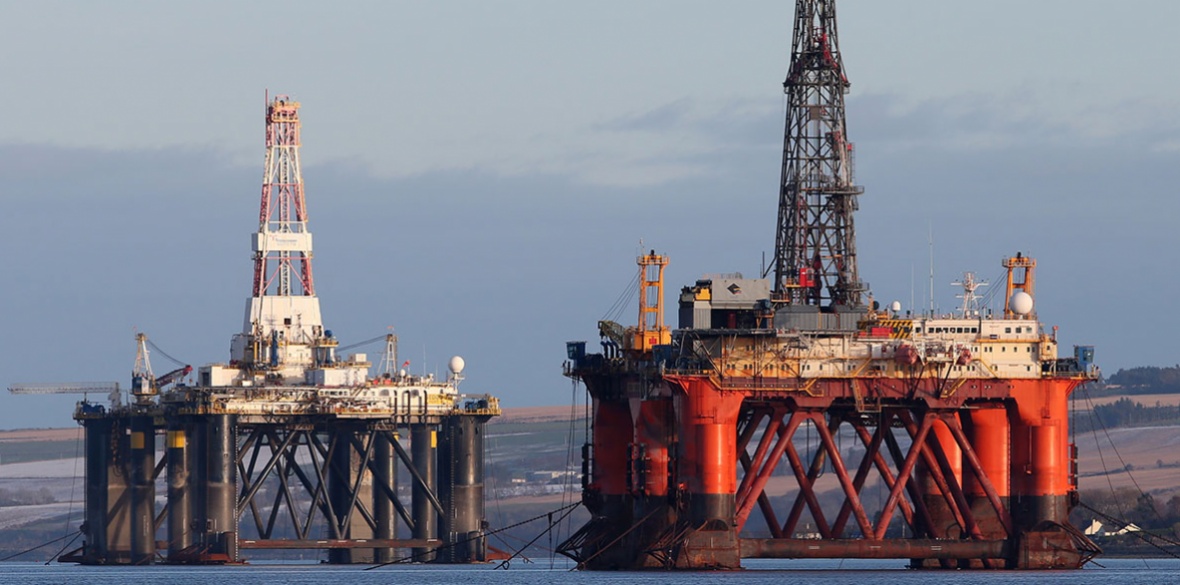
An oil platform standing amongst other rigs that have been left in the Cromarty Firth near Invergordon in the Highlands of Scotland, February 15, 2016
BUSINESSES across Britain have backed the Labour government’s ban on new oil and gas licensing in the North Sea, according to new research today.
The study, carried out by Public First on behalf of fair transition think tank Uplift, found that 70 per cent of British business leaders and 65 per cent in Scotland backed the policy, 54 per cent believed it would benefit their business, and 77 per cent believed phasing out fossils fuels was in the public interest.
In Scotland, the heart of Britain’s fossil fuel industry, 82 supported wider UK government efforts to end use of fossil fuels for energy.
And despite 47 per cent believing the pace of change to be too slow, a majority believe it will be achieved by the government’s 2050 target.
Fifty-two per cent of business leaders in Scotland expressed confidence that new jobs would be created to replace the tens of thousands lost as North Sea oil and gas production dwindles.
But echoing the views of trade unions, they argue it is governments’ responsibility to support workers through that shift.
After a disappointing COP29, we should prepare for more extreme weather events like the floods that hit Valencia last month | David Ramos/Getty Images
Summit proves change won’t come until floods and wildfires are killing tens of thousands in rich Global North cities
While COP29 in Baku narrowly avoided collapsing, its results were bitterly disappointing for delegations from across the Global South, who ended up with barely a quarter of the annual $1.3trn of support they were seeking by 2035 to respond to climate breakdown.
Quite apart from other factors, more than 1,500 pro-carbon lobbyists worked hard to limit progress and ensure that burning oil, gas and coal at profit continues for as long as possible whatever the global consequences. After all, the world’s fossil fuel industries rake in around a trillion dollars in profits a year.
Meanwhile, more and more examples are emerging of accelerating climate breakdown. The flooding in Valencia is just one, but scarcely noticed in Europe is the thoroughly weird weather being experienced in the eastern United States.
This autumn there have been over five hundred wildfires in New Jersey alone, a 5,000-acre fire has been burning for a week on the New York-New Jersey border prompting a voluntary evacuation, and New York City’s Fire Department was called out to deal with 271 brush fires in the first two weeks of November alone.
As if timed for that and certainly released with COP29 in mind, Carbon Brief, a website covering the latest developments in climate science, climate policy and energy policy, has mapped every published study on ‘impossible’ weather events – record heatwaves or storms that would not have happened without the overall global climate changes.
The first such study came in 2004, the year after weeks of extreme heat hit Europe and killed 70,000 people across the continent over several months. That early example of an ‘impossible’ weather event kick-started a new field of research known as ‘extreme event attribution’, which looks at how climate change has influenced extreme weather.
There are now 600 studies of 750 such extreme events spanning the past 20 years – a tiny fraction of the total number of these kinds of events. Of these 750, Carbon Brief found that scientists and researchers had concluded that 74% were made more likely or more severe because of climate change.
This has added to the growing sense of urgency right across the climate science community coupled with a highly critical view of the whole COP process. Even before the dismaying summit in the Azerbaijani capital, both last year’s COP in Abu Dhabi and the year before in Egypt were notable for their lack of progress even as the urgency of preventing climate breakdown was becoming more and more obvious.
There are other risks to global security including nuclear weapons, pandemics, cyber warfare, AI misuse and the progressive destruction of biodiversity, but climate breakdown is different from all of these. It is not a future risk, it is a current happening, it is accelerating, and we now have very few years left to get on top of it. If we don’t then a worldwide catastrophe with many hundreds of millions dying and societal collapse will become increasingly likely.
Does it have to be like that?
As things stand, in terms of changing attitudes, developments in renewables, resistance of the fossil carbon industries and, of course, Donald Trump’s looming presidency in the US, a reasonable prognosis for the next decade has three elements.
First, the use of renewable energy resources does continue to increase but not at anything like the rate required, so net carbon emissions will continue to rise, not fall, for most of the next ten years. Second, resistance to decarbonisation will continue from many quarters, no doubt now including the White House. Finally, severe weather events will become both more common and more destructive.
Eventually, and it might take more than a decade, the disasters will be so great, including sudden weather events in rich cities in the Global North killing many tens of thousands of people, that public pressure across the world will force governments to respond. There will be no alternative to engage in truly transformative change.
But what that means is that the task ahead by then will be hugely greater than if the transformation starts much sooner, so timescales become crucial, especially what can speed up the process.
There is, though, one thing to remember at a time of widespread pessimism. If nations had got their act together 25 years ago after the Kyoto Protocols, were signed we would be in a far more favourable position worldwide than we are now. We are acting more than two decades late.
But climate breakdown is not happening as a slow, steady process of change, creeping up almost unawares. If that had been the case then with all the reasons not to act, especially the global fossil carbon lobby, we would have been in an even worse position now. Instead, it is happening at variable rates in two respects, some parts of the world – such as the polar regions – are warming up much faster than others and extreme weather events are happening much more often.
We are therefore getting a foretaste of what will affect everyone a few years before it does, and this gives us just a little more time to act. It means that the next ten years, and perhaps even the five years to 2030, will be the key time for us to come to terms with the transformation in society that is essential for global well-being. That is possible, just.
Hussam Abu Safiyeh, director of the Kamal Adwan Hospital, is treated by colleagues for his injuries following an Israeli strike that hit the medical compound in Beit Lahia in the northern Gaza Strip on November 23, 2024. (Photo: AFP via Getty Images)
“These people, they target everyone, but I swear, this will not stop us from continuing our humanitarian work,” said a Gaza hospital director injured in an Israeli strike.
More than 1,000 doctors and nurses are among at least 44,211 people killed in Israel’s 13-month assault on the Gaza Strip, officials in the Hamas-governed Palestinian enclave said Sunday.
“Over 310 other medical personnel were arrested, tortured, and executed in prisons,” Gaza’s Government Media Office also said in a statement, according to Turkey’s state-run Anadolu Agency. “The Israeli army also prevented the entry of medical supplies, health delegations, and hundreds of surgeons into Gaza.”
“Hospitals have been a declared target for the Israeli army, which bombed, besieged, and stormed them, killing doctors and nurses, injuring others after directly targeting them,” the office said. The statement came after the director of the main partially functioning hospital in northern Gaza was injured in an Israeli strike.
Hussam Abu Safiyeh is the director of Kamal Adwan Hospital—which, according to Al Jazeera, Israeli forces have repeatedly attacked, damaging “the facility’s generators, fuel tanks, and main oxygen station.”
The wounded director said: “These people, they target everyone, but I swear, this will not stop us from continuing our humanitarian work. We will keep on providing this service no matter what it costs us.”
Since the Hamas-led October 7, 2023 attack on Israel, in addition to killing tens of thousands of Palestinians, Israeli forces have injured at least 104,567 others. Along with attacking hospitals, they have destroyed many homes, schools, and religious sites, and displaced most of the enclave’s 2.3 million people.
Israel—which has been armed by the Biden administration and bipartisan U.S. Congress—faces a genocide case at the International Court of Justice over its conduct in Gaza. Additionally, the International Criminal Court earlier this week issued arrest warrants for Israel’s current prime minister and former defense minister, Benjamin Netanyahu and Yoav Gallant, as well as Hamas leader Mohammed Diab Ibrahim Al-Masri.
Last month, 99 U.S. healthcare providers who have volunteered in Gaza since last fall sent U.S. President Joe Biden and Vice President Kamala Harris a letter detailing “the massive human toll from Israel’s attack” and urging them to “end this madness now!”
“It is likely that the death toll from this conflict is already greater than 118,908, an astonishing 5.4% of Gaza’s population,” the Americans wrote. “With only marginal exceptions, everyone in Gaza is sick, injured, or both. This includes every national aid worker, every international volunteer, and probably every Israeli hostage: every man, woman, and child.”
“We quickly learned that our Palestinian healthcare colleagues were among the most traumatized people in Gaza, and perhaps in the entire world,” they continued. “All were acutely aware that their work as healthcare providers had marked them as targets for Israel. This makes a mockery of the protected status hospitals and healthcare providers are granted under the oldest and most widely accepted provisions of international humanitarian law.”
They added that “we wish to be absolutely clear: Not once did any of us see any type of Palestinian militant activity in any of Gaza’s hospitals or other healthcare facilities. We urge you to see that Israel has systematically and deliberately devastated Gaza’s entire healthcare system, and that Israel has targeted our colleagues in Gaza for torture, disappearance, and murder.”
Despite such appeals and accounts, the outgoing Biden-Harris administration has declined to cut off weapons to the Israeli government and earlier this week most U.S. senators from both major parties rejected a trio of resolutions from Sen. Bernie Sanders (I-Vt.) that would have blocked some American arms sales to Israel.