I sought safety in the UK. I was sent to prison instead

Original article by Samyar Bani and Melissa Pawson republished from Open Democracy under a Creative Commons Attribution-NonCommercial 4.0 International licence.
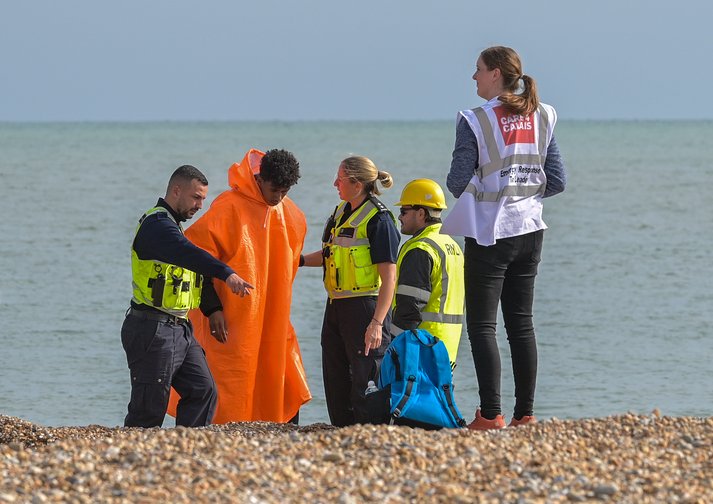
Border force and police officers take people to shore after they arrived in Kent in October 2022
 | Stuart Brock/Anadolu Agency/Getty Images. All rights reserved

I was labelled a ‘smuggler’ and spent over two years in prison for touching the tiller on a dinghy. That’s not justice

Samyar Bani, 42, is an Iranian refugee who travelled to the UK in a dinghy on 1 June 2019. He was arrested on arrival and convicted of assisting unlawful entry into the UK in November 2019. His initial sentence of six years was later reduced to five. An appeal hearing in December 2021 then acquitted him of all charges. The appeals judge determined that the law had been interpreted incorrectly, as Bani and co-passengers had intentionally been picked up by police before disembarking on UK shores. This interview has been edited for clarity and length, and the final transcript was reviewed by Samyar before publication. It is part of the series How migration became a criminal offence.

Melissa Pawson (BTS): Can you tell us why you left Iran?

Samyar Bani: I had a problem with the government there. So I came to England to ask for help as an asylum seeker.

Melissa: What was the journey from Iran like?

Samyar: I left my home country on 1 January 2017. First, I went to Turkey and stayed there for six months. Then I went to Greece. There are so many refugees in Greece. I tried to claim asylum there, but they didn’t accept my claim.

I like Greece. They have good weather, and Athens reminds me of my city, Shiraz. But I wasn’t allowed to stay. So I went to Germany. I was there for four months, but I couldn’t stay there either. They made a mistake in my asylum claim and rejected me as well.

I liked living in Germany, because I have a sister there. But Germany doesn’t like me. So I came to England.

Melissa: Did you travel through Calais?

Samyar: Yes, I lived in the Jungle there for around two months. There were too many people in the Jungle, and everyone was planning to go to England to claim asylum.

Editor’s note: the Jungle was the nickname of a large informal encampment on the outskirts of Calais, France. It was demolished in 2016 but undocumented people continued to live in the area.

When I was going to France from Germany on the train, I was searching on Google and Telegram and Facebook, and I found lots of information telling me that England supports people like me. I read that England understands that Iran isn’t a democracy. Because of that, I thought UK would support me.

So me and four other Iranians bought a boat together to come here.

Melissa: Why did you decide to buy the boat by yourselves?

Samyar: Because smugglers are so expensive. I think they charge around £2,500 per person. I don’t have that kind of money. Instead, each of us put in £500 for the boat to come here. We were six in the boat, including a child around 10 years old.

Melissa: So you crossed the English Channel and were picked up by the UK Border Force boat. Did they arrest you straight away?

Samyar: The police arrested everyone and sent us to the immigration detention centre. We stayed there the first night, and they transferred me to a hotel in London the next day.

They arrested me at the hotel after I’d been there for just one night. It was 6 or 7pm. Six people came to the hotel. One of them had a gun – it was a big one like a machine gun. There was no interpreter. They put my hands behind my back and arrested me. Then they transferred me to Kent police station.

I touched the tiller for maybe four or five seconds, that’s it

Melissa: You must have been very confused and scared.

Samyar: I was really confused. I was lying awake in the cell thinking maybe I’m not in England. Maybe I came to a different country. Every night after that I was talking to myself, asking, why does England think I’m a smuggler, why did England arrest me? This is wrong. This isn’t Iran, it’s not a dictatorship.

I kept thinking maybe the police would come to apologise. They would tell me, Mr. Bani, we were wrong. Sorry, you’re free now. Later, this just became a wish.

I was scared and stressed. It was a very dark time for me. I was alone, with no family or friends. I didn’t speak English.

Melissa: Did an interpreter and a lawyer explain what was happening at any point?

Samyar: After I’d been in the police station for two days, an interpreter came to speak to me. But he was from Afghanistan and spoke Pashto – I speak Farsi, which is a completely different language. Then a solicitor came. Then I got a different solicitor. I wasn’t allowed to choose either of them, they were just assigned to me. The second solicitor didn’t have time for me, he was really busy. He just came once and spoke to me for a short time. My case was very serious, but he barely gave me any time.

Melissa: Did they tell you what you had been accused of?

Samyar: They said I’m a smuggler. But I’m not a smuggler, I’m not trafficking people. They said they had video evidence showing me driving the boat, but the video was very short. When I took the tiller I was just following the orders of the police who were directing our boat. Before they took the video, there were different people driving boat.

We had bought the boat together. I wasn’t in command of this trip. I’m not a boat driver – I don’t even know how to swim, and I’d never seen a boat before the day we bought one. But I sat in the wrong place in the dinghy, near the engine, and ended up touching the tiller for maybe four or five seconds. That’s it. But that was enough.

The police know that real smugglers don’t come to England, but every boat has to be steered somehow. The people on board do that. So why not put everyone in jail? Why just me?

Melissa: Did you see the police recording you while you were in the boat?

Samyar: Yes, we saw them. And when the police took us onto their boat, everybody was scared. But I told them, “the police won’t kill you.” They want to help refugees.

Melissa: Were you able to speak to your family while you were being held?

Samyar: No, because I didn’t have their phone number. I had saved their number on my phone, like anyone else would, but the police took it from me when I went into custody.

I couldn’t speak to my wife for three years. She thought I’d died.

I wrote dozens of applications to ask my caseworker, my solicitor, anyone, to please get me back my mobile. Just so I can write the number down and then they could take back it again.

Melissa: That must’ve been incredibly difficult for you and your family. How did you find her number again?

Samyar: My sentence finished in December 2021, but they didn’t give me my phone back right away. I was living on the streets, with nowhere to go, when I found out about a charity called Care4Calais. They helped me to contact a solicitor and I was transferred to a hotel.

That solicitor wrote to the court so many times. It took maybe five months for the police to give my phone back. Maybe the police just really liked my mobile, I don’t know.

It hadn’t been used in more than two years and wouldn’t turn on at first. But I finally got the phone numbers from it and I called my wife.

Melissa: What was that phone call like?

Samyar: She was very confused. She asked me why I hadn’t spoken to her in three whole years. It was very, very hard.

I was so scared I’d be recognised. All the newspapers said I’m a smuggler. My picture was in the BBC

Melissa: How is your wife now, is she okay?

Samyar: She’s doing better now. She was struggling with depression before because I had disappeared.

Melissa: And how did the sentencing affect you?

Samyar: I changed my hair and my beard because I was so scared I’d be recognised. All the newspapers said I’m a smuggler, and my picture was in the BBC.

That wasn’t all undone when the appeal went through. I didn’t see any big headlines saying, ‘Bani is not guilty, he’s not a smuggler’. So I didn’t feel safe, even though I was free again.

It’s not been easy. I’m doing better now at least – better than prison.

Melissa: Can you tell us what your time in prison was like?

Samyar: I was in prison for just over two years after the sentencing. Including my time in remand, I was in prison for two and a half years.

Prison is bad for everybody. But for people who are not guilty, it’s so much worse. All the time, you’re thinking, why am I here?

I was in there with people who had been jailed for life. Some of them had murdered people, committed rape, attacked people, robbed, laundered money, run drugs operations. I remember asking someone what they’d done and they said, “I just killed one person”.

It was terrible.

Melissa: This sounds like a really scary experience. Can you tell us about the appeal?

Samyar: I went to the Royal Courts of Justice in London, and three judges reviewed my case. Three or four days later, they all agreed that a big mistake had been made because I hadn’t broken the law. They said I hadn’t come here illegally because we were transferred to the port by the police.

So then I was free. But I had to wear an electronic tag on my leg for six months. The Home Office said this is an immigration tag, but if that’s the case then I don’t understand why they don’t make everyone wear one. Surely the law is for everybody?

And when I got to the hotel two weeks later, there were lots of other asylum seekers there. But I was the only one with an electronic tag.

In Iran, if you change your religion the government will put you in prison and you could get the death penalty. That’s if people don’t kill you first

Melissa: You said you were first homeless after you were released – where were you sleeping?

Samyar: I slept on the streets for two weeks. It was rainy and people were everywhere getting ready for Christmas. It was a very hard time.

I went to a church and I told them I’m homeless. I showed them my immigration papers, but they said they couldn’t help because I didn’t have refugee status or a visa. And I wasn’t allowed to rent a house – I could only get support from the Home Office.

Melissa: What happened after that?

Samyar: My solicitor wrote lots of letters to the Home Office, and finally they helped me to get accommodation in a hotel.

But it wasn’t a hotel for asylum seekers, it was a quarantine hotel. So many people had Covid 19, and I caught it too. I had a very high temperature, I felt like I was dying. I was there for maybe two months, and then I was transferred to a hotel in Newcastle. After that they sent me to a shared house in Stockton-on-Tees.

Six months after I was released from prison, the Home Office sent me a letter telling me I have leave to remain for five years. That was in June 2022. I had good evidence and lots of paperwork, because I changed my religion in Iran.

I don’t believe in Islam, so I converted to Christianity. But in Iran, if you change your religion the government will put you in prison and you could get the death penalty. That’s if people don’t kill you first. Some people think that if they kill a convert, they’ll be rewarded by Allah.

This is fake. My religion is for me, and your religion is for you.

Melissa: Was this one of the reasons why you had to leave Iran?

Samyar: Yes, because I was scared that the government would arrest me and kill me. Then I came to England, and it was the same thing I was afraid of in Iran. I wasn’t guilty, but I was in prison anyway.

Melissa: And what’s your situation like now in Birmingham?

Samyar: I had to leave the Home Office accommodation two months after I got my visa, but I had no way of renting a place without help. I needed council support because I don’t have a guarantor.

I went to a charity called Open Door and they supported me to rent a shared room. I was 40 years old at the time – it’s hard to be sharing.

Then later an Iranian person helped me to rent a room in a house in Birmingham.

I haven’t started work yet because of my mental health and the arthritis in my back. I often get flashbacks from my time in prison – maybe one day is good, then the next day is bad. The Job Centre supports me but it’s not very much. I get around £300 in benefits for food and everything, and some of that has to go towards rent.

I’d like to get back into work, and I have lots of skills. I’m a tradesman – I design and fit kitchens. In Iran I had a house fitting company, and we did tiling, plumbing, plastering.

The Job Centre said I should do a very basic job like cleaning, but I can do more than that. I tried to take the certificates for plumbing and carpentry. I tried three times. But they refused me because my English isn’t good enough.

I’m working on that. I’m doing an English course, but my brain is so busy worrying about my family. Maybe after my family comes and we live together, I’ll feel well enough to focus on my courses, and I can get the certificate to do a carpentry job.

Melissa: Are you applying for your wife and daughter to join you in the UK?

Samyar: I already did, but it was refused. It’s because I had an Islamic marriage. I don’t believe in Islam, and I didn’t want an Islamic marriage. But if I’d had a different marriage in Iran, the government would’ve arrested me. My mother and father are Muslim, so I had no choice.

This has created a big problem for me. The Home Office said I didn’t have the right evidence, but I do. I have the marriage contract, and I have pictures and evidence showing that me and my wife lived together for a long time.

I’m appealing, but my solicitor said there’s a waiting list. It could be two years, it could be ten years. I don’t know. I just have to wait.

Melissa: It must be very hard, having been apart from them for so long.

Samyar: I have no choice. I can just talk to my wife on the phone. We can’t live together. The courts and immigration offices in this country, they don’t care about love. All they’re interested in is evidence.

Police understand who a smuggler is, and they don’t sit in the boat. They just do this so they can close the border to refugees

Melissa: We spoke before about how the courts decided you were a smuggler. What does the word ‘smuggler’ mean to you?

Samyar: A smuggler lives in France or a different country. You’ll never see a smuggler. They’re very clever, they won’t sit in the boat because it’s dangerous. A smuggler is someone who just likes money. They just take money.

Police understand who a smuggler is, and they don’t sit in the boat. They just pretend it’s different so they can close the border to refugees. It’s the same as the plan for Rwanda.

It’s not good for human rights. A better plan would be a visa for refugees, so we don’t have to make this journey in the first place.

Melissa: How would life have been different if this kind of visa had been available to you?

Samyar: I didn’t want to sit in the dinghy to come to UK. But I didn’t have a choice. Humans need life. My country wasn’t safe for me, so I came to the UK. That’s why I left my father, my mother, my wife and my daughter. I didn’t come here for money. I just came here to get help because Iran isn’t safe for me.

I had a good job in Iran – I liked my work, I liked my city. Shiraz is very beautiful, and it has good weather. All my family live there too – I have a big family. Now I’m alone here.

I like human rights, and I thought I might have mine respected here. But this is just a wish now. No country has real human rights.


Explore the rest of the series

This series looks at how the UK, EU and bordering countries are increasingly treating migration as a criminal offence, and targeting migrants and solidarity actors in the name of ‘anti-smuggling’ and ‘border control’.

Original article by Samyar Bani and Melissa Pawson republished from Open Democracy under a Creative Commons Attribution-NonCommercial 4.0 International licence.
Continue ReadingI sought safety in the UK. I was sent to prison instead

More than one in three children in poverty as UK deprivation hits record high

https://www.theguardian.com/society/2024/nov/18/more-than-one-in-three-uk-children-poverty-deprivation-record-high

An extra 260,000 children are on the breadline since before the Covid pandemic. Photograph: Orlando Britain/Alamy

Exclusive: Study finds almost quarter of UK population living in poverty, reaching the highest level this century

More than one in three children and a quarter of adults are living in poverty in the UK as deprivation levels rise to the highest in the 21st century, according to a landmark report.

The study by the Social Metrics Commission (SMC), which uses measures recently adopted by the UK government, found the cost of living crisis had plunged 2 million more people into severe hardship since 2019.

In total, more than 16 million people are defined as living in poverty, or 24% of the UK population – the highest since comparable records began in 2000.

Children accounted for the biggest rise of any social group falling into poverty, the report found, with an extra 260,000 on the breadline since before the Covid pandemic, meaning a record 36%, or 5.2 million children, were in deprivation.

It is likely to reignite calls for Labour to scrap the two-child benefit cap as, of those 5.2 million children, more than half (55%) lived in families with three or more children. About one in four of the children in poverty lived in a single-child household, with the same proportion in a two-child family.

Article continues at https://www.theguardian.com/society/2024/nov/18/more-than-one-in-three-uk-children-poverty-deprivation-record-high

Keir Starmer says pensioners can freeze to death and poor children can starve and be condemned to failure and misery all their lives.
Image of Keir Starmer and a poor child.
Zionist Keir ‘Kid Starver’ Starmer. Image thanks to The Skwawkbox.
Continue ReadingMore than one in three children in poverty as UK deprivation hits record high

Independent MPs challenge PM’s ‘flippant denial’ of Israel’s genocide in Gaza

Original article republished from MEMO under a Creative Commons Attribution-NonCommercial-ShareAlike 4.0 International License.

Former Labour Party leader Jeremy Corbyn makes a speech attending a protest against the Israeli army’s attack on displaced civilians in Al-Mawasi, on September 12, 2024 in London, United Kingdom. [Raşid Necati Aslım – Anadolu Agency]

Former Labour leader, Jeremy Corbyn, and the Independent Alliance of MPs have issued two letters challenging Prime Minister, Keir Starmer, and Attorney-General, Lord Hermer, KC, over their position on Israel’s genocide in Gaza.

The letters follow Starmer’s recent denial in Prime Minister’s Questions that Israel is committing genocide in Gaza, a stance echoed by Foreign Secretary, David Lammy, who claimed such descriptions “undermine the seriousness of that term”.

In their letter to Starmer, the MPs directly challenge his “flippant denial of genocide”, stating it “egregiously downplays the suffering of Palestinians and shows blatant disregard for international law.” They remind the Prime Minister that genocide’s legal definition focuses on intent rather than numbers killed, citing Article 2 of the Genocide Convention.

https://twitter.com/jeremycorbyn/status/1858488169005543921?ref_src=twsrc%5Etfw%7Ctwcamp%5Etweetembed%7Ctwterm%5E1858488169005543921%7Ctwgr%5E0adcacc6c07b213580e633702138a33407977175%7Ctwcon%5Es1_c10&ref_url=https%3A%2F%2Fwww.middleeastmonitor.com%2F20241119-independent-mps-challenge-pms-flippant-denial-of-israels-genocide-in-gaza%2F

“It is difficult to avoid the conclusion that your denial of the genocide in Gaza is rooted in the knowledge that, if you accepted the true scale of what is happening, you would be admitting your government’s ongoing complicity in crimes against humanity,” the letter states.

In their letter to Starmer, the MPs specifically ask whether the Prime Minister “sought or received any legal advice from the Attorney-General over the definition of genocide and its applicability to the situation in Gaza.” The letter demands to know if he has “received any other legal advice on this matter” and when such advice will be made public.

The group’s letter to Attorney-General, Lord Hermer, KC, specifically questions whether he has provided legal advice to the Prime Minister regarding the definition of genocide and its applicability to Gaza. They ask whether “the Prime Minister and the Foreign Secretary have publicly contradicted the findings of UN reports and pre-empted decisions of international courts on this issue.” Isreal is currently under investigation by the International Court of Justice (ICJ) for genocide.

The intervention comes as multiple international bodies have called Israel’s aggression in Gaza genocide. A UN Special Committee recently concluded that “the policies and practices of Israel during the reporting period are consistent with the characteristics of genocide,” including “the targeting of Palestinians as a group” and using “starvation as a weapon of war.” The MPs note that the ICJ ruled in January that Palestinians face a “real and imminent risk of irreparable prejudice” to their right to be protected from genocide.

Both letters demand transparency about any legal advice received regarding the definition of genocide and its application to Gaza. The Independent Alliance, which includes MPs Adnan Hussain, Ayoub Khan, Iqbal Mohamed, Jeremy Corbyn, and Shockat Adam, also calls for an end to UK arms sales to Israel.

The parliamentary challenge coincides with Pope Francis’s call for an investigation into whether Israel is committing genocide in Gaza, adding to growing international pressure for accountability over Israel’s military onslaught which has claimed the lives of 44 thousand Palestinians, the overwhelming majority of whom are women and children.

READ: UN Rapporteur says Israel is definitely committing genocide in Gaza

Original article republished from MEMO under a Creative Commons Attribution-NonCommercial-ShareAlike 4.0 International License.

Genocide denier and Current UK Prime Minister Keir Starmer is quoted that he supports Zionism without qualification. He also confirms that his active support and that of UK's air force has been essential in Israel's mass-murdering genocide. Includes URLs https://www.declassifieduk.org/keir-starmers-100-spy-flights-over-gaza-in-support-of-israel/ and https://youtu.be/O74hZCKKdpA
Genocide denier and Current UK Prime Minister Keir Starmer is quoted that he supports Zionism without qualification. He also confirms that UK air force support has been essential in Israel’s mass-murdering genocide. Includes URLs https://www.declassifieduk.org/keir-starmers-100-spy-flights-over-gaza-in-support-of-israel/ and https://youtu.be/O74hZCKKdpA
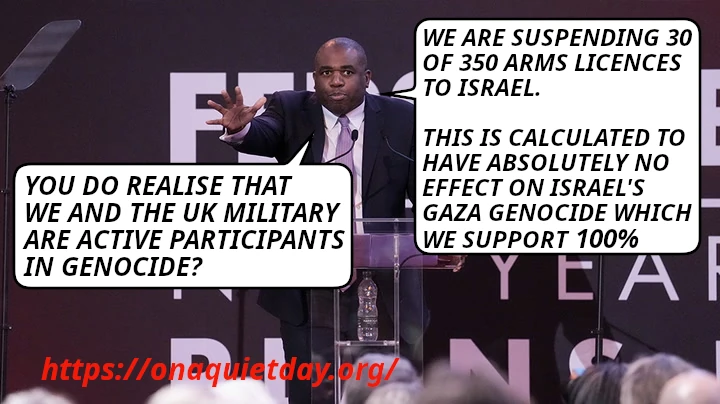
Genocide denying UK Foreign Secretary David Lammy says that UK is suspending 30 of 350 arms licences to Israel. He also confirms the UK government's support for Israel's Gaza genocide and the UK government and military's active participation in genocide.
Genocide denying UK Foreign Secretary David Lammy says that UK is suspending 30 of 350 arms licences to Israel. He also confirms the UK government’s support for Israel’s Gaza genocide and the UK government and military’s active participation in genocide.
Continue ReadingIndependent MPs challenge PM’s ‘flippant denial’ of Israel’s genocide in Gaza

Gaza bombardment worsens superbug outbreaks

Original article by Misbah Khan republished from TBIJ under a Creative Commons Attribution-NonCommercial-NoDerivs 3.0 Unported License.

Israeli blockades and bombings have left doctors without basic medicines to treat infections

Content warning: This story contains graphic images and descriptions of injuries

There is a growing and dire public health crisis taking place in Gaza. Israeli blockades and hospital bombings are fuelling a superbug emergency, with civilians who survive starvation and injury later facing untreatable, life-threatening infections.

Doctors on the ground told the Bureau of Investigative Journalism (TBIJ) they were treating wounds infested with maggots and using vinegar to fight infections.

“Wounds are left open much longer [and the] injured are delayed in receiving proper care or not able to get care at all, which increases the risk of infections and emergence of antimicrobial resistance [AMR],” says Krystel Moussally, an epidemiologist monitoring the situation for Doctors without Borders (MSF).

The infections are so severe that they don’t respond to many of the antibiotics that are designed to treat them. Badly infected wounds can lead to limb amputations and, in some cases, death.

Vinegar is being used to disinfect and treat wounds because other medicines are unavailable. Dr Khaled al Shawwa

Medical organisations, including MSF and Medical Aid Palestine, say that targeted bombings of hospitals and humanitarian aid blockades are restricting access to healthcare in Gaza, exacerbating infections that don’t respond to essential medicines.

In some cases, doctors have run tests to discover that infections can be fought with certain antibiotics – but have not been able to get their hands on the life-saving drugs.

‘I’ve never seen these types of cases before’

As explosions sound in the background, Dr Alaa Alshurafa tries to relay her day-to-day experience treating superbug infections in Gaza city. Over a WhatsApp call that keeps cutting out, she conveys the damage these drug-resistant infections are inflicting in the war zone.

Dr Alaa, 30, was forced to flee her home in northern Gaza with her family after the war began. Despite this, she is serving as a doctor at one of the medical points set up by The International Federation of Red Cross and Red Crescent Societies (IFRC) in Gaza city.

Every morning, before she leaves for work, she checks that no one on her route has reported a warning from the Israeli Defense Force of a potential airstrike. The clinic is a 15-minute walk from where she lives. She has to do the journey on foot, leaving her exposed to a potential attack by drone, air or sniper.

Dr Alaa al Shurafr’s walk to her clinic takes her past rubble. Dr Alaa al Shurafr

Once she does arrive at the clinic, the medical point is flooded with more than a hundred patients a day.

When she spoke to TBIJ, she was facing an outbreak of impetigo, a highly contagious bacterial skin infection most common in children. It causes blisters and itchy sores and is usually treated with an antibiotic cream.

“I’ve never seen these types of cases before,” Dr Alaa said. “It’s a very severe form of impetigo, an extensive form which includes faces and the whole body. We don’t have sufficient antibiotics.”

What little medicine is available is extremely expensive and while it does work sometimes, it is not always effective. “I’ve seen many cases that come again and again because of failure of treatment,” she said. “The rate of reinfection [could be] because of overcrowding and maybe misuse of antibiotics or nonadherence to the antibiotic regime plays a role.”

The most common type of bacteria that leads to impetigo is Staphylococcus aureus. A drug-resistant variant of this bacteria is behind the MRSA superbug.

70% of Staphylococcus aureus infections in wounded patients in Gaza are the MRSA superbug strain

MRSA infections are resistant to many common antibiotics, making them severe and even potentially fatal.

Moussally, the MSF epidemiologist, said: “It might be that this type of infection is difficult to treat not only because of [lack of] access to oral antibiotics, but more so because of a high resistance of the Staphylococcus bacteria causing it.”

Without adequate laboratory testing it is hard to say if the bacteria has developed stronger resistance.

Moussally’s work tracking drug-resistant bacteria in Gaza dates back to before 7 October and the start of the war. Then, MSF could monitor infections through labs at Nasser and Al-Awda Hospitals in Gaza. But over the course of the war, both hospitals have been besieged and attacked, making lab tests extremely challenging.

However, data collected by MSF at the hospitals from 2019 to 2023 showed that more than 70% of Staphylococcus aureus in wounded patients was the MRSA superbug strain.

Even before the war, superbugs were already a problem in Gaza; TBIJ reported on the issue as far back as 2018.

Open wounds left to fester

Content warning: graphic imagery below

In Gaza’s remaining hospitals, surgeons are overwhelmed by critical cases. Patients with open, but not initially deadly, wounds that need reconstructive surgery are lower priority, and often forced to wait or seek help at Red Cross and Red Crescent medical points.

Any length of time a person spends with their flesh or, in many cases, bone exposed raises the risk of superbugs and – as multiple doctors report – maggots.

“It is not uncommon to see explosive injury patients with limb injuries and open fractures to develop infections either from the wound itself or from… operations,” says Dr Abdulwhhab Abu Alamrain, who currently works in the orthopaedic department of a government hospital.

A leg injury, which developed a drug-resistant infection, sustained by a 35-year-old man in an explosion in September

Pseudomonas aeruginosa is another highly drug-resistant bacteria. It can infect wound dressings, causing bandages to turn green and smell like mown grass. Doctors in Dr Abdulwhhab’s orthopaedic department have seen cases; tests, available at a few private labs still operating in Gaza and seen by TBIJ, show some Pseudomonas infections don’t respond to any antibiotics at all.

Dr Abdulwhhab said: “This results in two options, either amputation or refusal [of an amputation] and face death. Unfortunately, we have seen many cases that have died either because of refusal or because they accept [the amputation] at the last moment [and die] waiting for surgery or on the operation table.”

Lessons from history

This is not the first time war has worsened a superbug crisis. During the war in Iraq, a lethal strain of the drug-resistant bacteria Acinetobacter baumannii infected American soldiers. Media at the time called it ‘Iraqibacter’.

The superbug infections weren’t confined to the borders of Iraq. Injured soldiers lost limbs, suffered sepsis, and some died back home in US hospitals after their wounds became infected with the bacteria.

The emergence of this strain of Acinetobacter baumannii was detected after its spread in the US hospitals. But due to the lack of testing capacity in Iraq, the extent to which it affected Iraqi civilians at the time is unknown.

“Iraq is a lesson about what war has done and why we have an ongoing crisis of AMR in a place like Iraq. We need to learn these lessons,” said Dr Omar Dewachi, an Iraqi medical anthropologist who narrates the touring exhibit The Pathogen of War.

Acinetobacter baumannii infections have also been reported in Gaza.

Using vinegar as medicine

With so many patients and so few drugs, some doctors report resorting to using vinegar to disinfect and treat wounds.

Moussally said: “Partially functioning hospitals are overcrowded with a huge caseload of injuries, lack of basic supplies needed to treat infections and do proper wound care management and are functioning with sub-standard infection prevention and control measures being the best they can do under the conditions they face. All of this drives AMR.”

Dr Khaled al Shawwa came home to Gaza city from Jerusalem to visit his family for the weekend on 5 October 2023 – two days before the Hamas attacks. He has been in Gaza ever since. He was previously a GP and had just completed his surgical qualification in Jerusalem.

He now works in the outpatient department at a clinic set up by MSF. There he deals with 80-130 patients a day. He told TBIJ: “We see Pseudomonas very frequently and sometimes we use vinegar, we apply it on the wounds. Nurses have a bottle of vinegar on the wound-dressing shelf.”

(Video may not appear for users who do not accept cookies)

The World Health Organization has repeatedly raised concerns about drug-resistant strains of Pseudomonas.

The best practice to prevent bacteria gaining resistance to even more antibiotics is to treat infections carefully with specific drugs, preferably after lab testing to make sure the medicine will work. In Gaza, however, doctors have to work with what they have.

“Drugs are not always available. We are guided by the availability of the drugs and availability of the tests. Where I work, the drugs come in shipments and donations. In some shipments you have one or two types of antibiotics. You don’t have many options … It’s not your decision,” Dr Khaled said.

Despite the limited resources, he and his colleagues at the local pharmacies have concocted a mixture of available antibiotics and steroids to try to treat difficult infections. “You have to do anything. You can’t just leave the patients alone.”

Israel Defense Forces did not respond to TBIJ’s request for comment.

Header image: The wreckage of an ambulance at the Kamal Adwan Hospital in northern Gaza. Credit: AFP via Getty Images.

Reporter: Misbah Khan
Video editor: Katia Pirnak
Global Health editor: Fiona Walker
Deputy editors: Chrissie Giles and Katie Mark
Editor: Franz Wild
Production editor: Frankie Goodway
Fact checker: Somesh Jha
Additional contributor: Hitham Toman

TBIJ has a number of funders, a full list of which can be found here. None of our funders have any influence over editorial decisions or output.

Original article by Misbah Khan republished from TBIJ under a Creative Commons Attribution-NonCommercial-NoDerivs 3.0 Unported License.

Genocide denier and Current UK Prime Minister Keir Starmer is quoted that he supports Zionism without qualification. He also confirms that his active support and that of UK's air force has been essential in Israel's mass-murdering genocide. Includes URLs https://www.declassifieduk.org/keir-starmers-100-spy-flights-over-gaza-in-support-of-israel/ and https://youtu.be/O74hZCKKdpA
Genocide denier and Current UK Prime Minister Keir Starmer is quoted that he supports Zionism without qualification. He also confirms that UK air force support has been essential in Israel’s mass-murdering genocide. Includes URLs https://www.declassifieduk.org/keir-starmers-100-spy-flights-over-gaza-in-support-of-israel/ and https://youtu.be/O74hZCKKdpA
Genocide denying UK Foreign Secretary David Lammy says that UK is suspending 30 of 350 arms licences to Israel. He also confirms the UK government's support for Israel's Gaza genocide and the UK government and military's active participation in genocide.
Genocide denying UK Foreign Secretary David Lammy says that UK is suspending 30 of 350 arms licences to Israel. He also confirms the UK government’s support for Israel’s Gaza genocide and the UK government and military’s active participation in genocide.
Continue ReadingGaza bombardment worsens superbug outbreaks

Government ‘hauled kicking and screaming into court’

https://morningstaronline.co.uk/article/government-hauled-kicking-and-screaming-into-court

Downing Street accepts ‘clear risk’ that fighter jet parts sold to Israel could be used to violate international humanitarian law, High Court hears

THE British government accepts there is a “clear risk” that parts for lethal fighter jets might be used by Israel to violate international humanitarian law but continues to export them anyway, the High Court heard today.

Global Legal Action Network (Glan) and human rights group Al-Haq have brought legal action against the Department for Business and Trade, accusing it of breaking its own rules by continuing exports if there is such a risk.

Between October and May, former business secretary Kemi Badenoch approved over 100 licences to Israel throughout its brutal onslaught on Gaza.

In September, the new Labour government eventually moved to ban just 30 out of 361 licences, excluding components for F-35 jets.

Described by its manufacturer Lockheed Martin as the “most lethal” fighter jet in the world, F-35s have been used extensively in Israel’s bloodshed.

Capable of dropping 2,000lb bombs, they are linked to the murder of 90 people in the al-Mawasi “safe zone” in July.

There are 79 companies registered in Britain that hold licences to export parts for the jet.

Article continues at https://morningstaronline.co.uk/article/government-hauled-kicking-and-screaming-into-court

Genocide denier and Current UK Prime Minister Keir Starmer is quoted that he supports Zionism without qualification. He also confirms that his active support and that of UK's air force has been essential in Israel's mass-murdering genocide. Includes URLs https://www.declassifieduk.org/keir-starmers-100-spy-flights-over-gaza-in-support-of-israel/ and https://youtu.be/O74hZCKKdpA
Genocide denier and Current UK Prime Minister Keir Starmer is quoted that he supports Zionism without qualification. He also confirms that UK air force support has been essential in Israel’s mass-murdering genocide. Includes URLs https://www.declassifieduk.org/keir-starmers-100-spy-flights-over-gaza-in-support-of-israel/ and https://youtu.be/O74hZCKKdpA
Genocide denying UK Foreign Secretary David Lammy says that UK is suspending 30 of 350 arms licences to Israel. He also confirms the UK government's support for Israel's Gaza genocide and the UK government and military's active participation in genocide.
Genocide denying UK Foreign Secretary David Lammy says that UK is suspending 30 of 350 arms licences to Israel. He also confirms the UK government’s support for Israel’s Gaza genocide and the UK government and military’s active participation in genocide.
Vote For Genocide Vote Labour.
Continue ReadingGovernment ‘hauled kicking and screaming into court’