Report Details Record-Breaking Health Threats of Climate Crisis, Fossil Fuel Subsidies

Original article by Julia Conley republished from Common Dreams under Creative Commons (CC BY-NC-ND 3.0). 
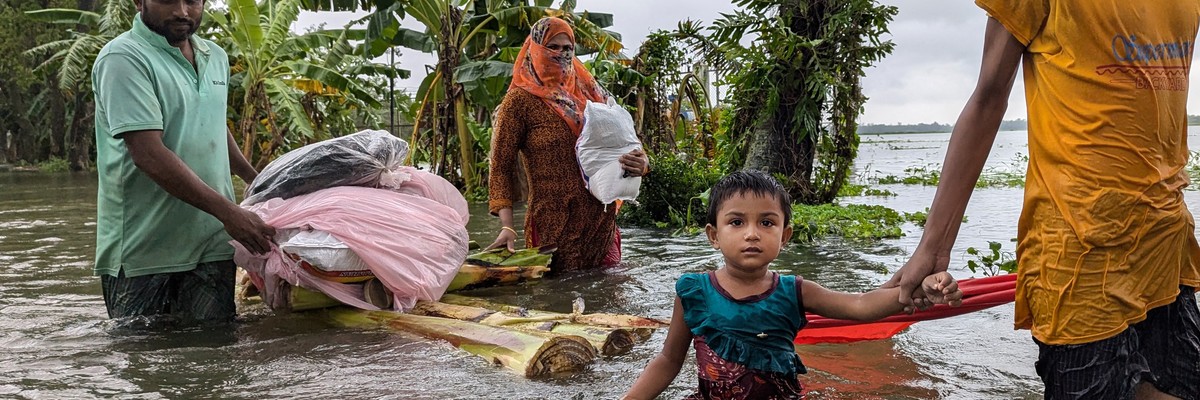
People wade through floodwaters in Feni, Bangladesh, on August 25, 2024. (Photo: Zakir Hossain Chowdhury/NurPhoto via Getty Images)

“No individual or economy on the planet is immune from the health threats of climate change,” said a lead researcher.

Over $1 trillion spent each year on subsidizing fossil fuel production must be redirected to public health efforts, said the experts behind a new annual report monitoring progress on the climate and global health.

The 2024 Report of the Lancet Countdown on Health and Climate Change, published Tuesday in The Lancet by the Lancet Countdown at Universiy College London (UCL), found that delayed action on the climate emergency is exposing people across the globe to record-breaking threats, with 10 of 15 indicators showing that specific health threats have reached “concerning new levels.”

“This year’s stocktake of the imminent health threats of climate inaction reveals the most concerning findings yet in our eight years of monitoring,” said Marina Romanello, executive director of the Lancet Countdown and a senior research fellow at UCL. “Once again, last year broke climate change records—with extreme heatwaves, deadly weather events, and devastating wildfires affecting people around the world.”

With 2023 named the hottest year on record earlier this year by the European Union’s Copernicus Climate Change Service, the researchers behind the new report found that the average person experienced an additional 50 days of dangerously hot weather that would not have happened without fossil fuel extraction heating the planet.

Heat-related deaths among people over age 65 reached the highest level ever recorded, 167% higher than in the 1990s and more than double the 65% increase that was expected if temperatures hadn’t changed since then.

An additional 151 million people across 124 countries experienced moderate or severe food insecurity last year, an increase that was associated with extreme drought that affected almost half of global land area.

“We must cure the sickness of climate inaction—by slashing emissions, protecting people from climate extremes, and ending our fossil fuel addiction.”

Changing climate conditions across the globe and the flooding that has come with more frequent hurricanes and tropical storms are also fueling a rise in the transmission of infectious diseases like dengue fever, according to the Lancet Countdown, and warmer coastal waters contributed a record-high number of cases of the bacterial infection vibriosis last year.

“The mosquitoes that spread infections like dengue fever epidemics are reaching new countries, and gradually moving north,” said Anthony Costello, a professor at UCL Institute for Global Health and co-chair of the countdown.

But despite those indicators and others, said Romanello, “we see financial resources continue to be invested in the very things that undermine our health.”

Researchers expressed optimism about rising investments in renewable energy, but warned that new fossil fuel investment accounted for more than a third of new energy spending in 2023, and 84% of world governments continue to subsidize fossil fuel production despite clear warnings from scientists that oil and gas extraction have no place on a pathway to limiting planetary heating to 1.5°C.

Governments are “in effect paying an estimated $1.4 trillion dollars per year to worsen the crisis,” reportedThe Hill.

Meanwhile, “only 68% of countries reported high-to-very-high implementation of the legally mandated capacities to manage health emergencies in 2023,” according to the Lancet Countdown. Just 35% of countries reported having early warning healthcare systems for heat-related illness.

“No individual or economy on the planet is immune from the health threats of climate change,” said Romanello. “The relentless expansion of fossil fuels and record-breaking greenhouse gas emissions compounds these dangerous health impacts and is threatening to reverse the limited progress made so far and put a healthy future further out of reach.”

Total carbon emissions from fossil fuel combustion reached nearly 40 gigatonnes last year, a 1.1% increase from 2022, contributing to high levels of air pollution as well as changing climate conditions.

“National-level net subsidies exceeded 10% of national health spending in 55% of the countries, and 100% in 27% of them,” reads a visual summary of the report. “These funds could be redirected towards supporting the transition to clean energy sources, protect vulnerable populations from soaring climate change risks, and enable a healthy future.”

Redirecting fossil fuel subsidies “would provide the opportunity to deliver a fair, equitable transition to clean energy and energy efficiency, and a healthier future, ultimately benefiting the global economy,” said Romanello.

Released less than two weeks before world governments are set to convene in Azerbaijan for the United Nations Climate Change Conference (COP29), where climate finance is expected to be a key issue, the report calls for “new strategies and finance for implementation” in order to protect global public health from climate disasters.

“These must acknowledge climate change’s effects on health and related systems, assess risks and vulnerabilities, and incorporate resilience to shocks,” reads a joint brief by the Lancet Countdown and Médecins Sans Frontières, also called Doctors Without Borders. “Adequate, predictable, and unified climate finance for adaptation and technical support is urgently needed to enable ministries of health and their implementing partners to adopt forward-thinking strategies, integrate anticipatory actions, and enhance flexibility and agility in their operating models.”

U.N. Secretary-General António Guterres said the report shows “we must cure the sickness of climate inaction—by slashing emissions, protecting people from climate extremes, and ending our fossil fuel addiction—to create a fairer, safer, and healthier future for all.”

To shift resources toward a “zero-emissions future,” said Costello, “people’s health must be put front and center of climate change policy to ensure the funding mechanisms protect well-being, reduce health inequities and maximize health gains, especially for the countries and communities that need it most.”

Original article by Julia Conley republished from Common Dreams under Creative Commons (CC BY-NC-ND 3.0). 
Continue ReadingReport Details Record-Breaking Health Threats of Climate Crisis, Fossil Fuel Subsidies

‘Two Genocidaires v. the World’: US, Israel Oppose Lifting Cuba Blockade

Original article by Jessica Corbett republished from Common Dreams under Creative Commons (CC BY-NC-ND 3.0). 
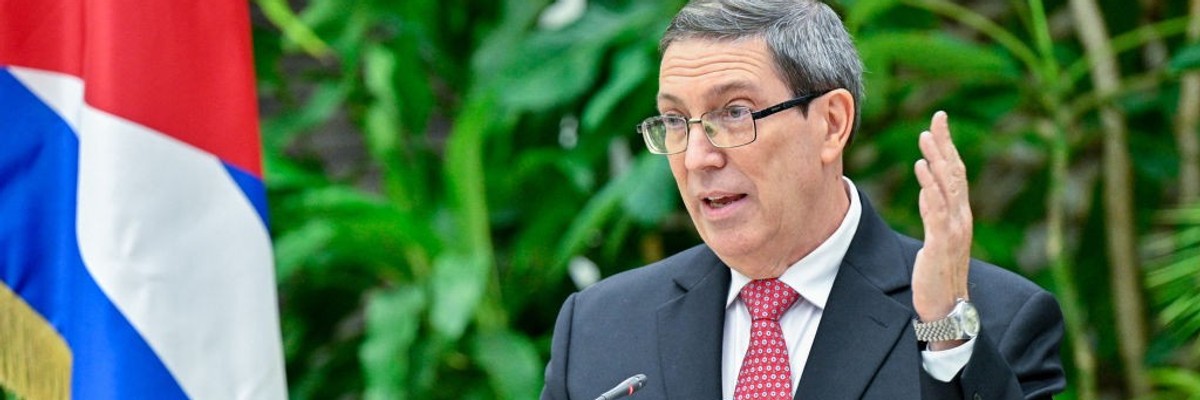
Cuban Foreign Minister Bruno Rodríguez speaks during a press conference on the impact of the U.S. embargo in Havana on September 12, 2024. (Photo: Adalberto Roque/AFP via Getty Images)

“The world has spoken—it’s time for the U.S. to listen and lift the blockade.”

The United Nations General Assembly on Wednesday once again overwhelmingly urged the U.S. government to end its decadeslong blockade on Cuba, with just the United States and Israel voting against the measure and Moldova abstaining.

The UNGA’s other 187 members present voted to adopt the nonbinding resolution on “the necessity of ending the economic, commercial, and financial embargo imposed by the United States” against the Caribbean island.

This is the 32nd straight year that the U.N. body has approved a resolution against the embargo that began in 1962.

“The U.S. and Israel stand isolated as the only two votes against,” Democratic Socialists of America’s International Committee said after the Wednesday vote. “The world has spoken—it’s time for the U.S. to listen and lift the blockade.”

Though a few other nations have opposed the resolution over the years, Michael Galant of Progressive International and the Center for Economic and Policy Research noted that this vote was “two genocidaires v. the world.”

https://twitter.com/michael_galant/status/1851665771799417344?ref_src=twsrc%5Etfw%7Ctwcamp%5Etweetembed%7Ctwterm%5E1851665771799417344%7Ctwgr%5Ea6b6d03bd80b0fd499be7e07fe5af333f055aa10%7Ctwcon%5Es1_c10&ref_url=https%3A%2F%2Fwww.commondreams.org%2Fnews%2Fcuba-blockade

Sorry, this content could not be embedded.

X

Israel faces a genocide case at the International Court of Justice for its yearlong assault of the Gaza Strip, which has killed at least 43,163 Palestinians and injured another 101,510, according to local officials in the Hamas-governed enclave. The U.S. Congress and Biden administration have given Israel billions of dollars in weapons and opposed U.N. cease-fire resolutions.

CodePink’s Medea Benjamin responded to the Wednesday vote with a video shared on social media, saying that Israel “loves blockades, because it’s doing its own blockade of Gaza,” and “is dependent on the United States to carry out its genocide.”

“Now this is not just some idle vote,” she said of the approved resolution. “This blockade that the U.S. maintains is a form of economic warfare. It’s no exaggeration to say that now, when there is an economic crisis in Cuba, the U.S. blockade, which keeps Cuba from using the financial markets, from having normal trade with countries all over the world, is actually leading to deaths, leading to people going hungry, leading to people lacking food and medicine that are essential for their lives.”

“And that’s why the United States must be condemned for this ongoing horrific, inhumane, and illegal blockade,” Benjamin added.

Cuba’s representative delivered similar remarks to the UNGA on Wednesday. As Reutersreported:

Cuban Foreign Minister Bruno Rodríguez said in a speech before the assembly that what is often referred to as the U.S. trade embargo is a “blockade” because the web of laws and regulations complicate financial transactions and the acquisition of goods and services not just from the United States but internationally.

“The blockade against Cuba is an economic, financial, and trade war which qualifies as genocide,” said Rodriguez, charging the U.S. policies were deliberately aimed at promoting suffering among the Cuban people to force change in the government.

Some international observers praised the countries who did condemn the blockade. Middle East expert Assal Rad declared, “This is the real international community.”

Manolo De Los Santos, a founder of the People’s Forum and a researcher at Tricontinental: Institute for Social Research, said that “this overwhelming consensus is in contrast with the indifference of the United States, which continues to deny any responsibility for sanctions while tightening its stranglehold on Cuba.”

https://twitter.com/PeoplesForumNYC/status/1851650328376050090?ref_src=twsrc%5Etfw%7Ctwcamp%5Etweetembed%7Ctwterm%5E1851650328376050090%7Ctwgr%5Ea6b6d03bd80b0fd499be7e07fe5af333f055aa10%7Ctwcon%5Es1_c10&ref_url=https%3A%2F%2Fwww.commondreams.org%2Fnews%2Fcuba-blockade

Sorry, this content could not be embedded.

X

Earlier this month, the People’s Forum published a letter in The New York Times to U.S. President Joe Biden, warning that he has “exactly 90 days to reverse” former Republican President Donald Trump’s “brutal policy on Cuba.”

Biden was vice president a decade ago when then-President Barack Obama “opened a hopeful new chapter in U.S.-Cuba relations by taking the first steps toward normalization,” the letter details. “People in both countries were optimistic that Cuba and the United States could become neighbors rather than Cold War enemies. However, Trump dismantled that policy, imposing pain and suffering on the Cuban people.”

“Removing the state sponsors of terrorism designation would allow Cuba to engage in financial transactions and restore its electrical grid, as well as address shortages of food and medicine to alleviate the immense hardship faced by the Cuban people, who have endured over 62 years of economic strife under the embargo,” the letter adds. “It’s time to act. Let Cuba live!”

Biden faced similar pressure in August, when hundreds of legal experts and groups called on him “to comply with existing international law by ending the use of broad unilateral coercive measures” particularly in “cases such as Cuba, Iran, North Korea, Syria, and Venezuela.”

https://twitter.com/DropSiteNews/status/1851722235905532114?ref_src=twsrc%5Etfw%7Ctwcamp%5Etweetembed%7Ctwterm%5E1851722235905532114%7Ctwgr%5Ea6b6d03bd80b0fd499be7e07fe5af333f055aa10%7Ctwcon%5Es1_c10&ref_url=https%3A%2F%2Fwww.commondreams.org%2Fnews%2Fcuba-blockade

Sorry, this content could not be embedded.

X

The U.N. vote comes as early voting is underway for the November 5 election in which Trump is facing Biden’s vice president, Kamala Harris.

Neither campaign provided details on each candidate’s position when contacted by Reuters earlier this week, though Morgan Finkelstein, national security spokesperson for Harris, said that the Democrat “stands with the people of Cuba as they fight for their rights after decades of repression and economic suffering at the hands of the communist regime” and “will stand up to all authoritarians—including the very leaders that Trump has praised and embraced.”

Original article by Jessica Corbett republished from Common Dreams under Creative Commons (CC BY-NC-ND 3.0). 

Continue Reading‘Two Genocidaires v. the World’: US, Israel Oppose Lifting Cuba Blockade

“No treatment, no pain relief, no escape,” UN says on healthcare in Gaza

Original article by Ana Vračar republished from peoples dispatch under a Creative Commons Attribution-ShareAlike 4.0 (CC BY-SA) license.

Source: Munir al-Bursh/X

Intensified Israeli attacks have devastated hospitals and healthcare in Gaza, with patients left to suffer amid a blockade of medical resources and repeated denials of evacuation permits

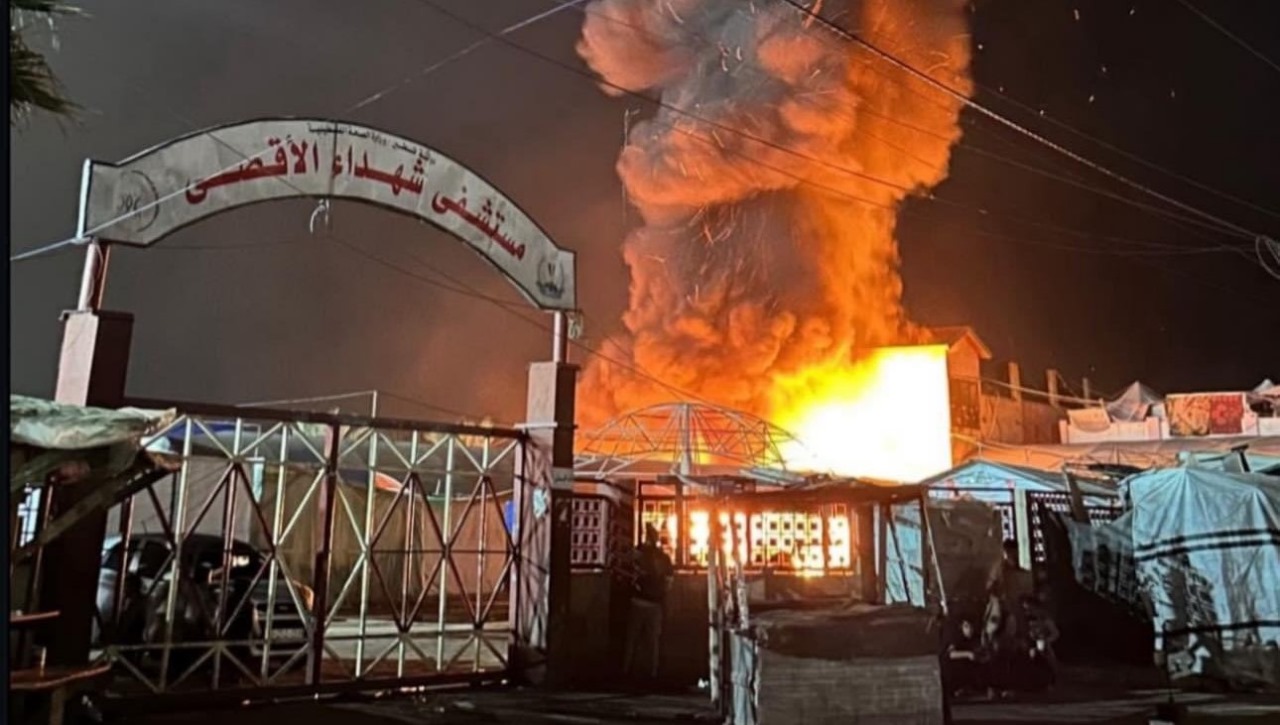
Conditions in Gaza’s healthcare system, already critical, have further deteriorated under Israeli Occupation Forces (IOF) attacks on hospitals in the north. Following the forced closure of the Indonesian Hospital, only two hospitals, Al-Awda and Kamal Adwan, remain partially functional. Al-Awda is difficult to access due to damaged road infrastructure, while Kamal Adwan endured a violent raid on October 25-26.

Both have in their care more patients than they can objectively provide care to. During the raid on Kamal Adwan, Israeli soldiers detained or disappeared 44 male staff members, with dozens still imprisoned. According to the UN, by October 29 only two doctors – the hospital director and a pediatrician – remained at Kamal Adwan to manage care for 150 patients without surgical, anesthesiology, or intensive care support. Despite appeals, Israel continues to block access for additional medical teams, supplies, and life-saving essentials.

Read more: 100,000 Palestinians trapped in northern Gaza amid ongoing Israeli massacres and siege

Medical evacuations remain practically non-existent. Since May, only 127 children have been permitted to leave Gaza for critical care. Thousands more injured children face indefinite waits for permits. UNICEF recently expressed what can only be described as desperation, calling out Israel’s bureaucratic “indifference” that leaves children suffering without relief or hope. And, while it is possible to know how few children were allowed to leave Gaza for medical care, Israel does not keep records of how many were denied. “When a patient is denied, there is nothing that can be done,” the agency said. “Trapped in the grip of an indifferent bureaucracy, children’s pain is brutally compounded.”

The situation is far beyond agony for children like Elia, a four-year-old girl who suffered severe burns and multiple amputations after an Israeli rocket attack. Hospitalized for over 40 days, she was admitted along with her mother, Eslam, who sustained similar injuries. Eslam died as a result of the attack in which she and her daughter were hurt, and only then was Elia granted medical evacuation, but without a clear timeline.

Children including infants with cancer and malnutrition, as well as 12-year-olds in need of bone surgery, have been repeatedly denied the right to be transferred to a place where they can access adequate care. “No treatment, no pain relief, no escape,” Elder said of the situation.

Read more: Final phase of polio vaccination in Gaza suspended amid Israeli attacks

There are no healthy people left in the Gaza Strip: those not suffering physical injury are either going hungry or struggling with mental health effects of trauma. Respiratory diseases, jaundice, and diarrhea are rampant due to destroyed sanitation infrastructure and chronic malnutrition. Without an immediate and lasting ceasefire, conditions are expected to worsen further.

Concerns include missing the thresholds set for the polio vaccination campaign, after the World Health Organization (WHO) and partners were forced to suspend the final phase of a polio vaccination campaign in northern Gaza due to escalating IOF violence. While WHO has expressed hopes to resume vaccinations from November 2 to 4, it remains to be seen if Israeli authorities will guarantee the necessary safety assurances.

People’s Health Dispatch is a fortnightly bulletin published by the People’s Health Movement and Peoples Dispatch. For more articles and to subscribe to People’s Health Dispatch, click here.

Original article by Ana Vračar republished from peoples dispatch under a Creative Commons Attribution-ShareAlike 4.0 (CC BY-SA) license.

Continue Reading“No treatment, no pain relief, no escape,” UN says on healthcare in Gaza

Morning Star: The good, the bad and the ugly in the Labour Budget

https://morningstaronline.co.uk/article/editorial-good-bad-and-ugly-labour-budget

Keir Starmer says pensioners can freeze to death and poor children can starve and be condemned to failure and misery all their lives.

So-called austerity is best understood as a massive transfer of wealth — from public to private, from the many to the few, as the fortunes of the super-rich ballooned while Britain endured the longest wage squeeze since the Napoleonic wars.

This is a grotesquely unequal country in which big banks and energy giants post the largest profits in their history, in which the richest 1 per cent own more than the poorer 70 per cent of the population put together, in which millions rely on foodbanks while the number of billionaires increased by a fifth during the Covid crisis alone.

When Reeves gives with one hand and takes away with the other — as PCS leader Fran Heathcote notes she does by offering a 1.7 per cent increase in departmental spending, while setting a 2 per cent savings target for those same departments — she cites pressure on the public finances that could be relieved easily through higher corporation tax, a financial transactions tax or a wealth tax. As Unite’s Sharon Graham notes, a 1 per cent tax on the richest 1 per cent would raise £25 billion, filling the so-called “black hole” in the budget at a stroke.

It is a choice to keep children in poverty with the two-child benefit cap, to pick pensioners’ pockets with the winter fuel payment cut and to continue Tory “reform” of the work capability assessment — estimated to cost over 400,000 people with mobility or mental health problems over £400 a month.

It is a choice to echo Tory hysteria over benefit fraud, when the amount lost to this is less than goes unclaimed in social security payments people are entitled to. Giving the Department for Work & Pensions power to remove money directly from bank accounts will likely increase non-take-up of benefits by people who need them but understandably fear their personal finances being exposed in this way.

And it’s a choice to hike the cost of a bus ticket by 50 per cent while maintaining a fuel duty freeze — when governments across Europe are making public transport cheaper because it is essential to reduce greenhouse gas emissions.

https://morningstaronline.co.uk/article/editorial-good-bad-and-ugly-labour-budget

Continue ReadingMorning Star: The good, the bad and the ugly in the Labour Budget

Thoughts of the Day 31 October 2024

Current UK Prime Minister Keir Starmer is quoted that he supports Zionism without qualification. He also confirms that his active support and that of UK's air force has been essential in Israel's mass-murdering genocide. Includes URLs https://www.declassifieduk.org/keir-starmers-100-spy-flights-over-gaza-in-support-of-israel/ and https://youtu.be/O74hZCKKdpA
Current UK Prime Minister Keir Starmer is quoted that he supports Zionism without qualification. He also confirms that his active support and that of UK’s air force has been essential in Israel’s mass-murdering genocide. Includes URLs https://www.declassifieduk.org/keir-starmers-100-spy-flights-over-gaza-in-support-of-israel/ and https://youtu.be/O74hZCKKdpA

UK Labour government’s budget by Rachel Reeves doesn’t really matter in the bigger picture. While we have Israel’s continuing genocide (genocides?) with the UK Labour government a major active participant the real big issue is the hugely devastating floods in Spain. ‘This Is Climate Change’: Devastating Flooding Kills More Than 70 in Spain.

The problem is that World governments are going to do very little to address climate change until they are forced to. It’s only getting worse since it’s not addressed despite fossil fuel industries and governments being aware for 60 years. Climate campaigners are imprisoned instead of the real climate criminals.

Continue ReadingThoughts of the Day 31 October 2024