Experts: The key ‘unknowns’ of overshooting the 1.5C global-warming limit

Spread the love

Original article by Cecilia Keating and Robert McSweeney republished from Carbon Brief under a CC license

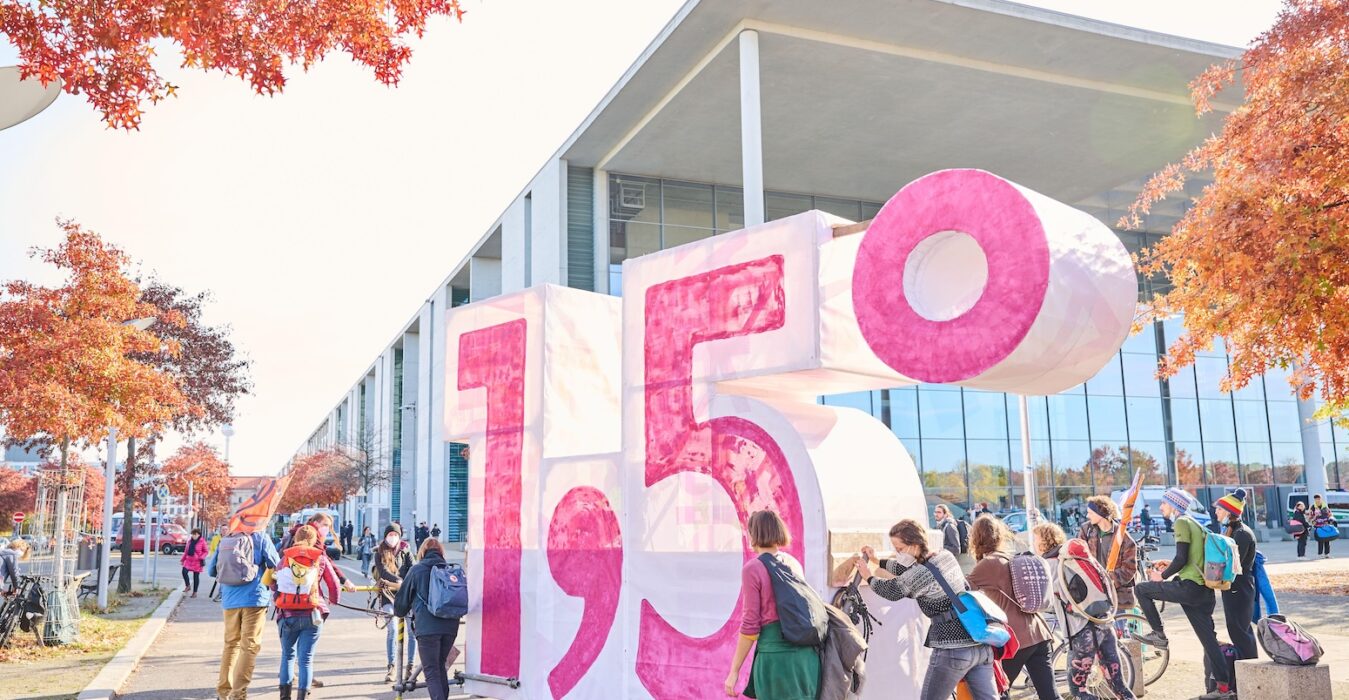
Demonstrators from Extinction Rebellion push self-made cart in the shape of the 1.5C climate target in Berlin, Germany. Credit: dpa picture alliance / Alamy Stock Photo

Last week, around 180 scientists, researchers and legal experts gathered in Luxenburg, Austria to attend the first-ever international conference focused on the controversial topic of climate “overshoot”.

This hypothesised scenario would see global temperatures initially “overshoot” the Paris Agreement’s aspirational limit of 1.5C, before they are brought back down through techniques that would remove carbon dioxide from the atmosphere.

(For more on the key talking points, new research and discussions that emerged from the three-day conference, see Carbon Brief’s full write-up of the event.)

On the sidelines of the conference, Carbon Brief asked a range of delegates what they consider to be the key “unknowns” around overshoot.

Below are their responses, first as sample quotes, then, in full:

  • Dr James Fletcher: “Yes, there will be overshoot, but at what point will that overshoot peak? Are we peaking at 1.6C, 1.7C, 2.1C?”
  • Prof Shobha Maharaj: “There are lots of places in the world where adaptation plans have been made to a 1.5C ceiling. The fact is that these plans are going to need to be modified or probably redeveloped.”
  • Sir Prof Jim Skea: “There are huge knowledge gaps around overshoot and carbon dioxide removal.”
  • Prof Kristie Ebi: “If there is going to be a peak – and, of course, we don’t know what that peak is – then how do you start planning?”
  • Prof Lavanya Rajamani: “To me, a key governance unknown is the extent to which our current legal and regulatory architecture…will actually be responsive to the needs of an overshoot world.”
  • Prof Nebojsa Nakicenovic: “One of my major concerns has been for a long time…is whether, even after reaching net-zero, negative emissions can actually produce a temperature decline.”
  • Prof Debra Roberts: “For me, the big unknown is how all of these areas of increased impact and risk actually intersect with one another and what that means in the real world.”
  • Dr Oliver Geden: “[A key unknown] is whether countries are really willing to commit to net-negative trajectories.”
  • Dr Carl-Friedrich Schleussner: “This is a bigger concern that I have – that we are pushing the habitability in our societies on this planet above that limit and towards maybe existential limits.”
  • Dr Anna Pirani: “I think that tracking global mean surface temperature on an overshoot pathway will be an important unknown.”
  • Prof Richard Betts: “One of the key unknowns is are we going to continue to get the land carbon sink that the models produce.”
  • Prof Hannah Daly: “The biggest unknown is whether countries can translate these global [overshoot] pathways into sustained domestic action…that is politically and socially feasible.”
  • Dr Andrew King: “[W]e still have a lot of uncertainty around other elements in the climate system that relate more to what people actually live through.”
Dr James Fletcher

Dr James Fletcher
Former minister for public service, sustainable development, energy, science and technology for Saint Lucia and negotiator at COP21 in Paris.

The key unknown is where we’re going to land. At what point will we peak [temperatures] before we start going down, and how long will we stay in that overshoot period? That is a scary thing. Yes, there will be overshoot, but at what point will that overshoot peak? Are we peaking at 1.6C, 1.7C, 2.1C? All of these are scary scenarios for small island developing states – anything above 1.5C is scary. Every fraction of a degree matters to us. Where we peak is very important and how long we stay in this overshoot period is equally important. That’s when you start getting into very serious, irreversible impacts and tipping points.

Prof Shobha Maharaj

Prof Shobha Maharaj
Adjunct professor at the University of Fiji and a coordinating lead author for Working Group II of the IPCC’s seventh assessment

First of all, there is an assumption that we’re going to go back down from overshoot. Back down is not a given. And secondly, we are still in the phase where we are talking about uncertainty. Climate scientists don’t like uncertainty. We are not acknowledging that uncertainty is the new normal… But because we’re so bogged down in terms of uncertainties, we are not moving towards [the issue of] what we do about it. We know it’s coming. We know the temperatures are going to be high. But there is little talk about the action. 

The focus seems to be more on how we can understand this or how we can model this, but not what we do on the ground. Especially when it comes to adaptation planning – [and around] how does this modify whatever the plans are? There are lots of places in the world where adaptation plans have been made to a 1.5C ceiling. The fact is that these plans are going to need to be modified or probably redeveloped. And no one is talking about this, especially in the areas that are least resourced in the world – which sets up a big, big problem.

Sir Prof Jim Skea

Sir Prof Jim Skea
Chair of the Intergovernmental Panel on Climate Change (IPCC) and emeritus professor at Imperial College London’s Centre for Environmental Policy

There are huge knowledge gaps around overshoot and carbon dioxide removal. As it’s very clear from the themes of this conference, we don’t altogether understand how the Earth would react in taking carbon dioxide out of the atmosphere. We don’t understand the nature of the irreversibilities and we don’t understand the effectiveness of CDR techniques, which might themselves be influenced by the level of global warming, plus all the equity and sustainability issues surrounding using CDR techniques.

Prof Kristie Ebi

Prof Kristie Ebi
Professor of global health at the University of Washington‘s Center for Health and the Global Environment

There are all kinds of questions about adaptation and how to approach effective adaptation. At the moment, adaptation is primarily assuming a continual increase in global mean surface temperature. If there is going to be a peak – and of course, we don’t know what that peak is – then how do you start planning? Do you change your planning? There are places, for instance when thinking about hard infrastructure, [where overshoot] may result in a change in your plan – because as you come down the backside, maybe the need would be less. For example, when building a bridge taller. And when implementing early warning systems, how do you take into account that there will be a peak and ultimately a decline? There is almost no work in that. I would say that’s one of the critical unknowns.

Prof Lavanya Rajamani

Prof Lavanya Rajamani
Professor of international environmental law at the University of Oxford

I think there are several scientific unknowns, but I would like to focus on the governance unknowns with respect to overshoot. To me, a key governance unknown is the extent to which our current legal and regulatory architecture – across levels of governance, so domestic, regional and international – will actually be responsive to the needs of an overshoot world and the consequences of actually not having regulatory and governance architectures in place to address overshoot.

Prof Nebojsa Nakicenovic

Prof Nebojsa Nakicenovic
Distinguished emeritus research scholar at the International Institute for Applied Systems Analysis and executive director of The World In 2050.

One of my major concerns has been for a long time – as it was clear that we are heading for an overshoot, as we are not reducing the emissions in time – is whether, even after reaching net-zero, negative emissions can actually produce a temperature decline…In other words, there might be asymmetry on the way down [in the global-temperature response to carbon removal] – it might not be symmetrical to the way up [as temperature rise in response to carbon emissions]. And this is really my major concern, that we are planning measures that are so uncertain that we don’t know whether they will reach the goal. 

The last point I want to make is that I think that the scientific community should, under all conditions, make sure that the highest priority is on mitigation.

Prof Debra Roberts

Prof Debra Roberts
Honorary professor at the University of KwaZulu-Natal, coordinating lead author on the IPCC’s forthcoming special report on climate change and cities, board chair of the Red Cross Red Crescent Climate Centre and co-chair of Working Group II for the IPCC’s sixth assessment

Well, I think coming from the policy and practitioner community, what I’m hearing a lot about are the potential impacts that come from the exceedance component of overshoot. What I’m not hearing a lot about is the responses to overshoot and their impacts – and how those impacts might interact with the impacts from temperature exceedance. So there’s quite a complex risk landscape emerging. It’s three dimensional in many ways, but we’re only talking about one dimension and, for policymakers, we need to understand that three dimensional element in order to understand what options remain on the table. For me, the big unknown is how all of these areas of increased impact and risk actually intersect with one another and what that means in the real world.

Prof Oliver Geden

Dr Oliver Geden
Senior fellow and head of the climate policy and politics research cluster at the German Institute for International and Security Affairs and vice-chair of IPCC Working Group III

[A key unknown] is whether countries are really willing to commit to net-negative trajectories. We are assuming, in science, global pathways going net negative, with hardly any country saying they want to go there. So maybe it is just an academic thought experiment. So we don’t know yet if [overshoot] is even relevant. It is relevant in the sense that if we do, [the] 1.5C [target] stays on the table. But I think the next phase needs to be that countries – or the UNFCCC as a whole – needs to decide what they want to do. 

Dr Carl-Friedrich Schleussner

Dr Carl-Friedrich Schleussner
Research group leader and senior research scholar at the International Institute for Applied Systems Analysis

I’m convinced that there’s an upper limit of overshoot that we can afford – and it might be not far outside the Paris range [1.5C-2C] – before human societies will be overwhelmed with the task of bringing temperatures back down again. This [societal limit] is lower than the geophysical limits or the CDR limit.

The impacts of climate change and the challenges that will come with it will undermine society’s abilities to cooperatively engage in what is required to achieve long-term temperature reversal. This is a bigger concern that I have – that we are pushing the habitability in our societies on this planet above that limit and towards maybe existential limits. We may not be able to walk back from it, even if we wanted to. That is a big unknown to me.

I’m convinced that there is an upper limit to how much overshoot we can afford, and it might be just about 2C or a bit above – it might not be much more than that. But we do not have good evidence for this. But I think these scenarios of going to 3C and then assuming we can go back down – I have doubts that future societies grappling with the impacts of climate change will be in the position to embark on such an endeavour.

Dr Anna Pirani

Dr Anna Pirani
Senior research associate at the Euro-Mediterranean Center on Climate Change (CMCC) and former head of the Technical Support Unit for Working Group I of the IPCC

I think that tracking global mean surface temperature on an overshoot pathway will be an important unknown – how to take account of natural variability in that context, to inform where we are on an overshoot pathway and how well we’re doing on it. I think, methodologically, that would prove to be a challenge. The fact that it occurs over many, many years – many decades – and, yet, we sort of think about it as a nice curve. We see these graphs that say “by the 2050s, we will be here and we’ll start declining and so on”. I think that what that actually translates to in the evolution of global surface temperatures is going to be very difficult to measure and track. Even how we report on that, internationally, in the UNFCCC [UN Framework Convention on Climate Change] context and what the WMO [World Meteorological Organization] does in terms of reporting an overshoot trajectory, that would be quite a challenge. 

Prof Richard Betts

Prof Richard Betts
Head of climate impacts research in the Met Office Hadley Centre and professor at the University of Exeter

One of the key unknowns is are we going to continue to get the land carbon sink that the models produce. We have got model simulations of returning from an overshoot. 

If you are lowering temperatures, you have got to reduce emissions. The amount you reduce emissions depends on how much carbon is taken up naturally by the system – by forests, oceans and so on. The models will do this; they give you an answer. But we don’t know whether they are doing the right thing. They have never been tested in this kind of situation.

In my field of expertise, one of the key [unknowns] is how these carbon sinks are going to behave in the future. That is why we are trying to get real-world data into the models – including through the Amazon FACE project – so we can really try and narrow the uncertainties in future carbon sinks. If the carbon sinks are weaker than the models think, it is going to be even harder to reduce emissions and we will need to remove even more by carbon capture and removal. 

Prof Hannah Daly

Prof Hannah Daly
Professor of sustainable energy at University College Cork

We know ever more about the profound – and often irreversible – damages that will be felt as we overshoot 1.5C. Yet we seem no closer to understanding what will unlock the urgent decarbonisation that remains our only way to avoid the worst impacts of climate change. 

Global models can show, on paper, what returning temperatures to safer levels after overshoot might look like. The biggest unknown is whether countries can translate these global pathways into sustained domestic action – over decades and without precedent in history – that is politically and socially feasible.

Dr Andrew King

Dr Andrew King
Associate professor in climate science at the University of Melbourne

I think, firstly, can we actually achieve net-negative emissions to bring temperatures down past a peak? It’s a completely different world and, unfortunately, it’s likely to be challenging and we’re setting ourselves up to need to do it more. So I think that’s a huge unknown. 

But then, beyond that, I think also, whilst we’ve built some understanding of how global temperature would respond to net-zero or net-negative emissions, we still have a lot of uncertainty around other elements in the climate system that relate more to what people actually live through. In our warming world, we’ve seen that global warming relates to local warming being experienced by everyone at different amounts. But, in an overshoot climate, we would see quite diverse changes for different people, different areas of the world, experiencing very different changes in our local climates. And also definitely worsening of some climate hazards and possibly reversibility in others, so a very different risk landscape as well, emerging post net-zero – and I think we still don’t know very much about that as well.

Original article by Cecilia Keating and Robert McSweeney republished from Carbon Brief under a CC license

Nigel Farage urges you to ignore facts and reality and be a climate science denier like him and his Deputy Richard Tice. He says that Reform UK has received £Millions and £Millions from the fossil fuel industry to promote climate denial and destroy the planet.
Donald Trump urges you to be a Climate Science denier like him. He says that he makes millions and millions for destroying the planet, Burn, Baby, Burn and Flood, Baby, Flood.
Elon Musk urges you to be a Fascist like him, says that you can ignore facts and reality then.

Continue ReadingExperts: The key ‘unknowns’ of overshooting the 1.5C global-warming limit

Three years left to limit warming to 1.5C, leading scientists warn

Spread the love

https://www.bbc.com/news/articles/cn4l927dj5zo

The Earth could be doomed to breach the symbolic 1.5C warming limit in as little as three years at current levels of carbon dioxide emissions.

That’s the stark warning from more than 60 of the world’s leading climate scientists in the most up-to-date assessment of the state of global warming.

Nearly 200 countries agreed to try to limit global temperature rises to 1.5C above levels of the late 1800s in a landmark agreement in 2015, with the aim of avoiding some of the worst impacts of climate change.

But countries have continued to burn record amounts of coal, oil and gas and chop down carbon-rich forests – leaving that international goal in peril.

Climate change has already worsened many weather extremes – such as the UK’s 40C heat in July 2022 – and has rapidly raised global sea levels, threatening coastal communities.

“Things are all moving in the wrong direction,” said lead author Prof Piers Forster, director of the Priestley Centre for Climate Futures at the University of Leeds.

“We’re seeing some unprecedented changes and we’re also seeing the heating of the Earth and sea-level rise accelerating as well.”

These changes “have been predicted for some time and we can directly place them back to the very high level of emissions”, he added.

Article continues at https://www.bbc.com/news/articles/cn4l927dj5zo

Neo-Fascist Climate Science Denier Donald Trump says Burn, Baby, Burn.
Elon Musk urges you to be a Fascist like him, says that you can ignore facts and reality then.
Continue ReadingThree years left to limit warming to 1.5C, leading scientists warn

Guest post: What 1.5C overshoot would mean for climate impacts and adaptation

Spread the love

Original article by multiple authors republished from Carbon Brief under a CC license

With average global temperatures set to see another record high this year, the chances of holding warming to no more than 1.5C continue to dwindle.

Keeping warming below 1.5C by the end of the century – in line with the long-term goal of the Paris Agreement – now likely involves “overshooting” 1.5C and then bringing temperatures back down later by removing carbon dioxide (CO2) from the atmosphere. 

(What this means for “net-negative” emissions is covered in a previous guest post.)

This raises a number of unknowns in terms of what overshoot means for the impacts of climate change on the planet, people and ecosystems. 

For example, even if global temperatures can be brought back down again by the end of the century, will the impacts of climate change also reduce? Will coral reefs be able to recover or will glaciers reform? What will it mean for the world’s coastlines, food production and endangered species?

For the past three years, we have been working on a Horizon Europe-funded project called PROVIDE to dive deeper into what overshoot really looks like for countries, regions and cities. 

This data is available on the Climate Risk Dashboard – a tool to help people see how climate change will affect them and how it depends on the actions taken today.

Until carbon emissions are reduced to net-zero, the world will not stop warming. Delay will result in ever more intense climate impacts – and increase the risk of crossing irreversible thresholds. 

Urban heat stress under overshoot

One of the clearest and most acute impacts of climate change is on extreme heatwaves. Our findings suggest that, were global average temperatures to decline, extreme heat events in most locations will also decrease, on average. 

But achieving a new balance in local climates would be a slow process, influenced by ongoing climate system adjustments for decades – if not centuries – to come.

Reversing climate change would most probably take several decades, even if overshoot is limited to a few tenths of a degree. This implies that the climate risks that generations alive today will be exposed to are largely determined by collective actions today. 

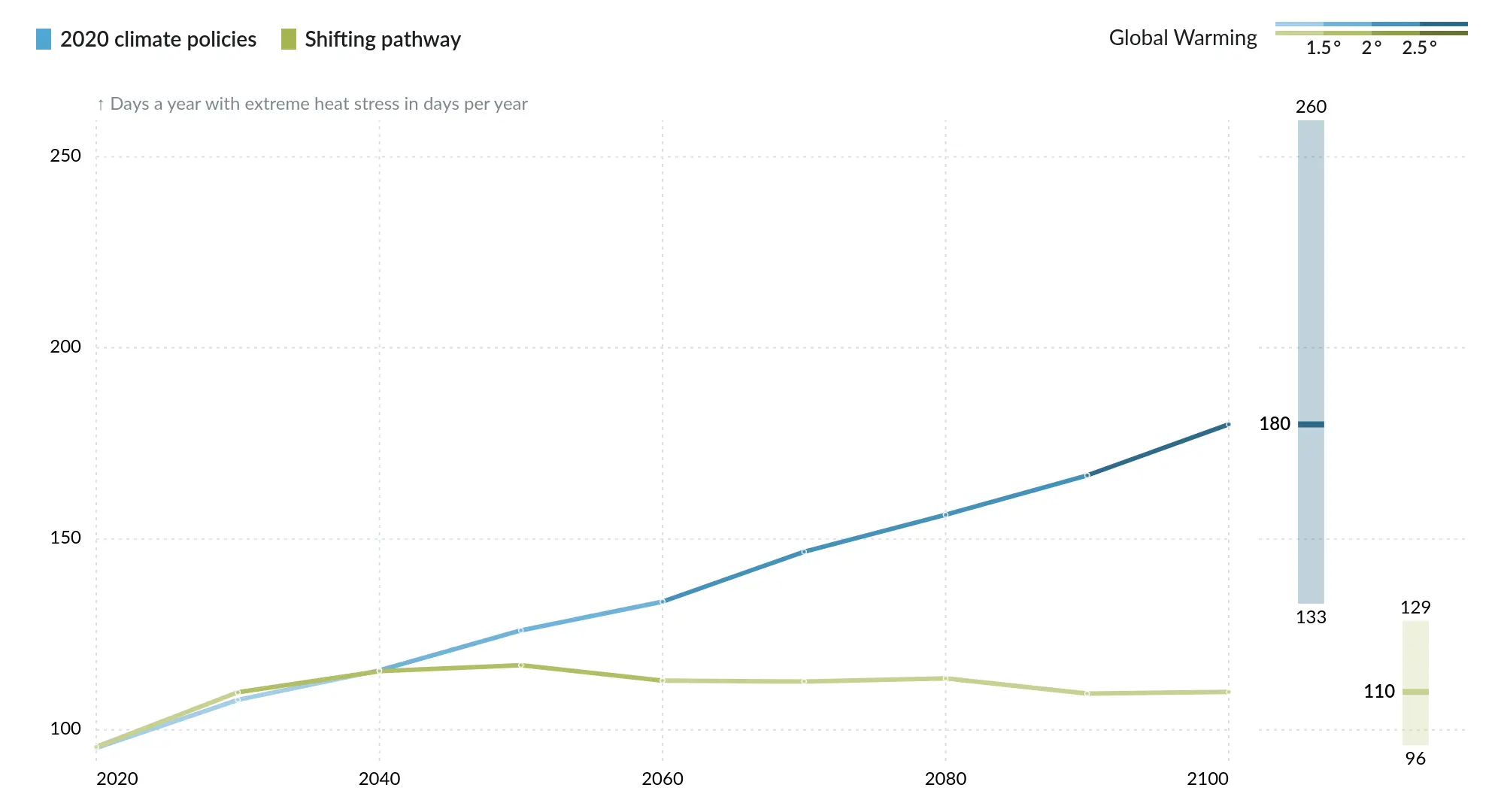
We can illustrate these differences for the risks of extreme heat stress for the Indian city of Chennai, one of 140 cities for which we modelled urban heat stress risks at 100-metre spatial resolution.  

The chart below shows the projected annual number of days of extreme heat stress in Chennai – defined as days where wet-bulb globe temperature (WBGT) goes over 31C. (WBGT is a metric that combines air temperature, humidity and exposure to direct sunlight.)

This level of heat stress approaches the limits of human survivability (without adaptation) – for example, physical outdoor labour is almost impossible under these conditions.

Under current 2020 climate policies, leading to a best estimate of about 3C of warming in 2100, extreme heat days increase pretty much unchecked. By the end of the century, around half of the days (180) per year would experience extreme heat stress conditions (or even higher). 

In contrast, in a 1.5C low-overshoot scenario (the IPCC Shifting Pathway), the number of extreme heat stress days would peak mid-century at around 120 days , before declining again to around 110 days by 2100 as global average temperature decreases from just above 1.5C to around 1.3C. This is a modest decline in extreme heat risk, yet a profound difference from a 3C world. 

Projected days a year with extreme heat stress in Chennai from 2020 to 2100
Projected days a year with extreme heat stress in Chennai from 2020 to 2100 under the climate policies of 2020 (blue) and 1.5C low-overshoot scenario called “IPCC Shifting Pathway” (green). Source: PROVIDE Dashboard

Irreversible consequences from overshoot

There are many other impacts of climate change that will be irreversible – for centuries to millennia – at peak temperatures, let alone if society is able to bring warming back down.

Coral reef lossglacier losssea level rise and the loss of many species and ecosystems all fall into this category.

Yet, a lot of these losses can still be avoided by stringent mitigation. For example, our multi-scenario framework allows us to explore glacier futures showing unavoidable, or “locked-in”, risks even under the lowest emission scenario we have explored, and compare them with the avoidable risks through stringent mitigation. 

Below, we provide an example for glacier volume projections for Peru, where glaciers serve as an essential freshwater resource during the extremely dry season of June to September. Due to past warming, glacier loss will continue over the coming decades. Under a current policy scenario (blue dots), 50% of the glacier volume might be lost as early as 2050.

Yet this does not need to happen. In fact, stringent mitigation pathways (green dots) are still possible that give a four-in-five chance of preserving 50% of today’s glacier ice in Peru, avoiding the worst and helping to maintain some of their vital uses.

Chart illustrating risks of losing 50% of 2020 glacier volume for Peru today and in 2030, 2050 and 2100
Chart illustrating risks of losing 50% of 2020 glacier volume for Peru today and in 2030, 2050 and 2100, under the climate policies of 2020 (blue) and 1.5C low-overshoot scenario called “IPCC Shifting Pathway” (green). Shading highlights the avoidable risk. Source: PROVIDE Dashboard.

Overshoot risks for the biosphere

Climate change represents a major threat to biodiversity globally. We modelled species at risk from local extinction for about 135,000 terrestrial fungi, plants, invertebrates and vertebrates based on the Wallace Initiative

Under the assumption that the 1950-2000 reference climate was suitable for the species at question, we model the proportion of species for which the local climate becomes unsuitable under ongoing climate change. 

In the chart below, we illustrate the risks to species in one of the countries with the world’s richest terrestrial biodiversity, Brazil. Under the current policy scenario (blue dots), the likelihood of 50% of species being at risk of local extinction rises to 74% by 2100. Yet, our analysis shows that this likelihood can still be avoided almost entirely by stringent mitigation (green dots). 

Chart showing the likelihood of 50% of Brazilian species being at risk of local extinction today and in 2030, 2050 and 2100
Chart showing the likelihood of 50% of Brazilian species being at risk of local extinction today and in 2030, 2050 and 2100, under the climate policies of 2020 (blue) and 1.5C low-overshoot scenario called “IPCC Shifting Pathway” (green). Shading highlights the avoidable risk. Source: PROVIDE Dashboard.

It is important to highlight that species loss does depend on a range of factors – of which climate suitability is only one. Yet there is a range of other human-caused stressors to biodiversity loss and a complex interdependencies of species and food webs in particular in the most biodiverse ecosystems implies the risk of knock-on effects and ecosystem tipping points

We also note that our results do not necessarily imply global species extinction and do not allow us to quantify if and how species survival under different overshoot trajectories would emerge. 

Overshoot will stress adaptation planning

Overshoot outcomes matter for climate risk assessments. Yet, in contrast with the prominence of overshoot pathways in the climate mitigation literature, their implications for adaptation planning have not been widely explored.

Overshoot would increase the threat of climate change that society needs to adapt to – and make that adaptation more difficult. Some options may become unavailable due to limits of adaptation

Also, timescales matter. Reversing an overshoot will take decades. Even assuming reversibility of climate hazards in the future as temperatures come down, this might only matter for adaptation decisions that involve a planning horizon of 50 years or more.

This is illustrated in the chart below, from our recent Nature study. This shows a stylised trajectory of warming (top chart) with overshoot (red bars) and how it compares to planning horizons for some example adaptation options (green bars), the lifetime of those measures (blue bars) and the intergenerational equity they involve (bottom chart).

The possibility of reversing long-term impacts in the future does not reduce the urgent need to act now on closing the wide gap in current adaptation efforts.

Figure showing stylised temporal evolution of a reversible climate impact driver
Figure showing: a) stylised temporal evolution of a reversible climate impact driver under a peak and decline scenario. Dashed lines indicate a low and high overshoot outcome with median timescales of global temperature reversibility typically in line with those from the IPCC AR6 database; and b) stylised illustration of adaptation-relevant timescales starting in 2030, including different planning horizons for adaptation planning (green bars) and lifetimes of individual adaptation measures (blue), and the effect of applying discounting (reflecting societal preferences towards intergenerational equity) to future damages and adaptation benefits. Source: Schleussner et al. (2024)

Limit peak warming and aim for long-term decline

While our results clearly underscore the importance of limiting peak warming to as low as possible, there are also very good arguments for aiming for a long-term global temperature decline, irrespective of the peak warming level. 

For a wide range of time-lagged climate impacts, such as ice sheet, peatland and permafrost loss, as well as large-scale irreversible tipping points, achieving temperature decline well below 1.5C is key to limiting long-term risks from global warming. 

Overshoot is clearly not an alternative way to achieve a similar climate outcome. Effectively limiting climate risks requires restricting peak warming as low and as close to 1.5C as possible – and then aim for long-term decline to reduce the climate impact legacy of human-caused emissions.

This guest post is by:

Dr Carl-Friedrich Schleussner leads the integrated climate impact group at the International Institute for Applied Systems Analysis (IIASA) and is a scientific advisor at Climate Analytics, Berlin.

Prof Rachel Warren, professor of global change and environmental biology at the University of East Anglia.

Dr Fabien Maussion, associate professor in glaciology at the School of Geographical Sciences, University of Bristol, UK.

Dr Niels Souverijns, urban climatologist at VITO Belgium and guest professor at KU Leuven.

Dr Quentin Lejeune, a climate scientist who has led the development of the PROVIDE Climate Risk Dashboard at Climate Analytics.

Original article by multiple authors republished from Carbon Brief under a CC license

Continue ReadingGuest post: What 1.5C overshoot would mean for climate impacts and adaptation

Meeting 1.5C warming limit hinges on governments more than technology, study says

Spread the love

Original article by AYESHA TANDON republished from Carbon Brief under a CC license.
The ability of governments to implement climate policies effectively is the “most important” factor in the feasibility of limiting global warming to 1.5C, a new study says. 

The future warming pathways used by the Intergovernmental Panel on Climate Change (IPCC) suggest that holding warming to 1.5C is unlikely, but still possible, when considering the technological feasibility and project-level economic costs of reaching net-zero emissions.

However, the new study, published in Nature Climate Change, warns that adding in political and institutional constraints on mitigation make limiting warming to 1.5C even more challenging. 

They find that the most ambitious climate mitigation trajectories give the world a 50% chance of limiting peak global warming to below 1.6C above pre-industrial temperatures. However, adding ”feasibility constraints” – particularly those involving the effectiveness of governments – reduces this likelihood to 5-45%.

The study shows that, thanks to advances such as solar, wind or electric vehicles, “the technological feasibility of climate-neutrality is no longer the most crucial issue”, according to an author on the study. 

Instead, he says, “it is much more about how fast climate policy ambition can be ramped up by governments”.

Emissions scenarios

In 2015, almost every country in the world signed the Paris Agreement – with the aim to limit global warming to “well below” 2C above pre-industrial levels, with a preference for keeping warming below 1.5C.

Since then, most countries have set net-zero targets and many are making progress towards achieving them. However, as the planet continues to warm, some scientists are questioning whether it is still possible to limit warming to 1.5C, the new study says.

The IPCC’s special report on 1.5C, published in 2018, included a cross chapter box on the “feasibility” of this temperature limit. The report says there are six components of feasibility that could inhibit the world’s ability to limit warming to 1.5C, as shown in the image below.

The six components of feasibility that could inhibit the world’s ability to limit warming to 1.5C, according to the IPCC”s special report on 1.5C. Source: IPCC SR1.5, cross chapter box 3.

The six components of feasibility that could inhibit the world’s ability to limit warming to 1.5C, according to the IPCC”s special report on 1.5C. Source: IPCC SR1.5, cross chapter box 3.

The IPCC’s working group three report from its sixth assessment cycle explores thousands of different future warming scenarios. These scenarios are mainly generated by integrated assessment models (IAMs) that examine the energy technologies, energy use choices, land-use changes and societal trends that cause – or prevent – greenhouse gas emissions.

Fewer than 100 of these scenarios result in warming of below 1.5C with limited or no overshoot, defined as more than a 50% chance of seeing a peak temperature below 1.6C.  These are known as the “C1 scenarios”. However, these scenarios do not consider all of the feasibility constraints outlined by the IPCC.

(Furthermore, these scenarios – which run from 2019 – assume that rapid decarbonisation began almost immediately. However, in reality, emissions have continued to rise since 2020, eating into the remaining “carbon budget” for warming to be limited to 1.5C more quickly than the models assume.)

The new study investigates five constraints. The first two – geophysical and technological – focus on the constraints presented by technologies, such as the growth of carbon capture and storage, nuclear power and solar generation, and the Earth’s total geological carbon storage capacity. 

For sociocultural constraints, the study explores behavioural changes that can accelerate decarbonisation, such as reduced energy demand. The authors refer to these as “enablers”. And the “economic constraint” focuses on carbon prices.

However, the authors say the “key innovation” of their study is the inclusion of “institutional constraints”, which measure a government’s ability to “effectively implement climate mitigation policies”. 

Policy constraints

All countries have different “institutional capabilities” to enforce policies. Some countries are able to quickly and successfully implement policies, such as taxation changes or environmental regulation. Other countries – which are often less wealthy – have lower levels of governance, making it harder to implement these measures.

Dr Christoph Bertram – an associate research professor at the University of Maryland and guest researcher at the Potsdam Institute for Climate Impact Research (PIK) – is the lead author of the study. He tells Carbon Brief that the paper uses a metric called the “governance indicator” to show how fast countries are expected to decarbonise. 

The indicator is based on the speed and success with which they have achieved their past “environmental goals” – for example, reductions in the sulphur emissions of power plants – he explains. Countries that were successful in achieving these targets in the past are given higher governance scores. 

Dr Marina Andrijevic, a researcher at the International Institute for Applied Systems Analysis (IIASA), led the study introducing these governance indicators, but was not involved in the new paper.

She tells Carbon Brief that the indicator is originally from the Worldwide Governance Indicators published by the World Bank. (See more on the indicators in the guest post Andrijevic and her co-authors wrote for Carbon Brief.)

The graph below, taken from the new study, shows how governance is expected to improve over the 21st century for countries with a population of more than 25 million in 2020, according to this indicator. Each colour indicates a different world region. The grey lines indicate a “pessimistic” scenario in which governance remains frozen at 2020 levels.

Expected increases in governance over the 21st century. Only countries with a population of more than 25 million in 2020 are shown. Each colour indicates a different world region. Source: Bertram et al (2024).


The authors use global average carbon prices as a “proxy” for the overall strength of a country’s climate policy, assuming that countries with higher levels of governance will implement higher carbon prices.

They develop a range of scenarios. In their optimistic scenario, carbon prices vary, but this does not explicitly constrain emissions reductions. In the “default” scenario, both carbon prices and emissions reductions are constrained. 

In the pessimistic scenario, governance indicator values are “frozen” at their 2020 levels, meaning that governments’ ability to implement new climate mitigation policies does not improve over the 21st century. 

Bertram tells Carbon Brief that the measure is “not perfect”, but says that it gives a good approximation of “how fast decarbonisation can happen in different countries”.

Is 1.5C ‘feasible’?

The authors used existing literature to quantify how much each of the five constraints might affect the world’s ability to limit global warming. They then produced a set of different “feasibility scenarios” and assessed their future CO2 emissions using eight IAMs.

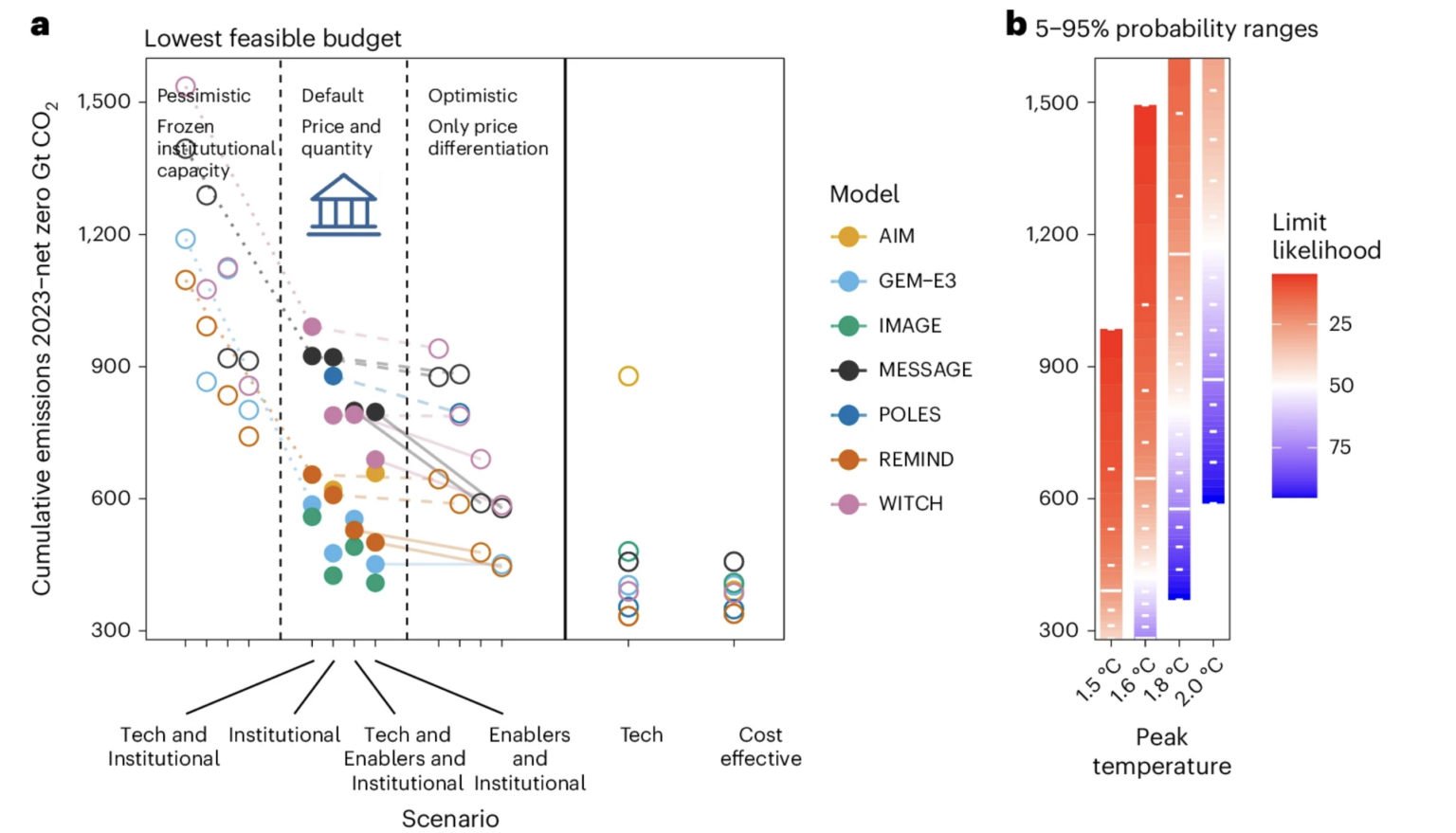
The plot below shows the minimum total global CO2 emissions that could be produced between 2023 and the date that net-zero CO2 is reached for these scenarios. In the panel “a”, on the left, each dot indicates a model result.

The column on the far left is a “pessimistic” institutional feasibility scenario, in which governance indicators do not improve beyond 2020 levels. Cumulative global CO2 emissions before net-zero here are the highest of any scenario explored.

The next column is the “default” assumption of carbon prices and emissions-reduction quantities, under four different combinations of constraints.

From left to right within this column, the combinations cover technological and institutional constraints, only institutional constraints, technological and institutional constraints with enablers and then institutional constraints with enablers.

The enablers include measures such as reduced energy demand in high income countries and increased electrification. This helps to “create more flexibility on the supply side and thus further improve the feasibility of implementation”, according to the paper.

The final column shows “optimistic” scenarios, divided between a scenario with technological constraints (left) and a “cost-effective” scenario, as used in the IPCC (right).

Panel “b” shows the likelihood, based on the 14 feasibility scenarios in panel a, of staying below 1.5C, 1.6C, 1.8C and 2.0C peak temperatures. Each bar indicates a different peak temperature. Red indicates a high likelihood of meeting the temperature target, given the level of emissions, and purple indicates a low likelihood. 

Minimum achievable carbon budget from 2023 until net-zero CO2, across 14 different feasibility scenarios. Source: Bertram et al (2024).

In scenarios without any institutional constraints, nearly all models are able to produce scenarios which line up with the IPCC’s C1 scenarios, which have more than a 50% chance of seeing a peak temperature below 1.6C. 

However, adding institutional constraints reduces this likelihood to 5-45%.

(A peak temperature of 1.6C would not necessarily breach the long-term goal of the Paris agreement, as long as temperatures were brought back down below the 1.5C threshold by the end of the century. However, there are risks associated with overshoot – such as crossing tipping points – and it relies more heavily on large-scale implementation of negative emissions technologies.)

Under the “pessimistic” institutional constraints, the ability of countries to cut emissions is “sharply curtailed”, the authors say, resulting in only a 30-50% chance of limiting warming even to 2C above pre-industrial levels.

The study shows that “technological constraints are not a crucial impediment to a fast transition to net-zero anymore,” Bertran tells Carbon Brief.

“Thanks to the latest advances in low-carbon technology deployment, such as solar, wind or electric vehicles, the technological feasibility of climate-neutrality is no longer the most crucial issue,” Prof Gunnar Luderer – a study author and lead of the energy systems group at the PIK – added in a press release

Instead, he said, “it is much more about how fast climate policy ambition can be ramped up by governments”. 

Future warming

The findings of this study have implications for meeting the Paris Agreement 1.5C limit. “Our study does not imply that the 1.5C target needs to be abandoned,” the study says. However, it adds: 

“The world needs to be prepared for the possibility of an overshoot of the 1.5C limit by at least one and probably multiple tenths of a degree even under the highest possible ambition.”

“The 1.5C target was always something that, while theoretically possible, was very unlikely given the real-world technical, institutional, economic and political setting that determines climate policy,” says Prof Frances Moore from the department of environmental science and policy at UC Davis, who was not involved in the study.

However, she tells Carbon Brief, the finding that humanity could still limit warming to 2C is “a signal of the progress countries have made in committing to climate action”.

Dr Carl-Friedrich Schleussner – a science advisor to Climate Analytics and honorary professor at Humboldt University Berlin – tells Carbon Brief that the paper is “an important contribution to the literature”. 

However, he says the results “need to be interpreted very cautiously”. For example, he notes that the study only considers CO2 emissions and not other greenhouse gases, such as methane.

In addition, he notes that “institutional capacities affect climate action in a myriad of different ways that are not easily representable in the modelling world”. As a result, the study authors had to “settle” on an approach that “may only be partly representative of ‘real world’ dynamics and is very sensitive to modelling assumptions”. 

Moore says this is a “valuable initial study”, but makes a similar point, noting that the “implementation of institutional constraints and demand-side effects is somewhat arbitrary and ad-hoc”, such as using carbon prices as a governance indicator.

Dr William Lamb is a researcher at the Mercator Research Institute and was also not involved in the study. He tells Carbon Brief that the study results are “sobering” and says that “we need to start focusing research, policy and advocacy on the underlying institutions and politics that shape climate action”.

He adds that there are other aspects of feasibility that could be considered:

“We know that incumbent fossil fuel interests are politically powerful in many countries and are able to obstruct the implementation of climate policies, or even reverse those that are already in place. In other words, some governments may be capable, but do not want to implement ambitious climate action.”

Original article by AYESHA TANDON republished from Carbon Brief under a CC license.

Continue ReadingMeeting 1.5C warming limit hinges on governments more than technology, study says

77% of Top Climate Scientists Think 2.5°C of Warming Is Coming—And They’re Horrified

Spread the love

Original article by OLIVIA ROSANE republished from Common Dreams under Creative Commons (CC BY-NC-ND 3.0).

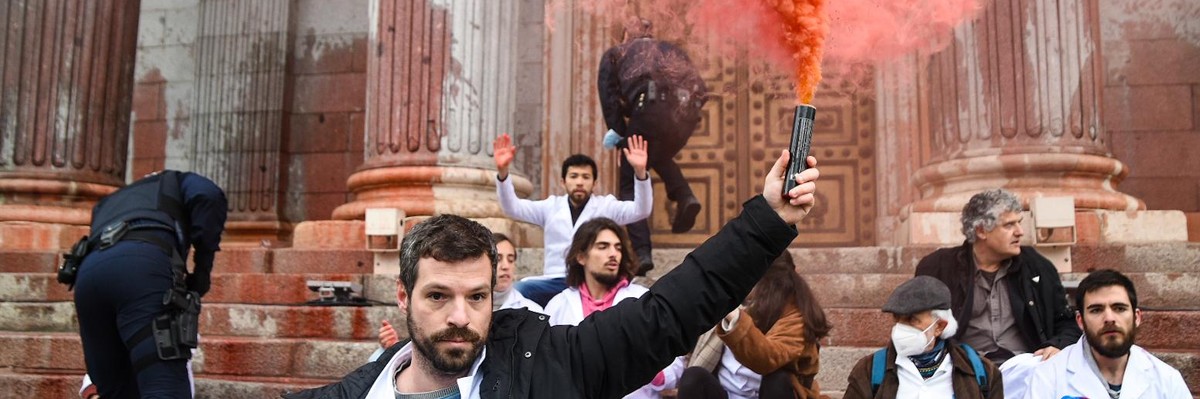
Scientists engage in civil disobedience on the steps of the Congress of Deputies in Madrid, Spain on April 6, 2022. 
(Photo: Scientist Rebellion)

“I expect a semi-dystopian future with substantial pain and suffering for the people of the Global South,” one expert said.

Nearly 80% of top-level climate scientists expect that global temperatures will rise by at least 2.5°C by 2100, while only 6% thought the world would succeed in limiting global heating to 1.5°C above preindustrial levels, a survey published Wednesday by The Guardian revealed.

Nearly three-quarters blamed world leaders’ insufficient action on a lack of political will, while 60% said that corporate interests such as fossil fuel companies were interfering with progress.

“I expect a semi-dystopian future with substantial pain and suffering for the people of the Global South,” one South African scientist told The Guardian. “The world’s response to date is reprehensible—we live in an age of fools.”

“What blew me away was the level of personal anguish among the experts who have dedicated their lives to climate research.”

The survey was conducted by The Guardian‘s Damian Carrington, who reached out to every expert who had served as a senior author on an Intergovernmental Panel on Climate Change (IPCC) report since 2018. Out of 843 scientists whose contact information was available, 383 responded.

He then asked them how high they thought temperatures would rise by 2100: 77% predicted at least 2.5°C and nearly half predicted 3°C or more.

“What blew me away was the level of personal anguish among the experts who have dedicated their lives to climate research,” Carrington wrote on social media. “Many used words like hopeless, broken, infuriated, scared, overwhelmed.”

The 1.5°C target was agreed to as the most ambitious goal of the Paris agreement of 2015, in which world leaders pledged to keep warming to “well below” 2°C. However, policies currently in place would put the world on track for 3°C, and unconditional commitments under the Paris agreement for 2.9°C.

The survey comes on the heels of the hottest year on record, which already saw a record-breaking Canadian wildfire season as well as extreme, widespread heatwaves and deadly floods. The first four months of 2024 have also been the hottest of their respective months on record, and the year has already seen the fourth global bleaching event for coral reefs.

“They can say they don’t care, but they can’t say they didn’t know.”

“I think we are headed for major societal disruption within the next five years,” Gretta Pecl of the University of Tasmania told The Guardian. “[Authorities] will be overwhelmed by extreme event after extreme event, food production will be disrupted. I could not feel greater despair over the future.”

Scientists said that governments and companies that profit from the burning of fossil fuels had prevented action. Many also blamed global inequality and the refusal of the wealthy world to step up, both in terms of reducing their own emissions and helping climate vulnerable nations adapt.

“The tacit calculus of decision-makers, particularly in the Anglosphere—U.S., Canada, U.K., Australia—but also Russia and the major fossil fuel producers in the Middle East, is driving us into a world in which the vulnerable will suffer, while the well-heeled will hope to stay safe above the waterline,” Stephen Humphreys at the London School of Economics said.

Despite their grim predictions, many of the scientists remained committed to researching and speaking out.

“We keep doing it because we have to do it, so [the powerful] cannot say that they didn’t know,” Ruth Cerezo-Mota, who works on climate modeling at the National Autonomous University of Mexico, told The Guardian. “We know what we’re talking about. They can say they don’t care, but they can’t say they didn’t know.”

Others found hope in the climate activism and awareness of younger generations, and in the finding that each extra tenth of a degree of warming avoided protects 140 million people from extreme temperatures.

“I regularly face moments of despair and guilt of not managing to make things change more rapidly, and these feelings have become even stronger since I became a father,” said Henri Waisman of France’s Institute for Sustainable Development and International Relations. “But, in these moments, two things help me: remembering how much progress has happened since I started to work on the topic in 2005 and that every tenth of a degree matters a lot—this means it is still useful to continue the fight.”

Peter Cox of the University of Exeter added: “Climate change will not suddenly become dangerous at 1.5°C—it already is. And it will not be ‘game over’ if we pass 2°C, which we might well do.”

“I’m not despairing, I’m not giving up. I’m pissed off and more determined to fight for a better world.”

Many of the scientists who still saw a hope of keeping 1.5°C alive pinned it on the speeding rollout and falling prices of climate-friendly technologies like renewable energy and electric vehicles. Also on Wednesday, energy think thank Ember reported that 30% of global electricity came from renewables in 2023 and predicted that the year would be the “pivot” after which power sector emissions would start to fall. Experts also said that abandoning fossil fuels has many side benefits such as cleaner air and better public health. Though even the more optimistic scientists were wary about the unpredictable nature of the climate crisis.

“I am convinced that we have all the solutions needed for a 1.5°C path and that we will implement them in the coming 20 years,” Henry Neufeldt of the United Nations’ Copenhagen Climate Center told The Guardian. “But I fear that our actions might come too late and we cross one or several tipping points.”

Several scientists gave recommendations for things that people could do to move the needle on climate. Humphreys suggested “civil disobedience” while one French scientist said people should “fight for a fairer world.”

“All of humanity needs to come together and cooperate—this is a monumental opportunity to put differences aside and work together,” Louis Verchot, based at the International Center for Tropical Agriculture in Colombia, told The Guardian. “Unfortunately climate change has become a political wedge issue… I wonder how deep the crisis needs to become before we all start rowing in the same direction.”

The publication of The Guardian‘s survey prompted other climate scientists to share their thoughts.

“As many of the scientists pointed out, the uncertainty in future temperature change is not a physical science question: It is a question of the decisions people choose to make,” Texas Tech University climate scientist Katharine Hayhoe wrote on social media. “We are not experts in that; And we have little reason to feel positive about those, since we have been warning of the risks for decades.”

Aaron Thierry, a graduate researcher at the Cardiff School of Social Sciences, pointed out that The Guardian‘s results were consistent with other surveys of scientific opinion, such as one published in Nature in the lead-up to COP26, in which 60% of IPCC scientists said they expected 3°C of warming or more by 2100.

James Dyke of the University of Exeter’s Global Systems Institute argued that there was room for scientists to share more negative thoughts without succumbing to or encouraging defeatism.

“I hear the argument that we must temper these messages because we don’t want people to despair and give up. But I’m not despairing, I’m not giving up. I’m pissed off and more determined to fight for a better world,” Dyke said on social media.

NASA climate scientist Peter Kalmus shared the article with a plea to “please start listening.”

“Elected and corporate ‘leaders’ continue to prioritize their personal power and wealth at the cost of irreversible loss of essentially everything, even as this irreversible loss comes more and more into focus. I see this as literally a form of insanity,” Kalmus wrote, adding that “capitalism tends to elevate the worst among us into the seats of power.”

However, he took issue with the idea that a future of unchecked climate change would be only “semi-dystopian.”

“We’re also at risk of losing any gradual bending toward progress, and equity, and compassion, and love,” Kalmus said. “All social and cultural struggles must recognize this deep intersection with the climate struggle.”

Original article by OLIVIA ROSANE republished from Common Dreams under Creative Commons (CC BY-NC-ND 3.0).

[dizzy: It is generally accepted by knowledgeable parties that 2.5C is “locked-in” in the sense that emissions already made will cause it. We need immediate reduction in climate heating gases by abandoning fossil fuels. Politicians worldwide are neglecting this necessary action and are indeed creating a worse situation by promoting fossil fuels through widespread and generous subsidies.]

14/5/24 I’m trying to verify the “locked-in” claim that I make above. It’s not particularly supported by this report.

14/5/24 8.30 pm BST

If greenhouse gas emissions stopped but greenhouse gases stayed at a fixed level then there’d be another ~0.5-0.6°C of slow warming in the pipeline, but in reality CO₂ would fall due to natural carbon sinks once emissions stop and largely cancel out this warming.

Aerosols mask ~0.6°C of warming, but even in the unlikely scenario of their sudden elimination models show only ~0.2-0.4°C of extra warming by 2100 as a result. A gradual partial phase-out of aerosol emissions could limit this unmasking effect to ~0.1-0.2°C spread over time, and cuts in non-CO₂ greenhouse gases like methanes could entirely counteract aerosol removal, minimising its impact.

Overall this likely reduces “locked-in” warming from the climate lag and aerosols to a negligible amount on top of the current (2021) warming of ~1.2°C – in contrast to the extra ~1.4°C sometimes claimed – and any short-term warming from aerosol reductions can be reduced and compensated for by reducing other short-lived greenhouse gases like methane.

All of this is quite academic of course – politicians do not intend to address global warming and instead intend to continue trashing the planet.

Continue Reading77% of Top Climate Scientists Think 2.5°C of Warming Is Coming—And They’re Horrified