A DeSmog Guide to How the World Changed in 2024

Spread the love

Original article by DeSmog Staff republished from DeSmog

As 2024 closes, Donald Trump (left) is taking over in the U.S., Keir Starmer (center) in the UK, and Canada’s Justin Trudeau (right) ends the year on shaky ground. Credit: DeSmog/Wikimedia Commons

Our editors and reporters weigh in on a year of seismic political events, and what they’re paying close attention to in 2025.

It’s no exaggeration to say that the global political terrain fundamentally shifted this year. 

Donald Trump is heading to the White House, Keir Starmer helped end 14 years of Conservative rule in the U.K. and Justin Trudeau is ending the year on shaky ground in Canada. 

Add to that a growing revival of old-school climate denial, surging oil and gas production, high level calls for PR firms to cut their ties to fossil fuels, emboldened hard-right farming groups, and new anti-greenwashing laws.

It was one of the most volatile and consequential years for climate action we’ve ever tracked at DeSmog. To help you make sense of it, we’ve asked our editors and contributors to weigh in on what they see as the year’s biggest takeaways – and the trends they’re paying attention to heading into 2025.  

‘We discovered a lot of new documents’

Brendan DeMelle, executive director: Whenever someone on the DeSmog team finds a new document demonstrating what the fossil fuel industry knew long ago, and we reflect on the fact that humans possessed clear knowledge of climate risks and yet made decisions to deny the science and delay action, it gives us great pause to consider the power of corporate interests over basic self-preservation of our species. 

In 2024, we discovered a lot of new documents and evidence demonstrating industry’s early knowledge of climate science dating to the 1950s, and a subsequent pivot to denial and delay strategies that seem unfathomable now. They knew better, they ignored responsible actions for decades, and here we are witnessing the devastating consequences which are in line with Exxon’s own models. People are suffering and dying. And what are the oil majors doing? Doubling down on production.

Publishing this evidence of denial and deception always gives me hope that we can make an impact far greater than our size. Climate justice has the wind in its sails, and every document and data point we can add only quickens the velocity of accountability. 

I’m also excited that documents that we found and published years ago continue to have great impact, both in climate liability lawsuits and in civil society. We’re thrilled about the news that Geoff Dembicki’s book ‘The Petroleum Papers’ — which was based on Imperial Oil documents DeSmog found — has been optioned for a TV series.

What I’m paying attention to in 2025: With our recent appointment of Geoff Dembicki as global managing editor, our team will be increasingly connecting the dots between international themes and actors in our global work to expose false solutions and shine light on the reach of climate denial and extreme right-wing attacks on the public interest across the world. 

We’ll be tracking the international spread of MAGA and the ongoing work of what we call the architecture of denial — networks like Jordan Peterson’s Alliance for Responsible Citizenship (ARC)Atlas NetworkKoch Network, Tim Dunn’s America First Policy Institute (AFPI)Project 2025 and other players. We’ll expose their coordinated efforts to undermine environmental protections and criminalize dissent to crush the public interest. We will not stop fighting for the future. And the way we do that at DeSmog is through hard-hitting investigative journalism that centers accountability for climate delay and denial. 

‘A resurgence of old-school climate denial’

Geoff Dembicki, global managing editor: I spent a lot of 2024 reporting on a single person – the Canadian conservative influencer Jordan Peterson, who’s evolved over the past few years into one of the world’s most consequential deniers of the climate crisis. In the spring, I went to sold-out Peterson performances in New York City and Fort Worth, where I learned that he’s using religious appeals to undermine public faith in science. My key takeaway: that anti-climate messages are becoming increasingly central to the worldview of the religious right, complicating political efforts to enlist the public in climate action with appeals to economic self-interest. 

What I’m paying attention to in 2025: It’s impossible to ignore the most turbulent political event of 2024 – the reelection of Donald Trump. As we move into 2025, I’ll be paying special attention to the ways that a second Trump administration alters the global landscape of climate disinformation and fossil fuel expansion. 

I fear that with Trump’s selection of Chris Wright as Energy Secretary – a fracking executive who’s been eagerly endorsed by the CO2 Coalition and other anti-science organizations – we are set to see an aggressive resurgence of old-school climate denial. And I will be closely looking at the influence Trump’s win has on Canada, where the Conservative Party leader – and fossil fuel populist – Pierre Poilievre is campaigning to unseat Prime Minister Justin Trudeau in a federal election scheduled for 2025. 
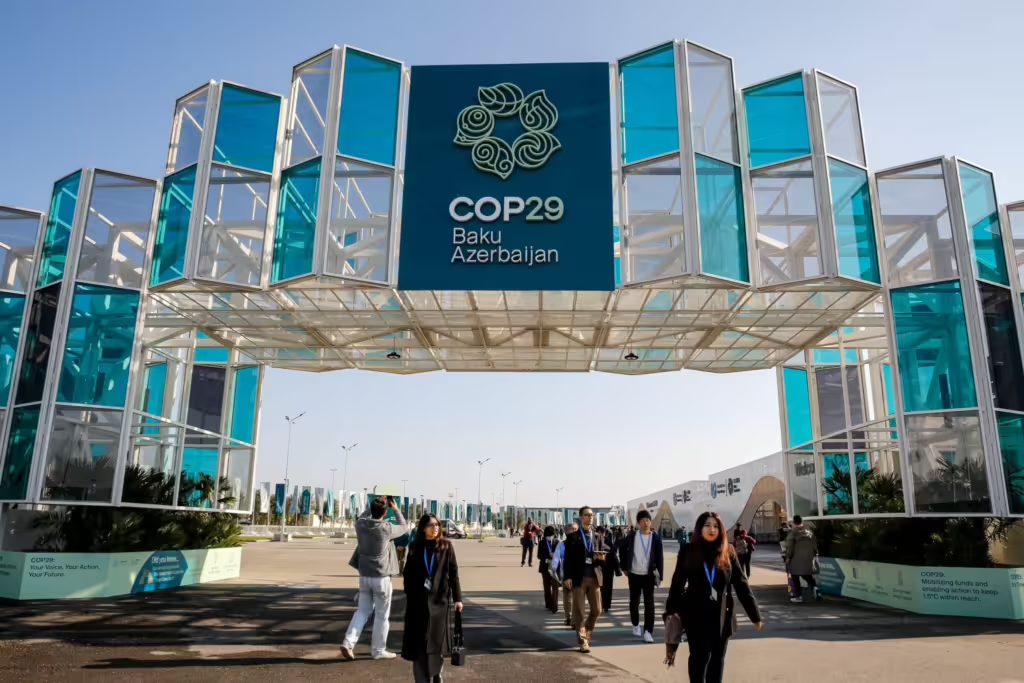
The COP29 entrance in Baku, Azerbaijan. Credit: Michal Busko / Alamy

Polluting industries’ new front against nature protection

Hazel Healy, UK editor-in-chief: In 2024 I travelled to the UN biodiversity talks in Colombia, with DeSmog reporter Rachel Sherrington. It was DeSmog’s first-ever nature-protection summit, and we’d heard mixed reports about whether there was any business lobbying going on at all. In Cali, along with tropical birds and old-school salsa, we were shocked to find oil and gas majors present, showcasing their biodiversity credentials with no hint of irony, with other usual suspects who used their participation to block regulations, such as the pesticide lobby. 

We did what DeSmog did best – mapped, analysed, and counted the delegates, learning that business lobbyists had doubled since the last summit. We applied the same lens, for the third year running to shine a light on ag lobbying at the climate COP less than a month later. My takeaway? That anti-climate agribusiness lobbying is not only here to stay, it’s taking aim at both nature and climate – and both must be tackled together.

What I’m paying attention to in 2025: I will be keeping an eye on how the big ag lobby is organising ahead of the COP30 climate summit in Brazil – seen as a beacon of hope by many in the movement for sustainable food and farming, but subject to powerful meat interests. We will be listening carefully to big ag’s talking points and challenging disinformation when we hear it. It’s also going to be really interesting to see the evolution of fledgling EU laws against greenwashing by corporations, and see whether any more cities follow the lead of Dutch city the Hague in banning fossil fuel ads altogether. 

‘Far-right parties gaining a new foothold’

Sam Bright, UK deputy editor: The UK general election dominated my coverage in 2024 – a six-week blitz of stories about the parties and politicians vying for our votes. We followed the money and found that, between the last election and the beginning of the 2024, the ruling Conservative Party had accepted £8.4 million from fossil fuel interests, climate science deniers, and polluting industries. We applied the same methodology to Reform UK, the radical right-wing party led by Trump fanatic Nigel Farage, and found that 92 percent of its funding during the period had come from dirty donors. This was somewhat ironic, given that Farage and his deputy Richard Tice now represent two of the constituencies most exposed to climate change.

What I’m paying attention to in 2025: I will be closely following the tentacles of the Trump administration in 2025 – tracking the ways in which his climate denial agenda is being exported to the UK and Europe. For years, DeSmog has been mapping the connections between dark money libertarian groups on both sides of the Atlantic. With Trump in the White House, Farage climbing in the polls, and far-right parties gaining a new foothold in Europe, these political connections are likely to intensify – posing a major threat to global climate action. 

‘Astroturfing and disinformation campaign’

TJ Jordan, investigative reporter (PR/Advertising, False Solutions): I worked for a global PR agency for four years, so I have a headstart in knowing where to look when investigating how these companies quietly protect the fossil fuel industry. In 2024 I analysed agency board directors’ ties to polluting companies; challenged the sustainability award shows rewarding agencies that work for oil producers; and went inside the elite PR firm fostering oil-reliant Azerbaijan’s image as a climate innovator ahead of hosting COP29. But my most challenging (and rewarding) project was a six-month investigation into the dirty tactics of a British-owned PR agency called MetropolitanRepublic. 

Protestors from student human rights group Justice Movement Uganda opposing the East Africa Crude Oil Pipeline. Credit: Bruce Nahabwe

The agency “squashed” (their word, not mine) the voices of Ugandan environmental land defenders on behalf of French oil giant TotalEnergies — which is building the world’s longest heated crude oil pipeline across Uganda and Tanzania — with a carefully constructed astroturfing and disinformation campaign called “Action for Sustainability.”

What I’m paying attention to in 2025: U.S.-based ad and PR holding company Omnicom is about to become the biggest provider of marketing, advertising, public relations, and lobbying services to the fossil fuel industry, after it bought fellow industry giant IPG. Outside pressure from the UN and campaign groups like Clean Creatives is increasing on big holding companies to reassess their work protecting the reputations of oil and gas producers. I’ll be keeping a close eye on how the Omnicom-IPG consolidation affects the individual agencies in these holding company networks and their ability to make decisions on who they work for.

‘The fallout of Canada’s new anti-greenwashing law’

Sarah Berman, Canada editor: Our reporters closely followed misleading fossil fuel ads and the fallout of Canada’s new anti-greenwashing law, which targets environmental claims that can’t be backed with evidence. The new legislation pushed the fossil fuel lobbyist group Pathways Alliance to immediately scrub its website of all content. The Canadian Association of Petroleum Producers followed suit, removing a section of its website devoted to carbon capture and storage. 

Canada Action, a third-party advertiser that claimed Canadian liquified natural gas (LNG) would help cut global carbon emissions on transit shelter ads, cut references to the environmental benefits of LNG on its website. Canadian oil sands companies even blamed the new law for delayed sustainability reports. Now, major cities like Toronto are looking to ban misleading fossil fuel ads on transit.

What I’m paying attention to in 2025: We’ve seen fewer greenwashing claims on transit in the second half of 2024, but the fight over Canada’s anti-greenwashing legislation is not over and DeSmog will continue to follow the latest developments. Our reporters expect oil sands companies and their allies to fight any effort to hold them accountable for spreading misinformation. Will this new legislation further push emitters to distance themselves from false solutions? Or will a Canadian election bring in a new government that is more favourable to polluters? 

‘Agriculture grabbed global headlines’

Phoebe Cooke, UK deputy editor: From the wave of farmers’ protests sweeping Europe to the greenwash of the intensive farming sector – this was a year in which agriculture grabbed global headlines by the scruff of the neck. Ahead of the European elections in June, our team worked with reporters across the EU to track how misinformation was fuelling debates on food and farming. 

Our series revealed links between hard-right farming groups and the Viktor Orbán-funded MCC Brussels think tank, dissected the false claims made ahead of the elections as well as the political candidates spreading them, and shone a light on the diverse stances between farming groups on protests. In Ireland, our work mapping the connections of the powerful farming lobby was cited in the parliament (Oireachtas) and became a major talking point ahead of a critical decision by the EU on whether to extend the country’s nitrates derogation.

What I’m paying attention to in 2025: This will be a crucial year for the newly elected European Commission to transform its agriculture and food sectors and to beef up its climate targets. As 720 MEPs get to work, we’ll investigate the populist politicians looking for ways to weaken key legislation, and continue to scrutinise the lobbying tactics of powerful corporations. With elections on the horizon in Germany and Poland, we’ll look to work in partnership with European journalists to enhance our cross-border coverage at this pivotal time.

Trump-oriented politics within Canada’

Mitchell Anderson, Canada contributor: I spent much of 2024 focusing on the evolving situation in Alberta, which produces almost 40 percent of Canada’s emissions with only 12 percent of the population. This work included itemizing unfunded environmental liabilities associated with fossil fuel extraction, particularly expanding oil sands operations. Alberta is also pushing the Pathways carbon capture scheme, a twice-rejected coal mine expansion in the foothills of the Rockies, and funded a $7 million “scrap the cap” ad campaign that would likely violate new federal competition regulations if the province was a company. 

All of these issues have been fertile ground for Desmog commentary that seeks to highlight cracks and contradictions within populist Alberta politics.  
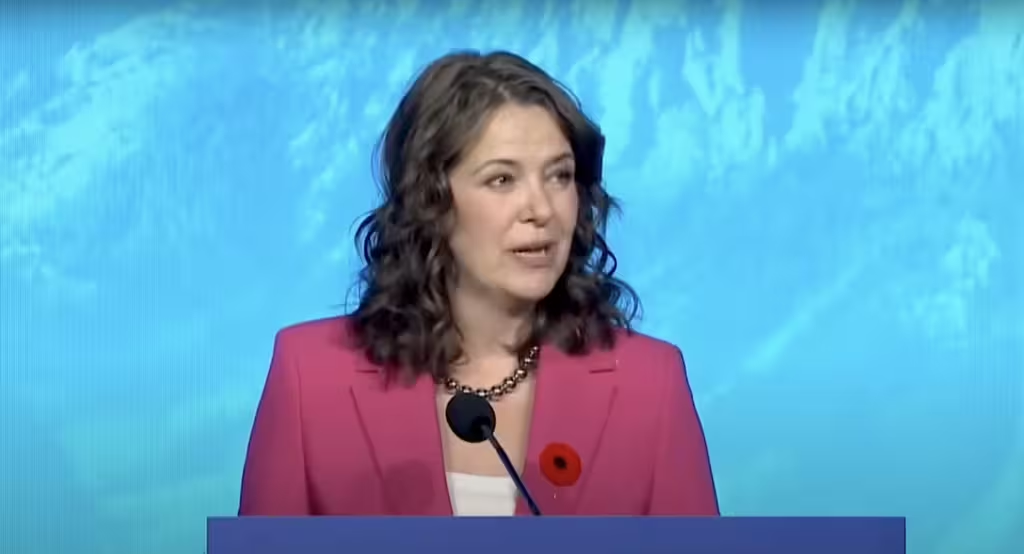
Alberta Premier Danielle Smith speaks at the UCP annual meeting, where delegates voted for an erroneous resolution claiming atmospheric CO2 is at a 1,000-year low. Credit: Danielle Smith / YouTube

What I’m paying attention to in 2025: The second Trump administration promises to upend many norms within society, politics, and the energy sector. DeSmog is well positioned to highlight how this chaotic political period will impact renewable technology, the fossil fuel industry, and our climate future. I will continue to focus on stories about the evolving situation in Alberta, which in many ways has become a cultural beachhead for Trump-oriented politics within Canada. 

Neighbouring British Columbia has become a political counterweight by aggressively scaling up renewable energy, creating numerous opportunities for contrasting case studies that highlight these diverging trajectories. A Canadian election in 2025 will add additional interest to a turbulent year as Pierre Poilievre seeks to centre his campaign against carbon pricing – often in the absence of facts. 

‘The DeSmog team will be very busy’

Taylor C. Noakes, Canada contributor: My focus areas in 2024 were principally industry and political reactions to new anti-greenwashing legislation; debunking industry-friendly (and often politically expedient) false solutions to the climate crisis (like LNGhydrogen, and carbon capture); and Canada’s ongoing culture war against renewables, which has resulted in nonsensical political decisions (like instituting a solar and wind power moratorium in Canada’s sunniest and windiest province). 

As in years past, I covered a number of major industry conferences in Canada and the United States (including annual carbon capturehydrogenLNG, and oil/gas industry conferences, mostly in Alberta). Highlights from these events include a ten minute one-on-one scrum with the Premier of Alberta on the failures of carbon capture, and reporting on Jane Fonda leading an anti-LNG protest (whose turnout was larger than the number of conference attendees).

What I’m paying attention to in 2025: I anticipate the new American president’s energy policies will have profound effects on Canada – whether it’s tariffs that sink what’s left of Canada’s oil and gas sector, American resource nationalism that prioritizes local resource exploitation over Canadian imports (or some combination thereof), or a Canadian reaction to U.S. trade war sabre rattling that emphasizes either an accelerated transition or the subsidized development of new markets for old technology. 

Whatever course it takes, I suspect the DeSmog team will be very busy. I’m looking forward to how this shakes out at the series of annual conferences I typically attend. In addition, I plan on keeping a close eye on hydrogen and carbon capture projects, as well as the growing grassroots resistance to fossil fuels, pipelines, and the industry in general. Successful Indigenous resistance to fossil fuel projects offers exciting opportunities for optimistic climate-change related reporting. Similar efforts by cities to ban fossil fuel advertising, and the use of gas for cooking, as well as rural communities banning CO2 pipelines, indicate real momentum and tangible results from the ground up. 

The immovable object that is the fossil fuel sector is meeting the unstoppable force that is people’s innate desire to live on a healthy planet. 2025 is going to be a thrilling year for environmental reporting.

‘Focusing on the financial’

Sharon Kelly, U.S. reporter: One of the oldest adages in investigative reporting is to follow the money. In seeking to understand what’s driving fossil fuel companies to double down on greenwashing and environmentally damaging projects, it helps to have a clear picture of what their incentives are and how those incentives are created. My work for DeSmog in 2024 focused on the financial: examining federal subsidies for carbon capture, created in the name of combatting climate change but with the effect of making it worse; reporting on evidence shale drillers attempted price-fixing to inflate oil prices, and on price-gouging by corporations when climate-fueled disasters strike; and seeking to understand oil and gas industry liabilities like abandoned wells – and what happens on the ground when companies fail to pay to clean up.

What I’m paying attention to in 2025: The risks and uncertainties surrounding fossil fuels are, if anything, amplified by the incoming administration. Despite the Trump administration’s ties to the oil and gas industry, Trump’s first term was marked by upheaval and disruptions for fossil fuel companies (and the rest of us). Autocratic impulses are often, at their core, a telling sign of fragility.

Whatever 2025 brings, we intend at DeSmog to keep the heat on the industry by examining the financial side of the climate crisis and the companies that have fueled it – whether that’s investigating the role false solutions play in oil and gas companies’ plans for the future, scrutinizing how over-hyped investments can cause outsized environmental damage while falling short for communities and investors alike, or staying watchful for fossil fuel companies seeking to benefit from the political power of the far-right (and vice versa).

‘Mapping the big money and political connections’

Adam Barnett, UK reporter

2024 was a target rich environment for anyone looking to cover climate denial, with a mountain of smog descending on the UK. So much, in fact, that I had to compile a map of the donors, media, think tanks, and fossil fuel companies pushing the Conservative government to turn against net zero. I also debunked the big climate myths peddled during the UK general election campaign, since the British media wasn’t going to.  

I gave the post-election Tory leadership contest the same treatment, exposing the climate record of the candidates and the dirty money pumped into the campaign – along with the Tories’ growing ties to Donald Trump’s Project 2025. 

I covered the rise of Nigel Farage’s right-wing Reform UK, recording its climate denial views and polices, and mapping the big money and political connections of this supposedly anti-establishment party – including one donor accused of sexual harassment and another with money in Russia. When millionaire GB News owner Paul Marshall bought the influential Spectator magazine, I revealed his hedge fund’s ties to a major oil and gas investor, (that’s on top of its own fossil fuel investments). 

What I’m paying attention to in 2025: With Conservative Party leader Kemi Badenoch flying to Washington to build ties with the incoming Trump team, a U.S. ambassador to the UK with oil and gas interests (both also covered in 2024), and Reform’s Nigel Farage curling up at the feet of Elon Musk, I expect to be covering the growing influence of Trumpian climate denial on the UK — along with transatlantic groups like Jordan Peterson’s Alliance for Responsible Citizenship (ARC), which is headed by a Tory peer.

I’ll also continue to expose the climate deniers hijacking protests around farming and anti-pollution schemes, and hold the Labour government to account on its climate targets. 

Original article by DeSmog Staff republished from DeSmog
Continue ReadingA DeSmog Guide to How the World Changed in 2024

26 Climate-Fueled Extreme Weather Events Killed at Least 3,700 People in 2024: Report

Spread the love

Original article by Jake Johnson republished from Common Dreams under Creative Commons (CC BY-NC-ND 3.0).

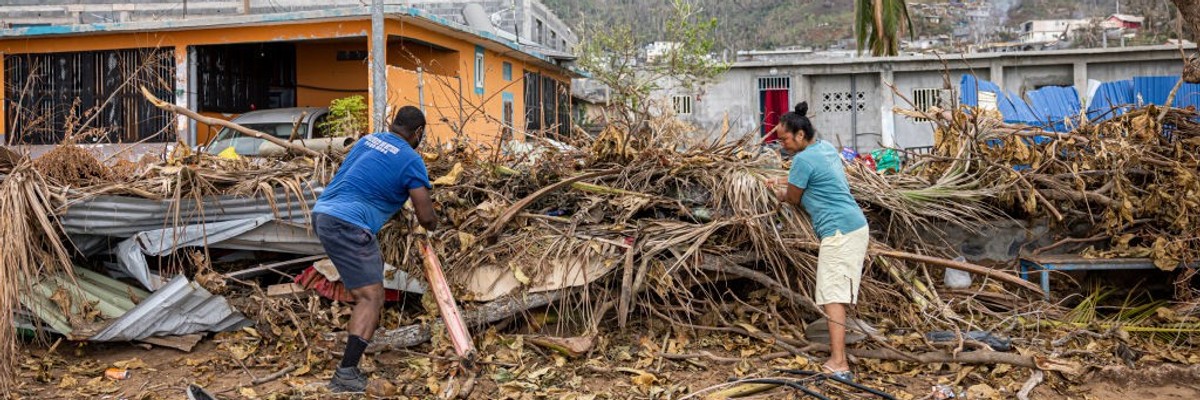
Residents collect garbage and debris to burn in the town of Acoua after Cyclone Chido wreaked havoc on the French island territory of Mayotte on December 25, 2024. (Photo: Patrick Meinhardt/AFP via Getty Images)

“This exceptional year of extreme weather shows how dangerous life has already become… and highlights the urgency of moving away from planet-heating fossil fuels as quickly as possible.”

Just over two dozen climate-fueled extreme weather events killed at least 3,700 people worldwide and displaced millions in 2024, according to a report published Friday as the hottest year on record drew to a close.

The new analysis from World Weather Attribution (WWA) and Climate Central states that extreme weather “reached dangerous new heights in 2024” as “record-breaking temperatures fueled unrelenting heatwaves, drought, wildfire, storms, and floods that killed thousands of people and forced millions from their homes.”

“This exceptional year of extreme weather shows how dangerous life has already become with 1.3°C of human-induced warming, and highlights the urgency of moving away from planet-heating fossil fuels as quickly as possible,” said the two organizations, which examined 26 destructive weather events that occurred in 2024—a fraction of the hundreds that took place globally this year.

Those 26 events—from Hurricane Helene in the United States to the typhoon that hammered the Philippines, China, and Taiwan— caused close to 4,000 deaths, according to WWA and Climate Central.

“It’s likely the total number of people killed in extreme weather events intensified by climate change this year is in the tens, or hundreds of thousands,” the analysis states.

“Extremes will continue to worsen with every fraction of a degree of fossil fuel warming.”

Around the world, the fossil fuel-driven climate emergency added, on average, 41 additional days of dangerous heat this year, Climate Central found.

“The countries that experienced the highest number of dangerous heat days are overwhelmingly small island and developing states, who are highly vulnerable and considered to be on the frontlines of climate change,” the analysis says.

WWA and Climate Central said their findings should spur global action to shift away from fossil fuel, the burning of which is “the primary reason extreme weather is becoming more severe,” they said.

“Extremes will continue to worsen with every fraction of a degree of fossil fuel warming,” WWA and Climate Central added. “A rapid move to renewable energy will help make the world a safer, healthier, wealthier, and more stable place.”

Original article by Jake Johnson republished from Common Dreams under Creative Commons (CC BY-NC-ND 3.0).

Continue Reading26 Climate-Fueled Extreme Weather Events Killed at Least 3,700 People in 2024: Report

Climate crisis deepens with 2024 ‘certain’ to be hottest year on record

Spread the love

https://www.theguardian.com/environment/2024/dec/09/climate-crisis-deepens-with-2024-certain-to-be-hottest-year-on-record

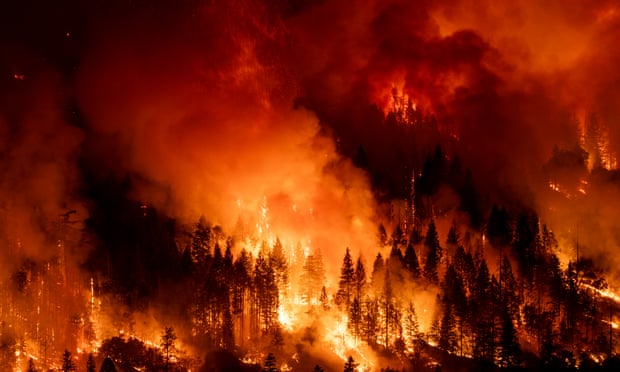
A wildfire in California this year. Fires driven by severe droughts have affected the western US, Canada, the Amazon forest and particularly the Pantanal wetlands. Photograph: David McNew/Getty Images

Average global temperature in November was 1.62C above preindustrial levels, bringing average for the year to 1.60C

This year is now almost certain to be the hottest year on record, data shows. It will also be the first to have an average temperature of more than 1.5C above preindustrial levels, marking a further escalation of the climate crisis.

Data for November from the EU’s Copernicus Climate Change Service (C3S) found the average global surface temperature for the month was 1.62C above the level before the mass burning of fossil fuels drove up global heating. With data for 11 months of 2024 now available, scientists said the average for the year is expected to be 1.60C, exceeding the record set in 2023 of 1.48C.

Fossil fuel emissions must fall by 45% by 2030 to have a chance of limiting heating to 1.5C. The recent Cop29 climate summit failed to reach an agreement on how to push ahead on the transition away from coal, oil and gas. The C3S data showed that November 2024 was the 16th month in a 17-month period for which the average temperature exceeded 1.5C.

The supercharging of extreme weather by the climate crisis is already clear, with heatwaves of previously impossible intensity and frequency now striking around the world, along with fiercer storms and worse floods.

https://www.theguardian.com/environment/2024/dec/09/climate-crisis-deepens-with-2024-certain-to-be-hottest-year-on-record

Continue ReadingClimate crisis deepens with 2024 ‘certain’ to be hottest year on record

State of the climate: 2024 will be first year above 1.5C of global warming

Spread the love

Original article by Zeke Hausfather republished from Carbon Brief under a CC license.

This year is now virtually certain to beat 2023 as the hottest year on record, Carbon Brief analysis shows.

It will also be the first full year to surpass 1.5C above pre-industrial levels across the majority of observational records.

In this latest “state of the climate” quarterly update, Carbon Brief finds:

  • The year 2024 has seen record warm temperatures for seven of the nine months of the year where data is so far available.
  • The world, as a whole, has warmed approximately 1C since 1970 – and 1.2C to 1.4C since the mid-1800s.
  • A strong El Niño event contributed to exceptionally high global temperatures early in the year, but record or near-record temperatures persisted despite the fading of El Niño in recent months.
  • Record global temperatures have been seen across many regions of the planet over the first nine months of the year.
  • Global temperatures are closely aligned with the projections from climate models.
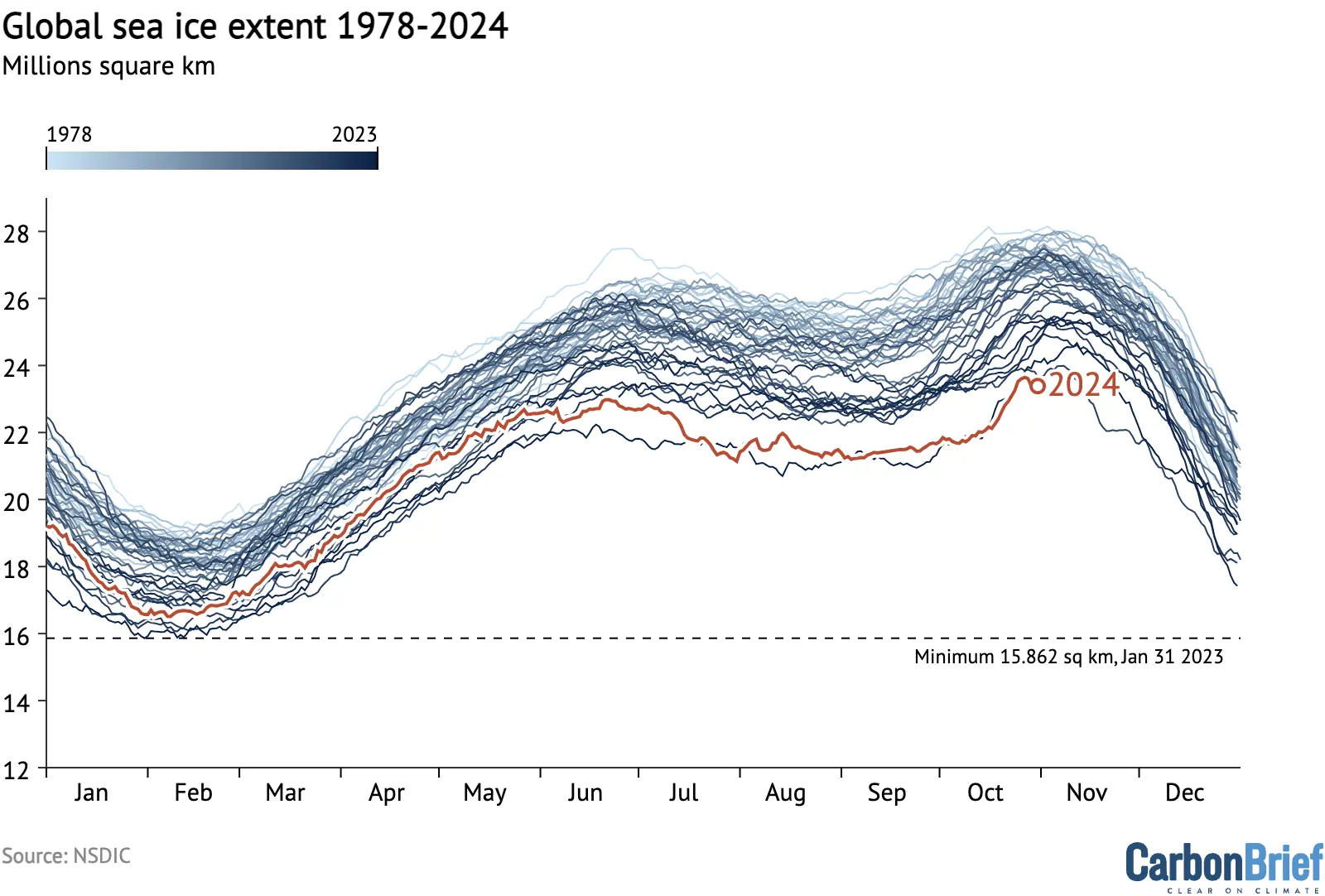
  • Global sea ice extent is currently at record lows and Antarctic sea ice has spent much of the year at near-record lows – second only to those seen in 2023.

The warmest year on record

In this latest quarterly state of the climate assessment, Carbon Brief has analysed records from five different research groups that report global surface temperature records: NASA’s GISTEMPNOAA’s GlobalTempHadley/UEA’s HadCRUT5Berkeley Earth; and Copernicus/ECMWF

The figure below shows Carbon Brief’s estimate of where 2024 temperatures will end up in each of the groups, based on the year to date and expected El Niño-Southern Oscillation (ENSO) conditions in the tropical Pacific for the remainder of the year. 

The dots reflect the best estimate, while the whiskers show the two sigma (95%) confidence interval of the projections. The prior record year (2023 in all groups) is shown by the coloured square. https://interactive.carbonbrief.org/state-of-the-climate/24-Q3/projections.htmlCarbon Brief’s project of 2024 annual global average surface temperatures for each group, along with 95% confidence intervals and prior record (2023) values. 1.5C above pre-industrial (1850-1900) levels is shown by a dashed line. The average projection represents a composite of all five records following the WMO approach. Chart by Carbon Brief.

In all cases, the projected global average temperature for 2024 is virtually certain to exceed the prior record set in 2023. 

Three of the five groups (Hadley, Berkeley and Copernicus/ECMWF) are very likely to show annual temperatures exceeding 1.5C above pre-industrial levels (defined here as the 1850-1900 period), while the NASA record has a roughly 40% chance of exceeding 1.5C. Only NOAA’s record is unlikely to show global temperatures above 1.5C this year.

These differences in warming since pre-industrial across different datasets primarily result from choice of ocean records used, as well as differences in approaches to filling in gaps between observations in the early part of the records (e.g. pre-1900s). It reflects the uncertainty in the degree of warming since the mid-1800s, with projected 2024 temperatures ranging from 1.44C (NOAA) to 1.61C (Berkeley Earth).

The figure also provides a composite average of the five different datasets, following the approach used in the sixth assessment report (AR6) from the Intergovernmental Panel on Climate Change (IPCC) and by the WMO. Carbon Brief’s analysis finds that 2024 will be the first year above 1.5C in the composite average. 

This provides a way to determine the first year where we can reasonably say that the world has passed that warming level – even though 2023 exceeded 1.5C in the Berkeley Earth dataset and 2024 will not exceed 1.5C in the NOAA dataset.

(It is important to note that exceeding 1.5C in a single year is not equivalent to breaching the Paris Agreement limit. The goal is generally considered to refer to long-term warming – typically over two or three decades – rather than annual temperatures that include the short-term influence of natural fluctuations in the climate, such as El Niño.)

The figure below shows the annual temperatures from each of these groups between 1970 and present, with the year-to-date 2024 temperatures for each record shown as individual points. https://interactive.carbonbrief.org/state-of-the-climate/24-Q3/records_2024_to_date.htmlAnnual global average surface temperatures from NASA GISTEMPNOAA GlobalTempHadley/UEA HadCRUT5Berkeley Earth and Copernicus/ECMWF (lines), along with 2024 temperatures to date (January-September, coloured shapes). Each series is aligned by using a 1981-2010 baseline, with warming since pre-industrial based on the IPCC AR6 estimate of warming between pre-industrial and the 1981-2010 period. Chart by Carbon Brief.

There is strong agreement between the different temperature records, with all of them showing approximately 1C warming between 1970 and present. Global temperatures have been around 1.3 above pre-industrial levels in recent years (with a range of 1.2C to 1.4C across the different temperature datasets, reflecting that the differences between them are larger in the 1800s and early 1900s).

As the chart below shows, 2024 (purple line) started out remarkably warm as a result of a strong El Niño event that built in 2023 (red) and peaked near the beginning of the year. 

However, global temperatures have remained quite elevated despite the fading of El Niño conditions, setting records through June and remaining quite close to 2023’s exceptional highs in recent months. 

Overall, 2024 has set or tied all-time records for seven of the 10 months available to-date in the ERA5 record. (This record uses weather model-based reanalysis to combine lots of different data sources over time.)https://interactive.carbonbrief.org/state-of-the-climate/24-Q3/monthly_global_temperature_anomalies_Q3_2024.htmlTemperatures for each month from 1940 to 2024 from Copernicus/ECMWF ERA5. Anomalies plotted with respect to a 1850-1900 baseline. Chart by Carbon Brief.

While human emissions of CO2 and other greenhouse gases are responsible for effectively all of the Earth’s long-term warming, temperatures in any given year are strongly influenced by short-term variations in the Earth’s climate that are typically associated with El Niño and La Niña events

These fluctuations in temperature between the ocean and atmosphere in the tropical Pacific help make some individual years warmer and some cooler. 

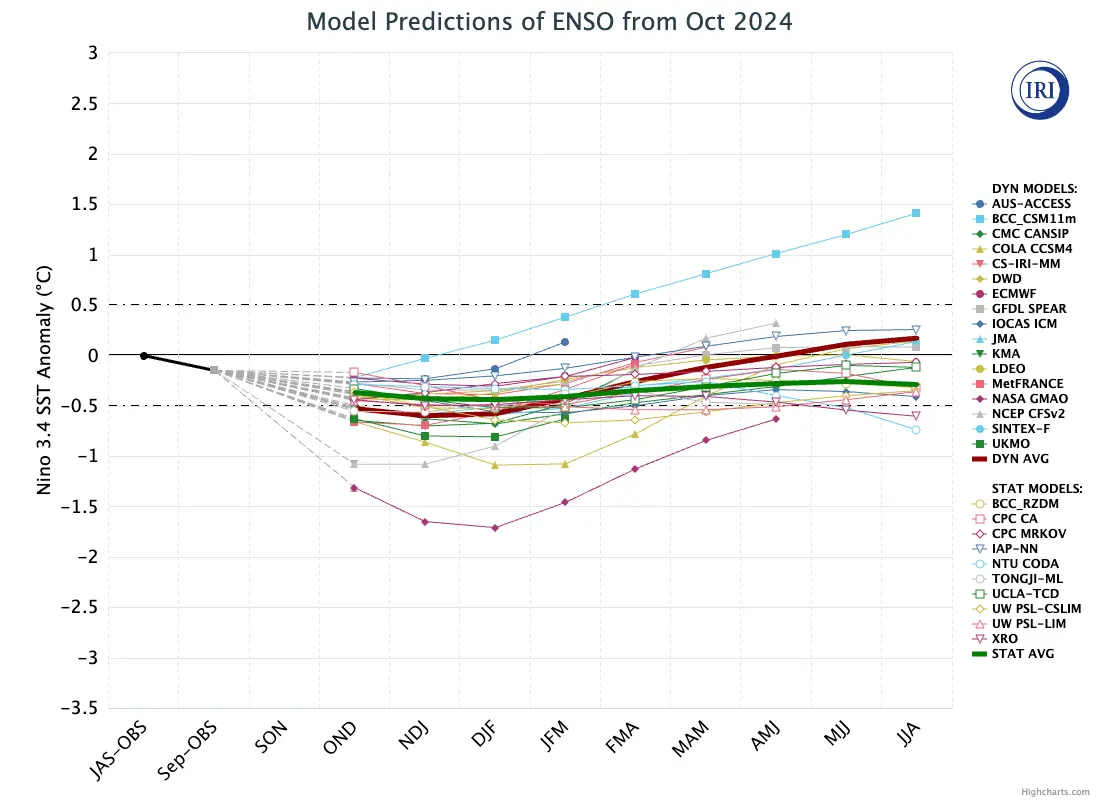
The figure below shows a range of different ENSO forecast models produced by different scientific groups. The values shown are sea surface temperature variations in the tropical Pacific – the El Niño 3.4 region – for three-month periods.

El Niño Southern Oscillation (ENSO) forecast models for overlapping three-month periods in the Niño3.4 region
El Niño Southern Oscillation (ENSO) forecast models for overlapping three-month periods in the Niño3.4 region (July, August, September – JAS – and so on) for the remainder of 2024 and then into the spring and summer of 2025. Credit: CPC/IRI ENSO forecast.

Most models expect neutral conditions in the tropical Pacific, with only a few crossing the -0.5C Niño 3.4 sea surface temperature (SST) anomaly that represents the development of a formal La Niña event. 

This should result in relatively cooler temperatures in 2025, though it is possible that the year ends up warmer than anticipated given the continuation of high temperatures in recent months – despite the absence of El Niño conditions.

Large areas of record warmth

While global average temperatures are an important indicator of changes to the broader climate system over time as a result of human activities, these impacts will differ as some regions experience more rapid warming or extreme heat events than is reflected in the global average.

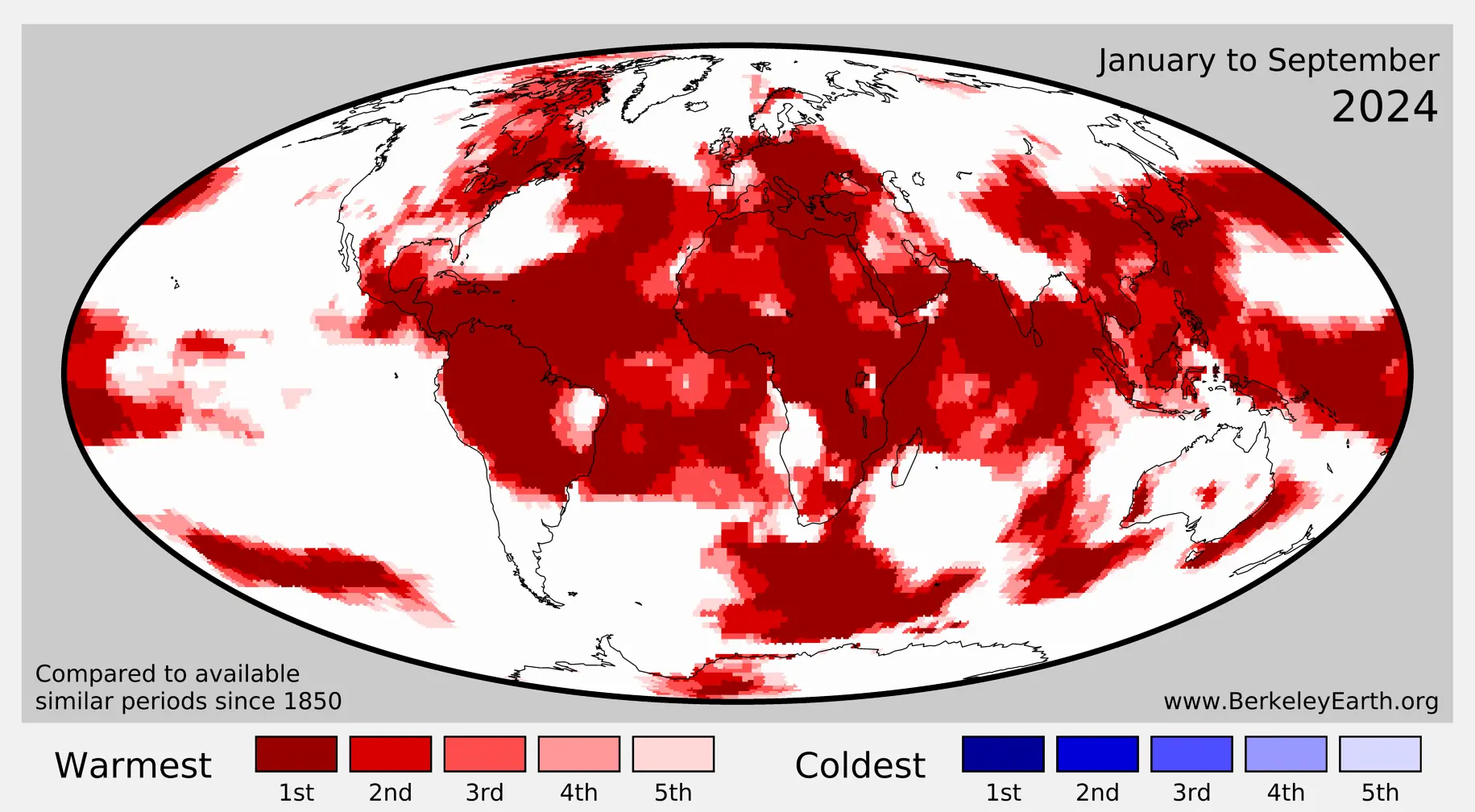
The figure below shows the parts of the world that saw record warm or cold temperatures over the first three quarters of 2024 (January through to September) in the Berkeley Earth dataset compared to all prior years since global temperature record began in 1850.

Map of year-to-date (January-September) regions that set new records (warmest through to fifth warmest). Note that no regions set cold records for the year-to-date in 2024.
Map of year-to-date (January-September) regions that set new records (warmest through to fifth warmest). Note that no regions set cold records for the year-to-date in 2024. Credit: Berkeley Earth

Notably, no area on Earth saw record cold (or even the second, third, fourth or fifth coldest temperatures on record). Nearly all of Central America and large parts of South America saw their warmest year to date on record, as did much of eastern Europe, Africa, China, south-east Asia, and Korea. 

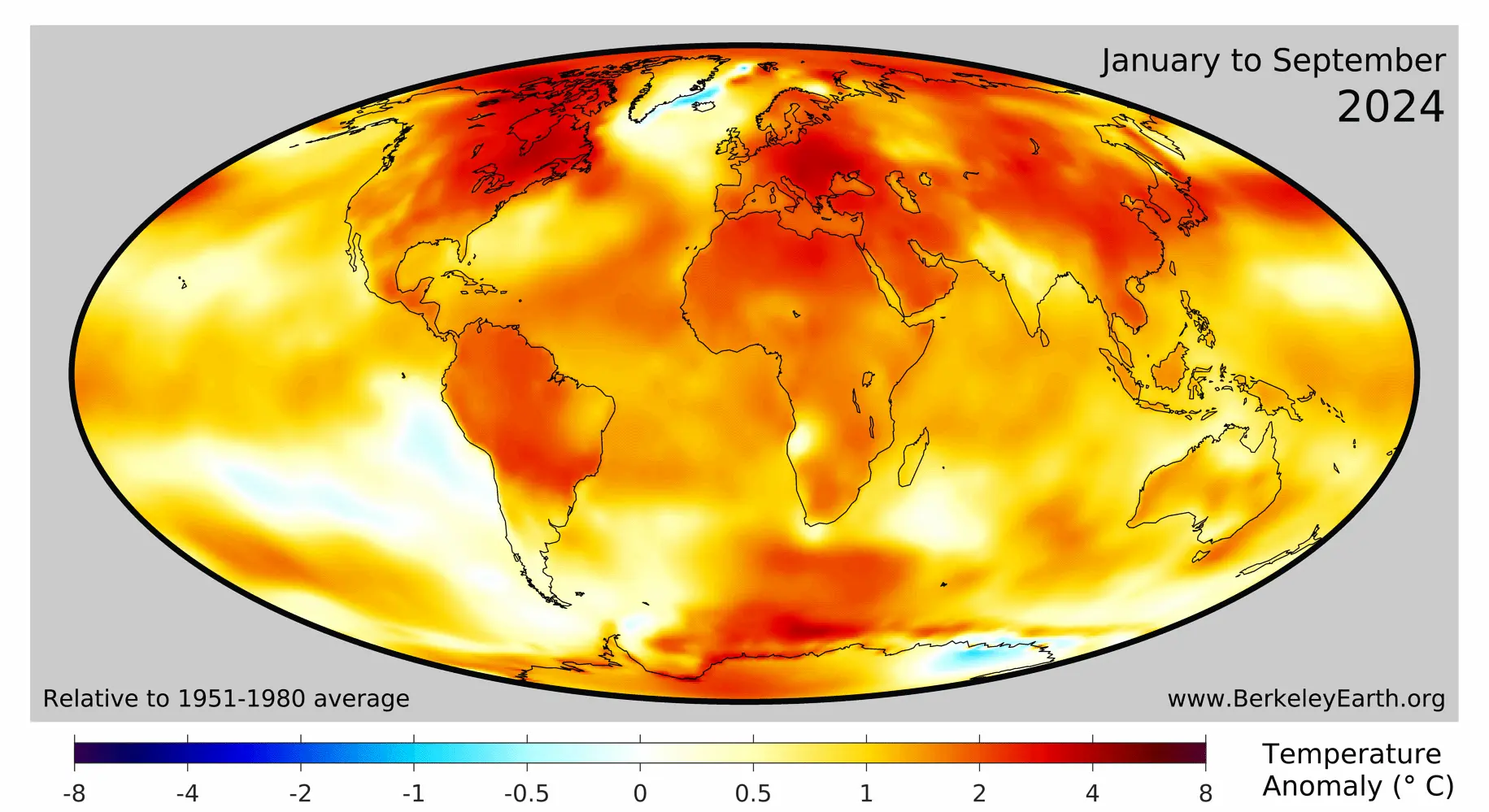
The figure below shows the temperature anomaly over the first nine months of the year compared to the 1951-80 baseline period used by Berkeley Earth. Warming was particularly pronounced over land regions, with many areas already showing warming of 1.5C or 2C above that baseline.

Map of year-to-date (January-September) global surface temperatures. Anomalies are shown relative to the 1951-80 period following the convention used by Berkeley Earth.
Map of year-to-date (January-September) global surface temperatures. Anomalies are shown relative to the 1951-80 period following the convention used by Berkeley Earth. Credit: Berkeley Earth

Temperatures are tracking climate model projections

Climate models provide physics-based estimates of future warming given different assumptions about future emissions, greenhouse gas concentrations and other climate-influencing factors

The figure below shows the range of individual models forecasts featured in AR6 – known collectively as the CMIP6 models – between 1970 and 2030, with grey shading and the average projection across all the models shown in black. Individual observational temperature records are represented by coloured lines.https://interactive.carbonbrief.org/state-of-the-climate/24-Q3/model_obs_comps_Q3_2024.htmlTwelve-month average global average surface temperatures from CMIP6 models and observations between 1970 and 2024. Models use SSP2-4.5 forcings after 2015.Anomalies plotted with respect to a 1981-2010 baseline. Chart by Carbon Brief.

While global temperatures were running below the pace of warming projected by climate models for much of the period between 2008 and 2022, the past two years have been closer to the model average

However, the CMIP6 models may be biassed a bit too warm, with a subset of “hot” models pushing up the average. The IPCC used an approach that weighted models based on how well they reproduced historical temperatures, rather than simply averaging all the models together.

Excluding these hotter models from the analysis results in observations over recent years much closer to the multi-model average and near the centre of the uncertainty range across all models. It also reveals that the past two years – 2023 and 2024 – have been near the upper end of the model range.https://interactive.carbonbrief.org/state-of-the-climate/24-Q3/model%20_obs_comps_filtered_Q3_2024.htmlTwelve-month average global average surface temperatures from CMIP5 models and observations between 1970 and 2024. Models use SSP2-4.5 forcings after 2015. Anomalies plotted with respect to a 1981-2010 baseline. Chart by Carbon Brief.

Record low global sea ice extent

Highly accurate observations of Arctic and Antarctic sea ice have been available since polar-observing satellites became available in the late 1970s. 

Arctic sea ice extent during the first three-quarters of 2024 has been below or at the low end of the historical 1979-2010 range, but has not seen any record daily lows. 

Antarctic sea ice, on the other hand, set new all-time low records for a few days in July and September, and has generally been the second lowest on record (after 2023) from June onwards.

The figure below shows both Arctic (red) and Antarctic (blue) sea ice extent in 2024, the historical range in the record between 1979 and 2010 (shaded areas) and the record lows (dotted black line).

Unlike global temperature records (which only report monthly averages), sea ice data is collected and updated on a daily basis, allowing sea ice extent to be viewed through to the present day.https://interactive.carbonbrief.org/state-of-the-climate/24-Q3/sea_ice.htmlArctic and Antarctic daily sea ice extent from the US National Snow and Ice Data Center. The bold lines show daily 2024 values, the shaded area indicates the two standard deviation range in historical values between 1979 and 2010. The dotted black lines show the record lows for each pole. Chart by Carbon Brief.

Global sea ice extent is estimated by combining both Arctic and Antarctic sea ice extent. The figure below shows global sea ice extent in each year, with 2024 shown in red. Currently global sea ice extent is at record-low levels, below the prior record for this date set in 2023.

Global sea ice extent

Methodological note

statistical multivariate regression model was used to estimate the range of likely 2024 annual temperatures for each group that provides a temperature record. This model used the average temperature over the first six months of the year, the average ENSO 3.4 region value during the first nine months of the year and the average predicted ENSO 3.4 value during the last three months of the year to estimate the annual temperatures. 

The model was trained on the relationship between these variables and annual temperatures over the period of 1950-2023. The model then uses this fit to predict both the most likely 2024 annual value for each group, as well as the 95% confidence interval. The predicted ENSO 3.4 region values for the last three months of 2024 are taken from the IRI plume forecast.

The percent likelihood of different year ranks for 2024 is estimated by using the output of the regression model, assuming a normal distribution of results. This allows Carbon Brief to estimate what percent of possible 2024 annual values fall above and below the temperatures of prior years for each group, as well as the likelihood of the year exceeding 1.5C in each record.

Original article by Zeke Hausfather republished from Carbon Brief under a CC license.

Continue ReadingState of the climate: 2024 will be first year above 1.5C of global warming

Youth Demand spray ‘GENOCIDE CONFERENCE’ at the Labour Party conference

Spread the love
Youth Demand group spray paints 'GENOCIDE COFENCE' at the UK Labour Party Conference, Liverpool, 24 September 2024.
Youth Demand group spray paints ‘GENOCIDE COFENCE’ at the UK Labour Party Conference, Liverpool, 24 September 2024.

Two Youth Demand supporters have taken action at the Labour Party conference by painting ‘GENOCIDE CONFERENCE’ on the front entrance. Youth Demand are calling for a two-way arms embargo on Israel and for the new UK government to halt all new oil and gas licences granted since 2021.

At around 10:50am two Youth Demand supporters walked up to the security check-in building, where all guests must pass through, of the Labour Party conference being held in Liverpool and spray pained ‘GENOCIDE’ and were part way through writing ‘CONFERENCE’ before they were tackled by plain clothes police officers and arrested.

A Youth Demand spokesperson said:

“Labour is still arming Israel despite a majority of the public backing a complete arms embargo. Despite admitting there is a ‘clear risk’ of ‘serious violation of international humanitarian law’, they have spinelessly suspended less than 10% of arms licenses.

They claim their national conference is ‘democracy in action’. This is a joke when in reality Labour sold our democracy to arms and fossil fuel companies. Just last week it was revealed Starmer accepted a £4,000,000 donation from a hedge fund with hundreds of millions of pounds worth of shares in fossil fuels and weapons.

One of those taking action today was Danny Lusardi, 23, a graduate from Lancaster. He said:

“The Labour government has admitted the arms it’s selling to Israel are being used for war crimes. But still they’re happy to keeping licensing 90% of those sales. We’re here to show them the British public can’t accept that.”

“It’s our duty as citizens to hold our government to account. When they won’t listen to the democratic will of the people, that means breaking windows and spraying paint.”

“As we approach a year of watching Israel’s genocide on the news and social media, it’s time to ask ourselves: are we serious about ending it now?”

Continue ReadingYouth Demand spray ‘GENOCIDE CONFERENCE’ at the Labour Party conference