Climate change made the ‘supercharged’ 2024 Pantanal wildfires 40% more intense

Spread the love

Original article by Orla Dwyer and Ayesha Tandon republished from Carbon Brief under a CC license

A firefighter working to put out a fire in the Pantanal in Mato Grosso do Sul, Brazil on 7 July 2024. Credit: Xinhua / Alamy Stock Photo

Human-caused climate change made the “unprecedented” wildfires that spread across Brazil’s Pantanal wetlands in June 2024 between four and five times more likely, according to a new rapid attribution study.

South America’s Pantanal – the world’s largest tropical wetland – experienced exceptionally hot, dry and windy conditions in June, causing blazes in the region to soar.  

The World Weather Attribution (WWA) service finds that the month was the hottest, driest and windiest year in the 45-year record.

The team conducted an attribution study to find the “fingerprint” of climate change on these weather conditions. 

They find that, in a world without climate change, these conditions would be very rare – occurring only once every 161 years. 

In today’s climate, which has already warmed by 1.2C above pre-industrial temperatures as a result of human-caused warming, these conditions are a one-in-35 year event. 

The authors also explore how wildfires in the region could continue to worsen as the planet warms. 

They find that if that planet reaches warming levels of 2C, the likelihood of these conditions could double, to once every 18 years.

Soaring fires

The vast Pantanal wetland extends across Brazil, Bolivia and Paraguay. 

It is one of the most biodiverse places on earth, home to more than 4,700 plant and animal species. 

Every year, hot and dry weather conditions make the wetland prone to wildfires – usually between July and September.

By June this year, intense wildfires were already soaring. The number of Pantanal fires increased by 1,500% in the first half of this year compared to the same period in 2023, according to data from Brazil’s National Institute for Space Research reported by the Brasil de Fato newspaper. 

This amounts to more than 1.3m hectares of the wetland burned so far this year – an area around eight times the size of London. 

A firefighter working to put out a fire in the Pantanal in Mato Grosso do Sul, Brazil on 7 July 2024. Credit: Xinhua / Alamy Stock Photo

Around 2,500 fires were identified in June, which is the highest number since 1998 and more than six times the level reported in 2020, which was “known as the ‘year of flames,’ when wildfires ravaged the area and sparked widespread outcry”, the Associated Press said. 

The region is currently experiencing its worst drought in 70 years, which Brazil’s government has said is being “intensified by climate change and one of the strongest El Niño phenomena in history”. 

Prolonged dry periods, high temperatures and land-use change all contribute to wildfire conditions, says Dr Maria Lucia Barbosa, a postdoctoral researcher at the Federal University of São Carlos in Brazil, who was not involved in the attribution study. She tells Carbon Brief: 

“While fires are a natural part of the Pantanal ecosystem, the recurrence of extreme fire seasons – such as the current one, shortly after the devastating 2020 fires – suggests that, alongside climate change, a new fire regime may be emerging in the ecosystem, characterised by increased severity and frequency.”

Hot, dry and windy

Wildfire intensity and duration are influenced by a wide range of factors, including weather, vegetation and fire management strategies.

The authors of the new study focus on a metric called the “daily severity rating” (DSR), which combines information on maximum temperature, humidity, wind speed and precipitation. Dr Clair Barnes – a research associate at Imperial College London’s Grantham Institute and author on the study – told a press briefing that this metric “indicates how difficult it is likely to be to control the fire once it starts”.

High temperatures and wind speeds, as well as low humidity and rainfall, are very conducive to wildfires spreading and, therefore, produce a high DSR. 

The map below shows the average DSR in the Pantanal in June 2024. It reveals that most of the Pantanal was experiencing wildfire risk above the 1990-2020 average over that month. 

DSR in the Pantanal in June 2024. Light red indicates a low DSR and low fire risk conditions. Dark red indicates high DSR and high fire risk conditions. Source: WWA (2024)

The weather conditions in the Pantanal in June 2024 were “really unusual for the time of year”, Barnes said. 

To investigate how atypical the weather conditions in June 2024 were, the authors analysed temperature, windiness, rainfall and humidity data from the past 45 years.

The chart below depicts annual average rainfall and annual average daily maximum temperature in the Pantanal over 1979-2024. It shows that over the past 45 years, the average temperature in the Pantanal has been steadily increasing and total rainfall has been decreasing. 

Annual average rainfall and annual average daily maximum temperature in the Pantanal region over 1979-2024. Each dot indicates one year. Green indicates years between 1979-99, yellow indicates 2000-18, orange shows 2019-23 and dark red shows 2024. Source: WWA (2024)

The authors find that June 2024 was the hottest, least rainy and windiest June since records began. They also find that the relative humidity was the second lowest on record.

Annual rainfall across the Pantanal has been decreasing over the past 40 years, the authors note. They point out that natural variability and deforestation are known to impact rainfall patterns across South America, but add that climate change “may also be influencing the drying trend”.

Attribution

Attribution is a fast-growing field of climate science that aims to identify the “fingerprint” of climate change on extreme-weather events, such as heatwaves and droughts. 

To conduct attribution studies, scientists use models to compare the world as it is today to a “counterfactual” world without human-caused climate change. In this study, the authors investigated the impact of climate change on DSR in the Pantanal region.

They find that in today’s climate – which has already warmed by 1.2C as a result of human activity – fire weather conditions like the ones that drove the wildfires in the Brazilian Pantanal during June 2024 are a “relatively rare event”, and would be expected to occur roughly once every 35 years.

However, they say, if the planet continues to warm, these events could become more likely. If the climate warms to 2C above pre-industrial levels, the likelihood of these fire conditions will double compared to today.

The graphic below shows how often June fire weather conditions, such as those seen in the Brazilian Pantanal in June 2024, could be expected under different warming levels.

The square on the left shows a world without climate change, in which these DSR levels would happen once every 161 years. The middle square shows that in today’s climate, the DSR is a one-in-35 year event. And the square on the right shows that in a 2C world, a June DSR like that of 2024 could be expected once every 18 years.

How often June fire weather conditions – such as those seen in the Brazilian Pantanal in June 2024 – could be expected under different climates: (from left to right) pre-human-caused climate change, today and under 2C warming. Each dot indicates one year, and pink dots indicate years in which June DSR matches or exceeds the levels seen in 2024 in the Brazilian Pantanal. Source: WWA (2024)

The authors also investigate how climate change affected DSR “intensity”. They find that human-induced warming from burning fossil fuels increased the June 2024 DSR by about 40%.

The authors add that as the climate continues to warm, this trend is likely to worsen. The authors warn that if warming reaches 2C above pre-industrial temperatures, similar June fire weather conditions will become 17% “more impactful”.

(These findings are yet to be published in a peer-reviewed journal. However, the methods used in the analysis have been published in previous attribution studies.)

Fire impacts

Wildfires have wide-ranging impacts on people and nature in the Pantanal. In one example, a 2021 study found that around 17m vertebrates were “killed immediately” by the fires in 2020. 

Wildfires can “devastate [the] livelihoods” of people living in the Pantanal and “pose significant health risks” from the resulting smoke, Barbosa says. 

She notes that wildfires release CO2 into the atmosphere, contributing to climate change, and they “lead to widespread loss of habitat, endanger wildlife and disrupt ecological balances”. She tells Carbon Brief: 

“Species that are already threatened or have limited ranges are particularly vulnerable to habitat destruction caused by fires.

“Repeated fires can push fire-sensitive vegetation into a state of permanent degradation, further threatening the ecological integrity of the region.” 

Some fires are permitted for agricultural purposes – such as to burn degraded pasture – during the rainy season, from around November to April. This practice is banned in the drier summer months, but a 2020 piece from Mongabay notes that “in reality, the ban is not always respected and enforcement is haphazard”. 

A jaguar in an area scorched by wildfires at the Encontro das Aguas park in the Pantanal wetlands in Mato Grosso, Brazil on 17 November 2023. Credit: Associated Press / Alamy Stock Photo

Filippe Santos, a researcher at Portugal’s University of Évora and one of the authors of the study, told a press briefing that “fire is part of the dynamics” of the Pantanal – when it is controlled. 

Low-intensity fires allow animals “time to leave” the area, he said, adding:

“What we see with wildfires, is that this does not happen, because the fire is so intense and on such a large scale that animals don’t have time to run away.” 

The “highly intense” wildfires also “don’t give nature enough time to recover”, Santos says. 

In June, Brazil’s environment minister, Marina Silva, told the government news agency Agencia Brasil that the country is “facing one of the worst situations ever seen in the Pantanal”, adding that the fires are heightened by climate extremes and criminal activities. 

Most Pantanal fires are caused by human activity, a 2022 study found. Police in Brazil are investigating the “possible culprits” behind 18 fire outbreaks in the region, Silva said last month. 

A plane dropping water as part of firefighting efforts in an area of the Pantanal affected by forest fire in Mato Grosso do Sul, Brazil on 5 July 2024. Credit: Xinhua / Alamy Stock Photo

In recent weeks, a law to improve coordination on tackling fires took effect in Brazil. 

A statement from the Institute for Society, Population and Nature, a Brazilian NGO, says this new policy is a “significant milestone” and will establish “guidelines for the practice of integrated fire management across all biomes and territories in the country”. 

Barbosa says it will be a “challenge” to implement this policy. She would like to see a “comprehensive national early warning system for multiple hazards to ensure risk reduction” for a range of threats – including wildfires. She tells Carbon Brief: 

“Collaboration with local communities, firefighters and brigades is crucial for prevention and response efforts…A coordinated approach that integrates all stakeholders, along with the establishment of a national fund dedicated to fire management, is essential for mitigating the impacts of future fire seasons.”

Original article by Orla Dwyer and Ayesha Tandon republished from Carbon Brief under a CC license

Continue ReadingClimate change made the ‘supercharged’ 2024 Pantanal wildfires 40% more intense

13 Months of Record-Smashing Heat Called ‘Another Red Alert’ for Humanity

Spread the love

Original article by BRETT WILKINS republished from Common Dreams under Creative Commons (CC BY-NC-ND 3.0).

Rescuers carry away a man, affected by the scorching heat, on a stretcher as Muslim pilgrims arrive to perform the symbolic “stoning of the devil” ritual as part of the Hajj pilgrimage in Mina, Saudi Arabia on June 16, 2024. (Photo: Fadel Senna/AFP via Getty Images)

“This alarming record underlines the need to urgently phase out fossil fuels, and to hugely increase climate finance,” said one campaigner.

Scientists on Monday underscored the urgent need to accelerate the transition from fossil fuels to renewable energy following the publication of data from the European Union’s climate change monitor showing that last month was the hottest June ever recorded and that 2024 is likely to be the planet’s hottest year on record.

Each month since June 2023 has been the hottest since records have been kept, the European Union’s Copernicus Climate Change Service (C3S) said last week in its latest monthly bulletin.

According to the agency, June “was 1.50°C above the estimated June average for 1850-1900, the designated preindustrial reference period, making it the 12th consecutive month to reach or break the 1.5°C threshold.”

“European temperatures were most above average over southeast regions and Turkey, but near or below average over western Europe, Iceland, and northwestern Russia,” C3S noted. “Outside Europe, temperatures were most above average over eastern Canada, the western United States and Mexico, Brazil, northern Siberia, the Middle East, northern Africa, and western Antarctica.”

“Temperatures were below average over the eastern equatorial Pacific, indicating a developing La Niña, but air temperatures over the ocean remained at an unusually high level over many regions,” the agency added.

C3S Director Carlo Buontempo said in a statement Monday that “even if this specific streak of extremes ends at some point, we are bound to see new records being broken as the climate continues to warm.”

“This is inevitable unless we stop adding greenhouse gases into the atmosphere and the oceans,” he stressed.

In an interview with The Associated Press published Monday, C3S climate scientist Nicolas Julien called the new data “a stark warning that we are getting closer to this very important limit set by the Paris agreement.”

“The global temperature continues to increase,” he added. “It has at a rapid pace.”

Zeke Hausfather, a researcher at the California-based nonprofit Berkeley Earth, told Reuters, “I now estimate that there is an approximately 95% chance that 2024 beats 2023 to be the warmest year since global surface temperature records began in the mid-1800s.”

As Reuters reported Monday:

The changed climate has already unleashed disastrous consequences around the world in 2024. More than 1,000 people died in fierce heat during the Hajj pilgrimage last month. Heat deaths were recorded in New Dehli, which endured an unprecedentedly long heatwave, and amongst tourists in Greece.

“This is not good news at all,” Aditi Mukherji, who co-authored the most recent Intergovernmental Panel on Climate Change (IPCC) report, told The Guardian.

“We know that extreme events increase with every increment of global warming,” she added, “and at 1.5°C, we witnessed some of the hottest extremes this year.”

The Guardian surveyed hundreds of IPCC authors earlier this year. Three-quarters of them said they expect Earth to heat by at least 2.5°C by the end of this century. Half of the surveyed scientists expect temperatures to rise above 3°C by 2100.

“It is a crisis,” said Mukherji, and one that has a clear solution, given that burning fossil fuels is the leading cause of global heating.

Antonia Juhasz, a senior researcher on fossil fuels at Human Rights Watch, told Nation of Change that “as a result of the burning of fossil fuels, heatwaves are becoming more common, and intense heatwaves are more frequent.”

“We can break the cycle, we can make oil companies stop burning fossil fuels,” she added.

Reacting to the latest C3S data, Amnesty International climate adviser Ann Harrison said on social media that “this alarming record underlines the need to urgently phase out fossil fuels, and to hugely increase climate finance.”

Original article by BRETT WILKINS republished from Common Dreams under Creative Commons (CC BY-NC-ND 3.0).

Continue Reading13 Months of Record-Smashing Heat Called ‘Another Red Alert’ for Humanity

‘Omen of the Future’: Off-The-Charts Hot Oceans Scare Scientists

Spread the love

Original article by JESSICA CORBETT republished from Common Dreams under Creative Commons (CC BY-NC-ND 3.0). 

A diver looks at one of the coral nurseries on the reefs of the Society Islands in French Polynesia, where major bleaching is occurring, on May 9, 2019. (Photo: Alexis Rosenfeld/Getty Images).

After 2023 was the hottest year in human history, experts warn that 2024 “has strong potential to be another record-breaking year.”

While global policymakers continue to drag their feet on phasing out planet-heating fossil fuels, scientists around the world “are freaking out” about high ocean temperatures, as they told The New York Times in reporting published Tuesday.

A “super El Niño” has expectedly heated up the Pacific, but Times reporter David Gelles spoke with ocean experts from Miami to Cambridge to Sydney about record heat in the North Atlantic as well as conditions around the poles.

“The sea ice around the Antarctic is just not growing,” said Matthew England, a University of New South Wales professor who studies ocean currents. “The temperature’s just going off the charts. It’s like an omen of the future.”

Rob Larter, a marine geophysicist with the British Antarctic Survey who watches polar ice levels, told the paper that “we’re used to having a fairly good handle on things. But the impression at the moment is that things have gone further and faster than we expected. That’s an uncomfortable place as a scientist to be.”

Last week, Jeff Berardelli, WFLA‘s chief meteorologist and climate specialist, also highlighted the warm North Atlantic and that “all signs are pointing to a busy hurricane season” later this year.

Noting that in the middle of this month, sea surface temperatures in the North Atlantic were around 2°F higher than the 1990-2020 normal and nearly 3°F above the 1980s, Berardelli explained:

That may not sound like a lot, but consider this is averaged over the majority of the basin shown in the red outline in the image above. A deviation like that is unheard of… until now.

To put it into more relatable terms, considering what’s been normal for the most recent 30 years, the statistical chance that any February day would be as warm as it is right now is 1-in-280,000. That’s not a typo. This is according to University of Miami researcher Brian McNoldy…

And that 1-in-280,000 is compared against a recent climate, which had already been warmed substantially by climate change. If you tried to compare it against a climate considered normal around the year 1900, the math would become nonsensical. Meaning an occurrence like this simply would not be possible.

McNoldy also stressed the shocking nature of current conditions to the Times, telling Gelles that “the North Atlantic has been record-breakingly warm for almost a year now… It’s just astonishing. Like, it doesn’t seem real.”

The new comments from McNoldy and other scientists come on the heels of various institutions and experts worldwide recently confirming that 2023 was the hottest year in human history. Research also showed that it was the warmest year on record for the oceans, which capture about 91% of excess heat from greenhouse gases.

As Common Dreams reported last month, Adam Scaife, a principal fellow at the United Kingdom’s Met Office, said that “it is striking that the temperature record for 2023 has broken the previous record set in 2016 by so much because the main effect of the current El Niño will come in 2024.”

That’s the warm phase of the El Niño Southern Oscillation, a climate phenomenon that also has a cool phase called La Niña expected later this year. Still, Scaife warned that “the Met Office’s 2024 temperature forecast shows this year has strong potential to be another record-breaking year.”

Throughout the record-shattering 2023, experts also expressed alarm. After an April study showed that the ocean is heating up faster than previously thought, the BBC revealed that some scientists declined to speak about it on the record, reporting that “one spoke of being ‘extremely worried and completely stressed.'”

In July, when a buoy roughly 40 miles south of Miami recorded a sea surface temperature of 101.1°F just after a “100% coral mortality” event at a restoration site, Florida State University associate professor Mariana Fuentes told NPR that “if you have several species that are being impacted at the same time by an increase in temperature, there’s going to be a general collapse of the whole ecosystem.”

The following month, the European Union’s Copernicus Climate Change Service announced that the average daily global ocean surface temperature hit 69.7°F, and deputy director Samantha Burgess said, “The fact that we’ve seen the record now makes me nervous about how much warmer the ocean may get between now and next March.”

“The more we burn fossil fuels, the more excess heat will be taken out by the oceans, which means the longer it will take to stabilize them and get them back to where they were,” Burgess emphasized at the time.

Last year ended with a United Nations climate summit that scientists called “a tragedy for the planet,” because the final deal out of the conference—led by an Emirati oil CEO—did not demand a global phaseout of fossil fuels.

Azerbaijan, which is set to host this year’s U.N. conference in November, has similarly selected a former fossil fuel executive to lead the event. The country also plans to increase its gas production by a third during the next decade.

Original article by JESSICA CORBETT republished from Common Dreams under Creative Commons (CC BY-NC-ND 3.0). 

Continue Reading‘Omen of the Future’: Off-The-Charts Hot Oceans Scare Scientists

Extreme UK flood levels are happening much more often than they used to, analysis shows

Spread the love

Original article by Louise Slater and Jamie Hannaford republished from the Conversation under Creative Commons Attribution-No Derivatives licence.

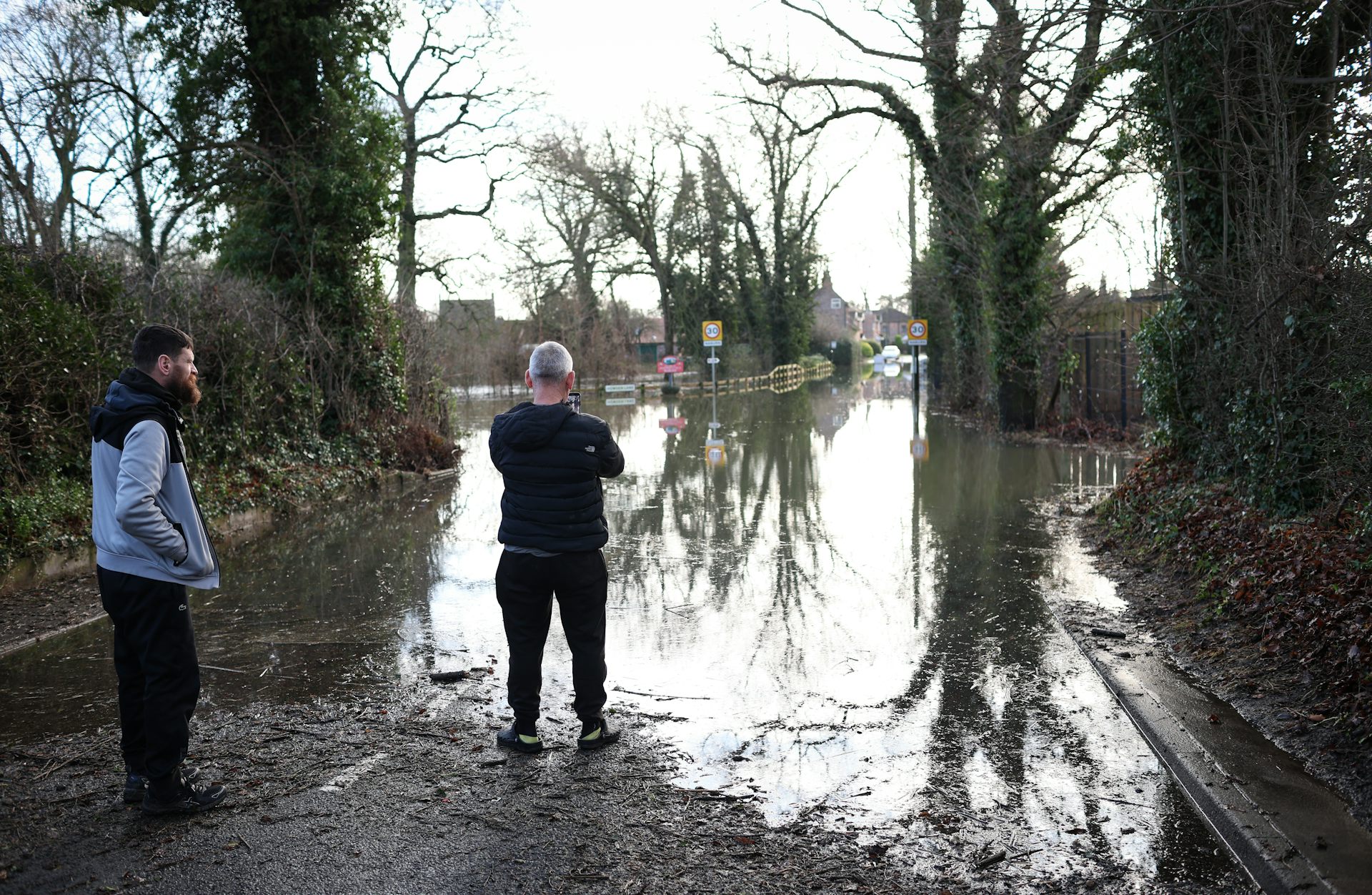
Flooding on the River Ouse, near York. January 4 2024. EPA-EFE/Adam Vaughan

Heavy rain across southern Britain meant that most rivers in England swelled at the beginning of 2024, prompting widespread flooding.

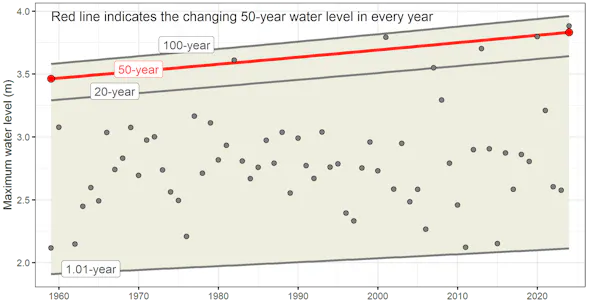
The River Trent was among the most severely affected. Water levels at the Drakelow gauging station in the west Midlands reached 3.88 metres on January 4 – well above the previous record set less than four years earlier in February 2020.

Are floods growing larger and happening more often in the UK? There are two ways to answer this question. One is to consult computer models which project Earth’s climate in the future, and the other is to search the historical record.

Climate projections are important but highly uncertain as they indicate a wide range of potential futures for any given river. Projections also only tell part of the story as they do not reflect the patterns of water use, changes to groundwater levels or to the urban environment that can decide flooding on a particular river.

That’s why we give equal importance to historical data, although we cannot project past changes directly into the future. Historical archives of river monitoring data can help us understand how the largest floods are changing on the River Trent.

For instance, how is the 50-year water level (the highest point a river would be expected to reach in 50 years on average) changing? On the River Trent at Drakelow, the 50-year water level has risen from about 3.46 metres in 1959 to 3.83 metres in 2024. This means the largest floods are indeed getting bigger.

How the January 2024 floods compare

The flood water level on the Trent at the start of January 2024 was actually higher than what scientists would consider a once-in-50-year event in today’s warmer climate.

The 50-year water level on the River Trent has risen in 65 years. Grey circles indicate the highest water level in each year. L. Slater

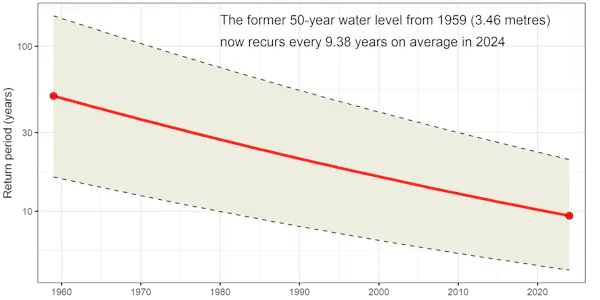
Another way to understand how much floods have changed is to consider how often they happen today compared with the past. If we look at the 50-year level from 1959 (about 3.46 metres), how often would such a flood occur in today’s climate?

On the Trent, a 3.46-metre flood level would now be expected to occur every 9.38 years, on average, in 2024. This makes sense, considering there have already been six events in which the river level exceeded 3.5 metres since the 1980s. The historical data shows that extreme water levels are being reached more frequently on the Trent.

The 50-year flood level from 1959 (3.5 metres) now recurs every nine years in 2024. L. Slater

Our analysis of the Trent aligns with results from a previous study which looked at rivers across the rest of the UK. In many places, 50-year floods are now happening less than every ten years, on average.

This is partly due to climate change and also partly due to natural variations in the climate which see rivers cycle through spells of more and less flooding. The UK went through a “flood-poor” period in the 1960s, 70s and 80s, and has been going through a “flood-rich” period since then.

Prepare for worse

It is worth noting that there are caveats to this type of analysis which tries to assess how extreme events are changing over time. Caution must be exercised when looking at long records of river levels given changes in river management practices and measurement techniques over time.

It should also be noted that these results use a different methodology to the industry standard for flood estimation.

But what matters is not the precise changes in the frequency of major floods (from 50 years down to nine or even two-and-a-half years, according to some statistical methods). It is understanding that the frequency of large floods is changing fast.

For many UK rivers with more extensive historical archives of river level measurements, floods appear to be occurring far more frequently than before. In a smaller number of places, they are occurring less frequently.

We need to better understand how flood risk will evolve in response to further human-induced warming. The UK’s efforts to predict and prepare for future floods are supported by the Environment Agency’s flood hydrology roadmap, which is mobilising a wide community of researchers and practitioners.

Overall, the UK must prepare to live with bigger floods and be able to predict flood-rich periods several years ahead. This starts with an understanding of how the severity and frequency of such events is changing.

To support this effort, we are preparing a range of tools to guide flood planners, including an interactive map allowing users to explore how flood return periods are changing across the UK. Being better prepared for extreme events in a warming climate starts with understanding what it will mean for your local area.

Original article by Louise Slater and Jamie Hannaford republished from the Conversation under Creative Commons Attribution-No Derivatives licence.

Continue ReadingExtreme UK flood levels are happening much more often than they used to, analysis shows

2023 Destroys Global Heat Record as Fossil Fuel Emissions Boil the Planet

Spread the love

Original article by JAKE JOHNSON republished from Common Dreams under Creative Commons (CC BY-NC-ND 3.0).

Indonesian firefighters work to extinguish a wildfire in Ogan Ilir, Indonesia on September 14, 2023.  (Photo: Muhammad A.F/Anadolu Agency via Getty Images)

“How many more records does it take before we phase out fossil fuels and deal with it?” asked one climate campaigner.

European scientists officially confirmed Tuesday that 2023 was the hottest year on record, surpassing 2016 by a huge margin as greenhouse gas emissions from fossil fuels continue to drive global temperatures to terrifying new highs.

The conclusion from the European Union’s Copernicus Climate Change Service was hardly unexpected given the unparalleled heatwaves that gripped large swaths of the planet last year, ushering in what the head of the United Nations called “the era of global boiling.”

Last year’s global average temperature was 14.98°C, 0.17°C warmer than 2016, 0.60°C warmer than the 1991-2020 average, and 1.48°C warmer than the 1850-1900 pre-industrial level, according to Copernicus.

“2023 was an exceptional year with climate records tumbling like dominoes,” said Copernicus deputy director Samantha Burgess. “Not only is 2023 the warmest year on record, it is also the first year with all days over 1°C warmer than the pre-industrial period. Temperatures during 2023 likely exceed those of any period in at least the last 100,000 years.”

Liz Bentley, chief executive of the U.K.’s Royal Meteorological Society told CNN on Tuesday that after last year’s record-shattering summer, scientists predicted that global warming would reach around 1.3°C above pre-industrial levels.

That projection, Bentley said, has been “annihilated” by the new Copernicus data, which shows that planetary warming is perilously close to the Paris accord’s 1.5°C target.

“If you look at climate projections, when we expect to see temperature changes of close to 1.5°C, indeed it has come sooner than many would have expected,” Bentley added. “We’ve definitely seen an acceleration towards that, rather than it being a kind of linear progression. It feels like it’s rising much more exponentially.”

Scientists expect 2024 to be even hotter than last year, raising the stakes for badly lagging global efforts to rein in planet-warming fossil fuel production, which in 2023 hit record levels in the United States—the largest historical contributor to greenhouse gas emissions.

“How many more records does it take before we phase out fossil fuels and deal with it?” asked climate campaigner Mike Hudema.

Copernicus director Carlo Buontempo said in a statement Tuesday that “the extremes we have observed over the last few months provide a dramatic testimony of how far we now are from the climate in which our civilization developed.”

“This has profound consequences for the Paris Agreement and all human endeavors,” said Buontempo. “If we want to successfully manage our climate risk portfolio, we need to urgently decarbonize our economy whilst using climate data and knowledge to prepare for the future.”

Original article by JAKE JOHNSON republished from Common Dreams under Creative Commons (CC BY-NC-ND 3.0).

Continue Reading2023 Destroys Global Heat Record as Fossil Fuel Emissions Boil the Planet