‘Green’ UK pensions are bankrolling US fossil fuels

Spread the love

Article by Josephine Moulds and Simon Lock republished from The Bureau of Investigative Journalism under a Creative Commons Attribution-NonCommercial-NoDerivs 3.0 Unported License.

Public sector pensions have ploughed billions into opaque investment funds which are financing ruinous gas projects on the US Gulf Coast

In brief

  • UK public sector pension schemes are bankrolling rapid expansion of liquefied natural gas production in the US South, posing a major climate threat
  • US gas projects are reaping rewards from price shocks caused by Trump’s war in Iran
  • Gas terminals are frequently built in poor neighbourhoods, causing health problems in nearby communities

Trump’s war in Iran has boosted the fortunes of US gas companies – and UK savers are unwittingly bankrolling their expansion.

Sixty local government pension funds have invested a total of £8bn into funds paying for the rapid construction of gas infrastructure on the Gulf Coast of the US. Residents say these terminals are already causing health problems in their communities. Experts say they represent one of the biggest threats to the future of the planet.

Over 7 million school staff, civil servants and other public sector workers either save with, or receive their pension from, local government pension schemes. Our revelations have sparked concerns among local councillors, who have urged fund managers to divest from fossil fuels.

While the companies behind these projects are enjoying a boost from the war in Iran, they could tumble in value as the world switches to renewable forms of energy. Councillor Andrew Scopes, who sits on an advisory panel for West Yorkshire Pension Fund, said: “We will still be paying benefits out in 60 years’ time. We need to be looking beyond the possible short-term gains, at the long-term risk.”

Recommended Articles

Members of the scheme were dismayed to find what they were bankrolling. “The UK could be funding a safer, healthier future for all via renewable energy generated in the UK that is cheap, safe, clean and owned by us,” said Jane Thewlis, a retired social worker.

The news comes as the government is making changes to the law governing pension schemes. During a debate in the House of Lords, peers from several parties raised the issue of pension fund investments in climate-wrecking companies.

Baroness Hayman, a crossbench peer, told us: “Many UK pension funds are already reducing their exposure to fossil fuels, recognising the risks these investments pose. But with £3 trillion held in UK pensions, and the climate and nature challenge growing, there is a clear opportunity to better protect savers from rising financial and environmental risks.”

A gas explosion

The giant white orbs containing liquefied natural gas (LNG) look almost alien. Scores of these terminals are popping up along the 1,200km Louisiana and Texas coastline, a building frenzy turbo-charged by Trump’s second term. If all the planned terminals are built, the LNG produced in the US would generate the same amount of greenhouse gases each year as every EU country combined, says Jeremy Symons, a former official at the US environmental regulator.

UK pension funds have supported this expansion for years. In 2019, a little-known infrastructure fund called Stonepeak put up $1.3bn to complete the construction of the Calcasieu Pass gas terminal in the south-west corner of Louisiana. Twenty miles inland, building has started on another terminal also funded by Stonepeak.

Calcasieu Pass LNG terminalVenture Global

UK savers in 12 local government pension schemes, including West Yorkshire, South Yorkshire and Worcestershire, have invested over £360m in Stonepeak funds that financed these plants, according to figures from council records and data provider Pitchbook.

Since starting operations, Calcasieu Pass has reported hundreds of emissions violations and paid authorities a $245,000 settlement. That’s unlikely to make much difference to its owner, Venture Global, a major Trump donor. Its shares rocketed by more than 80% after the US and Israel started bombing targets in Iran.

Roishetta Ozane, a resident turned activist, lives near both terminals. She told us that pollution from the nearby gas, petrochemicals and oil infrastructure has caused asthma and an increase of cancer in the area – an account borne out by academic research.

“We’re seeing more women develop health issues that are living near these facilities, having pre-term babies or having miscarriages,” she said. “We’re seeing our air quality deteriorate. We have a drinking water crisis.” She said residents had to deal with noise pollution from construction and the flaring of excess gas from the terminals.

Roishetta Ozane (second left)

Two of her children have asthma. She told us the doctor said pollution may have exacerbated the seizures suffered by her son, who died last year. “When my son passed away, I was like, what are we doing this for?” she said. “We’re fighting for our children, for our future, for our community, but yet they’re dying.”

Further down the coast, a huge fireball at Freeport LNG in June 2022 made the risks of these installations vividly clear. IFM Global Infrastructure Fund – which counts among its investors more than 20 UK pension funds, including Avon, East Sussex and Aberdeen – paid $1.3bn to help build Freeport LNG in 2013. It continues to hold a stake in the project.

Travelling south, the construction boom continues. Right next to the Mexican border, Rio Grande LNG is building a sprawling complex that the NGO Sierra Club estimates will match the emissions of 50 coal-fired power plants every year. Campaigners say the project is already contributing to habitat loss in an area critical for endangered animals such as ocelots, falcons and sea turtles.

French bank Société Générale backed out of funding the controversial project. But it was able to proceed thanks to a $5bn commitment from BlackRock’s Global Infrastructure Partners Fund V – which is supported by nearly £200m of UK savers’ pensions, from Waltham Forest to Greater Manchester.

In total, we found eight US-based LNG terminals backed by UK pension money. Taken together, those terminals would give rise to more CO₂ every year than the entire UK several times over, according to Sierra Club data.

https://flo.uri.sh/visualisation/28573619/embed?auto=1 [“Sorry, this content could not be embedded.”]

A spokesperson for IFM Investors told us that the fund publicly discloses its infrastructure equity assets. They added: “Natural gas is increasingly utilised as a transition fuel for decarbonisation globally … These assets benefit from investment from long-term, trusted capital partners like pension funds, who can reinvest in them and pave the way for carbon emissions reduction.”

LNG is often promoted as a cleaner alternative to traditional fossil fuels. However, a peer-reviewed study found it is 33% worse in terms of planet-heating emissions over a 20-year period compared with coal.

Worcestershire Pension Fund said it invests through structures that mean “exposure to any single asset is indirect, limited, and a very small component of a broader portfolio.” It said the Stonepeak fund in question “publishes detailed annual reports and complies fully with statutory disclosure requirements”.

A greener pension

When it comes to curbing carbon emissions, council pension funds and campaigners have tended to focus on selling their shares in companies like BP and Shell. But a growing portion of pension funds are invested in so-called “private markets”. Typically this involves putting money into a number of big funds, which in turn invest in everything from private equity to property to company loans.

Private markets can offer healthy returns. They’re also something of a black hole for information, which makes following the money much more difficult. And they’re often excluded from the scope of council climate commitments.

The upshot is that even pension schemes that have promised not to invest in fossil fuels have ploughed money into funds that are paying for major gas projects.

Take Waltham Forest Pension Fund, which in 2016 became the first local authority to make such a commitment. Simon Miller, a former councillor who chaired the pension fund committee, said the council already had a number of green goals to improve the lives of residents. “[But] we had a pension fund that was merrily invested in fossil fuels that was absolutely out of lockstep with the political direction and philosophy of the borough.”

The council’s pension fund proceeded to sell its investments in fossil fuel companies over the following five years.

According to its latest report, however, Waltham Forest is still invested in funds managed by Global Infrastructure Partners that have financed Rio Grande LNG and Allete, which owns an 18,000-acre coal mine in North Dakota.

https://frontend.poool.fr/engage/56TXL-DGRM7-IPY34-9YVAW/67b3726b9f79a3dc6ea9504c [“Sorry, this content could not be embedded.”]

Lewisham Pension Fund has also brought down the emissions associated with its investments after committing to sell its holdings in fossil fuel companies. But it remains invested in a huge infrastructure fund operated by JP Morgan Asset Management. While this fund has substantial investments in renewable energy, it continues to hold a 50% stake in Third Coast, which spilled over 1 million gallons of oil into the Gulf of Mexico in 2023.

In February 2024, West Yorkshire Pension Fund said it would no longer lend to the oil, gas and coal sector. According to the new standards set by the authority, councillor Andrew Scopes said, the decision to invest in a Stonepeak fund that bankrolled an LNG plant on Ozane’s doorstep would be “very difficult to justify”.

Jane Thewlis, a campaigner and member of the scheme, said: “We are particularly concerned if [West Yorkshire Pension Fund] is funding LNG infrastructure in the US, which is not compatible with a livable climate. We expect our elected representatives to use our money to fund a safe future – not to hasten the end of humanity.”

West Yorkshire Pension Fund said its environmental, social and governance policy “takes account of the current status and role of gas and oil within the energy transition, particularly with regard to reliability, affordability and coal displacement”. It said LNG is seen as “a bridge between today’s fossil‑fuel‑dominated energy system and a future low or zero‑carbon one”.

JP Morgan, Stonepeak and Waltham Forest council declined to comment on the record. Lewisham council said it cannot comment in a pre-election period. Third Coast, the LNG port operators, Global Infrastructure Partners and other local councils did not respond to requests for comment.

What next?

  • We are providing our research to campaigners and pension fund advisory panels so they can challenge decision makers on investments in infrastructure funds
  • New rules mean that council pension funds will be combined into pension fund pools, limiting councillors’ power over investment decisions. We will investigate what that means for funds that have committed to invest responsibly
  • Parliament is discussing the first of a number of pension reforms, where campaigners are pushing for greater recognition of climate risk

Article by Josephine Moulds and Simon Lock republished from The Bureau of Investigative Journalism under a Creative Commons Attribution-NonCommercial-NoDerivs 3.0 Unported License.

Neo-Fascist Climate Science Denier Donald Trump says Burn, Baby, Burn.
Elon Musk urges you to be a Fascist like him, says that you can ignore facts and reality then.
Continue Reading‘Green’ UK pensions are bankrolling US fossil fuels

Climate activists shuts down Aberdeen incinerator choking working-class kids

Spread the love

https://morningstaronline.co.uk/article/climate-activists-shuts-down-aberdeen-incinerator-choking-working-class-kids

Climate activists outside an incinerator in Aberdeen, July 13, 2024 Photo: Climate Camp Scotland

SOME 100 climate activists have shut down an Aberdeen incinerator in the heart of the city’s most deprived community, Torry.

A £150 million waste-to-energy plant sited just 300 yards from a primary school and burning a staggering 150,000 tonnes of unrecycleable waste a year was brought to a standstill on Saturday as Climate Camp Scotland and local campaigners stood together on the picket line.

Demanding an end to private profiteering from pollution, the residents renewed their opposition to the plant, a joint project between Acciona Ltd, its operator Indaver UK, and Aberdeen City, Aberdeenshire and Moray councils which opened, to local fury, in December despite a national moratorium on new incinerators.

Karryghan, an Edinburgh climate activist who joined the action, said: “Whether this is the Scottish government missing its ‘world-leading’ targets, or the continuing oil and gas projects from UK governments, this system makes promises but never puts words into action.

“The system that allows energy companies to make record billion-pound profits from polluting communities like Torry must be replaced. A fair world must have the interests of everyday people and their communities at the heart of it.”

https://morningstaronline.co.uk/article/climate-activists-shuts-down-aberdeen-incinerator-choking-working-class-kids

Continue ReadingClimate activists shuts down Aberdeen incinerator choking working-class kids

‘North Sea Fossil Free’: Activists in 6 Countries Protest ‘Unhinged’ Oil and Gas Development

Spread the love

Original article by OLIVIA ROSANE republished from Common Dreams under Creative Commons (CC BY-NC-ND 3.0). 

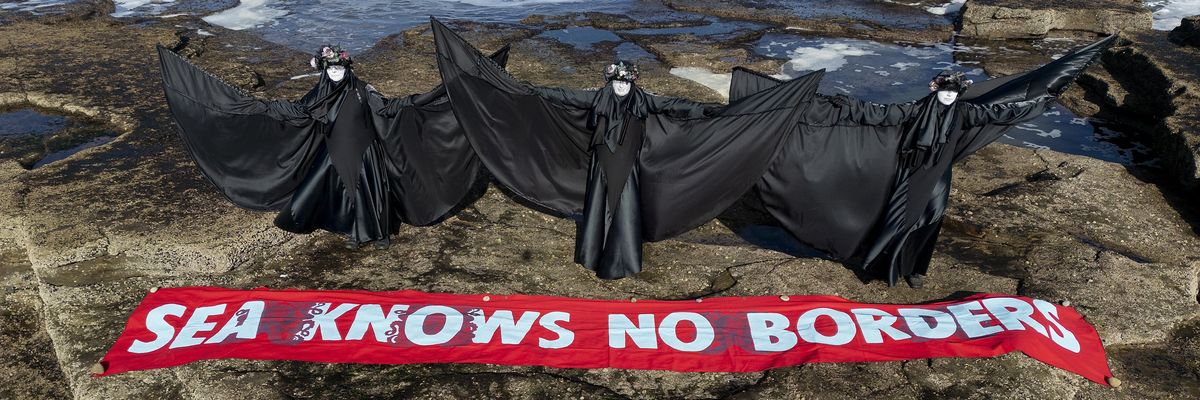
The “oil slicks” performance artist group demonstrates the impacts of a potential oil spill on Scotland’s Moray Firth as part of a North Sea-wide day of action on March 16, 2024.  (Photo: XR Forres)

“Going full steam ahead with new North Sea oil and gas is a sure fire route to the worst climate scenarios,” one campaigner said.

Climate activists in six North Sea countries came together on Saturday to carry out acts of civil disobedience in protest of their governments’ continued fossil fuel development.

Demonstrators in the United KingdomNorway, Sweden, Denmark, Germany, and the Netherlands blockaded roads, ports, and refineries; dropped banners; and held solidarity concerts as part of the North Sea Fossil Free campaign to demand that their governments align their plans for the shared body of water with the Paris agreement goal of limiting global heating to 1.5°C above preindustrial levels.

“For too long, the U.K., Norway, and other North Sea countries have avoided scrutiny for their oil drilling plans as the emissions are not included in their national inventories,” a spokesperson for Extinction Rebellion U.K. told Common Dreams. “Going full steam ahead with new North Sea oil and gas is a sure fire route to the worst climate scenarios.”

“The only serious response we can make is for citizens to unite, but we need to see many many more people doing this work.”

The day of action, which was organized by Extinction Rebellion (XR), came days after a new report from Oil Change International revealed that none of five North Sea countries—Norway, the U.K., the Netherlands, Germany, and Denmark—have plans consistent either with limiting warming to 1.5°C or with the agreement to transition away from fossil fuels reached at last year’s United Nations COP28 climate conference. If the five countries were counted as one, they would be the seventh biggest producer of oil and gas in the world.

In particular, these governments continue to issue permits to explore for and develop oil and gas fields, despite the fact that the International Energy Agency has said that no new fossil fuel development is compatible with limiting global temperature rise to 1.5°C. In one high-profile example, the U.K. approved the undeveloped Rosebank oil field in September 2023. Taken together, these permits could lead to more than 10 billion metric tons of greenhouse gas emissions.

The worst offenders were Norway and the U.K., which could be among the top 20 developers of oil and gas fields through mid-century if they do not change course.

“The five major North Sea countries are at a crossroads: One path leads toward global leadership in climate action and green industries, where they take bold action to phase out oil and gas production that creates sustainable jobs and communities. The other path leads to catastrophic climate change, economic crisis, and the loss of status as climate leaders globally, as they cling to outdated practices while the world moves forward,” Silje Ask Lundberg, North Sea campaign manager at Oil Change International, said when the report was released.

Extinction Rebellion co-founder Clare Farrell said that the North Sea governments’ policies were a betrayal of their citizens and the world following the hottest year on record.

“Temperatures have tracked 1.5°C above average recently, almost 2°C,” Farrell said. “Our global commitments, such that they are, are being flushed away with no regard for what the public really want. Where’s the consent for that here in our democracies? No government has a mandate to do that. So people deserve to know that our governments are willfully destroying everything. The people of these North Sea nations have not consented to destroying civilization, but that’s what is going to happen. Their governments are unhinged and unchecked.”

Saturday’s protests, Farrell continued, were a way for the people in these countries to make their voices heard.

“The only serious response we can make is for citizens to unite, but we need to see many many more people doing this work,” Farrell said. “Direct action like this should shake us awake; our governments will destroy democracy and society if we let them continue, that’s the course we are on, and they are redoubling their efforts despite the facts and knowing how much suffering they are already causing all over the world as climate breaks down.”

The demands of Saturday’s protests were threefold: An end to new oil and gas infrastructure in the North Sea, for governments to tell the truth about the realities of the climate crisis, and for the countries to pursue a just transition to renewable energy. In addition, many activists made additional demands specific to their nations’ policies.

The Netherlands

In the Netherlands, activists with Extinction Rebellion and Scientist Rebellion blocked all roads and railways leading to the largest oil refinery in Europe: Shell’s Pernis refinery. They targeted Shell because the oil major has received new permits to drill in the Victory Gas Field and has also restarted its drilling in the Pierce Field. What’s more, the company has refused to clean up its aging equipment in the North Sea, leaving old pipelines and drilling platforms to rust and pollute the sea with mercury, polonium, and radioactive lead. While there are 75 aging Shell oil and gas platforms in the Dutch North Sea that should be removed by 2035, current efforts are not on track to meet this deadline.

“Like the rest of the fossil industry, Shell is only interested in profits and shareholder returns,” said Bram Kroezen of XR Netherlands, adding that Shell’s appeal of a landmark court ruling ordering it to reduce emissions showed that the company “completely lacks a moral compass.”

Germany

Activists with Ende Gelände blocked off access to a floating liquefied natural gas (LNG) terminal in the port of Brunsbüttel, Germany, beginning at 9:00 am local time. The activists are calling for an end to LNG imports, as new science reveals the so-called “bridge” fuel may in fact be at least as damaging to the climate as coal due to previously unaccounted for methane leaks.

“LNG is a double climate killer,” Rita Tesch, spokesperson for Ende Gelände, said in a statement. “Because it consists of methane. Methane is even more harmful to the climate than carbon dioxide. It escapes into the atmosphere during transportation by LNG ships and at terminals such as here in Brunsbüttel, and heats it up rapidly. The carbon dioxide from burning it is on top of that. It’s clear: LNG imports are a climate crime!”

Norway

Activists with XR Norway targeted Rafnes Petroleum Refinery, with some blockading access on land while another group entered the security area by boat.

“I’m ashamed to be a Norwegian,” XR Norway spokesperson Jonas Kittelsen said in a statement. “Norway profits massively from aggressively expanding our oil and gas sector, causing mass suffering and death globally. My government portrays us as better than the rest of the world, which we are not.”

Denmark

Performance collective Becoming Species and Extinction Rebellion Denmark worked together to stage a creative protest targeting the oil company Total Energies, which is the leading oil and gas producer in the Danish North Sea and currently has plans to reopen “Tyra Feltet,” Denmark’s largest gas field. Four members of the band Octopussy Riot climbed a Total-owned container and staged a punk concert in Denmark’s Esbjerg Harbor.

“We octopuses have formed the band Octopussy Riot and have arrived here to play our song, a demand for you two-legs to stop oil and gas extraction,” performer Linh Le, said. “The sea is dying, our climate collapsing. We will not accept that the most rich and powerful destroy our home. We do not want to go extinct.”

Sweden

Members of XR Sweden blocked the road to Gothenburg’s Oil Harbor, where the group has been protesting since May of 2022. The activists called on Sweden to stop investing in the harbor and on city officials to develop a plan to dismantle the harbor and refineries.

“Twenty-two million tons of oil enter Gothenburg’s port every year, which is owned by the city,” one activist said. “There is no plan for decommissioning. This does not go together with the climate goals.”

Scotland

Finally, protesters across Scotland stood in solidarity with the other actions with performances and banner drops. In Aberdeen, activists unfurled banners outside the offices of Equinor, which owns 80% of Rosebank, and Ithaca, which owns the remaining 20%. The banners read, “North Sea Fossil Free,” “Stop Rosebank,” and “Sea knows no borders.” In Dundee, protesters targeted the Valaris 123 oil platform off the coast with banners. Shetland Stop Rosebank also brought signs to Lerwick Harbor, from where the first stage of Rosebank’s development is launching. XR Forres organized a performance of the group the “oil slicks” along the Moray Firth, to demonstrate what an oil spill would do to its unique coastal landscape.

“All countries should align their drilling plans with the Paris agreement now,” the XR U.K. spokesperson said. “We thank everyone who has taken action today in defense of a livable planet.”

Original article by OLIVIA ROSANE republished from Common Dreams under Creative Commons (CC BY-NC-ND 3.0). 

Continue Reading‘North Sea Fossil Free’: Activists in 6 Countries Protest ‘Unhinged’ Oil and Gas Development

Extinction Rebellion UK target Wood Group for “utter contempt” for UK taxpayers

Spread the love
Extinction Rebellion UK protest at Wood Group Aberdeen 3 July 2023

Extinction Rebellion are protesting the Wood Group’s Aberdeen and Staines offices after Wood Group significantly reduced it’s renewables operations and expanded it’s fossil fuel operations weeks after receiving a £430m government-backed “green transition loan” in 2021.

https://www.theguardian.com/environment/2023/jun/07/scottish-firm-expands-oil-and-gas-business-after-green-transition-loan

… After receiving the £430m loan, Wood grew its upstream oil and gas business by 17% so that it accounted for more than $3bn (£2.4bn) in revenue in 2022, up from $2.6bn in 2021, according to an analysis of the company’s financial results by the Guardian and the investigative journalism organisation Point Source.

Over the same period the company reduced the size of its renewable, hydrogen, and carbon capture business units by 35% so that they only accounted for revenues of $222.8m in 2022, down from $344.6m in 2021.

The five-year loan, which was the first of its kind and was designed to help Wood transition away from fossil fuels, was announced in August 2021 by Liz Truss when she was international trade secretary.

At the time, Truss said the engineering company had “already made great strides in repositioning its business for a low-carbon future”.

After being awarded the loan, Wood announced a string of at least 20 major contract awards for work on oil, gas and petrochemical infrastructure.

Continue ReadingExtinction Rebellion UK target Wood Group for “utter contempt” for UK taxpayers