Global wildfires burned an area of land larger than India in 2024

Spread the love

Original article by Orla Dwyer, Yanine Quiroz, Ayesha Tandon and Giuliana Viglione republished from Carbon Brief under a CC license

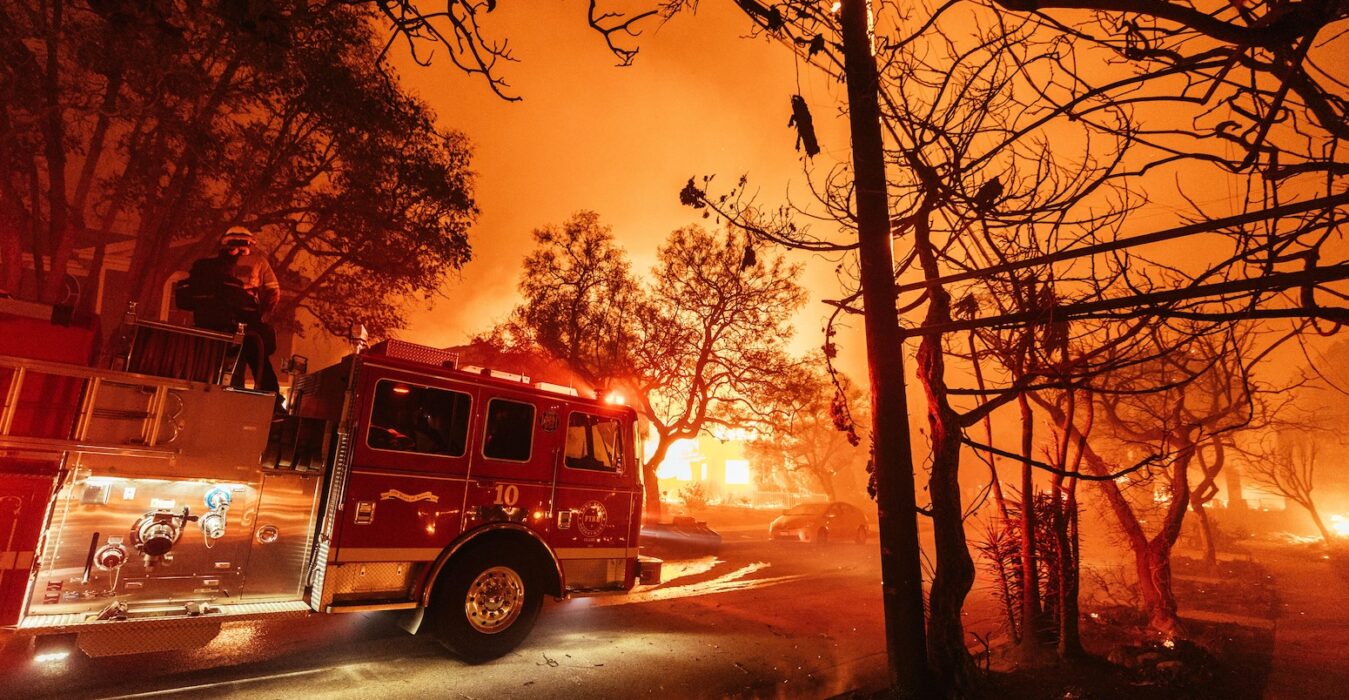
Palisades resident evacuate the area during the Palisades Fire on 7 January 2025. Credit: Kit Karzen / Alamy Stock Photo

“Extreme” wildfires emitted more than 8bn tonnes of carbon dioxide during the 2024-25 “global fire season”, according to a new report. 

The annual “state of wildfires” report from an international team of scientists finds that fires burned at least 3.7m square kilometres of land – an area larger than India – between March 2024 and February 2025. 

This is almost 10% below the average annual area burned over the past two decades.

But, due to an increase in wildfires in carbon-rich forests, the CO2 emissions resulting from these fires were almost 10% above average. 

The report also zooms in on four of the most prominent extreme wildfire events during this time: southern California; north-east Amazonia; South America’s Pantanal-Chiquitano region; and the Congo Basin. 

All of these events were found to have been more likely to occur as a result of human-caused climate change. 

The researchers identify that, in some cases, the area burned by these fires was 25-35 times larger than it would have been without global warming. 

The report also estimates that more than 100 million people around the world were exposed to wildfires in 2024 and 2025. 

These fires are “reshaping lives, economies and ecosystems on a global scale”, one of the report authors, Dr Carmen Steinmann from ETH Zürich, said in a statement. 

‘Increasing extent and severity’

Scientists from dozens of institutions analyse “extreme wildfires” globally between March 2024 and February 2025 in the second annual edition of the report.

The report explains that the “March-February definition of the global fire season latest global fire season is chosen so as to align with an annual lull in the global fire calendar in the boreal spring months”.

According to the report, the authors “harness‬‭ and‬‭ adopt‬‭ new‬‭ methodologies‬‭ brought‬‭ forward‬‭ by‬‭ the‬‭ scientific‬‭ community”. They add that in future reports, they hope to “enhance the tools presented in this report to predict extremes with increasing lead times, monitor emerging situations in near-real time and explain their causes rapidly”.

In the report’s “summary for policymakers”, study author Dr Matthew Jones, from the University of East Anglia, says:

“[The report] focuses on the global extreme wildfire events of the global fire season, explains why they happened and fingerprints the role of climate change as one of the key drivers of changing wildfire risk globally.”

The authors aim to “deliver actionable information” to policy experts and wider society about wildfires, the report says.

Using satellite data, the authors find that 3.7m square kilometres (km2) of land burned globally between March 2024 and February 2025. This means that the 2024-25 fire season ranks 16th out of all fire seasons since 2002, indicating below-average burned area compared to the rest of the 21st century. 

However, the global fire emissions database shows that the 2024-25 wildfire season drove more than 8bn tonnes of CO2 emissions, according to the report. This is 10% above the average of wildfire seasons since 2002.

Jones explains that this is indicative of a trend towards “increasing extent and severity of fire in global forests, which are carbon-rich”, as opposed to less carbon-rich grassland biomes.

The chart below shows global burned area (top) and carbon emissions (bottom) during the 2024-25 wildfire season, compared to the average over 2002-24, for different world regions. Red bars indicate that the 2024-25 wildfire season had higher-than-average burned area or emissions for the given region, while blue indicates lower-than-average numbers. 
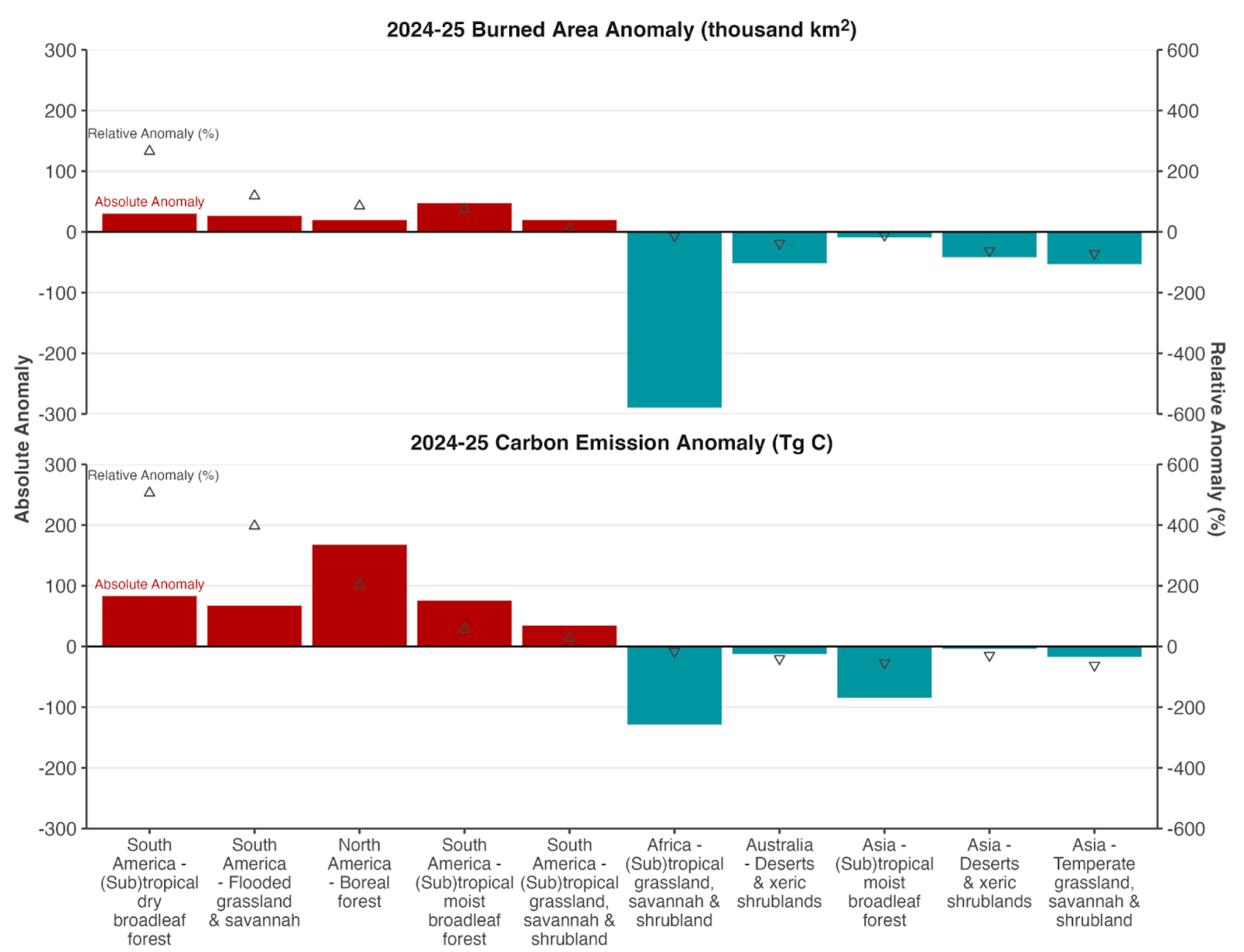
Burned area, in thousands of km2 (top) and carbon emissions in teragrams of carbon.
Burned area, in thousands of km2 (top) and carbon emissions in teragrams (equivalent to millions of tonnes) of carbon (bottom) during the 2024-25 wildfire season, compared to the 2002-24 average, for different world regions and biomes. The triangles (right y-axis) indicate the percentage of the relative anomaly compared to the average. Source: Kelley et al. (2025)

Savannas, grasslands and shrublands account for more than 80% of the burned area in a typical year, with forests and croplands making up the rest.

According to the report, burned area in tropical and subtropical grasslands, savannah and shrublands‬‭ was 10% below the 2002-24 average over 2024-25, but still contributed 70% towards the total global burned area.

The 2024-25 wildfire season was the second consecutive year that African‬‭ savannahs‬‭ “experienced‬‭ a‬‭ low‬‭ fire‬‭ season”, the report notes, with below average burned area and carbon emissions. 

Meanwhile, the report finds that the greatest increases in burned area and carbon emissions during the 2024-25 wildfire season were seen in the ‭Canada’s boreal‬‭ forests‬‭, the‬‭ moist‬‭ tropical‬‭ forests‬‭ in‬‭ the Amazon region, the‬‭ Chiquitano‬‭ dry‬‭ forests‬‭ of‬‭ Bolivia and the Cerrado – a tropical savannah in central Brazil.

The graphic below shows some key figures from the 2024-25 wildfire season.
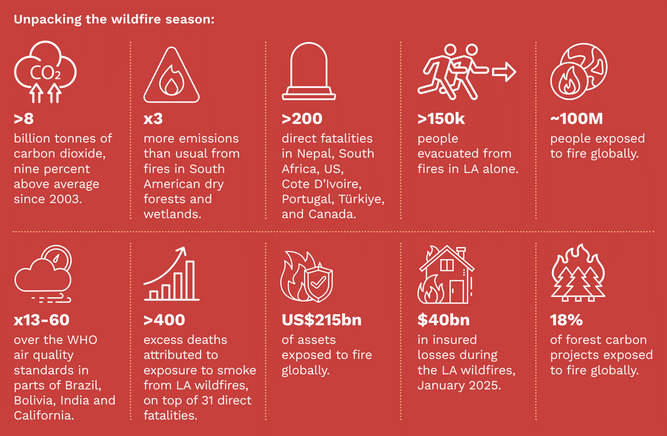
Key figures from the 2024-25 wildfire season
Key figures from the 2024-25 wildfire season. Source: State of wildfires project, summary for policymakers (2025).

Study author Dr Douglas Kelley, from the UK Centre for Ecology and Hydrology, told a press briefing that the author team spent time “actively engaging with a big regional panel of experts”. 

The team identified four “focal events” – extreme wildfire events that were chosen both for the severity of the fire and the impacts on people and the environment.

For each focal point, the study authors assessed the drivers of the wildfire. They also used attribution – a field of climate science that aims to identify the “fingerprint” of climate change on an extreme event – to determine the contribution of human-caused climate change.

Finally, the authors estimated the likelihood of similar events occurring in the future as the climate continues to warm over the coming century. 

Kelley told the press briefing that “capturing fires themselves can be quite tricky”, because they are affected by a range of different factors.

The report notes that wildfires are affected by changes in weather, with hot and dry weather providing the best conditions for wildfires. It adds that changes in land use are also important, as they can affect ignition. 

Kelley explained that the report authors used “multiple types of attribution” to capture these different factors, using a range of fire models, weather forecasting models and land use data.

North America

In North America, 2024-25 was an “extreme” fire year, the report says.

Both burned area and carbon emissions reached their second-highest levels since records began in 2002 and 2003, respectively. Across the continent, the burned area was 35% higher than the average since 2002 and the carbon emissions were more than double the average emissions since 2003. 

In Canada, 46,000km2 of land burned during the 2024-25 fire season, releasing 282m tonnes of carbon (Mt). The burned area was 85% higher than average, but the associated emissions were more than 200% higher than average, according to the report.

The report also notes that the wildfire season started early in Canada in 2024, due to earlier-than-normal snowmelt, as well as persistent, multiyear drought and “holdover fires” that reignited in the spring after smouldering through the winter months.

In the US, more than 64,000 individual wildfires contributed to a total burned area larger than 36,000km2. More than 8,000 wildfires in Mexico led to a record 16,500km2 of burned area. 

The regions experiencing record or near-record burned area and carbon emissions were varied: from the Canadian tundra and the north-western US mountain ranges to California’s grasslands and Mexico’s tropical forests. In the far-northern boreal forest – which contains around 20% of the world’s forest carbon – the season trailed only the record-breaking 2023-24 fire season in burned area and associated emissions. 

The researchers select the January 2025 southern California wildfires as one of the four “focal events” of the report.

The maps below show the locations of the four focal events: southern California, the Congo Basin, north-east Amazonia and the Pantanal-Chiquitano. The colours show the percentage difference from the average burned area, with blue indicating less burned area than average and darker browns showing more burned area. 
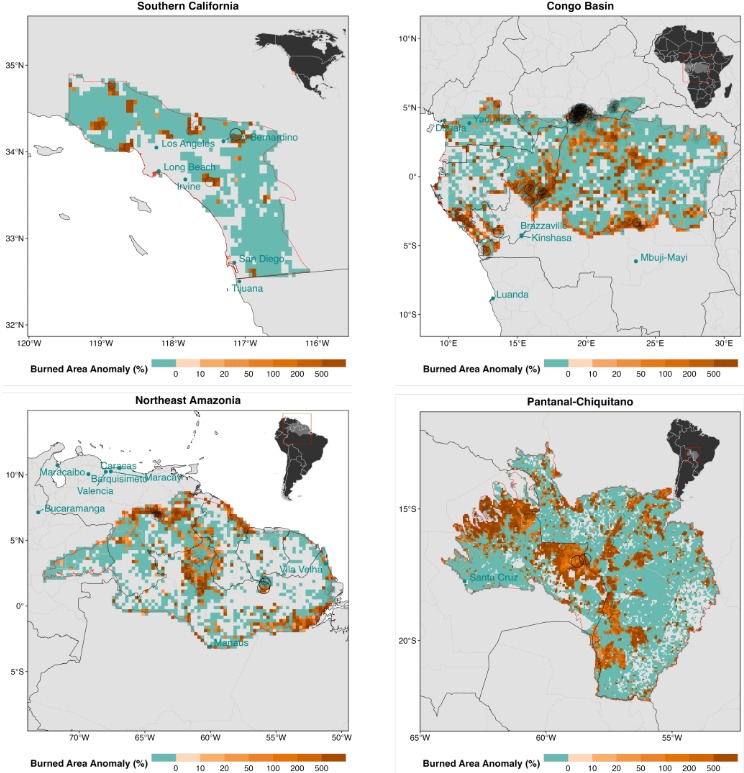
The burned area anomaly, expressed as a percentage difference from the 2002-24 average, for each of four focal events
The burned area anomaly, expressed as a percentage difference from the 2002-24 average, for each of four focal events (clockwise from top left): southern California, Congo Basin, Pantanal-Chiquitano and north-east Amazonia. The inset on each chart shows the location of the event. Blue colours indicate negative anomalies (less burned area than usual) and browns indicate positive anomalies. Source: Kelley et al. (2025)

In early January 2025, more than a dozen fires broke out in and around Los Angeles. Although January is “well outside the typical fire period”, the fires “became the most expensive wildfires ever recorded in just a few short days”, Prof Crystal Kolden – a study author and the director of the University of California, Merced’s Fire Resilience Center – wrote in the report. 

The two largest fires, named the Palisades fire and the Eaton fire, resulted in at least 30 deaths, more than 11,500 homes destroyed and more than 153,000 people being evacuated from their homes. 

The fires resulted in estimated economic losses of $140bn, placing “substantial pressure on the already volatile home insurance market in California”, according to the report. It notes that the fires also contributed to the “housing and affordability crisis” in southern California.

The report says that the severity of the January fires was largely due to intensifying extremes in the water cycle – an unusually wet period that allowed vegetation to flourish, followed by an unusually arid winter that dried out that vegetation, turning it into fuel. It notes:

“Between 5 and 25 January, favourable weather, fuel availability and ignition sources aligned, leading to create ideal conditions for ignition and rapid fire spread.

“The substantial suppression efforts deployed is unaccounted for in our modelling framework and could be one of the possible reasons the fires did not escalate even further.”

Previous attribution analysis found that the January 2025 fires were “likely influenced” by human-driven climate change. The report authors also find that the burned area in the southern California event was 25 times greater due to climate change.

However, whether extreme fire activity in southern California continues to intensify depends largely on how the region’s plants and trees respond to increased atmospheric CO2, the report says. It also notes that climate models disagree as to whether wintertime rainfall will increase or decrease in future climates.

South America

The report finds that South America had a total area burned by wildfires of 120,000km2 during the 2024-25 fire season – 35% higher than average. 

That translated into the release of 263Mt of carbon – the “highest carbon emissions on record for the continent” and 84% above average, the report says.

Jones, a study author, said in a press briefing that South America “hasn’t seen carbon emissions like this on record before”.

The report underlines that South America’s fire season was “unprecedented” in many ways, such as fire extent, emission levels, intensity and their impacts on society and the environment, although not in the number of fires.

For example, fires in the north-east Amazon impacted air quality, crops, houses and native vegetation, affecting people living in the region, including Indigenous peoples such as the Yanomami, the report says.
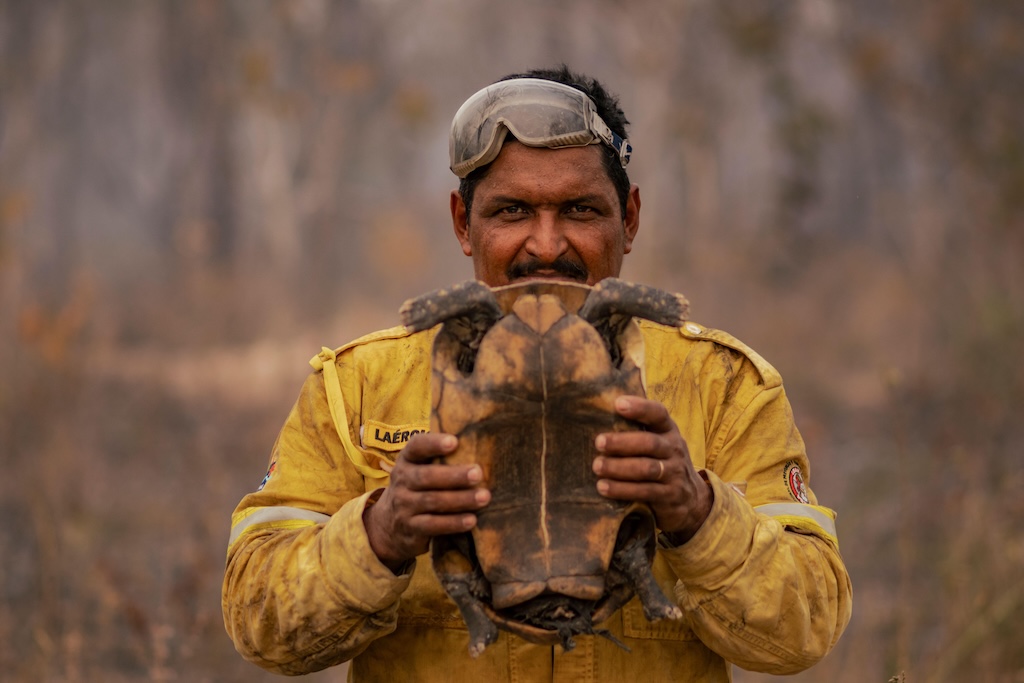
Laercio Fernandes, a volunteer firefighter and Indigenous man, holds a shell of a turtle found dead after a forest fire hit the Kadiwéu Indigenous land, in Mato Grosso do Sul, Brazil, in 2024.
Laercio Fernandes, a volunteer firefighter and Indigenous man, holds a shell of a turtle found dead after a forest fire hit the Kadiwéu Indigenous land, in Mato Grosso do Sul, Brazil, in 2024. Credit: Diego Cardoso / Alamy Stock Photo

The country with the largest area burned by wildfires during the 2024-25 fire season was Brazil, with a total burned area of 243,000km2, followed by Bolivia, with a total of 107,000km2 of burned area, and Venezuela, with a total of 43,000km2 of burned area.

The most-affected biomes in the region were the Amazon rainforest, with 47,000km2 of wildfires above the average since 2002. 

Second was the Chiquitano and Chaco dry forests – encompassing parts of Bolivia, Brazil, Paraguay and Argentina. These biomes experienced a “record-breaking” fire season with more than 46,000km2 of burned area. These fires resulted in 100Mt of carbon emissions – six times higher than the average since 2003.

More than 46,000km2 of the Pantanal – the largest tropical wetland located in Brazil, Bolivia and Paraguay – burned in 2024-25, with associated carbon emissions of 67Mt above the average.

According to the report, fire activity in the region was primarily driven by “anomalous dry weather”.

In the north-eastern Amazon, the severity of the fire season between January and April 2024 was compounded by natural sources of climate variability, such as El Niño and the Atlantic Meridional Mode, which contributed to very high temperatures and absence of rainfall. There, deep soil moisture dropped to 1%.

Meanwhile, in Pantanal and Chiquitano, “extreme dry weather” since 2023 and “multiple years of below-average rainfall” contributed to the severe fires, the report says. Study author Dr Francesca Di Giuseppe said in a briefing that the “wet season that usually happens between February and May failed completely to recharge the soil that kept completely dry and this drove most of the fire season” in the region.

The authors conduct an attribution analysis and find that the fire weather conditions in the north-eastern Amazon that season were “significantly more likely” due to climate change. In the Pantanal and Chiquitano, the conditions were 4.2-5.5 times more likely due to climate change.

Africa

Overall, the scale of fires across Africa was “well-below average” in 2024 and 2025, the report finds, except in certain areas, including the Congo Basin, northern Angola and South Africa. 

In 2024, a record-high amount of land was burned in the Congo Basin – a biodiverse region in central Africa spanning six countries that holds the world’s second-largest tropical forest. This burned area was 28% higher than the annual average and there were 4,000 fires in total, 20% more than usual, in 2024. 

Fires also caused “hazardous” air pollution and contributed to the Congo Basin’s highest loss of primary forest in a decade. 

The analysis in the report finds that it is “virtually certain” that human-caused climate change contributed to the extreme fire weather in this region in July and August 2024. 

The hot, dry and windy conditions were 3-8 times more likely to occur as a result of climate change and the area scorched by fires was three times greater than it would have been otherwise, the findings show.  

Climate change has also driven an increase of more than 50% in the average annual burned area in the Congo Basin, which the researchers say is “one of the most robust signals of climate influence” in the fire trends they analysed. 

Drought was a major factor behind the fires, the report finds, and water stress is expected to be the main driver shaping future fires in the Congo Basin. 
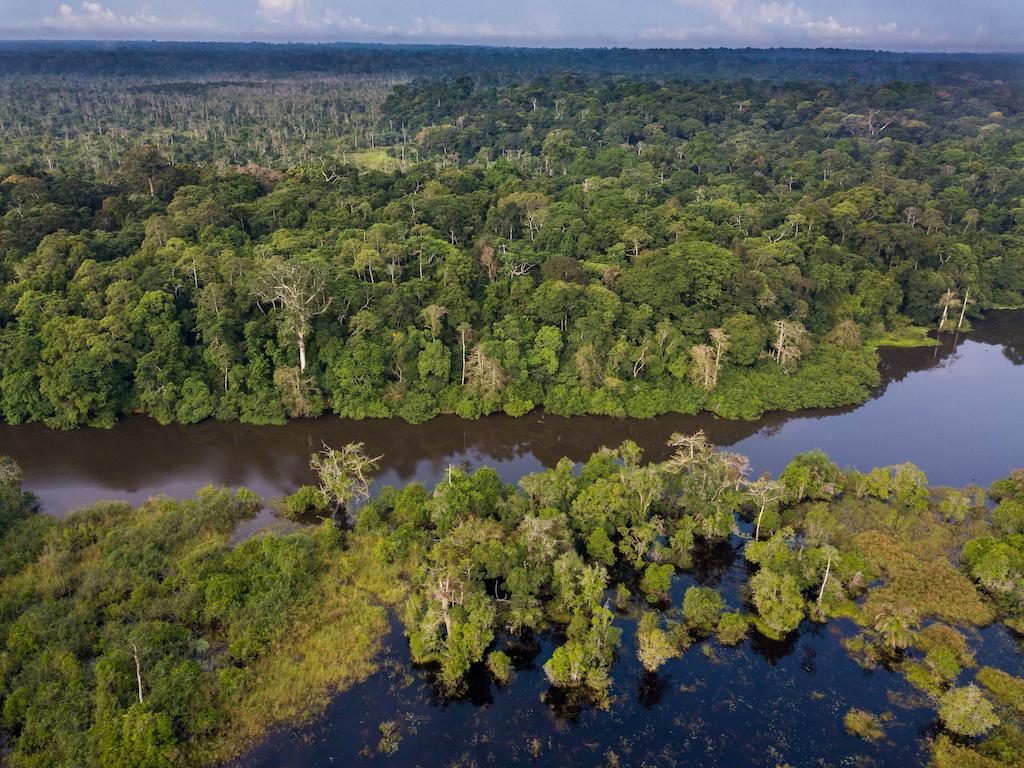
Congo rainforest along Rembo Ngowe river in Akaka, Loango National Park, Gabon.
Congo rainforest along Rembo Ngowe river in Akaka, Loango National Park, Gabon. Credit: Lee Dalton / Alamy Stock Photo.

These fires are “part of a long-term trend of increasing fire encroachment into African moist forests, driven by climate change and human pressure”, says Prof Michael Wimberly, a professor at the University of Oklahoma who was not involved in the report, but has researched wildfires in Africa. He tells Carbon Brief: 

“The increased fire activity in the Congo Basin is troubling because of the vast expanses of unfragmented forests and peatlands that store massive amounts of carbon, provide habitat for threatened species and supply vital resources to local populations.”

The report notes that there is “sparse reporting and poor media coverage” on the impacts of fires in the Congo Basin in 2024, despite millions of people being impacted. 

In South Africa, 34 people were killed and thousands of livestock and homes were destroyed in fires last year. In Ivory Coast, 23 people were killed and 50km2 of land was burned. 

Dr Glynis Humphrey, a postdoctoral research fellow at the University of Cape Town, who was not involved in the study, adds that a below-average burned area across Africa “does not necessarily indicate a decline in fire risk or impact”. She tells Carbon Brief: 

“In some ecosystems, fewer but more intense fires are being observed, which can still have severe ecological and atmospheric consequences.”

Using climate models, the researchers project that fires to the extent of those in the Congo Basin last year could occur up to 50% more often by 2100, under a medium-emissions pathway. 

The region is also projected to see more increases in extreme wildfire risk by the end of this century. Gabon, Equatorial Guinea and the central part of the Democratic Republic of the Congo could see some of the largest increases in burned area, which, the report estimates, could double or quadruple in some cases. 

Humphrey notes that fire patterns are “shifting” in response to climate change, which is “leading to significant consequences for ecosystems that don’t typically burn – like the forests in the Congo Basin”. She tells Carbon Brief: 

“This is of concern, as primary forests harbour critical biodiversity that supports ecosystem functioning and provide services to people…These forests are also sanctuaries for endangered species.”

Original article by Orla Dwyer, Yanine Quiroz, Ayesha Tandon and Giuliana Viglione republished from Carbon Brief under a CC license

Nigel Farage urges you to ignore facts and reality and be a climate science denier like him and his Deputy Richard Tice. He says that Reform UK has received £Millions and £Millions from the fossil fuel industry to promote climate denial and destroy the planet.
Donald Trump urges you to be a Climate Science denier like him. He says that he makes millions and millions for destroying the planet, Burn, Baby, Burn and Flood, Baby, Flood.
Elon Musk urges you to be a Fascist like him, says that you can ignore facts and reality then.

Continue ReadingGlobal wildfires burned an area of land larger than India in 2024

Drawing lessons from the Cuban Revolution: organization, unity, and internationalism

Spread the love

This article by republished from peoples dispatch under a Creative Commons Attribution-ShareAlike 4.0 (CC BY-SA) license.

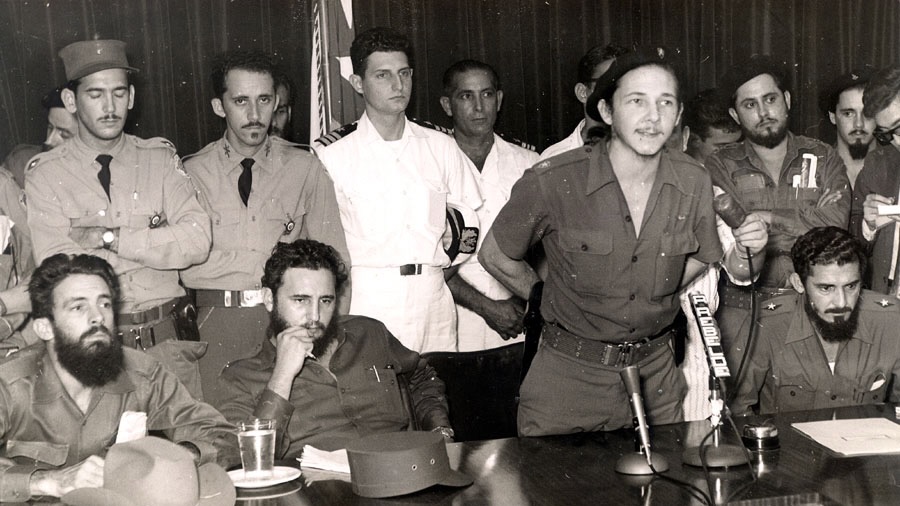
On February 16, 1959, Cuba established the Ministry of the Revolutionary Armed Forces, the executive body of their defense force, and its first Army General, Raúl Castro Ruz. Photo: Miguel Díaz-Canel/X

A recent webinar by Pan Africanism Today and the International Peoples’ Assembly looked at global struggles, from Africa to Latin America, showing how Cuba’s enduring resistance offers vital lessons in organization, unity, and internationalism for today’s movements fighting oppression and war.

The world is in an era marked by relentless wars and overlapping crises, from the devastating civil war in Sudan and violence in the Democratic Republic of Congo to the unfolding genocide in Palestine. The demand to end all wars has never carried greater urgency. And in the midst of all these visible battlegrounds persists a more enduring and insidious conflict; the hybrid war and economic blockade waged against the Cuban people and their revolution.

This was the central focus of a recent global webinar convened under the banner of Pan-African and internationalist solidarity, bringing together progressive voices to draw lessons from Cuba’s anti-imperialist struggle. The session, held on October 15, was facilitated by Mbali Gwenda from Pan Africanism Today, who situated the discussion within a broader historical and moral framework, invoking the revolutionary spirits of Thomas Sankara, martyred on the same date in 1987, and Assata Shakur who recently passed, and whose life consistently symbolized uncompromising resistance to oppression.

“We are dealing with the question of the hybrid war and blockade against the Cuban Revolution and her people,” Gwenda said. “A revolution that has been a source of inspiration for all oppressed peoples throughout the world till this day.”

The keynote address was delivered by Manolo De Los Santos, executive director of The People’s Forum and a researcher at the Tricontinental: Institute for Social Research, who framed Cuba’s defiance not as a miracle, but as the outcome of a centuries-long process of people’s struggle, organization, and consciousness.

The long arc of revolution

De Los Santos began by looking at Cuba’s revolution more than an event confined to the years 1953–1959, when Fidel Castro, Che Guevara, and others led the guerrilla war against the Batista dictatorship. Revolutions, he reminded the audience, are not events but processes, collective journeys of resistance that unfold across generations.

Cuba’s revolution, he argued, has roots reaching back to centuries of anti-colonial and anti-slavery resistance, when the island was still a colony of the Spanish Empire. Unlike many independence movements in Latin America, Cuban revolutionaries understood that genuine freedom required addressing three interlinked questions:

  1. Could Cuba truly be independent if it remained a slaveholding society?
  2. Could it be free if it continued under the exploitative system of capitalism?
  3. Could it claim sovereignty while dominated by imperial powers, first Spain and later the United States?

These questions shaped the consciousness of generations of Cuban patriots, culminating in the 1959 triumph of the socialist revolution. But as he explained, the revolution’s endurance has rested on three essential pillars: organization, unity, and internationalism.

Organization: the bedrock of resistance

Organization, De Los Santos emphasized, has been the Cuban people’s greatest weapon against imperial aggression. From the early independence wars to the 26th of July Movement led by Fidel Castro, Cubans have understood that only a disciplined, organized people can confront an empire with infinite resources.

This organizational spirit persisted after 1959, with the creation of mass democratic structures that unite workers, women, peasants, students, and youth. The Federation of Cuban Women, for example, mobilizes millions in defense of gender equality and revolutionary ideals, while student and peasant organizations remain vital spaces for political education and collective problem-solving.

Even under today’s extreme shortages such as the lack of fuel to power garbage collection, Cuban communities respond not with despair but with collective initiative, a reflection of their revolutionary organization and social consciousness.

Unity, he continued, has been the second indispensable lesson from Cuba. Every time the people were divided, the empire gained the upper hand; every time they stood together, they won. This unity has transcended class, race, and regional divisions, dismantling the legacies of slavery and racism that imperialism imposed.

The Cuban Revolution’s unity was forged not just through ideology but through practice, through collective participation in building a new society. It remains, as Manolo put it, “the most important defense the Cuban people have.”

Internationalism is the soul of the revolution

If organization is the body and unity the shield, then internationalism is the soul of the Cuban Revolution.

Quoting Fidel Castro, the New York-based researcher reminded participants that “a people who are not willing to fight for the freedom of others will never be able to fully fight for their own freedom.”

This principle drove Cuba to send tens of thousands of its sons and daughters to fight alongside liberation movements in Angola, Namibia, and South Africa, contributing directly to the defeat of apartheid. As he noted, “Cuba doesn’t need gold or minerals from Africa, it knows that its freedom is tied to the freedom of the peoples of the African continent.”

Even today, with over 24,000 Cuban doctors working abroad, many across Africa, Cuba continues this legacy of solidarity. The US, in its campaign of distortion, now accuses Cuba of “human trafficking” for this very act of humanitarianism.

Read more: Cuba’s medical brigades in Africa embody a long tradition of solidarity

The anatomy of a hybrid war

The United States’ war against Cuba has been fought through unconventional means. It is a hybrid war, a combination of economic blockade, financial strangulation, media disinformation, and covert sabotage.

For more than 65 years, the blockade has inflicted immense human and economic damage. In 2024 alone, it cost Cuba USD 7.5 billion, money that could have been used to buy food, medicine, or oil for its 11 million citizens.

The US uses its control of global financial systems to punish any country or institution that trades with Cuba. Banks in Africa or Latin America face sanctions simply for handling Cuban transactions. The blockade’s reach extends into every corner of global trade, designed to isolate Cuba and make daily life unbearable for its people.

Read More: Tens of thousands of Cubans march in support of Venezuela’s sovereignty amid US aggression

The war is also fought in the terrain of ideas. US-funded media campaigns spread false narratives about repression and poverty in Cuba while erasing the country’s achievements in health, education, and solidarity.

Socialism and survival

When asked on how Cuba has managed to survive more than six decades of blockade, Manolo’s answer was clear: because Cuba made a socialist revolution.

Socialism, he said, allowed Cuba to create a system where the needs of the people come before profit. In capitalist societies, when crises hit, the rich survive and the poor starve. In Cuba, food, healthcare, and education are distributed equitably, even in times of scarcity. This social organization transforms a siege economy into a community of resilience.

This difference, he explained, is what makes Cuba unique among nations facing US aggression. It’s also what inspires global movements seeking alternatives to neoliberalism and imperial domination.

Cuba, Sankara, and the spirit of resistance

The session also honored Thomas Sankara linking a symbolic bridge between the African and Latin American revolutionary traditions. Both embodied a commitment to self-reliance, dignity, and international solidarity.

Sankara’s vision of a self-determined Africa resonated deeply with the Cuban experience. His assassination on October 15, 1987 marked a turning point in African politics, yet his ideas continue to inspire movements across the continent, just as Cuba continues to stand as living proof that another world is possible.

Read More: Thomas Sankara’s legacy lives on in Burkina Faso 38 years after his death

A call for global solidarity

In closing, Manolo issued a clear call; the Cuban people will overcome the blockade, but they cannot and should not do it alone. Their survival depends on the solidarity of all who believe in justice, sovereignty, and equality.

Cuba’s endurance is not simply a Cuban story; it is a lesson for all peoples resisting imperial domination. As the world faces renewed militarization and economic warfare, the spirit of organization, unity, and internationalism must also be crucial as ever.

“When they stand with the Palestinians, when they stand with the Congolese, when they stand with the peoples of the African continent,” Manolo concluded, “they are breaking the blockade too.”

This article by republished from peoples dispatch under a Creative Commons Attribution-ShareAlike 4.0 (CC BY-SA) license.

Continue ReadingDrawing lessons from the Cuban Revolution: organization, unity, and internationalism

Only 3 years left – new study warns the world is running out of time to avoid the worst impacts of climate change

Spread the love
Piyaset/Shutterstock

Piers Forster, University of Leeds and Debbie Rosen, University of Leeds

Bad climate news is everywhere. Africa is being hit particularly hard by climate change and extreme weather, impacting lives and livelihoods.

We are living in a world that is warming at the fastest rate since records began. Yet, governments have been slow to act.

The annual global climate change conference of the parties (COP30) is just months away. All of the 197 countries that belong to the United Nations were supposed to have submitted updated national climate plans to the UN by February this year. These plans outline how each country will cut its greenhouse gas emissions in line with the legally binding international Paris Agreement. This agreement commits all signatories to limiting human-caused global warming to no more than 1.5°C above pre-industrial levels.

Governments must also bring their newly updated national climate action plans to COP30 and show how they plan to adapt to the impacts that climate change will bring.

But so far, only 25 countries, covering around 20% of global emissions, have submitted their plans, known as Nationally Determined Contributions. In Africa, they are Somalia, Zambia and Zimbabwe. This leaves 172 still to come.

The nationally determined contributions are very important in setting out countries’ short- to medium-term commitments on climate change. They also provide a direction of travel that can inform broader policy decisions and investments. Aligning climate plans with development goals could lift 175 million people out of poverty.

But arguably only one of the submitted plans – the UK’s – is compatible with the Paris Agreement.

We are climate scientists, and one of us (Piers Forster) leads the global science team that publishes the annual Indicators of Global Climate Change report. This report gives an overview of the state of the climate system. It is based on calculations of the net emissions of greenhouse gases globally, how these are concentrating in the atmosphere, how temperatures are rising on the ground, and how much of this warming has been caused by humans.

The report also looks at how extreme temperatures and rainfall are intensifying, how much the sea levels are rising, and how much carbon dioxide can still be emitted before the planet’s temperature exceeds 1.5°C more than it was in pre-industrial times. This is important because staying within 1.5°C is needed to avoid the worst impacts of climate change.

Our report shows that human-caused global warming reached 1.36°C in 2024. This boosted average global temperatures (a combination of human-induced warming and natural variability in the climate system) to 1.52°C. In other words, the world has already reached the level where it has warmed so much that it cannot avoid significant impacts from climate change. There is no doubt we are in dangerous waters.

Our dangerously hot planet

Although last year’s global temperatures were very high, they were also alarmingly unexceptional. The data speaks for itself. Continued record high levels of greenhouse gas emissions have led to rising atmospheric concentrations of carbon dioxide, methane and nitrous oxide.

The result is rising temperatures that are rapidly eating into the remaining carbon budget (the amount of greenhouse gases that can be emitted within an agreed time). This will be exhausted in less than three years at current levels of emissions.

We need to face this head on: the window to stay within 1.5°C is essentially shut. Even if we can bring temperatures back down in future, it will be a long and difficult road.

At the same time, climate extremes are intensifying, bringing long-term risks and costs to the global economy but also, importantly, people. The African continent is now facing its deadliest climate crisis in over a decade.

It would be impossible to imagine economies operating without fast access to trusted data. When share prices plummet or growth stalls, politicians and business leaders act decisively. None would tolerate outdated intelligence on sales or the stock market.

But when it comes to climate, the speed of climate change often outpaces the data available. This means fast decisions can’t be made. If we treated climate data as we do financial reports, panic would ensue after each dire update. But while governments routinely pivot when faced with an economic downturn, they have been far slower to respond to what key climate indicators – the Earth’s vital signs – are telling us.

What needs to happen next

As more countries develop their climate plans, it’s time for leaders across the globe to face the hard truths of climate science.

Governments need to have fast access to trusted climate data so that they can develop up-to-date national climate plans. The national climate plans need to take a global perspective too. This is really important for fairness and equity. For example, developed countries must acknowledge that they’ve emitted more greenhouse gases and take the lead in presenting ambitious mitigation efforts and in providing finance for other countries to decarbonise and adapt.

In Africa, the UN is hosting UNFCCC Climate Week in Addis Ababa in September. As well as making plans for COP30, there will be sessions on accessing climate finance and ensuring that the transition to zero human-caused carbon emissions by 2050 (net zero) is just and equitable. The summit also aims to support countries that are still working on their national climate plans.

If nationally determined contributions are implemented, the pace of climate change will slow down. This is vital not just for the countries – and economies – currently on the frontline against climate change, but for a functioning global society.

Just five of the G20 countries have submitted their 2035 plans: Canada, Brazil, Japan, the United States and the United Kingdom. But the G20 is responsible for around 80% of global emissions. This means that South Africa’s current G20 presidency can help to ensure that the world prioritises efforts to help developing countries finance their transition to a low-carbon economy.

Another worrying factor is that just 10 of the updated nationally determined contributions have reaffirmed or strengthened commitments to move away from fossil fuels. This means that national climate plans from the European Union, China and India will be key in testing their climate leadership and keeping the Paris Agreement’s 1.5°C temperature goals alive. Many other countries will be scrutinising what these countries commit to before they submit their own national climate plans.

The data in our report helps the world to understand not just what’s happened in recent years, but also what to expect further down the track.

Our hope is that these and other countries submit ambitious and credible plans well before COP30. If they do, this will finally close the gap between acknowledging the climate crisis and making decisive efforts to address it. Every tonne of greenhouse gas emissions matters.

Piers Forster, Professor of Physical Climate Change; Director of the Priestley International Centre for Climate, University of Leeds and Debbie Rosen, Research and Innovation Development Manager for the Priestley Centre for Climate Futures, University of Leeds

This article is republished from The Conversation under a Creative Commons license. Read the original article.

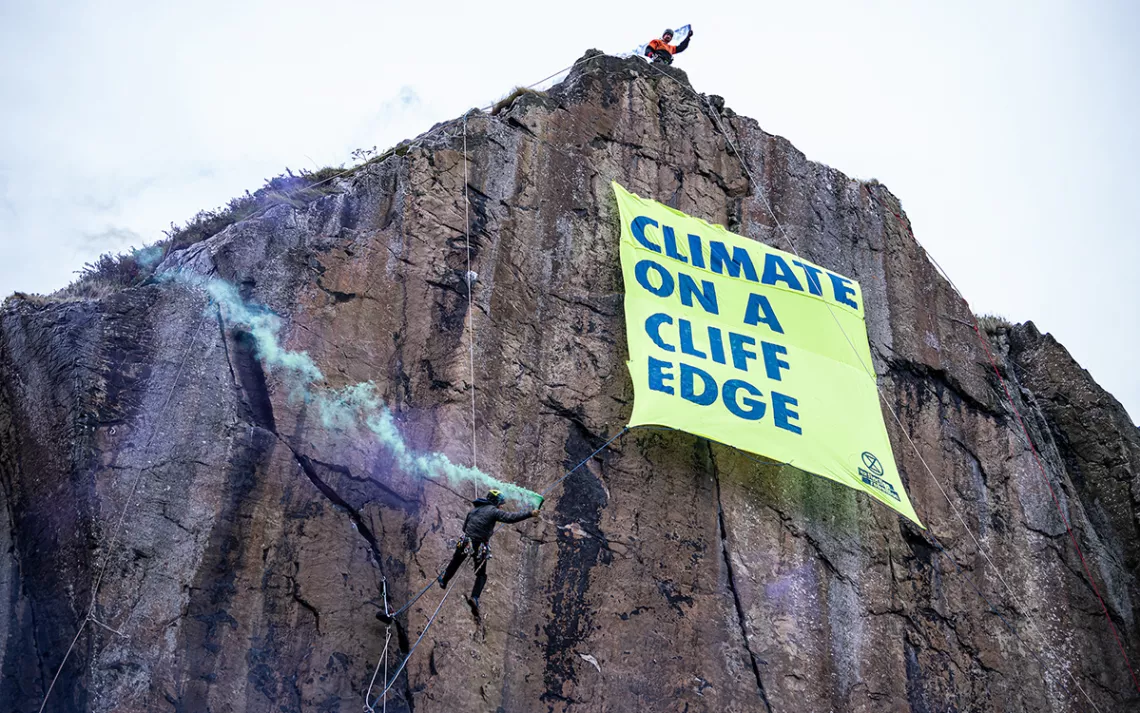
Experienced climbers scale a rock face near the historic Dumbarton castle in Glasgow, releasing a banner that reads “Climate on a Cliff Edge.” One activist, dressed as a globe, symbolically looms near the edge, while another plays the bagpipes on the shores below. | Photo courtesy of Extinction Rebellion and Mark Richards
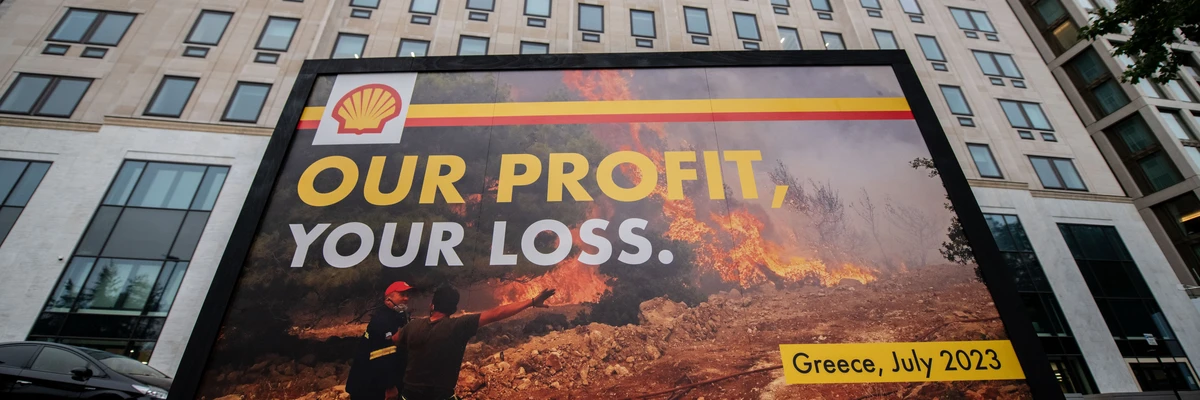
Greenpeace activists display a billboard during a protest outside Shell headquarters on July 27, 2023 in London.
Greenpeace activists display a billboard during a protest outside Shell headquarters on July 27, 2023 in London. (Photo: Handout/Chris J. Ratcliffe for Greenpeace via Getty Images)

Continue ReadingOnly 3 years left – new study warns the world is running out of time to avoid the worst impacts of climate change

Women take to the streets across the world demanding end to inequality and violence

Spread the love

https://morningstaronline.co.uk/article/women-take-streets-across-world-demanding-end-inequality-and-violence

Women chant slogans during a protest marking International Women’s Day in Istanbul, Turkey, March 8, 2025

WOMEN took to the streets of cities across Europe, Africa, South America and elsewhere to mark International Women’s Day with demands for ending inequality and gender-based violence.

On the Asian side of Istanbul, Turkey’s biggest city, a rally in Kadikoy saw members of dozens of women’s groups listen to speeches, dance and sing in the spring sunshine.

The colourful protest was overseen by a large police presence, including officers in riot gear and a water cannon truck.

Protesters pushed back against the idea of women’s role being confined to marriage and motherhood, carrying banners reading “Family will not bind us to life” and “We will not be sacrificed to the family.”

From Athens to Madrid, Paris, Munich, Zurich and Belgrade and in many more cities across the continent, women marched to demand an end to treatment as second-class citizens in society, politics, family and at work.

https://morningstaronline.co.uk/article/women-take-streets-across-world-demanding-end-inequality-and-violence

Continue ReadingWomen take to the streets across the world demanding end to inequality and violence

Food prices will climb everywhere as temperatures rise due to climate change – new research

Spread the love
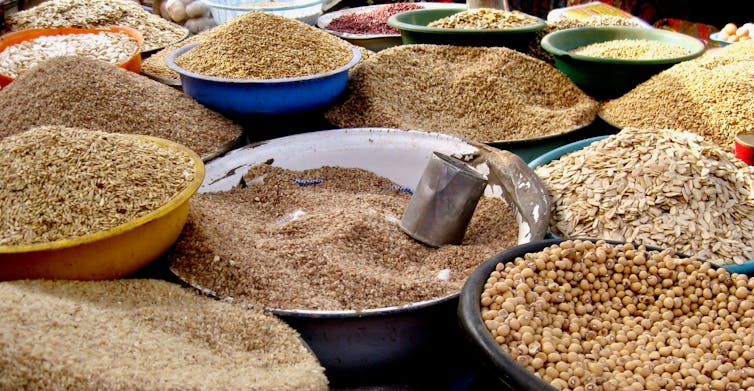
A food market in Ghana, where many already don’t have access to a healthy and varied diet.
Lauren Huddleston / shutterstock

Jessica Boxall, University of Southampton and Michael Head, University of Southampton

Climate change, and specifically rising temperatures, may cause food prices to increase by 3.2% per year, according to a new study by researchers in Germany. As climate change continues to worsen, this price inflation will mean more and more people around the world don’t have a varied and healthy diet, or simply don’t have enough food.

The new analysis shows that global warming could cause food price inflation to increase by between 0.9 and 3.2 percentage points per year by 2035. The same warming will cause a smaller rise in overall inflation (between 0.3 and 1.2 percentage points), so a greater proportion of household income would need to be spent on buying food.

This effect will be felt worldwide, by high and low-income countries alike, but nowhere more so than in the global south. As with various other consequences of climate change, Africa will be worst affected despite contributing little to its causes.

Our own research on food security in Ghana, west Africa, gives a sense of what price inflation might mean in practice. The The Intergovernmental Panel on Climate Change describes west Africa as a “hotspot” of climate change, with models predicting extreme rising temperatures and reduced rainfall. With more than half of the population being directly dependent on rain-fed agriculture, Ghana is particularly vulnerable to climate change.

We recently carried out a study in Mion, a rural district in the north of the country. We spoke to almost 400 people, and very single one of them told us they had experienced some level of food insecurity in the previous 12 months. Some 99% said climate change was at least partly to blame.

Additionally, 62% were moderately or severely food insecure, with 26% experiencing severe food insecurity (going without food for an entire day). These percentages are much worse than Ghana’s national averages (39% and 6% respectively), but similar to some of the poorest countries in west Africa such as Togo, Burkina Faso and Benin.

We also carried out a similar study among refugees from neighbouring Burkina Faso who fled across the border to the upper east region of Ghana. Again, 100% had experienced food insecurity.

Mion isn’t suffering from a sudden famine, and nothing particularly unusual has happened to cause this food insecurity. This situation is considered to be a “normal phenomenon” due to the effects of climate change.

Climate-related food inflation can be broken down into two interlinked problems.

Shifting seasons, pests and diseases

The first is that the same climate change effects that are causing the inflation are already making food harder to get hold of. For instance, higher temperatures can cause long-established and predictable farming seasons to shift and so may hinder crop production.

Other consequences can include more pest and disease outbreaks that deplete livestock and food reserves, and heat stress to already-poor roads which makes it harder to access rural communities.

All of these factors push prices higher and reduce the purchasing power of affected households. The drivers of food inflation are already worsening food insecurity.

The second part of this problem is the rise in inflation itself. A 3% annual price increase would mean households are less able to purchase what they need.

They would likely need to compromise on quality or perhaps even culturally important foods. This in turn makes people more vulnerable to disease and other health issues. Malnutrition is the leading cause of immunodeficiency globally.

In Ghana, we found that those who reported more knowledge of climate change were more likely to be food secure. This is despite few people having any formal education. This is evidence that affected populations are very aware of the changing temperatures and unpredictability of the climate, and are perhaps engaging in proactive mitigation practices.

Those without any schooling are more likely to engage in a climate-sensitive occupations such as farming, and so would be more immediately exposed. Teaching people about climate change might provide some capacity to adapt to it, and therefore increase food security.

Alterations in the climate are a hunger-risk multiplier for those populations with entrenched vulnerability. In light of this, 134 countries at COP28 signed a declaration to incorporate food systems into their climate action, to ensure everyone has enough to eat in light of climate change.

The researchers behind the new study suggest that reducing greenhouse gas emissions could limit any impacts on the global economy. We also suggest that diversifying economies would serve as some protection for those communities reliant on agriculture for both their food and income.

Government intervention could also ensure financial protection and nutritional aid for those vulnerable to becoming trapped in the poverty cycle by inflation and diminished accessibility to food.The Conversation

Jessica Boxall, Public Health & Nutrition Research Fellow, University of Southampton and Michael Head, Senior Research Fellow in Global Health, University of Southampton

This article is republished from The Conversation under a Creative Commons license. Read the original article.

Continue ReadingFood prices will climb everywhere as temperatures rise due to climate change – new research