“The Labour government is trashing its climate credentials one absurd decision at a time. Only one day after receiving critical advice from its own climate advisors on the need to lower flying demand, ministers continue to support yet more unnecessary expansion for the benefit of wealthy investors.
“Pushing through these damaging plans shows such poor economic judgement. Over 100,000 extra flights a year won’t deliver for our communities. Labour should listen to the public who think airport expansion is the wrong priority. Most of us fly once a year if at all and would rather see cheaper train tickets and more bus routes instead to help with our daily journeys and create jobs where we live, in contrast with frequent flyers leaching money out of the economy.
“The green economy grew by ten per cent last year, and this is where Labour should be investing to deliver high-wage, long-term jobs across the entire country.”
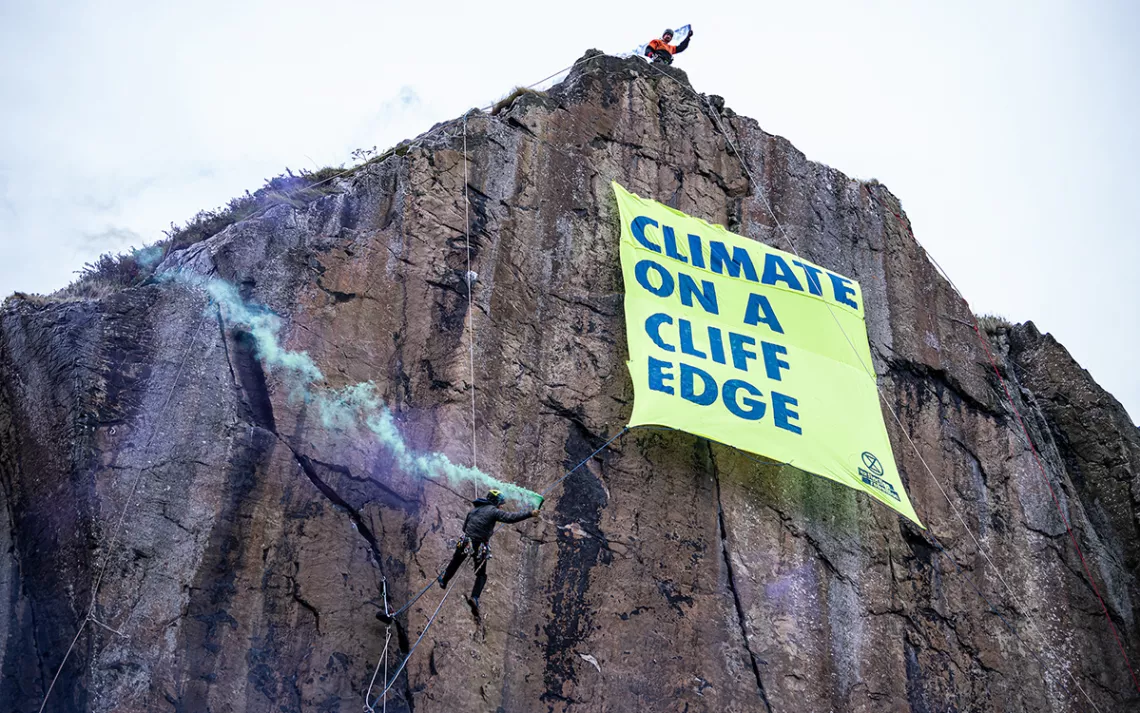
Experienced climbers scale a rock face near the historic Dumbarton castle in Glasgow, releasing a banner that reads “Climate on a Cliff Edge.” One activist, dressed as a globe, symbolically looms near the edge, while another plays the bagpipes on the shores below. | Photo courtesy of Extinction Rebellion and Mark Richards
So BP representing the fossil fuels industry and the filthy rich has given the climate, biodiversity and all humanity an unambiguous big two fingers. They’re saying fekk you, our profits come before anything, we continue to destroy the climate and all else. Despite the UK government saying no new licences in the North Sea we don’t know where they’re at with licence decisions pending for Rosebank and Jackdaw and government support for airport expansions at Gatwick and Heathrow. If they were serious about climate there would be no hesitation in refusing all these projects. Then there’s the big orange slug that Starmer is reporting to today. The planet can’t afford any of this. Capitalist scum have already fekked the climate, it’s going to get destroyed at a far greater rate now and these absolute bstards are pulling out all the stops.
Neo-Fascist Climate Science Denier Donald Trump says Burn, Baby, Burn.
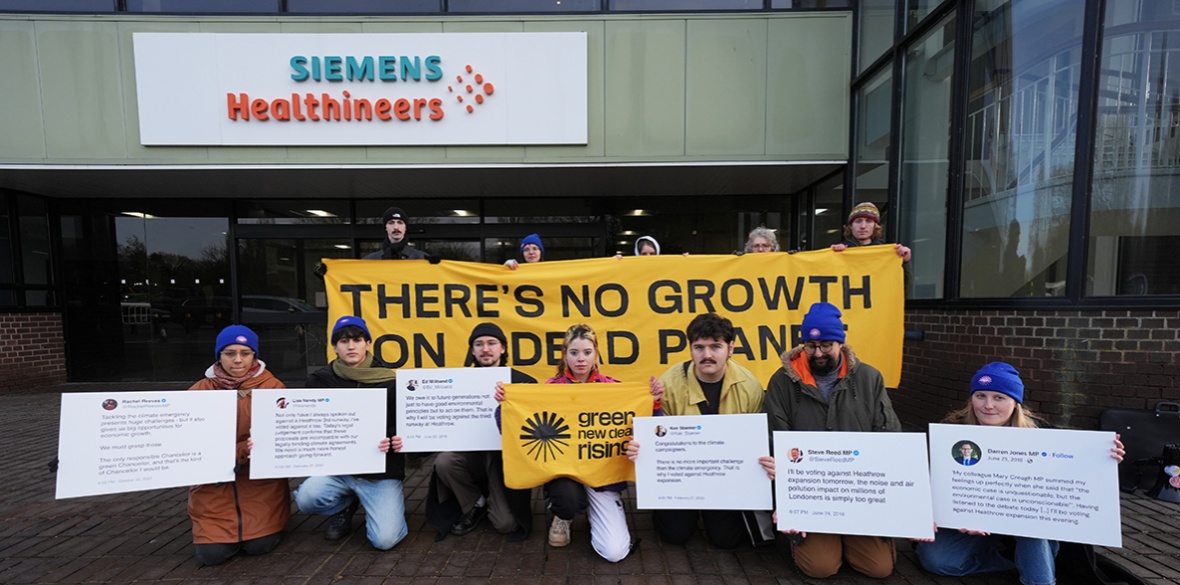
Activists from Fossil Free London and Green New Deal Rising take part in a protest against a third runway at Heathrow, and expansion at Gatwick and Luton, outside Siemens Healthineers in Eynsham, Oxfordshire, January 29, 2025
HEATHROW expansion cannot be the quick fix to the economy, campaigners warned today after the government backed a new multibillion-pound investment programme.
The airport’s chief executive Thomas Woldbye announced funding for upgrades and expansion ahead of its proposal for a third runway, expected to be submitted to the government this summer.
The government said that the investment programme will secure thousands of steel jobs by increasing the demand for British-made steel.
But polling by climate charities suggests a majority of the public believes expansion is the “wrong priority,” with 67 per cent of respondents also saying they did not see much, if any, benefit to taxpayers.
No Third Runway Coalition chairman Paul McGuinness called the announcement “almost Orwellian,” arguing that the government had relied on a Heathrow-commissioned report to promote the project rather than its own Treasury assessment.
…
Greenpeace UK’s chief scientist Dr Doug Parr said that the “real winners” will be Mr Woldbye and “the rest of the polluting aviation industry.”
“The only ‘perks’ for most people will be noise, air pollution and climate emissions,” he said.
Dr Parr said a third runway is “bad economics,” saying: “Instead of picking up any old polluting project from the discard pile, the Chancellor should focus on green industries that can attract investment and bring economic and social benefits for years to come, like secure jobs, affordable energy bills and cheaper, better transport.”
Environmentalists and locals have resisted a third runway at London’s Heathrow, Europe’s busiest airport, for more than two decades. Today, their efforts took a major setback.
The UK government has announced it will give the green light to airport expansion. This is not guaranteed to increase growth in the national economy as Chancellor Rachel Reeves hopes. More flights and more emissions are certain, however, at a time when experts are practically screaming at governments to rein them in.
“No airport expansions should proceed” without a UK-wide plan to annually assess and control the sector’s climate impact said the government’s watchdog, the Climate Change Committee, in 2023. Aeroplanes are 8% of UK emissions and 2% of the world’s, but they also release gases that seed heat-trapping clouds in the upper atmosphere, which triples air travel’s greenhouse effect.
While the government’s own advisers have effectively ruled out new runways for the sake of net zero, airport and airline bosses play a different tune. So what does the sector propose to manage its own pollution?
Not enough cooking oil to save us
Aviation is a notoriously difficult sector to decarbonise says Richard Sulley, a senior research fellow in sustainability policy at the University of Sheffield: “If electric or hydrogen-powered planes are possible, it won’t be for many years yet.”
To justify air travel emissions ballooning in the meantime, the aviation sector has promised a mix of “supply-side” measures, like replacing kerosene with so-called “sustainable aviation fuel” (SAF), which Reeves described as “a game changer”, and making planes lighter and more fuel-efficient.
Efficiency, in this context, is a slippery path to decarbonisation. When a high-emitting activity is reformed so that it consumes less energy, the efficiency savings are generally eclipsed by the increasing demand it drives.
“Indeed, the sector’s own plans for growth will outstrip efforts to decarbonise through synthetic fuel, delivering a neutral effect at best,” Sulley says.
“Demand-side” measures like fewer flights, taxes on frequent flying and domestic flight bans (see France) could cut emissions, he notes, but are seldom mentioned.
The UK has set a target for airline fuel to be 10% SAF by 2030. So far we’re at 1.2% – and Sulley reports that the industry has not said how it will scale up in time.
Even if airlines start taking their commitment to SAF seriously very soon, it’s a dubious solution to aviation’s climate impact according to political economists Gareth Dale (Brunel University) and Josh Moos (Leeds Beckett University).
Earlier SAF test flights burned coconut oil – 3 million coconuts to power a journey from London to Amsterdam, as Dale and Moos calculate it. At that rate, they argue Heathrow would exhaust the world’s entire crop in a few weeks (there are 18,000 commercial airports worldwide).
Modern SAF is blended with waste products from farms and kitchens. But the pair argue that the market for used cooking oil is “notoriously unregulated”. SAF may in fact be relabelled palm oil from plantations that are erasing orangutan habitat in the tropics. Again, Dale and Moos argue there is not enough used cooking oil to meet existing, let alone future, demand.
Transport for the rich, by the rich
At least the hype around SAF addresses the main problem, albeit misleadingly. Policy experts David Howarth (University of Essex) and Steven Griggs (De Montfort University) marvel at how often “carbon-neutral airports” in aviation sustainability strategies simply mean terminals powered by renewable energy.
“A terminal’s heating or lighting is, of course, largely irrelevant when its core business is as emissions-intensive as flying,” says Sulley.
Unfortunately for Rachel Reeves, a 2023 report by the New Economics Foundation found that any economic benefits of airport expansion will be largely confined to the airports themselves. Meanwhile, a wealthy subset of UK society can be expected to capture the biggest share of any new flight capacity. Each year, around half of British residents do not fly at all, Sulley points out.
At the stratospheric heights of that subset are the private jet passengers who are served by “more or less dedicated airports” that are more obscure to the general public, says Raymond Woessner, a geographer at Sorbonne Université. A study published in November found that emissions from these flights rose by 46% between 2019 and 2023. The lead author described wealthy passengers using jets “like taxis”.
“Discretion and anonymity” is what one airport nestled in the Oxfordshire countryside promises for “routine celebrity, head of state and royal visits”. Without state direction or regulation, it is these people who are setting the agenda for air travel.
Woessner notes that the world’s richest man, Elon Musk, successfully lobbied to derail a high-speed rail project in California in 2013. Instead of an option that has shown its ability to cut flight demand, the US will be offered intercontinental rocket travel.
Musk’s company SpaceX says that rockets could ferry passengers between New York and Shanghai in under an hour. Rockets would burn “vastly more fuel per trip than conventional aircraft”, says aerospace engineer Angadh Nanjangud of Queen Mary University of London, but this might “drive critical research into carbon-neutral” methane-based rocket fuel.
It would not be the first time an industry seeking to grow has used an as yet fantastical fuel to justify more carbon in Earth’s atmosphere.
“There is the potential to create a good life for all within planetary boundaries,” say Dale and Moos.
“But getting there requires clipping the wings of the aviation industry.”
Commenting ahead of the Chancellor’s speech on growth when she is expected to signal government backing for airport expansion in the South East, including a third runway at Heathrow, Greenpeace UK’s chief scientist Dr Doug Parr said:
“The third runway at Heathrow is bad economics. There’s little evidence that airport expansion in the southeast will boost the economy – the only things that will grow for sure are noise, air pollution and climate emissions. The last thing our economy needs is more billions in damage from storms and floods.
“Fewer and fewer business people choose air travel – the vast majority of flights are taken by a wealthy elite of frequent leisure flyers. Most of the benefits of airport expansion will go to jet-setters, airlines and airport bosses, leaving taxpayers and holidaymakers to pay billions for new infrastructure and transport links.
“Chasing growth for growth’s sake is not an economic strategy. Instead of picking up any old polluting project from the discard pile, the Chancellor should focus on green industries that can attract investment and bring economic and social benefits for years to come, like secure jobs, affordable energy bills and cheaper, better transport.”
Orcas comment on killer apes destroying the planet by continuing to burn fossil fuels.