Neo-Fascist Climate Science Denier Donald Trump says Burn, Baby, Burn.
The commitment was no new oil or gas extraction. Chancellor Rachel Reeves is expected to abandon that today by announcing new oil and gas extraction in the North Sea. There will be some BS explaining that it’s somehow not new when of course it is. This was expected from these shits (they abandon all their commitments) from the expansion of airports and possibly allowing the huge Rosebank proposed oil field.
Ed Miliband is a useful idiot pretending that the Labour Party have a responsible climate policy which is shown to be untrue and they’re just climate wrecking shits like other right-wingers.
Elon Musk urges you to be a Fascist like him, says that you can ignore facts and reality then.Nigel Farage urges you to ignore facts and reality and be a climate science denier like him and his Deputy Richard Tice. He says that Reform UK has received £Millions and £Millions from the fossil fuel industry to promote climate denial and destroy the planet.
“In light of this latest scientific evidence, it would be dangerously foolish to do anything to put our burning world in even greater danger.
“Yet that is exactly what the government is doing – determined to expand Heathrow and Gatwick airports and refusing to rule out giant new oil and gas fields at Rosebank and Jackdaw coming on stream.
“The government is sending totally the wrong signals to the markets. We need a government committed to speeding up the transition away from fossil fuels. The government must make it clear now that it will not allow new North Sea oil and gas drilling go ahead.
“We must also get serious about how we make our communities more resilient to the now-unavoidable impacts of climate change. We need our homes and our communities to be fit for the future.”
I am only able to quote small sections of this copyrighted article by George Monbiot published in the Guardian. The whole article is here.
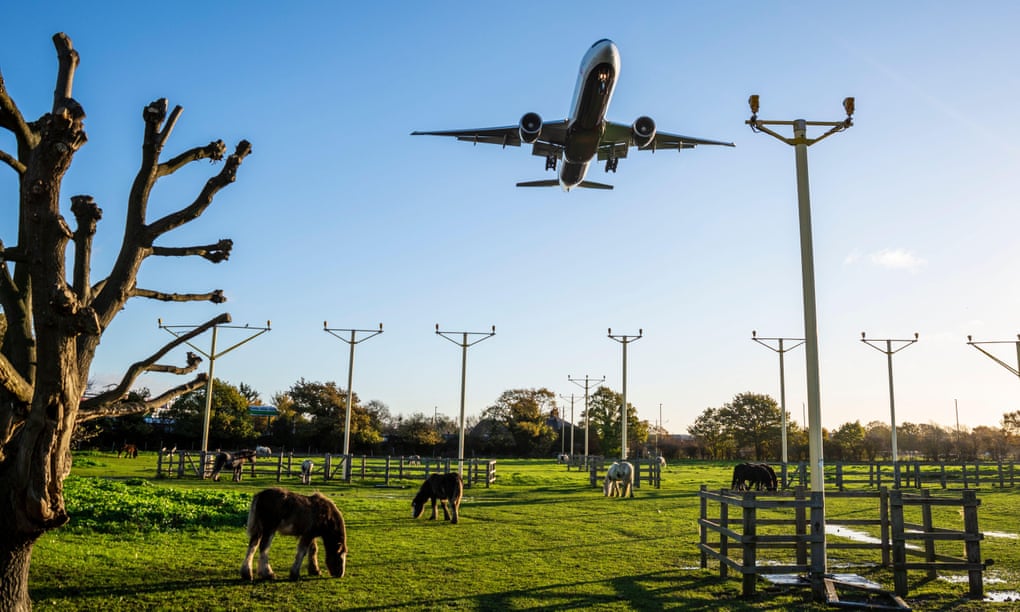
A plane comes into land at Heathrow airport, London. Photograph: Avpics/Alamy
Our rivers, our wildlife, the air we breathe: the government is sacrificing all to the insatiable god of GDP – and mocking our objections
I can scarcely believe I’m writing this, but it’s hard to dodge the conclusion. After 14 years of environmental vandalism, it might have seemed impossible for Labour to offer anything but improvement. But on green issues, this government is worse than the Tories.
The last prime minister to insist that growth should override every other consideration, and to fling insults at anyone who disagreed, was Liz Truss. She called those of us seeking to defend the living world an “anti-growth coalition”, “voices of decline” and “enemies of enterprise” who “don’t understand aspiration”.
Now Keir Starmer has picked up her theme and run with it. Those who challenge government policies that might promote GDP growth, however destructive and irrational, such as the planned expansion of Heathrow, Gatwick, Luton and Doncaster Sheffieldairports, are “time-wasting nimbys”, “zealots” and “blockers”, engaged in “self-righteous virtue-signalling”.
After all, these are the kind of people who might send “congratulations to the climate campaigners” whose legal challenge stopped plans to build a third Heathrow runway at the court of appeal. Or who insist that Heathrow expansion should be blocked because “there is no more important challenge than the climate emergency”. Oh, hang on, that was Starmer, writing in 2020. You know, the one you voted for, not the new model, channelling the worst Tory prime minister of modern times.
Now his chancellor, Rachel Reeves, insists that growth “trumps other things”, including the government’s environmental commitments. The verb is unfortunate. The government’s new rhetoric is horribly reminiscent of the convicted felon: monomania, slogans and insults take the place of nuanced and complex policy.
…
I am only able to quote small sections of this copyrighted article by George Monbiot published in the Guardian. The whole article is here.
Orcas comment on killer apes destroying the planet by continuing to burn fossil fuels.
Planes queuing for takeoff at Heathrow airport in Britain. Credit: david pearson / Alamy Stock Photo
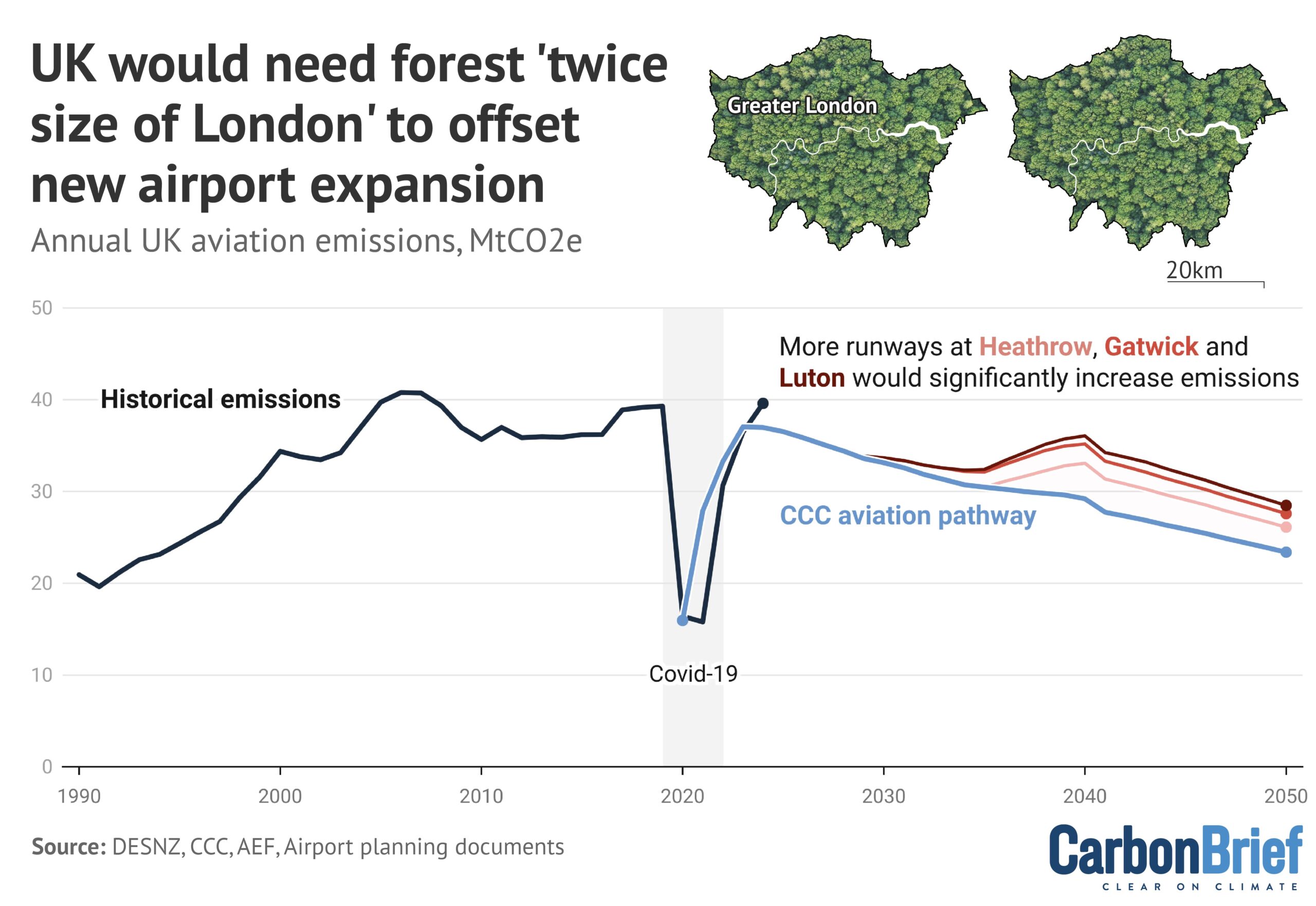
A forest twice the size of Greater London would need to be planted in the UK to cancel out the extra emissions from the expansion of Heathrow, Gatwick and Luton airports, Carbon Brief analysis reveals.
New runaways at these airports surrounding London would result in cumulative emissions of around 92m tonnes of extra carbon dioxide equivalent (CO2e) by 2050, if the number of flights increases in line with their operating company targets.
If the UK is to remain on track for net-zero, it would need to cut emissions further in other sectors of the economy or remove an equivalent amount from the atmosphere.
For example, offsetting these emissions would require more than 300,000 hectares of trees to be planted within just a few years. This equates to all the trees planted in the UK since 2000.
The Labour government is set to back all three airport expansions, according to mediareporting ahead of a speech by chancellor Rachel Reeves this week.
This is in spite of opposition from within the Labour party and the government’s climate advisors recommending against airport expansion.
Reeves has stressed that “sustainable aviation fuels” (SAFs) and electric planes could help to offset these emissions.
However, such technologies are still in the early stages of deployment and previous Carbon Brief analysis suggests the role of SAFs in achieving net-zero may be limited.
Two Londons
Reeves is expected to reveal plans for a third runway at Heathrow in a speech on Wednesday.
This, alongside suggestions she will also announce her support for the expansion of Gatwick and Luton airports, has prompted days of political debate over the friction between the government’s climate and economic plans.
Reeves sees the expansion of airports as a key part of the government’s “growth strategy”. However, senior Labour politicians, notably energy secretary Ed Miliband, have previously opposed such expansions on environmental grounds.
For her part, the chancellor told BBC News that she thought “sustainable aviation and economic growth go hand in hand”.
Carbon Brief has used estimates of passenger numbers from the airports’ planning applications, combined with assumptions used by UK government advisors the Climate Change Committee (CCC), to calculate emissions from the three expansions.
As the chart below shows, the CCC assumes aviation emissions fall in the coming years due to technological and efficiency improvements.
However, the expansion of Heathrow, Gatwick and Luton would drive an uptick in emissions around 2040 as the projects are completed, if the expected number of extra flights take off and if there are no additional improvements in aircraft efficiency.
This would amount to an additional 92MtCO2e being emitted cumulatively by 2050.
In order to remain on track for the UK’s net-zero target, these emissions would need to be avoided by additional technological innovations in the aviation sector, balanced by faster cuts in other parts of the economy – or removed from the atmosphere after being emitted.
Annual UK aviation emissions, MtCO2e. The blue line indicates the trajectory for emissions set out by the CCC. The three red lines indicate the additional emissions that would result from the expansion of Heathrow, Gatwick and Luton airports, plus the resulting flights. The airport expansions are assumed to follow approximate timelines based on their respective planning applications, with some dates assumed based on the views of AEF. The Heathrow expansion is assumed to be in operation in 2035 and at full capacity by 2040. The Gatwick expansion is assumed to be operational in 2028 and at full capacity by 2038. The Luton expansion is assumed to be operational in 2033 and at full capacity by 2043. Sources: DESNZ, CCC, AEF, airport planning documents.
Aviation is generally viewed as a difficult sector to decarbonise, due to the lack of cheap and effective technologies to cut emissions from planes.
This is why campaigners and researchers frequently stress demand reduction as the most effective way to cut aviation emissions.
The UK’s net-zero plans already allow for aviation to be one of the final sectors producing sizable volumes of emissions in 2050, when most of the economy has decarbonised.
One strategy to remove the excess emissions from the additional Heathrow, Gatwick and Luton flights would be to plant more trees. However, this would be a significant undertaking, as Carbon Brief analysis shows.
It would require planting around 301,000 hectares of new forest by around 2028 so that the trees are large enough by the middle of the century to absorb significant amounts of CO2.
This is equivalent to around twice the size of Greater London, which covers 157,000 hectares. It is 10 times higher than the UK’s most recent annual tree-planting target and equates to all of the trees planted in the past 24 years across the country.
More passengers
Government advisors at the CCC have recommended that there should be no more than a 25% growth in the number of air passengers from 2018 levels, in order to meet the UK’s net-zero goal by 2050.
This amounts to an increase from 292 million passengers to 365 million by 2050. The number of UK flights collapsed during Covid-19 lockdowns and has been slow to recover to pre-pandemic levels, but the number of air passengers in 2023 reached 273 million.
The CCC has consistentlystressed that there should be “no net increase” in airport capacity if the UK is to reach net-zero by the middle of the century, meaning any expansion is “balanced by reductions in capacity elsewhere”. It has also stated there should be no airport expansion without a UK-wide framework for managing capacity.
The committee criticised the previous Conservative government for setting “no plans” to limit growth in passenger numbers in its “jet-zero” strategy, which envisaged demand for flying increasing by 70% out to 2050.
Airport expansion at Heathrow, Gatwick and Luton would help bring the total number of passengers at these three sites up to 243 million in 2050, according to the airports’ own planning applications, compiled by the Aviation Environment Federation (AEF).
This amounts to an additional 100m passengers passing through these airports, compared to 2018 levels. This would bring the total number of UK passengers to 392 million – equivalent to a 34% increase in UK airport traffic – meaning that growth at Heathrow, Gatwick and Luton alone would be enough to breach the CCC’s guidance.
(In reality, more than 20 UK airports have plans for more capacity and some already have unused capacity, so it is unlikely that expansion would be limited to three airports around London.)
SAF concerns
The CCC leaves some flexibility in its advice to the government, allowing for future capacity growth, if “the carbon intensity of aviation is outperforming the government’s emissions reduction pathway”.
Essentially, if clean technologies slash aviation emissions faster than expected, then there will be space for more flights within a pathway to net-zero by 2050.
This has been alluded to by Reeves in recent days. She has stated that a “lot has changed in terms of aviation” and reportedly based an internal proposal to expand Heathrow on the use of “sustainable aviation fuels” (SAFs).
In reality, there has been very limited progress in developing SAFs or any other technologies to decarbonise planes in the UK. In 2023, the CCC chastised the Conservative government for “rel[ying] heavily on nascent technologies”.
Government modelling has shown SAFs will have a limited impact on cutting UK aviation emissions. Experts have pointed to the issues with the supply of materials for making SAFs and noted that none of the five SAF plants originally pegged to start construction in the UK this year are being built yet.
Methodology
This analysis is based on the CCC’s sixth carbon budget “balanced pathway” for the aviation sector, combined with data obtained from AEF on the expected increase in passenger numbers from the expansion of Heathrow, Gatwick and Luton airports.
The CCC pathway assumes that the emissions per passenger fall from 0.14 tCO2 in 2020 to 0.06tCO2 in 2050, accounting for the rollout of SAF and more efficient aircraft. It also assumes that no net expansion of airport capacity occurs.
Therefore, in this analysis, the three airport expansions are considered additional to the emissions included within the CCC pathway.
To calculate the additional emissions from the expansion of the three airports, the additional passenger numbers this would facilitate are multiplied by the emissions intensity per passenger in each year of the CCC pathway.
The additional passenger numbers from each airport are added to a Department for Transport pathway that assumes no further expansion. Each airport expansion is assumed to ramp up linearly from the year of operation to the year of operation at full additional capacity.
Based on the airport planning applications and AEF, it is assumed that:
The Heathrow expansion will be operational by 2035 and operating at full capacity by 2040.
The Gatwick expansion will be operational by 2028 and operating at full capacity by 2038.
The Luton expansion will be operational by 2033 and operating at full capacity by 2043.
The calculated CO2 removals from planting trees are based on assumptions used by the CCC’s sixth carbon budget “balanced pathway”, in which there is a 2:1 ratio of conifers to broadleaves planted across the country.
The CO2 removals per hectare for conifers and broadleaves are taken from the UK Centre for Ecology and Hydrology (CEH), whose numbers are also used by the CCC.
Based on these numbers, the cumulative emissions removed per hectare of forest after 22 years – from the start of airport expansion in 2028 to 2050 – is 304tCO2. Dividing this value by the total additional cumulative emissions from the airport expansion (92 MtCO2), gives a total area required of 301,000ha. Given that Greater London is 157,200ha, this corresponds to approximately two (1.91) times the area of Greater London.
Historical UK aviation emissions are taken from the Department of Energy Security and Net Zero (DESNZ) up to 2022. For 2023 and 2024, the emissions are estimated based on percentage annual changes in UK jet fuel use, which are then applied to the emissions from 2022.
Police, security and medical staff parked their vehicles after Letzte Generation (Last Generation) activists staged a demonstration at Frankfurt airport. Photograph: Timm Reichert/Reuters
Flights at Germany’s busiest airport ‘gradually resuming’ on second day of coordinated ‘oil kills’ protests
Climate activists have disrupted flights at Frankfurt and Oslo airports on the second day of coordinated “oil kills” protests across Europe and North America.
Demanding an end to fossil fuels by 2030, supporters of Letzte Generation (Last Generation) briefly suspended flights at Frankfurt airport on Thursday morning. The activists said they had cut a wire fence, entered on bicycles and skateboards and glued themselves to the tarmac.
In Oslo, protesters from Folk Mot Fossilmakta and Scientist Rebellion Norway caused large queues by blocking a check-in lane with a banner that read: “Fast track to phase out.”
“I would rather not be here today, but I can no longer stand and watch as our elected officials do too little, too slowly,” said Ina Nagler, a climate researcher who took part in the Oslo protest. “The science is clear: We must drastically reduce the use of fossil fuels during this decade.”
The protests, which seek to pressure governments to speed the shift to a clean economy, have hit airports during the start of the busy summer season. On Wednesday morning, activists disrupted travel plans at airports from Helsinki to Barcelona. Further airport protests are expected in the US and Canada on Thursday.