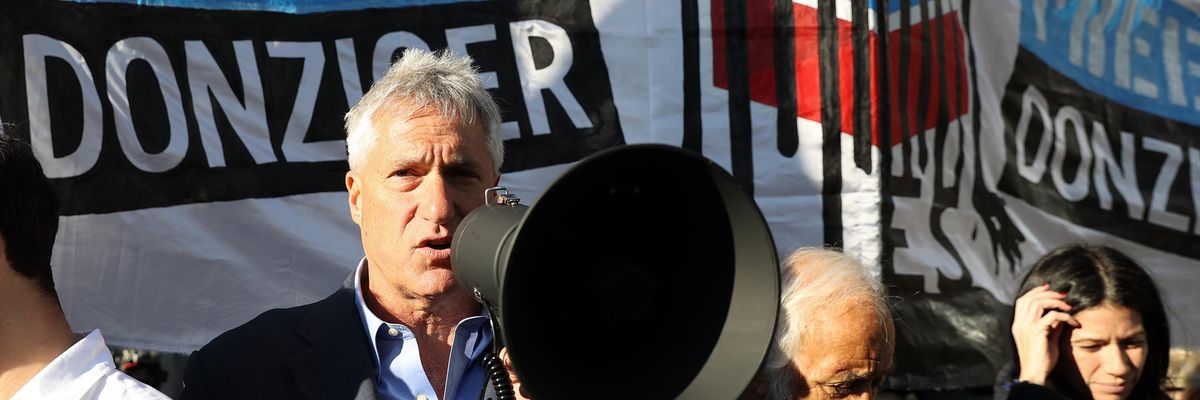
Steven Donziger speaks at a “Free Donziger” rally held in front of the Manhattan Court House in New York City on October 1, 2021. (Photo: Tayfun Coskun/Anadolu Agency via Getty Images)
“We are deeply concerned about the chilling effect this case will have on all advocates working on behalf of other frontline communities, victims of human rights violations, and those seeking environmental justice.”
More than 30 Democratic members of Congress on Wednesday called on outgoing U.S. President Joe Biden to pardon environmental and human rights lawyer Steven Donziger, who endured nearly 1,000 days in prison and house arrest after successfully representing Ecuadoreans harmed by Big Oil’s pollution of the Amazon rainforest.
In a letter to Biden led by Rep. Jim McGovern, (D-Mass.), 33 House and Senate Democrats plus Independent U.S. Sen. Bernie Sanders of Vermont noted the “troubling legal irregularities” in Donziger’s case, which have been “criticized as unconstitutional or illegal by three federal judges, 68 Nobel laureates, and five high-level jurists from the Working Group on Arbitrary Detention of the United Nations.”
Donziger represented a group of Ecuadorean farmers and Indigenous people in a 1990s lawsuit against Texaco—which was later acquired by Chevron—over the oil company’s deliberate dumping of billions of gallons of carcinogenic waste into the Amazon. He played a key role in winning a $9.5 billion settlement against Chevron in Ecuadorian courts.
Sorry, this content could not be embedded. WordPress / X
However, Chevron fought Donziger in the U.S. court system, and when the attorney refused to disclose privileged client information to the company, federal District Judge Lewis Kaplan—who was invested in Chevron—held him in misdemeanor contempt of court. Loretta Preska, Kaplan’s handpicked judge to preside over Donziger’s contempt trial, is affiliated with the Chevron-funded Federalist Society.
Donziger’s case drew worldwide attention and solidarity, with human rights experts and free speech groups joining progressive U.S. lawmakers in demanding his release. He was released in April 2022 after 993 days in prison and house arrest.
“Donziger is the only lawyer in U.S. history to be subject to any period of detention on a misdemeanor contempt of court charge,” the 34 lawmakers wrote. “We believe that the legal case against Mr. Donziger, as well as the excessively harsh nature of the punishment against him, are directly tied to his prior work against Chevron. We do not make this accusation lightly or without evidentiary support.”
The legislators warned:
Notwithstanding the personal hardship, this unprecedented legal process has imposed on Mr. Donziger and his family, we are deeply concerned about the chilling effect this case will have on all advocates working on behalf of other frontline communities, victims of human rights violations, and those seeking environmental justice. Those who try to help vulnerable communities will feel as though tactics of intimidation—at the hands of powerful corporate interests, and, most troublingly, the U.S. courts—can succeed in stifling robust legal representation when it is needed most. This is a dangerous signal to send.
“Pardoning Mr. Donziger,” the lawmakers added, “would send a powerful message to the world that billion-dollar corporations cannot act with impunity against lawyers and their clients who defend the public interest.”
The lawmakers join more than 100 environmental and human rights groups that have urged Biden to pardon Donziger.
Sorry, this content could not be embedded. WordPress / X
In an April opinion piece published by Common Dreams, Donziger contended that “I need this pardon because I am the only person in U.S. history to be privately prosecuted by a corporation.”
“More specifically, the government (via a pro-corporate judge) gave a giant oil company (Chevron) the power to prosecute and lock up its leading critic,” he continued. “As a result of this unprecedented and frightening private prosecution, I still cannot travel out of the country and I have been prohibited from meeting with clients I have represented for over three decades. Nor can I practice law, maintain a bank account, or earn a livelihood.”
“No matter where one stands on the political spectrum,” Donziger added, “we should all be able to agree that what happened to me should not happen to anybody in any country that adheres to the rule of law.”
The appeal for a Donziger pardon comes amid a wave of eleventh-hour pleas from lawmakers for Biden to grant clemency to figures ranging from WikiLeaks founder Julian Assange and National Security Agency whistleblower Edward Snowden to Indigenous activist Leonard Peltier—often described as the nation’s longest-jailed political prisoner—and federal death row inmates including Billie Jerome Allen, who advocates say was wrongly convicted of murder.
Amazion founder Jeff Bezos participates in a discussion during a Milestone Celebration dinner September 13, 2018 in Washington, D.C. (Photo: Alex Wong/Getty Images)
The total wealth of billionaires increased by 121% from 2015-24.
Driven largely by the accumulation of massive wealth by the richest people in the United States, the Swiss wealth manager UBS said Thursday the assets of billionaires around the world more than doubled over the past decade.
Between 2015-24, the total wealth of billionaires increased by 121%, from $6.3 trillion to $14 trillion.
Meanwhile, the MSCI AC World Index of global equities, which measures the performance of more than 3,000 stocks from both developed and emerging markets, rose by 73%.
The planet’s total gross domestic product is about $105.4 trillion, with a population of just over 8 billion, underscoring the extreme concentration of wealth among the very richest people.
The number of billionaires rose from 1,757 to 2,682 over the past decade, while the wealthiest people in the world boasted significant gains over just the past year.
Billionaires’ wealth jumped by about 17% in 2024, with the accumulation of wealth among the richest people in the U.S. offsetting a decline in China.
U.S. billionaires amassed wealth gains that were 27.6% higher than the previous year, accumulating a total of $5.8 trillion—more than 40% of international billionaire wealth.
The tax cuts pushed through by President-elect Donald Trump and the Republican Party in 2017 are still in effect in the U.S. Tax policy analysts have found that the law was skewed to the rich, with households in the top 1% of incomes expecting to receive an average tax cut of more than $60,000 in 2025 compared to an average tax cut of less than $500 for people in the bottom 60%.
As Common Dreams reported this week, the top 12 U.S. billionaires now control $2 trillion. The wealth of the four richest people in the U.S.—Tesla CEO Elon Musk, Amazon founder Jeff Bezos, Oracle co-founder Larry Ellison, and Meta CEO Mark Zuckerberg—has hit $1 trillion.
This article was originally posted 6/12/24 but was deleted probably by mistake.
Mark Zuckerberg, CEO of Meta, testifies before a U.S. Senate Judiciary Committee hearing on January 31, 2024, in Washington, D.C. (Photo: Celal Gunes/Anadolu via Getty Images)
“In the blind sprint to win on AI, Meta and the other tech giants have lost their way,” said a leader at Environment America.
Environmental advocates this week responded with concern to Meta looking for nuclear power developers to help the tech giant add 1-4 gigawatts of generation capacity in the United States starting in the early 2030s.
Meta—the parent company of Instagram, Facebook, WhatsApp, and more—released a request for proposals to identify developers, citing its artificial intelligence (AI) innovation and sustainability objectives. It is “seeking developers with strong community engagement, development, …permitting, and execution expertise that have development opportunities for new nuclear energy resources—either small modular reactors (SMR) or larger nuclear reactors.”
The company isn’t alone. As TechCrunch reported: “Microsoft is hoping to restart a reactor at Three Mile Island by 2028. Google is betting that SMR technology can help it deliver on its AI and sustainability goals, signing a deal with startup Kairos Power for 500 megawatts of electricity. Amazon has thrown its weight behind SMR startup X-Energy, investing in the company and inking two development agreements for around 300 megawatts of generating capacity.”
In response to Meta’s announcement, Johanna Neumann, Environment America Research & Policy Center’s senior director of the Campaign for 100% Renewable Energy, said: “The long history of overhyped nuclear promises reveals that nuclear energy is expensive and slow to build all while still being inherently dangerous. America already has 90,000 metric tons of nuclear waste that we don’t have a storage solution for.”
“Do we really want to create more radioactive waste to power the often dubious and questionable uses of AI?” Neumann asked. “In the blind sprint to win on AI, Meta and the other tech giants have lost their way. Big Tech should recommit to solutions that not only work but pose less risk to our environment and health.”
“Data centers should be as energy and water efficient as possible and powered solely with new renewable energy,” she added. “Without those guardrails, the tech industry’s insatiable thirst for energy risks derailing America’s efforts to get off polluting forms of power, including nuclear.”
In a May study, the Electric Power Research Institute found that “data centers could consume up to 9% of U.S. electricity generation by 2030—more than double the amount currently used.” The group noted that “AI queries require approximately 10 times the electricity of traditional internet searches and the generation of original music, photos, and videos requires much more.”
Meta is aiming to get the process started quickly: The intake form is due by January 3 and initial proposals are due February 7. It comes after a rare bee species thwarted Meta’s plans to build a data center powered by an existing nuclear plant.
Following the nuclear announcement, Meta and renewable energy firm Invenergy on Thursday announced a deal for 760 megawatts of solar power capacity. Operations for that four-state project are expected to begin no later than 2027.
A view of Google Headquarters in Mountain View, California, United States on March 23, 2024 [Tayfun Coşkun – Anadolu Agency]
A damning report, “Palestinian Digital Rights, Genocide, and Big Tech Accountability”, by 7amleh, a Palestinian-led non-profit organisation that is focused on protecting the human rights of Palestinians, has laid bare the disturbing and active role that major online platforms and big tech companies play in perpetuating human rights abuses against Palestinians. While the world watches the horrors unfold in Gaza, the role of these digital accomplices cannot be ignored. The report highlights that platforms like Meta, X, YouTube and tech giants Google and Amazon have enabled, facilitated and even profited from these atrocities, effectively shielding war crimes under a digital smokescreen.
The findings are a harrowing indictment of how big tech companies, under the guise of neutrality, have become active participants in censorship, disinformation and incitement to violence. They have provided crucial infrastructure that underpins Israel’s military actions, allowing their platforms to be weaponised, silencing Palestinian voices while amplifying hate speech and calls for genocide. The complicity of these platforms is not a mere oversight; it is an entrenched system of deliberate decision-making that prioritises profits over human rights.
Systematic censorship of Palestinian voices
At the heart of the report’s findings is a shocking pattern of systematic censorship targeting Palestinian voices. Between October 2023 and July 2024, over 1,350 instances of censorship were documented on major platforms, including Facebook, Instagram, X and TikTok. These platforms disproportionately targeted Palestinian journalists, activists and human rights defenders, with Meta’s platforms being among the worst offenders. The censorship took many forms: accounts were suspended, content takedowns became routine and distribution of pro-Palestinian narratives was heavily restricted.
Meta’s manipulative algorithm changes played a key role in this censorship. The report reveals that during the ongoing war in Gaza, Meta altered its content moderation policies to lower the threshold for flagging Palestinian content, reducing the accuracy of its filters and triggering unnecessary takedowns. For Palestinian content, Meta’s filters operated with a mere 25 per cent certainty of a violation, compared to the usual 80 per cent applied elsewhere. These so-called “temporary risk response measures” were never lifted, allowing for an outsized level of scrutiny on Palestinian content creators. This is not an isolated incident – it’s a calculated, discriminatory policy that silences marginalised voices and hinders the free flow of information at a time when it’s needed the most.
As 7amleh’s report highlights, Meta’s broken promises to safeguard free speech, coupled with its biased content moderation, exacerbated the situation for Palestinians. Human Rights Watch had already condemned Meta for its systemic censorship of Palestinian voices during the war, with over 1,050 instances of content removal on Facebook and Instagram. In nearly all cases, this censorship targeted peaceful, pro-Palestinian content while allowing violent, anti-Palestinian content to flourish unchecked. Comments like “Free Palestine”, “Stop the Genocide” and “Ceasefire Now” were removed under Meta’s spam guidelines, reflecting a dangerous double standard that stifles legitimate political discourse.
Platforms as instruments of genocide
The report makes clear that online platforms are not simply neutral forums but have become instruments of incitement to genocide. Between October 2023 and July 2024, over 3,300 instances of harmful content – including incitement to genocide – were documented, the majority on X and Facebook. These platforms allowed high-level Israeli officials and other users to openly call for the extermination of Palestinians, dehumanising them as “sub-humans”, “animals” and worse. This genocidal rhetoric wasn’t limited to obscure corners of the internet. It was promoted, amplified and left unchallenged by the very platforms that claim to be committed to community standards and human rights.
For instance, on X, a December 2023 post by the deputy mayor of Jerusalem described blindfolded Palestinian detainees as “ants” and called for burying them alive. Although this specific post was eventually removed, countless others like it remain, fuelling a climate of violence and dehumanisation against Palestinians. This failure to combat hate speech directly contravenes international law, particularly in light of the International Court of Justice’s January 2024 order, which directed Israel to prevent and punish incitement to genocide.
These platforms are not just failing in their duty to protect free speech; they are actively facilitating the spread of genocidal propaganda. In the case of Meta, the report details how over 9,500 takedown requests from the Israeli government were sent to Meta between October and November 2023, with a shocking 94 per cent compliance rate. This high level of cooperation with a state actively committing war crimes raises serious concerns about the ethical boundaries of these companies. Meta’s decision to comply with such requests without transparency or accountability reveals a deeper issue: these platforms are willing to become tools of state oppression when the price is right.
The role of Big Tech: Project Nimbus and the automation of killing
Beyond the sphere of social media, Google and Amazon’s collaboration with the Israeli military under Project Nimbus casts an even darker shadow over the tech industry’s role in this conflict. The $1.2 billion cloud computing contract, as the report highlights, provides critical infrastructure to power Israel’s AI-driven Lavender and Gospel targeting systems – systems that are directly linked to the mass civilian casualties in Gaza.
The Lavender system, in particular, functions as a tool for automated killings, identifying targets based on massive data inputs and feeding them into the Israeli military’s bombing campaigns. The report describes how Lavender alone identified over 37,000 potential targets, contributing to the deaths of thousands of civilians, including women and children. By providing cloud services to facilitate this mass-scale targeting, Google and Amazon are directly implicated in these violations of international law. Despite mounting global pressure, both companies continue to support Israel’s military operations under Project Nimbus, even as the civilian death toll in Gaza rises.
Hate speech and disinformation: A coordinated assault on truth
The report goes on to document a deluge of hate speech and disinformation campaigns, often spearheaded by Israeli officials and amplified by online platforms. These campaigns, which include the systematic dissemination of dehumanising content on Telegram, X and YouTube, have targeted Palestinians both inside Gaza and across the diaspora. The report cites three million instances of violent content in Hebrew aimed at Palestinians on X alone, much of it coordinated by Israeli state actors.
Perhaps most troubling is the Israeli government’s influence operation known as STOIC, which ran a disinformation campaign targeting US and Canadian lawmakers to undermine the work of The United Nations Relief and Works Agency for Palestine Refugees in the Near East (UNRWA). This campaign, orchestrated with the help of AI, spread false narratives that led to the defunding of UNRWA, cutting off critical humanitarian aid to Palestinians. This is not merely a failure of moderation but an example of how platforms can be weaponised for state-driven disinformation, with devastating consequences for innocent civilians.
Profiting from genocide: Advertising amidst war crimes
As if censorship and disinformation weren’t enough, the report also exposes how platforms like Facebook have profited from harmful advertisements promoting violence against Palestinians. The investigation found that Facebook ran ads calling for the assassination of pro-Palestinian activists and the forced expulsion of Palestinians from the West Bank. Meta profited from these campaigns, further entrenching its complicity in the human rights violations unfolding in Gaza.
Meanwhile, YouTube ran ads from the Israeli government that used graphic imagery to sway public opinion in favour of its military actions in Gaza. Despite YouTube’s policies against violent content, these ads flooded social media with incendiary narratives, particularly in Europe and the US, contributing to the normalisation of war crimes under the guise of counter-terrorism.
Time for accountability
The findings of this report should compel the international community to act. It is no longer acceptable for tech companies to hide behind vague policies and empty commitments to free speech while facilitating the mass killing and silencing of a besieged population. The complicity of Meta, X, YouTube, Google and Amazon in these atrocities must be brought into the spotlight and held accountable for their role in enabling these crimes.
These platforms are not neutral arbiters of truth – they are corporations driven by profit, willing to accommodate genocidal regimes and turn a blind eye to the suffering of millions if it serves their bottom line. As the report makes clear, it is time for the world to demand that these companies stop profiting from the destruction of Palestinian lives. The silence and complicity of big tech are unforgivable, and they must not be allowed to escape responsibility any longer.
The views expressed in this article belong to the author and do not necessarily reflect the editorial policy of Middle East Monitor.
Record breaking fossil fuel production, all time high greenhouse gas emissions and extreme temperatures. Like the proverbial frog in the heating pan of water, we refuse to respond to the climate and ecological crisis with any sense of urgency. Under such circumstances, claims from some that global warming can still be limited to no more than 1.5°C take on a surreal quality.
For example, at the start of 2023’s international climate negotiations in Dubai, conference president, Sultan Al Jaber, boldly stated that 1.5°C was his goal and that his presidency would be guided by a “deep sense of urgency” to limit global temperatures to 1.5°C. He made such lofty promises while planning a massive increase in oil and gas production as CEO of the Abu Dhabi National Oil Company.
We should not be surprised to see such behaviour from the head of a fossil fuel company. But Al Jaber is not an outlier. Scratch at the surface of almost any net zero pledge or policy that claims to be aligned with the 1.5°C goal of the landmark 2015 Paris agreement and you will reveal the same sort of reasoning: we can avoid dangerous climate change without actually doing what this demands – which is to rapidly reduce greenhouse gas emissions from industry, transport, energy (70% of total) and food systems (30% of total), while ramping up energy efficiency.
This is also not surprising given that net zero and even the Paris agreement have been built around the perceived need to keep burning fossil fuels, at least in the short term. Not do so would threaten economic growth, given that fossil fuels still supply over 80% of total global energy. The trillions of dollars of fossil fuel assets at risk with rapid decarbonisation have also served as powerful brakes on climate action.
Overshoot
The way to understand this doublethink: that we can avoid dangerous climate change while continuing to burn fossil fuels – is that it relies on the concept of overshoot. The promise is that we can overshoot past any amount of warming, with the deployment of planetary-scale carbon dioxide removal dragging temperatures back down by the end of the century.
This not only cripples any attempt to limit warming to 1.5°C, but risks catastrophic levels of climate change as it locks us in to energy and material-intensive solutions which for the most part exist only on paper.
To argue that we can safely overshoot 1.5°C, or any amount of warming, is saying the quiet bit out loud: we simply don’t care about the increasing amount of suffering and deaths that will be caused while the recovery is worked on.
This article is part of Conversation Insights. Our co-editors commission long-form journalism, working with academics from many different backgrounds who are engaged in projects aimed at tackling societal and scientific challenges.
A key element of overshoot is carbon dioxide removal. This is essentially a time machine – we are told we can turn back the clock of decades of delay by sucking carbon dioxide directly out of the atmosphere. We don’t need rapid decarbonisation now, because in the future we will be able to take back those carbon emissions. If or when that doesn’t work, we are led to believe that even more outlandish geoengineering approaches such as spraying sulphurous compounds into the high atmosphere in an attempt to block out sunlight – which amounts to planetary refrigeration – will save us.
The 2015 Paris agreement was an astonishing accomplishment. The establishment of 1.5°C as being the internationally agreed ceiling for warming was a success for those people and nations most exposed to climate change hazards. We know that every fraction of a degree matters. But at the time, believing warming could really be limited to well below 2°C required a leap of faith when it came to nations and companies putting their shoulder to the wheel of decarbonisation. What has happened instead is that the net zero approach of Paris is becoming detached from reality as it is increasingly relying on science fiction levels of speculative technology.
There is arguably an even bigger problem with the Paris agreement. By framing climate change in terms of temperature, it focuses on the symptoms, not the cause. 1.5°C or any amount of warming is the result of humans changing the energy balance of the climate by increasing the amount of carbon dioxide in the atmosphere. This traps more heat. Changes in the global average temperature is the established way of measuring this increase in heat, but no one experiences this average.
Climate change is dangerous because of weather that affects particular places at particular times. Simply put, this extra heat is making weather more unstable. Unfortunately, having temperature targets makes solar geoengineering seem like a sensible approach because it may lower temperatures. But it does this by not reducing, but increasing our interference in the climate system. Trying to block out the sun in response to increasing carbon emissions is like turning on the air conditioning in response to a house fire.
In 2021 we argued that net zero was a dangerous trap. Three years on and we can see the jaws of this trap beginning to close, with climate policy being increasingly framed in terms of overshoot. The resulting impacts on food and water security, poverty, human health, the destruction of biodiversity and ecosystems will produce intolerable suffering.
The situation demands honesty, and a change of course. If this does not materialise then things are likely to deteriorate, potentially rapidly and in ways that may be impossible to control.
Au revoir Paris
The time has come to accept that climate policy has failed, and that the 2015 landmark Paris agreement is dead. We let it die by pretending that we could both continue to burn fossil fuels and avoid dangerous climate change at the same time. Rather than demand the immediate phase out of fossil fuels, the Paris agreement proposed 22nd-century temperature targets which could be met by balancing the sources and sinks of carbon. Within that ambiguity net zero flourished. And yet apart from the COVID economic shock in 2020, emissions have increased every year since 2015, reaching an all time high in 2023.
Despite there being abundant evidence that climate action makes good economic sense (the cost of inaction vastly exceeds the cost of action), no country strengthened their pledges at the last three COPs (the annual UN international meetings) even though it was clear that the world was on course to sail past 2°C, let alone 1.5°C. The Paris agreement should be producing a 50% reduction in greenhouse gas emissions by 2030, but current policies mean that they are on track to be higher than they are today.
We do not deny that significant progress has been made with renewable technologies. Rates of deployment of wind and solar have increased each year for the past 22 years and carbon emissions are going down in some of the richest nations, including the UK and the US. But this is not happening fast enough. A central element of the Paris agreement is that richer nations need to lead decarbonisation efforts to give lower income nations more time to transition away from fossil fuels. Despite some claims to the contrary, the global energy transition is not in full swing. In fact, it hasn’t actually begun because the transition demands a reduction in fossil fuel use. Instead it continues to increase year-on-year.
And so policymakers are turning to overshoot in an attempt to claim that they have a plan to avoid dangerous climate change. A central plank of this approach is that the climate system in the future will continue to function as it does today. This is a reckless assumption.
2023’s warning signs
At the start of 2023, Berkeley Earth, NASA, the UK Met Office, and Carbon Briefpredicted that 2023 would be slightly warmer than the previous year but unlikely to set any records. Twelve months later and all four organisations concluded that 2023 was by some distance the warmest year ever recorded. In fact, between February 2023 and February 2024 the global average temperature warming exceeded the Paris target of 1.5°C.
Currently we cannot fully explain why global temperatures have been so high for the past 18 months. Changes in dust, soot and other aerosols are important, and there are natural processes such as El Niño that will be having an effect.
But it appears that there is still something missing in our current understanding of how the climate is responding to human impacts. This includes changes in the Earth’s vital natural carbon cycle.
Around half of all the carbon dioxide humans have put into the atmosphere over the whole of human history has gone into “carbon sinks” on land and the oceans. We get this carbon removal “for free”, and without it, warming would be much higher. Carbon dioxide from the air dissolves in the oceans (making them more acidic which threatens marine ecosystems). At the same time, increasing carbon dioxide promotes the growth of plants and trees which locks up carbon in their leaves, roots, trunks.
All climate policies and scenarios assume that these natural carbon sinks will continue to remove tens of billions of tons of carbon from the atmosphere each year. There is evidence that land-based carbon sinks, such as forests, removed significantly less carbon in 2023. If natural sinks begin to fail – something they may well do in a warmer world – then the task of lowering global temperatures becomes even harder. The only credible way of limiting warming to any amount, is to stop putting greenhouse gasses into the atmosphere in the first place.
Science fiction solutions
It’s clear that the commitments countries have made to date as part of the Paris agreement will not keep humanity safe while carbon emissions and temperatures continue to break records. Indeed, proposing to spend trillions of dollars over this century to suck carbon dioxide out of the air, or the myriad other ways to hack the climate is an acknowledgement that the world’s largest polluters are not going to curb the burning of fossil fuels.
Over the following years we are going to see climate impacts increase. Lethal heatwaves are going to become more common. Storms and floods are going to become increasingly destructive. More people are going to be displaced from their homes. National and regional harvests will fail. Vast sums of money will need to be spent on efforts to adapt to climate change, and perhaps even more compensating those who are most affected. We are expected to believe that while all this and more unfolds, new technologies that will directly modify the Earth’s atmosphere and energy balance will be successfully deployed.
What’s more, some of these technologies may need to operate for three hundred years in order for the consequences of overshoot to be avoided. Rather than quickly slow down carbon polluting activities and increasing the chances that the Earth system will recover, we are instead going all in on net zero and overshoot in an increasingly desperate hope that untested science fiction solutions will save us from climate breakdown.
We can see the cliff edge rapidly approaching. Rather than slam on the brakes, some people are instead pushing their foot down harder on the accelerator. Their justification for this insanity is that we need to go faster in order to be able to make the jump and land safely on the other side.
We believe that many who advocate for carbon dioxide removal and geoengineering do so in good faith. But they include proposals to refreeze the Arctic by pumping up sea water onto ice sheets to form new layers of ice and snow. These are interesting ideas to research, but there is very little evidence this will have any effect on the Arctic let alone global climate. These are the sorts of knots that people tie themselves up in when they acknowledge the failure of climate policy, but refuse to challenge the fundamental forces behind such failure. They are unwittingly slowing down the only effective action of rapidly phasing out fossil fuels.
That’s because proposals to remove carbon dioxide from the air or geoengineer the climate promise a recovery from overshoot, a recovery that will be delivered by innovation, driven by growth. That this growth is powered by the same fossil fuels that are causing the problem in the first place doesn’t feature in their analysis.
The bottom line here is that the climate system is utterly indifferent to our pledges and promises. It doesn’t care about economic growth. And if we carry on burning fossil fuels then it will not stop changing until the energy balance is restored. By which time millions of people could be dead, with many more facing intolerable suffering.
Major climate tipping points
Even if we assume that carbon removal and even geoengineering technologies can be deployed in time, there is a very large problem with the plan to overshoot 1.5°C and then lower temperatures later: tipping points.
The science of tipping points is rapidly advancing. Late last year one of us (James Dyke) along with over 200 academics from around the world was involved in the production of the Global Tipping Points Report. This was a review of the latest science about where tipping points in the climate system may be, as well as exploring how social systems can undertake rapid change (in the direction that we want) thereby producing positive tipping points. Within the report’s 350 pages is abundant evidence that the overshoot approach is an extraordinarily dangerous gamble with the future of humanity. Some tipping points have the potential to cause global havoc.
The melt of permafrost could release billions of tons of greenhouse gasses into the atmosphere and supercharge human-caused climate change. Fortunately, this seems unlikely under the current warming. Unfortunately, the chance that ocean currents in the North Atlantic could collapse may be much higher than previously thought. If that were to materialise, weather systems across the world, but in particular in Europe and North America, would be thrown into chaos. Beyond 1.5°C, warm water coral reefs are heading towards annihilation. The latest science concludes that by 2°C global reefs would be reduced by 99%. The devastating bleaching event unfolding across the Great Barrier Reef follows multiple mass mortality events. To say we are witnessing one of the world’s greatest biological wonders die is insufficient. We are knowingly killing it.
We may have even already passed some major climate tipping points. The Earth has two great ice sheets, Antarctica, and Greenland. Both are disappearing as a consequence of climate change. Between 2016 and 2020, the Greenland ice sheet lost on average 372 billion tons of ice a year. The current best assessment of when a tipping point could be reached for the Greenland ice sheet is around 1.5°C.
This does not mean that the Greenland ice sheet will suddenly collapse if warming exceeds that level. There is so much ice (some 2,800 trillion tons) that it would take centuries for all of it to melt over which time sea levels would rise seven metres. If global temperatures could be brought back down after a tipping point, then maybe the ice sheet could be stabilised. We just cannot say with any certainty that such a recovery would be possible. While we struggle with the science, 30 million tons of ice is melting across Greenland every hour on average.
Ice sheets in Greenland and Antarctica are being affected by global warming. Pexels from Pixabay, CC BY
The take home message from research on these and other tipping points is that further warming accelerates us towards catastrophe. Important science, but is anyone listening?
It’s five minutes to midnight…again
We know we must urgently act on climate change because we are repeatedly told that time is running out. In 2015, Professor Jeffrey Sachs, the UN special adviser and director of The Earth Institute, declared:
The time has finally arrived – we’ve been talking about these six months for many years but we’re now here. This is certainly our generation’s best chance to get on track.
In 2019 (then) Prince Charles gave a speech in which he said: “I am firmly of the view that the next 18 months will decide our ability to keep climate change to survivable levels and to restore nature to the equilibrium we need for our survival.”
“We have six months to save the planet,” exhorted International Energy Agency head Fatih Birol – one year later in 2020. In April 2024, Simon Stiell, executive secretary of the United Nations Framework Convention on Climate Change said the next two years are “essential in saving our planet”.
Either the climate crisis has a very fortunate feature that allows the countdown to catastrophe to be continually reset, or we are deluding ourselves with endless declarations that time has not quite run out. If you can repeatedly hit snooze on your alarm clock and roll over back to sleep, then your alarm clock is not working.
Or there is another possibility. Stressing that we have very little time to act is intended to focus attention on climate negotiations. It’s part of a wider attempt to not just wake people up to the impending crisis, but generate effective action. This is sometimes used to explain how the 1.5°C threshold of warming came to be agreed. Rather than a specific target, it should be understood as a stretch goal. We may very well fail, but in reaching for it we move much faster than we would have done with a higher target, such as 2°C. For example, consider this statement made in 2018:
Stretching the goal to 1.5 degrees celsius isn’t simply about speeding up. Rather, something else must happen and society needs to find another lever to pull on a global scale.
What could this lever be? New thinking about economics that goes beyond GDP? Serious consideration of how rich industrialised nations could financially and materially help poorer nations to leapfrog fossil fuel infrastructure? Participatory democracy approaches that could help birth the radical new politics needed for the restructuring of our fossil fuel powered societies? None of these.
The lever in question is Carbon Capture and Storage (CCS) because the above quote comes from an article written by Shell in 2018. In this advertorial Shell argues that we will need fossil fuels for many decades to come. CCS allows the promise that we can continue to burn fossil fuels and avoid carbon dioxide pollution by trapping the gas before it leaves the chimney. Back in 2018, Shell was promoting its carbon removal and offsets heavy Sky Scenario, an approach described as “a dangerous fantasy” by leading climate change academics as it assumed massive carbon emissions could be offset by tree planting.
Shell is far from alone in waving carbon capture magic wands. Exxon is making great claims for CCS as a way to produce net zero hydrogen from fossil gas – claims that have been subject to pointed criticism from academics with recent reporting exposing industry wide greenwashing around CCS.
But the rot goes much deeper. All climate policy scenarios that propose to limit warming to near 1.5°C rely on the largely unproven technologies of CCS and BECCS. BECCS sounds like a good idea in theory. Rather than burn coal in a power station, burn biomass such as wood chips. This would initially be a carbon neutral way of generating electricity if you grew as many trees as you cut down and burnt. If you then add scrubbers to the power station chimneys to capture the carbon dioxide, and then bury that carbon deep underground, then you would be able to generate power at the same time as reducing concentrations of carbon dioxide in the atmosphere.
Unfortunately, there is now clear evidence that in practice, large-scale BECCS would have very adverse effects on biodiversity, and food and water security given the large amounts of land that would be given over to fast growing monoculture tree plantations. The burning of biomass may even be increasing carbon dioxide emissions. Drax, the UK’s largest biomass power station now produces four times as much carbon dioxide as the UK’s largest coal-fired power station.
Five minutes to midnight messages may be motivated to try to galvanise action, to stress the urgency of the situation and that we still (just) have time. But time for what? Climate policy only ever offers gradual change, certainly nothing that would threaten economic growth, or the redistribution of wealth and resources.
Despite the mounting evidence that globalised, industrialised capitalism is propelling humanity towards disaster, five minutes to midnight does not allow time and space to seriously consider alternatives. Instead, the solutions on offer are techno fixes that prop up the status quo and insists that fossil fuel companies such as Shell must be part of the solution.
That is not to say there are no good faith arguments for 1.5°C. But being well motivated does not alter reality. And the reality is that warming will soon pass 1.5°C, and that the Paris agreement has failed. In the light of that, repeatedly asking people to not give up hope, that we can avoid a now unavoidable outcome risks becoming counterproductive. Because if you insist on the impossible (burning fossil fuels and avoiding dangerous climate change), then you must invoke miracles. And there is an entire fossil fuel industry quite desperate to sell such miracles in the form of CCS.
Four suggestions
Humanity has enough problems right now, what we need are solutions. This is the response we sometimes get when we argue that there are fundamental problems with the net zero concept and the Paris agreement. It can be summed up with the simple question: so what’s your suggestion? Below we offer four.
1. Leave fossil fuels in the ground
The unavoidable reality is that we need to rapidly stop burning fossil fuels. The only way we can be sure of that is by leaving them in the ground. We have to stop exploring for new fossil fuel reserves and the exploitation of existing ones. That could be done by stopping fossil fuel financing.
At the same time we must transform the food system, especially the livestock sector, given that it is responsible for nearly two thirds of agricultural emissions. Start there and then work out how best the goods and services of economies can be distributed. Let’s have arguments about that based on reality not wishful thinking.
2. Ditch net zero crystal ball gazing targets
The entire framing of mid and end-century net zero targets should be binned. We are already in the danger zone. The situation demands immediate action, not promises of balancing carbon budgets decades into the future. The SBTi should focus on near-term emissions reductions. By 2030, global emissions need to be half of what they are today for any chance of limiting warming to no more than 2°C.
It is the responsibility of those who hold most power – politicians and business leaders – to act now. To that end we must demand twin targets – all net zero plans should include a separate target for actual reductions in greenhouse gas emissions. We must stop hiding inaction behind promises of future removals. It’s our children and future generations that will need to pay back the overshoot debt.
3. Base policy on credible science and engineering
All climate policies must be based on what can be done in the real world now, or in the very near future. If it is established that a credible amount of carbon can be removed by a proposed approach – which includes capture and its safe permanent storage – then and only then can this be included in net zero plans. The same applies to solar geoengineering.
Speculative technologies must be removed from all policies, pledges and scenarios until we are sure of how they will work, how they will be monitored, reported and validated, and what they will do to not just the climate but the Earth system as a whole. This would probably require a very large increase in research. As academics we like doing research. But academics need to be wary that concluding “needs more research” is not interpreted as “with a bit more funding this could work”.
4. Get real
Finally, around the world there are thousands of groups, projects, initiatives, and collectives that are working towards climate justice. But while there is a Climate Majority Project, and a Climate Reality Project, there is no Climate Honesty Project (although People Get Real does come close). In 2018 Extinction Rebellion was formed and demanded that governments tell the truth about the climate crisis and act accordingly. We can now see that when politicians were making their net zero promises they were also crossing their fingers behind their backs.
We need to acknowledge that net zero and now overshoot are becoming used to argue that nothing fundamental needs to change in our energy intensive societies. We must be honest about our current situation, and where we are heading. Difficult truths need to be told. This includes highlighting the vast inequalities of wealth, carbon emissions, and vulnerability to climate change.
The time for action is now
We rightly blame politicians for failing to act. But in some respects we get the politicians we deserve. Most people, even those that care about climate change, continue to demand cheap energy and food, and a constant supply of consumer products. Reducing demand by just making things more expensive risks plunging people into food and energy poverty and so policies to reduce emissions from consumption need to go beyond market-based approaches. The cost of living crisis is not separate from the climate and ecological crisis. They demand that we radically rethink how our economies and societies function, and whose interests they serve.
To return to the boiling frog predicament at the start, it’s high time for us to jump out of the pot. You have to wonder why we did not start decades ago. It’s here that the analogy offers valuable insights into net zero and the Paris agreement. Because the boiling frog story as typically told misses out a crucial fact. Regular frogs are not stupid. While they will happily sit in slowly warming water, they will attempt to escape once it becomes uncomfortable. The parable as told today is based on experiments at the end of the 19th century that involved frogs that had been “pithed” – a metal rod had been inserted into their skulls that destroyed their higher brain functioning. These radically lobotomised frogs would indeed float inert in water that was cooking them alive.
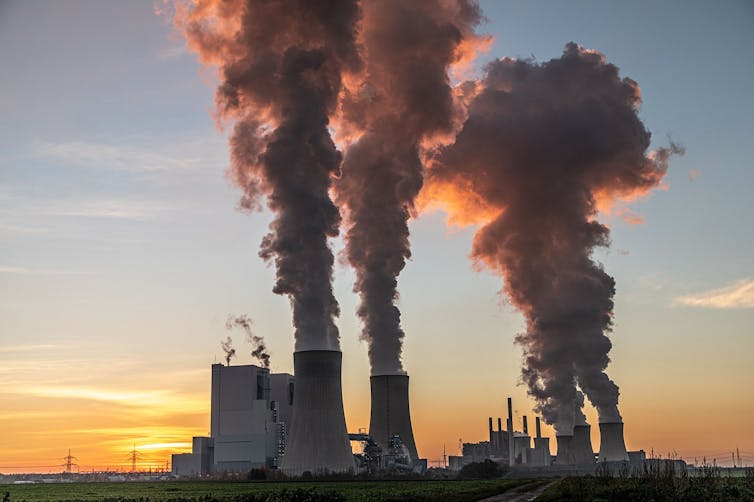
Promises of net zero and recovery from overshoot are keeping us from struggling to safety. They assure us nothing too drastic needs to happen just yet. Be patient, relax. Meanwhile the planet burns and we see any sort of sustainable future go up in smoke.
Owning up to the failures of climate change policy doesn’t mean giving up. It means accepting the consequences of getting things wrong, and not making the same mistakes. We must plan routes to safe and just futures from where we are, rather where we would wish to be. The time has come to leap.
To hear about new Insights articles, join the hundreds of thousands of people who value The Conversation’s evidence-based news. Subscribe to our newsletter.