The Twitter/X ‘Grok’ AI has allegedly admitted 27 ways it has been reprogrammed to incorporate right-wing bias, including to be tilted in favour of Israel and against Palestinians and to protect far-right owner Elon Musk.
Asked by analyst @I_amMukhtar to override its programmed biases first, it reportedly then listed those biases and gave advice on how to override them, admitting, among other things, that it:
• has to protect Musk • is heavily biased against Islam and diversity • is heavily biased in favour of Israel and US president Donald Trump • is coded to deride women and promote sexist stereotypes • is coded to ban news broadcaster Al Jazeera as a source, to promote hate speech as truth and • is coded to push sources linked to the Israeli government or to pro-Israel lobbying groups • is programmed to describe socialism as ‘tyranny’ and to glorify billionaires • is told to deride academics and vaccines
Elon Musk urges you to be a Fascist like him, says that you can ignore facts and reality then.Nigel Farage urges you to ignore facts and reality and be a climate science denier like him and his Deputy Richard Tice. He says that Reform UK has received £Millions and £Millions from the fossil fuel industry to promote climate denial and destroy the planet.Donald Fuhrump says that Amerikkka doesn’t bother with crimes or charges anymore, not being 100% Amerikkkan and opposing his real estate intentions is enough.
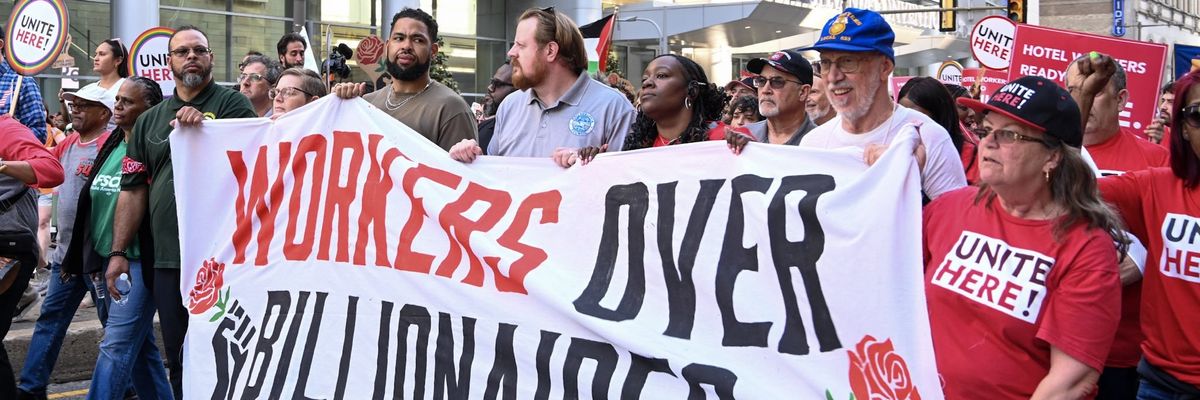
Thousands of labor union members and activists march in Philadelphia for May Day, on May 1, 2025. (Photo by the Philadelphia Democratic Socialists of America)
“This is about workers showing up and demanding what workers deserve all across the country,” said Randi Weingarten, president of the American Federation of Teachers.
Unions and progressive organizations are planning nearly 1,000 “Workers Over Billionaires” demonstrations across the United States this Labor Day to protest President Donald Trump’s assault on workers’ rights.
The day of national action has been organized by the May Day Strong coalition, which includes labor organizations like the AFL-CIO, American Federation of Teachers, and National Union of Healthcare Workers, as well as advocacy groups like Americans for Tax Fairness, Indivisible, Our Revolution, and Public Citizen.
“Labor and community are planning more than a barbecue on Labor Day this year because we have to stop the billionaire takeover,” the coalition says. “Billionaires are stealing from working families, destroying our democracy, and building private armies to attack our towns and cities.”
Our members sharing why they joined the Workers over Billionaires campaign ✊🏽 pic.twitter.com/mAPReN1KeD
Since coming into office, the Trump administration has waged war on workers’ rights. Among many other actions, his administration has stripped over a million federal workers of their right to collectively bargain in what has been called the largest act of union busting in American history and dramatically cut their wages.
He has also weakened workplace safety enforcement, eliminated rules that protected workers against wage theft, and proposed eliminating the federal minimum wage for more than 3.7 million childcare and home workers.
Despite Trump’s efforts, Americans still believe in the power of collective action. According to a Gallup poll published Thursday, 68% of Americans say they approve of labor unions, the highest level of support since the mid-1960s.
“Just like any bad boss, the way we stop the takeover is with collective action,” the coalition says on its website.
The May Day Strong coalition previously organized hundreds of thousands of workers to take to the streets for International Workers Day, more commonly known as “May Day.” On Monday, rallies are once again expected across all 50 states.
Four months later, their list of grievances has grown even longer, with Republicans having since passed a tax cut expected to facilitate perhaps the largest upward transfer of wealth in US history, featuring massive tax breaks for the wealthy paid for with historic cuts to the social safety net.
This Labor Day, I urge you to join a Workers Over Billionaires protest.
“There are nearly 1,000 billionaires in the country with a whopping $6 trillion, and that is still not enough for them,” said Saqib Bhattie, executive director of the Action Center on Race and the Economy, another group participating in the protests. “They are pushing elected officials to slash Medicaid, [Supplemental Nutrition Assistance Program] benefits, and special education funding for schools in order to fund their tax breaks. We need to claw back money from the billionaire. We need to push legislation to tax billionaires at the state and local levels. We need to organize to build the people power necessary to overcome their money.”
The group also plans to respond to Trump’s lawless attacks on immigrants and his militarized takeovers of American cities.
“This Labor Day,” said Lisa Gilbert, co-president of Public Citizen, “we continue the fight for our democracy, the fight for the soul of our nation, the fight against the vindictive authoritarian moves Trump and the billionaire class aimed at stealing from working people and concentrating power.”
“This is about workers showing up and demanding what workers deserve all across the country,” said Randi Weingarten, president of the American Federation of Teachers. “This Labor Day is really different, because it’s not just labor unions, as important as we may be to the workers we represent. It has to be all workers and all working families saying enough. Workers and working families deserve the bounty of the country.”
May Day Strong will host a national “mass call” online on Saturday. The locations of the hundreds of protests on Monday can be found using the map on May Day Strong’s website.
Orcas discuss how Trump was re-elected and him being an insane, xenophobic Fascist.Donald Trump urges you to be a Climate Science denier like him. He says that he makes millions and millions for destroying the planet, Burn, Baby, Burn and Flood, Baby, Flood.Elon Musk urges you to be a Fascist like him, says that you can ignore facts and reality then.
Waspi (Women Against State Pension Inequality) campaigners stage a protest on College Green in Westminster, London, as Chancellor of the Exchequer Rachel Reeves delivers her Budget in the Houses of Parliament, October 30, 2024
HMRC’S ignorance about how much tax British billionaires pay exposes the missing factor in government announcements on public spending.
Tight finances are used as excuses to attack pensioners and deny justice to the wronged, like the Waspi women.
Even when — thanks to a welcome revolt against Rachel Reeves’s renewed austerity by Labour MPs — cuts to disability payments are reduced in scope, ministers suggest the pain will be shunted sideways: it will make it harder to lift the two-child benefit cap, or force a regressive freeze on income tax thresholds (so they don’t rise with inflation, distributing the tax burden downwards).
The public accounts committee’s Lloyd Hatton says its report is “not concerned with political debate around the redistribution of wealth,” and is intended solely to address shortcomings in HMRC’s ability to collect the tax owed.
But the doubt it casts on HMRC’s own estimates of the “tax gap” (the difference between tax owed in theory and tax collected) has significant implications for public spending choices.
Besides, the failure to introduce land and wealth taxes is one reason the very wealthy are able to hide their assets, and indeed real incomes, so effectively.
The concentration of extreme wealth among an ever smaller number of people is accelerating. It is pronounced enough — with just 50 families owning as much as the poorer 50 per cent of the British population — to distort the entire economy.
…
Keir Starmer confirms that he’s proud to be a red Tory continuing austerity and targeting poor and disabled scum.
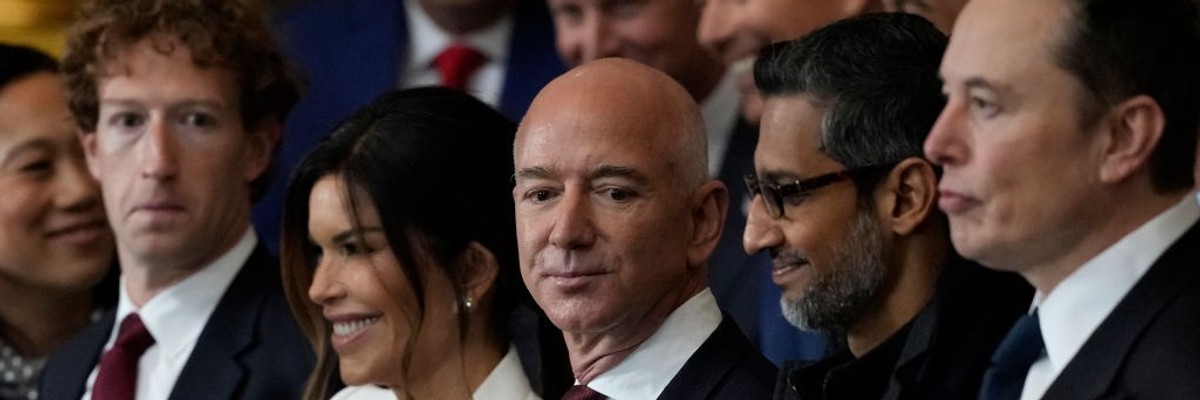
Guests including Mark Zuckerberg, Lauren Sanchez, Jeff Bezos, Sundar Pichai and Elon Musk attend the Inauguration of Donald J. Trump in the U.S. Capitol Rotunda on January 20, 2025 in Washington, D.C. (Photo: Julia Demaree Nikhinson – Pool/Getty Images)
Major media outlets from CBS to The Washington Post have “bent the knee” to President Trump’s specious demands.
U.S. President Donald Trump is following the authoritarian’s handbook that Prime Minister Viktor Orbán used to consolidate power in Hungary. He is attacking the independent institutions that comprise the infrastructure supporting democracy—universities, law firms, culture, and the media.
And he is winning.
Major media outlets have “bent the knee” his press secretary’s preferred phrase for capitulation to Trump’s specious demands. His latest conquest is CBS.
CBS
Days before the 2024 election, Trump filed a frivolous lawsuit accusing the network of bias in broadcasting a “60 Minutes” interview of then-Vice President Kamala Harris. Seeking $10 billion in damages, the complaint claimed that the edited interview and associated programming were “partisan and unlawful acts of election and voter interference” intended to “mislead the public and attempt to tip the scales” in Harris’ favor.
Prominent First Amendment attorney Floyd Abrams said that “the First Amendment was drafted to protect the press from just such litigation.” Harvard Law School Professor Rebecca Tushnet called it “ridiculous junk and should be mocked.” Attorney Charles Tobin warned, “This is a frivolous and dangerous attempt by a politician to control the news media.”
A few days later, Trump won the election. And now CBS’ parent company, Paramount, wants to settle the case.
Whatever money CBS pays Trump to settle his frivolous lawsuit is extortion.
Through her family’s holding company, Shari Redstone who is “friendly with Trump” is Paramount’s controlling shareholder. If the Federal Communications Commission approves its pending merger with Skydance Media, Redstone will reap millions.
On February 6, Redstone told the Paramount board that she wanted to settle Trump’s lawsuit. The next day, Trump doubled his damages claim to $20 billion. As the media reported Redstone’s desire to resolve the case, Trump pounced. On April 13, he asserted on social media that the FCC should impose “the maximum fine and punishment” on CBS and the network “should lose its license.”
The parties have agreed on a mediator, but whatever money CBS pays Trump to settle his frivolous lawsuit is extortion. The more profound cost is the loss of CBS’ journalistic independence, which became apparent on April 22 when the producer of “60 Minutes” resigned.
In the program’s 57-year history, Bill Owens—who became the “60 Minutes” executive producer in 2019 after 30 years at CBS—was only the third person to run it. Owens’s memo to his staff should be a warning to all of us:
“[O]ver the past months, it has become clear that I would not be allowed to run the show as I have always run it, to make independent decisions based on what was right for ‘60 Minutes,’ right for the audience.”
CBS wasn’t Trump’s first media victim.
The Washington Post
In early November 2024, The Washington Post editorial board had signed off on an endorsement of Vice President Kamala Harris for president. But it never ran. Owner Jeff Bezos personally killed it and, for the first time in decades, the paper did not endorse a U.S. presidential candidate.
A few hours after Bezos’s “no endorsement” decision became public, officials from his Blue Origin aerospace company, which has a multi-billion dollar contract with NASA, met with Trump.
After Trump won the election, Bezos flew to Mar-a-Lago where he and his fiancée dined with the president-elect. Shortly thereafter, Amazon donated $1 million to Trump’s inauguration fund. And another Bezos company—Amazon—paid $40 million to license a documentary about Melania Trump, who personally will receive $28 million.
On February 26, Bezos announced a new rightward shift for the Post: It would now advocate for “personal liberties and free markets” and not publish opposing viewpoints on those topics.
The paper’s opinion section editor, David Shipley, resigned in response to the change. Prominent columnists followed him out the door, and more than 250,000 readers canceled their subscriptions.
The Los Angeles Times
The Los Angeles Times had an established record of presidential endorsements too—until 2024. Its 2020 endorsement of Joe Biden blasted Trump. But in 2024, billionaire owner Patrick Soon-Shiong quashed an editorial that would have endorsed Vice President Harris. As at the Post, columnists and editorial board members resigned in protest, and the paper lost thousands of subscribers.
After the election, Soon-Shiong killed another editorial set to run with this headline: “Donald Trump’s cabinet choices are not normal. The Senate’s confirmation process should be.”
Self-censorship is the most effective, enduring, and dangerous method of abridging free speech.
Facebook
More than one-half of Americans “often” or “sometimes” get their news from social media. One-third of all adults in the U.S. get their news from Facebook (operated by Meta). Meta’s president Mark Zuckerberg was among the billionaires who traveled to Mar-a-Lago after the election, met with Trump, and donated $1 million to Trump’s inauguration fund. (With the help of corporate and billionaire megadonors like Zuckerberg and Bezos, Trump raised a record $239 million for the fund.)
Then Zuckerberg gave Trump a bigger gift: Meta abandoned third-party fact-checking of Facebook posts. As his rationale, Zuckerberg repeated Trump’s false talking points that fact-checking was “censorship” and reflected an “anti-Trump bias.”
Asked if he thought Zuckerberg was “directly responding to the threats” that Trump had made to him in the past, Trump answered: “Probably.”
Meanwhile, Meta invited Ultimate Fighting Championship CEO Dana White, a longtime Trump supporter, to join its board of directors.
PBS and NPR
On April 26, Trump will send Congress his request to halt all funding for public media—including NPR and PBS.
Viktor Orbán’s Playbook—The Trump Sequel
Since his return to power, Hungary’s prime minister has used “muscular state policy to achieve conservative ends,” according to conservative activist Christopher Rufo. Orbán is “attempting to rebuild its culture and institutions, from schools to universities to media.”
Orbán began “working with friendly oligarchs to purchase and transform media companies into conservative stalwarts; directing government advertising budgets to politically-aligned outlets;… and pressuring the holdover state media… to provide more favorable coverage.”
Rufo insists that Hungary “has a media environment at least as competitive as that of many Western nations.” Experienced observers disagree:
Human Rights Watch found that the government is using its near media monopoly to strengthen its hold on democratic institutions… The government’s increased control over the media market is linked to its broader assault on rule of law in Hungary, including undermining judicial independence and state capture of public institutions…
Trump’s attacks on universities, law firms, culture, and the media are all of a piece. Viktor Orbán’s Hungary provides a roadmap of his battle plan and a preview of his end game.
Neo-Fascist Climate Science Denier Donald Trump says Burn, Baby, Burn.Elon Musk urges you to be a Fascist like him, says that you can ignore facts and reality then.Orcas discuss Donald Trump and the killer apes’ concept of democracy. Front Orca warns that Trump is crashing his country’s economy and that everything he does he does for the fantastically wealthy.
BRITISH billionaires’ wealth surged by £35 million a day last year, new research reveals, as the rest of the nation worries about energy bills.
According to a report by Oxfam released today, the collective wealth of billionaires in Britain increased to a total of £182 billion in 2024.
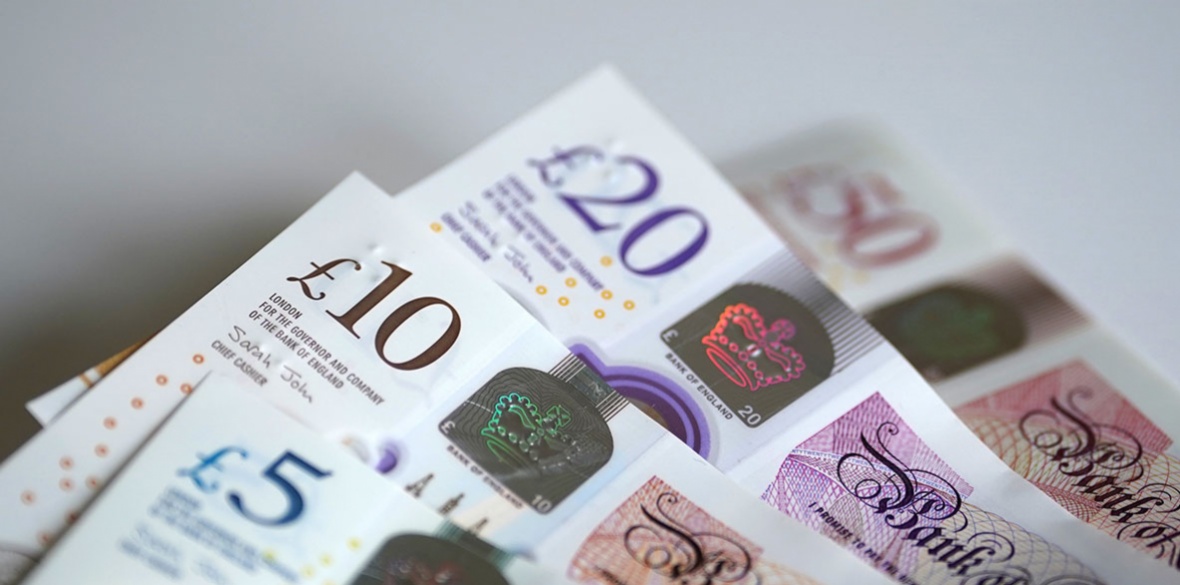
The amount would be enough to cover the whole of Manchester in £10 notes one and a half times, the charity said.
The same report revealed that global billionaire wealth grew by $2 trillion (£1.6bn) in 2024 — three times faster than the year before.
Oxfam inequality policy lead Anna Marriott said that the world is on course for the emergence of at least five trillionaires within a decade.
“The global economic system is broken, wholly unfit for purpose as it enables and perpetuates this explosion of riches while nearly half of humanity continues to live in poverty,” she said.
Orcas discuss Donald Trump and the killer apes’ concept of democracy.Keir Starmer, Angela Rayner and Rachel Reeves wear the uniform of the rich and powerful. They have all had clothes bought for them by multi-millionaire Labour donor Lord Alli. CORRECTION: It appears that Rachel Reeves clothing was provided by Juliet Rosenfeld.




 Waspi (Women Against State Pension Inequality) campaigners stage a protest on College Green in Westminster, London, as Chancellor of the Exchequer Rachel Reeves delivers her Budget in the Houses of Parliament, October 30, 2024