
How the weather got ‘stuck’ over the UK – and produced an unusually dry and warm spring

Spread the love
Wildfires have ignited in forests and on moorland across the UK in recent months. LSP EM/Shutterstock

Simon H. Lee, University of St Andrews and Matthew Patterson, University of St Andrews

A “blocking” weather system lingering high above the UK has produced one of the driest, warmest and brightest starts to spring on record.

April 2025 was the sunniest since records began in 1910. This followed the third-sunniest March, and both months saw temperatures well above average nationwide. On May 1, the temperature reached 29.3°C in Kew Gardens in London – a new record for the date.

Meteorologists are warning of the potential for a summer drought, as the UK has seen roughly half its usual amount of rainfall for March and April. While farmers fret about this year’s harvest, some water companies are urging customers to help reservoir levels recover by limiting water use.

Meanwhile, wildfires have engulfed forest and moorland in areas of Scotland, Wales and England.
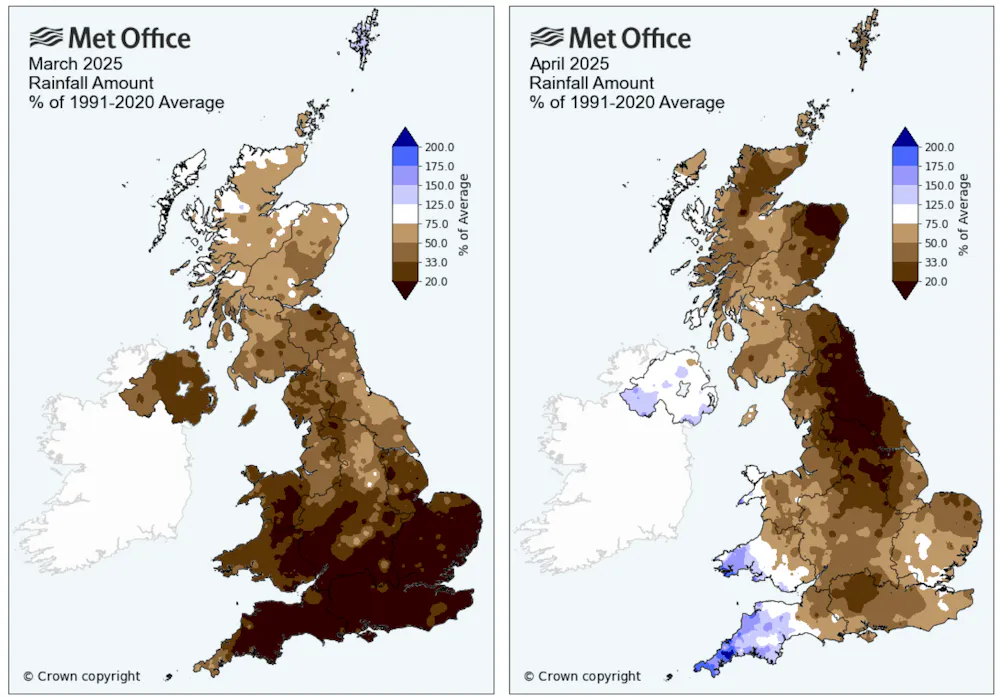
Two maps of the UK, showing mostly dark brown colours which indicate rainfall below 50% of normal.
Most of the UK has experienced a record-dry spring so far. Met Office

For several weeks, a stubborn area of high pressure over the UK has diverted the usual flow of mild, moist air from the North Atlantic like a boulder in a river. This is known as a blocking weather system.

Within it, air descends, warms and dries, which is why this weather pattern tends to be linked to heatwaves and drought. Blocking is usually persistent, making it seem like the weather is stuck.

Here’s how climate change may have played a role in setting up this unusual spring.


Get your news from actual experts, straight to your inbox. Sign up to our daily newsletter to receive all The Conversation UK’s latest coverage of news and research, from politics and business to the arts and sciences. Join The Conversation for free today.


The human fingerprint

The warming climate means that unusually warm weather is occurring more often and becoming more intense. At the same time, we can expect more periods of both severe drought and extreme rainfall. Sudden changes from drought to deluge, termed “weather whiplash”, are due to the intensification of the water cycle in a warmer atmosphere that can hold more water vapour.

However, certain weather patterns are necessary to produce extreme weather. More blocking events in future could increase the chance of heatwaves or drought. But are blocking weather patterns becoming more common?

It’s difficult to determine how weather patterns will change as a result of the rising concentration of greenhouse gases in the atmosphere, which is predominantly caused by the burning of fossil fuels.

Part of the difficulty arises from the fact that weather patterns vary year to year. Several years in a row with more blocking events than usual could make it seem like blocking is increasing due to climate change, but it could simply be down to chance.

As a result, it is difficult to detect the fingerprint of human activity from weather observations alone. For example, blocking weather patterns over Greenland during summer have happened more often in recent decades, which can enhance the melting of the ice sheet. But it isn’t clear that this trend is the result of human-induced climate change.

Climate models do suggest future changes in the occurrence of blocking, however. These computer simulations, consisting of equations that describe the fundamental physics of the atmosphere, are the main tool scientists use to perform experiments that parse how the climate will behave in future.
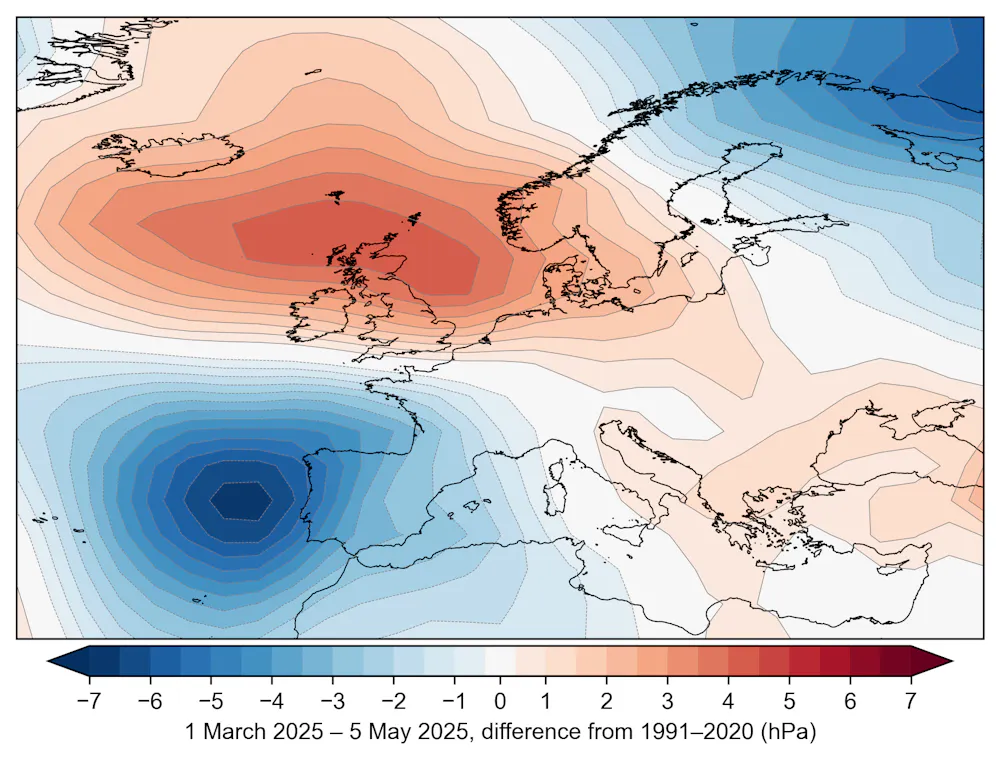
A map of pressure anomalies over Europe.
The blocking system is visible in the area of high pressure over Britain and Ireland. National Centers for Environmental Prediction/National Center for Atmospheric Research/NOAA Physical Sciences Laboratory, CC BY

When scientists run climate model simulations with increased greenhouse gas concentrations the results consistently show a decrease in blocking events. But blocking generally happens more often in real life than model simulations, which reduces the confidence scientists have in future projections.

Keeping track of the jet stream

The movement of weather systems in Earth’s mid-latitudes – including over the UK – is linked to the jet stream, which is a fast-flowing river of air driven by the contrast in temperature between the poles and mid-latitudes.

Some researchers have suggested that, because the Arctic is warming faster than the tropics, the jet stream may weaken and become more “wavy”, increasing the occurrence of blocking events, contrary to what most climate models show.

Outside of the scientific community, this idea has become popular. However, the hypothesis remains controversial among scientists, and observational evidence has weakened in recent years.

In fact, around ten kilometres above the Earth’s surface, near commercial aircraft cruising altitudes, the opposite trends are occurring: the temperature difference between the Arctic and mid-latitudes is increasing, acting to increase the strength of the jet stream.

There are considerable challenges with understanding how climate change is affecting the large-scale atmospheric patterns which drive the weather we experience. These include large natural variability and imperfect climate models. Models mostly suggest a decline in blocking events with climate change, though this remains relatively uncertain compared with other aspects of the science.

Overall, we can be confident that climate change is bringing warmer conditions in all seasons. Scientists also have strong evidence to suggest that drought conditions will become more common. These changes are already affecting food production, energy generation and water availability and these impacts will continue to worsen with climate change.


Don’t have time to read about climate change as much as you’d like?
Get a weekly roundup in your inbox instead. Every Wednesday, The Conversation’s environment editor writes Imagine, a short email that goes a little deeper into just one climate issue. Join the 45,000+ readers who’ve subscribed so far.


Simon H. Lee, Lecturer in Atmospheric Science, University of St Andrews and Matthew Patterson, Research Fellow in climate and machine learning, University of St Andrews

This article is republished from The Conversation under a Creative Commons license. Read the original article.
Continue ReadingHow the weather got ‘stuck’ over the UK – and produced an unusually dry and warm spring

Israel’s blocking of aid to Gaza is a weapon in its brutal war against Palestinians

Spread the love

Original article by Abdul Rahman and Ana Vračar republished from peoples dispatch under a Creative Commons Attribution-ShareAlike 4.0 (CC BY-SA) license.

Photo: UNRWA

Israel’s deliberate blocking of humanitarian aid to Gaza has emerged as key weapon against the people of the territory. More than 20 Palestinians have reportedly been killed due to starvation in the last few weeks and numbers are expected to explode in the coming days.

Though Israel denies it has any such policy, almost all UN agencies working to provide aid on the ground in Gaza, as well as several other groups, have termed the deliberate blocking of aid as the most important reason for an imminent famine in the besieged Palestinian territory. 

Research conducted by organizations such as Refugees International show that, “Israeli conduct has consistently impeded aid operations within Gaza, blocked legitimate relief operations, and resisted implementing measures that would genuinely enhance the flow of humanitarian aid in Gaza.”

By denying adequate aid to Gaza, Israel has been in violation of the interim order passed by the International Court of Justice (ICJ) on January 26 while hearing the genocide petition filed by South Africa. The ICJ had asked Israel to facilitate “urgently needed basic services and humanitarian assistance to address the adverse conditions of life.”

In its submission to the court in February, Israel claimed it had complied with the ruling. However, UN data shows that the actual number of trucks with aid reaching Gaza decreased by half in February in comparison to the previous month. International organizations still describe experiences where the Israeli Occupying Forces (IOF) block their entry into Gaza, especially North Gaza, after being made to wait for hours on end.

According to Philippe Lazzarini, Commissioner General of UNRWA, in February, on an average just 98 trucks entered Gaza in comparison to around 200 trucks a day in January. Before October 7, Israel used to allow around 500 trucks a day to the besieged territory for a population of over 2.3 million.

Israel’s denial of adequate aid to Gaza also violates the UN Security Council resolution adopted in December which talks about greater access to humanitarian aid to Palestinians in Gaza. 

The US, which was the primary mover of the UN security council resolution, recently airdropped aid to Gaza. While delivering his State of the Union address on March 7, President Joe Biden also talked about opening a temporary port in Gaza to deliver faster aid. Both the moves confirm the claims that there is not enough aid reaching Gaza at the moment, despite Israeli claims.

However, the US act is widely seen as a face-saving exercise given the Biden administration’s reluctance to press Israel for a permanent ceasefire in Gaza and its supply of arms and ammunition which is used by Israel to bomb Palestinians.

The Biden administration has failed to make Israel comply with its own National Security Memorandum (NSM 20) as well. It requires that countries seeking security aid from the US make arrangements for adequate humanitarian assistance.

Medea Benjamin of CODEPINK highlighted on her page on X that Biden says “Israel must allow more aid into Gaza and protect civilians. But it doesn’t. And Biden keeps sending them more weapons.”

Meanwhile “after five months of war, Palestinians are struggling to find adequate food, water, shelter and basic medicine. Famine level hunger is already widespread and worsening” in Gaza, Refugees International’s report says. The lack of adequate food has significant health implications for children in Gaza who have been the primary victims of Israel’s war since October 7.

Israel weaponized starvation against Palestinians

Israel has killed over ten thousand children in its bombings and ground offensives in Gaza since October 7. In addition to that, the health effects of Israel’s blockade on aid delivery are worsening by the day.

According to the World Health Organization (WHO), 1 in 6 children under 2 years of age in Gaza are acutely malnourished. The combination of food shortages, lack of clean water, and inadequate healthcare provision is having devastating effects, particularly on young children and mothers.

Many women are facing extreme difficulties in initiating and continuing breastfeeding due to their own nutritional status and stress. “People are hungry, exhausted, and traumatized,” said Adele Khodr, Regional Director of UNICEF’s Middle East and North Africa office.

The food shortage in the north is so severe that health workers report 95% of female patients are suffering from anemia. “There have been many operations performed, such as cesarean sections, to remove fetuses, [which] died of malnutrition among women,” Mohammed Salha, director of Al-Awda Hospital, told ActionAid.

Pediatricians at Kamal Adwan Hospital have reported not having the resources to treat more than half the children admitted to the hospital for malnutrition, as there is no food or medical supplement the staff can give them. “The most we can do for them is give them a saline solution or sugar solution,” physician Imad Dardonah told UN teams visiting the institution.

Israeli obstacles to aid delivery also mean that there is not enough infant formula or diapers. On the rare occasions when these essential supplies are found, their cost puts them out of reach for most of the population in Gaza.

A box of diapers in northern Gaza now costs around ILS 200 (USD 55), while monthly income before October 7, 2023, was reported around ILS 1,200 (USD 343)— not even enough to cover a newborn’s monthly supply during her first month of life, let alone food on top of that.

Restrictions are also being applied to the number of international medical teams allowed into Gaza and to field hospitals, which would allow for a partial expansion of much-needed health service capacities.

The siege is causing a devastating paradox: at the same time, there are too few health workers to respond to the needs of the population and those who have been working in Gaza’s healthcare system since October; and there are too many health workers in comparison to the operational surgery capacities—the only remaining functional operation rooms are located at the European Hospital in southern Gaza, according to surgeon Ghassan Abu Sittah.

Some countries have attempted to circumvent Israel’s aid blockade by airdropping supplies, but the amounts reaching the population in Gaza this way are nowhere near sufficient. To adequately stock hospitals and health centers, several international agencies have warned, it is paramount to ensure unimpeded passage for truck convoys carrying a wide range of supplies, not just a specific type of food or sanitary bandages.

When it comes to aid delivery, the UN humanitarian coordinator for the occupied Palestinian territories, James McGoldrick, said, “There is no alternative to food trucks, to road transports.”

Original article by Abdul Rahman and Ana Vračar republished from peoples dispatch under a Creative Commons Attribution-ShareAlike 4.0 (CC BY-SA) license.

Continue ReadingIsrael’s blocking of aid to Gaza is a weapon in its brutal war against Palestinians