‘Grim News for the Planet’ as Arctic Sea Ice Hits Record Low

Spread the love

Original article by Julia Conley republished from Common Dreams under Creative Commons (CC BY-NC-ND 3.0).

An aerial view shows the Vatnajokull glaciers in Iceland are melting into the ocean or forming lagoons due to global warming and climate change on February 23, 2025. (Photo: Evrim Aydin/Anadolu via Getty Images)

“The environment does not care about politics. Keep spewing greenhouse gases and face the consequences.”

European Union officials said the Copernicus Climate Change Service had issued its latest “stark reminder of why climate action is urgent” when the bloc’s program announced that it observed less sea ice covering the Earth’s oceans last month than at any other point in recorded history.

In the Arctic, sea ice reached its lowest monthly extent on record, at 8% below average, in early February, and it remained below the previous record for the rest of the month.

The oceans were missing an area of ice roughly the size of the United Kingdom last month, according to Copernicus (C3S), and the finding was not an anomaly in recent sea ice observations.

February marked the third consecutive month in which record low sea ice levels for the corresponding month were observed in the Arctic.

C3S reported that in the Antarctic, sea ice levels have rapidly declined in 2025 after appearing to recover to near-record levels in December 2024.

Last month, sea ice near the South Pole reached its fourth-lowest monthly extent, at 26% below average.

C3S said the daily sea ice extent in the Antarctic may have also reached its annual minimum toward the end of the month, which will be confirmed later in March; if confirmed, it would be the second-lowest annual minimum in the satellite record.

“February 2025 continues the streak of record or near-record temperatures observed throughout the last two years,” said Samanatha Burgess, strategic lead for climate at the European Center for Medium-Range Weather Forecasts. “One of the consequences of a warmer world is melting sea ice, and the record or near-record low sea ice cover at both poles has pushed global sea ice cover to an all-time minimum.”

The melting sea ice was recorded as global average temperatures rose 1.59°C (2.8°F) above the pre-industrial average last month, making it the third-warmest February on record.

In Europe, the temperatures that most exceeded averages were recorded last month in parts of Scandinavia, Iceland, and the Alps. Outside of Europe, “temperatures were most above average over large parts of the Arctic.”

The low extent of sea ice will lead to “more solar heat absorbed by the darker oceans,” and “faster warming,” said Simon Oldridge, a climate campaigner.

The loss of sea ice can also lead to the collapse of ocean currents that are crucial for marine life to thrive.

C3S reported on the record-low sea ice levels as campaigners in the U.S. and around the world condemned recent anti-climate actions taken by U.S. President Donald Trump and the Republican Party, including the country’s exit from the Paris climate agreement, the GOP’s passing of a bill to end a federal program aimed at reducing planet-heating methane emissions, and Trump’s push to fast-track fossil fuel projects—as scientists warn that new extractive projects have no place on a pathway to limiting planetary heating and avoiding its worst impacts.

“The environment does not care about politics,” said public health expert Ali Khan. “Keep spewing greenhouse gases and face the consequences.”

Original article by Julia Conley republished from Common Dreams under Creative Commons (CC BY-NC-ND 3.0).
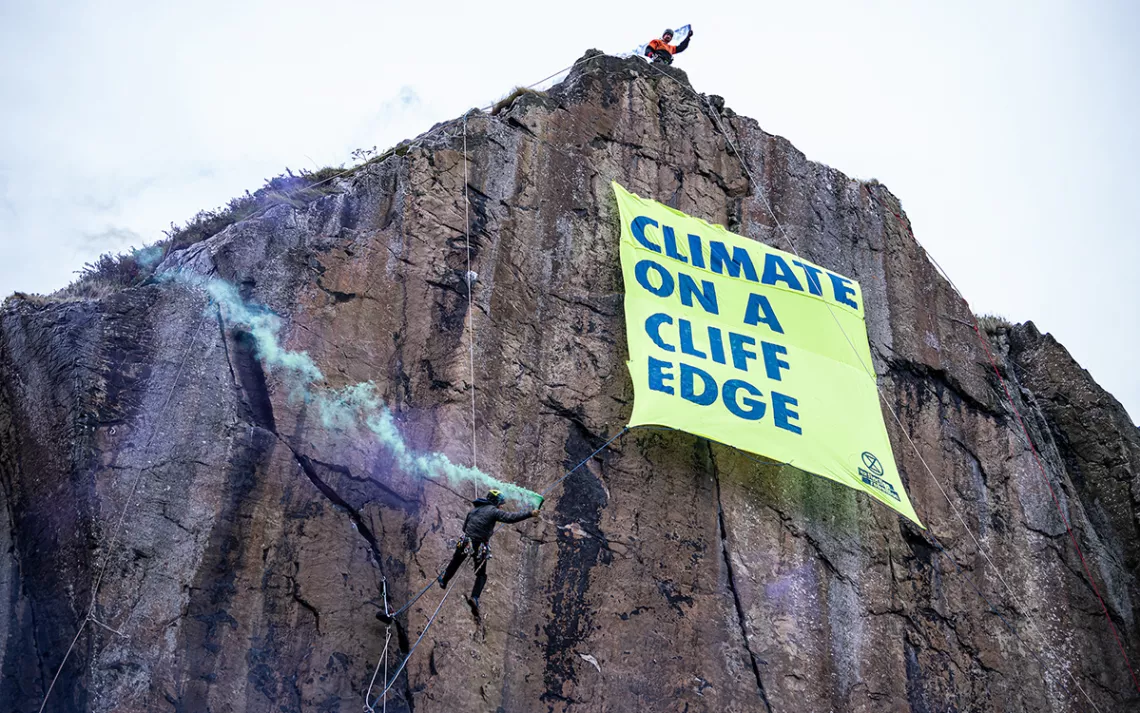
Experienced climbers scale a rock face near the historic Dumbarton castle in Glasgow, releasing a banner that reads “Climate on a Cliff Edge.” One activist, dressed as a globe, symbolically looms near the edge, while another plays the bagpipes on the shores below. | Photo courtesy of Extinction Rebellion and Mark Richards
Neo-Fascist Climate Science Denier Donald Trump says Burn, Baby, Burn.

Continue Reading‘Grim News for the Planet’ as Arctic Sea Ice Hits Record Low

13 Months of Record-Smashing Heat Called ‘Another Red Alert’ for Humanity

Spread the love

Original article by BRETT WILKINS republished from Common Dreams under Creative Commons (CC BY-NC-ND 3.0).

Rescuers carry away a man, affected by the scorching heat, on a stretcher as Muslim pilgrims arrive to perform the symbolic “stoning of the devil” ritual as part of the Hajj pilgrimage in Mina, Saudi Arabia on June 16, 2024. (Photo: Fadel Senna/AFP via Getty Images)

“This alarming record underlines the need to urgently phase out fossil fuels, and to hugely increase climate finance,” said one campaigner.

Scientists on Monday underscored the urgent need to accelerate the transition from fossil fuels to renewable energy following the publication of data from the European Union’s climate change monitor showing that last month was the hottest June ever recorded and that 2024 is likely to be the planet’s hottest year on record.

Each month since June 2023 has been the hottest since records have been kept, the European Union’s Copernicus Climate Change Service (C3S) said last week in its latest monthly bulletin.

According to the agency, June “was 1.50°C above the estimated June average for 1850-1900, the designated preindustrial reference period, making it the 12th consecutive month to reach or break the 1.5°C threshold.”

“European temperatures were most above average over southeast regions and Turkey, but near or below average over western Europe, Iceland, and northwestern Russia,” C3S noted. “Outside Europe, temperatures were most above average over eastern Canada, the western United States and Mexico, Brazil, northern Siberia, the Middle East, northern Africa, and western Antarctica.”

“Temperatures were below average over the eastern equatorial Pacific, indicating a developing La Niña, but air temperatures over the ocean remained at an unusually high level over many regions,” the agency added.

C3S Director Carlo Buontempo said in a statement Monday that “even if this specific streak of extremes ends at some point, we are bound to see new records being broken as the climate continues to warm.”

“This is inevitable unless we stop adding greenhouse gases into the atmosphere and the oceans,” he stressed.

In an interview with The Associated Press published Monday, C3S climate scientist Nicolas Julien called the new data “a stark warning that we are getting closer to this very important limit set by the Paris agreement.”

“The global temperature continues to increase,” he added. “It has at a rapid pace.”

Zeke Hausfather, a researcher at the California-based nonprofit Berkeley Earth, told Reuters, “I now estimate that there is an approximately 95% chance that 2024 beats 2023 to be the warmest year since global surface temperature records began in the mid-1800s.”

As Reuters reported Monday:

The changed climate has already unleashed disastrous consequences around the world in 2024. More than 1,000 people died in fierce heat during the Hajj pilgrimage last month. Heat deaths were recorded in New Dehli, which endured an unprecedentedly long heatwave, and amongst tourists in Greece.

“This is not good news at all,” Aditi Mukherji, who co-authored the most recent Intergovernmental Panel on Climate Change (IPCC) report, told The Guardian.

“We know that extreme events increase with every increment of global warming,” she added, “and at 1.5°C, we witnessed some of the hottest extremes this year.”

The Guardian surveyed hundreds of IPCC authors earlier this year. Three-quarters of them said they expect Earth to heat by at least 2.5°C by the end of this century. Half of the surveyed scientists expect temperatures to rise above 3°C by 2100.

“It is a crisis,” said Mukherji, and one that has a clear solution, given that burning fossil fuels is the leading cause of global heating.

Antonia Juhasz, a senior researcher on fossil fuels at Human Rights Watch, told Nation of Change that “as a result of the burning of fossil fuels, heatwaves are becoming more common, and intense heatwaves are more frequent.”

“We can break the cycle, we can make oil companies stop burning fossil fuels,” she added.

Reacting to the latest C3S data, Amnesty International climate adviser Ann Harrison said on social media that “this alarming record underlines the need to urgently phase out fossil fuels, and to hugely increase climate finance.”

Original article by BRETT WILKINS republished from Common Dreams under Creative Commons (CC BY-NC-ND 3.0).

Continue Reading13 Months of Record-Smashing Heat Called ‘Another Red Alert’ for Humanity