Major Polluters In ‘Ludicrous’ Push For Carbon Capture at Party Conferences

Spread the love

Original article by Adam Barnett and Rachel Sherrington republished from DeSmog.

The technology could provide cover for fossil fuel companies to explore more oil and gas drilling, campaigners say.

By Adam Barnett and Rachel Sherrington on Sep 29, 2023 @ 05:14 PDT
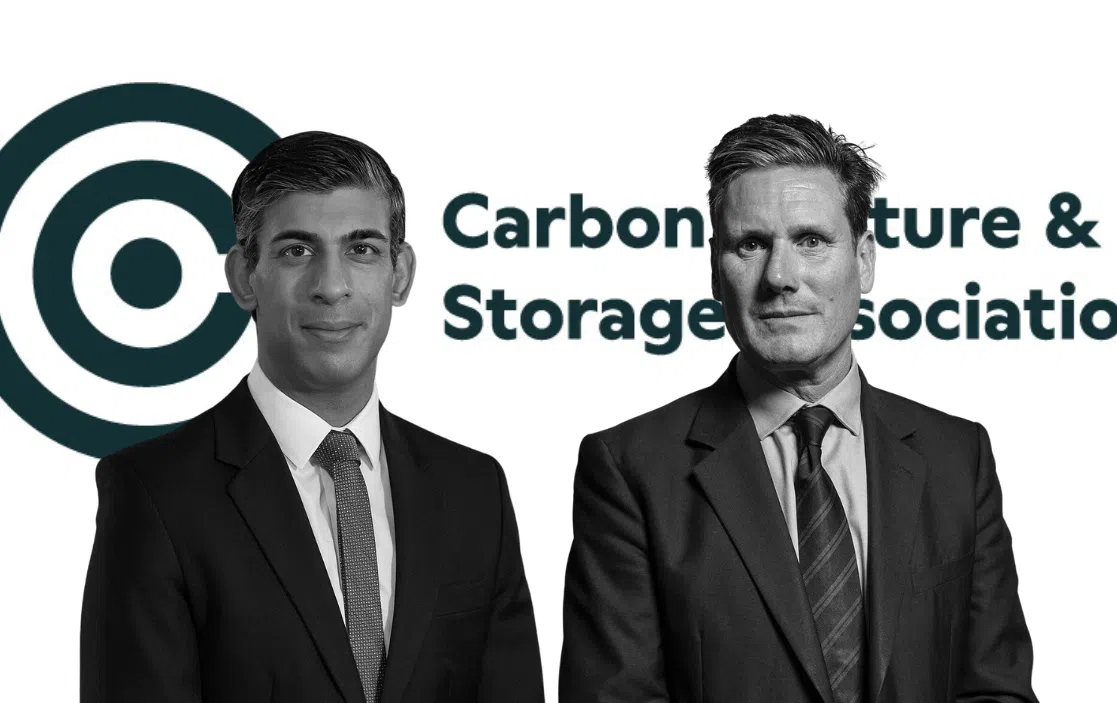
Prime Minister Rishi Sunak and Labour leader Keir Starmer. Credit: DeSmog via UK Parliament (CC BY 3.0)

A trade group for contested carbon capture with close ties to major oil and gas companies is sponsoring over a dozen events at the Conservative and Labour conferences over the next fortnight. 

Fossil fuel companies are using the technology as “a fig leaf” to pursue oil and gas drilling, campaigners have warned, as industry lobbyists across the energy sector seek to win over policymakers.

The Carbon Capture and Storage Association (CCSA), a trade body promoting carbon capture utilisation and storage (CCUS), is due to host 15 events across the Conservative and Labour gatherings, which begin on Sunday in Manchester.

The London-based CCSA describes itself as the “lead” European organisation for CCUS, promoting the “rapid” and “commercial” deployment of the technology. The process involves capturing CO2 emissions from industrial production and storing it underground. Some technologies allow the captured CO2 to be re-used by converting it into plastics, concrete or biofuel. 

The group says that its members are “companies across the CCUS industry” including “support services in the energy sector” such as law, banking and consultancy.  

Nearly a fifth of the CCSA’s 100 members are oil and gas companies, including BP, Exxon, Shell and Equinor. Fossil fuels are the largest contributor to climate change, producing 75 percent of global greenhouse gas emissions and nearly 90 percent of all carbon dioxide emissions.

The CCSA board is also dominated by key figures at oil and gas companies, including BP, Equinor, TotalEnergies and Shell. 

Lorne Stockman, research co-director at the campaign group Oil Change International, told DeSmog: “It’s very clear what carbon capture serves and who it’s a solution for, and that’s the fossil fuel industry. 

“This isn’t about the best way of addressing the climate crisis, it’s about keeping the industry in business.”

He said the companies were trying to hedge their bets by winning over both the Conservatives and Labour, in the hope of continued government funding to support the high infrastructure costs.

“They pay both parties as much as they can,” said Stockman. “They’ve got the resources, they’ve got the money, they’ve got the influence, and of course they’re showing up to ensure that the fossil fuel industry continues to get public support even while we try to confront the climate emergency.”

Carbon capture and storage, and the extension of the technology, CCUS, has been touted by major polluters as a way to cut their production emissions to meet climate targets. 

But the role of carbon capture in the energy transition is hotly contested. Climate scientists point to the failure of CCS to remove significant amounts of CO2 emissions while campaigners warn of the high costs compared to renewable energy. The vast majority of companies use the captured CO2 to extract more oil through a process called “enhanced oil recovery”.

A DeSmog analysis published this week found the majority of large-scale global CCS projects have spectacularly failed to deliver what they promised, overran budgets and targets, and resulted in a net increase in emissions.

A CCSA spokesperson told DeSmog: “We are proud to bring a wide variety of our members to party conferences this year to engage with politicians, delegates and the media on the vital role carbon capture and storage technology will play in the net zero transition. 

“This technology will ensure industry can continue to support jobs making critical products such as steel and cement in the UK, rather than importing them from abroad, as well as creating 70,000 new jobs in green industries. 

“Carbon capture technology will be an important part of the solution, alongside reducing energy use and rolling out renewable electricity as we all work together to reach net zero.”

Fossil Fuel Presence

The UK government has committed £20 billion of investment for carbon capture and storage over the next 20 years, and aims to capture and store 20-30 million tonnes of CO2 per year by 2030 and over 50 million by 2035. 

The “CCUS Investor Roadmap”, updated this year, sets out plans to deliver four CCUS “low-carbon” industrial clusters by 2030, and capture and store nine million tonnes of CO2 from industrial CCS by 2035.

Despite well-documented concerns over carbon capture, industry executives will look to increase the government’s commitments further and showcase its “key role in decarbonising industry”, when they join the Conservatives in Manchester next week, and Labour in Liverpool later in the month. 

Experts and MPs – yet to be named – have been invited to the group’s ticketed drinks receptions, while a number of talks are dedicated to promoting the technology as a crucial part of the UK’s “green industrial revolution”.

“Our politics are shot through with oil and gas lobbyists, it’s just at party conferences they come into the light a little bit more,” Tessa Khan, executive director of fossil fuel campaign group Uplift, told DeSmog.

“This is a ludicrous amount of special pleading for a technology, carbon capture and storage, that, on the current trajectory, will play a marginal role in reducing industrial emissions and at worst is a fig leaf for more oil and gas drilling.”

The CCSA reception in Liverpool at the Labour Party conference will feature food, drinks and speeches from industry leaders, with members of the shadow cabinet expected to attend.

Doug Parr, chief scientist and policy director at Greenpeace, told DeSmog that CCS “has been used and continues to be used as a cover for fossil fuel exploitation”. 

“If the CCS crew are out and about at party conferences, one has to have a suspicion, given the number of fossil fuel industries that continue to be involved with them, that that’s what’s being attempted in the UK”, he said. 

Board Members and Political Influence

Individuals from the fossil fuel industries are well represented on the CCSA board, as well as the group’s membership. 

Oil and gas companies TotalEnergies, Wintershall Dea, Uniper, Phillips 66 UK, Neptune Energy and Eni are also members of the CCSA, alongside Drax, the UK’s single largest emitter of CO2. Drax is seeking an estimated £31.7 billion in subsidies for its proposed biomass energy carbon capture and storage (BECCS) plant, which is being trialled in its CCUS “incubation area” in North Yorkshire.

The CCSA board is also dominated by career oil and gas executives who have spent decades working in the industry.

Chair of the CCSA, Jonathan Briggs, is director of a CCS project run by Vitol, a Dutch multinational energy and commodity company which trades oil, gas and coal. Briggs works on the “Humber Zero” project to decarbonise VPI Power’s Combined Cycle Gas Turbine in Immingham, North Lincolnshire.

The board includes Rowaa Ahmar, group head of public affairs, policy and bioenergy with carbon capture and storage (BECCS) at biomass company Drax, the UK’s largest single emitter of CO2. 

Other board members include Graeme Davies, a project director at Harbour Energy; Shirley Oliveira, vice president for hydrogen and CCUS advisory services at BP; Dan Sadler, UK vice president for low carbon solutions at Equinor; Gaël Le Parc, UK CCS director for TotalEnergies; and Steve Schofield, head of climate and carbon policy and advocacy at the corporate relations department of Shell. 

The CCSA also has political connections. CCSA president, Baroness Liddell, was a Labour minister under former prime ministers Tony Blair and Gordon Brown. Joe Butler-Trewin, CCSA’s Public Affairs and Communications Officer in London, worked on Keir Starmer’s 2020 campaign for the Labour leadership. 

The Conservative and Labour parties did not respond when contacted for comment. 

Original article by Adam Barnett and Rachel Sherrington republished from DeSmog.

Continue ReadingMajor Polluters In ‘Ludicrous’ Push For Carbon Capture at Party Conferences

Green Groups Slam Biden Admin for Awarding $1 Billion to ‘Unproven’ Carbon Capture Projects

Spread the love

Original article by JULIA CONLEY republished from Common Dreams under Creative Commons (CC BY-NC-ND 3.0).

“Fossil fuel interests see a clear benefit in promoting direct air capture as a means to preserve the dominance of dirty fossil fuels,” said one advocate.

Campaigners demand far-reaching climate action at a rally.  (Photo: michael_swan/flickr/cc)

Climate action groups on Friday said the U.S. Department of Energy’s newly announced $1.2 billion in grants for two carbon capture projects are far from the climate action that scientists and advocates have demanded for years—despite the Biden administration’s claim that the “next-generation technologies” must be used alongside renewable energy sources to draw down carbon emissions.

The department said it will invest $1.2 billion to build the nation’s first commercial plants that will conduct “direct air capture,” in which “giant vacuums… can suck decades of old carbon pollution straight out of the sky,” as Energy Secretary Jennifer Granholm told reporters on Thursday.

The unproven technology has been a key focus of oil and gas lobbyists, who argue that fossil fuel companies can continue their planet-heating extraction activities if plants are built to remove the pollution they cause.

Advocacy group Food & Water Watch noted that one oil company, Occidental, stands to benefit directly from the grants because its wholly owned subsidiary, 1Point5, was selected by the Energy Department as one of the recipients.

“Direct air capture is expensive, unproven, and will ultimately make almost no difference in reducing climate pollution… Capturing just a quarter of our annual carbon emissions would require all of the power currently generated in the country.”

“Fossil fuel interests see a clear benefit in promoting direct air capture as a means to preserve the dominance of dirty fossil fuels,” said Jim Walsh, the group’s policy director. “The federal government is handing them hundreds of millions of dollars in subsidies, when it should be pursuing policies to end the era of fossil fuels.”

Occidental plans to build one of the plants in Kleberg County, Texas, while nonprofit research firm Battelle will build another in Calcasieu Parish, Louisiana—one of the state’s air pollution hotspots, according to New Orleans Public Radio.

“Frontline communities that have borne the brunt of environmental racism and climate change for generations say, ‘Enough!'” said Marion Gee, co-executive director of the national grassroots coalition Climate Justice Alliance. “In an effort to move quickly and carelessly to balance a ‘carbon budget,’ the backyards that he’s talking about building in won’t be [White House Deputy Chief of Staff John] Podesta’s, President [Joe] Biden’s, or their neighbors. It’ll be Black folks, Indigenous communities, and poor BIPOC neighbors—sacrificed, yet again, in the name of protecting corporate interests.”

Critics note that carbon capture is expensive and requires a huge amount of energy to run the “capturing” mechanisms, increasing the very emissions companies aim to remove from the atmosphere.

Former Vice President Al Gore said in a TED Talk last month that turning to carbon capture—as the Biden administration did when it included $3.5 billion to fund a total of four direct air capture plants in the 2021 bipartisan infrastructure law—is a “moral hazard” that will give fossil fuel giants “an excuse for not ever stopping oil.”

“That gives them a license to continue producing more and more oil and gas,” he said.

Basav Sen, climate justice policy director at the Institute of Policy Studies, accused the Biden administration of playing “cynical political game of squandering public funds on unproven, expensive, and potentially dangerous schemes such as direct air capture, purportedly to gain credibility for backing climate solutions, while doubling down on expanding fossil fuels.”

The grants were announced days after President Joe Biden angered campaigners by claiming that “practically speaking,” he has already declared a climate emergency, despite his approval earlier this year of a massive oil drilling project in Alaska and his recent proposal to update rules for—but not end—fossil fuel leasing on public lands.

As Common Dreams reported in May, Food & Water Watch recently unveiled an interactive online website titled Carbon Capture Scam to expose the “false narratives” being pushed by the fossil fuel industry and lawmakers to promote a “dangerous distraction from the pressing need to move off oil and gas.”

“Direct air capture is expensive, unproven, and will ultimately make almost no difference in reducing climate pollution,” said Walsh on Friday. “Capturing just a quarter of our annual carbon emissions would require all of the power currently generated in the country.”

“Even if the technology was effective, there are still serious questions about whether there is a safe and effective way to store the captured carbon dioxide,” he added. “A more practical and effective approach would be to invest money in wind and solar energy—which would be far more effective in actually reducing climate pollution.”

Original article by JULIA CONLEY republished from Common Dreams under Creative Commons (CC BY-NC-ND 3.0).

Continue ReadingGreen Groups Slam Biden Admin for Awarding $1 Billion to ‘Unproven’ Carbon Capture Projects

World cannot meet climate targets relying on carbon capture and storage

Spread the love

[Hopefully globalwitness will not mind me quoting them at length. Rishi Sunak’s UK government has been promoting CCS recently.]

https://www.globalwitness.org/en/campaigns/fossil-gas/world-cannot-meet-climate-targets-relying-carbon-capture-and-storage/

Fossil fuels

United Kingdom

Unable to ignore the catastrophic emissions produced by burning fossil fuels, the fossil fuel industry has turned to carbon capture and storage (CCS) as a solution that allows them to carry on business as usual.

But with serious concerns about this unproven technology, Global Witness and Friends of the Earth Scotland have commissioned world-renowned climate scientists at the Tyndall Centre in Manchester to assess the role of fossil fuel-based Carbon Capture and Storage (CCS) in the energy system, and its ability to help to achieve the Paris Agreement goal of limiting global average temperature increases to 1.5°C.

This ground-breaking research finds that CCS cannot be relied on to deliver global 2030 emissions reductions, whilst the majority of CCS that exists is being used to extract more oil. It finds:

Current status of fossil fuel-based CCS in the energy system

  • The scale of deployment of CCS to date is significantly less than proponents have predicted, with only 26 CCS plants currently in operation globally.
  • Global operational CCS capacity is currently 39MtCO2 per year, this is about 0.1% of annual global emissions from fossil fuels and less than Scotland’s territorial emissions in 2018.There is no operational CCS capacity in the UK or the EU at all.
  • 81% of carbon captured to date has been used to extract more oil via the process of Enhanced Oil Recovery (EOR). This means CCS is being predominantly used for carbon-emitting oil extraction that wouldn’t have otherwise been possible.
  • Current CCS projects usually target 90% capture at peak capacity. The Petra Nova facility missed capture targets by around 17% between starting in 2017 and its mothballing in May 2020.

Key implications for delivering Paris Agreement goal to limit warming to 1.5°C

  • Fossil fuel-based CCS is not capable of operating with zero emissions. Many projections assume a capture rate for CCS of 95%, however, capture rates at that level are unproven in practice.
  • Fossil fuel-based CCS will continue to entail residual, process and supply chain greenhouse gas emissions. There must be consideration of whether fossil fuel hydrogen with CCS is sufficiently low-carbon relative to remaining carbon budgets.
  • Even if the technology is to become economically and technically viable at scale, optimistic forecasts do not anticipate significant CCS capacity until at least the 2030s.
  • A focus on CCS will not help achieve 2030 CO2 emission reduction targets being adopted by Governments, which have to be met if we are to prevent a climate catastrophe. The research emphasises the real danger of reliance on CCS in energy for delivering these vital emission reductions, given they cannot be expected to any degree until at least 2030.

On the basis of this research, Friends of the Earth Scotland and Global Witness believe the promotion of CCS in energy is a distraction from the rapid growth of renewable energy and energy efficiency required. We urge instead reliance on technologies that can deliver the emissions reductions required by 2030 if we are to deliver on the Paris Agreement goals.

Download a summary brief of the report produced by Global Witness and Friends of the Earth Scotland: Downloads

The full report is available to download from the Tyndall Centre website and below.

Full Report: A Review of the Role of Fossil Fuel Based Carbon Capture and Storage in the Energy System

https://www.globalwitness.org/en/campaigns/fossil-gas/world-cannot-meet-climate-targets-relying-carbon-capture-and-storage/

Continue ReadingWorld cannot meet climate targets relying on carbon capture and storage

Statement on Carbon Capture

Spread the love

UK Prime Minister Rishi Sunak is set to announce a multi-million pound carbon capture scheme called Acorn. Carbon Capture has never worked and is instead a manufactured hoax by the oil and gas industry to enable themselves to continue profiteering and fekking the planet.

Sunak must know this and is willing to waste more public millions further supporting the fossil fuel industry destroying the planet.

https://www.theguardian.com/environment/2023/mar/30/government-gambles-on-carbon-capture-and-storage-tech-despite-scientists-doubts

Scientists told the Guardian that an overdependence on CCS was ill-advised. More than 700 scientists have written to the prime minister asking him to grant no new oil and gas licences, describing CCS as “yet to be proved at scale”, and the UN secretary-general called on governments last week to stop developing oil and gas.

Bob Ward, head of policy at the Grantham Institute, said CCS technology would be needed for certain industries, but that using it to enable the continued use of fossil fuels was a mistake. “What does not make sense is to carry on with further development of new fossil fuel reserves on the assumption that CCS will be available to mop up all the additional emissions. While the costs of CCS will come down, it will make fossil fuel use even more expensive, and it will not eliminate all the risks resulting from the price volatility and energy insecurity of fossil fuels. A successful and competitive economy in the future will be powered by clean and affordable domestic energy, not unreliable and insecure fossils fuels,” he said.

“CCS is not required if the government moves to renewables as quickly as possible – especially as I am unaware of any CCS that works,” added Mark Maslin, professor of earth science at UCL.

Kevin Anderson, professor of energy and climate at Manchester, said: “When it comes to energy emissions, the claimed prospect of CCS continues its long-established role in supporting the development of the oil and gas industry and in further delaying real cuts in emissions. Given the huge cost, very high-life cycle emissions and appalling record of working as promised, there is little, if any, merit in pursuing CCS as a major plank of UK energy strategy.”

Continue ReadingStatement on Carbon Capture

Watchdog Group Launches Counter Attack on ‘Dangerous Carbon Capture Hype’

Spread the love

Original article by Julia Conley at Common Dreams republished under Creative Commons (CC BY-NC-ND 3.0).

“Carbon capture and storage is a lifeline for the fossil fuel industry and a dangerous distraction from the pressing need to move off oil and gas,” said one advocate.

The national climate watchdog group Food & Water Watch on Monday unveiled a new interactive multimedia resource where users can learn more about “false narratives” regarding carbon capture and storage, an unproven technology pushed by fossil fuel companies eager to avoid what scientists and energy experts say is the actual solution to the climate emergency: Ending the burning of coal, gas, and oil to bring down carbon emissions.

Visitors to the group’s new “resource hub” first encounter a title card reading, “The Carbon Capture Solution” before the last word is crossed out and replaced with “Scam.”

The site, titled Carbon Capture Scam, includes video storytelling, expert testimonials, analysis, infographics, and other content that help explain to readers why carbon capture and storage (CCS) is simply “a lifeline for the fossil fuel industry” rather than a real solution that will reduce carbon emissions in the atmosphere and planetary heating.

CCS refers to technologies that are designed to trap and remove carbon emissions from smokestacks and the atmosphere, such as a $1 billion project at Petra Nova coal plant in Texas and one at the San Juan Generating Station in New Mexico, both of which were found to be unfeasible.

“What carbon capture and storage is, is a complex set of machines that is attached to a smokestack where carbon dioxide is being emitted, and it captures that CO2,” said biologist Sandra Steingraber in a video featured on the site. “Problem one, it’s going to increase the energy, just to run the machinery, by 20%.”

Other emissions aside from carbon also increase with the use of CCS technology, added Steingraber, such as smog, formaldehyde, and benzene.

“These are chemicals that we know cause heart attack and stroke, that shorten lifeaspans, that are linked to childhood asthma, and are also linked to preterm birth—preterm birth being the number one cause of disability in the United States,” said Steingraber.

The Carbon Capture Scam, Explained by Dr. Sandra Steingraber

Despite evidence that CCS is more expensive than its proponents admit as well as being energy-intensive and actually contributing to a net increase in emissions, the Environmental Protection Agency last week unveiled new power plant rules that rely heavily on the unproven technology and include plans to build thousands of miles of new pipelines to carry the emissions proponents say will be trapped and stored.

The Bipartisan Infrastructure Law and Inflation Reduction Act also allocated billions of dollars to expand CCS.

“The fossil fuel industry has spent millions of dollars promoting carbon capture and policy makers at all levels have taken the bait, doling out billions of dollars to support its development. But CCS is a lifeline for the fossil fuel industry and a dangerous distraction from the pressing need to move off oil and gas,” said Food & Water Watch executive director Wenonah Hauter on Monday.

“Our Carbon Capture Scam web hub exposes the industry lies behind CCS through detailed research, and gives people an opportunity to take action and fight back against CCS and for a truly clean, renewable energy future,” she added.

Lawmakers from both sides of the aisle have joined the fossil fuel industry in attempting “to lull consumers into thinking there’s an easier fix than ending fossil fuel use,” reads Carbon Capture Scam.

“Stop spreading false hope about direct carbon capture,” said climate scientist Peter Kalmus, who is quoted on the site. “It won’t help prevent catastrophic damage in the short term, it would require tremendous energy, and it may never scale up. Keep researching, but don’t bet on it happening. [Definitely] don’t bet the whole planet.”

Instead of investing in CCS, Carbon Capture Scam says, Congress must stop peddling “dangerous carbon capture hype,” end its industry-approved “delay tactics,” and ramp up efforts to shift to a renewable energy system.

“Renewable energy and energy efficiency are reliable, cost-effective, and ready for widespread deployment,” reads the website. “Given huge advances in production and storage, we could meet 100% of our energy needs with clean, renewable energy—today. All we need is the political will to make it happen.”

Original article by Julia Conley at Common Dreams republished under Creative Commons (CC BY-NC-ND 3.0).

Continue ReadingWatchdog Group Launches Counter Attack on ‘Dangerous Carbon Capture Hype’