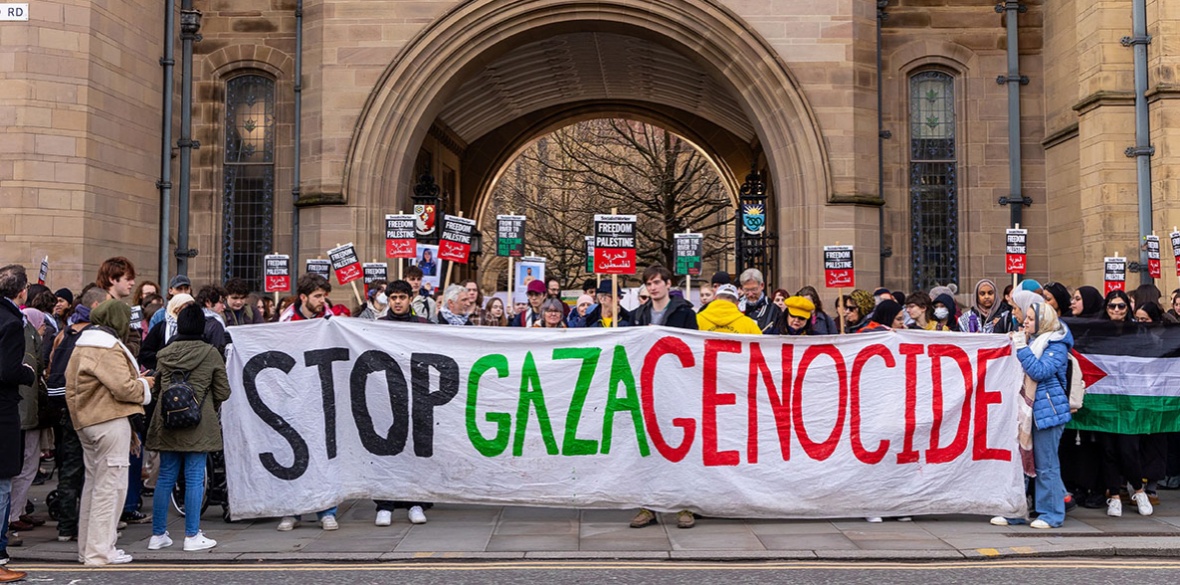
Protesters outside the University of ManchesterPhoto: Neil Terry Photography
WORKERS and students walked out across the country today to demand the government back a permanent ceasefire in Gaza, as the death toll climbs to over 27,000.
As part of the day of strike action, called by the Stop the War Coalition and the Campaign for Nuclear Disarmament, workers gathered for a lunchtime rally outside Parliament organised by civil servants’ union PCS. Members of NEU and the UCU also walked out across the country.
Media workers protested outside BBC headquarters over its coverage of Israel’s war crimes as the death toll for journalists tops 85.
A Media Workers for Palestine spokesperson said: “A number of the BBC’s own journalists have accused the corporation of investing greater effort in humanising Israeli victims of the war compared with Palestinians and failing to provide key historical context in its coverage.
…
Students and lecturers joined the action and walked out of universities across the country including in Birmingham, Bristol, Glasgow and Manchester.
Inequitable distribution of income has severe consequences.
The Post Office scandal has once again exposed the shortcomings of performance related pay for company directors. The company had remuneration committees staffed by hand-picked obedient non-executive directors. None opposed the rewards accruing from wrongful prosecution of more than 900 subpostmasters and dutifully rewarded directors. Paula Vennells, chief executive from 2012-2019 picked up bonuses of £2.2m for wrecking lives.
Performance related pay has boosted the remuneration of directors even when performance is negative, as exemplified by the 2007-08 financial crash, collapse of Carillion, BHS, London Capital and Finance, Patisserie Valerie, Debenhams and others.
The bottom line is a key feature of most performance related remuneration schemes. The median tenure of a FTSE100 CEO is about 3.75 years and temptation is to grab higher pay in the shortest possible time. Profits can be boosted by depressing wages, dodging taxes, postponing repair and maintenance; cutting investment and spending on innovation; and by using novel accounting practices. Directors are rewarded for such tactics as shareholders chase short-term returns. Little attention is paid to the long-term damage and social cohesion.
Workers invest their brain, brawn and life in companies but have become just another disposable commodity. In the words of former US President Abraham Lincoln: “Capital is only the fruit of labor, and could never have existed if labor had not first existed. Labor is the superior of capital, and deserves much the higher consideration.”
…
Inequitable distribution of income has severe consequences. Millions struggle to have access to good food, housing, education, pension and other essentials. Inequalities are a threat to democracy as the rich are able to control media, buy lobbyists and fund political parties to advance their interests, to the exclusion of the vast majority of the people.
“I have never been more upset and disappointed in our current government”
…
“I think a ceasefire is crucial,” one audience member said, adding: “What I also think is crucial is that the UK government is held to account for their role in licensing arms to Israel at the moment.” Her contribution was met with applause from the rest of the audience.
Another member of the audience echoed her comments, saying: “I have never been more upset and disappointed in our current government, with how they have dealt with the situation.”
He then went on to say: “Whether it’s the Conservative Party, and even the Labour Party – it’s an absolute disgrace. How many lives need to be lost? We have been 25-30,000 Gazan lives, people who have done nothing wrong. I completely echo what you say. Israel do have a right to defend themselves – absolute. But at the risk – not at the risk – the death, murder of 25-30,000 people who have done nothing wrong, I can’t understand this.”
Four years on after Britain left the European Union, a damning new poll shows just how disillusioned the public are with Brexit, with the majority believing it to be a failure.
The poll, carried out by Ipsos for the Evening Standard, found that 57% believe Brexit has been more of a failure than success, while only 13% say that it has been a success.
Younger adults, Londoners, and graduates are more likely to say that Brexit has been a failure.
A breakdown of the survey results showed that 70% of 18 to 34-year-olds think Brexit has been more of a failure, as do 64% of 35-54s, compared to 38% of those aged 65+.
…
Many of the promises made by Brexiteers have failed to materialise, including grater control of borders, free trade deals with America and of course who could forget the promise to invest £350 million more a week into the NHS after Brexit.
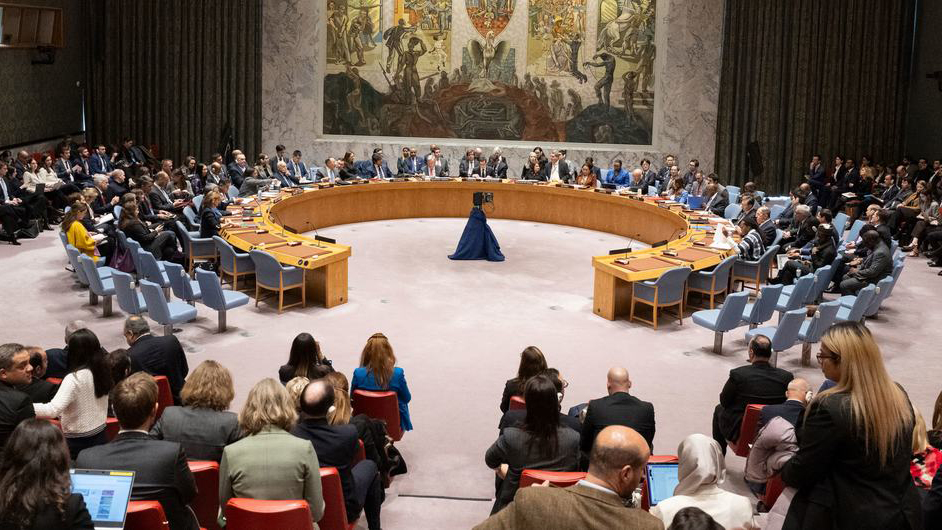
The UN Security Council meets on the situation in the Middle East, including Palestine (Photo via United Nations)
Participants in the UN Security Council highlighted need for a ceasefire in Gaza and a long term solution to the Palestinian question as necessary for peace
On January 23, speaking during the two day extended meeting of the UN Security Council on Palestine, UN Secretary General Antonio Guterres underlined that “Israel’s clear and repeated rejection” of a two-state solution is unacceptable. He also warned that this refusal and “denial of the right to statehood to the Palestinian people would indefinitely prolong a conflict that has become a major threat to global peace and security.”
Most of the countries which participated in the two day proceedings demanded an immediate humanitarian ceasefire and a two-state solution, claiming it necessary for regional and global peace.
Invoking ever deteriorating humanitarian conditions in Gaza, Guterres termed it “collective punishment” executed by Israeli forces, asserting that “nothing can justify it.”
More than 25,700 Palestinians have been killed, over 63,000 have been wounded, and nearly 90% of Gaza’s population has been displaced due to relentless bombings and ground offensives carried out by Israeli armed forces since October 7.
Israel has maintained that its war in Gaza is in response to Palestinian resistance forces, mainly Hamas, attacking inside its borders on October 7, in which nearly 1,200 people were killed and nearly 250 Israelis were taken as hostages.
Speaking in the meeting, Gilad Erdan, the Israeli ambassador to the UN, claimed that until persons involved in the October 7 attacks are handed over and hostages are released, war in Gaza will not end.
Most of the members of the UN Security Council repeated the call for an immediate ceasefire and called for better delivery of humanitarian aid to Gaza.
The Chinese ambassador to the UN, Zhang Jun, also noted that the Israeli leadership’s repeated rejection of a two-state solution is unacceptable, and demanded that it must be rejuvenated by granting Palestinians full membership to the UN.
Israeli Prime Minister Benjamin Netanyahu had, earlier this month, rejected the calls for a Palestinian state, calling it untenable and a threat to Israeli security.
The need for a two-state solution was raised by the Palestinian Foreign Minister Riyad Maliki, who denounced the war in Gaza as Israel’s “premeditated effort to inflict maximum pain on the Palestinian population.”
“No home, hospital, school, mosque, church or UNRWA shelter is safe from Israeli bombardments, 2,000 pound bombs dropped with no care whatsoever for civilian lives,” he noted.
South Africa, which has taken Israel to the International Court of Justice for its genocide of Palestinians, maintained that there cannot be selective implementation of international law and Israel must face consequences for its repeated violations of the same.
US positions provide a carte blanche to Israeli crimes
Speaking during the meeting, the US representative Uzra Zeya claimed the centrality of a two-state solution. She claimed that the US has been making efforts to prevent greater civilian casualties in the Israeli war in Gaza. However, US policies in Gaza were heavily criticized by both the permanent members of the UNSC and others as detrimental to peace.
Chinese ambassador Jun condemned the repeated use of veto by the US in earlier UNSC meetings on ceasefire resolutions, identifying them as impeding all efforts to peace.
The US had vetoed resolutions proposing a ceasefire in the UNSC in previous months and tried to excuse Israeli bombings in Gaza as the Zionist state’s right to self defense.
Jun hoped that all members of the international community must prioritize ceasefire in Gaza, and ways to stop the spread of the war in the region.
Russian Foreign Minister Sergei Lavrov asserted that the UNSC must take steps to prevent further destabilization in the region, which has been caused by US policies which vetoes ceasefire resolutions and provides carte blanche to Israeli acts of “collective punishment of Palestinians.”
Lavrov emphasized that until a ceasefire is implemented the talks about future solutions to the conflict are useless.
Iranian Foreign Minister Hussein Amir Abdollahian warned the US against violating Yemeni sovereignty by carrying out repeated air strikes against it. He alleged that it is a trap laid down by Israel with the objective of expanding the war in Gaza to the regional level.
Abdollahian proposed that a referendum among all Palestinians must be held to find a permanent solution to the Palestinian question.
Lebanese Foreign Minister Abdallah Bou Habib emphasized that all stakeholders, including the US, should see that Israel wants to expand the war across the region, and underlined that his country does not want war.
He emphasized that “what happened on October 7 did not happen in a vacuum” and if no attempts are made to secure a lasting solution “it will happen again,” as there is no peace in the region until there is justice for Palestinians.
Speaking in the meeting on Tuesday, the Saudi delegate Waleed El-Khereiji said that because of the “Israeli war machine,” tensions in the region, including in the Red Sea and Yemen, are increasing. He demanded that the Security Council make sure that Israel stops its violations of international law.
On Sunday, in an interview with CNN, Saudi Foreign Minister Faisal bin Farhad al-Saud denied any possibility of normalization of relations with Israel, as proposed by the US, until there is a road map for a two-state solution and an independent Palestinian state. “What we are seeing is Israelis crushing Gaza, the civilian population of Gaza. This is completely unnecessary, completely unacceptable, and has to stop.”
Ali, the MP for Birmingham Hall Green, said: “Is it not time for the prime minister to now admit that he has the blood of thousands of innocent people on his hands and for him to commit to demanding an immediate ceasefire and an ending of UK’s arms trade with Israel.”
In a swipe at Keir Starmer’s claim to have “changed” Labour since Jeremy Corbyn’s time as leader, the PM replied: “That’s the face of the changed Labour Party.”
Three hours later, Ali posted an apology for his remarks on X (formerly Twitter).
HuffPostUK understands that came after a dressing down by Labour’s chief whip, Alan Campbell.
…
(2/2) the Prime Minister in my question.
We all have a responsibility to be respectful in the language that we use, even when discussing difficult and, at times, sensitive issues.
‘What will it take for him to back a permanent, bilateral ceasefire?’
Rishi Sunak faced MPs in parliament today at the latest Prime Minister’s Questions (PMQs). He fielded questions from the Labour leader Keir Starmer on the Rwanda scheme and the SNP’s Westminster leader Stephen Flynn on the cost of living crisis.
But one of the most dramatic moments in the exchanges came as a result of a question from Green Party MP Caroline Lucas. She asked Sunak “what will it take for him to back a permanent, bilateral ceasefire?”
Speaking in the House of Commons, Lucas said: “Until the UK government calls for an immediate ceasefire, it is complicit in Gaza. Not my words, but those of the head of Oxfam, who like every single agency trying to operate on the ground is clear: that aid can’t be effectively delivered while fighting continues. More UK aid is, of course, welcome, but even when it does get through, it can result in what one Palestinian aid worker calls ‘bombing us on full stomachs’.
“24,000 people have already been killed. So can he tell us what will it take for him to back a permanent, bilateral ceasefire?”