International pressure increases on Israel as it continues committing genocide in Gaza

Spread the love

Original article republished from peoples dispatch under a Creative Commons Attribution-ShareAlike 4.0 (CC BY-SA) license.

South Africa’s ICJ case against Israel has received widespread support as it faces increased criticism for its genocidal war on Gaza

Israel has come under fire over comments from a number of ultra right-wing ministers and politicians who have called for the complete and permanent transfer and expulsion of the Palestinian population of Gaza. The officials have suggested that Gazans should be forcibly transferred to other countries in the region, as well as to countries in Africa.

The United Nations, the Netherlands, Saudi Arabia, Kuwait, Qatar, Egypt, Jordan, France, the European Union, as well as Israel’s primary backer, the United States, among others have condemned these statements and noted that such a move would constitute a grave violation of international law.

Israel’s far right Minister of Security Itamar Ben-Gvir responded to the criticism from the US stating: “Really appreciate the United States of America but with all due respect we are not another star on the American flag. The United States is our best friend, but first of all we will do what is best for the State of Israel: the migration of hundreds of thousands from Gaza will allow the residents of the enclave to return home and live in security and protect the IDF soldiers.”

Harsh criticisms have been lodged from progressives at the US and France who allege that their policies supporting Israel financially and politically throughout their genocidal war on Gaza have created the conditions for Israel to openly fantasize about this escalation of ethnic cleansing.

The growing international alarm and condemnation comes just a week before the International Court of Justice (ICJ) is scheduled to hold public hearings over the genocide case that South Africa has filed against Israel over its war in Gaza. Turkey and Malaysia, have both endorsed the South African case against Israel.

Notably, the National Security Council spokesperson John Kirby rejected the case, an 84-page application, and called it “meritless”.

Worsening humanitarian crisis across Gaza

The United Nations has once again reiterated that the humanitarian situation in Gaza will continue to deteriorate if there is no ceasefire, emphasizing that a number of areas have been rendered completely inaccessible due to Israel’s shelling.

The United Nations Office for the Coordination of Humanitarian Affairs (OCHA) wrote in an update: “The UN and other humanitarian partners have been unable to deliver urgently needed life-saving humanitarian assistance north of Wadi Gaza for three days due to access delays and denials, as well as active conflict. This includes medicines that would have provided vital support to more than 100,000 people for 30 days, as well as eight trucks of food for people who currently face catastrophic and life-threatening food insecurity.”

The office added, “Humanitarian organizations are calling for urgent, safe, sustained and unhindered humanitarian access to areas north of Wadi Gaza, which has been severed from the south for more than a month.”

The OCHA along with the World Health Organization also reported that “more than 400,000 cases of infectious diseases have been reported since 7 October, with some 180,000 people suffering from upper respiratory infections.  There also have been more than 136,000 cases of diarrhea reported — half among children under the age of 5.”

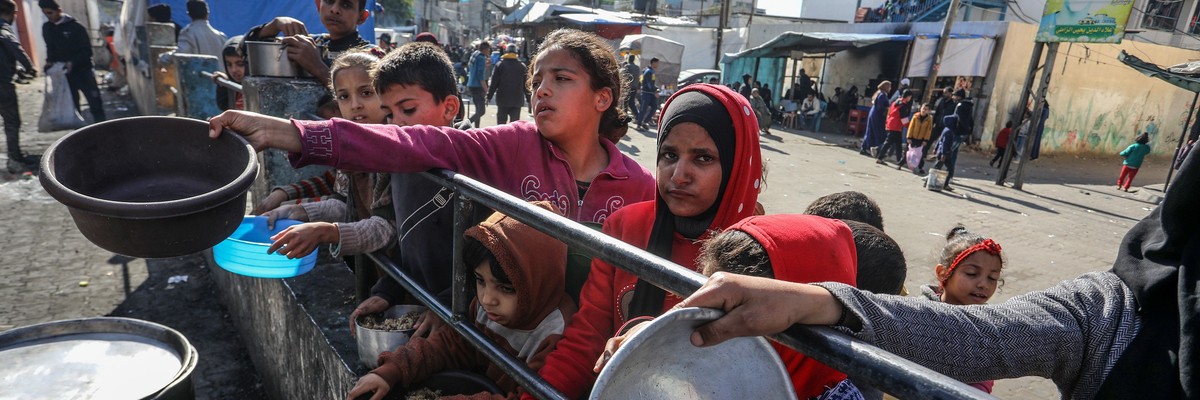
Humanitarian organizations have emphasized that there is an urgent, critical need for humanitarian assistance, including medical aid, to treat and save the lives of those suffering from diseases and illnesses and to alleviate the extreme suffering and hardships of the population of around 2.1 million, of which 1.9 million are currently internally displaced.

Day 90

Scores of Palestinians have been killed in fresh airstrikes and ground bombardment over the last 24 hours in Gaza.

The total death toll since October 7 has risen to at least 22,438 Palestinians killed, including more than 9,000 children and 4,000 women, along with more than 57,614 injured, more than 75% of whom are women and children. 7000 other Palestinians are reported missing, feared to be trapped under the rubble of the widespread destruction and rubble of damaged buildings.

Hospitals continue to be targeted by Israel. The al-Amal hospital and the surrounding areas in Khan Younis run by the Palestinian Red Crescent Society (PRCS) has been under Israeli attack for the past two weeks according to a PRCS statement which has endangered the lives of thousands of IDPs who were taking refuge there. “The displaced persons are living in an atmosphere of horror and panic. This has forced dozens of them to leave again this morning and yesterday, fearing for their lives after they took refuge in the PRCS as a safe place protected by international humanitarian law.”

They reported that in addition to killing and injuring patients and displaced persons taking refuge at al-Amal, the Israeli bombing destroyed the transmitter station of the PRCS VHF communications which creates “a major obstacle to the response of ambulance crews to the wounded, the sick, and humanitarian cases.”

Original article republished from peoples dispatch under a Creative Commons Attribution-ShareAlike 4.0 (CC BY-SA) license.

Continue ReadingInternational pressure increases on Israel as it continues committing genocide in Gaza

Israel is decimating Gaza’s health infrastructure as disease threatens the majority of its population

Spread the love

The public health situation among people displaced by Israeli attacks worsens by the day, as targeting of health workers and infrastructure continues

Original article by Ana Vračar republished from peoples dispatch under a Creative Commons Attribution-ShareAlike 4.0 (CC BY-SA) license.

Healthcare workers at Al-Awda hospital. Photo: Al-Awda

The number of people infected with contagious diseases in Gaza continues to rise. The latest data from the World Health Organization (WHO) warns that 180,000 people are currently suffering from respiratory infections. Additionally, the UN’s health agency reports that 55,000 people have lice and scabies, 42,000 are experiencing various forms of skin rashes, and 136,000, half of whom are children under 5 years old, have contracted diarrhea.

While these diseases would not be deadly under conditions with a functioning health system and adequate living conditions, in the current situation, they could be life-threatening. “Unless something changes, the world faces the prospect of almost a quarter of Gaza’s 2 million population – close to half a million human beings – dying within a year. These would be largely deaths from preventable health causes and the collapse of the health system,” estimated Devi Sridhar, Chair in Global Public Health at the University of Edinburgh, at the end of 2023.

If a permanent ceasefire does not take immediate effect, though, things are unlikely to change, as reiterated by WHO Director-General Tedros Adhanom Ghebreyesus in a statement. WHO teams, now participating in fairly regular missions on the ground, are sending reports about overcrowding in Gaza’s hospitals and shelters. According to the Palestinian Ministry of Health, on January 4, only 9 out of 36 hospitals were partially functioning in the Strip, resulting in an average bed occupancy of 351% and 261% occupancy in intensive care units.

Israel’s attacks on healthcare in Palestine are affecting everyone, especially the most vulnerable. Cancer and dialysis patients cannot access the specific care they need, and most have not yet been transferred to hospitals abroad as announced. The Ministry of Health estimates that 5,300 patients need to be transferred abroad for treatment, but until January 5, less than 1,000 were moved. This number includes 571 people injured in the attacks and 401 patients who required distinct forms of care, including cancer patients.

Children and pregnant women are also groups most at risk from the attacks and their consequences. Over 5,000 babies were born in Gaza just last month, all requiring adequate care and nutrition. With mothers and families going hungry, it is evident that some of them are also lacking proper food. Among the newborns are about 130 premature babies dependent on incubators, yet most incubators are located in northern Gaza, which, in terms used by the WHO, has become a medical disaster zone.

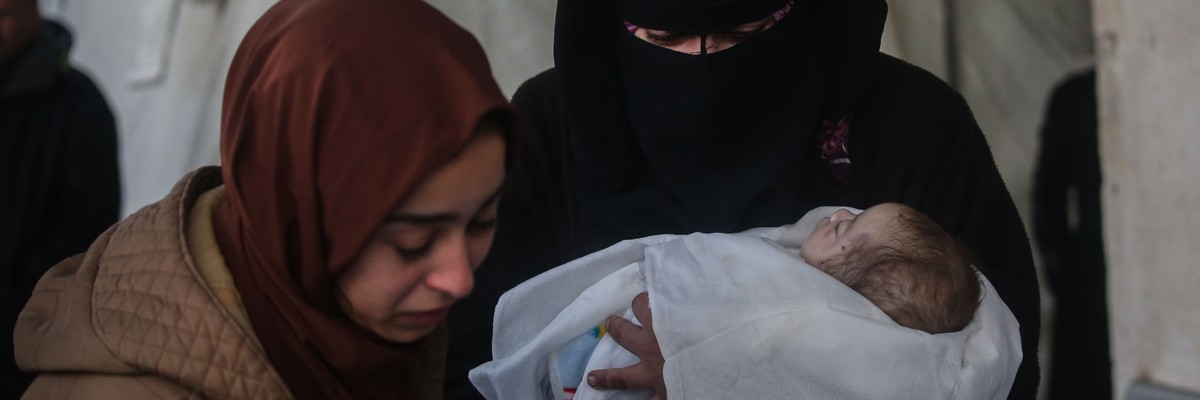
In addition to going hungry and sleeping in overcrowded tents, newborns and children are also not getting vaccinated. Recounting the experience of a woman who recently gave birth, Nareman, who was “taken from her tent in a temporary camp by horse-drawn carriage to a hospital to give birth to her daughter, before returning to her makeshift home straight after,” the WHO warned that the health system in Gaza is struggling to ensure standard immunization routines. Nareman’s baby is among those who are yet to receive planned vaccines, and she is staying with her sisters and brothers at the camp, who are reportedly in ill health themselves.

The UN Relief and Works Agency for Palestine Refugees in the Near East (UNRWA) has managed to deliver 600,000 key vaccines into Gaza in the period between December 25-29, 2023, and is planning to deliver some 960,000 more together with WHO and UNICEF. Yet, this is no easy feat as Israeli Occupying Forces (IOF) continue to target health infrastructure and health workers. Since the beginning of the attacks on October 7, 326 health workers in Palestine were killed by Israeli attacks, 764 were injured, and 65 were arrested, according to Ministry of Health data.

Many more experienced violence and intimidation by the IOF, including ambulances and partners of the Palestinian Red Crescent Society (PRCS). On January 4, Israeli soldiers attacked a PRCS ambulance. Not long before that, the organization reported attacks targeting the house of Anwar Abu Holi, Director of the Central Gaza Ambulance Center, as well as multiple attacks on the Al-Amal Hospital in Khan Younis.

As shelling in the proximity of the hospital began, Al-Amal offered shelter to approximately 14,000 forcibly displaced people. The attacks, said the PRCS, endangered the lives of thousands. “The displaced persons are living in an atmosphere of horror and panic.”

The attacks that have taken place since the beginning of January killed 7 people, including a days-old baby, injured 11 more, and were reported by the PRCS to be ongoing on January 5, without a meaningful indication they would stop anytime soon.

Original article by Ana Vračar republished from peoples dispatch under a Creative Commons Attribution-ShareAlike 4.0 (CC BY-SA) license.

Continue ReadingIsrael is decimating Gaza’s health infrastructure as disease threatens the majority of its population

Breaking from U.S., Canada votes for ceasefire—but continues Israeli arms shipments

Spread the love

Original article by DAVE MCKEE republished from People’s World under http://creativecommons.org/licenses/by-nc-nd/3.0/us/.

A Palestinian flag flies near the Peace Tower during a rally on Parliament Hill in Ottawa on Nov. 4, 2023. | Spencer Colby / The Canadian Press via AP

TORONTO—Peace and solidarity activists across Canada were pleased to see the government support the United Nations vote on Dec. 12 calling for a ceasefire in Gaza. They should be pleased—it was their efforts which helped make it happen.

Without the continuing mass mobilizations against Israel’s war in communities large and small, the Liberal government of Prime Minister Justin Trudeau would surely not have felt compelled to shift from its two-month-long refusal to support a ceasefire.

At the same time, the same activists are rightfully disgusted that the government took so long to take even a modest stand against a bloody siege that many rightfully recognize as a genocide.

In the time it took for Ottawa to decide that a ceasefire was worth supporting, over 18,000 Palestinian people have been killed and nearly 50,000 wounded. The majority of the people killed and wounded are women and children. Eighty-five percent of the people in Gaza have been displaced by the siege, according to the U.N.—this would be like having over 32 million of Canada’s 38 million people displaced.

The government’s public statements on the ceasefire vote have been contradictory, leaving many people concerned that the Liberals will quickly weasel their way out of any commitment to action. When Trudeau has used the word “ceasefire” (which is not very often), he has stressed that it must be “sustainable” but has avoided saying it must be permanent.

His government took great pains to amend the previous U.N. resolution for a ceasefire, on Oct. 27, to make it explicitly condemn Hamas. When the amendment failed, Canada abstained from voting on the resolution. Trudeau’s current qualified call for a “sustainable ceasefire” suggests that the government is still guided by the same thinking.

The Canadian government needs to issue a clear, public call for an immediate and permanent ceasefire, beginning with and focused on Israel’s vicious offensive against the people of Gaza. Imposing conditions through an assumed moral equivalency between Israel’s violence and that of Hamas will only stall a ceasefire before it can even begin.

Ottawa also needs to back up a real call for a ceasefire by ending its military support for the genocidal siege itself. Canada can and should immediately halt shipments of arms to Israel. Where the government has so far failed to do this, protesters have tried by blockading arms manufacturers like L3Harris and Lockheed Martin.

Certainly, it is positive that Canada has finally been pushed to support a ceasefire. But this only makes the work of the peace and solidarity movements more urgent and more important. Over the past nine weeks, millions of people in this country have protested and petitioned the government, and that wave of mobilization needs to continue—and grow—if Ottawa is to be pushed from words to real action.

People’s Voice

Original article by DAVE MCKEE republished from People’s World under http://creativecommons.org/licenses/by-nc-nd/3.0/us/.

Continue ReadingBreaking from U.S., Canada votes for ceasefire—but continues Israeli arms shipments

Meet the Companies Profiting From Israel’s War on Gaza

Spread the love

Original article by JESSICA CORBETT republished from Common Dreams under Creative Commons (CC BY-NC-ND 3.0).

Smoke rises as Israeli artillery units and howitzers stationed in the military zone launch attacks near the Gaza border in Nahal Oz, Israel on December 10, 2023. (Photo: Mostafa Alkharouf/Anadolu via Getty Images)

“As global resistance to war and apartheid grows, it is important that the public know exactly who is making this violence possible.”

As of Wednesday, a U.S.-based Quaker group’s online database listed over two dozen companies profiting from the bloodshed in the Gaza Strip, where Israeli forces have spent the last 10 weeks waging what experts call a “genocidal” war that sent defense stocks soaring.

Backed by $3.8 billion in annual military aid from the United States, Israel declared war on October 7 in retaliation for a Hamas-led attack that killed over 1,100 people. Since then, Israeli forces have killed over 20,000 Palestinians in Gaza—sparking massive protests demanding a cease-fire around the world, including many led by Jewish people.

“War and attacks on civilians will never bring safety or peace to Israelis or Palestinians.”

The growing death toll, displacement, destruction of civilian infrastructure, and difficulties in delivering humanitarian aid to the besieged enclave have also increased scrutiny of a $14.3 billion package for the war that the Biden administration requested from Congress as well as criticism of the U.S. weapon-makers and billionaire donors who are arming and enabling the Israel Defense Forces (IDF).

“The scale of destruction and war crimes in Gaza would not be possible without massive weapon transfers from the U.S.,” said Noam Perry of the American Friends Service Committee (AFSC), the group behind the tool, in a statement Wednesday. “As global resistance to war and apartheid grows, it is important that the public know exactly who is making this violence possible.”

As the AFSC webpage details:

Shortly after October 7, the U.S. government started transferring to Israel massive amounts of weapons. Among these weapons, Israel received more than 15,000 bombs and 50,000 artillery shells within just the first month-and-a-half. These transfers have been deliberately shrouded in secrecy to avoid public scrutiny and prevent Congress from exercising any meaningful oversight.

Some of these weapons were purchased using U.S. taxpayers’ money through the Foreign Military Sales program; some were direct commercial sales purchased through Israel’s own budget; and some were replenished U.S. military stockpiles in Israel, which the Israeli military may also use. A list of known U.S. arms transfers is maintained by the Forum on the Arms Trade.

The webpage notes that the list is based on reporting, social media, and other open sources, and “focuses on weapons used by Israel because all Palestinian militant groups are already sanctioned and receive no support from Western governments or corporations.”

For example, Boeing, the world’s fifth-largest weapon manufacturer, makes F-15 fighter jets and Apache AH-64 attack helicopters used by the Israeli forces, as well as “multiple types of unguided small diameter bombs (SDBs) and Joint Direct Attack Munition (JDAM) kits” that have been used “extensively” during the war, including in a bombing of Gaza’s Jabalia refugee camp.

After decades of Israeli occupation forces using Caterpillar’s armored D9 bulldozers to “demolish Palestinian homes and civilian infrastructure in the occupied West Bank and to enforce the blockade of the Gaza Strip,” the machines “have been crucial in the Israeli military’s ground invasion” of the enclave, according to AFSC.

While both of those war profiteers are based in the United States, the list isn’t limited to U.S. firms, also calling out the world’s seventh-largest weapon manufacturer, the U.K.’s BAE Systems, and Israel’s largest weapon manufacturer, Elbit Systems, “one of the primary suppliers of weapons and surveillance systems to the Israeli military.”

Other companies on the list include weapons giants such as General Dynamics, General Electric, L3Harris Technologies, Leonardo, Lockheed Martin, Northrop Grumman, and RTX—formerly Raytheon—as well as vehicle companies AM General, Ford, Oshkosh, Toyota, and drone manufacturers AeroVironment, Skydio, and XTEND.

The list also targets U.S.-based Colt’s Manufacturing Company, which makes firearms including the M16, and Emtan Karmiel, an Israeli firm that “delivered some 12,000 rifles” to the country’s forces within a week of October 7. It also includes Israel Aerospace Industries, a state-owned manufacturer that “makes multiple weapons systems specifically for the Israeli military.”

Other Israeli firms listed include Plasan, which makes the SandCat light armored vehicle, and MDT Armor, which is owned by the Israeli company Shladot and makes the David Urban Light Armored Vehicle used by the military for patrols and reconnaissance.

The other foreign firms on the list are ThyssenKrupp, the German company that built four warships for Israel, and Nordic Ammunition Company, which makes the M141 Bunker Defeat Munition, a shoulder-fired “bunker-buster” rocket.

“As a Quaker organization with a long history of work in Palestine and Israel, including in Gaza, we support a full arms embargo to both Israeli and Palestinian militant groups,” Perry stressed Wednesday. “War and attacks on civilians will never bring safety or peace to Israelis or Palestinians. We need a permanent cease-fire and to work toward a just and lasting peace in the region.”

Original article by JESSICA CORBETT republished from Common Dreams under Creative Commons (CC BY-NC-ND 3.0).

Continue ReadingMeet the Companies Profiting From Israel’s War on Gaza

After Bad Gaza Poll, Biden Told to Choose ‘Option That Upholds Human Rights’

Spread the love

Original article by JAKE JOHNSON republished from Common Dreams under Creative Commons (CC BY-NC-ND 3.0). 
U.S. President Joe Biden arrives for a meeting at the White House on December 13, 2023 in Washington, D.C. (Photo: Chip Somodevilla/Getty Images)

A New York Times/Sienna College survey found that the U.S. president’s handling of the Gaza crisis is unpopular with voters across the political spectrum.

The New York Times suggested Tuesday that U.S. President Joe Biden has “few politically palatable options” after a survey the newspaper conducted with Siena College showed that his handling of Israel’s war on the Gaza Strip is broadly unpopular with the American electorate.

Matt Duss, a former foreign policy adviser to Sen. Bernie Sanders (I-Vt.), responded that Biden’s choice is clear.

“He should choose the option that upholds human rights and international law, which is what he promised during his campaign,” wrote Duss, executive vice president of the Center for International Policy. “Support a cease-fire.”

The Times/Siena College poll of U.S. voters found that Biden’s current approach—which has consisted of unconditional military support for Israel accompanied by mild calls for the protection of Gaza civilians and opposition to a lasting cease-fire—has just 33% support and 57% opposition.

Among young voters who were critical to Biden’s 2020 victory over former President Donald Trump, the opposition is even more pronounced, with 73% of those between the ages of 18 and 29 saying they disapprove, according to the new survey. Forty-seven percent of young voters said they believe Biden is too supportive of Israel, while just 6% said he’s too supportive of the Palestinians.

The survey’s findings amplified concerns that, in addition to rendering himself complicit in genocide, Biden is alienating key elements of the Democratic base by arming the Israeli military as it carries out mass atrocities in the Gaza Strip.

“Yet another major poll finds that Biden is killing his own reelection bid with his inhumane and strategically nonsensical Gaza policy,” Trita Parsi, executive vice president of the Quincy Institute for Responsible Statecraft, wrote on social media.

The survey was released ahead of an expected United Nations Security Council vote on a resolution calling for a “suspension of hostilities.” A previous version of the resolution called for a “cessation of hostilities,” but the text was reportedly watered down in an effort to prevent the U.S. from once again wielding its veto power.

As the Biden administration’s opposition to a sustained cease-fire leaves the U.S. increasingly isolated on the world stage, the Times/Siena College poll found that 44% of U.S. voters—including 59% of Democrats—believe Israel should “stop its military campaign in order to protect against civilian casualties, even if not all Israeli hostages have been released.”

Sixty-five percent of Democratic voters believe Israel should stop its assault on Gaza to prevent additional civilian deaths “even if Hamas has not been fully eliminated” in line with the Israeli government’s stated objective.

During a meeting last week with Israeli Prime Minister Benjamin Netanyahu, Biden national security adviser Jake Sullivan reportedly urged the far-right leader to transition to a “lower intensity” form of warfare in Gaza “in a matter of weeks, not months,” the latest signal that the Biden administration is feeling domestic and international pressure as the humanitarian catastrophe worsens and the death toll climbs.

“I don’t want to see any baby die. So, first of all, we’ve got to take that on. We’ve got to get a cease-fire. This has to stop.”

Shira Lurie, assistant professor of American History at Saint Mary’s University, warned in an op-ed for the Toronto Star on Monday that Biden’s continued arming of Israel and opposition to a permanent cease-fire “could have severe ramifications in the electoral college” in 2024 “as several key states, including Arizona, Georgia, Michigan, Minnesota, and Wisconsin, have significant Muslim populations.”

A lawmaker from one of those states, Rep. Debbie Dingell (D-Mich.), said in an NBC News interview on Sunday that “there’s a lot that has to be done” for Biden to win back the votes of those who are furious over his support for Israel’s decimation of Gaza.

“All of us in this country need to understand what’s happening in Gaza right now. You can fight about how many thousands of people have been killed, but 6,000 to 8,000 children have been killed,” said Dingell. “Eighty-five percent of the people in Gaza have had to leave their homes. They’re living in shelters. Disease is going up. There’s one toilet for 220 people, one shower for 4,500 people. They don’t have food. They don’t have medicine. They don’t have utilities.”

“I can’t tell you the number of families that I’ve spoken to who’ve lost entire families,” she continued. “We’ve got to show some empathy and compassion. A Jewish baby and a Palestinian baby are babies. I don’t want to see any baby die. So, first of all, we’ve got to take that on. We’ve got to get a cease-fire. This has to stop.”

Original article by JAKE JOHNSON republished from Common Dreams under Creative Commons (CC BY-NC-ND 3.0). 

Continue ReadingAfter Bad Gaza Poll, Biden Told to Choose ‘Option That Upholds Human Rights’