‘Thought of the Day’ is a feature of BBC Radio 4 news at early in the morning. It usually features some religious nutter spouting some very simplistic religious rubbish. It’s a sermon and sermons are usually fantastic babbliing by mad people. The trouble is – of course – that the presentation is within their particular religious framework often with no regard for logic or reason. It used to drive me mad – I’d be thinking “You’re so biased and short-sighted, can’t you see <WHATEVER>?”. I’ve just heard “Prayer for the Day” for the first time ever because I’m up so early, need to remember to change channel in future.
So here I am giving my own thoughts of the day. While I realise that I am regarded very highly be some of my valued audience, you are so welcome to disagree. I want you to disagree. Make notes. He’s wrong on this, this and this. That’s not how it works because … <YOUR REASONING>. Don’t just disagree, know exactly why and what you disagree with, be able to argue what points you disagree with me.
It’s a real shame that you can’t comment on this blog – that’s because comments are censored probably by UK’s Home Secretary Yvette Cooper with the full knowledge and agreement of UK Prime Minister Keir Starmer. That’s a topic for another Thoughts of the Day, let’s just say that it doesn’t really conform with human rights laws, does it? No doubt that there’s some justification for it … OK let’s leave it for now and discuss it soon on some laterer Thoughts of the Day. I’ve also not forgotten that I’m supposed to write a piece on carbon capture and storage but I have been and am still quite ill.
Back to the point, let’s have some thoughts of the day, more thoughts of the day I suppose.
Firstly, you don’t need to be Sherlock Holmes do you? United States providing a missile interception capability to Israel, drones and rockets getting through …
Trying to find an appropriate nickname for Kamala Harris who fully supports Israel’s genocide.
Secondly, I think that we should regard public statements by US and UK on Israel to be intended to deceive and mislead. Their actions prove that they’re talking total BS in public. USUK militaries are participating as much as the IDF FFS.
Thirdly, I think that WW3 is on the cards. I was expecting it a few weeks ago actually and it’s getting on a bit really re: the presidential election. People get scared and tend to vote with what they’ve got if there’s a war on. Russia and North Korea [ed and China] will be on Iran’s side. Russia has got some of it’s fleet there already. I know from keeping up with the news that Russia has got some F.O. serious new missiles the capabilities of which have yet to be demonstrated.
There’s a protest on 2 November. I’ve got a bus ticket and some walking boots on the way.
Even now, decades after we first began trying to avert the worst of global warming, more than 80% of the world’s total energy comes from fossil fuels.
You might think this would make fossil fuel production extremely profitable. But it’s not always the case. Much of the most accessible oil has already been extracted and burned. Many countries want to shore up domestic sources of fossil fuels to boost energy security. Energy price fluctuations and competition from new energy sources such as solar, wind and fossil gas have made it harder for some fossil fuel companies to make money, especially in coal.
You might have wondered – why would some of the largest companies on Earth need subsidies? Here’s why.
Australia’s surging liquefied natural gas industry has been boosted by government funding. KDS Photographics/Shutterstock
Private companies, public money
Globally, private companies dominate fossil fuel production, though fossil fuel-rich nations often have state-owned companies, such as Saudi Arabia’s Aramco and Russia’s Rosneft.
Why would governments give fossil fuel companies money? Many reasons. But the most important is that wealthy countries have historically needed huge volumes of fossil fuels for manufacturing, transport and power. Many countries have some sources of fossil fuels inside their borders, but only a few are self-sufficient. This has enabled fossil fuel giants such as Saudi Arabia to become wealthy beyond belief.
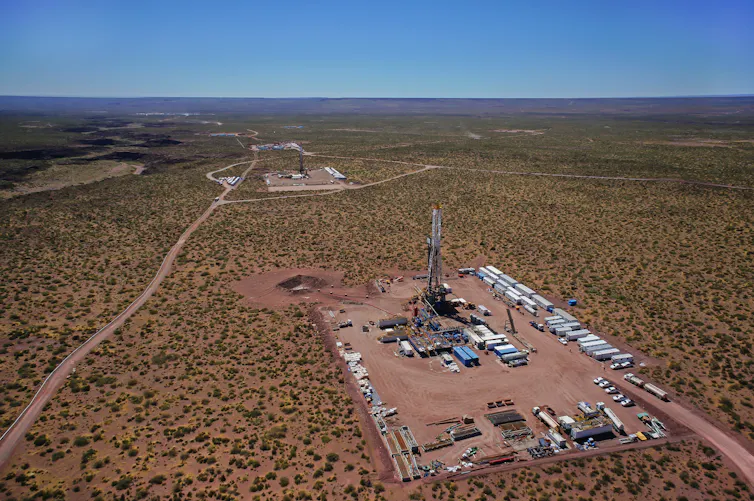
Many governments have used subsidies to boost their energy security and encourage local producers to seek out new sources of coal, gas and oil. These subsidies can make all the difference in making fossil fuel companies competitive internationally. For instance, Canada spent billions on subsidies to boost its oil sands and fracking projects.
Subsidies were essential in the United States’ fracking revolution. Novel approaches to extracting fossil gas and oil – boosted by major tax incentives – turned the US from a major importer of oil and gas into a net exporter by 2019.
You can see why the US did this. At a stroke, it went from being dependent on energy provided by foreign nations to being independent.
Once subsidies are in place, they become very hard to remove. Indonesia’s lavish fuel subsidies now account for 2% of the nation’s GDP. When the national government tried to walk these back, there were riots.
And there’s another reason, too. Fossil fuels are still playing an important role in boosting the economy in most nations. Subsidising them has long been seen as a way to maintain economic growth and stability.
Globally, these subsidies are estimated at a staggering $10.5 trillion each year.
This figure has grown sharply in recent years, after Russia’s invasion of Ukraine. As European nations tried to wean themselves off Russia’s gas, energy prices surged worldwide. In response, some countries introduced new subsidies to support businesses and consumers.
The top-line figure of $10.5 trillion includes two types of subsidy – explicit (meaning real dollars change hands) and implicit (for example, governments building roads and railways to encourage crude oil transport).
Explicit subsidies
Explicit fossil fuel subsidies are direct financial incentives from governments to fossil fuel producers and consumers. These incentives come in different forms, such as tax breaks, direct payments, grants and price controls. All of them aim to reduce the financial burden associated with fossil fuel production and use.
In Australia, explicit subsidies include fuel tax credits and exploration tax reductions. Fossil fuel companies can get subsidies to offset the losses they make during the years it takes to find and begin extracting new fossil fuels.
In the US, oil and gas companies benefit from the oil depletion allowance, which permits them to deduct a percentage of their gross income from oil and gas sales as an expense. They can also claim tax deductions for intangible drilling costs, such as the wages of workers and material needed to find new sources of oil and gas.
China, too, uses direct subsidies, discounted land-use fees, and preferential loans as explicit subsidies to boost coal production and consumption. The national government also supports fossil fuel consumption through direct payments to consumers.
China has used subsidies to encourage exploitation of its large coal resources. zhaoliang70/Shutterstock
Implicit subsidies
Implicit subsidies are often described as “imaginary”. That doesn’t mean they don’t exist, just that they’re not a direct transfer to directly paid to fossil fuel producers.
For instance, the cost of burning fossil fuels is borne by the global community and the natural world, in the form of climate change, damage to human health and other harms. Most fossil fuel companies don’t have to pay a cent for the pollution their products cause – so in effect, they are being granted an indirect subsidy.
Implicit incentives also include government investment in facilities such as transport networks, pipelines, oil refineries and port infrastructure, which will accelerate fossil fuel production and delivery. Think of the Middle Arm development in Darwin, funded by both the federal and territory government.
Why are these subsidies still being paid?
As the world grapples with a worsening climate crisis, fossil fuel subsidies are under great scrutiny.
It’s politically difficult to withdraw subsidies once given. This is why governments around the world have instead begun to give subsidies and tax incentives to green energy developers, including the enormous $500 billion Inflation Reduction Act in the US, the European Union’s Green Deal, and China’s massive subsidies of green technologies such as electric vehicles and solar panels.
The goal here is to make renewable energy and electrified transport steadily more affordable and competitive – just as fossil fuel subsidies did for oil, gas and coal.
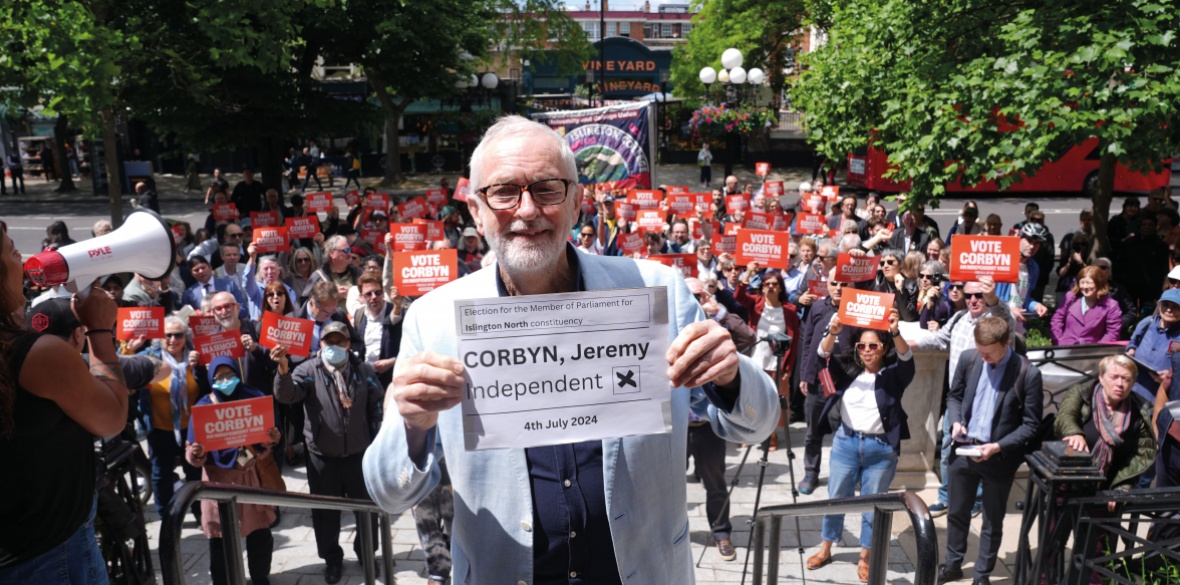
ALL TO PLAY FOR: Jeremy Corbyn poses outside Islington Town Hall, north London, after handing in his nomination papers for the general election
WILL Jeremy Corbyn win? It is the anxious question asked thousands of times a day by men and women on the left across Britain.
Across the world, come to that. The Islington North MP is recognised globally as one of the foremost champions for peace and social justice.
…
Five years ago he was leading Labour’s charge for office. His period as party leader did one thing the Establishment can never forgive — it gave them a fright. Keir Starmer is the instrument of their vengeance.
Interviewed by the Star in a cafe in the shadow of Finsbury Park station, near his campaign headquarters, he is invited to reflect on what has become of his party of nearly 60 years.
“It’s very sad. When I stepped down as leader it had 600,000 members, it was developing community organising, delayed for two years by officialdom.
“That was the direction we were going in — a broad, community-based grassroots campaigning party. Now it is a very centralised party. Local parties like Islington North have been treated with absolute disdain by the national party.”
His campaign has focused heavily on the local and has not really attacked his former party.
Prompted, Corbyn acknowledges that “if Labour loses that social milieu of people fighting for social justice and peace it just becomes a vehicle with no soul.”
That is the price of the consensus which Corbynism briefly shattered and is now in advanced restoration. Nationally, it is an arid campaign.
“The duopoly of the economic offer, both parties promise the same spending plans, same taxation regime, means the inequalities of the past 15 years are hard-wired into economic plans for the future.”
…
As ever, Jeremy Corbyn is most fluent, most at ease when discussing either the social problems on the ground, in his own constituency above all, or the dangers facing the world as a whole. I put to him George Galloway’s recent warning that Britain could be at war within six months.
“George is not wrong about that. We are moving towards a very very dangerous situation. Defence spending is by consensus to rise to 2.5 per cent and there are pretty loud voices saying it should go even more, to 3 per cent.”
He slates the bipartisan obsession “with Britain’s global military role — for what? We are building up to a cold war with China,” incurring vast spending on the Aukus nuclear submarine pact ”and not doing anything to bring about peace, not in the Ukraine war, not in Palestine.”
Re-elected, “I will be that voice for peace,” he pledges, a rare politician’s commitment that you can be absolutely sure will be honoured.
…
“The Gaza crisis has sorted a lot of people out. I think that the opportunity for politics coming back offered by the peace movement is going to be the future. People who come together for social justice.
“If you want to know what the future looks like, look at the demonstrations, people from all walks of life, communities, religions, races; all of this is a way forward.
“It includes a lot of people in the Labour Party who have radical political demands” but also the wave of independent candidates challenging Labour in this election.
“I would expect after the election to see a political grassroots movement, a community of activity from the grassroots.” In Islington, he pledges to establish a people’s assembly to render account to.
Zionist Keir Starmes is quoted “I support Zionism without qualification.” He’s asked whether that means that he supports Zionism under all circumstances, whatever Zionists do.
Across corporate media, journalists and pundits introduced conspiracy theories to discredit the pro-Palestine student protest movement, particularly that they are funded by foreign countries or “outside agitators.”
Joe Scarborough and Hillary Clinton on MSNBC‘s Morning Joe (5/9/24) to talk about “misinformation,” agreeing that student protesters are “extremists…funded by Qatar.”
MSNBC‘s Joe Scarborough (5/9/24) went on a rant about the college students who have been staging the protests, suggesting to guest Hillary Clinton that they were influenced by China or Qatar:
I’m going to talk about radicalism on college campuses. The sort of radicalism that has mainstream students getting propaganda, whether it’s from their professors or whether it’s from Communist Chinese government through TikTok, calling the president of the United States “Genocide Joe.” Calling you and President Clinton war criminals.
Eventually, he called the students “extremists—I’m sorry—funded by Qatar.”
Clinton responded: “You raised things that need to be vented about.”
Scarborough’s claim that Qatar funds the students likely comes from a Jerusalem Post article (4/30/24), which called the protests “despicable.” The story reported, “Qatar has invested $5.6 billion in 81 American universities since 2007, including the most prestigious ones: Harvard, Yale, Cornell and Stanford.” Of course, funding universities is not the same as funding student protests; the university administrations that actually received the Qatari funding have often been quite hostile to the protesters.
‘Mr. Putin’s message’
Nancy Pelosi, interviewed by Dana Bash on CNN (1/28/24), accused protesters of being “connected to Russia” because “to call for a ceasefire is Mr. Putin’s message.”
House Speaker Emeritus Nancy Pelosi (D–Calif.) suggested on CNN’s State of the Union (1/28/24) that Russia has played a role in the protests:
And what we have to do is try to stop the suffering and gossip….. But for them to call for a ceasefire is Mr. Putin’s message…. I think some of these protesters are spontaneous and organic and sincere. Some I think are connected to Russia.
CNN’s Dana Bash asked, “you think some of these protests are Russian plants?” Pelosi responded: “I don’t think they’re plants; I think some financing should be investigated.”
Like MSNBC, Fox News (5/2/24) has also pushed the narrative suggesting that China is behind the protests: “China may be playing a significant role in the anti-Israel protests by using TikTok to foment division on college campuses,” Alicia Warren wrote.
Gordon Chang, a senior fellow at the far-right, anti-Muslim Gatestone Institute, told Fox that “China is using the curation algorithm of TikTok to instigate protests.”
The presence of pro-Palestinian advocacy on TikTok has been cited by lawmakers as a justification for censoring the social media platform (FAIR.org, 5/8/24). But the messages on TikTok, which is popular among younger people, may simply reflect public opinion among that demographic. According to the Pew Research Center, “Younger adults are much less supportive of the US providing military aid to Israel than are older people.”
In a story headlined, “Campus Protests Give Russia, China and Iran Fuel to Exploit US Divide,” the New York Times (5/2/24) described “overt and covert efforts by the countries to amplify the protests.” The story included some speculation about foreign influence: “There is little evidence—at least so far—that the countries have provided material or organizational support to the protests,” Steven Lee Myers and Tiffany Hsu wrote. If there was any evidence, they did not present it.
The journalists blamed the protests for having “allowed” these “foreign influence campaigns…to shift their propaganda to focus on the Biden administration’s strong support for Israel.”
‘Professional outside agitators’
ADL’s Jonathan Greenblatt on CNN (4/29/24): “There’s no rule that says the school needs to tolerate students or, again, outside activists dressing like they’re in Al Qaeda.”
Beyond foreign influence, another conspiracy theory pushed by corporate media about student protesters is that they are influenced by “outside agitators.” While people who are not students have joined the protests, the term has long been used to delegitimize movements and portray them as led by nefarious actors.
New York City Mayor Eric Adams was an early source of this claim, announcing at a press conference (4/30/24) that Columbia students have “been co-opted by professional outside agitators.” He made a similar statement in mid-April as well (4/21/24).
On MSNBC (5/1/24), NYPD deputy police commissioner Kaz Daughtry defended the claim, holding up a bicycle lock with a substantial metal chain that police had found at Columbia. “This is not what students bring to school,” he said. In fact, Columbia sells the bike lock at a discount to students (FAIR.org, 5/9/24).
CNN‘s Anderson Cooper (4/29/24) asked the Anti Defamation League’s Jonathan Greenblatt about the outside agitators, “How many of them are actually students?” “A lot of them are not students,” Greenblatt replied, adding unironically: “You can’t even tell who’s an outside agitator and who’s an actual student.”
CNN senior political commentator David Axelrod tweeted (4/30/24): “It will be interesting to learn how many of those arrested in Hamilton Hall at Columbia are actually students.”
“I really believe they are brainwashed,” Donald Trump (Fox News, 4/30/24) said of student protesters.
Former president Donald Trump made a similar claim on Fox (4/30/24). “I really think you have a lot of paid agitators, professional agitators in here too, and I see it all over. And you know, when you see signs and they’re all identical, that means they’re being paid by a source,” he told Fox host Sean Hannity. He continued: “These are all signs that are identical. They’re made by the same printer.”
It’s worth noting that a political movement is not like an intercollegiate athletic competition, where it’s cheating for non-students to play on a college team; it’s not illegitimate for members of the broader community to join an on-campus protest, any more than it’s unethical for students to take part in demonstrations in their neighborhoods.
“If you’re a protester who’s planned it, you want all outsiders to join you,” Justin Hansford of the Thurgood Marshall Civil Rights Center told PolitiFact (5/6/24). “That’s why this is such a silly concept.”
That didn’t stop the New York Post (5/7/24) from publishing an op-ed by former New York Lt. Gov. Betsy McCaughey headlined “Pursue Anti-Israel ‘Outside Agitators’ Disrupting Colleges—and End the Nonsense for Good.” McCaughey wrote, “Ray Kelly, former NYPD commissioner, nailed it Sunday when he said the nationwide turmoil ‘looks like a conspiracy.’” It looks like a conspiracy theory, anyway.
Tents situation
NYPD deputy police commissioner Kaz Daughtry (Fox 5 New York, 4/23/24): “Look at the tents. They all were the same color. They all were the same type of tents.”
One key piece of evidence offered for the “outside agitators” claim was the uniformity of many of the encampments’ tents. When Fox 5 New York (4/23/24) invited two NYPD representatives to discuss the protests, NYPD’s Daughtry said: “Look at the tents. They all were the same color. They all were the same type of tents.” He continued: “To me, I think somebody’s funding this. Also, there are professional agitators in there that are just looking for something to be agitated about, which are the protests.”
“Somebody’s behind this, and we’re going to find out who it is,” Daughtry said.
That students might be observing the world and their role in it, and acting accordingly, was not considered.
Newsweek (4/23/24) quoted Daughtry’s claim with no rebuttal or attempt to evaluate its veracity, under the headline, “Police Investigating People ‘Behind’ Pro-Palestinian Protests.” Fox News anchor Bret Baier (4/23/24) also cited the tents as a smoking gun: “We do see, it is pretty organized. The tents all look the same. And it’s expanding.”
The problem with this conspiracy theory is that the look-alike tents at most encampments were not expensive at all. As HellGateNYC (4/24/24) pointed out, the two-person tents seen at Columbia cost $28 on Amazon (where they’re the first listing that comes up when you search “cheap camping tent”), and the ones at NYU were even cheaper, at $15. While many Columbia students receive financial aid, the basic cost of tuition, fees, room and board at the school is $85,000 a year. What’s another $15?
‘Soros paying student radicals’
Fox News (4/26/24): “Progressive anti-Israel agitators across the country…are associated with groups tied to far-left groups with radical associations backed by dark money and liberal mega-donor George Soros.”
And finally, some news outlets alleged that the student protesters are funded by financier George Soros. For example, Fox (4/26/24) reported that a group that funds National Students for Justice in Palestine (NSJP) received a donation from an unnamed nonprofit that is funded by Soros. Fox was apparently referring to the Tides Foundation, a philanthropy that Soros has given money to; Tides gave $132,000 to WESPAC, a Westchester, N.Y., peace group that serves as a financial sponsor to NSJP in Palestine (PolitiFact, 5/2/24; Washington Post, 4/26/24). In standard conspiratorial reasoning, this three-times-removed connection means that, as Fox put it, protests attended by SJP members are “backed by dark money and liberal mega-donor George Soros.”
The New York Post (4/26/24) published a similar piece, headlined “George Soros Is Paying Student Radicals Who Are Fueling Nationwide Explosion of Israel-Hating Protests.”
On NewsNation (5/1/24), House Speaker Mike Johnson (R-La.) also suggested Soros may be connected, saying that the FBI should investigate:
I think the FBI needs to be all over this. I think they need to look at the root causes and find out if some of this was funded by—I don’t know—George Soros or overseas entities. There’s sort of a common theme and a common strategy that seems to be pursued on many of these campuses.
Soros is a billionaire philanthropist who survived the Holocaust. He has come to represent an antisemitic trope among right wingers of a puppet master controlling events behind the scenes (see FAIR.org, 3/7/22). To put it simply, these supposedly antisemitic protesters are now on the receiving end of antisemitism.
Featured image: New York Post graphic (4/26/24) alleging that Jewish billionaire George Soros is bankrolling “Israel hate camps.”