The Trump administration is targeting climate organizations that received a Biden-era grant.
The FBI is moving to criminalize groups like Habitat for Humanity for receiving grants from the Environmental Protection Agency under the Biden administration.
Citibank revealed in a court filing Wednesday that it was told to freeze the groups’ bank accounts at the FBI’s request. The reason? The FBI alleges that the groups are involved in “possible criminal violations,” including “conspiracy to defraud the United States.”
“The FBI has told Citibank that recipients of EPA climate grants are being considered as potentially liable for fraud. That is, the Trump administration wants to criminalize work on climate science and impacts,” the @capitolhunters account wrote Wednesday on X. “An incoming administration not only cancels federal grants but declares recipients as criminals. All these grantees applied under government calls FOR ENVIRONMENTAL WORK, were reviewed and accepted. Trump wants to jail them.“
Neo-Fascist Climate Science Denier Donald Trump says Burn, Baby, Burn.Elon Musk urges you to be a Fascist like him, says that you can ignore facts and reality then.
Scientist Sandra Steingraber is arrested outside Citigroup’s New York City headquarters on June 12, 2024. (Photo: Alec Connon)
I am here today to say to Citi that if you won’t listen to the data of scientists, you will need to listen to the bodies of scientists blocking your doors.
Editor’s note: The following is a speech read by Sandra Steingraber before being arrested outside Citigroup’s New York City headquarters on June 12, 2024.
My name is Sandra Steingraber. I have a PhD in biology, and I’ve worked as a scientist my whole adult life.
Here are two things biologists are worried about.
The first thing is happening in the ocean. When fossil fuels are burned and CO2 fills the atmosphere, some of it falls into the sea.
When carbon dioxide touches water, it turns into carbonic acid: H2CO3.
Acid makes calcium carbonate (CaCO3) dissolve. Seashells are made of calcium carbonate. So fossil fuels are turning our oceans into pits of acid, and animals made of shells are starting to dissolve.
I did not become a biologist to write eulogies for the species I study.
All together, the babies of animals with shells are called zooplankton.
Zooplankton are the basis of the marine food chain.
If you dissolve their parents, zooplankton disappear—along with the fish who eat them.
One half of the world’s human population depends on fish for protein. The pH of the oceans is now on track to crash the world’s fish stocks. As a biologist I worry about that.
Now let’s go on land and look at bees. Bumblebees also have babies, and they need to stay cool. So adult bees beat their wings like a thousand little ceiling fans to cool the bee nursery. But they can’t keep up due to more intense heatwaves. Baby bees are dying. Populations are crashing.
Bees help plants have sex. Bees turn flowers into fruits, nuts, vegetables. One-third of the food we eat is made for us by bees. And they do it for free. It’s called an ecosystem service.
If we lose the bees, crops fail. This is how the ecological crisis becomes a human rights crisis. Biologists are worried about this
I have studied climate change since 1982. I’ve testified. I’ve sent letters to the White House. I’ve met with the science adviser. I went to the Paris climate talks. But CO2 levels just reached a new high, and Citigroup is financing the arsonists.
Citi has poured $396 billion dollars into the fossil fuel industry just since 2016.
So, I am here today to say to Citi that if you won’t listen to the data of scientists, you will need to listen to the bodies of scientists blocking your doors. Today my body is a data point. And all together, all these data points on this blockade line make a trend. The trend is that when extinction rates accelerate, scientists get louder.
My message to Citi CEO Jane Fraser: I did not become a biologist to write eulogies for the species I study. I am morally obligated to use my knowledge to defend life against extinction and oppose those who finance it.
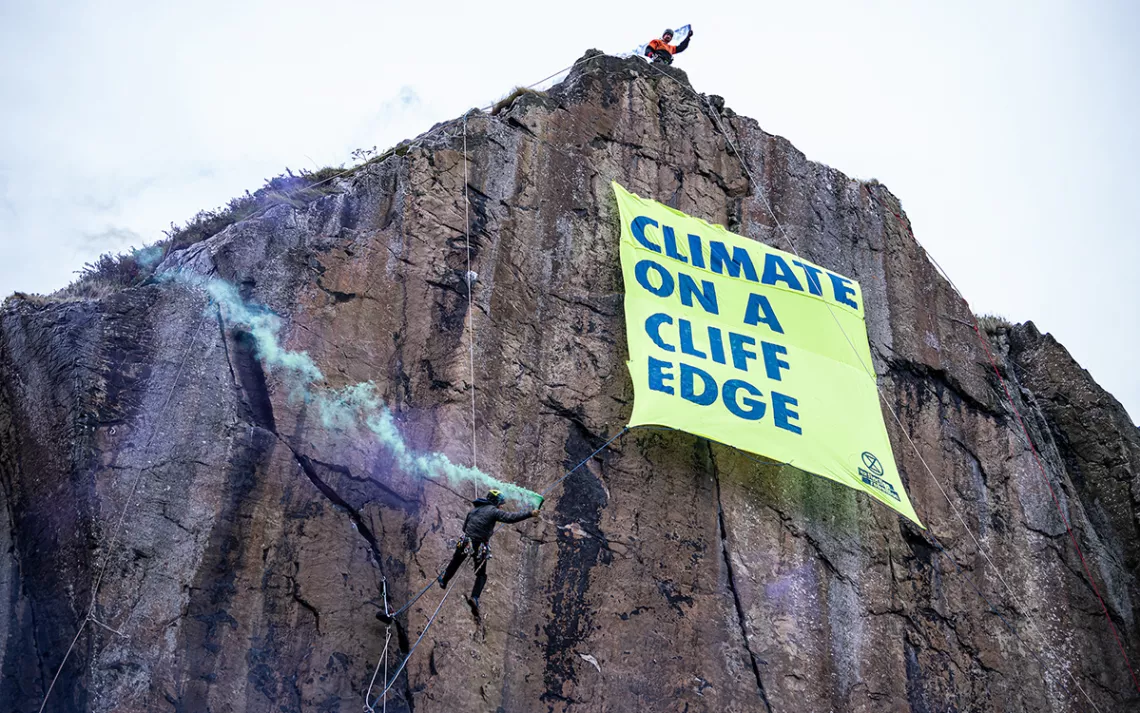
Experienced climbers scale a rock face near the historic Dumbarton castle in Glasgow, releasing a banner that reads “Climate on a Cliff Edge.” One activist, dressed as a globe, symbolically looms near the edge, while another plays the bagpipes on the shores below. | Photo courtesy of Extinction Rebellion and Mark Richards
Original article by EDWARD CARVER republished from Common Dreams under Creative Commons (CC BY-NC-ND 3.0).
Police arrest a climate protester at Citigroup’s headquarters in New York City on June 12, 2024. (Photo: Bank On Our Future/X)
“I invite you to join us, at any level of risk tolerance,” said one participant in the New York demonstration. “It feels deeply meaningful—even joyful—to be a part of this movement and to stand on the right side of history.”
Police arrested 28 people, including several scientists, protesting outside Citigroup’s headquarters in New York City on Wednesday as climate campaigners continued a series of actions targeting the bank for financing oil and gas projects.
Dozens of scientists and allies, some wearing white lab coats, marched to the bank’s entrances holding signs and banners with messages like “The Science Is Clear,” as they condemned Citigroup for financing nearly $400 billion in fossil fuel extraction in the eight years after the 2015 Paris agreement was signed.
Several scientists gave speeches before or as they were being arrested.
“I have studied climate change since 1982,” Sandra Steingraber, a biologist and retired scholar in residence at Ithaca College, said in a speech outside the Wall Street giant’s entrances. “I’ve testified. I’ve sent letters to the White House. I’ve met with the science advisor. I went to the Paris Climate talks. But carbon dioxide levels just reached a new high, and Citi here is financing the arsonists.”
Police arrested Steingraber, who, as she was being taken away in handcuffs, declared: “I’m not interested in writing eulogies for the species that I study!”
BREAKING: Scientists arrested for blockading the doors of @citibank, the world’s second largest funder of fossil fuels.
— New York Communities for Change (@nychange) June 12, 2024
The scientists’ protest was part of a series of climate actions undertaken as part of the Summer of Heat, a program organized by Climate Defenders, Climate Organizing Hub, New York Communities for Change, Planet Over Profit, and Stop The Money Pipeline (STMP).
A total of 28 people were arrested Wednesday, including several scientists, Alec Connon, STMP co-director, told Common Dreams. Dozens of campaigners were also arrested at Citigroup’s headquarters on both Monday, in a highly-attended kickoff to the summer activism series, and Tuesday, in an orca-themed follow-up.d
During Wednesday’s protest, the scientists delivered a joint letter, published Monday by the Union of Concerned Scientists and addressed to Citigroup’s leadership, urging the bank to stop financing fossil fuel projects scientists delivered a letter addressed to Citigroup’s leadership urging the bank to stop financing fossil fuel projects.
Activist pressure on major banks has risen in recent years following revelations—notably in the annual Banking on Climate Chaos report, published by nonprofit groups—about the key role they’ve played in funding oil, gas, and coal projects. The most recent report found that the world’s 60 largest banks had provided $6.9 trillion in funding to the fossil fuel industry in the eight years after the Paris Agreement.
The pressure has had an effect on some banks: HSBC and, more recently, Barclays have declared that they would stop financing new oil and gas projects. However, the Bureau of Investigative Journalism has reported that HSBC remains involved in fossil fuel deals.
Bank loans to fossil fuel companies are used not just to continue extraction at existing sites but also to explore and develop new reserves, even though the International Energy Agency has said there can be no more such development if climate goals are to be met. Citigroup has funded more new extraction than any bank in the world, the Banking on Climate Chaos report found.
Yet in response to Monday’s action, Citigroup claimed it was part of the transition to a green economy.
“Citi respects the advocacy of climate activists, and we are supporting the transition to a low-carbon economy through our net zero commitments and our $1 trillion sustainable finance goal,” a bank spokesperson said a statement, according to media outlets. “Our approach reflects the need to transition while also continuing to meet global energy needs.”
The statement did not win over climate activists. “This is the sort of bald-faced corporate lie that could cost us our planet,” Peter Kalmus, a NASA climate scientist, wrote in a Newsweek op-ed published Wednesday.
Kalmus attended Wednesday’s protest. Standing outside Citigroup’s headquarters, he said, “We’ve written thousands and thousands of papers and they have not listened to us. They’re fools. They’re stupid. They’re being unwise. They have to start listening to scientists.”
Summer of Heat organizers have events planned throughout the summer. In the op-ed, Kalmus reached out to readers to join the effort.
“I invite you to join us, at any level of risk tolerance,” he wrote. “In my experience, and in the experience of many other climate activists I know, civil disobedience has been a very effective way to create social change. And a big change is happening: A transition from a profit-above-life, colonial-extractivist, genocidal mindset, to a loving, sharing, interconnected mindset. It feels deeply meaningful—even joyful—to be a part of this movement and to stand on the right side of history.”
Original article by EDWARD CARVER republished from Common Dreams under Creative Commons (CC BY-NC-ND 3.0).
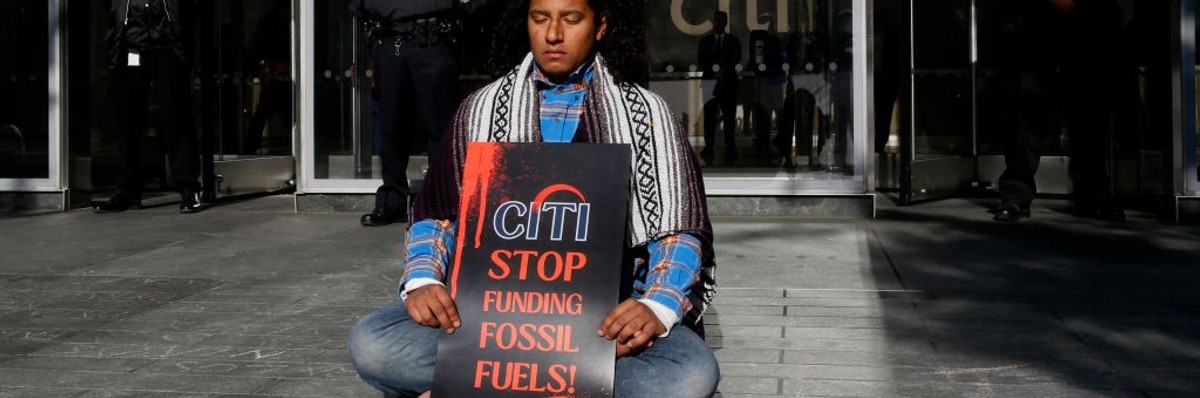
Environmental activist protest outside CitiBank Headquarters in New York City on April 25, 2023, calling for an end to fossil fuel financing. (Photo by Leonardo Munoz / AFP via Getty Images)
Here’s why we will be using our bodies to shut down Citibank’s global headquarters over and over again, this summer.
This summer, along with dozens of others, I’ll be helping to run the Summer of Heat on Wall Street, a campaign of sustained nonviolent civil disobedience against the banks, investors, and insurance companies financing fossil fuel expansion.
As we have written about here already, our plan is simple: using our bodies, we will continually blockade the New York headquarters of the Wall Street giants bankrolling coal, oil, and gas expansion; week after week, we will disrupt the companies disrupting our climate and our planet.
Since the adoption of the Paris Agreement in 2015, Citi has provided $204.46 billion in financing to the company’s most rapidly developing new coal, oil, and gas fields. Remarkably, Citi has provided more money to those oil and gas companies than even JPMorgan Chase―the bank that climate activists like to call the “Doomsday Bank.”
To be clear, I’m talking here only about the financing Citi has provided for companies developing new oil and gas reserves, not merely investing in infrastructure to keep the oil pumping from existing reserves. When we take into account financing to all fossil fuel companies, Citi has provided a little shy of $400 billion to coal, oil, and gas companies since 2015. But focusing on expansion is important.
Numerous climate experts, from the International Energy Agency to the Intergovernmental Panel on Climate Change, have made it clear that to stave off the worst of climate catastrophe, there must be no investment in new fossil fuel expansion. But last year alone, Citibank provided $14.6 billion to the companies most rapidly expanding their coal, oil, and gas operations.
Citibank’s financing of fossil fuel expansion not only drives climate chaos, it also results in environmental racism. To give just one example, 70% of the air pollution generated by ExxonMobil is dumped on communities of color, contributing to the higher levels of heart disease, strokes, cancer, and other illnesses that are widely associated with living near oil and gas infrastructure.
Citibank’s top fossil fuel client is ExxonMobil. Yet when asked by Congress if she knew what environmental racism was, Citi CEO Jane Fraser replied: “Only vaguely.”
Not content with merely financing fossil fuels, Citi also works to block climate action both from its own investors and the U.S. government.
CEO Jane Fraser is chair of a group called the Financial Services Forum and a board member of the Bank Policy Institute, groups that have fought tooth and nail to weaken climate-financial regulation advanced by the Biden Administration. Citi also donates to several high-profile politicians who work against action on climate, including Congressman Andy Barr who has led the charge in a series of fossil fuel-backed, right-wing attacks designed to prevent the financial industry from taking action on climate.
For the past three years, Citi has faced a shareholder resolution from investors calling for a report on how the bank ensures that the oil, gas, and mining companies it finances respect Indigenous rights and sovereignty. Yet, in spite of Ms. Fraser’s previous claims in 2020 that Citi was committed to being ”an anti-racist institution,” Citi has fought the resolution each year, urging investors to vote against it, even as they remain one of the world’s largest funders of oil and gas in the Amazon rainforest.
Besides its role in the climate crisis and environmental racism, there are plenty other reasons to be angry at Citibank, too. In the early 20th century, Citi actively lobbied the US government to invade and occupy Haiti, which it promptly did, resulting in decades of bloodshed and misery for Haitians. A century later, Citi did as much as any bank to cause the financial crisis of 2008, which led to nearly 3.8 million Americans losing their homes; no bank received a larger bailout from the government than Citi.
And then there’s the fact that Citi is the foreign bank with the largest presence in Israel and a major financier of weapons manufacturers that are currently providing Israel with fighter jets and missiles being used to massacre Palestinians.
All of this is why Citibank is our number one target this summer.
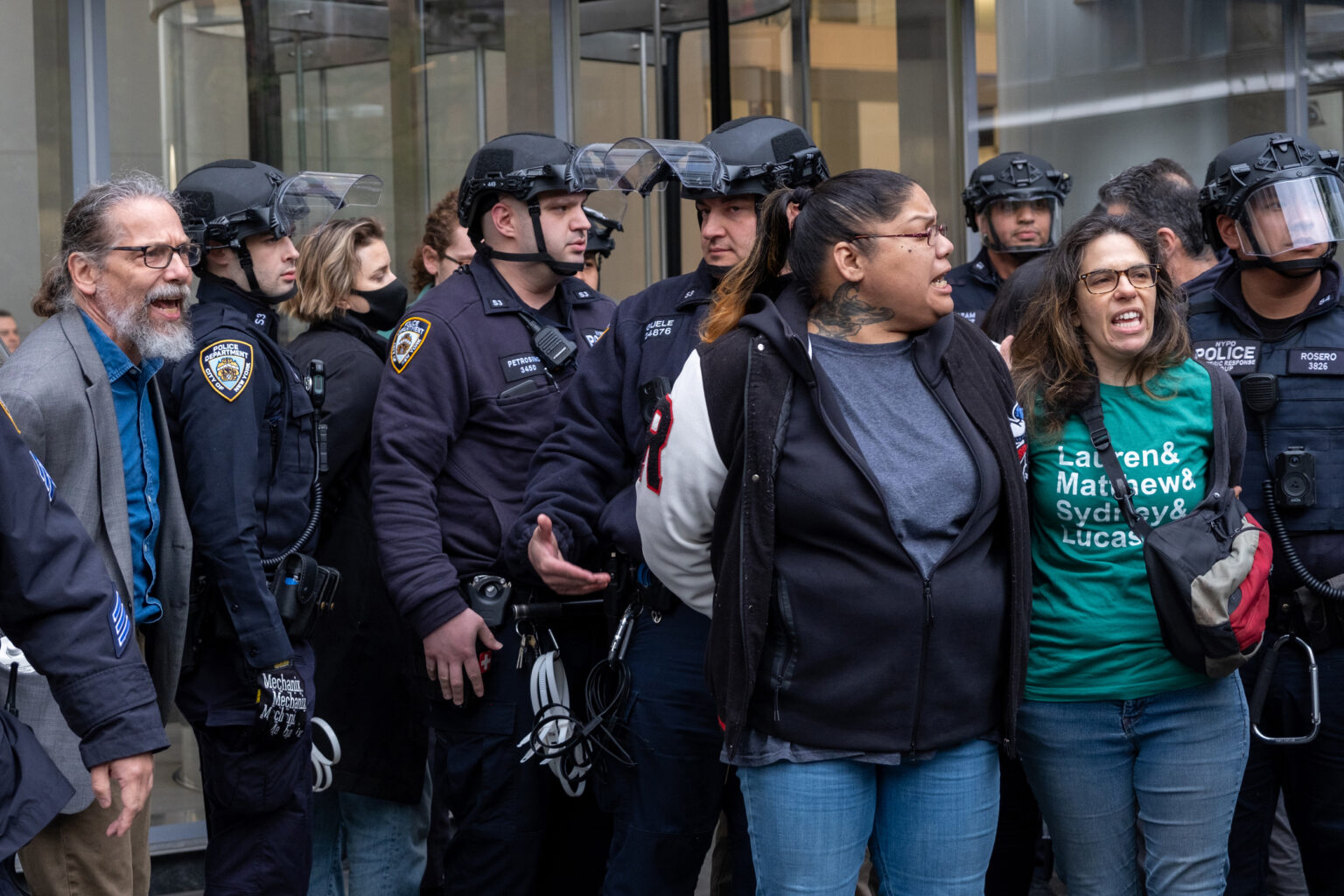
During a demonstration at Citibank’s headquarters in Manhattan on Wednesday, 33 protesters were taken into custody, including Rachel Rivera (center), a board member with New York Communities for Change. Credit: Keerti Gopal/Inside Climate News
Campaigners pressuring Citibank say they see the bank as potentially movable on its funding of fossil fuels, citing the company’s commitments to sustainability.
NEW YORK—Climate demonstrators blocked entrances to Citibank’s headquarters in Manhattan at the start of the workday on Wednesday and Thursday, part of a series of Earth Week actions pressuring the bank to end its financing of fossil fuels. On both mornings, it took the New York Police Department less than 10 minutes to start making arrests.
Climate activists, citing Citibank as the second largest financier of fossil fuels in the world, are engaged in a multi-year campaign to pressure the bank to stop financing oil, gas and coal projects. The week’s protests follow a mock environmental justice hearing at a New York church on Monday, where advocates spoke about the health harms and human rights violations of Citibank-financed fossil fuel projects in Peru, Canada and domestically. The New York demonstration was timed alongside actions in Seoul, South Korea, Melbourne, Australia, Jakarta, Indonesia, Belfast, Northern Ireland, and Dallas that also targeted Citibank’s financing of coal, oil, natural gas and military projects.
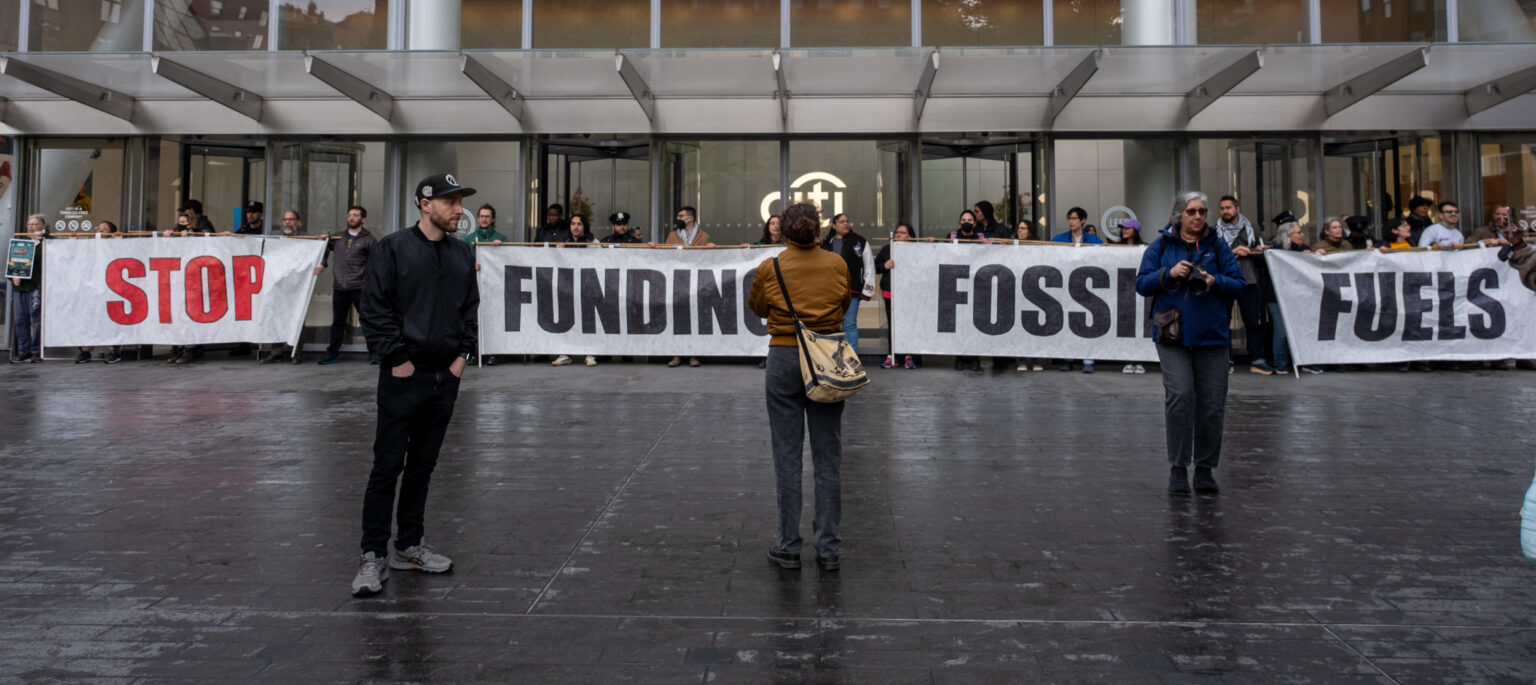
At about 8:15 Wednesday morning, activists holding four large white banners that together read “Stop Funding Fossil Fuels” blocked the main entrance to Citibank’s headquarters while smaller groups of demonstrators stood outside other entrances to the building. Police began taking protesters into custody at 8:30 and arrested approximately 33 activists for disorderly conduct at Wednesday’s protest, according to activists and the office of NYPD’s deputy commissioner of public information.
Protesters barricaded the main entrance to Citibank’s headquarters in Manhattan on Wednesday morning. Credit: Keerti Gopal/Inside Climate News
…
Campaigners have said that, since 2016, Citibank has provided $332 billion in fossil fuel financing, and calculate that the bank has given $1.85 billion in financing to oil and gas operations in the Amazon since 2009 and $1.78 billion in financing to ConocoPhillips, the company behind the contentious Willow Project.