Racism is central to Reform UK, but the party is also entangled with anti‑establishment fakery, climate change denial, transphobia, misogyny and pro‑corporate policies.
The anti-establishment fakery was on display last November, when Farage posted on social media, “Big business and big government work together. There is nothing about Sir Keir Starmer that represents change.”Adding to this already vile concoction of politics is misogyny and transphobia. This was on display at Reform UK’s recent regional conference in Leicester, where Tice opened his speech with a transphobic joke about pronouns. The result is an over-arching package of the politics of division. This is hardly a surprise from a party whose senior members say they look to Marine Le Pen’s fascist National Rally (RN) and the far right Alternative for Germany (AfD) as inspiration.
Farage likes to paint Reform UK as the insurgent force in British politics. He claims that Reform UK is “very much on the side of the little guy or woman”. Its MPs often denounce the two-party system and multinational corporations in favour of “real entrepreneurship”. This language is an attempt to mobilise the historic base of the far right, which has typically built among small producers and independent professionals.
But Reform UK is as establishment as it gets. Four out of the five Reform UK MPs—Nigel Farage, Richard Tice, Rupert Lowe and Lee Anderson—are millionaires.
Its policies are a mish-mash of pro-corporate proposals. Tax cuts for business, austerity measures totalling £50 billion a year, a massive programme of deregulation, tax relief for private healthcare, abolishing inheritance tax for property under £2 million and scrapping net zero climate targets.
It’s clear the party stands for putting more money in the pockets of the bosses and the rich.
And it uses climate denial to drive further division. Deputy leader Richard Tice is one of the worst for this. At one point he stated “there is no climate crisis” and claimed “CO2 isn’t a poison. It’s plant food”.
Adding to this already vile concoction of politics is misogyny and transphobia. This was on display at Reform UK’s recent regional conference in Leicester, where Tice opened his speech with a transphobic joke about pronouns. The result is an over-arching package of the politics of division. This is hardly a surprise from a party whose senior members say they look to Marine Le Pen’s fascist National Rally (RN) and the far right Alternative for Germany (AfD) as inspiration.
More than $120 million from a few ultra-wealthy families has powered the Heritage Foundation and other groups that created the plan to remake American government.
Since 2020, donor networks linked to just six family fortunes have funneled more than $120 million into Project 2025 advisory groups, a DeSmog analysis has found.
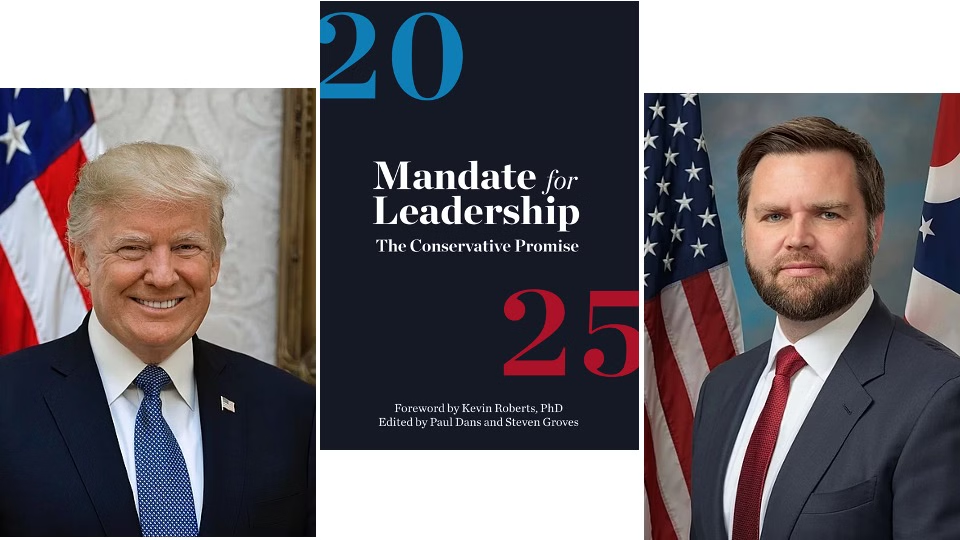
More than 100 nonprofits led by the Heritage Foundation, a right-wing think tank that has engaged in climate change denial and obstruction for decades, have signed on as advisors to the Project 2025’s 900-page “Mandate for Leadership” document — a plan to rapidly “reform,” or radically alter, the U.S. government by shuttering bureaus and offices, overturning regulations, and replacing thousands of public sector employees with hand-picked political allies.
In its official Project 2025 materials, Heritage Foundation leadership repeatedly draws attention to the size and diversity of its advisory board, suggesting that its numerous “coalition partners” are part of a broad, “movement-wide effort” representing a variety of independent viewpoints.
“Project 2025 is unparalleled in the history of the conservative movement—both in its size and scope but also for organizing [so many] different groups under a single banner,” the organization wrote in an October 2023 press release.
But an analysis of financial disclosure forms shows the same small group of donors supporting Project 2025’s advisors again and again — hardly a sign of ideological diversity. Of the 110 nonprofits formally supporting Project 2025, almost 50 received major donations from the same six sources of wealth since 2020.
Many of the organizations the six families funded also have close ties to Donald Trump and his running mate, Ohio Senator JD Vance, DeSmog found. Trump has repeatedly denied involvement in or knowledge of Project 2025, though that position conflicts with a growing number of news reports — a disavowal made more awkward by the fact that Vance wrote the foreword to Dawn’s Early Light, a forthcoming book by Heritage Foundation president Kevin D. Roberts that describes his Project 2025 vision. DeSmog’s review of Project 2025’s financial backers found additional links to Trump, Vance, and key figures in their orbit that had not been previously known.
These six donor networks, linked to the family fortunes of a handful of wealthy industrialists, have spent years working to loosen environmental regulations and promote climate change denial. Though Heritage describes Project 2025 as a mainstream effort to “return government to the people,” its funding sources suggest something far less populist: a vehicle for the obsessions of ultra-rich donors on the far-right fringe, pushing an agenda to reshape American democracy and overturn regulations needed to maintain a livable climate.
Representatives from the six donor networks did not respond to DeSmog’s outreach on this story. The Heritage Foundation did not reply to a request for comment.
The Coors Family At least $2.7 million to Project 2025 groups since 2020
In 1972, Joseph Coors, grandson of Coors Brewing Company founder Adolph Coors, kick-started the Heritage Foundation with an initial gift of $250,000. For years, he supported the conservative think tank’s growth, ultimately funneling his funds through the Adolph Coors Foundation, the nonprofit he started with his brother Bill in 1976.
“There wouldn’t be a Heritage Foundation without Joe Coors,” former Heritage president Edwin J. Feulner wrote in a 2003 tribute.
Joseph Coors meets with Ronald Reagan in 1981. Credit: Wikipedia
The tradition continues today, with billionaire Peter H. Coors — retired beer magnate and Adolph’s great-grandson — at the helm. The Adolph Coors Foundation funded 22 Project 2025 advisory groups between 2020 and 2023, including $300,000 to the Heritage Foundation. Vance has been connected to Heritage since at least 2017, when he wrote the forward to that organization’s “Index of Culture and Opportunity” and gave a keynote address at a Heritage event promoting the report.
Of the Project 2025 groups, Coors funded Hillsdale College, which The New Yorker called “the Christian liberal-arts college at the heart of the culture wars,” most heavily, with nearly $900,000 in donations since 2020. Former Heritage staffer James Braid, today Vance’s deputy chief of staff and legislative director, spent 10 months as a James Madison fellow at Hillsdale College in 2021. Braid appeared on camera in a Project 2025 training video recently obtained by ProPublica and Documented. Braid was also an advisor at American Moment, another Project 2025 group.
The Coors Foundation gave an additional $5.9 million to DonorsTrust, a not-for-profit that describes itself as a philanthropic partner for conservative and libertarian donors — and that gives hundreds of millions of dollars to conservative causes annually, including to numerous Project 2025 advisors, as well as other organizations that downplay or deny the science and urgency of climate change.
Charles G. Koch At least $9.6 million to Project 2025 groups since 2020
In terms of raw numbers, Charles Koch — the CEO and chairman of Koch Industries, a sprawling conglomerate with an oil refinery focus — isn’t the biggest donor to Project 2025 groups in the past few years. But his support for the vast fundraising apparatus that powers conservative charities, including dozens of the initiative’s coalition partners, goes back decades, and his influence can’t be underestimated. A review of public financial disclosures by Greenpeace found that the network of charitable foundations linked to Koch and his late brother, David Koch, donated more than $165 million to climate-change-denying groups between 1986 and 2018. That includes more than $23 million to 16 nonprofits that Project 2025 lists among its advisors.
Throughout the 1990s, Koch Industries was also a “vital supporter” of the American Legislative Exchange Council (ALEC), a Project 2025 advisor. A membership group that connects more than 2,000 state legislators to over 300 corporations and private foundations, ALEC calls itself “a forum for stakeholders to exchange ideas”; New Yorker investigative journalist Jane Mayer, in her book Dark Money, describes it as an enormously successful effort “aimed at waging conservative fights in every state legislature in the country.” Foundations linked to Charles G. Koch donated more than $1.2 million to ALEC since 2020, Desmog’s review found, mostly through his Stand Together Trust.
Koch’s largest donations to Project 2025 groups since 2020 included $3.8 million to the Texas Public Policy Foundation (TPPF), a climate-change-denying nonprofit with close links to both the Heritage Foundation and the Trump administration. In 2018, Trump tapped Brooke Rollins, TPPF’s CEO since 2003, for a post at the Office of American Innovation; in 2020, he named her to lead his administration’s domestic policy strategy. By 2019, there were so many connection points between TPPF and the Trump administration that Politico’s E & E News wrote a story about it.
Rollins was succeeded at TPPF by Kevin Roberts, who had been promoted to CEO by 2021, when he left to become president of The Heritage Foundation. Koch-linked nonprofits also donated $845,000 to Heritage since 2020.
Richard and Elizabeth Uihlein At least $13 million to Project 2025 groups since 2020
The Uihleins are co-founders of Uline, a company that sells shipping and packing supplies — including its ubiquitous brand of cardboard boxes — and other bulk business goods. They donate heavily to conservative causes through the Ed Uihlein Foundation, named after Richard’s father, a packaging company entrepreneur whose grandfather was an original founder of the Schlitz beer company.
Among its donations to 13 different Project 2025 groups since 2020, Uihlein’s largest grants went to the Foundation for Government Accountability ($6.6 million), a limited-government think tank that has railed against “the Biden administration’s radical climate agenda,” and the American Cornerstone Institute ($2.5 million), founded by neurosurgeon and former Trump cabinet member Dr. Ben Carson. Carson has called climate change “irrelevant” as recently as 2015.
Outside the nonprofit sphere, the Uihleins are major donors to the Trump campaign. An analysis of Federal Election Commission data showed that the couple donated $10 million to Make America Great Again, Inc., a pro-Trump super PAC, in May 2024.
The Scaife Family At least $21.5 million to Project 2025 groups since 2020
Richard Mellon Scaife died in 2014, but his contribution to conservative causes is still felt today. A billionaire heir to the vast Mellon fortune, which was created thanks to his progenitors’ exploits in oil and aluminum production, banking, and other industries, Scaife provided years of critical financial support to the Heritage Foundation, starting in 1973. A 1999 article in the Washington Post called him the “funding father of the Right.”
Today, two foundations Scaife once controlled — the Sarah Scaife Foundation and the Allegheny Foundation — continue to give heavily to conservative causes, including to numerous organizations involved in climate change denial. DeSmog’s review found that Scaife family foundations gave $4.1 million to the Heritage Foundation since 2022, while also contributing to 22 other Project 2025 advisory groups.
Scaife foundations also donated an additional $1.2 million to the State Policy Network, an ALEC-linked group that supports conservative nonprofits that oppose government regulation, including 25 members of Project 2025’s coalition.
Barre Seid At least $22.4 million to Project 2025 groups since 2020
The enigmatic industrialist Barre Seid primarily built his fortune through his company Tripp Lite, an electronics manufacturer specializing in surge protectors. He is reportedly a major benefactor supporting the Heartland Institute, a Project 2025 advisor organization that The Economist called “the world’s most prominent think tank supporting skepticism about man-made climate change” — a description Heartland approvingly quotes on its website.
In late 2020, Barre donated 100 percent of Tripp Lite’s shares to Marble Freedom Trust, a nonprofit controlled by Federalist Society co-chairman Leonard A. Leo. In early 2021, Leo sold the shares, netting $1.65 billion. The amount is said to be “among the largest — if not the largest — single contributions ever made to a politically focused nonprofit,” according to The New York Times.
Since May 2020, Marble Freedom Trust has donated $100 million to Concord Fund, also known as the Judicial Crisis Network, a Leo-linked nonprofit. In that time, Concord has donated $22.4 million to eight Project 2025 groups, giving most heavily ($11.9 million) to Susan B. Anthony Pro-Life America.
Seid also gave $2 million to Independent Women’s Voice, the sister organization of Independent Women’s Forum, a Project 2025 advisor. During her time as director for the Independent Women’s Forum’s Center for Energy and Conservation, Mandy Gunasekara, a former Trump administration Environmental Protection Agency official, authored Project 2025’s chapter on restructuring the EPA — with recommendations that include “cutting its size and scope” dramatically.
The Bradley Family At least $52.9 million to Project 2025 groups since 2020
The Lynde and Harry Bradley Foundation was originally established in 1942 by brothers Lynde and Harry Bradley, founders of the Allen-Bradley company, which made its fortune manufacturing a wide range of electronic products. Their descendants have continued to financially support the foundation for years to come, including with a reported $200 million gift in 2015.
But it was Michael W. Grebe, who served as CEO of the foundation between 2002 and 2016, who cemented its reputation as a conservative powerhouse, steering donations to a network of activist organizations like The Heritage Foundation, the Mackinac Center for Public Policy, and the Heartland Institute (all Project 2025 coalition partners). The current chairman is James Arthur “Art” Pope, CEO of the North Carolina grocery chain Variety Wholesalers, a longtime Koch ally.
The Bradley Foundation and a second philanthropic vehicle it supports, the Bradley Impact Fund, donated over $50 million to 29 different Project 2025 advisors since 2020. That’s not including an additional $56 million to DonorsTrust, which a 2013 Mother Jones investigation dubbed, along with its affiliate group Donors Capital Fund, the “dark money ATM” of the U.S. conservative movement. The Bradley Foundation’s Project 2025-linked donations include more than $7.7 million to Turning Point USA, a “powerful ally” of the Trump presidential campaign, which promotes conservative causes on university campuses and is funded in part by the fossil fuel industry. Its single largest donation was $27.1 million in 2022 to Project 2025 advisor Turning Point Legal, founded by former Trump advisor, and past president of a coal lobby group, Stephen Miller.
An updated database shows that more than 1,000 oil and gas companies around the world are planning to expand their planet-wrecking infrastructure.
More than a thousand fossil fuel companies around the world are currently planning to build new liquefied natural gas terminals, pipelines, or gas-fired power plants even as scientists warn that fossil fuel expansion is incompatible with efforts to prevent catastrophic warming.
That’s according to an updated database released Wednesday by Urgewald and dozens of partner groups. Described as the most comprehensive public database on the fossil fuel industry, the Global Oil & Gas Exit List (GOGEL) covers 1,623 companies that are operating in the upstream, midstream, or gas-fired power sector and collectively account for 95% of global oil and gas production.
More than a thousand fossil fuel companies around the world are currently planning to build new liquefied natural gas terminals, pipelines, or gas-fired power plants even as scientists warn that fossil fuel expansion is incompatible with efforts to prevent catastrophic warming.
That’s according to an updated database released Wednesday by Urgewald and dozens of partner groups. Described as the most comprehensive public database on the fossil fuel industry, the Global Oil & Gas Exit List (GOGEL) covers 1,623 companies that are operating in the upstream, midstream, or gas-fired power sector and collectively account for 95% of global oil and gas production.
JUST RELEASED The Global Oil & Gas Exit List (GOGEL) with fresh numbers: Despite the climate crisis, almost every upstream company is still developing new oil&gas fields. In addition, 1,023 companies planning new LNG terminals, pipelines, gas power plants. https://t.co/DsBgFMR7QZpic.twitter.com/BCUGpd5PYJ
According to the 2023 GOGEL, 96% of the 700 upstream oil and gas companies in the database are exploring or actively developing new oil and gas fields, projects that Urgewald said “severely jeopardize efforts to limit global temperature increase to 1.5 °C.”
Nearly 540 companies in the database are collectively planning to produce 230 billion barrels of oil equivalent (bboe) over the short term, the database shows.
“The seven companies with the largest short-term expansion plans are Saudi Aramco (16.8 bboe), QatarEnergy (16.5 bboe), Gazprom (10.7 bboe), Petrobras (9.6 bboe), ADNOC (9.0 bboe), TotalEnergies (8.0 bboe) and ExxonMobil (7.9 bboe),” Urgewald noted. “These seven companies are responsible for one-third of global short-term oil and gas expansion.”
The database also shows that fossil fuel companies are planning to expand global LNG capacity by 162%, a significant threat to critical climate targets. A United Nations-backed report published last week warned that fossil fuel expansion plans are “throwing humanity’s future into question.”
Urgewald pointed specifically to the LNG boom in the U.S., which the group said is “cementing its position as the world’s largest export hub for LNG” with 21 new export facilities planned along the Gulf Coast. Those facilities account for more than 40% of worldwide LNG expansion documented in the GOGEL database.
“Most of the fossil gas that will be exported from these terminals stems from the Permian Basin, the heart of the U.S. fracking industry,” Urgewald observed.
The updated database shows that nearly 80 companies—including Exxon, Chevron, and BP—are currently operating in the Permian Basin, located in the U.S. Southwest.
Climate campaigners and experts have also sounded alarm over Calcasieu Pass 2 (CP2), a planned $10 billion LNG export hub that would ship up to 24 million tons of gas annually once it is completed.
“The fossil fuel industry wants to pave undeveloped wetlands all along the coast with LNG facilities like NextDecade Corporation’s Rio Grande LNG Terminal, Rebekah Hinojosa, a member of the South Texas Environmental Justice Network said Wednesday. “Besides their environmental implications, these plans violate Indigenous sacred lands, and people working in fishing, shrimping, and eco-tourism risk losing their jobs. Our communities refuse to be sacrificed for the fracking industry’s dirty gas exports.”
One of the many occasions UK Prime Minister Rishi Sunak uses a private jet.
Political leaders owe their citizens the truth about the costs and the challenges of the energy transition on a warming planet. Last week, UK Prime Minister Rishi Sunak failed – and California Governor Gavin Newsom passed – that test.
…
If Sunak had mustered the courage to tell Brits the truth, rather than throwing up flack about excessive costs and burdens, he could have taken a cue from Newsom and said this instead: “The cost-of-living crisis is a fossil fuel crisis. Inflation persists. It’s not complicated. It’s not complicated. It’s the burning of oil. It’s the burning of gas. It’s the burning of coal – and we need to call that out.”
“The rise in energy prices started last winter, when many countries experienced low gas stocks, leading to a rise in gas prices. Russia’s invasion of Ukraine and volatile market conditions led to further price hikes,” wrote van Halm. European gas prices peaked in August 2022 at more than €300 per megawatt-hour (/MWh), she noted, when before the Covid-19 pandemic and Russia’s invasion of Ukraine, European gas prices were regularly around €10–20/MWh.
Image of InBedWithBigOil by Not Here To Be Liked + Hex Prints from Just Stop Oil’s You May Find Yourself… art auction. Featuring Rishi Sunak, Fossil Fuels and Rupert Murdoch.
Boris Johnson confirms his thumbs up from Rupert Murdoch
Our investigation reveals secretive funding sources for think tanks that boast of influencing the government
Influential right-wing UK think tanks with close access to ministers have received millions in ‘dark money’ donations from the US, openDemocracy can reveal.
The TaxPayers’ Alliance, the Institute of Economic Affairs (IEA), Policy Exchange, the Adam Smith Institute and the Legatum Institute have raised $9m from American donors since 2012. Of this, at least $6m has been channelled to the UK, according to tax returns filed with US authorities – representing 11% of the think tanks’ total UK receipts, with the figure reaching 23% for the Adam Smith Institute.
In that time, all five have steadily increased their connections in the heart of government. Between them, they have secured more than 100 meetings with ministers and more than a dozen of their former staff have joined Boris Johnson’s government as special advisers.
Representatives from right-wing think tanks – many of whom are headquartered at 55 Tufton Street in central London – frequently appear in British media and have been credited with pushing the Tories further to the right on Brexit and the economy.
As openDemocracy revealed yesterday, ExxonMobil gave Policy Exchange $30,000 in 2017. The think tank went on to recommend the creation of a new anti-protest law targeting the likes of Extinction Rebellion, which became the Police, Crime, Sentencing and Courts Act 2022.
None of these think tanks disclose their UK donors. With the exception of the Adam Smith Institute, none provide any information about the identity of donors to their US fundraising arms.
But an investigation by openDemocracy has identified dozens of the groups’ US funders by analysing more than 100 publicly available tax filings.
The Scottish National Party MP Alyn Smith said that the findings showed that the UK’s lobbying laws were not tough enough.
“He who pays the piper calls the tune,” he told openDemocracy. “We urgently need to rewrite the laws governing this sort of sock puppet funding so that we can see who speaks for who.”
Last month, Smith asked an IEA representative who funded the think tank on BBC’s flagship question time show.
Among the US-organisations who have donated to UK think tanks are oil companies and several of the top funders of climate change denial in the US.
The think tanks’ US arms received $5.4m from 18 donors who have also separately donated a combined $584m towards a vast network of organisations promoting climate denial in the US between 2003 to 2018, according to research from climate scientists.
The John Templeton Foundation, founded by the late billionaire American-British investor, has donated almost $2m to the US arms of the Adam Smith Institute and the IEA. Researchers claim that the John Templeton Foundation has a “history of funding what could be seen as anti-science activities and groups (particularly concerning climate-change and stem-cell research)”.
The National Philanthropic Trust, a multi-billion-dollar fund that does not disclose its own donors, has given almost $2m to the IEA, Policy Exchange, TaxPayers’ Alliance and the Legatum Institute’s US fundraisers. The trust has donated $22m to climate denial organisations, one of which described it as a “vehicle” for funnelling anonymous donations from the fossil fuel industry.
The Sarah Scaife Foundation, founded by the billionaire heir to an oil and banking fortune, has given $350,000 to the Adam Smith Institute and the Legatum Institute. The foundation is one of the biggest funders of climate denial in the US, contributing more than $120m to 50 organisations promoting climate denial since 2012. Last month, openDemocracy revealed that the foundation, which has $30m in shares in fossil fuel companies, gave $210,525 to a UK climate sceptic group.
Policy Exchange, the influential conservative think tank, published a report in 2019 – two years after taking money from ExxonMobil – claiming that Extinction Rebellion were “extremists” and calling for the government to introduce new laws to crack down on the climate protest group.
New anti-protest laws passed under the Police, Crime, Sentencing and Courts Act last month appear to have been directly inspired by the report. The Home Office did not deny that it considered the recommendations when approached for comment.
The American Friends of the IEA also received a $50,000 donation from ExxonMobil in 2004, while the main UK branch of the IEA has received donations from BP every year since 1967.
The Legatum Institute has received $154,000 from the Charles Koch Foundation in 2018 and 2019. The foundation was set up by the American billionaire co-owner of Koch Industries, one the biggest fossil fuel companies in the US.
Andy Rowell, co-author of “A Quiet Word: Lobbying, Crony Capitalism and Broken Politics in Britain”, told openDemocracy: “For years, there have been calls for think tanks, who are so often joined at the hip with government, to be transparent and disclose who funds them.
“The fact that so much dark money is behind these groups, and much of it is linked to climate denial groups, is a political scandal that can’t be allowed to continue, especially given our climate emergency.”
In all, US donors account for more than a tenth of the overall income of the IEA, Policy Exchange, Adam Smith Institute and TaxPayers’ Alliance.
Anti-green lobbying
While all the think tanks say they do not dispute the science on climate change, many are campaigning to increase the UK’s dependency on fossil fuels and deregulate energy markets in response to the cost of living crisis.
The TaxPayers’ Alliance, Adam Smith Institute and the IEA have all called for the UK’s ban on fracking to be overturned. In April, the government agreed to review the moratorium it had imposed in 2019, when scientists deemed fracking unsafe. The U-turn came after concerted pressure from anti-net zero Tory MPs and lobby groups.
The IEA has also called for the government to approve the opening of a new coal mine in Cumbria, while the TaxPayers’ Alliance has called for the government to scrap green energy bill levies. Tory MP Ben Bradley has cited the TaxPayers’ Alliance in Parliament while claiming that levies will exacerbate the cost of living crisis.
Environmental groups say cutting the levies, which are used to invest in energy efficiency measures and renewable energy, would be self-defeating and merely delay the UK’s longer-term transition away from fossil fuels.
Johnson’s think tank cabinet
Right-wing think tanks like the IEA have come to play an increasingly influential role in shaping British politics, despite the lack of transparency around their funding.
The IEA has boasted that 14 members of Boris Johnson’s cabinet – including the home secretary Priti Patel, the foreign secretary Liz Truss and the business secretary Kwasi Kwarteng, are “alumni of IEA initiatives”.
Ministers have recorded 26 meetings with the think tank since 2012, but there may be additional, undeclared private meetings. In 2020, Truss, who was then the secretary of state for trade, failed to declare two meetings with the IEA, arguing that they were made in a personal capacity.
Mark Littlewood, the director of the IEA, has boasted of securing access to ministers and MPs for his corporate clients, including BP, telling an undercover reporter in 2018 that he was in “the Brexit influencing game”.
Others like Policy Exchange, which was co-founded by the ‘levelling up’ secretary Michael Gove, can claim to have had some of their policy ideas taken up by the government.
Gove’s recently announced plan to allow residents to vote on whether to allow developments on their street was first proposed by Policy Exchange last year. Campaigners said the plan will not help increase the supply of affordable housing.
Several of the think tanks were accused by a whistleblower of coordinating with one another to advocate for a hard break from the European Union following the referendum vote.
Shamir Sanni, a former pro-Brexit campaigner who worked for TaxPayers’ Alliance before going public with his claims, alleged that the organisation regularly met with the IEA, the Adam Smith Institute to agree on a common line on issues relating to Brexit.
Sanni subsequently won an unfair dismissal case against the TaxPayers’ Alliance. The organisations he identified have all denied they act as lobbyists or coordinate.