Climate Disinformation ‘Normalised’ on French TV and Radio, Report Finds

Spread the love

Original article by Joey Grostern republished from DeSmog

Credit: Pexels

New findings from an alliance of NGOs challenges the belief that climate falsehoods are confined to social media.

Climate disinformation was routinely broadcast in news programmes across French TV and radio in the first three months of 2025, with 128 verified cases identified by an alliance of NGOs.

Using AI to identify misleading narratives, which were then reviewed by fact-checkers, the alliance assessed programmes classed as “news” by the French broadcast regulator ARCOM from 19 TV and radio stations.

A preliminary report was produced by the French NGOs Data For Good, QuotaClimat, and Science Feedback. The study also identified 379 cases of ‘discourses of delay’ – arguments intended to slow the transition to carbon neutrality by undermining climate science, solutions or experts – which focused particularly on discrediting advocates of net zero. The final results will be published in September.

“We expected to find cases, but not a finding of this magnitude. It truly reflects how climate disinformation has been underestimated as a threat by the news media,” said Eva Morel, secretary general of QuotaClimat.

“This is a call to action: climate disinformation is being normalised, and we need trusted sources of information to counter it before it is too late.”

The majority of these attacks (61 percent) were aimed at discrediting solutions to the climate crisis, while 13 percent attempted to deny or minimise the scientific consensus on climate change.

Private media companies were responsible for 81 percent of climate disinformation broadcast. One station – Sud Radio – broadcast one-third of all the cases identified by the researchers. 

The station, owned by the consultancy firm Fiducial, attracts over 4.5 million monthly listeners, and was the first to receive a warning from the French broadcast regulator ARCOM in 2024 for broadcasting climate science denial. Sud Radio was approached for comment.

The same year, the regulator levied at €20,000 fine against another TV station, CNews, for a similar broadcast violation.

The report highlights how the success of anti-climate political parties across the Western world is fuelling climate disinformation on the news.

The researchers found a “significant spike in climate disinformation” during the week of Donald Trump’s inauguration in January, with almost half of the disinformation referencing the new president’s views on climate change.

“Given the growing influence of governments that openly deny climate change around the world, and the rising media and electoral traction of political parties positioning themselves on this issue, the permeability of traditional media to climate disinformation during geopolitical events is alarming,” the report states.

For example, Philippe Karsenty, the spokesperson for ‘Trump France’, said during an interview with BMFTV on 21 January: “we’ve been lied to for years” about climate change, which the interviewer did not correct.

The report alleges that broadcasting such a comment without a correction is in direct breach of an agreement that BMFTV renewed with ARCOM in December 2024. Namely, the agreement states that BFMTV commits to “ensuring honesty of information in its programming” and “distinguishing between facts and commentary” when presenting on “controversial issues”. BMFTV was approached for comment.

The alliance recommends that newsrooms expand coverage of environmental issues, support journalist training in environmental literacy, and introduce live fact-checking teams for interviews.

The alliance also urges ARCOM to respond to complaints of climate disinformation with “speed and proportionality”. It encourages advertisers to reassess their partnerships with broadcasters who spread climate disinformation and raise concerns with the stations.

The growing prominence of climate disinformation on broadcast channels is an issue across the Western world. As revealed by DeSmog, one-third of presenters on the right-wing platform GB News expressed climate science denial on air in 2022. GB News, which is co-owned by the hedge fund manager Paul Marshall, has given dozens of appearances to groups that reject basic climate facts.

However, the UK’s broadcast regulator Ofcom has so far refused to investigate the channel for spreading false climate claims.

Original article by Joey Grostern republished from DeSmog

Continue ReadingClimate Disinformation ‘Normalised’ on French TV and Radio, Report Finds

Governments Must Tackle Climate Disinformation, Experts Urge

Spread the love

Original article by Joey Grostern republished from DeSmog.

Scientists and campaigners are calling on governments and tech companies to tackle climate disinformation. Credit: MauriceNorbert via Alamy

An open letter from climate scientists and campaigners warns of the dangers associated with false climate claims.

Governments around the world must take “immediate and decisive action” to tackle climate disinformation, scientists and campaign groups have urged as talks at the COP29 climate summit in Baku, Azerbaijan enter their fourth day. 

A coalition of 55 climate information integrity groups and 42 leading climate scientists and experts have signed an open letter urging countries to counter the risk of false and misleading claims that are wrecking efforts to slow climate change. 

It comes two days after UK Prime Minister Keir Starmer spoke at COP29 arguing that “there is no national security without climate security” – and a week after the election in the United States of Donald Trump, who has previously called climate change a “hoax”. 

The letter published today – signatories to which include Friends of the Earth, the Institute of Strategic Dialogue, and regional branches of Greenpeace and WWF – lists steps governments could take. 

These include adopting a universal definition of climate disinformation, such as the working definition proposed by the Climate Action Against Disinformation (CAAD) coalition, another signatory. 

According to the letter, the definition should cover anything that misrepresents scientific data or “falsely publicises” supposed solutions to climate change which in fact contribute to global warming, often referred to as “greenwashing”. 

Such a definition should cover “deceptive or misleading online behaviour” that undermines public understanding of climate change, the fact it is caused by human activity, and the need for urgent mitigation and adaptation action, the letter said. 

Signatories also urged governments to take action against organisations which give a platform to climate disinformation – including social media outlets, advertising technology providers, broadcasters, and publishing companies. 

“The spread of disinformation continues to undermine and delay our collective ability to act, jeopardising progress at crucial negotiations and the upcoming G20 Summit in Brazil”, the letter said.  

“Climate disinformation, waged by vested interests, undermines climate action and puts our collective future at risk. Our information ecosystem is being damaged, and those responsible must be held accountable.”

The letter ends by arguing that “by adopting these principles, governments can foster a healthier and safer online environment that supports informed decision-making and enables effective climate action.”

The world’s leading climate science group, the UN’s Intergovernmental Panel on Climate Change (IPCC), has warned that efforts to tackle climate change were being delayed by “rhetoric and misinformation that undermines climate science and disregards risk and urgency”.

“As disinformation continues to be an obstacle to vital climate action, the message from this open letter to decision makers globally is clear: protecting truth in the climate conversation is critical if we are to secure meaningful change”, said Max MacBride, Head of Counter-Disinformation at Roots Greenpeace, the NGO’s grassroots campaign initiative.

“At Roots, we see every day how climate disinformation stifles youth advocacy, and we join this call to hold governments and platforms accountable for enabling informed, equitable climate action”, he said.

Climate Disinformation Threats 

A CAAD report published earlier this week found that climate disinformation is widespread online, and is hobbling efforts to address climate change. 

The report said that social media platforms bear responsibility for allowing “super spreaders” to “pollute their platforms with debunked claims attacking renewable energy and electric vehicles”.

CAAD also found that fossil fuel companies were allowed to use digital advertising across Meta platforms to greenwash their reputations, by promoting false solutions or presenting fossil fuels as essential to the energy transition. 

A study published in February found that 14 percent of Americans don’t believe climate change is real – even as growing numbers of Americans say they are concerned about the climate.

“In the US, we’ve painfully experienced the role disinformation has played in thwarting disaster response and threats to the lives of responders”, Kate Cell, Senior Climate Campaign Manager at the Union of Concerned Scientists, told DeSmog.

“As climate-fueled disasters become more common around the world, governments can protect their residents by addressing the problem of climate disinformation systemically.” 

Another report released this week by the scrutiny NGO InfluenceMap found 2.500 cases of fossil fuel companies pushing arguments which contradict IPCC recommendations since COP28 last year. 

Thais Lazzeri, founder of educational group FALA, a signatory to the letter, told DeSmog: “The letter comes at a unique time for Brazil, which is hosting the G20 and the incoming COP30 Presidency. The alliance of so many Brazilian institutes and professionals shows the urgency for answers and the intersectoral power of this Brazilian network, willing to work together.”

She added: “At the opening of the Brazil space at CO29, Environment Minister, Marina Silva, said that denialism doesn’t fit. The Brazilian government can lead by example and guarantee information integrity policies and strategic, connected actions to change the game.”

DeSmog has previously reported on news media spreading false climate claims, with The Telegraph newspaper in the UK attacking climate solutions – a trend that has increasing since July’s general election. As revealed by DeSmog in 2023, one in three presenters on the right-wing broadcaster GB News had spread climate disinformation during the previous year. 

“It is much easier to pollute the waters of public discussion on climate change causes and consequences than it is to keep them clean and productive,” said Max Boykoff, signatory to the letter and professor of Environmental Studies at Boulder University in Colorado and founder of the Media Climate Change Observatory, a project which analyses mentions of climate change in news media.

“Therefore, more proactive, clear, accurate and effective communication efforts are consistently and repeatedly needed. That motivates this call for government action to curb disinformation about climate change.”

Original article by Joey Grostern republished from DeSmog.

Related: UK & Government Petitions: Run a public information campaign on the climate crisis

Continue ReadingGovernments Must Tackle Climate Disinformation, Experts Urge

Report Details Big Oil Lobby’s Relentless Opposition to a Green Transition

Spread the love

Original article by JESSICA CORBETT republished from Common Dreams under Creative Commons (CC BY-NC-ND 3.0). 

An oil refinery is shown at dusk in Thailand.  (Photo: credit: Suriyapong Thongsawang/Getty Images)

Climate campaigners said the “brilliant and disturbing” publication “shows the crucial need for increased awareness of the delaying tactics of fossil fuel companies.”

Echoing years of academiccongressional, and journalistic research, a U.K.-based think tank on Thursday released a report detailing how top fossil fuel industry trade groups have “used a playbook of narratives and arguments to systematically oppose, weaken, and delay the transition to renewables and electric vehicles (EVs) since at least 1967.”

The new InfluenceMap analysis focuses on the American Petroleum Institute (API), FuelsEurope, and Fuels Industry U.K.—whose spokespeople responded to the report by insisting to SustainableViews that the oil and gas industry is playing an “essential” role in the transition and it is necessary to harness “vast energy resources, from oil and natural gas to renewables.”

Meanwhile, InfluenceMap’s report calls out the organizations for their use of three narratives over the past five decades that “has likely contributed to delaying the energy transition and continues to pose a serious threat to policy progress on climate change.”

“Between 1950 and 2022, the members of these associations have a combined contribution of approximately 350 billion tons of greenhouse gas emissions, accounting for approximately 18% of the world’s total cumulative CO2 emissions from fossil fuels and industry,” the report notes.

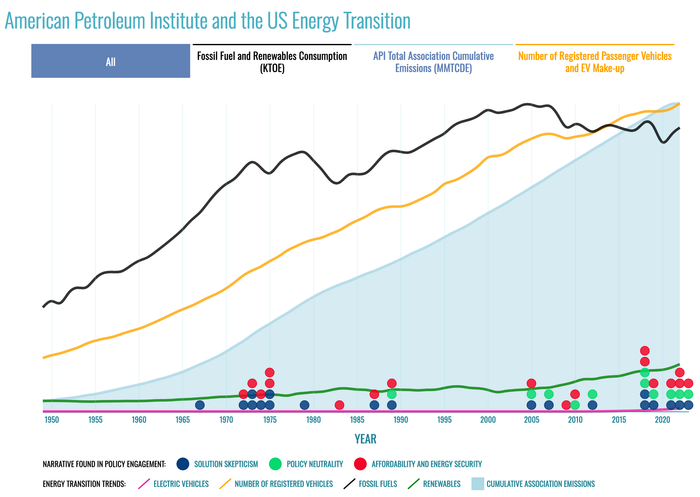
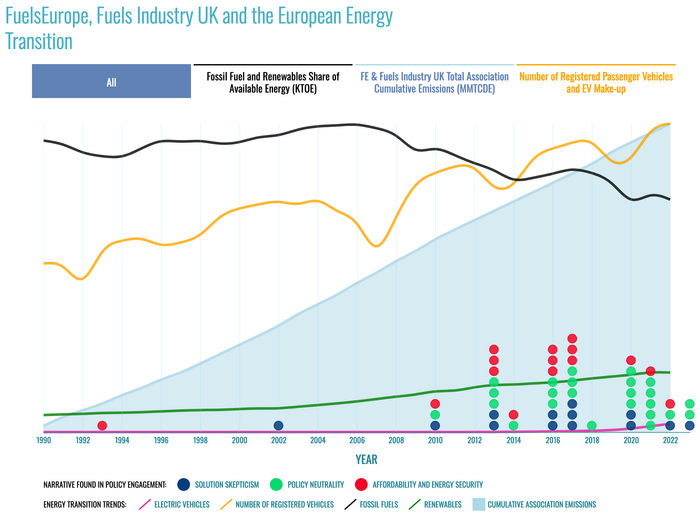
InfluenceMap traced the narratives “across 51 separate instances of the associations’ advocacy against fossil fuel alternatives between 1967 and 2023,” the publication explains. “These narratives include ‘Solution Skepticism,’ which has been in use for 56 years, ‘Policy Neutrality’ for 34 years, and ‘Affordability and Energy Security’ for 51 years.”

The group defined the narratives as follows:

  • Solution Skepticism: downplays the impact and viability of alternative energy.
  • Policy Neutrality: promotes consumer choice, market solutions, and minimal government intervention.
  • Affordability and Energy Security: paints fossil fuel alternatives as a risk to cost-effective and secure energy.

“Despite advancements in understanding the threats posed by the climate crisis, these narratives persist as of 2023,” the report says. It also emphasizes that the narratives contradict science-based policy recommendations from the United Nations’ Intergovernmental Panel on Climate Change (IPCC) and the International Energy Association (IEA).

Some examples identified by InfluenceMap include API comments on the Clean Air Act and amendments in 1967, 1970, and 1989 as well as the association’s remarks on the Inflation Reduction Act of 2022 and pollution standards for heavy-duty vehicles last year. The publication also points to FuelsEurope’s 2021 comments on European Union Performance Standards and the group’s participation in a 2022 letter about the Energy Performance of Buildings Directive.

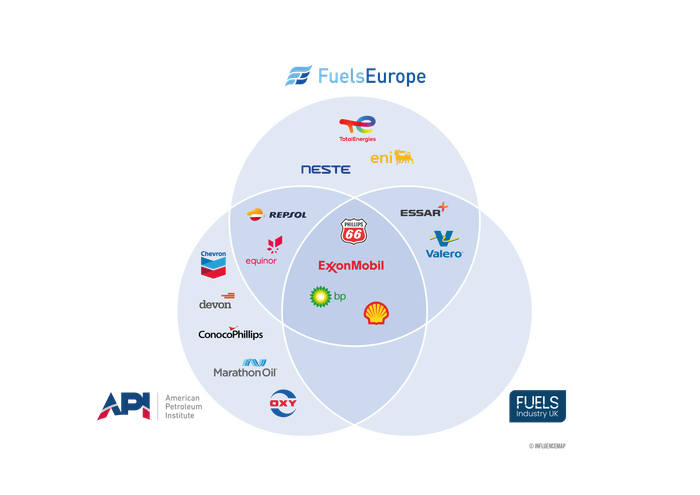
InfluenceMap produced graphics to display its findings, including one that shows key members of each association as of March. Members of all three include BP, ExxonMobil, Shell, and Phillips 66.

“Some of the world’s largest oil and gas companies are still paying a high premium to participate in industry associations that may no longer represent them on climate policy,” the report states, pointing to how associations’ actions contrast with public positions taken by some major fossil fuel corporations. “Meanwhile, Shell, Chevron, and Exxon have disclosed that they pay between $5 million and $12.5 million per year to hold a membership with the API.”

The think tank also made a pair of graphics showing how the trade associations’ documented use of the three narratives aligns with fossil fuel and renewables consumption, association members’ cumulative emissions, and the number of EVs compared with the total number of registered passenger vehicles since the 1950s.

“This report shows that even faced with mounting scientific evidence over decades, the oil and gas industry have pushed ahead with a damaging messaging strategy they developed as early as the 1960s,” said Tessa Khan, founder and executive director of Uplift, which supports a rapid and fair transition away from fossil fuel production in the U.K.

“It shows the crucial need for increased awareness of the delaying tactics of fossil fuel companies from policymakers if they are to successfully drive the energy transition forward at the pace we need,” Khan added.

Calling the report “brilliant and disturbing,” the U.K.-based Fossil Free Parliament said that “this is exactly why we need to remove the industry’s seat at the table in Westminster.”

In the United States, Democratic federal lawmakers recently concluded a probe into BP, Chevron, ExxonMobil, Shell, API, and the U.S. Chamber of Commerce for decades of spreading climate disinformation, after which they urged the U.S. Department of Justice to investigate all six.

Original article by JESSICA CORBETT republished from Common Dreams under Creative Commons (CC BY-NC-ND 3.0). 

Continue ReadingReport Details Big Oil Lobby’s Relentless Opposition to a Green Transition