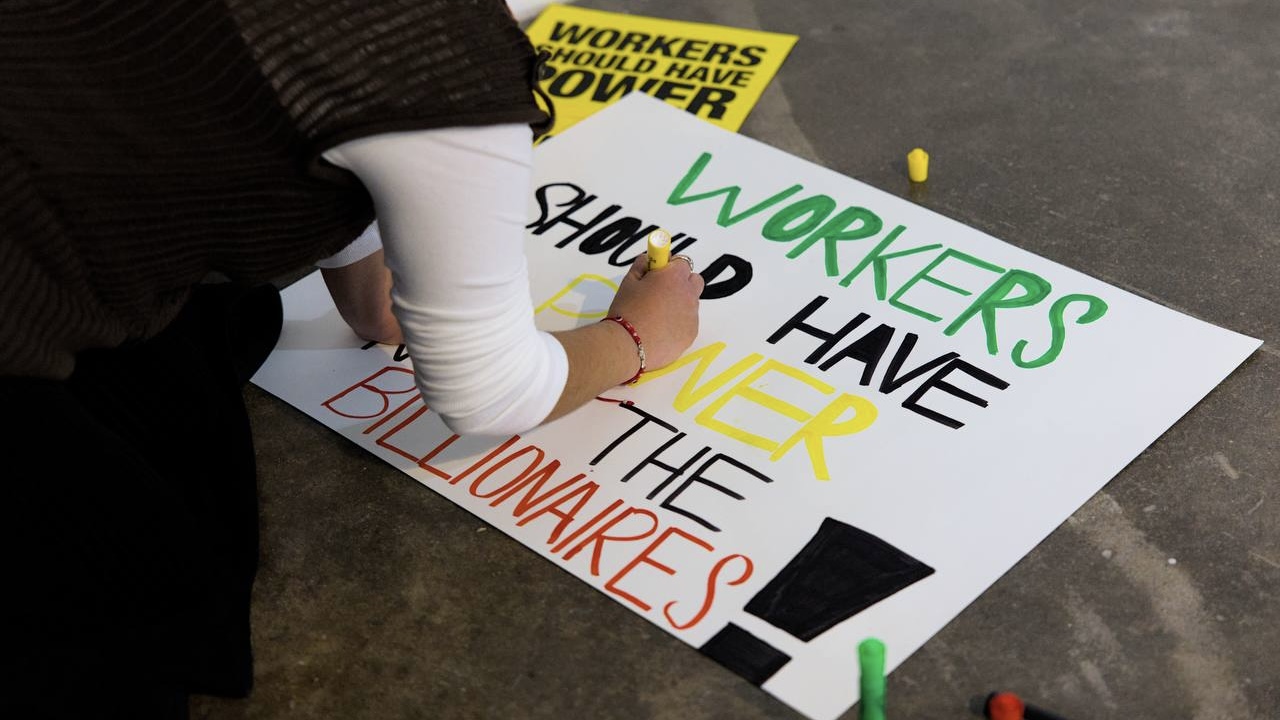
Activists in Houston, Texas designing signs for Inauguration Day protests. Photo: Vivek Venkatraman
Demonstrators mobilizing in over 40 US states to launch movement pledging to oppose “ultra-right, billionaire agenda”
Demonstrations have been called in more than 80 US cities, in over 40 states, on the day of incoming President Donald Trump’s inauguration. These cities include Washington DC, New York, Boston, Los Angeles, Portland, Seattle, Atlanta, Charlotte, Montgomery, Chicago, Houston, and New Orleans.
These demonstrations, intended to mark the start of a movement against Trump’s “ultra-right, billionaire agenda”, have been endorsed by a variety of working class and grassroots organizations. These include the Party for Socialism and Liberation, United Auto Workers Local 4811, the Palestinian Youth Movement, United Educators of San Francisco, Black Men Build, the Democratic Socialists of America, the People’s Forum, the Palestinian Youth Movement, the ANSWER Coalition, the US Palestinian Community Network, UNITE HERE Local 2, Artists Against Apartheid, CODEPINK, the Los Angeles Tenants Union, and Dream Defenders.
Conveners of the demonstrations have spoken to the variety of Trump’s promised attacks on working people. “Trump is planning to wage war on immigrant families through a brutal mass deportation campaign,” said Claudia De La Cruz, who ran on a socialist platform in her campaign for president against both Harris and Trump, on the ticket of the Party for Socialism and Liberation. “We will stand up and say NO to these attacks. Trump is a billionaire, was elected with the help of other billionaires, and runs the government on behalf of the billionaire class. All working people, no matter where you were born, should stand together in solidarity against the billionaire class that wants to rob and exploit us all.”
Brian Becker, the national director of the ANSWER Coalition, does not believe Trump’s promises to “put American Workers first.” According to Becker, Trump “ran a con game during the election.”
“His real agenda is to destroy worker’s rights, deport millions of immigrant families,” Becker said. Trump plans to “pave the way for a complete corporate takeover by ending regulations to protect the environment, firing thousands of public sector workers, and transferring ever-larger parts of the national treasury to the military industrial complex.”
Manolo De Los Santos, Executive Director of The People’s Forum, said, “The Trump victory in the 2024 election represents the complete failure of the Democratic Party to stop the rise of the ultra-right.”
“We can defeat the Trump program not by following the Democratic Party establishment, but by building a massive movement against the ruling class and the political system that gives everything to billionaires while impoverishing an ever larger section of the population.”
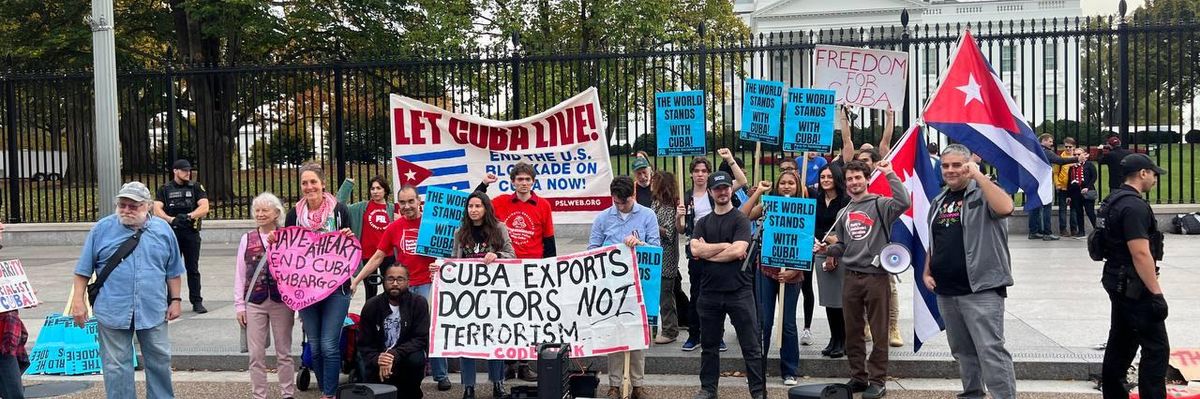
CodePink led a November 2, 2022 rally against the U.S. economic blockade of Cuba outside the White House in Washington, D.C. (Photo: CodePink)
“Seriously? You wait until six days before leaving office to do what you promised to do during your 2020 campaign?” said one observer.
In a move likely to be reversed by the incoming Trump administration, President Joe Biden on Tuesday notified Congress of his intent to remove Cuba from the U.S. State Sponsors of Terrorism list, a designation that critics have long condemned as politically motivated and meritless.
Noting that “the government of Cuba has not provided any support for international terrorism” and has “provided assurances” that it will not do so in the future, the White House said in a memo that the Biden administration is moving to rescind the first Trump administration’s January 2021 addition of Cuba to the State Sponsors of Terrorism (SSOT) list and take other measures to ease some sanctions on the long-suffering island of 11 million inhabitants.
Cuba’s SSOT designation was based mostly on the socialist nation’s harboring of leftist Colombian rebels and several U.S. fugitives from justice for alleged crimes committed decades ago, even though no other country has been placed on the SSOT list for such a reason and despite right-wing Cuban exile terrorists enjoying citizenship—and even heroic status—in the United States.
“Despite its limited nature, it is a decision in the right direction and in line with the sustained and firm demand of the government and people of Cuba, and with the broad, emphatic, and repeated call of many governments, especially Latin America and the Caribbean, of Cubans living abroad, political, religious and social organizations, and numerous political figures from the United States and other countries,” the Cuban Ministry of Foreign Affairs said in a statement.
“It is important to note that the economic blockade and much of the dozen coercive measures that have been put into effect since 2017 remain in force to strengthen it, with full extraterritorial effect and in violation of international law and human rights of all Cubans,” the ministry added.
For 32 straight years, the United Nations General Assembly has overwhelmingly voted for resolutions condemning the U.S. blockade of Cuba. And for 32 years, the United States, usually along with a small handful of countries, has opposed the measures. Last year’s vote was 187-2, with Israel joining the U.S. in voting against the resolution.
Cuba followed Biden’s move by announcing it would “gradually” release 553 political prisoners following negotiations with the Catholic Church, The New York Timesreported.
Many progressives welcomed Biden’s shift. Congresswoman Nydia Velázquez (D-N.Y.) said in a statement that Cuba’s SSOT designation “has only worsened life for the Cuban people without advancing U.S. interests” and “has made it harder for Cubans to access humanitarian aid, banking services, and the ability to travel abroad.”
“It has also deepened food and medicine shortages and worsened the island’s energy crisis, especially after Hurricane Rafael,” she added. “These hardships have driven an unprecedented wave of migration, leading to the largest exodus in Cuba’s history.”
Rep. Ilhan Omar (D-Minn.) called Biden’s move “a long overdue action that will help normalize relations with our neighbor.”
“This is a step toward ending decades of failed policy that has only hurt Cuban families and strained diplomatic ties,” Omar added. “Removing this designation will help the people of Cuba and create new opportunities for trade and cooperation between our nations. I look forward to continuing the work to build bridges between our countries and supporting policies that benefit both the American and Cuban people.”
David Adler, the co-general coordinator at Progressive International, called the delisting “far too little, far too late.”
“POTUS removing Cuba’s SSOT designation in the final days of his presidency only means one thing: He knew—from day one—that the designation was simply an excuse to punish the Cuban people,” Adler added. “But he maintained it anyway. Sickening.”
The peace group CodePink released a statement welcoming Biden’s shift, but adding that “it is unacceptable that it took this administration four years to address these injustices.”
“President Biden made the inhumane decision every single day to not alleviate the suffering of millions of Cubans by keeping this designation in place,” the group added. “As we mark this overdue progress, we can only hope that the Trump administration does not reverse these crucial steps towards justice and diplomacy.”
Trump’s nominee for secretary of state, Sen. Marco Rubio (R-Fla.) is the son of Cuban immigrants and a fierce critic of Cuba’s socialist government. In 2021, Rubio introduced legislation aimed at blocking Cuba’s removal from the SSOT list. Trump has also tapped Mauricio Claver-Carone—a staunch supporter of sanctioning Cuba—as his special envoy for Latin America.
Alex Main, director of international policy at the Center for Economic and Policy Research, said Tuesday that “while this decision, which comes years after 80 members of Congress urged Biden to reverse Trump’s ‘total pressure’ approach should have been made long ago, it is better late than never.”
“Sixty years of failed policy should be more than enough, and hopefully the new administration will have the wisdom and the courage to pursue a new course, one that’s in the best interest of both the U.S. and the Cuban people,” Main added.
Cuba was first placed on the SSOT list by the Reagan administration in 1982 amid an ongoing, decadeslong campaign of U.S.-backed exile terrorism, attempted subversion, failed assassination attempts, economic warfare, and covert operations large and small in a futile effort to overthrow the revolutionary government of longtime leader Fidel Castro. Cuba says U.S.-backed terrorism has killed or wounded more than 5,000 Cubans and cost its economy billions of dollars.
In stark contrast, Cuba has not committed any terrorism against the United States.
Former President Barack Obama removed Cuba from the SSOT in 2015 during a promising but ultimately short-lived rapprochement between the two countries that abruptly ended when Trump took office for the first time in 2017.
“Cuba will continue to confront and denounce this policy of economic war, the interference programs, and the disinformation and discredit operations financed each year with tens of millions of dollars from the United States federal budget,” the Cuban Foreign Ministry said Tuesday. “It will also remain ready to develop a relationship of respect with that country, based on dialogue and noninterference in the internal affairs of both, despite differences.”
The Biden admin has taken the long overdue step of removing Cuba from the State Sponsors of Terror list. Congratulations & thank you to @dsa_cuba organizers and our friends @AllianceForCuba@LAWGaction, @NNOCuba, & everyone who helped make the case for Cuba at home & in… pic.twitter.com/6fJkVF1Ldz
David Adler, the co-general coordinator at Progressive International, called the delisting “far too little, far too late.”
“POTUS removing Cuba’s SSOT designation in the final days of his presidency only means one thing: He knew—from day one—that the designation was simply an excuse to punish the Cuban people,” Adler added. “But he maintained it anyway. Sickening.”
The peace group CodePink released a statement welcoming Biden’s shift, but adding that “it is unacceptable that it took this administration four years to address these injustices.”
“President Biden made the inhumane decision every single day to not alleviate the suffering of millions of Cubans by keeping this designation in place,” the group added. “As we mark this overdue progress, we can only hope that the Trump administration does not reverse these crucial steps towards justice and diplomacy.”
Trump’s nominee for secretary of state, Sen. Marco Rubio (R-Fla.) is the son of Cuban immigrants and a fierce critic of Cuba’s socialist government. In 2021, Rubio introduced legislation aimed at blocking Cuba’s removal from the SSOT list. Trump has also tapped Mauricio Claver-Carone—a staunch supporter of sanctioning Cuba—as his special envoy for Latin America.
Alex Main, director of international policy at the Center for Economic and Policy Research, said Tuesday that “while this decision, which comes years after 80 members of Congress urged Biden to reverse Trump’s ‘total pressure’ approach should have been made long ago, it is better late than never.”
“Sixty years of failed policy should be more than enough, and hopefully the new administration will have the wisdom and the courage to pursue a new course, one that’s in the best interest of both the U.S. and the Cuban people,” Main added.
Cuba was first placed on the SSOT list by the Reagan administration in 1982 amid an ongoing, decadeslong campaign of U.S.-backed exile terrorism, attempted subversion, failed assassination attempts, economic warfare, and covert operations large and small in a futile effort to overthrow the revolutionary government of longtime leader Fidel Castro. Cuba says U.S.-backed terrorism has killed or wounded more than 5,000 Cubans and cost its economy billions of dollars.
In stark contrast, Cuba has not committed any terrorism against the United States.
Former President Barack Obama removed Cuba from the SSOT in 2015 during a promising but ultimately short-lived rapprochement between the two countries that abruptly ended when Trump took office for the first time in 2017.
“Cuba will continue to confront and denounce this policy of economic war, the interference programs, and the disinformation and discredit operations financed each year with tens of millions of dollars from the United States federal budget,” the Cuban Foreign Ministry said Tuesday. “It will also remain ready to develop a relationship of respect with that country, based on dialogue and noninterference in the internal affairs of both, despite differences.”
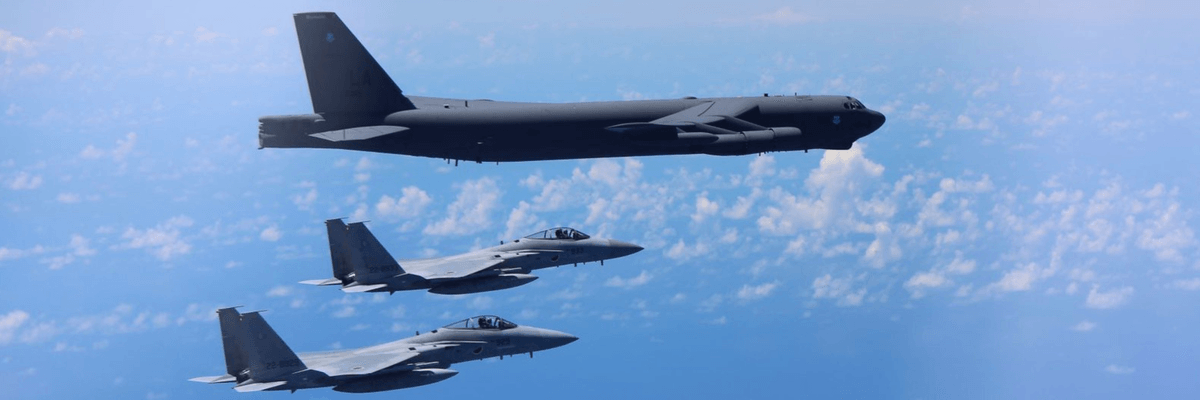
F-15 fighters escort a U.S. B-52 bomber in this August 31, 2021 photo. (Photo: Japan Air Self-Defense Force/U.S. Indo-Pacific Command/flickr/cc)
“The Western press are waxing lyrical about the new Syria being born—but not a word on the U.S. and Israeli bombs falling from the sky,” said Yanis Varoufakis.A-10 ground attack aircraft
U.S. military forces launched dozens of airstrikes on more than 75 Islamic State targets in Syria on Sunday after the fall of longtime Syrian President Bashar al-Assad and amid ongoing Israeli and Turkish attacks on the war-torn Middle Eastern nation.
According to U.S. Central Command (CENTCOM), warplanes including B-52 bombers, F-15 fighters, and A-10 ground attack aircraft “conducted dozens of precision airstrikes targeting known ISIS camps and operatives in central Syria.”
CENTCOM called the strikes “part of the ongoing mission to disrupt, degrade, and defeat ISIS in order to prevent the terrorist group from conducting external operations and to ensure that ISIS does not seek to take advantage of the current situation to reconstitute in central Syria.”
The U.S., “together with allies and partners in the region, will continue to carry out operations to degrade ISIS operational capabilities even during this dynamic period in Syria,” CENTCOM added.
“The Biden administration ordering ongoing airstrikes is a disappointing sign that they have no intent on reversing their deadly policy of interventionism.”
Responding Monday to the latest attacks on Syria by U.S. forces, Danaka Katovich, national co-director of the peace group CodePink, told Common Dreams: “We condemn the U.S. airstrikes in Syria. The U.S. has sowed chaos in Syria and the entire region for years and the Biden administration ordering ongoing airstrikes is a disappointing sign that they have no intent on reversing their deadly policy of interventionism.”
U.S. and coalition forces have killed and maimed at least tens of thousands of Syrians and Iraqis during the Obama, Trump, and Biden administrations as part of the anti-ISIS campaign and wider so-called War on Terror.
Commenting on the dearth of coverage of the strikes by the corporate media, prominent Greek leftist Yanis Varoufakissaid on social media that “the Western press are waxing lyrical about the new Syria being born—but not a word on the U.S. and Israeli bombs falling from the sky.”
“Is there no bottom to the moral void of the Western press?” he added.
Sunday’s U.S. strikes came as al-Assad and relatives fled to Russia—where they have been granted asylum—amid the fall of the capital, Damascus, to rebel forces.
Also on Sunday, Israeli forces seized more territory in Syria’s Golan Heights and ordered residents of five villages to “stay home and not go out until further notice” if they want to remain safe. Israel conquered the western two-thirds of the Golan Heights in 1967 and has unlawfully occupied it ever since. In 1981, Israel illegally annexed the occupied lands.
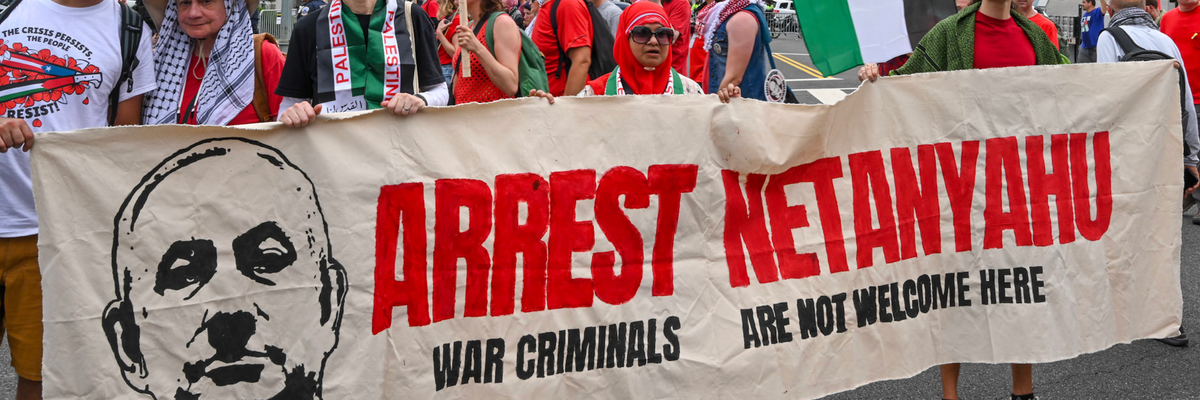
“We will not allow any hostile force to establish itself on our border,” right-wing Israeli Prime Minister Benjamin Netanyahu—who is wanted by the International Criminal Court for alleged war crimes and crimes against humanity in Gaza—said in a video posted on social media.
Numerous Israelis celebrated the seizure on social media, while others cautioned against boasting about what is almost certainly an illegal conquest.
Meanwhile in northern Syria, Turkish airstrikes in support of Syrian National Army rebels—who are battling U.S.-backed Syrian Democratic Forces (SDF) fighters in and around the Kurdish-controlled city of Manbij—reportedly killed numerous civilians along with dozens of militants.
In what it called a “horrific massacre,” the London-based Syrian Observatory for Human Rights said Monday that 11 civilians from the same family, including women and six children, were killed in a Turkish drone strike on the SDF-controlled village of Al-Mustariha in northern Raqqa Governate.
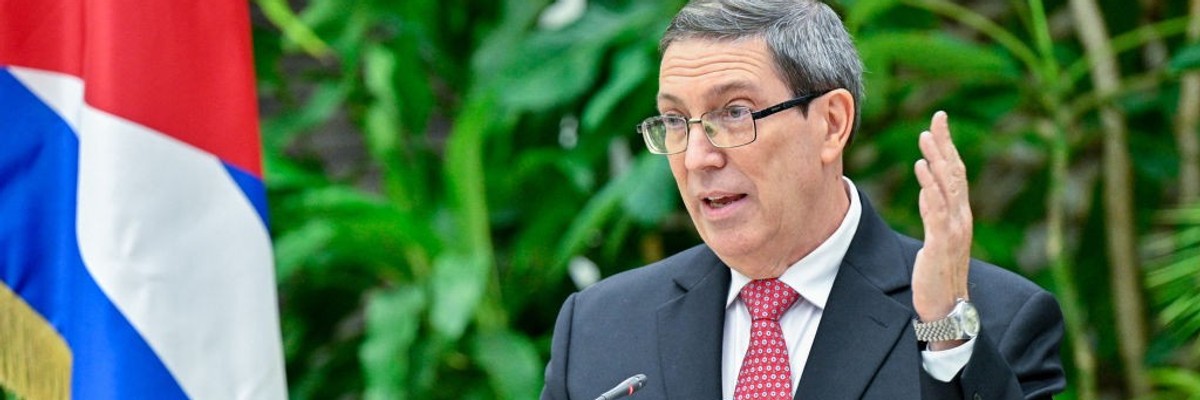
Cuban Foreign Minister Bruno Rodríguez speaks during a press conference on the impact of the U.S. embargo in Havana on September 12, 2024. (Photo: Adalberto Roque/AFP via Getty Images)
“The world has spoken—it’s time for the U.S. to listen and lift the blockade.”
The United Nations General Assembly on Wednesday once again overwhelmingly urged the U.S. government to end its decadeslong blockade on Cuba, with just the United States and Israel voting against the measure and Moldova abstaining.
The UNGA’s other 187 members present voted to adopt the nonbinding resolution on “the necessity of ending the economic, commercial, and financial embargo imposed by the United States” against the Caribbean island.
This is the 32nd straight year that the U.N. body has approved a resolution against the embargo that began in 1962.
“The U.S. and Israel stand isolated as the only two votes against,” Democratic Socialists of America’s International Committee said after the Wednesday vote. “The world has spoken—it’s time for the U.S. to listen and lift the blockade.”
Though a few other nations have opposed the resolution over the years, Michael Galant of Progressive International and the Center for Economic and Policy Research noted that this vote was “two genocidaires v. the world.”
Israel faces a genocide case at the International Court of Justice for its yearlong assault of the Gaza Strip, which has killed at least 43,163 Palestinians and injured another 101,510, according to local officials in the Hamas-governed enclave. The U.S. Congress and Biden administration have given Israel billions of dollars in weapons and opposed U.N. cease-fire resolutions.
CodePink’s Medea Benjamin responded to the Wednesday vote with a video shared on social media, saying that Israel “loves blockades, because it’s doing its own blockade of Gaza,” and “is dependent on the United States to carry out its genocide.”
“Now this is not just some idle vote,” she said of the approved resolution. “This blockade that the U.S. maintains is a form of economic warfare. It’s no exaggeration to say that now, when there is an economic crisis in Cuba, the U.S. blockade, which keeps Cuba from using the financial markets, from having normal trade with countries all over the world, is actually leading to deaths, leading to people going hungry, leading to people lacking food and medicine that are essential for their lives.”
“And that’s why the United States must be condemned for this ongoing horrific, inhumane, and illegal blockade,” Benjamin added.
Cuba’s representative delivered similar remarks to the UNGA on Wednesday. As Reutersreported:
Cuban Foreign Minister Bruno Rodríguez said in a speech before the assembly that what is often referred to as the U.S. trade embargo is a “blockade” because the web of laws and regulations complicate financial transactions and the acquisition of goods and services not just from the United States but internationally.
“The blockade against Cuba is an economic, financial, and trade war which qualifies as genocide,” said Rodriguez, charging the U.S. policies were deliberately aimed at promoting suffering among the Cuban people to force change in the government.
Some international observers praised the countries who did condemn the blockade. Middle East expert Assal Rad declared, “This is the real international community.”
Manolo De Los Santos, a founder of the People’s Forum and a researcher at Tricontinental: Institute for Social Research, said that “this overwhelming consensus is in contrast with the indifference of the United States, which continues to deny any responsibility for sanctions while tightening its stranglehold on Cuba.”
Earlier this month, the People’s Forum published a letter in The New York Times to U.S. President Joe Biden, warning that he has “exactly 90 days to reverse” former Republican President Donald Trump’s “brutal policy on Cuba.”
Biden was vice president a decade ago when then-President Barack Obama “opened a hopeful new chapter in U.S.-Cuba relations by taking the first steps toward normalization,” the letter details. “People in both countries were optimistic that Cuba and the United States could become neighbors rather than Cold War enemies. However, Trump dismantled that policy, imposing pain and suffering on the Cuban people.”
“Removing the state sponsors of terrorism designation would allow Cuba to engage in financial transactions and restore its electrical grid, as well as address shortages of food and medicine to alleviate the immense hardship faced by the Cuban people, who have endured over 62 years of economic strife under the embargo,” the letter adds. “It’s time to act. Let Cuba live!”
Biden faced similar pressure in August, when hundreds of legal experts and groups called on him “to comply with existing international law by ending the use of broad unilateral coercive measures” particularly in “cases such as Cuba, Iran, North Korea, Syria, and Venezuela.”
The U.N. vote comes as early voting is underway for the November 5 election in which Trump is facing Biden’s vice president, Kamala Harris.
Neither campaign provided details on each candidate’s position when contacted by Reuters earlier this week, though Morgan Finkelstein, national security spokesperson for Harris, said that the Democrat “stands with the people of Cuba as they fight for their rights after decades of repression and economic suffering at the hands of the communist regime” and “will stand up to all authoritarians—including the very leaders that Trump has praised and embraced.”
Israeli tanks are pictured near the Israel-Lebanon border on September 30, 2024. (Photo: Erik Marmor/Getty Images
“The Biden administration has acted recklessly in giving Israel a blank check to light the entire region on fire.”
Israeli forces invaded southern Lebanon early Tuesday with the open support of the United States, which endorsed what it called “limited operations to destroy Hezbollah infrastructure” despite warnings that a ground assault could spark a wider conflict and intensify the humanitarian disaster facing Lebanese civilians.
The Israel Defense Forces (IDF) described its ground invasion with the same terms it has used to characterize its bombing campaigns in Lebanon and Gaza, which—despite being called “targeted” at Hezbollah and Hamas—have frequently killed scores of civilians and obliterated schools, hospitals, shops, and residential buildings. Since mid-September, Israeli airstrikes in Lebanon have killed more than a thousand people and displaced roughly a million.
The IDF launched its ground invasion with the backing of the Biden administration. In a statement, the White House said that the invasion of Lebanon is “in line with Israel’s right to defend its citizens and safely return civilians to their homes.”
A spokesperson for the White House National Security Council acknowledged the risk of “mission creep” only to effectively wave it away, saying that “we will keep discussing that with the Israelis.”
Analysts likened Israel’s movement of troops into Lebanon to its invasion of the southern Gaza city of Rafah earlier this year—an operation that was initially described as limited but ultimately left the area in ruins.
“Gaza was a testing ground for Israel to see what they could get away with and, it turns out, the answer is absolutely anything it wants,” said historian and analyst Assal Rad. “It did not stop at Gaza or the West Bank and it may not stop at Lebanon, because war was [Israeli Prime Minister Benjamin] Netanyahu’s objective all along and his prize is Iran.”
“Make no mistake: The Biden administration is providing cover for Israel as it invades a neighboring, sovereign nation.”
The invasion comes after the Netanyahu government rejected a three-week cease-fire proposal put forth by the U.S., France, and other nations and intensified its bombing of Lebanon, hammering Beirut with airstrikes that killed Hezbollah leader Hassan Nasrallah and many civilians. The attack that killed Nasrallah was reportedly carried out with 2,000-pound bombs supplied by the U.S.
Coverage of the invasion in the Western corporate media painted the U.S. as “increasingly powerless,” with “limited” influence to forestall a massive ground assault on Lebanon. But the Biden administration has yet to seriously leverage American military aid to prevent a war that could envelop the entire region.
On the contrary, billions of dollars of aid and American weapons have continued to flow to Israel, enabling its war on Gaza and Lebanon. The Washington Post observed that “the events of recent weeks appear to fit a pattern in which the administration urges against specific Israeli actions only to later backtrack so it can avoid imposing conditions on military aid.”
The U.S. has also engaged in what’s been described as “unprecedented” intelligence-sharing with Israel, further deepening its complicity in the devastating wars.
Sarah Leah Whitson, executive director of Democracy for the Arab World Now (DAWN), said in a statement late Monday that “Israel’s invasion of Lebanon, following its devastating attacks on Lebanon over the past two weeks, is the entirely predictable consequence of the Biden administration’s ceaseless coddling and resupply of weapons to Israel, whatever public bleats for cease-fires the administration has otherwise made.”
“The Biden administration has acted recklessly in giving Israel a blank check to light the entire region on fire, all while disregarding our own legal obligations under both U.S. and international law to halt the weapons flow to them,” Whitson added.
The U.S.-based anti-war group CodePink said that “Israel claims its operation in Lebanon is ‘targeted,’ but like in Gaza, civilians are the real victims.”
“Make no mistake: The Biden administration is providing cover for Israel as it invades a neighboring, sovereign nation,” the group said. “U.S. taxpayers fund Israel’s military, providing billions annually and supplying weapons used to kill innocent people.”
“The Biden administration and Congress could halt this escalation by cutting military aid, demanding a cease-fire, and holding Israel accountable,” CodePink continued, “but instead, they allow continued aggression across the Middle East.”