Amid economic hardship and repression, Kenyans reject the Finance Bill 2024

Spread the love

Original article by Nicholas Mwangi republished from peoples dispatch under a Creative Commons Attribution-ShareAlike 4.0 (CC BY-SA) license.
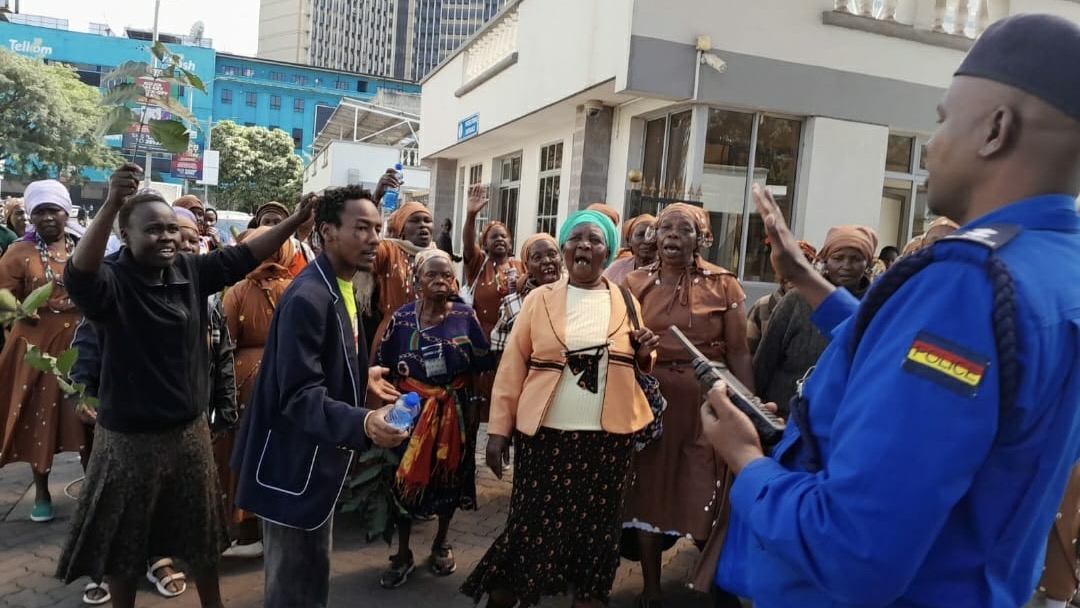
Police heavily repressed the protests against the Finance Bill 2024 on Tuesday June 18. Photo: Mathare Justice Center

Hundreds were arrested and brutalized in Nairobi by police forces during protests against the government’s finance bill

On Tuesday June 18, the streets of Kenya’s capital were the site of a major showdown, as peaceful protesters advocating for the rejection of the Finance Bill 2024 were met with brutal repression by state forces. According to human rights groups in Kenya, between 300-400 protesters were arrested as they rallied against the punitive tax measures proposed by the government. The protest organized by a wide variety of civil society organizations and left groups was violently disrupted by police forces attempting to prevent the demonstrators from reaching the parliament building, where organizers had planned to launch a sit-in at 2 pm.

Despite the heavy-handed police attacks with water cannons, and tear gas, the protesters persisted throughout the day, ensuring their voices were heard by those in power and not allowing their right enshrined in article 37 of the constitution – “Assembly, demonstration, picketing and petition” to be compromised. This article outlines that every person has the right, peaceably and unarmed, to assemble, to demonstrate, to picket, and to present petitions to public authorities.”

The tension and public dissent exerted considerable pressure on the government. This was evident as President William Ruto convened an early meeting with members of parliament. The outcome of this meeting saw some “compromises” in the government’s stance on the contentious finance bill. The parliamentary finance committee announced the government’s U-turn at a press briefing on Tuesday, attended by the president and ruling party lawmakers. They announced the decision to withdraw certain proposed taxes, including those on cooking oil, mobile money services, and motor vehicles. The concession was clearly a direct response to the mounting public outcry nationwide.

However, the selective removal of these taxes has done little to appease the masses. Many view it as a strategic move by the government to placate the population while still pushing through other unpopular measures. The finance bill of 2024, in its entirety, remains widely rejected by the masses. The protesters’ message is clear: they demand a complete overhaul of the proposed financial policies, not just a piecemeal reduction of specific taxes.

Ruto’s neoliberal Finance Bill

The Finance Bill 2024, much like its predecessor in 2023, has stirred controversy and discontent across Kenya due to its stringent and, many argue, draconian proposals. This widespread dissatisfaction is deeply rooted within the broader context of an already high cost of living, which will be increased by the proposed new taxes. Beginning last week, Kenyans have voiced their disapproval with the finance bill by taking to social media, where they posted the contacts of Members of Parliament (MPs) and encouraged each other to reach out to their leaders, urging them to reject the bill.

The Finance Bill 2024, officially published by the National Assembly on May 9, 2024, outlines the Government of Kenya’s proposed tax measures for the financial year 2024-2025. Among the numerous changes proposed are significant amendments to Income Tax, Value Added Tax (VAT), and Excise Duty, as well as modifications to the administration of taxes in Kenya. One of the most contentious proposals in the bill is the imposition of a 16% Value Added Tax on financial transactions, and among basic commodities.

Many protested as they believe this will worsen their financial hardships rather than alleviate them. The protests are set to continue, with the third round of Parliament scheduled for June 20th.

The government’s justification for raising taxes, claiming it is necessary for Kenya to live within its means, is hypocritical given its extensive and often unnecessary expenditures. For instance, the government has increased its borrowing target for the fiscal year starting in July to Sh 597 billion, a substantial sum that raises questions about fiscal responsibility. A closer look at government spending reveals significant outlays that contrast sharply with its message.

According to Business Daily, the latest budget control data show a significant rise in travel perks for foreign and local trips, with an increase of Sh 1.62 billion from the Sh 12.4 billion spent in a similar period the previous year. The Parliamentary Service Commission’s spending has also surged by 18.5% to Sh 1.86 billion, and the bill for Members of Parliament (MPs) has grown by 4% to Sh 4 billion. Such figures highlight a pattern of lavish expenditure that stands in stark contradiction to the government’s narrative of financial prudence.

Further, the bill has received backing from the International Monetary Fund (IMF), despite widespread public outcry against it. This support from the IMF is not surprising as they did the same last year, and many Kenyans feel that the country has been effectively mortgaged to the institution. Historically, the IMF’s involvement has brought about economic policies and austerity measures that are seen as an attack on the working class and the marginalized peasants alike, often leading to increased economic strain for the average citizen.

Organized resistance poses more serious challenge to government

What distinguishes the current wave of protests from previous ones is the nature of their organization. Unlike past protests that were primarily mobilized by opposition party leader Raila Odinga against the government, these demonstrations have been driven by different organizations and particularly on online platforms, which have successfully translated their digital activism into tangible, on-the-ground action. This movement has seen an unexpectedly high level of participation from “Gen Z” and the middle class, groups that have traditionally been less involved in these demonstrations.

As the protests continue, the Kenyan government will continue to face mounting pressure to address the economic concerns of the masses. In the last two months there have been three major protests organized by grassroots movements among them against state demolitions on the informal settlements of the downtrodden coming to terms with the recent flood crisis that killed many and destroyed properties of unknown value. The fight for total liberation continues.

Nicholas Mwangi is a member of the Ukombozi Library in Kenya.

Original article by Nicholas Mwangi republished from peoples dispatch under a Creative Commons Attribution-ShareAlike 4.0 (CC BY-SA) license.
Continue ReadingAmid economic hardship and repression, Kenyans reject the Finance Bill 2024

Dozens of Pro-Palestinian Rights Protesters Arrested for Blocking JFK Airport Entrance

Spread the love

Original article by JULIA CONLEY republished from Common Dreams under Creative Commons (CC BY-NC-ND 3.0). 

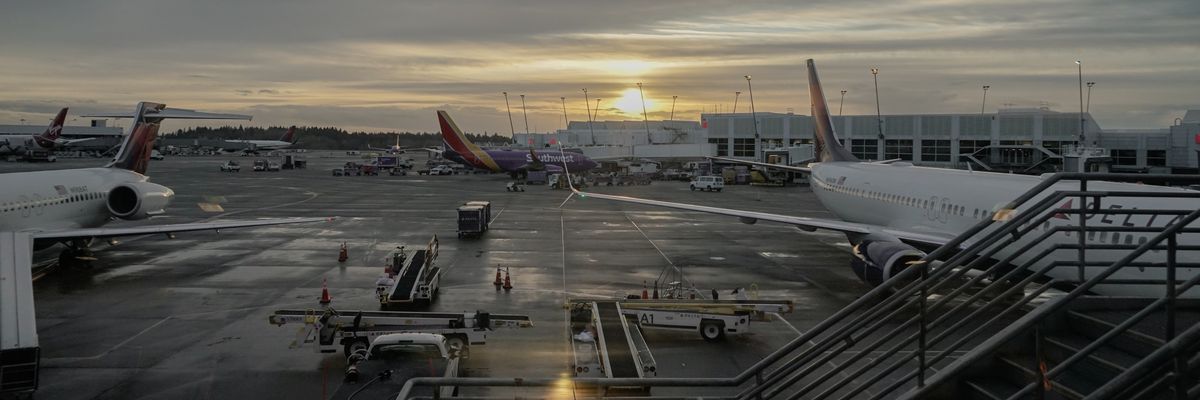
Airplanes are seen on a tarmac.  (Photo: Afif Ramdhasuma on Unsplash)

Organizers demonstrated to call attention to the ongoing forced displacement of Palestinians and the denial of their right to return home.

More than two dozen human rights campaigners were arrested on Wednesday for blocking Interstate 678, the Van Wyck Expressway, in New York—the road that leads to John F. Kennedy International Airport—in one of the latest highway protests demanding justice for Palestinians.

The protesters blocked the road at about 11:30 am and continued the action for about 20 minutes, The Messenger reported, displaying banners that read, “Right to Return, Right to Remain” and “Divest From Genocide.”

Independent journalist Talia Jane reported that the protesters aimed to call attention to the Israeli government’s denial of the Palestinian people’s right to return to their homes, which they were forced to flee in 1948 when the state of Israel was created.

The protest was held on the 81st day of Israel’s U.S.-backed bombardment of Gaza, which has killed at least 21,110 people and injured more than 55,000, as well as displacing more than 80% of the blockaded enclave’s population.

The campaigners linked arms and blocked the expressway days after Israeli Prime Minister Benjamin Netanyahu publicly said the government’s objective is the so-called “voluntary” migration of Gaza’s 2.3 million people—another mass displacement of Palestinians nearly 75 years after they were driven from what is now Israel.

Some travelers headed for JFK on the busy holiday travel day exited their vehicles and walked to the airport with their luggage.

At least one told the demonstrators, “Good luck,” as she climbed over a highway barricade to get to the airport.

The Port Authority of New York told The Messenger that 26 people were arrested “for disorderly conduct and impeding vehicular traffic” and that officials dispatched two buses to offer rides to travelers.

The outlet reported that protesters carrying signs that read, “Land Back” also assembled outside Los Angeles International Airport, blocking travelers from entering.

National Jewish-led Palestinian rights groups Jewish Voice for Peace and IfNotNow have blocked bridges and highways and organized mass protests in other travel hubs since Israel began its total blockade and air and ground assault in Gaza, which has threatened the population with starvation and disease as well as bombings.

Neither group had claimed responsibility for Wednesday’s protests at press time.

Original article by JULIA CONLEY republished from Common Dreams under Creative Commons (CC BY-NC-ND 3.0). 

Continue ReadingDozens of Pro-Palestinian Rights Protesters Arrested for Blocking JFK Airport Entrance

Hundreds of Thousands March in London Demanding ‘End to War on Gaza’

Spread the love

Original article by Jon Queally republished from Common Dreams under Creative Commons (CC BY-NC-ND 3.0).

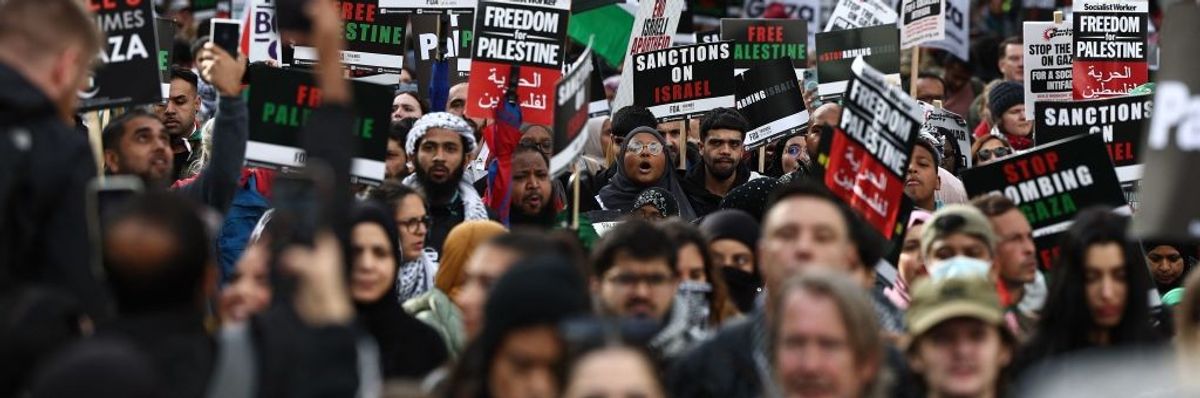
People take part in a ‘March For Palestine,’ in London on October 21, 2023, to “demand an end to the war on Gaza.” (Photo by Henry Nicholls / AFP via Getty Images)

The large-scale demonstration in the U.K. occurred as paltry levels of humanitarian aide were finally allowed through the southern border of Gaza, but nowhere near enough given the scale of death and destruction.

Organizers and participants said hundreds of thousands of people were in the streets of central London on Saturday to demand an immediate cease-fire in Gaza as the Israeli military continued its bombardment of the besieged enclave a full two weeks after Hamas’ Oct. 7 attack.

Organized by a coalition that includes the Solidarity Campaign, Friends of Al-Aqsa, Stop the War Coalition, Muslim Association of Britain, Palestinian Forum in Britain, and the Campaign for Nuclear Disarmament, the march also called for Israel to “end its occupation of Palestinian land and apartheid rule over the Palestinian people.”

The demonstration began at Marble Arch, weaving its way through central parts of the city before ending at Downing Street, where a mass rally was held.

While many in the streets put the number of demonstrators in the hundreds of thousands, other outlets put the number closer to 100,000.

“As a Palestinian who’d like to return home one day, as a Palestinian who has brothers and sisters in Gaza, and family, I wish we can do more but protest is what we can do at the minute,” one marcher toldReuters.

At a smaller protest in Cardiff, Maggie Morgan, from the local affiliate of the Palestinian Solidarity Campaign, explained to the BBC that demonstrators in the UK were “taking to the streets as a show of solidarity to the people of Gaza, to show our support for them, but also to make the government listen, and say ‘not in our name,’ we’re not having this.”

On Friday, protests against the assault on Gaza—which has already claimed over 4,000 lives and thousands more injured—were seen across the Middle East, from Cairo in Egypt, with specific demands to open the Rafah Border to allow refugees out and humanitarian supplies, to Iraq, Yemen, Jordan, Indonesia, and beyond.

“We want the border to be opened immediately so aid can reach people in Gaza,” one protester in Cairo’s Tahrir Square told a correspondent with the Middle East Eye.

The Rafah crossing was finally opened on Saturday, but only 20 trucks of supplies were allowed to enter Gaza, an amount described by the Associated Press as “a trickle” compared to what aid experts say is necessary.

Cindy McCain, the executive director of the World Food Programme, toldAl Jazeera in an interview that 20 trucks were simply inadequate given the scale of the humanitarian disaster Palestinians and others trapped in Gaza now face.

“The situation inside Gaza is dire. Not only is there no food, there is no water, electricity, or fuel. And that combination is not only catastrophic but can lead to more starvation and disease as well,” McCain explained. “We’ve got to get more trucks in.”

Medical agencies and other relief workers on the ground have said that the absence of fuel in Saturday’s convoy means that hospitals remain on the verge of collapse.

“Without fuel entering the Gaza Strip to support generating electricity, thousands of Palestinian lives are at risk of death in hospitals, ” said the Palestine Red Crescent Society in a statement. “Ambulance will no long be able to save lives. Bakeries will no longer be able to provide bread. It shall leave the population without potable water, and risk outbreak of diseases.”

In a dispatch on Saturday, UNRWA Commissioner-General Philippe Lazzarini, who heads the UN agency mandated with administering humanitarian assistance and protection in Gaza, said the ongoing assault by Israel has put the lives of everyone inside the territory at great risk.

“For the past two weeks, the war has continued unabated,” said Lazzarini. “In the Gaza Strip, relentless air strikes and bombardments, coupled with evacuation orders issued by the Israeli Forces, have displaced nearly 1 million people and caused the death and injuries of far too many civilians.”

He continued: “Civilians—wherever they are—must be protected. The life of all civilians, the integrity of all UN facilities and premises, as well as civilian infrastructures, including hospitals, must be shielded from harm and protected at all times under international humanitarian law.”

With global condemnation directed at Israel for what international legal scholars have warned may be overt acts of genocide and collective punishment in response to Hamas’ attack, U.N. Secretary-General António Guterres on Saturday, speaking from Cairo, said, “The people of Gaza need a commitment for much, much more—a continuous delivery of aid to Gaza at the scale that is needed.”

Guterres further demanded a humanitarian cease-fire to rescue Gaza from what he called “a godawful nightmare.”

And Lazzarini added, “Let me be clear: protecting civilians in times of conflict is not an aspiration or an ideal; it is an obligation and a commitment to our shared humanity. I echo the calls from the UN Secretary-General on all parties to reach an urgent humanitarian ceasefire. This is the only way out of this mayhem; any other way will plunge Gaza—and the world—deeper into fathomless, dark depths.”

Original article by Jon Queally republished from Common Dreams under Creative Commons (CC BY-NC-ND 3.0).

Continue ReadingHundreds of Thousands March in London Demanding ‘End to War on Gaza’