The oil industry has succumbed to a dangerous new climate denialism

Spread the love
Opec predicts oil demand will be 10% higher by the 2040s.
Iurii

Adi Imsirovic, University of Surrey

If we have not been warned of the dangers of climate change this summer, we never will be. Extreme heat, forest fires and floods have been all over news reports. Yet the oil and gas industry remains largely in denial.

The International Energy Agency (IEA) says steep cuts in oil and gas production are necessary to reach the Paris (COP 21) goal of keeping global warming at 1.5℃. However, only a tiny fraction of the industry, accounting for less than 5% of oil and gas output, has targets aligned with the IEA’s “net zero” requirements.

The current secretary general of production cartel Opec, Haitham al-Ghais, expects global oil demand to rise by about 10% to 110 million barrels a day by 2045, a volume incompatible with the Paris goals. The UK government has just offered a helping hand, granting around 100 new North Sea licences. What are we to make of this mismatch?

The new denialism

Typical of the new breed of climate denialism is a recent report by the Energy Policy Research Foundation (ERPF), a body funded by the US government and various undisclosed corporate interests and foundations. It sees the IEA’s requirements as a “seal of approval … to block investment in oil and gas production by western companies”. The report views meeting the targets as too costly, too harsh on poor countries and too bad for the energy security of the west.

In fact, it is wrong on each account. Many eminent economists and scientists use the concept of the social cost of carbon (SCC), which is defined as the cost to society of releasing an additional tonne of CO₂. Expert estimates from 2019 put this at between US$171 and US$310 (£133 to £241). If we go with, say, US$240 per tonne, the social cost of continued carbon equivalent emissions comes out at almost US$8.5 trillion every year.

A recent study has factored into the calculation climate feedback loops. This is where one problem caused by global warming leads to others, such as melting permafrost unleashing stores of methane.

When the study estimated the economic damage that this could cause, it produced an SCC in excess of US$5,000. That implies annual costs of more like US$170 trillion a year, which makes the US$4 trillion investment into clean energy that the IEA thinks necessary to meet the Paris climate goals look like a drop in the ocean.

It may help to break this down to one barrel of oil. A special IEA report for COP28 estimates that on average, each barrel of oil emits 0.53 tonnes of CO₂ equivalent in greenhouse gas across its life cycle, 20% of which comes from production.

Going back to our average SSC per tonne of US$240, that points to a social cost of US$126 per barrel. With oil currently at US$85 per barrel, the societal damage from producing, transporting, refining and consuming it is far greater – and that’s before including climate feedbacks.

Meanwhile, the arguments by the EPRF and like-minded supporters about energy security are laughable. The history of the oil and gas industry is a history of wars and geopolitical tensions. Transitioning to cleaner fuels can only increase our energy security and reduce the need to police remote autocracies.

The argument that poor countries need to continue burning carbon for development reasons is no better. In its latest report from 2022, the Intergovernmental Panel on Climate Change (IPCC) said climate change would probably see an increase in “losses and damages, strongly concentrated among the poorest vulnerable populations”.

Equally, the World Health Organization estimates that: “Between 2030 and 2050, climate change is expected to cause approximately 250,000 additional deaths per year from malnutrition, malaria, diarrhoea and heat stress.”

How to respond

The denialists offer no alternatives to cutting carbon emissions, and often simply ignore climate change altogether. The recent ERPF report mentions climate change only four times. It is as if heatwaves, forest fires, flooding, rising sea levels and the demise of natural habitat caused by climate inaction were happening on another planet.

We still have time to limit global warming below 1.5℃. It is true that we will need oil and gas for many years, and that there are currently no alternatives for certain sectors such as air travel, shipping and some industries. Nonetheless, there is still much that can be done now to make a substantial difference.

To incentivise the transition to cleaner energy, governments need to end fossil fuel subsidies, which the IMF estimates amounted to US$5.9 trillion in 2020 alone. We also need to put a proper price on carbon – only 40 countries have attempted this so far, and none has it anywhere near the estimated social cost of emitting carbon.

Countries that resist charging their own polluters should face a carbon border adjustment mechanism, which is a tariff that effectively puts the polluter on the same footing as local players. If all the actors in the fossil fuel supply chain had to face the cost of the damage they cause, the need to phase out long-term investments in fossil fuels would become more obvious.

The IEA requirements for “net zero” are just one of the pathways towards meeting the Paris goal of 1.5℃ warming. Others are explored by some of the more credible actors in the petroleum industry, such as Shell, BP and Norway’s Equinor, but all require a substantial decline in oil demand and production by 2050.

Required production cuts
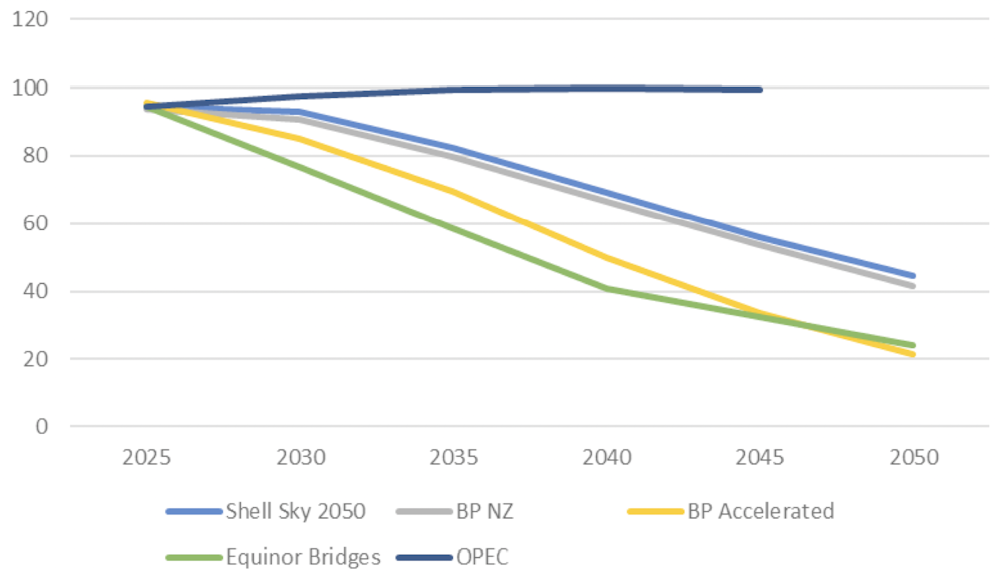
Graph showing the required production cuts to meet net zero
I left the IEA’s scenario off the graph because it published so few datapoints, but it is broadly in line with the others. Meanwhile, the Opec data is for reference and not a net zero scenario.
BP, Shell, Equinor and Opec

Instead of criticising efforts to slow climate change and sponsoring ridiculous reports calling for more fossil fuels, the oil industry should eliminate leakages, venting and flaring of methane, and electrify as many processes as possible using renewable power. It should also employ carbon capture, usage and storage technologies over the next ten years – yes this will increase the price of fossil fuels, but that is exactly what we need to make clean sources of energy competitive across the board and speed up the energy transition.

The sooner the industry starts facing up to the realities of climate change, the more chance it has to survive. The companies and even countries that produce fossil fuels will have to face and pay the cost for the damage they cause. Those costs are already massive and will grow. Those that survive will do so only as a provider of clean and sustainable energy.


Imagine weekly climate newsletter

Don’t have time to read about climate change as much as you’d like?

Get a weekly roundup in your inbox instead. Every Wednesday, The Conversation’s environment editor writes Imagine, a short email that goes a little deeper into just one climate issue. Join the 20,000+ readers who’ve subscribed so far.The Conversation


Adi Imsirovic, Fellow, University of Surrey

This article is republished from The Conversation under a Creative Commons license. Read the original article.
Continue ReadingThe oil industry has succumbed to a dangerous new climate denialism

‘Gleefully Encouraging the Arsonists’: UK Government Commits to More Fossil Fuel Drilling

Spread the love

Original article by JAKE JOHNSON republished from Common Dreams under Creative Commons (CC BY-NC-ND 3.0).

“The U.K. government is blatantly in denial about climate breakdown.”

U.K. Prime Minister Rishi Sunak announced Monday that his government will approve hundreds of new licenses for oil and gas drilling in the North Sea, drawing anger from climate advocates who say he’s doing the bidding of the fossil fuel industry amid a nightmarish wave of extreme weather.

Paying lip service to the nation’s net-zero emissions target, the Tory leader also laid out plans for two new carbon capture and storage facilities in Northeast Scotland and the Humber, lining up behind an oil industry-backed approach to reining in pollution that critics say is a false solution to the global climate crisis.

“Burning oil and gas is driving extreme weather and killing people on every continent, yet Rishi Sunak is gleefully encouraging the arsonists to go and put more fuel on the fire,” said Mary Church, a campaigner with Friends of the Earth Scotland. “By committing to future licensing rounds on the same day, it’s clear to see that carbon capture is little more than a greenwashing tactic by Big Oil to try and keep their climate-wrecking industry in business.”

Major fossil fuel giants such as Shell and BP have maintained oil and gas facilities in the North Sea for years. According to a recent analysis by Greenpeace, oil and gas licenses approved by the U.K. government over the past two years are set to generate as much carbon dioxide as Denmark emits annually—roughly the equivalent of 14 million cars.

“History will view this as an act of gross criminality. Our future sacrificed for the profits of a tiny elite.”

Philip Evans of Greenpeace U.K. said Monday that Sunak’s new announcements are “nothing but a cynical political ploy to sow division, and the climate is collateral damage.”

“Just as wildfires and floods wreck homes and lives around the world, Rishi Sunak’s government has decided to row back on key climate policies, attempted to toxify net zero, and recycled old myths about North Sea drilling,” said Evans. “Relying on fossil fuels is terrible for our energy security, the cost of living, and the climate. Our sky-high bills and recent extreme weather have demonstrated that.”

“Rishi Sunak knows that any oil and gas from the North Sea will just be sold on the international market, making oil companies even richer at the expense of the rest of us. How will this help our bills exactly?” Evans asked, countering the prime minister’s claims that new drilling will enhance the U.K.’s “energy security.”

“If Sunak were serious about boosting our energy security while keeping energy bills down,” Evans continued, “he’d remove the absurd barriers holding back cheap, homegrown renewables and launch a nationwide insulation program to tackle energy waste in our homes.”

Nick Dearden, director of the U.K.-based advocacy group Global Justice Now, wrote that “history will view this as an act of gross criminality. Our future sacrificed for the profits of a tiny elite.”

“The talk of securing our independence couldn’t be further from the truth,” Dearden added. “This leaves us on the hook for £billions, even if the next govt rescinds these contracts, as they must, the fossil fuel elite will pocket a fortune at our expense.”

In addition to the new drilling license commitments, the Financial Times reported Sunday that the U.K. government has “made it cheaper for industry to pollute in Britain compared with the E.U. by watering down reforms to the carbon market.”

“The U.K. government is blatantly in denial about climate breakdown,” said Church.

Original article by JAKE JOHNSON republished from Common Dreams under Creative Commons (CC BY-NC-ND 3.0).

Continue Reading‘Gleefully Encouraging the Arsonists’: UK Government Commits to More Fossil Fuel Drilling

‘Devastating’: Right-Wing Swedish Government Shutters Environment Ministry

Spread the love

“It is impossible to describe more clearly how little this government values ​​the environment and the climate,” said the leader of the Swedish Greens.

This image has an empty alt attribute; its file name is jake-johnson-200x200.jpg

JAKE JOHNSONOctober 19, 2022

In one of its first moves after taking power Tuesday, Sweden’s newly elected right-wing government scrapped the country’s environment ministry, drawing outrage from opposition lawmakers who say the step threatens to undermine the nation’s chances of meeting its climate targets.

“They don’t care about our common future. Expect huge cuts in green funding.”

Per Bolund, the leader of the Swedish Greens, wrote on social media that the axing of the environment ministry shows “how little this government values ​​the environment and the climate.”

“This is a historic decision with devastating consequences for environmental issues,” Bolund added, noting that Sweden will now be without a separate environment ministry for the first time in five decades.

Pär Holmgren, a Swedish meteorologist and member of the European Parliament, also expressed outrage on Twitter.

Following the change announced by right-wing Prime Minister Ulf Kristersson, new environment minister Romina Pourmokhtari will work under the minister for energy, business, and industry, Ebba Busch.

Busch is the leader of Sweden’s Christian Democrats, part of the right-wing coalition now governing the country after winning a slim majority in September’s elections. The bloc includes the Sweden Democrats, a far-right xenophobic party.

Bloomberg reported Tuesday that “Kristersson’s government is heavily dependent on the nationalist Sweden Democrats, the only party in parliament that doesn’t back the country’s target of having net zero emissions by 2045.”

“The four-party alliance that agreed on forming the new government last week said they would seek to lower fuel prices, partly by reducing the percentage of biofuels that has to be mixed into gas and diesel to the minimum level required by the European Union,” Bloomberg noted. “That would make it more difficult to reach a target of reducing transport emissions by 70% by 2030.”

Kristersson is also pushing for an expansion of nuclear power, aiming to reverse earlier efforts to dismantle the country’s reactors.

The Associated Press reported Tuesday that Kristersson said “Sweden’s goal on electricity production would change from ‘100% renewable’ to ‘100 percent fossil-free,’ which leaves room for nuclear energy.”


Republished from Common Dreams under Creative Commons (CC BY-NC-ND 3.0) licence.

Apologies for bad news Sunday, this blog doesn’t do denial of reality.

Continue Reading‘Devastating’: Right-Wing Swedish Government Shutters Environment Ministry

Earth has lost 28 trillion tonnes of ice in less than 30 years

Spread the love

‘Stunned’ scientists say there is little doubt global heating is to blame for the loss

A total of 28 trillion tonnes of ice have disappeared from the surface of the Earth since 1994. That is stunning conclusion of UK scientists who have analysed satellite surveys of the planet’s poles, mountains and glaciers to measure how much ice coverage lost because of global heating triggered by rising greenhouse gas emissions.

The scientists – based at Leeds and Edinburgh universities and University College London – describe the level of ice loss as “staggering” and warn that their analysis indicates that sea level rises, triggered by melting glaciers and ice sheets, could reach a metre by the end of the century.

“To put that in context, every centimetre of sea level rise means about a million people will be displaced from their low-lying homelands,” said Professor Andy Shepherd, director of Leeds University’s Centre for Polar Observation and Modelling.

The scientists also warn that the melting of ice in these quantities is now seriously reducing the planet’s ability to reflect solar radiation back into space. White ice is disappearing and the dark sea or soil exposed beneath it is absorbing more and more heat, further increasing the warming of the planet.

Greta Thunberg: After two years of school strikes, the world is still in a state of climate crisis denial

Science doesn’t tell anyone what to do, it merely collects and presents verified information. It is up to us to study and connect the dots. When you read the IPCC SR1.5 report and the UNEP production gap report, as well as what leaders have actually signed up for in the Paris agreement, you see that the climate and ecological crisis can no longer be solved within today’s systems. Even a child can see that policies of today don’t add up with the current best available science.

We need to end the ongoing wrecking, exploitation and destruction of our life support systems and move towards a fully decarbonised economy that is centred on the wellbeing of all people, democracy and the natural world.

If we are to have a chance of staying below 1.5C of warming, our emissions need to immediately start reducing rapidly towards zero and then on to negative figures. That’s a fact. And since we don’t have all the technical solutions we need to achieve that, we have to work with what we have at hand today. And this has to include stopping doing certain things. That’s also a fact. However, it’s a fact that most people refuse to accept. Just the thought of being in a crisis that we cannot buy, build or invest our way out of seems to create some kind of collective mental short circuit.

This mix of ignorance, denial and unawareness is at the very heart of the problem. As it is now, we can have as many meetings and climate conferences as we want. They will not lead to sufficient changes, because the willingness to act and the level of awareness needed are still nowhere in sight. The only way forward is for society to start treating the crisis like a crisis.

Continue ReadingEarth has lost 28 trillion tonnes of ice in less than 30 years