Seven Labour MPs have had the whip suspended for six months after voting against the government on an amendment to scrap the two-child benefit cap.
Ex-shadow chancellor John McDonnell was among the Labour MPs who voted for an SNP motion calling for an end to the policy, which prevents almost all parents from claiming Universal Credit or child tax credit for more than two children.
Mr McDonnell backed the SNP motion alongside Richard Burgon, Ian Byrne, Rebecca Long-Bailey, Imran Hussain, Apsana Begum and Zarah Sultana.
MPs rejected the SNP amendment by 363 votes to 103, in the first major test of the new Labour government’s authority.
Losing the whip means the MPs are suspended from the parliamentary party and will now sit as independent MPs.
Nearly all of the rebels were allies of the former Labour leader Jeremy Corbyn, who now sits as an independent MP and put his name to the SNP motion.
In a statement on social media, Ms Sultana said she would “always stand up for the most vulnerable in our society”, adding that scrapping the cap would “lift 33,000 children out of poverty”.
The new Labour government has promised an ‘ambitious plan’ to end child poverty, but it is yet to commit to ending the two-child limit
The new Labour government has launched a taskforce to work towards ending child poverty, but charities have warned that “good intentions are not enough” as they ramp up calls for the two-child benefit cap to be scrapped.
Keir Starmer’s party has promised an “ambitious” plan for ending child poverty, but it has so far refused to commit to removing the two-child limit, which is also referred to as the two-child benefit cap and has been described as “one of the cruellest welfare policies of the past decade”.
It means that families who have a third child or subsequent children born after April 2017 are denied up to £3,500 a year compared with those whose children were born sooner.
…
Alison Garnham, chief executive of Child Poverty Action Group, said: “The taskforce is a welcome first step towards fulfilling the government’s pledge to bring in an ambitious child poverty strategy.
“But with a record number of kids in poverty now, scrapping the two-child limit on benefits has to happen in the government’s first budget. The two-child limit is driving up child poverty more than any other policy, children need it to be removed as a priority.”
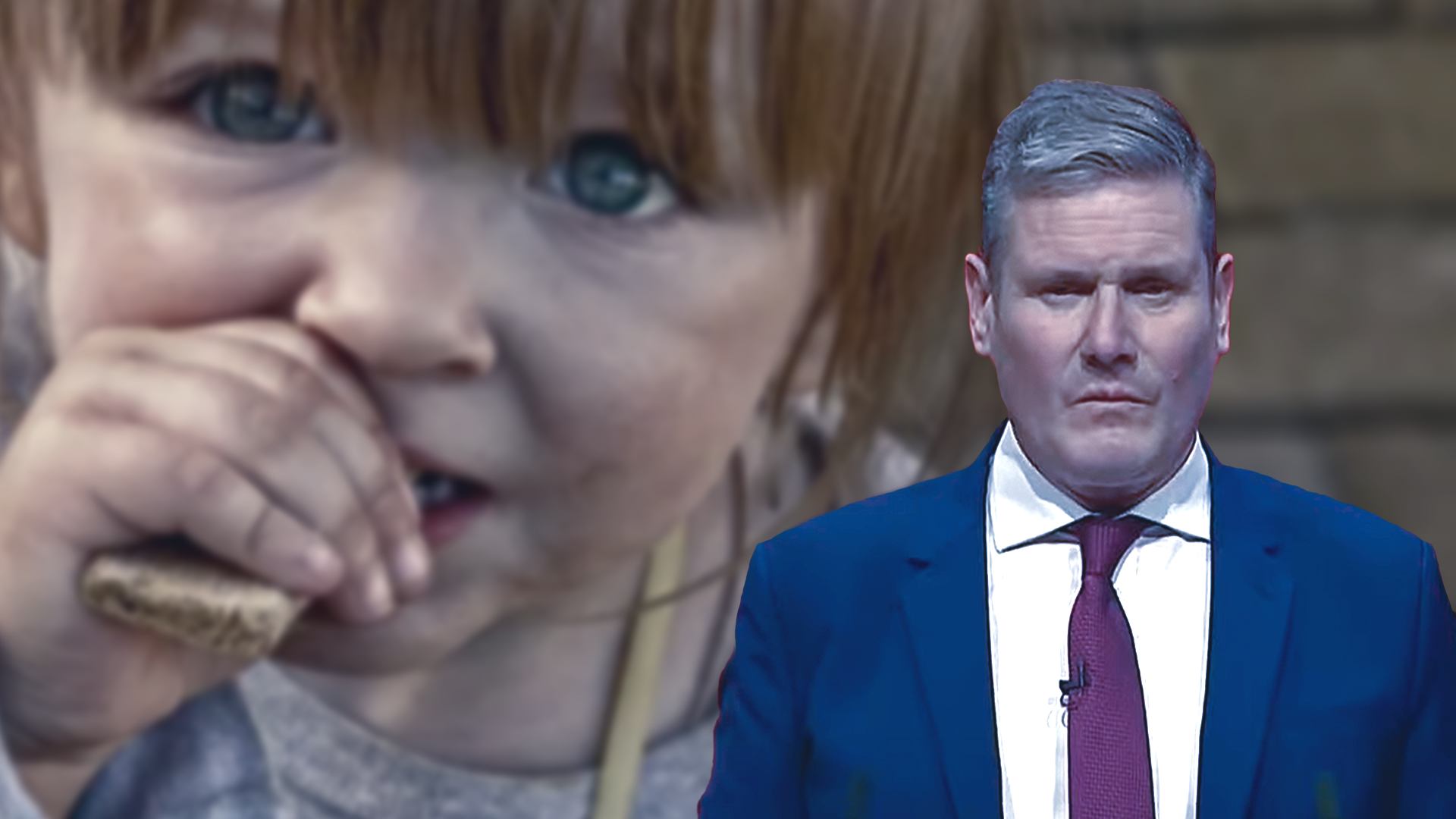
Zionist Keir ‘Kid Starver’ Starmer. Image thanks to The Skwawkbox.
Capital Gains Tax is paid at a lower rate than Income Tax so that unearned income is taxed less than earned income: rich people who don’t even have to watch it coming in are taxed less than the hard-working families that we hear so much about. The Green Party argues that hundreds of thousands of children can be lifted out of poverty if Labour committed to equalising capital gains tax to pay to scrap the two-child benefit cap. The four newly elected Green MPs, will be proposing a reasoned amendment to the King’s Speech that includes the scrapping of the two-child benefit.
The IFS estimates that the cap will impact 2.63 million children by the end of this parliament and that scrapping the cap would cost in the region of £3.4billion – before taking into account the wider economic impact of poverty on health and welfare systems. In their recent manifesto, the Green Party estimated that making Capital Gains Tax fairer could raise £16bn, a move that would impact less than 2% of income taxpayers. This £16bn figure is supported by research conducted by Arun Advani, a tax expert at the University of Warwick, who estimated that equalising CGT and income tax rates would raise £16.7bn a year.
Green MPs will today propose an amendment to propose the government scraps the two-child benefit cap. Green Party Co-Leader and Bristol Central MP Carla Denyer, speaking on behalf of the Green group of MPs said
“I think Labour are serious when they say they want to change the country. But the change they are looking to achieve will always be hamstrung for as long as they limit their own potential to raise additional revenue to spend on frontline services. The impact of this approach is already clear. Every day we have children going hungry, unable to concentrate in school or struggling to ascertain even the very basics – this is the real world impact of child poverty. And so today we’re offering Labour a positive fairer taxation that will allow them to redistribute money from some of the wealthiest to some of the very poorest. This is a political choice that they must now make.”
Green Party Work, Employment and Social Security Spokesperson, Prof Catherine Rowett said, “Scrapping the two-child benefit cap is a moral and practical imperative. It is a matter of social, economic and racial justice. Today we have outlined one way that Labour, if they had the political will, could choose to help millions of children. And child poverty blights lives and costs millions, as generations of children are condemned to lower achievement and a lifetime of poor health. When they say there is no money, remember this is a political choice – they’re ignoring the political, social and economic costs of keeping children in poverty.”
PRESSURE piled on Labour to scrap the government’s cruel “sibling penalty” today as campaigners warned it’s set to push the majority of large families below the poverty line by the end of this parliament.
The two-child benefit limit, introduced in 2017, stops parents from claiming universal credit or child tax credit for more than two children.
But figures from the Department for Work and Pensions show 1.6 million children are now affected by the policy, rising by 100,000 in a year.
The Resolution Foundation warned the policy will push most large families below the breadline by the end of the parliament and said abolishing it would lift 490,000 children out of poverty.
Sir Keir Starmer pledged to reduce child poverty at Labour’s manifesto launch, but failed to commit to scrapping the cap.
The cost of living is the most important issue for many voters this election. It’s no surprise why. In 2022, nearly 4 million people in the UK experienced destitution, meaning they could not meet their basic physical needs such as having enough to eat and staying warm.
The UK’s social security system is failing in its core purpose to prevent poverty. And yet the Conservatives have promised more crackdowns on welfare, with the prime minister linking this with his pledge to lower taxes.
When the Conservative-Liberal Democrat coalition government came to power in 2010, they inherited a social security system in radically better shape than it is now. What happened?
Want more election coverage from The Conversation’s academic experts? Over the coming weeks, we’ll bring you informed analysis of developments in the campaign and we’ll fact check the claims being made. Sign up for our new, weekly election newsletter, delivered every Friday throughout the campaign and beyond.
People received working-age benefit payments for different needs: jobseeker’s allowance, income support for single parents and incapacity benefit for long-term illness and disability. Housing benefit went directly to landlords to cover claimants’ rent.
Enter the global financial crisis. The Conservative-led government’s response was austerity cuts: cutting back on welfare to tackle the budget deficit.
Lowering the value of benefits is the biggest austerity cut to have affected incomes. In 2010, the government switched from uprating the value of benefits each year in line with the retail price index to using a different measure of inflation, the consumer price index, instead. This is usually lower and effectively makes payments worth less.
In 2012, the government introduced a new system of tougher rules and sanctions on people receiving benefits. Conservative politicians said this would end “the ‘something for nothing’ culture”, but the change has had lasting negative effects.
Benefit sanctions were always part of the system, but became extreme in 2012. If, for example, someone misses one Jobcentre appointment their benefit could be reduced or removed for 28 days.
Many people receiving benefits have been penalised with sanctions. Bricolage/Shutterstock
Other cuts to incomes followed the Welfare Reform Act 2012. The “bedroom tax” penalised social housing tenants who had “extra” bedrooms. The idea was to reduce renters’ housing benefit so they would downsize to a smaller home. However long-term housing shortages mean that smaller properties are rarely available.
In 2013, the household benefit cap was introduced to limit the maximum amount a family could receive in benefits payments. It had the most impact on families with children and those with high rents.
Universal credit
Universal credit, introduced in 2013, was billed as the biggest shake-up of benefits in 70 years. It promised to make work pay and simplify the system. It replaced separate tax credit, unemployment, lone parent, disability and housing payments with a single payment.
Research from think tank the Resolution Foundation suggests that universal credit provides more support for working people who rent their homes than the previous system. But disabled people who cannot work are likely to be much worse off than under the old system.
There are other problems with universal credit. Unlike under the previous system that gave housing benefit straight to landlords, claimants have to pay their rent from a pot of money provided by the government that is almost certainly too small to cover all their costs.
The first universal credit payment takes around five weeks to arrive, meaning people may fall into rent arrears. A result is that some landlords take legal action to evict those receiving universal credit.
The two-child limit was applied to tax credits and universal credit in 2017 to remove income for third or subsequent children. Large families faced increased poverty as a result.
In 2020, the pandemic hit. Universal credit and tax credits were raised by £20 per week, but this ended in late 2021. The cost of living crisis has since widened the gap between benefits and prices.
Today, the value of universal credit falls £890 per month short of the cost of living for single people over 25. This is because of the changes to uprating and the benefit freeze.
In Feburary 2024, charity the Trussell Trust published research showing that over half of people on universal credit had run out of money for food in the previous month.
What can the next government do?
The next UK government must make emergency repairs to social security to halt harrowing declines in health and lifeexpectancy. This should ensure a minimum acceptable standard of living, including restoring the value of benefits such as universal credit to cover the costs of living.
Since 71% of children living in poverty are in working families, employers should be required to pay the real living wage. In-work universal credit also needs to top up wages enough to make work pay.
Repairing the social safety net is an enormous challenge, but public support for it has been on the rise for years. In 2010, many people thought benefit claimants didn’t deserve any help. But from 2015 there has been a growing preference to help people receiving benefits.