In response to COP28 President Al Jaber’s science-denying comments at the She Changes Climate Event, as reported by The Guardian, Romain Ioualalen, Oil Change International’s Global Policy lead, said:
“COP28 President Al Jaber’s science-denying statements are alarming and raise deep concerns about the Presidency’s capacity to lead the UN climate talks, at a time when leadership and a clear vision are most needed. Of course, denying science has been part of the fossil fuel industry’s playbook for decades. But science is not up for debate: we must phase out fossil fuels to have a livable planet.
“The science is clear. Not only do fossil fuels need to be phased out, but the phaseout needs to start now. The latest reports from the IEA and the IPCC show that maintaining a 50% chance of limiting global warming to 1.5°C requires an immediate end to investments in new oil, gas, and coal production and hazardous liquid fossil gas infrastructure.
“Instead of casting doubt on climate science, we expect the COP28 president to facilitate an outcome on a full, fast, fair, and funded phaseout of fossil fuels at COP28. Over 100 countries have now called for a phase out of fossil fuels and science is clear that limiting warming to 1.5°C without relying massively on dangerous technological distractions such as CCS requires eliminating fossil fuels from the global economy.”
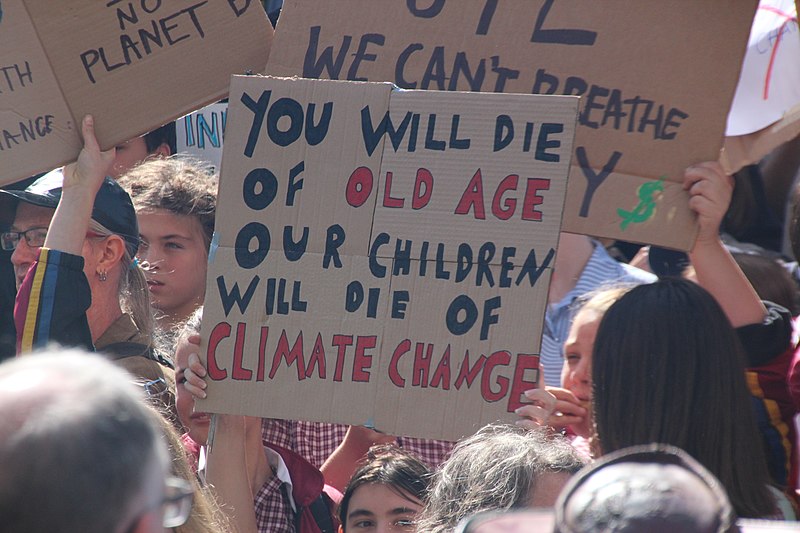
Craig Bennett says the way recent and current older generations have allowed environmental degradation will be viewed harshly by people in the future who will have to live with consequences that, in many cases, will be increasingly devastating. Image: A1Cafel Creative Commons Attribution-Share Alike 2.0 Generic via wikimedia.
The buildings and steaming cooling towers of a coal-fired power plant behind a landscape park in Germany. Frank Bienewald / LightRocket via Getty Images
… Carbon offsets are in theory a way to cancel out greenhouse gas emissions by funding an activity that will remove a supposedly equal amount of carbon dioxide from the atmosphere or prevent an equal amount of carbon pollution. They can be purchased by everyone from major companies pursuing net-zero emissions goals to individuals looking to compensate for high-carbon activities like flying. Typically, an institution or individual will purchase a certain amount of carbon credits, with one credit usually standing in for one metric ton of carbon dioxide — or what is typically emitted by driving 2,513 miles in a gas car — removed from the atmosphere. (That’s roughly the distance between San Francisco and Atlanta). Whoever buys the carbon credit is essentially buying the right to count the emissions reduction as theirs even if it’s being performed by a tree-planting or renewable energy project on the other side of the globe.
…
Quick Facts
One carbon credit usually equals one metric ton of carbon dioxide supposedly removed from the atmosphere, or the equivalent of driving 2,513 miles in a gas-powered car.
The voluntary carbon market quadrupled in value between 2020 and 2021 to reach nearly $2 billion.
The average tree absorbs 20 pounds of carbon dioxide each year during the first 20 years of its life.
Only four percent of carbon offset projects actively remove carbon dioxide from the atmosphere, as opposed to preventing additional emissions.
More than 170 climate, environmental and Indigenous rights groups signed an open letter opposing carbon offsets.
At least 52 percent of carbon-offset generating wind projects in India would have been built anyway.
California’s forest carbon offsets program likely overestimated its emissions reductions by at least 80 percent.
A Ryanair program to offer passengers €1 carbon offsets only actually offset the company’s emissions by 0.01 percent.
Sixty-six percent of highly-polluting companies studied relied on carbon offsets to meet their net zero targets.
There are only around 500 million hectares of land available for tree-planting carbon offset projects and Shell wants to claim 10 percent of it.
…
They’re a Scam: One of the main criticisms of carbon offsets is that many projects don’t really do what they say they are going to do, namely, prevent additional emissions. A major ProPublica report published in 2019 reviewed 20 years of forest-preservation-based offset projects and found that “In case after case […] carbon credits hadn’t offset the amount of pollution they were supposed to, or they had brought gains that were quickly reversed or that couldn’t be accurately measured to begin with.” A 2021 study of wind farms in India found that at least 52 percent of the projects used to back offsets would have been constructed regardless and that therefore the selling of the offsets to polluting industries actually increased emissions. Two studies of California’s forest carbon offsets program found that it overestimated its emissions reductions by at least 80 percent. The dubious nature of many carbon-offset projects leads to charges of greenwashing, because fossil fuel or airline companies can use their purchasing of offsets to market themselves as being more sustainable than they really are. For example, a Ryanair program to charge its customers €1 to offset their flight only lowered the company’s emissions by 0.01 percent.
…
They’re a Distraction From Reducing Emissions: Even if every carbon offset project worked exactly as advertised, however, it wouldn’t be an effective tool for fighting climate change. That’s because the climate crisis is caused by pumping greenhouse gas emissions into the atmosphere and will only be halted if emissions actually stop as well. Yet a 2021 study looking at net-zero pledges from the sectors responsible for 64 percent of greenhouse gas emissions found that 66 percent of them relied on carbon offsets. Oil, gas and mining companies were especially dependent on offsets for their net zero plans.
…
What everyone in the climate space can agree on is that the emphasis needs to move away from purchasing offsets and towards actually reducing fossil fuel emissions. At their best, offsets could be a stop-gap measure to fund beneficial projects and counteract emissions that there is not yet a technologically feasible way to reduce directly. At their worst, carbon offsets risk giving polluters an easy way to greenwash their image while continuing business as usual, actually increasing emissions through miscounting and reproducing the injustices underlying the climate crisis. Given that the current system tips more towards the latter than the former, it’s important for governments, companies and individuals to focus on not putting greenhouse gas emissions in the atmosphere in the first place.