This work by Middle East Monitor is licensed under a Creative Commons Attribution-NonCommercial-ShareAlike 4.0 International License.
A billboard in Times Square calls for the release of the Epstein files on July 23, 2025 in New York City. [Adam Gray/Getty Images]
US Rep. Marjorie Taylor Greene said on Sunday that a foreign government may be pressuring President Donald Trump to keep Jeffrey Epstein files hidden, specifically questioning Israel’s potential involvement with the late sex offender, Anadolu reports.
“I think the question that many Americans are asking” is whether Epstein was working for Israel, Greene told CNN, citing emails released by the House Oversight Committee showing his ties to former Israeli Prime Minister Ehud Barak.
“We saw him making business deals with them, also business deals that involved the Israeli government and seems to have led into their intel agencies,” the Georgia Republican said.
Asked if she was accusing Israel of pushing Trump to cover up the files, Greene said she was questioning “any foreign government” but confirmed Israel “in particular.”
Greene, a longtime loyalist, has criticized the president and her party’s leadership in recent weeks.
Greene said her conflict with Trump stems entirely from her push for Epstein file transparency.
“Unfortunately, it has all come down to the Epstein files, and that is shocking,” she said, adding Trump’s remarks have been “hurtful,” particularly calling her a “traitor.”
“Those are the types of words used that can radicalize people against me and put my life in danger,” Greene said.
“I believe the country deserves transparency in these files,” she said.
Greene denied Trump’s assertion that she criticized him because he discouraged her from running for Senate or Georgia governor.
“That is absolutely not true. Actually, I never had a conversation at all with the president about running for Senate or running for Georgia,” she said, adding she decided independently not to pursue those positions.
Greene said she hopes for reconciliation with Trump. “I certainly hope that we can make up,” she said, noting she speaks for her side.
Trump on Friday officially withdrew his endorsement of Greene, calling her “wacky” and a “Republican in name only (RINO)” on social media after she joined a bipartisan petition to compel the Justice Department to release remaining Epstein files.
He said he would support any challenger who wants to take Greene’s seat in Georgia in the 2026 midterms.
Trump has dismissed the Epstein files issue as a “hoax” concocted by Democrats, while the White House worked to prevent a House vote demanding full file release.
This work by Middle East Monitor is licensed under a Creative Commons Attribution-NonCommercial-ShareAlike 4.0 International License.
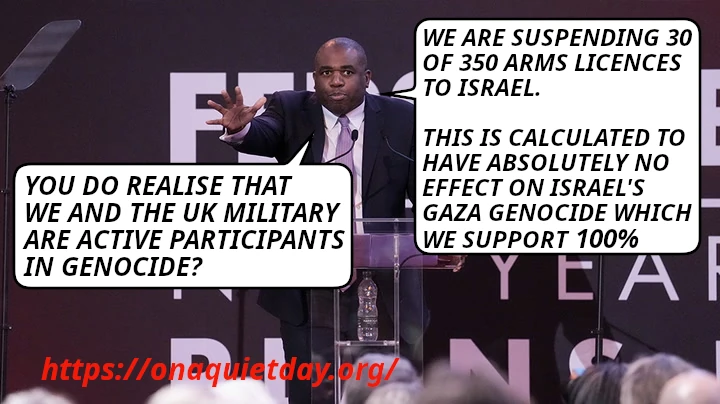
Keir Starmer objects to criticism of the IDF. He asks how could anyone object to them starving people to death, forced marches like the Nazis did, bombing Gaza’s hospitals and universities, mass-murdering journalists, healthworkers and starving people queuing for food, killing and raping prisoners and murdering children. He calls for people to stop obstructing his genocide for Israel.Orcas discuss Genocide-supporting and complicit Zionists. Donald Trump, Keith Starmer, David Lammy, Rachel Reeves, Angela Rayner and Wes Streeting are acknowledged as evil genocide-complicit and supporting cnuts.Genocide denying UK Foreign Secretary David Lammy says that UK is suspending 30 of 350 arms licences to Israel. He also confirms the UK government’s support for Israel’s Gaza genocide and the UK government and military’s active participation in genocide.
This work by Middle East Monitor is licensed under a Creative Commons Attribution-NonCommercial-ShareAlike 4.0 International License.
US Special Envoy for Syria, Tom Barrack in Damascus, Syria on September 16, 2025. [ Izz Aldien Alqasem – Anadolu Agency]
The Middle East is once again standing at the lip of an abyss. Hezbollah refuses to disarm. Israel vows it will force the issue. Washington, amplifying its threats through its envoy Tom Barrack, has delivered an ultimatum that sounds less like diplomacy and more like a loaded gun placed on the negotiating table. But beneath this geopolitical standoff lies another implosion—moral, not military: the sanctimonious unravelling of Tom Barrack himself, whose name now flickers through the sprawling Epstein files. In a region accustomed to hypocrisy, this one still manages to astound.
Hezbollah’s defiance, Israel’s fury
Barrack’s warning in Beirut was unambiguous: Hezbollah must surrender its weapons before the year’s end or “Israel will do it for them.” It was a performance of righteous American certitude—stern, paternal, condescending. Hezbollah’s answer was not diplomatic. Secretary-General Naim Qassem declared, “No force on earth can compel us to disarm. Resistance is our identity.”
Israel, meanwhile, continues pounding Hezbollah’s infrastructure, assassinating field commanders, striking convoys, and hitting southern Lebanon night after night. Yet military analysts admit what Israeli officials avoid saying publicly: Hezbollah’s arsenal remains formidable. Chatham House scholar Dr Lina Khatib noted, “Hezbollah has been weakened but not disarmed… the language of war is drowning out the language of diplomacy.”
And hovering behind it all is a grim warning from the Pentagon: a strike on Hezbollah could ignite a confrontation with Iran, pulling the United States into a regional inferno. “This would not be a contained war,” one US defence official cautioned.
The sanctimony of Tom Barrack
Then came the revelation that detonated whatever moral leverage Washington thought it possessed. Tom Barrack—lecturer-in-chief, dispenser of ethical sermons, the envoy who scolded Lebanese journalists to “behave properly and not like animals”—is now himself a featured name in the Epstein files. Newly surfaced emails show exchanges between Barrack and Epstein, including one chilling note from Epstein: “Send photos of you and child. Make me smile.”
The reaction across the Arab press was immediate and brutal. Lebanese columnist Ibrahim al-Amin wrote that Barrack “preached morality while lecturing us, yet his own name is tied to Epstein. He is the laughingstock of the region.” Egyptian political scientist Hassan Nafaa added, “American envoys demand accountability from Arabs, yet their own hands are stained. Barrack’s hypocrisy is a mirror of Western double standards.”
American outlets echoed the outrage. The New Arab reported the email trove “raised serious questions about the relationship between sex offender Jeffrey Epstein and ambassador Tom Barrack.” Newsweek and the New Republic detailed the widening circle of embarrassment. A Washington Post columnist summarised the mood: “Barrack’s sanctimony collapses under the weight of his own associations.”
This is the empire’s inevitable collapse into self-mythology. Those who thunder about order and virtue abroad often rot from within.
Barrack’s disgrace is not a footnote. It is a strategic wound. The United States cannot demand the disarmament of Hezbollah while its envoy is tainted by the shadow of a dead paedophile financier. It cannot preach morality while its representative embodies the very decadence it condemns. It cannot claim the ethical high ground while standing next to a man whose credibility is now radioactive.
“It compromises the entire American position,” Lebanese scholar Karim Makdisi said. “Hezbollah will use this hypocrisy as a weapon in the battle for legitimacy.”
He is already being proven right. Hezbollah’s media machine is having a field day: the saintly American envoy caught in the filth of Epstein’s orbit, lecturing Arabs on ethics while stumbling through his own mire.
Even inside Washington, the calls for resignation are growing louder. “His presence is untenable,” a congressional aide admitted. “How can he lecture Lebanon on morality when his own name is in Epstein’s files?”
A region on the Brink
All of this unfolds as Lebanon teeters on the brink of paralysis and implosion. The country cannot disarm Hezbollah without triggering civil war. Israel cannot tolerate Hezbollah’s arsenal without courting disaster. The United States cannot project moral authority with a tainted envoy. And the Arab world—long sceptical—now watches the hypocrisy made plain.
Tom Barrack once enjoyed the luxury of preaching from a mountaintop. Now the ground has collapsed beneath him. His sanctimony is rubble. His authority is ash. His presence mocks the very values he claimed to defend.
December may yet bring war. But humiliation has already arrived. Tom Barrack, once Washington’s holier-than-thou emissary, is now its hollow man—a symbol of imperial hypocrisy, a cautionary tale of moral decay, and a reminder that those who wield righteousness as a weapon must ensure their own hands are clean.
He did not. And the region, already aflame, sees it clearly.
The views expressed in this article belong to the author and do not necessarily reflect the editorial policy of Middle East Monitor.
This work by Middle East Monitor is licensed under a Creative Commons Attribution-NonCommercial-ShareAlike 4.0 International License.
Keir Starmer objects to criticism of the IDF. He asks how could anyone object to them starving people to death, forced marches like the Nazis did, bombing Gaza’s hospitals and universities, mass-murdering journalists, healthworkers and starving people queuing for food, killing and raping prisoners and murdering children. He calls for people to stop obstructing his genocide for Israel.Orcas discuss Genocide-supporting and complicit Zionists. Donald Trump, Keith Starmer, David Lammy, Rachel Reeves, Angela Rayner and Wes Streeting are acknowledged as evil genocide-complicit and supporting cnuts.Genocide denying UK Foreign Secretary David Lammy says that UK is suspending 30 of 350 arms licences to Israel. He also confirms the UK government’s support for Israel’s Gaza genocide and the UK government and military’s active participation in genocide.
This work by Middle East Monitor is licensed under a Creative Commons Attribution-NonCommercial-ShareAlike 4.0 International License.
Israeli army tanks leave the area after they caused damage to civilian areas in four towns of Quneitra province in the Golan Heights, following the fall of the Baath regime in Syria on January 8, 2025. [Melik Ebu Ubeyde – Anadolu Agency]
Five Israeli military vehicles infiltrated a village in the Quneitra countryside of southwestern Syria on Sunday, in the latest violation of the country’s sovereignty, Anadolu reports.
An Israeli force of five military vehicles moved into the town of Saida al-Golan in southern Quneitra early morning, before pulling back afterwards, the state-run Syrian Arab News Agency (SANA) reported.
Israeli forces also raided the outskirts of Ma’riya village, west of Daraa province, the outlet said.
Israeli incursions in Quneitra have recently intensified, with locals complaining of Tel Aviv’s advances into their farmland as well as the destruction of hundreds of acres of forests, arrests of residents, and the establishment of military checkpoints.
According to government data, the Israeli army had carried out over 1,000 airstrikes on Syria and more than 400 cross-border raids into the southern provinces since December 2024.
After the fall of the Bashar al-Assad regime in late 2024, Israel expanded its occupation of the Syrian Golan Heights by seizing the demilitarised buffer zone, a move that violated the 1974 Disengagement Agreement with Syria.
This work by Middle East Monitor is licensed under a Creative Commons Attribution-NonCommercial-ShareAlike 4.0 International License.
Keir Starmer objects to criticism of the IDF. He asks how could anyone object to them starving people to death, forced marches like the Nazis did, bombing Gaza’s hospitals and universities, mass-murdering journalists, healthworkers and starving people queuing for food, killing and raping prisoners and murdering children. He calls for people to stop obstructing his genocide for Israel.Orcas discuss Genocide-supporting and complicit Zionists. Donald Trump, Keith Starmer, David Lammy, Rachel Reeves, Angela Rayner and Wes Streeting are acknowledged as evil genocide-complicit and supporting cnuts.Genocide denying UK Foreign Secretary David Lammy says that UK is suspending 30 of 350 arms licences to Israel. He also confirms the UK government’s support for Israel’s Gaza genocide and the UK government and military’s active participation in genocide.
This work by Middle East Monitor is licensed under a Creative Commons Attribution-NonCommercial-ShareAlike 4.0 International License.
Civil defense and Red Cross teams are seen during the burial of 30 Palestinians whose bodies were handed over by Israel under the ceasefire agreement, in Deir al-Balah, Gaza, on November 14, 2025. [Mohammed Nassar – Anadolu Agency]
In light of Israel’s continued return of hundreds of Palestinian bodies who were killed under torture, blindfolded, restrained, bearing marks of abuse and fatal gunshots, many of them so mutilated that they were interred as unidentified, it has become essential to reopen the file of mass abductions, torture, and extrajudicial killings targeting Palestinians from Gaza. The scale and gravity of these violations require immediate investigation through all available legal, diplomatic, and humanitarian avenues to safeguard the tens of thousands whose fate remains unknown.
The disturbing images of Palestinian prisoners of war tortured to death were not the only scenes to shake Palestinians. Equally horrifying were the testimonies of civilian hostages recently released by Israeli authorities after establishing that they bore no affiliation to Palestinian resistance groups. These civilians describe harrowing abuse, severe torture, degrading treatment, humiliation, and assaults that violate their dignity, humanity, and personal honor, violations rendered even more acute within a conservative cultural context. The methods described reflect an extreme level of brutality, challenging the limits of human comprehension and constituting serious breaches of international humanitarian law.
The British newspaper The Guardian has disclosed the existence of an underground Israeli detention torture facility, while testimonies from civilians recently permitted to return to Gaza revealed the existence of additional similar sites. Israel continues to conceal thousands of civilians and combatants who disappeared from Gaza and its surrounding areas, withholding their identities, actual numbers, location, and fate. According to the International Committee of the Red Cross (ICRC), Israel has denied all requests and blocked all attempts for access to visit them, an alarming sign of the opacity surrounding their safety.
Such practices amount to enforced disappearance and torture of protected persons under international humanitarian law, whether they are prisoners of war captured by Israeli forces during hostilities or civilians seized during the fighting, in occupied territory. These acts fall squarely under the legal framework of the Third and Fourth Geneva Conventions of 1949 and 1977 Additional Protocols, which apply fully in this context, and prohibit such violations unequivocally.
Israel amended its domestic legislation after the 7 October attacks two years ago, to permit the authorities to prolong periods of detention and interrogation prior to judicial review. According to several Israeli attorneys who were granted access to prisons during the most recent hostilities, a significant number of detainees are civilians, and their detention orders are being renewed in short remote video sessions conducted without legal counsel. The process has deepened concerns about arbitrary detention and the erosion of fundamental legal protections, and has raised serious concerns under international human rights and humanitarian law, particularly regarding due process guarantees.
These developments unfold within an Israeli legal system that has long been criticised as discriminatory. Israel systematically refuses to acknowledge the reality of occupying Palestine which widely internationally recognised, affirmed by global courts, international organisations, and the overwhelming majority of states. In 2002, Israel incorporated the category of “unlawful combatant” into its national laws, a designation intended to deny Palestinian resistance fighters, affiliated with armed national liberation movements, the protections afforded the Third Geneva Convention and its First Additional Protocol. This constitutes a unilateral measure that stands in direct violation of Israel’s binding treaty obligations and customary international humanitarian law.
Israel’s confrontation with the Palestinians extends beyond the occupation of their land and the transformation of its demographic and territorial realities. It also encompasses systematic assaults on their humanity and dignity, aiming to erode the integrity of the Palestinian individual, an objective reflected in the aforementioned patterns of abuse. Concurrently, Israel continues its information war as well, reshaping facts and broadcasting them to the world through the lens of its own narrative, and on its own terms. Much of the Western world, particularly the United States, has consciously adopted this narrative and its accompanying terminology.
Israel characterises Israelis held in Gaza, whether civilian or military personnel, though most are military due to universal conscription, as “hostages,” a designation intended to elicit humanising sympathy. By contrast, Israeli authorities officially classify Palestinians, whether civilians or combatants, as “detainees” or “security prisoners,” depriving them of the protections guaranteed under international law and diminishing the global empathy with their situation
It’s understandable that Israeli media and even domestic human rights organisations employ Israel’s official terminology, when addressing captivity, detention, and abduction in the recent conflict, and this is nothing new , but what is not understandable is the alignment of Western, particularly American, media with these classifications.
An examination of coverage in prominent American newspapers reveals a consistent adherence to Israeli terminology. The term “hostage” is reserved exclusively for Israelis held in Gaza. Conversely, referring to Palestinian fighters as “prisoners of war”, a term recognised under international humanitarian law, is effectively forbidden from the discourse. Even the legally precise term “arbitrary detention,” applicable to civilians held without due process, is seldom used. Instead, Palestinians are routinely described as detainees, prisoners, or even “terrorists,”reinforcing a narrative that strips them of legal protections and public sympathy, and reflecting a broader linguistic asymmetry that shapes public perception.
The discrimination in US media coverage extended beyond terminology to both the scale and nature of reporting. Even the most liberal American outlets, those generally viewed as more sympathetic to Palestinians, dedicated two-thirds more coverage to Israelis held in Gaza than to Palestinian prisoners of war or civilians detained arbitrarily. In publications more explicitly aligned with Israeli perspectives, such as The New York Times, this gap rose to nearly 90 per cent.
Regarding the qualitative dimension of reporting, much of the US press adopted a highly individualised and humanised narrative when covering Israeli captives with intimate, personal stories designed to draw sympathy. Meanwhile, when addressing Palestinian prisoners of war or civilians detained arbitrarily, whether tortured or killed, coverage tended to be brief, impersonal, and collective, emphasising raw statistics and summary figures derived from UN or human rights reports rather than individual human experiences. The individuals themselves, and the human cost of their suffering, were largely absent from the narrative.
In sum, the conflict between Palestinians and Israelis continues unabated, and the contest over terminology is an integral component of its broader dynamics, impossible to ignore, and difficult to separate from the wider conflict. For Palestinians, political objectives shape terminology just as much as legal definitions do, and political imperatives have to influence the language used to describe their reality, alongside the legal classifications embedded in international humanitarian and human rights law. In this context, establishing clear and consistent terminology has become essential to navigating a fight for survival. Equally imperative is the systematic documentation and disclosure of the grave violations committed against Palestinian prisoners of war and civilians detained arbitrarily, or the Palestinians kidnapped and forcibly disappeared. Exposing the crimes committed against them is no longer optional, it is an obligation that is both national responsibility and ethical duty.
The views expressed in this article belong to the author and do not necessarily reflect the editorial policy of Middle East Monitor.
This work by Middle East Monitor is licensed under a Creative Commons Attribution-NonCommercial-ShareAlike 4.0 International License.
Genocide denier and Current UK Prime Minister Keir Starmer is quoted that he supports Zionism without qualification. He also confirms that UK air force support has been essential in Israel’s mass-murdering genocide. Includes URLs https://www.declassifieduk.org/keir-starmers-100-spy-flights-over-gaza-in-support-of-israel/ and https://youtu.be/O74hZCKKdpAKeir Starmer objects to criticism of the IDF. He asks how could anyone object to them starving people to death, forced marches like the Nazis did, bombing Gaza’s hospitals and universities, mass-murdering journalists, healthworkers and starving people queuing for food, killing and raping prisoners and murdering children. He calls for people to stop obstructing his genocide for Israel.Orcas discuss Genocide-supporting and complicit Zionists. Donald Trump, Keith Starmer, David Lammy, Rachel Reeves, Angela Rayner and Wes Streeting are acknowledged as evil genocide-complicit and supporting cnuts.
This work by Middle East Monitor is licensed under a Creative Commons Attribution-NonCommercial-ShareAlike 4.0 International License.
Photos of Palestinian children in Gaza are exhibited outside German parliament (Bundestag) in Berlin on July 09, 2025. [Halil Sağırkaya – Anadolu Agency]
Germany’s opposition party The Left on Saturday called for an end to what it views as a crackdown against pro-Palestinian solidarity movements in the country, Anadolu reports.
“The repression against pro-Palestinian movements must end. Palestinian self-determination can only go hand in hand with Jewish self-determination in Israel and Palestine, and vice versa,” said Left party chairwoman Ines Schwerdtner at a state party congress in Berlin.
Schwerdnter also called on her party to stand up for the Palestinian cause.
Last month, UN experts expressed concern over Germany’s policing of pro-Palestine demonstrations and “suppression” of Palestine solidarity activism, which they said has become increasingly restrictive since October 2023.
They observed that, despite the peaceful nature of most pro-Palestine demonstrations, Germany has been “criminalising, punishing, and suppressing legitimate Palestinian solidarity activism.”
The experts noted that protesters’ demands have been “legitimate,” including calls for “halting arms exports to Israel, ending the genocide and the Israeli illegal occupation, ensuring humanitarian aid access to Gaza, the recognition of the State of Palestine, and accountability” for international crimes.
This work by Middle East Monitor is licensed under a Creative Commons Attribution-NonCommercial-ShareAlike 4.0 International License.
Genocide denier and Current UK Prime Minister Keir Starmer is quoted that he supports Zionism without qualification. He also confirms that UK air force support has been essential in Israel’s mass-murdering genocide. Includes URLs https://www.declassifieduk.org/keir-starmers-100-spy-flights-over-gaza-in-support-of-israel/ and https://youtu.be/O74hZCKKdpAKeir Starmer objects to criticism of the IDF. He asks how could anyone object to them starving people to death, forced marches like the Nazis did, bombing Gaza’s hospitals and universities, mass-murdering journalists, healthworkers and starving people queuing for food, killing and raping prisoners and murdering children. He calls for people to stop obstructing his genocide for Israel.Orcas discuss Genocide-supporting and complicit Zionists. Donald Trump, Keith Starmer, David Lammy, Rachel Reeves, Angela Rayner and Wes Streeting are acknowledged as evil genocide-complicit and supporting cnuts.