This work by Middle East Monitor is licensed under a Creative Commons Attribution-NonCommercial-ShareAlike 4.0 International License.
Israeli Defence Minister Israel Katz in Washington, United States on July 18, 2025. [Yasin Öztürk – Anadolu Agency]
Israeli Defence Minister Israel Katz declared the border area with Egypt a closed military zone, citing security concerns, local media reported on Thursday, Anadolu reports.
“We are declaring war. Anyone who enters the restricted area will be harmed,” Katz said during a discussion late Wednesday, as cited by the public broadcaster KAN.
Army Radio said the defence minister agreed with the Shin Bet Chief, David Zinni, to classify alleged attempts to smuggle weapons through the border with Egypt as a “terrorist threat” to help the security services “to use appropriate tools to combat it.”
According to Yedioth Ahronoth, the defence minister ordered “to hit any unauthorised entity that infiltrates the forbidden area.”
The daily claimed that the decision came after what it called “massive weapons smuggling operations” along the border.
There was no immediate comment from Egyptian authorities on the Israeli claims.
In recent months, the Israeli army has repeatedly claimed to have thwarted weapon smuggling attempts via drones, without specifying the parties behind these alleged operations.
The Israeli army has killed nearly 69,000 Palestinians and injured over 170,000 others in a brutal offensive in the Gaza Strip since October 2023. The assault came to a halt under a ceasefire agreement that took effect on Oct. 10.
Genocide denier and Current UK Prime Minister Keir Starmer is quoted that he supports Zionism without qualification. He also confirms that UK air force support has been essential in Israel’s mass-murdering genocide. Includes URLs https://www.declassifieduk.org/keir-starmers-100-spy-flights-over-gaza-in-support-of-israel/ and https://youtu.be/O74hZCKKdpAKeir Starmer objects to criticism of the IDF. He asks how could anyone object to them starving people to death, forced marches like the Nazis did, bombing Gaza’s hospitals and universities, mass-murdering journalists, healthworkers and starving people queuing for food, killing and raping prisoners and murdering children. He calls for people to stop obstructing his genocide for Israel.Orcas discuss Genocide-supporting and complicit Zionists. Donald Trump, Keith Starmer, David Lammy, Rachel Reeves, Angela Rayner and Wes Streeting are acknowledged as evil genocide-complicit and supporting cnuts.
This work by Middle East Monitor is licensed under a Creative Commons Attribution-NonCommercial-ShareAlike 4.0 International License.
Hamas’ armed wing, the Izz ad-Din al-Qassam Brigades hold a Palestinian flag as they destroy a tank of Israeli forces in Gaza City, Gaza on October 07, 2023. [Hani Alshaer – Anadolu Agency]
The Arab Book Fair in Istanbul, held in the second week of last August, featured an important new book: “The Dictionary of Resistance: The Al-Aqsa Flood and Its Centrality in the Coming Great Change” by Prof. Dr. Saif al-Din Abdel-Fattah, Professor of Political Theory and Thought at Cairo University.
In this book, Abdel-Fattah closely follows the Al-Aqsa Flood since its outbreak on October 7, 2023. We met the political thinker and discussed with him his vision of the Flood, the role of resistance against the occupation, his interpretation of Palestinian steadfastness, and the regional and global reactions — both popular and official.
We also touched on his expectations for the future of the Palestinian cause in light of the Flood and its repercussions. Below is the full dialogue:
1. Your reading of the Al-Aqsa Flood from the very first day was unique. You even stopped your then-ongoing series of articles titled “Ambiguous Concepts” and immediately began what you called “The Dictionary of Resistance.” Why did you consider this event so early on as worthy of such a shift?
It is important to emphasise that speaking about the Flood has a story. My interest in resistance and its role goes back to an earlier period, when I supervised the distinguished researcher Basheer Abu al-Qaraya’s dissertation entitled “The Intifada Model.” It was a valuable study about resistance when it took the form of an uprising.
So, when the Al-Aqsa Flood erupted on 7 October 2023, it was essential to address this major event. It was not just another incident — I sensed that it would have a tremendous impact and far-reaching echoes. I therefore halted my “Ambiguous Concepts” series and immediately turned to focus on the Flood.
I saw that the continuity of the event and escalation of its effects warranted close monitoring, exploring its different dimensions and perspectives, and reflecting on the idea of resistance and everything tied to it; the Palestinian cause and the state of the Muslim Ummah in light of this Flood.
I regarded the Flood as one of God’s extraordinary days — a day that highlights the methodology of Tawhid (monotheism), its link to the meanings of struggle and resistance, and its potential to build the Ummah and its future. Hence began the important series “The Dictionary of Resistance,” which I started publishing on 13 October 2023.
Political thinker Saif al-Din Abdel-Fattah.
2.When your book was published in August 2025, it carried the subtitle “The Al-Aqsa Flood and Its Centrality in the Coming Great Change.” This phrase has great significance. Could you elaborate on what you mean by this “great change,” and how you see the Flood as central to it?
As mentioned earlier, this matter relates to the value and stature of the event not only historically but also for the future — and its centrality to the great coming change. There are certain catalysts for the Ummah, and one of the most important of them was the Flood.
The Al-Aqsa Flood of 7 October expressed a form of centrality for the Ummah, even if the response was not as strong as hoped. This day’s centrality lay in several things, most importantly that it directly confronted the Zionist entity — one of the greatest acts of resistance and struggle against it.
This confrontation confirmed two important points:
That the ultimate liberation of Jerusalem, Al-Aqsa Mosque, and Palestine is possible.
That this artificial, fragile entity — no matter how strong or arrogant it appears — is inherently vulnerable not only to defeat but to disappearance altogether.
The idea of Israel’s demise is not, as some dismissively say, mere wishful thinking by dreamers in our Arab and Islamic world. Rather, it is being discussed at multiple levels — even among Zionist thinkers themselves and globally. Some now openly speak of foreseeing the end of this fabricated entity. Mass demonstrations worldwide have confirmed the call for the full liberation of Palestine, the return of Palestinians to their land, and for those who occupied it to return to where they came from, since they have no legitimate claim to it.
As for the “great change,” it is inevitable. Catalysts like the Flood — and earlier, the Battle of the Sword of Jerusalem and the stone-throwing Intifadas — are preludes to it. This great change will affect the entire region — the Arab and Muslim world, which has long been fragmented for many reasons.
The time has come to view this change wisely, with balance and determination, and to invest in ensuring it becomes a change for us and not against us. This requires awareness of the divine laws (sunan) governing such transformations. Without that awareness, we cannot manage this coming change.
This transformation will touch all the factors that led to the Ummah’s decline, weakness, and backwardness. It will mark a historical turning point of great importance — raising questions of how, why, and when change should occur, and by what means. The great change is inevitable, and everyone must prepare for it. The Ummah must seize the opportunity of the Flood and others like it to strengthen its unity, collective identity, and effectiveness, and to reclaim its rightful place.
3.You often speak of “comprehensive civilisational resistance.” What do you mean by that, especially in the context of the Al-Aqsa Flood?
Resistance is not limited to weapons and military confrontation. It is a broad, comprehensive concept that encompasses all aspects of life. It includes culture, education, knowledge, economy, media, and values.
When we speak of civilizational resistance, we are talking about a project that mobilizes all resources of the Ummah in confronting oppression, occupation, and colonialism. The Al-Aqsa Flood showed us that true resistance integrates military steadfastness with cultural, intellectual, and spiritual dimensions.
This comprehensive vision of resistance is essential if we want the Flood to lead to lasting change, not just temporary victories.
4. In your writings, you often contrast two concepts: “weakness” and “steadfastness.” How do you see these ideas reflected in the Palestinian experience?
There is a difference between weakness and steadfastness. Weakness means surrender, loss of will, and collapse in the face of aggression. Steadfastness, however, is the ability to persevere, to endure trials, and to transform suffering into strength.
The Palestinians have embodied steadfastness in its most profound sense. Despite siege, displacement, massacres, and continuous war, they have preserved their identity, culture, and will to resist. This is not weakness; it is resilience that inspires the entire Ummah.
The Flood brought this distinction to light once again. It showed that the occupation, despite its weapons and Western support, is fragile, while the steadfastness of the oppressed Palestinians is stronger than the aggressor’s power.
5. Some argue that October 7, 2023, was just a military operation, while you see it as an event of “civilizational meaning.” How do you explain this?
Indeed, the Flood was a military operation in form, but in content it carried civilisational significance. It was not only about breaking through a border or capturing soldiers. It symbolised a confrontation between truth and falsehood, between an oppressed people and an occupying power.
Its meanings extended beyond the battlefield:
– It revived the centrality of Palestine in the global conscience.
– It disrupted the normalisation projects that sought to erase the cause.
– It exposed Western hypocrisy in supporting occupation and covering up genocide.
Thus, the Flood was not a passing military event but a moment that restructured the intellectual, cultural, and moral narrative worldwide.
6. The “normalisation” trend and the Abraham Accords have been heavily debated. How did the Flood affect these projects, in your view?
Normalisation sought to make the occupation a natural, accepted reality — to erase Palestine from memory. The Abraham Accords were presented as if they marked the end of the conflict.
But the Flood came like a thunderbolt that shattered these illusions. It reminded everyone — Arabs, Muslims, and the world — that the occupation is illegitimate and that Palestine remains the central cause.
Many who once promoted normalisation now feel ashamed and silenced. The popular will in the Arab and Muslim worlds, which always rejected normalisation, has found new strength. The Flood restored the cause to its rightful place at the heart of our identity and our future.
7. You emphasise the role of psychological warfare. How do you see this playing out in the context of the Flood and the ongoing war on Gaza?
Psychological warfare is central to this battle. The occupation has long depended on instilling fear, despair, and hopelessness among Palestinians and Arabs. It wants us to believe it is invincible.
But the Flood shattered this image. 7 October showed that the enemy is not invincible, that its security doctrine can be breached, and that its army can be humiliated. This was a massive psychological blow to the Zionist entity and its supporters.
On the other hand, the Palestinians and the wider Ummah gained psychological strength. Hope was revived, faith in resistance renewed, and the certainty that liberation is possible became stronger.
The occupation continues its massacres to try to restore its deterrent image, but even here it is failing — the more it kills, the more it exposes its moral bankruptcy to the world.
8. What about the media dimension? How did the media shape the perception of the Flood and its aftermath?
Media is part of the battlefield. The occupation has global media institutions, Western political cover, and propaganda machinery. But today, alternative media, social media, and citizen journalism have exposed its crimes in real time.
The images from Gaza — the bombed homes, the massacred families, the steadfast children — have reached every corner of the earth. They cannot be hidden anymore.
This has changed global public opinion. For the first time, millions in the West are openly condemning Israel and questioning their governments’ blind support for it. The media war is no longer one-sided; it has become a space of resistance too.
9. In your book you speak of “epistemological frameworks” in reading the Flood. Could you explain what you mean?
Yes. The way we understand events depends on the frameworks of knowledge we use. If we view the Flood through a purely military or political lens, we reduce it to numbers — casualties, rockets, statistics.
But if we adopt a civilisational framework, we see its deeper meanings: the revival of identity, the reaffirmation of the cause, the exposure of global injustice, the awakening of the Ummah.
It is essential to build our own epistemology of resistance, rooted in our values and history, rather than adopting the narrow frameworks imposed by Western media or political elites. Only then can we grasp the true magnitude of the Flood.
10. Some analysts argue that the Flood has isolated Palestinians further. Others say it has revived the cause. Where do you stand?
Without hesitation, I say: the Flood has revived the cause. Palestine today is more central than it has been in decades.
Look at the global demonstrations: in London, New York, Cape Town, Jakarta, Istanbul, and beyond — millions marched for Gaza. Universities witnessed unprecedented solidarity. Even Jewish voices around the world rose to condemn Zionist crimes.
Yes, Western governments continue to support the occupation, but their peoples are shifting. The moral tide is turning. And within the Arab and Muslim worlds, the cause has returned to the center of consciousness, after years of neglect.
So, far from isolating the Palestinians, the Flood has connected them more deeply to global movements for justice and liberation.
11. Looking ahead, what do you foresee for the future of the Palestinian cause after the Flood?
The Flood has already reshaped the landscape. The Palestinian cause has re-emerged as a defining issue — not only regionally but globally.
In the near future, I expect:
– Greater polarisation: between those who stand for justice and liberation and those who support oppression and genocide.
– Deepening crisis for the Zionist entity: militarily, politically, and morally. It will face existential questions more seriously than ever before.
– Strengthened resolve among Palestinians: the conviction that steadfastness and resistance can achieve what negotiations and concessions never could.
In the long run, I believe the Flood will be remembered as the opening chapter of the decline of the occupation and the revival of the Ummah. The road is long, but the direction has been set.
12. What practical lessons should Muslims and pro-Palestinian movements draw from the Flood?
Several key lessons:
Unity of the cause: Palestine must remain central to our identity, politics, and culture. Any attempt to sideline it is betrayal.
Resistance is multidimensional: military struggle is vital, but so is intellectual, cultural, media, and economic resistance.
Steadfastness is power: the Palestinian model shows that endurance and faith can overcome even the most brutal oppression.
Awareness of divine laws (sunan): change comes through struggle, sacrifice, and preparation, not wishful thinking.
Mobilising global solidarity: the Flood proved that millions around the world are ready to oppose injustice — this must be cultivated and organized.
13. Finally, how do you personally sum up the meaning of the Al-Aqsa Flood?
For me, the Flood is one of those historic days in which God grants the oppressed people a victory that transcends the battlefield. It is a day that unmasks falsehood, revives faith, and restores dignity.
It showed us that liberation is not only possible — it is inevitable. The Flood reconnected us to Palestine, to Al-Aqsa, and to our collective destiny.
It is both a test and a promise: a test of our awareness, unity, and action — and a promise that justice will prevail, no matter how long it takes.
This work by Middle East Monitor is licensed under a Creative Commons Attribution-NonCommercial-ShareAlike 4.0 International License.
Genocide denier and Current UK Prime Minister Keir Starmer is quoted that he supports Zionism without qualification. He also confirms that UK air force support has been essential in Israel’s mass-murdering genocide. Includes URLs https://www.declassifieduk.org/keir-starmers-100-spy-flights-over-gaza-in-support-of-israel/ and https://youtu.be/O74hZCKKdpAKeir Starmer objects to criticism of the IDF. He asks how could anyone object to them starving people to death, forced marches like the Nazis did, bombing Gaza’s hospitals and universities, mass-murdering journalists, healthworkers and starving people queuing for food, killing and raping prisoners and murdering children. He calls for people to stop obstructing his genocide for Israel.Orcas discuss Genocide-supporting and complicit Zionists. Donald Trump, Keith Starmer, David Lammy, Rachel Reeves, Angela Rayner and Wes Streeting are acknowledged as evil genocide-complicit and supporting cnuts.
This work by Middle East Monitor is licensed under a Creative Commons Attribution-NonCommercial-ShareAlike 4.0 International License.
Israeli Prime Minister Benjamin Netanyahu speaks during a press conference in Jerusalem on December 9, 2024 [MAYA ALLERUZZO/POOL/AFP via Getty Images]
Israeli Prime Minister Benjamin Netanyahu was re-elected leader of the right-wing Likud Party on Thursday, with the premier nominated as the party’s candidate in the upcoming legislative elections, Anadolu reports.
According to Israeli Channel 14, Netanyahu was re-elected unopposed during a meeting of the party’s Election and Oversight Committee in Tel Aviv.
Under the party’s bylaws, a candidate is automatically elected when only one nomination is submitted, without the need for a vote.
Israel’s upcoming elections are scheduled for Oct. 27, 2026.
Netanyahu has led multiple Israeli governments since first taking office in 1996.
Thursday’s decision signals Netanyahu’s intention to run again despite the ongoing corruption charges against him.
Israeli law does not require him to resign unless convicted by the Supreme Court.
Genocide denier and Current UK Prime Minister Keir Starmer is quoted that he supports Zionism without qualification. He also confirms that UK air force support has been essential in Israel’s mass-murdering genocide. Includes URLs https://www.declassifieduk.org/keir-starmers-100-spy-flights-over-gaza-in-support-of-israel/ and https://youtu.be/O74hZCKKdpAKeir Starmer objects to criticism of the IDF. He asks how could anyone object to them starving people to death, forced marches like the Nazis did, bombing Gaza’s hospitals and universities, mass-murdering journalists, healthworkers and starving people queuing for food, killing and raping prisoners and murdering children. He calls for people to stop obstructing his genocide for Israel.Orcas discuss Genocide-supporting and complicit Zionists. Donald Trump, Keith Starmer, David Lammy, Rachel Reeves, Angela Rayner and Wes Streeting are acknowledged as evil genocide-complicit and supporting cnuts.
This work by Middle East Monitor is licensed under a Creative Commons Attribution-NonCommercial-ShareAlike 4.0 International License.
Smoke billows from the area following Israeli attacks on the town of Tayr Dibba in the southern Lebanese province of Tyre, Lebanon, on November 6, 2025. [Houssam Shbaro – Anadolu Agency]
The Israeli army launched a series of airstrikes in southern Lebanon on Thursday evening, shortly after warning residents to evacuate, despite a ceasefire agreement in place since November 2024, Anadolu reports.
Israeli fighter jets struck a building in Tayr Debba in the Tyre district, and another in Al-Taybeh in the Marjayoun district. Airstrikes also targeted a building in Aita al-Jabal in Bint Jbeil, and another in Zoutar al-Sharqiya in Nabatieh, the Lebanese news agency NNA reported.
No information was yet available about casualties.
Footage obtained by Anadolu and shared on social media showed powerful explosions and rising flames, and smoke following the strikes in the three towns.
According to NNA, Israeli drones flew at very low altitude over the capital, Beirut, and its southern suburbs.
The attacks came after the Israeli army ordered Lebanese residents in the three towns to evacuate before the attacks.
The army claimed that the strikes aimed to thwart Hezbollah’s attempts to rebuild its capabilities in Aita al-Jabal, al-Taybeh, and Tayr Debba.
There was no comment from Hezbollah on the Israeli attacks.
Tensions have been mounting in southern Lebanon for weeks, with the Israeli army intensifying near-daily air raids inside Lebanese territory despite the ceasefire, under the pretext of targeting Hezbollah members and infrastructure.
Israeli Channel 12 reported on Thursday that Tel Aviv is preparing for another possible round of fighting with Hezbollah.
The Israeli army has killed more than 4,000 people and injured nearly 17,000 in its attacks on Lebanon, which began in October 2023 and turned into a full-scale offensive in September 2024.
Genocide denier and Current UK Prime Minister Keir Starmer is quoted that he supports Zionism without qualification. He also confirms that UK air force support has been essential in Israel’s mass-murdering genocide. Includes URLs https://www.declassifieduk.org/keir-starmers-100-spy-flights-over-gaza-in-support-of-israel/ and https://youtu.be/O74hZCKKdpAKeir Starmer objects to criticism of the IDF. He asks how could anyone object to them starving people to death, forced marches like the Nazis did, bombing Gaza’s hospitals and universities, mass-murdering journalists, healthworkers and starving people queuing for food, killing and raping prisoners and murdering children. He calls for people to stop obstructing his genocide for Israel.Orcas discuss Genocide-supporting and complicit Zionists. Donald Trump, Keith Starmer, David Lammy, Rachel Reeves, Angela Rayner and Wes Streeting are acknowledged as evil genocide-complicit and supporting cnuts.
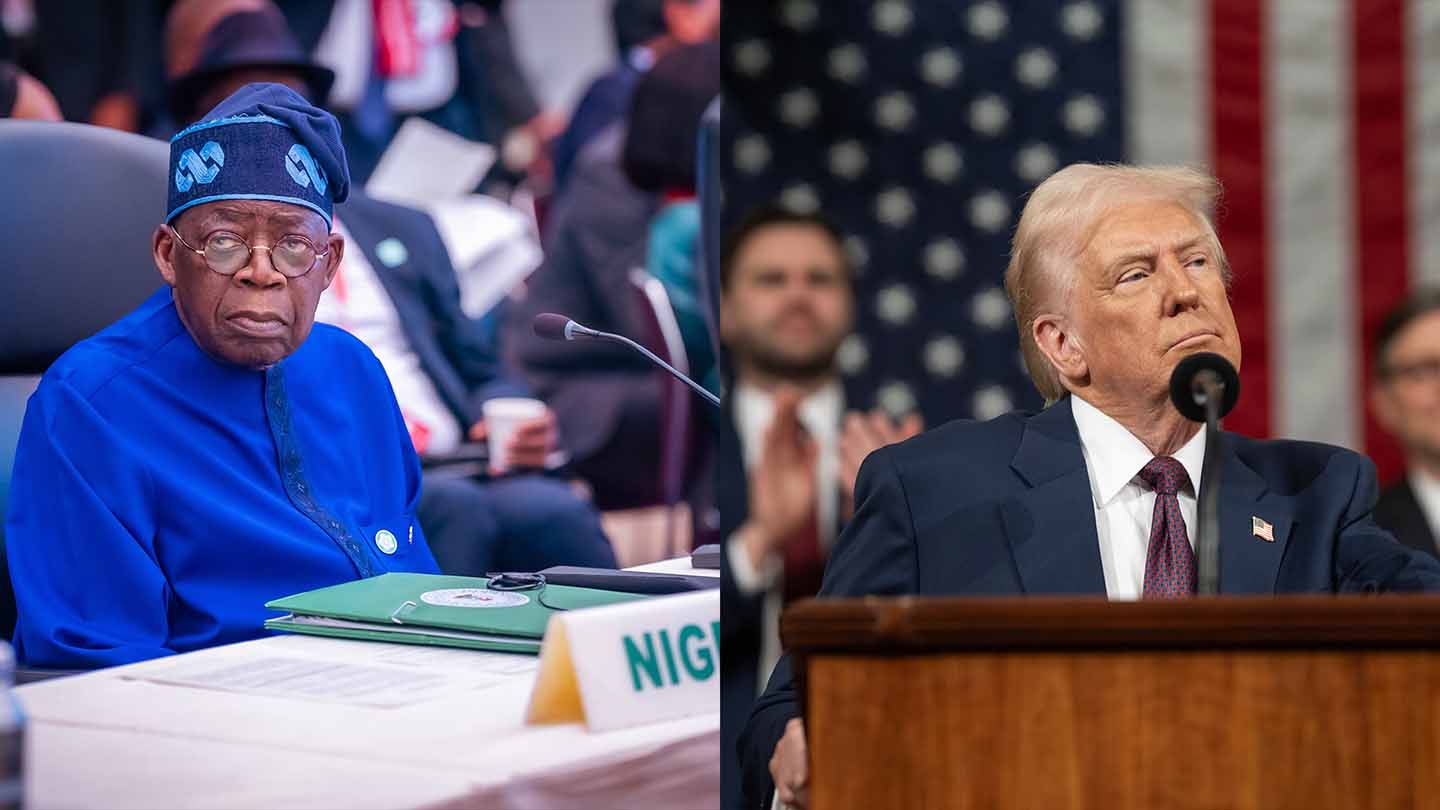
Nigerian President Bola Ahmed Tinubu and US President Donald Trump. Photos via X
“We know the heart and intent of Trump is to help us fight insecurity,” states the spokesperson of Nigeria’s President Bola Tinubu, who has time and again demonstrated his loyalty to the West.
US President Donald Trump has threatened to go “guns-a-blazing” into Africa’s most populous country, Nigeria, which he denigrated as a “disgraced country”. In a social media post on Saturday, November 1, he declared, “I am hereby instructing our Department of War to prepare for possible action. If we attack, it will be fast, vicious, and sweet.”
“Yes sir,” War Secretary Pete Hegseth replied to his post. “The Department of War is preparing for action.”
Why? Ostensibly to “wipe out the Islamic Terrorists who are committing these horrible atrocities” against “our CHERISHED Christians”. For over two months, the US right wing has been peddling a conspiracy about a “genocide” against Christians in Nigeria.
Championing this false claim, Senator Ted Cruz has proposed the so-called “Nigeria Religious Freedom Accountability Act” to use “powerful sanctions and other tools” against Nigerian officials he accuses of “ignoring and even facilitating the mass murder of Christians by Islamist jihadists.”
Myth of Christian genocide
Facts, however, contradict this accusation. The majority of people killed by the Boko Haram and Islamic State West Africa Province are Muslims, simply because they make up the majority in the northern region these Islamist insurgencies are ravaging. For the same demographic reasons, Muslims are also the majority victims of bandits who kill, loot, and kidnap in the northwest region, where the state is struggling to enforce the rule of law.
In the central region, Christian victims of violence are in the majority, not because of their religious identity but because of their occupation: farming. Amid intensifying competition over depleting land and water due to climate change, raids on farmlands by mobile herders, groups of whom are armed, are a serious problem in several African countries suffering desertification.
90% of these herders are Muslims, while in this region of Nigeria, farmers are predominantly Christian. But the violence is over resources, not faith. There is no evidence of a systematic and large-scale, religiously motivated targeting of Christians in Nigeria, where they are almost equal to Muslims in population.
“While Christians make up roughly 50% of the population, violence in which Christians have been specifically targeted in relation to their religious identity accounts for only 5% of reported civilian targeting events,” the Armed Conflict Location & Event Data Project reported in mid-2022.
Trump’s own envoy for Arab and African affairs, Massad Boulos, had pointed out at a summit last month in Italy to discuss counter-terrorism in West Africa that Boko Haram has killed more Muslims than Christians. Facts notwithstanding, “Christianity is facing an existential threat in Nigeria,” Trump insisted.
“Thousands of Christians are being killed. Radical Islamists are responsible for this mass slaughter,” he claimed, announcing on Friday, October 31, his decision to designate Nigeria a “country of particular concern” for systematic violation of religious freedoms.
“The characterization of Nigeria as religiously intolerant does not reflect our national reality, nor does it recognize government efforts to safeguard freedom of religion and belief,” replied Nigeria’s president, Bola Tinubu, a Muslim, married to a Christian Pastor.
A secular suffering
Under his secular regime, Christians, Muslims, and non-believers have all suffered alike, from hunger, unaffordability, unemployment, etc, as a consequence of his aggressive implementation of the IMF-World Bank prescribed reforms.
This crisis has enhanced the fertility of the ground for terror groups, bandits, and other criminal gangs to harvest more recruits, especially in the hinterlands and remote areas the state is struggling to police.
While struggling to restore security in these regions, Tinubu tried, albeit unsuccessfully, to lead the Nigerian military into a war with neighboring Niger at the behest of US ally France after its neocolonial puppet regime in Niger was ousted in mid-2023.
A year later, he unleashed his security forces on the domestic front to crush the “hunger protests” demanding a reversal of the IMF-World Bank prescribed liberalization, killing at least two dozen people. Another 1,200 protesters were arrested, many of whom were tortured in custody. Several, including minors, faced charges of treason.
Later in November, allegations of treason were leveled against Tinubu himself when the CIA objected to the release of the unredacted files of the US Drug Enforcement Agency (DEA) investigation into Tinubu in the early 1990s. Accused of laundering money for a major heroin racket in Chicago at the time, Tinubu entered into a plea bargain to avoid a trial, forfeiting USD 460,000 to US authorities.
Tinubu’s loyalty to the West, unrewarded
In response to Freedom of Information Act (FOIA) requests for the release of unredacted files of the investigation, “We oppose the full… release of the DEA’s Bola Tinubu heroin trafficking investigation records,” the DEA insisted. “While Nigerians have a right to be informed about what their government is up to, they do not have a right to know what their president is up to.”
Reminding that its activities are “carried out through clandestine means, and therefore they must remain secret,” the CIA objected to full release as it could “cause damage to US national security by indicating whether or not the CIA maintained any human intelligence sources related to Tinubu.”
“The CIA effectively confirmed that Nigeria’s sitting president is an active CIA asset,” remarked David Hundeyin, author of the documentary “Bola Ahmed Tinubu: From Drug Lord to Presidential Candidate.”
From his alleged contribution to US intelligence, his readiness to hurl Nigeria into war with a neighbor for France, his obedient implementation of IMF-World Bank diktats, and ruthless crushing of protests against it – Tinubu has time and again demonstrated his loyalty to the West.
But Trump is not placated. Ordering the Department of War to prepare for a military action, Trump doubled down on Sunday, adding that both airstrikes and boots on the ground were open options.
Groveling again
“Nigeria is US’s partner in the global fight against terrorism,” said Tinubu’s spokesperson, Daniel Bwala. “We know the heart and intent of Trump is to help us fight insecurity,” he groveled. “We do not see (Trump’s threat) in the literal sense… We know that Donald Trump has his own style of communication.” It was, he suggested, Trump’s way to “force a sit-down between the two leaders so they can iron out a common front to fight their insecurity”.
But he is confident that when Tinubu and Trump meet, “there will be better outcomes.” Will these “outcomes” from the suggested meeting include Tinubu’s walking back on his refusal to accept foreign nationals deported by the US? Will he throw open Nigeria’s vast critical mineral deposits for US extraction, which the establishment think tank, Brookings Institution, deems “a win-win policy”?