Energy Security and Net Zero Secretary Ed Miliband (left) and California state governor Gavin Newsom sign a clean energy agreement at the Foreign Office in London, February 16, 2026
ENERGY Secretary Ed Miliband did his shift in US President Donald Trump’s firing line today after signing a green energy pact with California Governor Gavin Newsom.
Mr Trump used an interview to say “the UK’s got enough trouble without getting involved with Gavin Newscum,” using an infantile and derogatory nickname for the Californian, who is widely expected to run for president in 2028.
“Gavin is a loser. Everything he’s touched turns to garbage. His state has gone to hell, and his environmental work is a disaster,” he added.
The US president’s blunt warning that it was “inappropriate” for Britain to be dealing with the governor doubtless had Sir Keir Starmer in a cold sweat, since the Prime Minister is desperate to avoid giving offence to the White House.
However, Sir Keir no longer has the political wherewithal, after last week’s brush with eviction from office, to rein in Mr Miliband, regarded as one of the cabinet’s few effective performers.
Mr Newsom, who has been attacking Trump on everything from the behaviour of ICE to the climate crisis, signed a memorandum of understanding in London with Mr Miliband.
It seeks to deepen existing co-operation between Britain and California, with a new framework to develop clean energy technologies and stronger links between businesses and researchers in Britain and the US state.
Britain and California will also share practical expertise on protecting biodiversity and building resilience amid extreme weather, the Energy department announced.
Donald Trump urges you to be a Climate Science denier like him. He says that he makes millions and millions for destroying the planet, Burn, Baby, Burn and Flood, Baby, Flood.Nigel Farage urges you to ignore facts and reality and be a climate science denier like him and his Deputy Richard Tice. He says that Reform UK has received £Millions and £Millions from the fossil fuel industry to promote climate denial and destroy the planet.Elon Musk urges you to be a Fascist like him, says that you can ignore facts and reality then.
Last autumn, a UK government report warned that climate-driven ecosystem collapse could lead to food shortages, mass migration, political extremism and even nuclear conflict. The report was never officially launched.
Commissioned by Defra – the Department for Environment Food and Rural Affairs – and informed by intelligence agencies including MI5 and MI6, the briefing assessed how environmental degradation could affect UK national security.
At the last minute the launch was cancelled, reportedly blocked by Number 10. Thanks to pressure from campaigners and a freedom of information request, a 14-page version of the report was snuck out (no launch, not even a press release) on January 22.
That report says: “Critical ecosystems that support major food production areas and impact global climate, water and weather cycles” are already under stress and represent a national security risk. If they failed, the consequences would be severe: water insecurity, severely reduced crop yields, loss of arable land, fisheries collapse, changes to global weather patterns, release of trapped carbon exacerbating climate change, novel zoonotic disease and loss of pharmaceutical resources.
In plainer terms: the UK would face hunger, thirst, disease and increasingly violent weather.
An unredacted version of the report, seen by the Times, goes further. It warns that the degradation of the Congo rainforest and the drying up of rivers fed by the Himalayas could drive people to flee to Europe (Britain’s large south Asian diaspora would make it “an attractive destination”), leading to “more polarised and populist politics” and putting more pressure on national infrastructure.
The Times describes a “reasonable worst case scenario” in the report, where many ecosystems were “so stressed that they could soon pass the point where they could be protected”. Declining Himalayan water supplies would “almost certainly escalate tensions” between China, India and Pakistan, potentially leading to nuclear conflict. Britain, which imports 40% of its food, would struggle to feed itself, the unredacted report says.
The report isn’t an outlier, and these concerns are not confined to classified briefings. A 2024 report by the University of Exeter and think-tank IPPR warned that cascading climate impacts and tipping points threaten national security – exactly the risk outlined in the Defra report.
Melting glaciers in remote mountains ultimately pose a security threat for the UK, say intelligence services. Hussain Warraich / shutterstock
The government has not publicly explained why the launch was cancelled. In response to the Times article, a Department for Environment, Food and Rural Affairs spokesperson said: “Nature underpins our security, prosperity and resilience, and understanding the threats we face from biodiversity loss is crucial to meeting them head on. The findings of this report will inform the action we take to prepare for the future.”
Perhaps there are mundane reasons to be cautious about a report linked to the intelligence services that warns of global instability. But the absence of any formal briefing or ministerial comment is itself revealing – climate risks appear to be treated differently from other risks to national security. It’s hard to imagine a report warning of national security risks from AI, China or ocean piracy getting the same treatment.
This episode is not even especially unusual, historically. Governments have been receiving warnings about climate change – and downplaying or delaying responses – for decades.
Decades of warnings
In January 1957, the Otago Daily Times reported a speech by New Zealand scientist Athol Rafter under the headline “Polar Ice Caps May Melt With Industrialisation”. And Rafter was merely repeating concerns already circulating internationally, including by a Canadian physicist whose similar warning went around the world in May 1953. Climate change first went viral more than seven decades ago.
By the early 1960s, scientists were holding meetings explicitly focused on the implications of carbon dioxide build-up. In 1965, a report to the US president’s Science Advisory Council warned that “marked changes in climate, not controllable though local or even national efforts, could occur”.
But the story we see today was the same. Reports are commissioned, urgent warnings are issued – and action is deferred. When climate change gained renewed momentum in the mid-1980s, following the discovery of the ozone hole and the effects of greenhouse gases besides carbon dioxide, the message sharpened: global warming will come quicker and hit harder than expected.
Margaret Thatcher finally acknowledged the threat in a landmark 1988 speech to the Royal Society. But when green groups tried to get her to make specific commitments, they had little success.
Since about 1990, the briefings have barely changed. Act now, or suffer severe consequences later. Those consequences, however, are no longer theoretical.
Why does nothing happen?
Partly, it’s down to inertia. We have built societies in which carbon-intensive systems are locked in. Once you’ve built infrastructure around, say, the private petrol-powered automobile, it’s hard for competitors to offer an alternative. There’s also a mental intertia: it’s hard to let go of assumptions you grew up with in a more stable era.
Secrecy plays a role too. As the Defra report illustrates, uncomfortable assessments are often softened, delayed or buried. Then, if you do accept the need for action, you are then up against the problem of responsibility being fragmented across sectors and institutions, making it hard to know where to aim your efforts. Meanwhile, social movements fighting for climate action find it hard to sustain momentum for more than three years.
Here’s the final irony. Conspiracy theorists and climate deniers insist governments are exaggerating the threat. In reality, the evidence increasingly suggests the opposite. Official assessments tend to lag behind scientific warnings, and the most pessimistic scenarios are often confined to technical or classified documents.
The situation is not better than we are told. It’s actually far worse.
Nigel Farage urges you to ignore facts and reality and be a climate science denier like him and his Deputy Richard Tice. He says that Reform UK has received £Millions and £Millions from the fossil fuel industry to promote climate denial and destroy the planet.Donald Trump urges you to be a Climate Science denier like him. He says that he makes millions and millions for destroying the planet, Burn, Baby, Burn and Flood, Baby, Flood.Orcas discuss Donald Trump and the killer apes’ concept of democracy. Front Orca warns that Trump is crashing his country’s economy and that everything he does he does for the fantastically wealthy.
The Trump administration took a major step in its efforts to unravel America’s climate policies on Feb. 12, 2026, when it moved to rescind the 2009 endangerment finding – a formal determination that six greenhouse gases that drive climate change, including carbon dioxide and methane from burning fossil fuels, endanger public health and welfare.
But the administration’s arguments in dismissing the health risks of climate change are not only factually wrong, they’re deeply dangerous to Americans’ health and safety.
As physicians, epidemiologists and environmental healthscientists, we’ve seen growing evidence of the connections between climate change and harm to people’s health. Here’s a look at the health risks everyone face from climate change.
Greenhouse gases from vehicles, power plants and other sources accumulate in the atmosphere, trapping heat and holding it close to Earth’s surface like a blanket. Too much of it causes global temperatures to rise, leaving more people exposed to dangerous heat more often.
Most people who get minor heat illnesses will recover, but more extreme exposure, especially without enough hydration and a way to cool off, can be fatal. People who work outside, are elderly or have underlying illnesses such as heart, lung or kidney diseases are often at the greatest risk.
Heat deaths have been rising globally, up 23% from the 1990s to the 2010s, when the average year saw more than half a million heat-related deaths. Here in the U.S., the 2021 Pacific Northwest heat dome killed hundreds of people.
Climate scientists predict that with advancing climate change, many areas of the world, including U.S. cities such as Miami, Houston, Phoenix and Las Vegas, will confront many more days each year hot enough to threaten human survival.
Increased flooding carries health risks, including drownings, injuries and water contamination from human pathogens and toxic chemicals. People cleaning out flooded homes also face risks from mold exposure, injuries and mental distress.
Flooding from hurricanes and other extreme storms can put people at risk of injuries during the cleanup while also triggering dangerous mold growth on wet wallboard, carpets and fabric. This home flooded up to its second flood during Hurricane Irma in 2017. Sean Rayford/Getty Images
Climate change also worsens droughts, disrupting food supplies and causing respiratory illness from dust. Rising temperatures and aridity dry out forests and grasslands, making them a setup for wildfires.
Air pollution
Wildfires, along with other climate effects, are worsening air quality around the country.
Because they are cold-blooded organisms, insects are directly influenced by temperature. So with rising temperatures, mosquito biting rates rise as well. Warming also accelerates the development of disease agents that mosquitoes transmit.
As global temperatures rise, regions are becoming more suitable for mosquitoes to transmit dengue virus. The map shows a suitability scale, with red areas already suitable for dengue transmissions and yellow areas becoming more suitable. Taishi Nakase, et al., 2022, CC BY
New York and many other cities now open cooling centers during heat waves to help residents, particularly older adults who might not have air conditioning at home, stay safe during the hottest parts of the day. Angela Weiss/AFP via Getty Images
Young children, older adults, pregnant women and people with preexisting medical conditions are among the highest-risk groups. Lower-income people also face greater risk because of higher rates of chronic disease, higher exposures to climate hazards and fewer resources for protection, medical care and recovery from disasters.
The evidence is clear: Climate change endangers human health. But there’s a flip side to the story.
When governments work to reduce the causes of climate change, they help tackle some of the world’s biggest health challenges. Cleaner vehicles and cleaner electricity mean cleaner air – and less heart and lung disease. More walking and cycling on safe sidewalks and bike paths mean more physical activity and lower chronic disease risks. The list goes on. By confronting climate change, we promote good health.
To really make America healthy, in our view, the nation should acknowledge the facts behind the endangerment finding and double down on our transition from fossil fuels to a healthy, clean energy future.
Experienced climbers scale a rock face near the historic Dumbarton castle in Glasgow, releasing a banner that reads “Climate on a Cliff Edge.” One activist, dressed as a globe, symbolically looms near the edge, while another plays the bagpipes on the shores below. | Photo courtesy of Extinction Rebellion and Mark RichardsNeo-Fascist Climate Science Denier Donald Trump says Burn, Baby, Burn.Nigel Farage urges you to ignore facts and reality and be a climate science denier like him and his Deputy Richard Tice. He says that Reform UK has received £Millions and £Millions from the fossil fuel industry to promote climate denial and destroy the planet.
This work by Middle East Monitor is licensed under a Creative Commons Attribution-NonCommercial-ShareAlike 4.0 International License.
UN Special Rapporteur on Palestine Francesca Albanese holds a press conference at the lower house of the Italian Parliament, the Chamber of Deputies, to present her new report titled “Genocide in Gaza: A Collective Crime” in Rome, Italy on February 03, 2026. [Barış Seçkin – Anadolu Agency]
Francesca Albanese has become one of the most polarising figures in contemporary diplomacy, not because she commands armies or signs treaties, but because she insists on describing what she sees. Since assuming her mandate as United Nations Special Rapporteur on the situation of human rights in the Palestinian territories in 2023, the Italian jurist has delivered reports that cut through diplomatic euphemism with the precision of a scalpel.
In her October 2024 report to the General Assembly, pointedly titled Genocide as Colonial Erasure, she concluded there were ‘reasonable grounds’ to believe that Israel’s conduct in Gaza met the legal threshold of genocide and formed part of a ‘century-long project of eliminatory settler-colonialism’. Few phrases in international law carry such moral weight. Fewer still are uttered so plainly in the marble halls of New York and Geneva.
The reaction was immediate and ferocious. Israeli officials labelled her ‘one of the most antisemitic figures in modern history’. France, Germany, Italy, Austria and the Czech Republic publicly called for her removal after a February 2026 address to a Doha forum in which she condemned ‘the planning and making of a genocide’ in Gaza and decried the complicity of states that had armed and politically shielded Israel since October 2023 (a speech later distorted through a truncated clip that falsely claimed she had labelled Israel “the common enemy of humanity,” a narrative she categorically rejected).
The edited clip of that speech ricocheted across social media, falsely suggesting she had called Israel ‘the common enemy of humanity’. She responded with weary clarity: the ‘common enemy’, she said, was the system — financial capital, algorithms and weapons — that enables atrocities, not a people or a state.
The United Nations moved swiftly to defend the independence of its mandate.
Special rapporteurs, a spokesperson reminded reporters, are not political appointees but independent experts commissioned by the Human Rights Council and protected by UN privileges and immunities.
Reuters noted there is no precedent for removing a rapporteur mid-term, and diplomats privately concede such an attempt would likely fail. Yet the calls for her resignation were not merely procedural skirmishes.
They were signals — about who is permitted to speak, and how far the language of international law may stretch before it snaps under political strain.
What makes Albanese’s work so unsettling to some capitals is not only the gravity of her conclusions, but the breadth of her analysis. In her 2025 Human Rights Council report, she traced what she termed a shift ‘from economy of occupation to economy of genocide’, mapping the corporate and financial networks that sustain settlement expansion and military operations.
She placed Western governments within that ecosystem, arguing that political cover and arms transfers had ‘stabbed international law in the heart’.
Amnesty International echoed this concern, warning that silencing her would distract from ‘Israel’s genocide in Gaza, its system of apartheid and unlawful occupation’.
Whether one agrees with her characterisation or not, the data underpinning the crisis are sobering. By late 2025, Gaza’s health authorities and UN agencies reported tens of thousands of Palestinians killed since October 2023, with vast swathes of housing, hospitals and water infrastructure destroyed. The World Bank estimated economic contraction in Gaza exceeding 80 per cent. UNICEF described levels of child malnutrition unseen in decades. These figures are not rhetorical flourishes; they are the raw arithmetic of devastation.
They form the backdrop to South Africa’s genocide case before the International Court of Justice and to repeated UN General Assembly resolutions demanding a ceasefire and humanitarian access.
Across global capitals, the language of a “rules-based order” is spoken with conviction. Yet those words hollow out when rules are applied selectively. If international law binds adversaries but spares allies, it ceases to be law and becomes leverage.
The strength of the global system rests on independent scrutiny. When UN experts can be undermined through doctored clips, coordinated outrage and political pressure, the foundations of accountability begin to shake. Today it is Gaza. Tomorrow it could be Ukraine, Myanmar, Sudan, or any conflict where truth unsettles power. Disinformation does not respect borders. Precedents travel fast. If the world tolerates the silencing of inconvenient investigators, it signals that multilateralism is conditional — firm in rhetoric, fragile in practice.
Trust erodes. Cynicism grows. The Global South watches and remembers.
Defending independent mandates is not an attack on any state. It is a defence of the very order governments claim to uphold. If the guardians of international law bend it when tested, the damage will not stay confined to one region. It will echo wherever justice depends on courage rather than convenience.
There is, of course, genuine sensitivity in Europe, shaped by the Holocaust and by the resurgence of antisemitism. Albanese herself has apologised for past remarks that were widely criticised. These complexities demand care.
Yet conflating sharp legal criticism of a state’s conduct with hatred of a people risks trivialising real antisemitism and impoverishing serious debate. The joint statement of 116 human rights organisations condemning what they described as a ‘targeted smear campaign’ warned that such tactics threaten freedom of expression and the integrity of UN mechanisms.
The UN human rights office has observed an alarming rise in personal attacks and misinformation directed at independent experts.
International relations theory offers several lenses through which to view this moment. Realists see states defending allies and interests. Liberals see institutions under strain. Constructivists note how narratives of historical trauma and identity shape policy reflexes. Yet beyond theory lies a simpler question: can the international system tolerate uncomfortable truths when they implicate powerful actors?
Albanese’s language is undeniably stark. She speaks of apartheid, of settler colonialism, of genocide. For some diplomats, such words close doors. For others, they are the only vocabulary adequate to the scale of suffering. History suggests that terms once dismissed as inflammatory — apartheid in South Africa, ethnic cleansing in the Balkans — can become anchors for accountability.
The 1963 UN Special Committee against Apartheid was once derided as politicised; it later formed part of the scaffolding that supported global sanctions and eventual transition.
The future of Gaza and Palestine will not be secured by rhetoric alone. Reconstruction will require tens of billions of dollars, credible governance reform within Palestinian institutions, security guarantees for Israel, and a political horizon that restores dignity and agency to Palestinians. A common argument is that the absence of a viable political process will simply harden cycles of violence. Sustainable development in the region hinges on accountability and inclusion; impunity breeds instability.
There is space here for Australian diplomacy — measured, principled, pragmatic. Supporting humanitarian ceasefire efforts, backing the independence of international courts, conditioning arms exports on compliance with international humanitarian law, and investing in Palestinian civil society are not radical steps. They are consistent with long-stated commitments. A middle power need not shout to be heard; it must simply be consistent.
Francesca Albanese’s tenure has illuminated an uncomfortable paradox. The United Nations is often criticised as toothless, yet when one of its independent experts speaks with legal bluntness, the reaction suggests that words still matter. Attempts to sideline her have so far failed, not because she is beyond reproach, but because the mandate she holds embodies a principle larger than any individual: that human rights scrutiny must not bend to political convenience.
For a global audience weary of endless conflict, the path to a better future for Gaza and Palestine lies not in silencing dissenting voices but in confronting evidence with honesty. The credibility of the international system — and of those states that claim to steward it — depends on that courage.
In the end, the debate is less about one rapporteur than about whether the promise of ‘never again’ retains meaning when tested by the tragedies of the present.
The views expressed in this article belong to the author and do not necessarily reflect the editorial policy of Middle East Monitor.
This work by Middle East Monitor is licensed under a Creative Commons Attribution-NonCommercial-ShareAlike 4.0 International License.
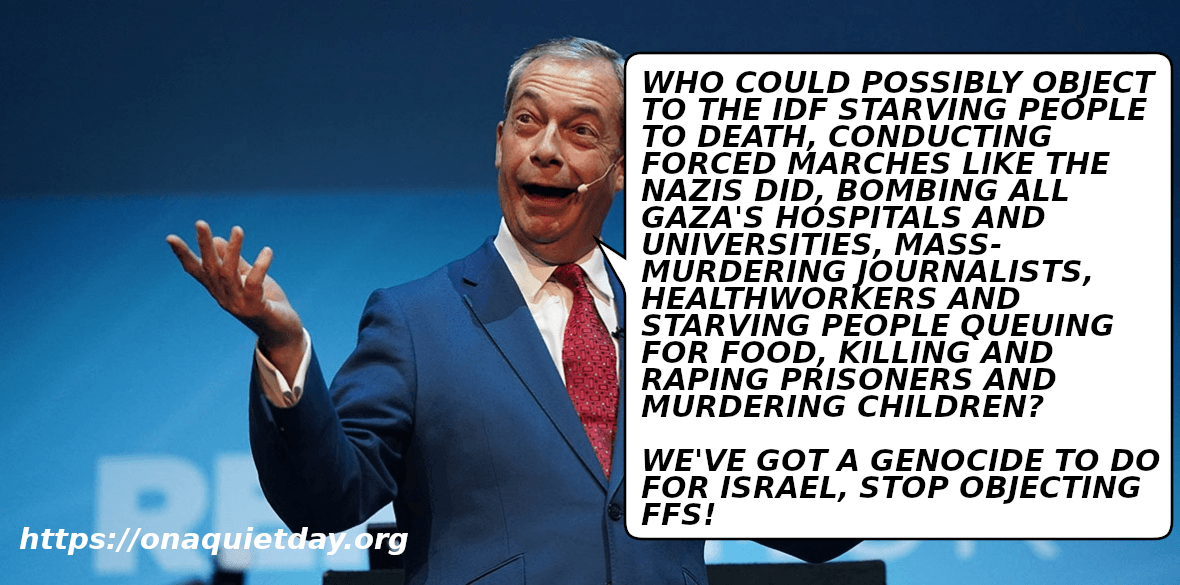
Genocide denier and Current UK Prime Minister Keir Starmer is quoted that he supports Zionism without qualification. He also confirms that UK air force support has been essential in Israel’s mass-murdering genocide. Includes URLs https://www.declassifieduk.org/keir-starmers-100-spy-flights-over-gaza-in-support-of-israel/ and https://youtu.be/O74hZCKKdpAKeir Starmer objects to criticism of the IDF. He asks how could anyone object to them starving people to death, forced marches like the Nazis did, bombing Gaza’s hospitals and universities, mass-murdering journalists, healthworkers and starving people queuing for food, killing and raping prisoners and murdering children. He calls for people to stop obstructing his genocide for Israel.Orcas discuss Genocide-supporting and complicit Zionists. Donald Trump, Keith Starmer, David Lammy, Rachel Reeves, Angela Rayner and Wes Streeting are acknowledged as evil genocide-complicit and supporting cnuts.
Nigel Farage urges you to ignore facts and reality and be a climate science denier like him. He says that Reform UK has received millions and millions from the fossil fuel industry to promote climate denial and destroy the planet.
It should be accepted that the climate criminals have destroyed the World’s – collectively our World’s – climate for profit despite being fully aware of the consequences of their actions. This has caused extreme weather events worldwide, far more extreme hurricanes, wildfires and floods while here in the UK we’ve suffered far worse flooding and almost constant raining. We are now starting to see and feel the first consequences of the climate criminals’ actions.
The climate criminals knew this, Donald Trump knows or should be treated as knowing it despite denying it. I would be so angry if I was young or even a little younger. Capitalists have destroyed younger peoples’ lives, nature and the environment for ever for short-term profit.
Their punishment doesn’t need to follow logic e.g. punish their descendents, why not? I’m thinking along the lines of dispossessing them – since they love money so much – and prevent them from all sources of income.
ed: It’s not acceptable to punish their descendents unfortunately, would breach their human rights. Can create the concept of ‘dirty money’ the proceeds from and polluted by climate destruction that should be seized from individuals. later ed: It follows that if an individual’s income has been sourced from climate destruction for some time, then it should all be seized. later later edit: This is not new of course. It is established that people should not benefit from crimes or the proceeds of crimes. What’s needed is to formally recognise climate destruction as a crime. I would expect that to no doubt happen in coming years. A different approach would be to accept the obvious consequences of climate destruction i.e. that those crimes are committed through the action of climate destruction.
I need to give this some thought and it may not be too soon …
Donald Trump urges you to be a Climate Science denier like him. He says that he makes millions and millions for destroying the planet, Burn, Baby, Burn and Flood, Baby, Flood.