People’s movements across the world launch campaign of solidarity with Venezuela

Spread the love

Original article republished from people dispatch under a Creative Commons Attribution-ShareAlike 4.0 (CC BY-SA) license.
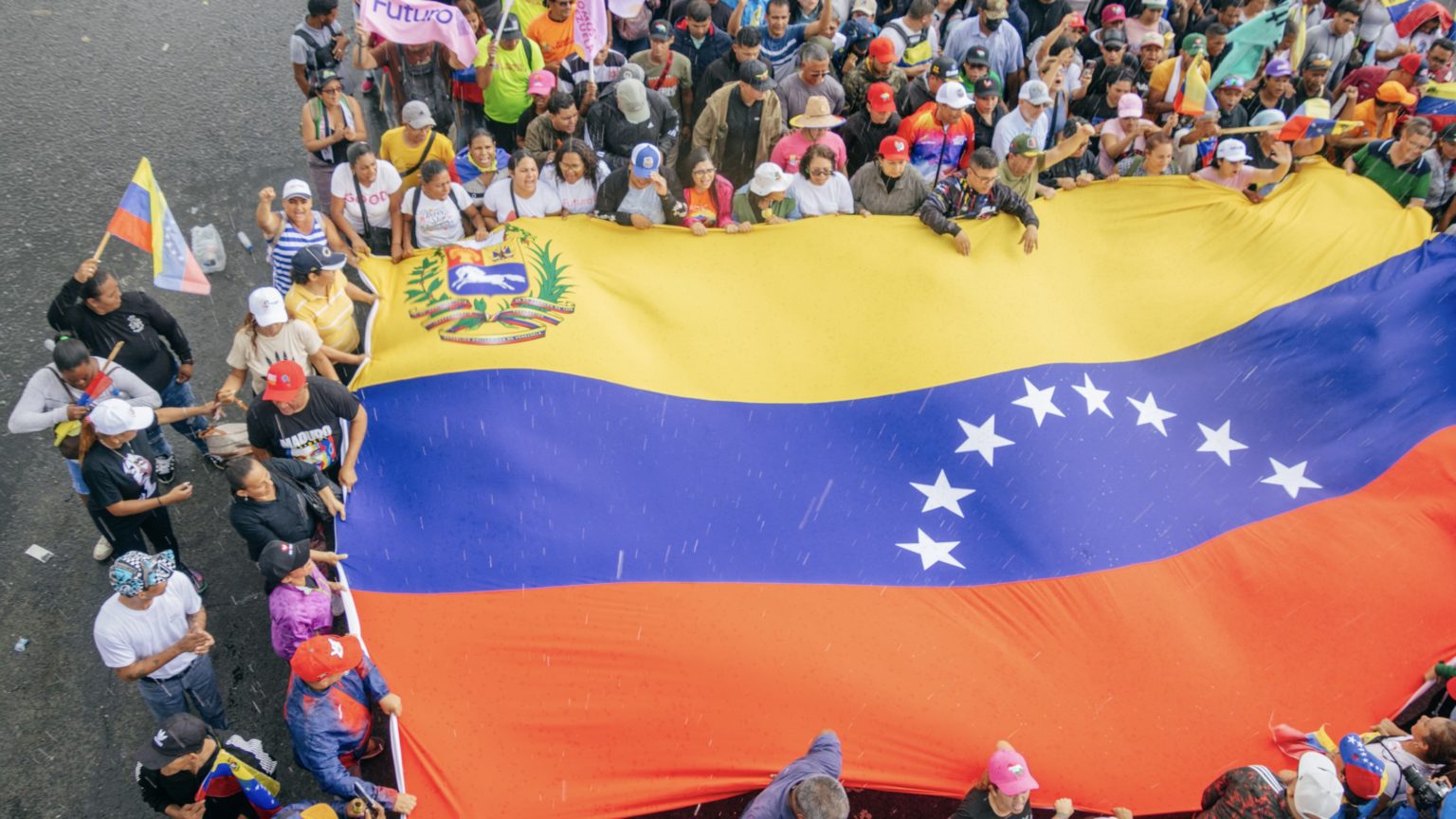
Venezuelan people marched in the rain on July 30 in defense of the electoral results. Photo: Zoe Alexandra

Social and workers’ movements across the world have launched a campaign to stand in solidarity with the Venezuelan people as they face a wave of attacks following the presidential elections.

On August 9, the ALBA Movimientos, a platform of social and political movements from across the Americas and the Caribbean, the International Peoples’ Assembly, the Simon Bolivar Institute, and the Assembly of Caribbean Peoples, launched a campaign titled: “For Democracy and Sovereignty: Hands Off Venezuela!” The campaign comes in the aftermath of Venezuela’s presidential election and a wave of seemingly coordinated attacks from right-wing political actors, mainstream media, and US and its allies.

The launch document states that, for several months, a media campaign has been created to question the legitimacy of the elections in the Caribbean country. “From the hegemonic media, with political and diplomatic strategies, it has been sought to install an idea of the illegitimacy of the recent Venezuelan electoral process,” states the communiqué.

The joint statement affirms that the campaign mentioned above against the legitimacy of the Venezuelan electoral process has been shaped from several communicational fronts: creating doubts about the technological capacity of the electoral machines, reinforcing the 930 economic sanctions against Venezuela, generating violence in the streets and illegally self-declaring González Urrutia as president of the country, among others.

The geopolitical importance of Venezuela, both for its geographic location and vast natural resources, are at the center of the current dispute, the organizations argue. “It is impossible [to understand the situation of] Venezuela without placing it in the regional and global geopolitical context: its privileged place in world oil production, its common goods placed at the service of the people, the place it occupies in the multipolar world together with the emerging countries, and of course, its leadership of a project of union and regional integration in Latin America and the Caribbean that gives continuity to the defeat of the FTAA and keeps alive the horizon of continental sovereignty far from the designs of the United States”.

In this way, the document invites progressive and revolutionary organizations to combat the media campaign imposed by the national and international opposition to Venezuela, which, according to the document, is directly aligned with the imperialist interests of the United States.

On August 9, the launch day of the campaign, the movement platforms have called on organizations across the globe to mobilize on the streets and on social media in support of Venezuela.

South African workers speak out in support of Venezuela

The National Union of Metalworkers of South Africa (NUMSA), in a press release issued on August 8, 2024, congratulated the Venezuelan people for holding free and fair elections, as well as congratulating the re-election with more than 51% of the votes of Nicolás Maduro as president of Venezuela.

NUMSA also questions the media campaign against the legitimacy of the electoral process that could lead to a coup d’état in Venezuela. According to the communiqué, “These media houses are not neutral. Their role is to advance the interests of capital and to promote US imperialism and hegemony. It is not in the interest of Western powers to endorse the elections in Venezuela…We are deeply concerned that US propaganda is being reproduced by many media houses that have sadly been trapped into reinforcing attempts at a coup by imperialism against the will of the Venezuelan people.”

In addition, the NUSMA communiqué insists on the close relationship that the Venezuelan opposition has with the geopolitical interests of the United States, including the friendship that María Corina Machado has professed with the Zionist government of Israel; “The United States does not have a commendable history in defending the dignity of most people. Today, we can take one look at the US-backed genocide against the Palestinian people to know this. It, therefore, comes as no surprise that the right-wing opposition coup leader in Venezuela is a Zionist”.

Likewise, the NUMSA communiqué recognizes the great economic and geostrategic value of Venezuela in current international relations, which is why there are imperial powers that seek to control the political future of Venezuela at any cost so that the recognition of the elections would be a way for the people to reaffirm their sovereignty and their ability to decide their future without the interference of other countries: “the US has set its sights on the enormous mineral wealth of Venezuela and seems determined to expropriate these through the imposition of a puppet regime under the leadership of Edmundo González. Against this backdrop, all progressive forces must reaffirm their unwavering commitment to the sovereignty of Venezuela. We call on our government, media, governments, and media houses worldwide to uphold the principles of peace, democracy, and national self-determination by acknowledging the outcomes of the Venezuelan election.”

Anti-imperialist and progressive movements from across the world are gearing up for the international campaign to condemn the so-called hybrid war against Venezuela and express their support to its struggle for sovereignty and democracy.

Original article republished from people dispatch under a Creative Commons Attribution-ShareAlike 4.0 (CC BY-SA) license.

Continue ReadingPeople’s movements across the world launch campaign of solidarity with Venezuela

Mainstream media scales up attacks against Maduro ahead of Sunday’s elections

Spread the love

Original article republished from peoples dispatch under a Creative Commons Attribution-ShareAlike 4.0 (CC BY-SA) license.

Closing campaign rally of Nicolás Maduro in Caracas. Photo: Zoe Alexandra

Numerous international media outlets have stepped up attacks against Nicolás Maduro in a seemingly scripted manner with key messages that they seek to establish as the truth

On Sunday, the people of Venezuela will head to the polls to elect their next president. The 21 million eligible voters in Venezuela have the opportunity to pick between 10 candidates from a broad range of political parties and currents. The two projected front runners however, are from completely opposite ends of the spectrum: incumbent President Nicolás Maduro and candidate for the right-wing Unitary Democratic Platform, Edmundo González.

As election day comes closer, and international mainstream media pays more attention to what is happening in the Caribbean country, several dominant patterns have emerged in the discourse and messages of these outlets.

First of all, several media outlets have carried profiles of the leading candidates, and presented a very stark dichotomy. Maduro is authoritarian, González is democratic. Maduro is oppressive, González is free. In these profiles, when talking about Maduro, they will talk about the alleged amount of money and properties that he owns, but when profiling González, no such questions are asked.

When speaking of González, another type of framing is used, namely, that of the chosen one who was able to bring about the unity of an opposition that has historically had enormous difficulties in reaching minimum agreements. In this way, they want to present a worn out, questioned and “possibly” corrupt candidate (Maduro), while on the other hand, they want to show a peaceful, conciliatory, and ethically pristine candidate (Gónzález). This framing also erases the other eight opposition candidates who are running in these elections who also represent important political sectors. This has a very clear political intention, although not explicitly stated.

It goes without saying that there is almost no mention of the ferocious hybrid war which Venezuela has been subjected to for the last decade and how the Maduro government has endured coup attempts, assassination attempts, a near complete blockade on the country’s economy and oil production, and attempted invasions by paramilitary groups. In this situation of an almost constant political and economic siege, Maduro and his party United Socialist Party of Venezuela (PSUV) have not only been able to initiate remarkable economic recovery, but also have forged unity amongst the diverse political progressive tendencies which are under the broad umbrella of Chavismo. During the last several months, the socialist candidate has traveled to dozens of cities and towns across the country to meet with the people, listen to them, and hear their demands of the government and the Bolivarian process. These multitudinous rallies and meetings have received almost no media attention.

Another type of premise that hegemonic media outlets have tried to establish is that of an almost certain electoral fraud if the candidate of the PSUV wins. At the same time they state that if the opposition wins, Maduro will not recognize the results (even though the government has repeatedly publicly stated that it will respect the results, whatever they may be).

That is to say, the media perspective acquires the structure of an informal fallacy called “false dilemma”, in which, according to the hegemonic narrative, either the opposition wins and Maduro ignores the results, or Maduro wins but only through electoral fraud.

For almost a month, these media outlets have also sought to express that the so-called opinion polls (carried out by corporate, right-wing pollsters) give such a wide advantage to González that Maduro will be unable to subtract such difference, implicitly stating that, for almost a month, the election has already been decided. This fatalism also relies on the false premise that election results are absolute and defined several weeks before voting day – completely undermining the people’s will and sovereignty to decide their future.

Furthermore, it is intentionally not said that other polls have put Maduro ahead in terms of voting intentions, thus reinforcing their message that either González wins overwhelmingly or that Maduro carries out electoral fraud. Hence, it is justified, in a somewhat bizarre way, when far-right opposition leaders like María Corina Machado that are backing the candidacy of González, say that the only result they will accept is the victory of their candidate. These figures continue to denounce that Chavismo would only accept a victory of its own. Ironically, only the PSUV has affirmed that it would accept the result, whatever it may be.

This type of Manichean media attitude provokes an evident polarization and increases the tension in a country that already suffered right-wing political violence and tensions after electoral processes.

With all eyes on Venezuela this Sunday, these predetermined media narratives are important to identify and debunk. It will not be the mainstream media outlets like the New York Times, CNN, InfoBae, Voz de América and others that will determine Venezuela’s future, it will be the Venezuelan people.


Original article republished from peoples dispatch under a Creative Commons Attribution-ShareAlike 4.0 (CC BY-SA) license.

Continue ReadingMainstream media scales up attacks against Maduro ahead of Sunday’s elections

Venezuela’s electoral authority debunks “vote rigging” narrative ahead of Sunday’s presidential elections

Spread the love

Original article republished from peoples dispatch under a Creative Commons Attribution-ShareAlike 4.0 (CC BY-SA) license.

The National Electoral Council’s headquarters in Caracas, 2024. Photo: teleSUR

In the week ahead of Venezuela’s presidential elections, the National Electoral Council met with international electoral observers and representatives from all political parties

The Venezuelan National Electoral Council (CNE) announced on Monday July 22 that all the electoral machines that will be used in the elections on Sunday, July 28 have been distributed. With this, the president of the CNE, Elvis Amoroso assured that the machines that will be used in Sunday’s elections have been reviewed by representatives of the political organizations.

“Witnesses from political organizations were present at the event to verify the operation of each of the telecommunications devices involved in the process of transmitting results and ensuring the network used by the CNE,” said Amoroso, at a press conference.

Amoroso also said that the representatives of the political parties that will participate in the elections were able to verify the security codes as well as the functioning of the software to be used by the machines. The CNE thus seeks to guarantee the integrity of the elections and to safeguard the decision of the voters of the Caribbean country.

On the other hand, in its eagerness to cover the election with greater international confidence, the CNE accredited several international observers such as the Carter Center of the United States, the Council of Electoral Experts of Latin America, and the UN Panel of Experts, among others.

Even though an international media campaign tried to popularize the idea that the presidential candidate and current president would not recognize the results, Maduro said in a political rally that “nobody is going to stain the name of Venezuela or the electoral process; rain, thunder or shine, on Sunday there will be free elections in Venezuela. And we will recognize and defend the results”.

Similarly, Jorge Rodríguez, deputy of the Venezuelan National Assembly and an important leader of the United Socialist Party of Venezuela (PSUV) said in an interview with El País, that “we will recognize the results of the National Electoral Council”, and that if the ruling party were to lose the elections, there would be a “peaceful transition”.

On the other hand, the political team of the right-wing candidacy of Edmundo González Urrutia has repeatedly refused to affirm that it will accept the result of the presidential elections if its candidate were to lose in the elections of Sunday, July 28. María Corina Machado, head of the Venezuelan opposition, said a few weeks ago to the newspaper La Opinión that “The only way for Nicolás Maduro to win is with a monumental fraud”.

This political uncertainty promoted by the right-wing keeps Venezuela on high alert in the face of possible allegations of electoral fraud that, according to Jorge Rodriguez, are already being planned from abroad: “The violent people are trying to deny reality, they have a center in Miami where they will chant fraud on the afternoon of July 28…On Sunday, we will take to the streets, to celebrate the triumph of President Nicolas Maduro!”.

Original article republished from peoples dispatch under a Creative Commons Attribution-ShareAlike 4.0 (CC BY-SA) license.

Continue ReadingVenezuela’s electoral authority debunks “vote rigging” narrative ahead of Sunday’s presidential elections