The waters of southern California historically warm every few years. But the marine heatwave that started last fall wasn’t caused by tropical currents. Photograph: Kevin Carter/Getty Images
Researchers warn the high-pressure conditions could disrupt marine life and ecosystems if it continues
…
The waters of southern California historically warm every few years as tropical currents make their way north, a phenomenon known as El Niño. But the marine heatwave that started last fall wasn’t caused by tropical currents. Instead, a high-pressure atmospheric system – think of calm, sunny days – has perched above southern California, warming both air and sea above historic levels. The same phenomenon has helped fuel a ferocious California heatwave on land.
The extended ocean warming has drawn comparisons to “the Blob”, a three-year marine heatwave caused by similar prolonged high-pressure conditions a decade ago that devastated marine life. The next few weeks are likely to determine whether this marine heatwave fizzles out or evolves into something more Blob-like, scientists say.
“The biggest concern is how the year plays out,” Andrew Leising, an oceanographer with the National Oceanic and Atmospheric Administration, said. “We could be looking at much larger impacts next fall and winter, if it stays warm and then it’s followed by a strong El Niño.”
…
Prolonged ocean heat has a devastating impact on phytoplankton and can cause harmful algal blooms. Those changes can wreak havoc on many forms of marine life, from sea lions and dolphins, to shore birds and halibut. The Blob years led to one of the worst Dungeness crab seasons in recent history, said Melissa Carter, a researcher at the UC-San Diego Scripps Institution of Oceanography.
Such heatwaves are becoming more common and lasting longer, partly because of the slow warming of the oceans driven by the climate crisis, and partly because of atmospheric changes that scientists are still struggling to understand.
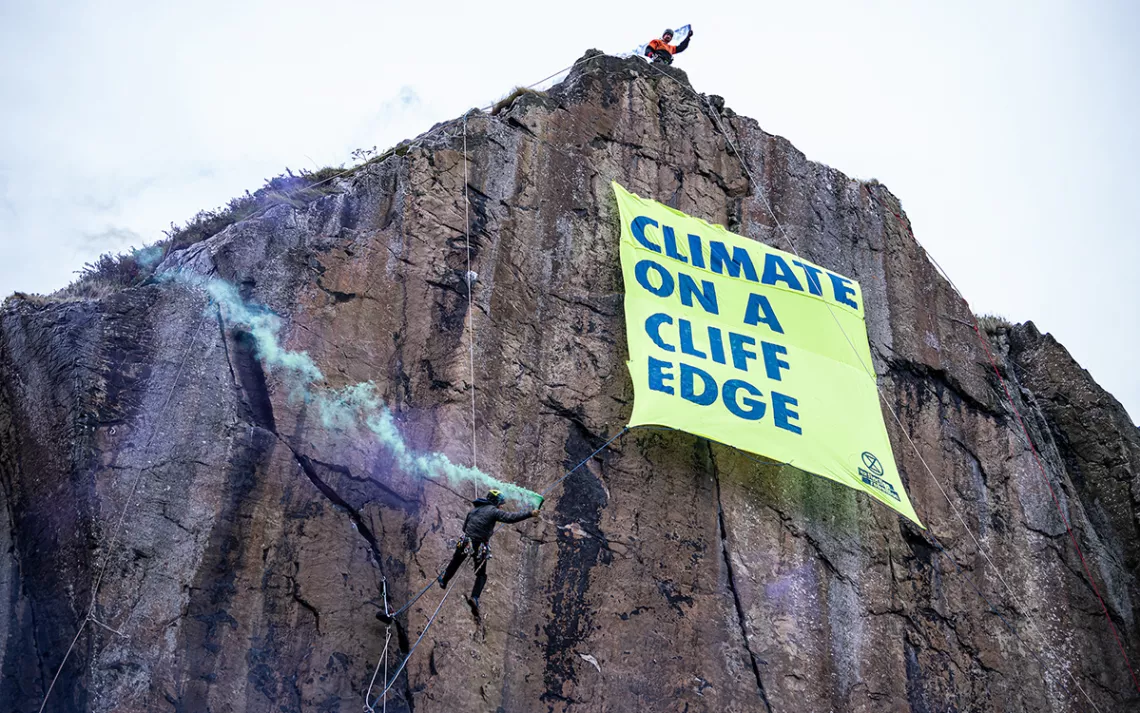
Donald Trump urges you to be a Climate Science denier like him. He says that he makes millions and millions for destroying the planet, Burn, Baby, Burn and Flood, Baby, Flood.Nigel Farage urges you to ignore facts and reality and be a climate science denier like him and his Deputy Richard Tice. He says that Reform UK has received £Millions and £Millions from the fossil fuel industry to promote climate denial and destroy the planet.Experienced climbers scale a rock face near the historic Dumbarton castle in Glasgow, releasing a banner that reads “Climate on a Cliff Edge.” One activist, dressed as a globe, symbolically looms near the edge, while another plays the bagpipes on the shores below. | Photo courtesy of Extinction Rebellion and Mark Richards
This year is now virtually certain to beat 2023 as the hottest year on record, Carbon Brief analysis shows.
It will also be the first full year to surpass 1.5C above pre-industrial levels across the majority of observational records.
In this latest “state of the climate” quarterly update, Carbon Brief finds:
The year 2024 has seen record warm temperatures for seven of the nine months of the year where data is so far available.
The world, as a whole, has warmed approximately 1C since 1970 – and 1.2C to 1.4C since the mid-1800s.
A strong El Niño event contributed to exceptionally high global temperatures early in the year, but record or near-record temperatures persisted despite the fading of El Niño in recent months.
Record global temperatures have been seen across many regions of the planet over the first nine months of the year.
Global temperatures are closely aligned with the projections from climate models.
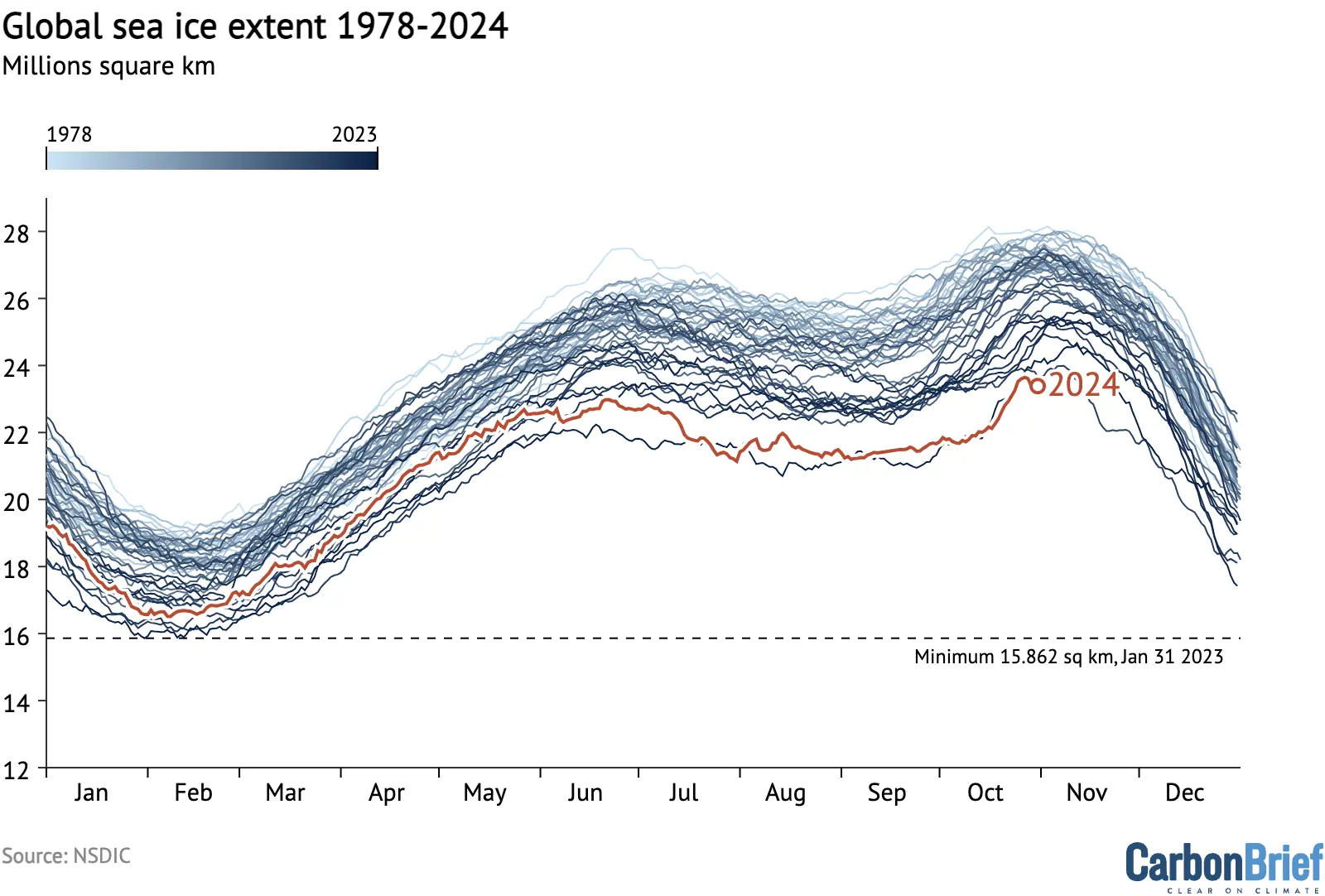
Global sea ice extent is currently at record lows and Antarctic sea ice has spent much of the year at near-record lows – second only to those seen in 2023.
The figure below shows Carbon Brief’s estimate of where 2024 temperatures will end up in each of the groups, based on the year to date and expected El Niño-Southern Oscillation (ENSO) conditions in the tropical Pacific for the remainder of the year.
The dots reflect the best estimate, while the whiskers show the two sigma (95%) confidence interval of the projections. The prior record year (2023 in all groups) is shown by the coloured square. https://interactive.carbonbrief.org/state-of-the-climate/24-Q3/projections.htmlCarbon Brief’s project of 2024 annual global average surface temperatures for each group, along with 95% confidence intervals and prior record (2023) values. 1.5C above pre-industrial (1850-1900) levels is shown by a dashed line. The average projection represents a composite of all five records following the WMO approach. Chart by Carbon Brief.
In all cases, the projected global average temperature for 2024 is virtually certain to exceed the prior record set in 2023.
Three of the five groups (Hadley, Berkeley and Copernicus/ECMWF) are very likely to show annual temperatures exceeding 1.5C above pre-industrial levels (defined here as the 1850-1900 period), while the NASA record has a roughly 40% chance of exceeding 1.5C. Only NOAA’s record is unlikely to show global temperatures above 1.5C this year.
These differences in warming since pre-industrial across different datasets primarily result from choice of ocean records used, as well as differences in approaches to filling in gaps between observations in the early part of the records (e.g. pre-1900s). It reflects the uncertainty in the degree of warming since the mid-1800s, with projected 2024 temperatures ranging from 1.44C (NOAA) to 1.61C (Berkeley Earth).
The figure also provides a composite average of the five different datasets, following the approach used in the sixth assessment report (AR6) from the Intergovernmental Panel on Climate Change (IPCC) and by the WMO. Carbon Brief’s analysis finds that 2024 will be the first year above 1.5C in the composite average.
This provides a way to determine the first year where we can reasonably say that the world has passed that warming level – even though 2023 exceeded 1.5C in the Berkeley Earth dataset and 2024 will not exceed 1.5C in the NOAA dataset.
(It is important to note that exceeding 1.5C in a single year is not equivalent to breaching the Paris Agreement limit. The goal is generally considered to refer to long-term warming – typically over two or three decades – rather than annual temperatures that include the short-term influence of natural fluctuations in the climate, such as El Niño.)
The figure below shows the annual temperatures from each of these groups between 1970 and present, with the year-to-date 2024 temperatures for each record shown as individual points. https://interactive.carbonbrief.org/state-of-the-climate/24-Q3/records_2024_to_date.htmlAnnual global average surface temperatures from NASA GISTEMP, NOAA GlobalTemp, Hadley/UEA HadCRUT5, Berkeley Earth and Copernicus/ECMWF (lines), along with 2024 temperatures to date (January-September, coloured shapes). Each series is aligned by using a 1981-2010 baseline, with warming since pre-industrial based on the IPCC AR6 estimate of warming between pre-industrial and the 1981-2010 period. Chart by Carbon Brief.
There is strong agreement between the different temperature records, with all of them showing approximately 1C warming between 1970 and present. Global temperatures have been around 1.3 above pre-industrial levels in recent years (with a range of 1.2C to 1.4C across the different temperature datasets, reflecting that the differences between them are larger in the 1800s and early 1900s).
As the chart below shows, 2024 (purple line) started out remarkably warm as a result of a strong El Niño event that built in 2023 (red) and peaked near the beginning of the year.
However, global temperatures have remained quite elevated despite the fading of El Niño conditions, setting records through June and remaining quite close to 2023’s exceptional highs in recent months.
Overall, 2024 has set or tied all-time records for seven of the 10 months available to-date in the ERA5 record. (This record uses weather model-based reanalysis to combine lots of different data sources over time.)https://interactive.carbonbrief.org/state-of-the-climate/24-Q3/monthly_global_temperature_anomalies_Q3_2024.htmlTemperatures for each month from 1940 to 2024 from Copernicus/ECMWF ERA5. Anomalies plotted with respect to a 1850-1900 baseline. Chart by Carbon Brief.
While human emissions of CO2 and other greenhouse gases are responsible for effectively all of the Earth’s long-term warming, temperatures in any given year are strongly influenced by short-term variations in the Earth’s climate that are typically associated with El Niño and La Niña events.
These fluctuations in temperature between the ocean and atmosphere in the tropical Pacific help make some individual years warmer and some cooler.
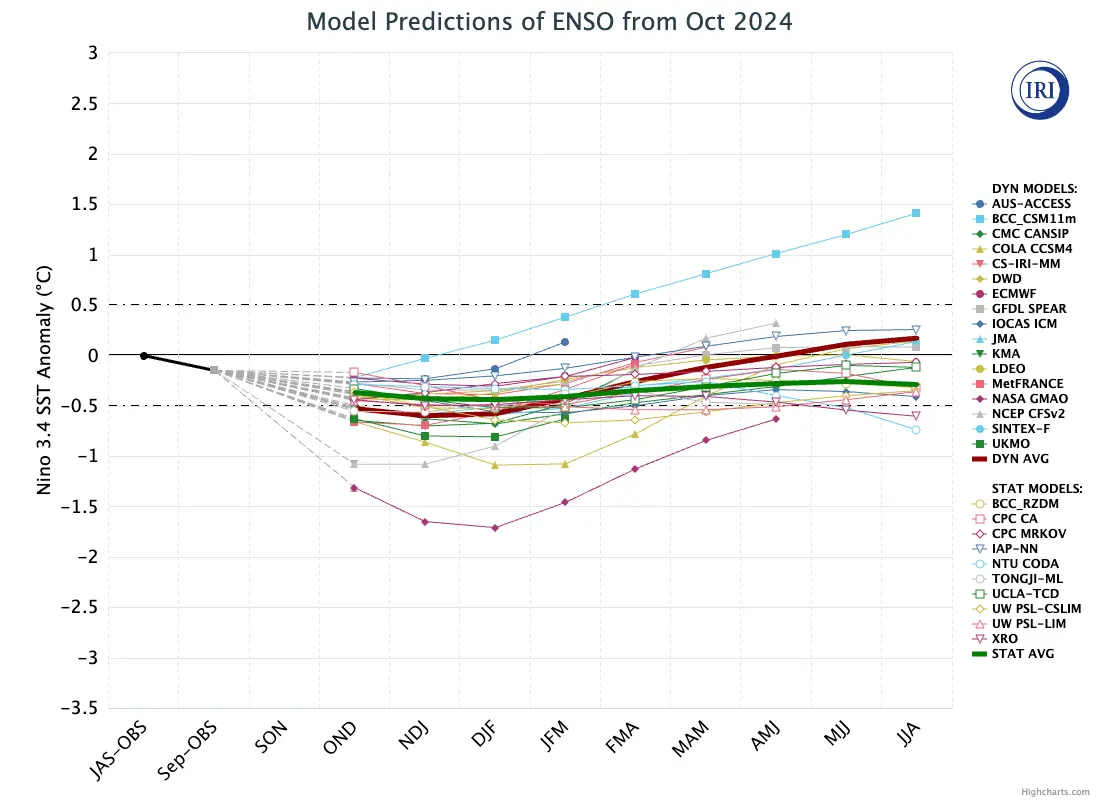
The figure below shows a range of different ENSO forecast models produced by different scientific groups. The values shown are sea surface temperature variations in the tropical Pacific – the El Niño 3.4 region – for three-month periods.
El Niño Southern Oscillation (ENSO) forecast models for overlapping three-month periods in the Niño3.4 region (July, August, September – JAS – and so on) for the remainder of 2024 and then into the spring and summer of 2025. Credit: CPC/IRI ENSO forecast.
Most models expect neutral conditions in the tropical Pacific, with only a few crossing the -0.5C Niño 3.4 sea surface temperature (SST) anomaly that represents the development of a formal La Niña event.
This should result in relatively cooler temperatures in 2025, though it is possible that the year ends up warmer than anticipated given the continuation of high temperatures in recent months – despite the absence of El Niño conditions.
Large areas of record warmth
While global average temperatures are an important indicator of changes to the broader climate system over time as a result of human activities, these impacts will differ as some regions experience more rapid warming or extreme heat events than is reflected in the global average.
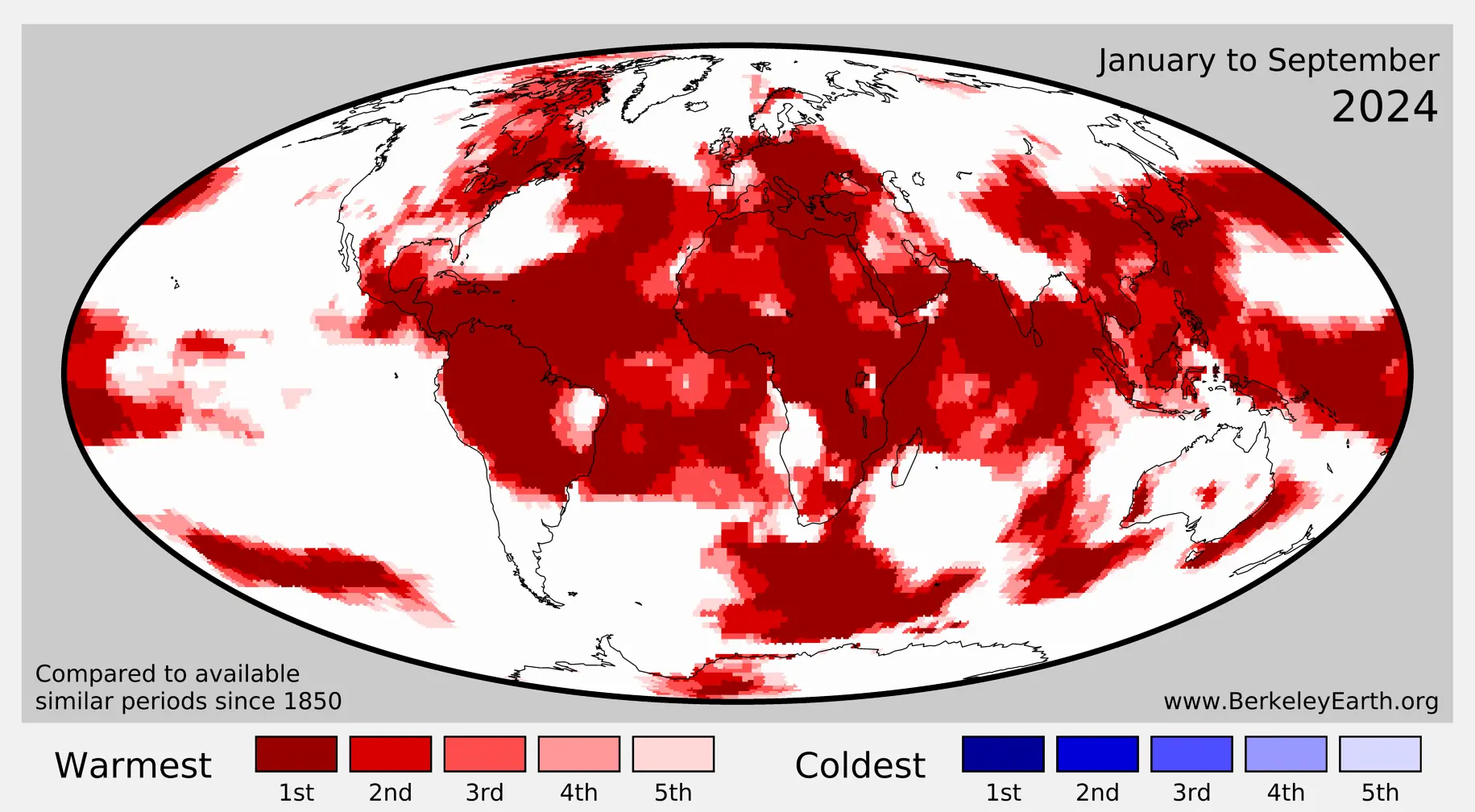
The figure below shows the parts of the world that saw record warm or cold temperatures over the first three quarters of 2024 (January through to September) in the Berkeley Earth dataset compared to all prior years since global temperature record began in 1850.
Map of year-to-date (January-September) regions that set new records (warmest through to fifth warmest). Note that no regions set cold records for the year-to-date in 2024. Credit: Berkeley Earth
Notably, no area on Earth saw record cold (or even the second, third, fourth or fifth coldest temperatures on record). Nearly all of Central America and large parts of South America saw their warmest year to date on record, as did much of eastern Europe, Africa, China, south-east Asia, and Korea.
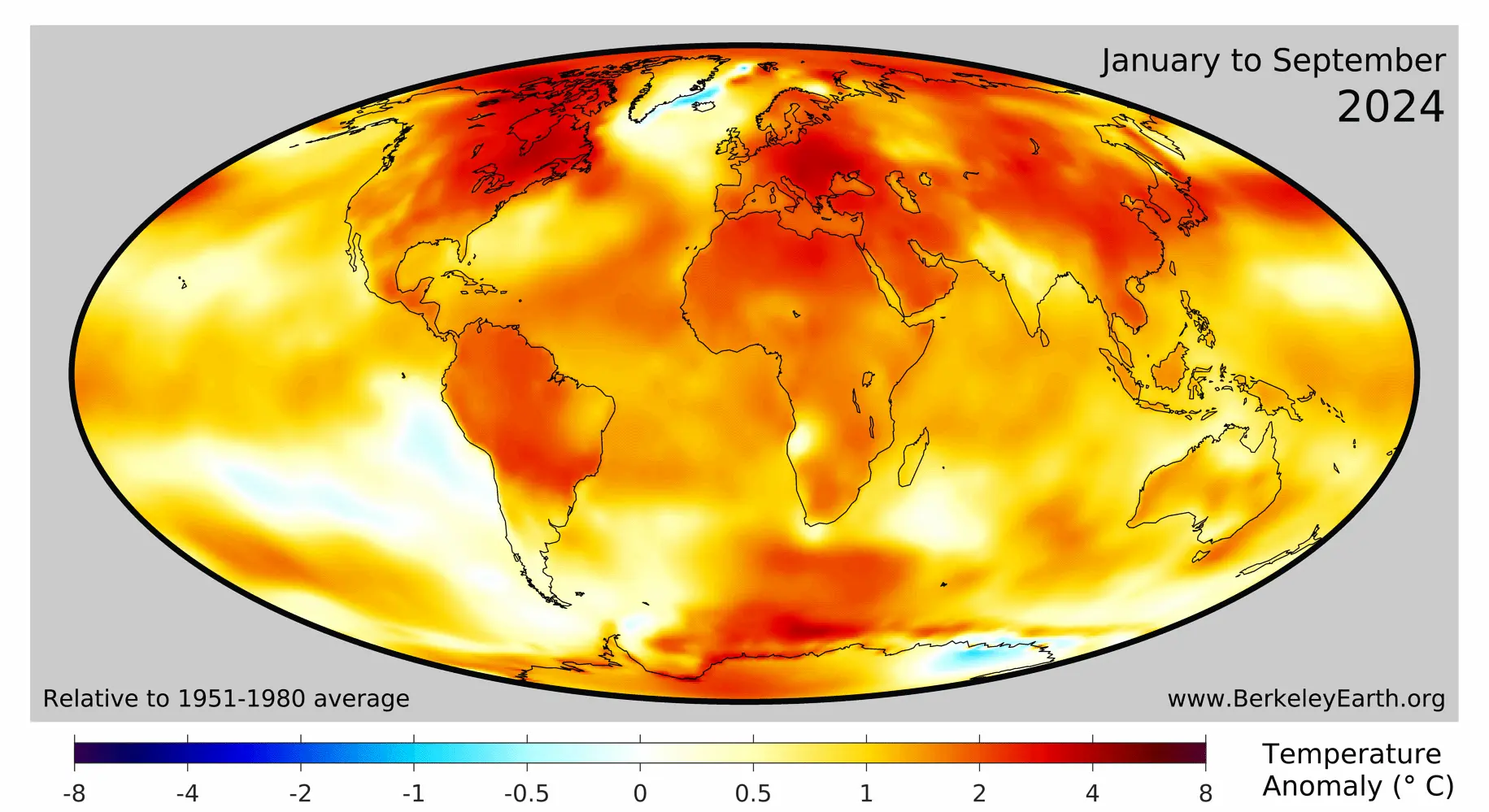
The figure below shows the temperature anomaly over the first nine months of the year compared to the 1951-80 baseline period used by Berkeley Earth. Warming was particularly pronounced over land regions, with many areas already showing warming of 1.5C or 2C above that baseline.
Map of year-to-date (January-September) global surface temperatures. Anomalies are shown relative to the 1951-80 period following the convention used by Berkeley Earth. Credit: Berkeley Earth
Temperatures are tracking climate model projections
Climate models provide physics-based estimates of future warming given different assumptions about future emissions, greenhouse gas concentrations and other climate-influencing factors.
The figure below shows the range of individual models forecasts featured in AR6 – known collectively as the CMIP6 models – between 1970 and 2030, with grey shading and the average projection across all the models shown in black. Individual observational temperature records are represented by coloured lines.https://interactive.carbonbrief.org/state-of-the-climate/24-Q3/model_obs_comps_Q3_2024.htmlTwelve-month average global average surface temperatures from CMIP6 models and observations between 1970 and 2024. Models use SSP2-4.5 forcings after 2015.Anomalies plotted with respect to a 1981-2010 baseline. Chart by Carbon Brief.
While global temperatures were running below the pace of warming projected by climate models for much of the period between 2008 and 2022, the past two years have been closer to the model average.
However, the CMIP6 models may be biassed a bit too warm, with a subset of “hot” models pushing up the average. The IPCC used an approach that weighted models based on how well they reproduced historical temperatures, rather than simply averaging all the models together.
Excluding these hotter models from the analysis results in observations over recent years much closer to the multi-model average and near the centre of the uncertainty range across all models. It also reveals that the past two years – 2023 and 2024 – have been near the upper end of the model range.https://interactive.carbonbrief.org/state-of-the-climate/24-Q3/model%20_obs_comps_filtered_Q3_2024.htmlTwelve-month average global average surface temperatures from CMIP5 models and observations between 1970 and 2024. Models use SSP2-4.5 forcings after 2015. Anomalies plotted with respect to a 1981-2010 baseline. Chart by Carbon Brief.
Record low global sea ice extent
Highly accurate observations of Arctic and Antarctic sea ice have been available since polar-observing satellites became available in the late 1970s.
Arctic sea ice extent during the first three-quarters of 2024 has been below or at the low end of the historical 1979-2010 range, but has not seen any record daily lows.
Antarctic sea ice, on the other hand, set new all-time low records for a few days in July and September, and has generally been the second lowest on record (after 2023) from June onwards.
The figure below shows both Arctic (red) and Antarctic (blue) sea ice extent in 2024, the historical range in the record between 1979 and 2010 (shaded areas) and the record lows (dotted black line).
Unlike global temperature records (which only report monthly averages), sea ice data is collected and updated on a daily basis, allowing sea ice extent to be viewed through to the present day.https://interactive.carbonbrief.org/state-of-the-climate/24-Q3/sea_ice.htmlArctic and Antarctic daily sea ice extent from the US National Snow and Ice Data Center. The bold lines show daily 2024 values, the shaded area indicates the two standard deviation range in historical values between 1979 and 2010. The dotted black lines show the record lows for each pole. Chart by Carbon Brief.
Global sea ice extent is estimated by combining both Arctic and Antarctic sea ice extent. The figure below shows global sea ice extent in each year, with 2024 shown in red. Currently global sea ice extent is at record-low levels, below the prior record for this date set in 2023.
Methodological note
A statistical multivariate regression model was used to estimate the range of likely 2024 annual temperatures for each group that provides a temperature record. This model used the average temperature over the first six months of the year, the average ENSO 3.4 region value during the first nine months of the year and the average predicted ENSO 3.4 value during the last three months of the year to estimate the annual temperatures.
The model was trained on the relationship between these variables and annual temperatures over the period of 1950-2023. The model then uses this fit to predict both the most likely 2024 annual value for each group, as well as the 95% confidence interval. The predicted ENSO 3.4 region values for the last three months of 2024 are taken from the IRI plume forecast.
The percent likelihood of different year ranks for 2024 is estimated by using the output of the regression model, assuming a normal distribution of results. This allows Carbon Brief to estimate what percent of possible 2024 annual values fall above and below the temperatures of prior years for each group, as well as the likelihood of the year exceeding 1.5C in each record.
Experts struggle to explain how rises in sea-surface temperatures have accelerated so quickly. Photograph: PPAMPicture/Getty Images
Rapid ocean warming and unusually hot winter days recorded as human-made global heating combines with El Niño
February is on course to break a record number of heat records, meteorologists say, as human-made global heating and the natural El Niño climate pattern drive up temperatures on land and oceans around the world.
A little over halfway into the shortest month of the year, the heating spike has become so pronounced that climate charts are entering new territory, particularly for sea-surface temperatures that have persisted and accelerated to the point where expert observers are struggling to explain how the change is happening.
“The planet is warming at an accelerating rate. We are seeing rapid temperature increases in the ocean, the climate’s largest reservoir of heat,” said Dr Joel Hirschi, the associate head of marine systems modelling at the UK National Oceanography Centre. “The amplitude by which previous sea surface temperatures records were beaten in 2023 and now 2024 exceed expectations, though understanding why this is, is the subject of ongoing research.”
Humanity is on a trajectory to experience the hottest February in recorded history, after a record January, December, November, October, September, August, July, June and May, according to the Berkeley Earth scientist Zeke Hausfather.
The world is very warm right now. We’re not only seeing record temperatures, but the records are being broken by record-wide margins.
Take the preliminary September global-average temperature anomaly of 1.7°C above pre-industrial levels, for example. It’s an incredible 0.5°C above the previous record.
So why is the world so incredibly hot right now? And what does it mean for keeping our Paris Agreement targets?
Here are six contributing factors – with climate change the main reason temperatures are so high.
1. El Niño
One reason for the exceptional heat is we are in a significant El Niño that is still strengthening. During El Niño we see warming of the surface ocean over much of the tropical Pacific. This warming, and the effects of El Niño in other parts of the world, raises global average temperatures by about 0.1 to 0.2°C.
Taking into account the fact we’ve just come out of a triple La Niña, which cools global average temperatures slightly, and the fact this is the first major El Niño in eight years, it’s not too surprising we’re seeing unusually high temperatures at the moment.
Still, El Niño alone isn’t enough to explain the crazily high temperatures the world is experiencing.
2. Falling pollution
Air pollution from human activities cools the planet and has offset some of the warming caused by humanity’s greenhouse gas emissions. There have been efforts to reduce this pollution – since 2020 there has been an international agreement to reduce sulphur dioxide emissions from the global shipping industry.
It has been speculated this cleaner air has contributed to the recent heat, particularly over the record-warm north Atlantic and Pacific regions with high shipping traffic.
It’s likely this is contributing to the extreme high global temperatures – but only on the order of hundredths of a degree. Recent analysis suggests the effect of the 2020 shipping agreement is about an extra 0.05°C warming by 2050.
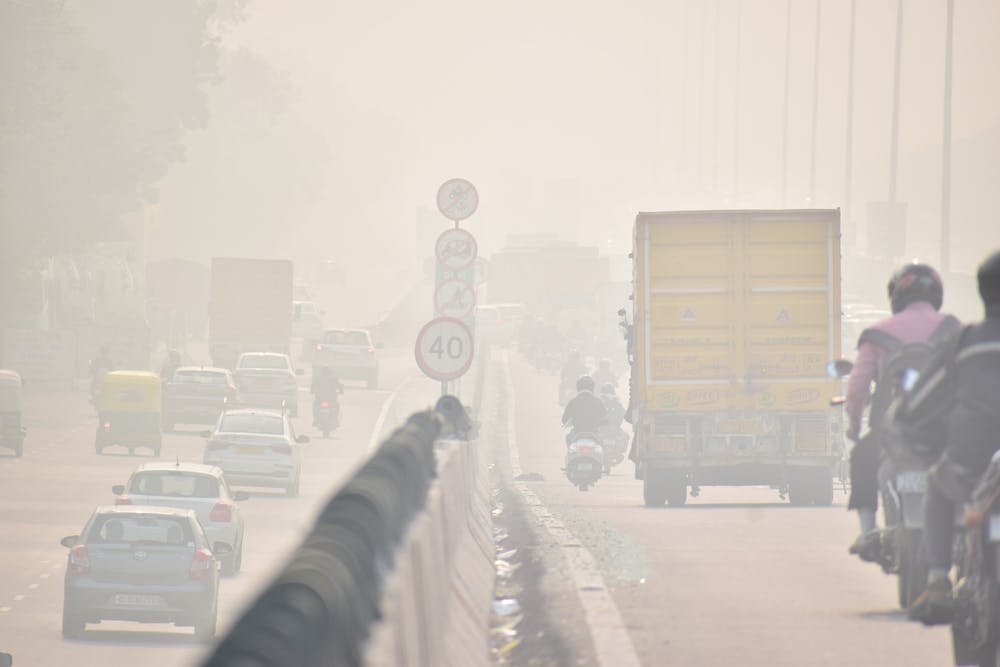
People pass through the rising pollution on the Delhi-Jaipur Expressway in Gurgaon, Haryana, India, on November 12 2021. Shutterstock
3. Increasing solar activity
While falling pollution levels mean more of the Sun’s energy reaches Earth’s surface, the amount of the energy the Sun emits is itself variable. There are different solar cycles, but an 11-year cycle is the most relevant one to today’s climate.
The Sun is becoming more active from a minimum in late 2019. This is also contributing a small amount to the spike in global temperatures. Overall, increasing solar activity is contributing only hundredths of a degree at most to the recent global heat.
4. Water vapour from Hunga Tonga eruption
On January 15 2022 the underwater Hunga Tonga–Hunga Haʻapai volcano erupted in the South Pacific Ocean, sending large amounts of water vapour high up into the upper atmosphere. Water vapour is a greenhouse gas, so increasing its concentration in the atmosphere in this way does intensify the greenhouse effect.
Even though the eruption happened almost two years ago, it’s still having a small warming effect on the planet. However, as with the reduced pollution and increasing solar activity, we’re talking about hundredths of a degree.
5. Bad luck
We see variability in global temperatures from one year to the next even without factors like El Niño or major changes in pollution. Part of the reason this September was so extreme was likely due to weather systems being in the right place to heat the land surface.
When we have persistent high-pressure systems over land regions, as seen recently over places like western Europe and Australia, we see local temperatures rise and the conditions for unseasonable heat.
As water requires more energy to warm and the ocean moves around, we don’t see the same quick response in temperatures over the seas when we have high-pressure systems.
The positioning of weather systems warming up many land areas coupled with persistent ocean heat is likely a contributor to the global-average heat too.
6. Climate change
By far the biggest contributor to the overall +1.7°C global temperature anomaly is human-caused climate change. Overall, humanity’s effect on the climate has been a global warming of about 1.2°C.
The record-high rate of greenhouse gas emissions means we should expect global warming to accelerate too.
While humanity’s greenhouse gas emissions explain the trend seen in September temperatures over many decades, they don’t really explain the big difference from last September (when the greenhouse effect was almost as strong as it is today) and September 2023.
Much of the difference between this year and last comes back to the switch from La Niña to El Niño, and the right weather systems in the right place at the right time.
The upshot: we need to accelerate climate action
September 2023 shows that with a combination of climate change and other factors aligning we can see alarmingly high temperatures.
These anomalies may appear to be above the 1.5°C global warming level referred to in the Paris Agreement, but that’s about keeping long-term global warming to low levels and not individual months of heat.
But we are seeing the effects of climate change unfolding more and more clearly.
The most vulnerable are suffering the biggest impacts as wealthier nations continue to emit the largest proportion of greenhouse gases. Humanity must accelerate the path to net zero to prevent more record-shattering global temperatures and damaging extreme events.
July 2023 was the hottest month ever recorded. And now we know something even more alarming. This week, the European Space Agency announced the July heat pushed the global average temperatures 1.5℃ above the pre-industrial average.
The ominous headlines seemed to suggest we’d blown past the 2015 Paris Agreement goal of holding warming to 1.5℃ – and around a decade earlier than expected.
Is that it? Game over, we lost?
Well, like all things to do with climate change, it’s not quite that simple. The threshold was breached for a month before average temperatures dropped back. And July 2023 isn’t actually the first time this has happened either – the dubious honour goes to February 2016, where we broke the threshold for a few days.
Remind me – why is 1.5℃ so important?
In 2015, the world looked like it was finally getting somewhere with action to combat climate change. After decades of arduous debate, 195 nations adopted the Paris Agreement, a formal but non-binding agreement with a clear goal: limit global warming to 1.5℃ above pre-industrial levels to avoid the worst effects of climate change.
But there’s nothing magic about this number. Every increase worsens the impacts. So why is 1.5℃ so important?
Essentially, it was thrashed out by experts as a threshold representing heightened danger. The Paris Agreement states avoiding dangerous climate change means keeping global temperatures “well below 2℃” of warming, and so the 1.5℃ threshold was born.
What’s a dangerous level of climate change? Basically, levels of warming where the damage becomes so widespread or severe as to threaten economies, ecosystems, agriculture, and risk irreversible tipping points such as the collapse of ice sheets or ocean circulations. More importantly, this level of warming risks pushing us beyond the limits of being able to adapt.
Put simply, the 1.5℃ threshold is the best estimate of the point where we are likely to find ourselves well up the proverbial creek, without a paddle.
Is it too late to act on climate change?
So, should we all just give up?
Not yet.
The global authority on climate change, the Intergovernmental Panel on Climate Change, defines 1.5℃ as a departure from global average temperatures above the 1850 to 1900 (pre-industrial) average.
It’s true that this threshold was exceeded for the month of July 2023. But the climate is more than a single month.
Global average temperatures go up and down every year on top of the global warming trend, because climates naturally vary year-to-year.
The most recent few years have been much warmer than average, but cooler than they could have been because of consecutive La Niña events.
This year, there’s been a significant acceleration in warming, largely due to the brewing El Niño event in the Pacific. El Niño years tend to be hotter.
To iron out year-to-year differences, we typically average data over several decades. As a result, a 2021 IPCC report defines the 1.5℃ threshold as the first 20-year period when we reach 1.5℃ of global warming (based on surface air temperatures).
Recent research shows the best estimate to pass this threshold is in the early 2030s. That means, by IPCC definitions, the average global temperature between the early 2020s and early 2040s is estimated to be 1.5C.
Dangerously close to the red line
All of this means we haven’t yet failed to meet our Paris targets. But the July record shows us we are dangerously close to the line.
As the world keeps heating up, we’ll see more and more months like this July, and move closer and closer to the threshold of 1.5℃, beyond which global warming will become more and more dangerous.
Is it still possible to stay below 1.5℃? Maybe. We would need extremely aggressive cuts to emissions to have a chance. Failing that, we will likely exceed the Paris target within the next decade or so.
Let’s say that happens. Would that mean we just give up on climate action?
Hardly. 1.5℃ is bad. 1.6℃ would be worse. 2℃ would be worse still. 3℃ would be unthinkable. Every extra increment matters.
The closer we stay to the line – even if we cross it – the better.
And there’s now good evidence that even if we overshoot 1.5℃, we could still reverse it by ending emissions and soaking up excess greenhouse gas emissions. It’s like turning around an enormous container ship – it takes time to overcome the inertia. But the sooner we turn around, the better.