Musk, who has recently been considering donating £100m to Farage’s far-right party, pinned a message at the top of his Twitter/X feed which read “Free Tommy Robinson!” earlier this week (Image: Martini)
REFORM UK leader Nigel Farage has branded Elon Musk a hero, despite the latter’s calls for far-right activist Tommy Robinson to be released from prison.
Musk, who has recently been considering a £100 million donation to Farage’s party, pinned a message at the top of his Twitter/X feed which read “Free Tommy Robinson!” earlier this week.
Robinson, real name Stephen Yaxley-Lennon, was jailed in October 2024 for contempt of court after he repeated false claims against a Syrian refugee.
The Clacton-on-Sea MP told conference attendees in Leicester that Musk had “a whole range of opinions, some of which I agree with very strongly, and others of which I am more reticent about”.
Farage expressed his admiration for Musk, calling him a “remarkable new entrant” into American politics who is “very helpful” for Reform and branding the world’s richest man a “hero”.
The billionaire Musk has downplayed the party’s extremist views in posts on X and in an op-ed in a German newspaper.
Mega-billionaire Elon Musk, owner of the social media site X, plans to hold an online audio discussion on the platform with the leader of a far right German party, amplifying the party’s fascist and neo-Nazi ideology.
The discussion between him and Alice Weidel, a leader for Alternative for Germany (AfD) and the party’s candidate for chancellor in the February 23 snap elections, will take place”very soon,” a spokesperson for Weidel said, indicating that it will “definitely” happen before the elections. The German-based newswire agency dpa reported that the talk between Weidel and Musk would occur on January 10.
In response to the planned change, independent journalist James Li asked Musk, “How does the algorithm determine ‘negativity’?”
Elon Musk is facing widespread backlash after announcing upcoming changes to the X social media algorithm that would promote content deemed informative or educational over other types of content.
According to Musk, the planned changes are in response to “Too much negativity” on the social media site. The entrepreneur wrote in a Jan. 3 social media post:
“Our goal is to maximize un-regretted user-seconds. Too much negativity is being pushed that technically grows user time, but not un-regretted user time.”
Users on X characterized the algorithm change as a form of censorship and questioned Musk over who would have a right to determine what constituted ‘negativity’ on the platform.
The upcoming change came days after Musk allegedly removed premium features from several accounts following an online feud over immigrant visas.
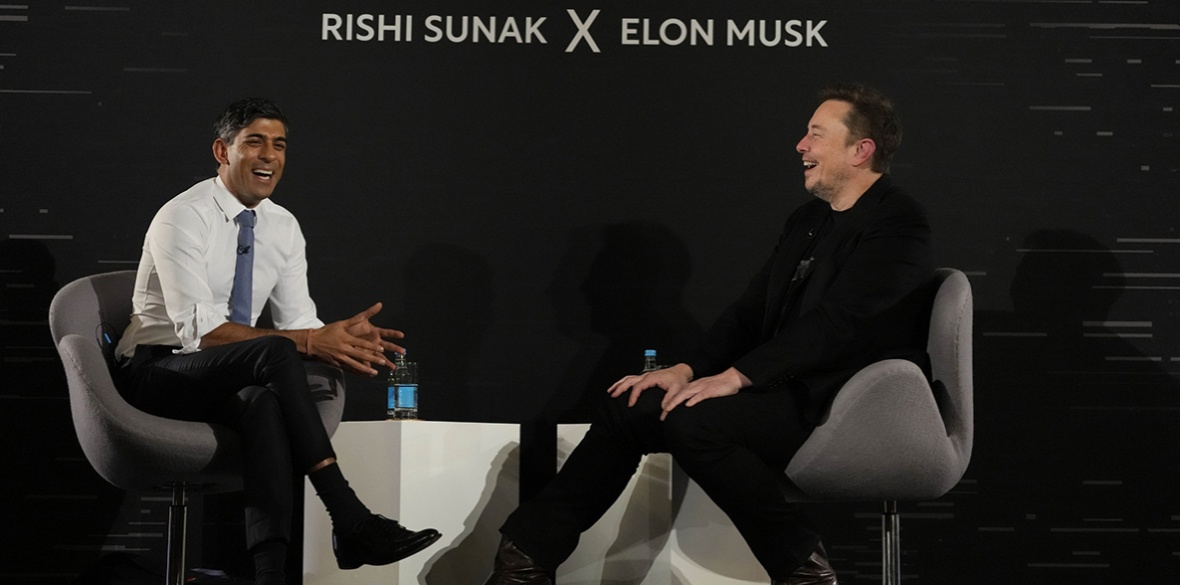
Then prime minister Rishi Sunak (left) and Elon Musk, CEO of Tesla and SpaceX in-conversation in central London, November 2, 2023
…
They [the UK Conservative Party or ‘Tories’] disregard the evidence of the inquiry they set up, which noted that child abuse was endemic in England and Wales (a separate inquiry is ongoing for Scotland); was enabled, covered up or ignored in multiple contexts from churches to schools, council-run care homes and when organised by criminal gangs; and is on the increase because of the rise in online pornography, grooming and pimping.
They instead frame the question in racist terms. Shadow home secretary Chris Philps asks for an inquiry to ask why grooming gangs are “overwhelmingly of south Asian background.” Shadow safeguarding minister Alicia Kearns calls on Phillips to release the “ethnicity data.”
They hype up a far-right trope about Asian, and specifically Muslim, grooming gangs that their own government reports disproved. Musk seizes on this too, retweeting claims Phillips is refusing to open an inquiry into “Muslim grooming gangs.”
Musk’s role is novel and dangerous. The richest man on Earth is incendiary, attacking Phillips as a “rape genocide apologist” and demanding that the King dissolve Parliament to protect children from the Labour government.
So far so Musk, but the Conservatives seem happy to take attack lines from the toxic tech tycoon and turn his transient fixations into British political weather.
Musk is soon to be a high-ranking member of the US government, which Keir Starmer is as ready to fawn on as his predecessors. Labour should stand up to this abuse or it will be humiliated, to the benefit — as Musk intends — of the British far right he openly supports.
That means rejecting the racist weaponisation of the issue.
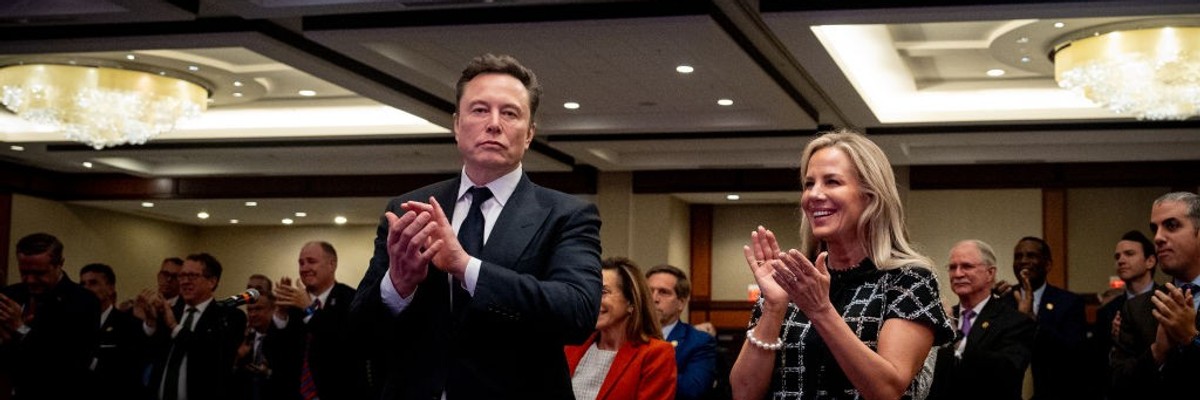
Elon Musk and the wife of House Speaker Mike Johnson (R-La.) applaud during a House Republican Conference meeting on November 13, 2024 in Washington, D.C. (Photo: Andrew Harnik/Getty Images)
“If there was ever a moment when progressives needed to communicate our vision to the people of our country, this is that time,” wrote Sen. Bernie Sanders. “Despair is not an option.”
A Bloomberg analysis of billionaire wealth published Tuesday found that the combined fortunes of the 500 richest people on the planet surpassed $10 trillion this year, a finding that came shortly after U.S. Sen. Bernie Sandersissued an urgent call to action to prevent the emergence of “an oligarchic and authoritarian society.”
The new analysis notes that the world’s top 500 billionaires “got vastly richer” this year with the help of “an indomitable rally in U.S. technology stocks.”
Just eight billionaires—Elon Musk, Mark Zuckerberg, Jensen Huang, Larry Ellison, Jeff Bezos, Michael Dell, Larry Page, and Sergey Brin—added more than $600 billion to their collective wealth in 2024 and accounted for 43% of the $1.5 trillion increase in net worth among the world’s 500 richest people, according to Bloomberg.
“But it was Musk—the so-called ‘first buddy’ of President-elect Donald Trump after unprecedented support for his reelection campaign—who dominated the world’s wealthiest in 2024,” Bloomberg observed, adding that Trump himself also saw his fortune surge to a record high this year, “boosted by the performance of his majority stake in Trump Media & Technology Group Corp.”
Musk’s use of his enormous fortune to influence the U.S. political system—including via his purchase of one of the world’s largest social media platforms and donations to Trump’s 2024 campaign—amplified existing concerns about the corrosive impact of massive wealth concentration on democracy.
“They do not believe in democracy—the right of ordinary people to control their own futures. They firmly believe that the rich and powerful should determine the future.”
In an email to supporters on Monday, Sanders (I-Vt.) called the rapid shift toward oligarchy in the U.S. “the defining issue of our time,” warning that billionaires have come to increasingly dominate not only “our economic life, but the information we consume and our politics as well.”
“A manifestation of the current moment is the rise of Elon Musk, and all that he stands for,” Sanders wrote, pointing to Musk’s outsize influence on the 2024 election and his key role in shaping Trump’s billionaire-dominated Cabinet.
“But it’s not just Musk. Billionaire owners of two major newspapers overrode their editorial boards’ decisions to endorse Kamala Harris, while many others are kissing Trump’s ring by making large donations to his inauguration committee slush fund,” the senator continued. “They do not believe in democracy—the right of ordinary people to control their own futures. They firmly believe that the rich and powerful should determine the future.”
Progressives, Sanders wrote, have a “radically different vision,” one that prioritizes “an economic system based on the principles of justice,” “a vibrant democracy based on one person, one vote,” and making “healthcare a human right.”
“Even though we are not going to succeed in achieving that vision in the immediate future with Trump as president and Republicans controlling Congress, it is important that vision be maintained and we continue to fight for it,” wrote Sanders.
Since Trump’s victory in the 2024 election, Sanders has focused heavily on the need to organize the working class to combat the threat posed by Musk and other far-right billionaires who have amassed obscene wealth and political power.
In his email on Monday, the senator said he intends to “travel, organize, hold events, and create content that reaches people where they are” in the coming weeks as part of the “struggle to determine where we go from here.”
“Will this effort be easy?” asked Sanders. “No, of course it will not. Can it be done? We have no choice. If there was ever a moment when progressives needed to communicate our vision to the people of our country, this is that time. Despair is not an option. We are fighting not only for ourselves. We are fighting for our kids and future generations, and for the well-being of the planet.”