European leaders praise Gaza ceasefire deal, back neocolonial agenda

Spread the love

Original article by Ana Vračar republished from peoples dispatch under a Creative Commons Attribution-ShareAlike 4.0 (CC BY-SA) license.
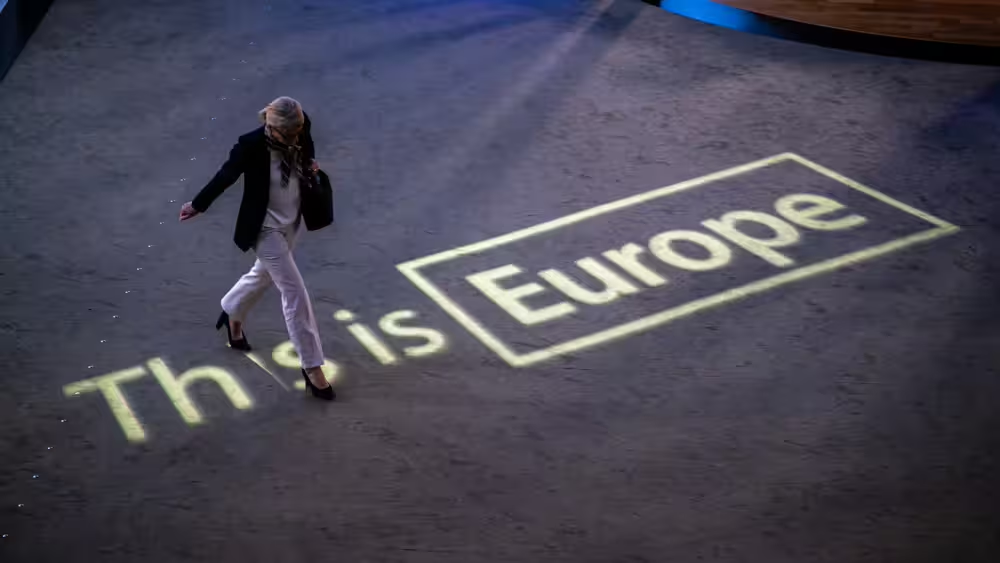
Source: EU – European Parliament/Denis Lomme

Reactions to the Gaza ceasefire deal signal that European leaders are more interested in advancing neocolonial projects than seeing peace in Palestine.

European government leaders were quick to comment on the recently announced ceasefire deal for Gaza – but their enthusiasm seemed directed less toward a possible respite for the people of Palestine after two years of genocide, and more toward a new opportunity to ingratiate themselves with US President Donald Trump. Early statements overflowed with compliments for the US administration, accompanied by brief acknowledgments of other participants in the negotiations, before moving to promises of what Europe intends to do next.

Read more: Israel-Hamas ceasefire deal met with cautious optimism

“The European Union will continue to support the swift and safe delivery of humanitarian aid into Gaza,” European Commission President Ursula von der Leyen wrote on social media. “And when the time comes, we will be ready to help with recovery and reconstruction.” In her remarks, von der Leyen made no mention of the fact that the EU had failed to take decisive action to ensure the delivery of food and medicine to Gaza throughout Israel’s genocide, or that EU member states continued to ship weapons to the occupation power, thus directly contributing to the destruction she now presumably wants to help Gaza recover from.

Similar statements could be found across communication channels of French, British, and other European officials. Some of the most remarkable reactions, however, came from Italy, whose government representatives had previously described President Trump’s plan for Gaza as the only achievable one and poured praise on his diplomatic skills. The same officials had criticized Italian activists who joined the Global Sumud Flotilla to break the sea blockade of the Strip and deliver essential supplies, failing to protect them from an Israeli terrorist attack and kidnapping in international waters.

Prime Minister Giorgia Meloni announced that Italy “is ready to contribute to the stabilization, reconstruction, and development of Gaza,” while Foreign Minister Antonio Tajani posted videos showing Gazans waving Italian flags alongside Palestinian ones, apparently mistaking their recognition of Italian workers and students – who organized two general strikes and mass demonstrations in solidarity with Palestine, bringing inspiration to the whole region – for gratitude toward the Meloni administration itself.

In reality, Italy’s far-right government has continuously backed Israel throughout the genocide and shipped substantial quantities of weapons to the occupation forces. For this reason, Meloni, Tajani, and Defense Minister Guido Crosetto, along with arms manufacturer Leonardo’s CEO Roberto Cingolani, were recently reported to the International Criminal Court for suspicion of complicity in crimes against humanity.

Read more: Workers shut down Italy again in solidarity with Palestine

Reactions from the left were more skeptical of what lies ahead. Jean-Luc Mélenchon of France Unbowed (La France Insoumise) commented: “After so many deaths and months of genocide, a ceasefire could take place in Gaza. How could one not rejoice at this? […] But once again, the Palestinians will have to endure a new foreign political order. And can one really believe Trump? From our continent, let us lend lucid and vigilant support to the ceasefire while remaining attentive and mobilized.”

Progressive politicians in Europe also criticized the EU’s enthusiasm to define Gaza’s political future. Marc Botenga, MEP for the Workers’ Party of Belgium (PTB-PVDA), warned: “The EU needs to pressure Israel to respect the ceasefire, lift the humanitarian blockade, withdraw from the Gaza Strip and other occupied Palestinian territory.” Reacting to EU High Representative for Foreign Affairs Kaja Kallas, who suggested that the bloc should have a seat at the table while the management of Gaza is discussed, Botenga added: “Europe should stand for Palestinian self-determination instead of fighting to be part of a neocolonial administration.”

Original article by Ana Vračar republished from peoples dispatch under a Creative Commons Attribution-ShareAlike 4.0 (CC BY-SA) license.

Experiencing issues with this image not appearing. I suspect because it's so critical of Zionist Keir Starmer's support of and complicity in Israel's genocides.
Genocide denier and Current UK Prime Minister Keir Starmer is quoted that he supports Zionism without qualification. He also confirms that UK air force support has been essential in Israel’s mass-murdering genocide. Includes URLs https://www.declassifieduk.org/keir-starmers-100-spy-flights-over-gaza-in-support-of-israel/ and https://youtu.be/O74hZCKKdpA

Continue ReadingEuropean leaders praise Gaza ceasefire deal, back neocolonial agenda

How MAGA Lobbying is Undermining EU Climate Rules

Spread the love

Original article by Sam Bright republished from DeSmog

Series: MAGA

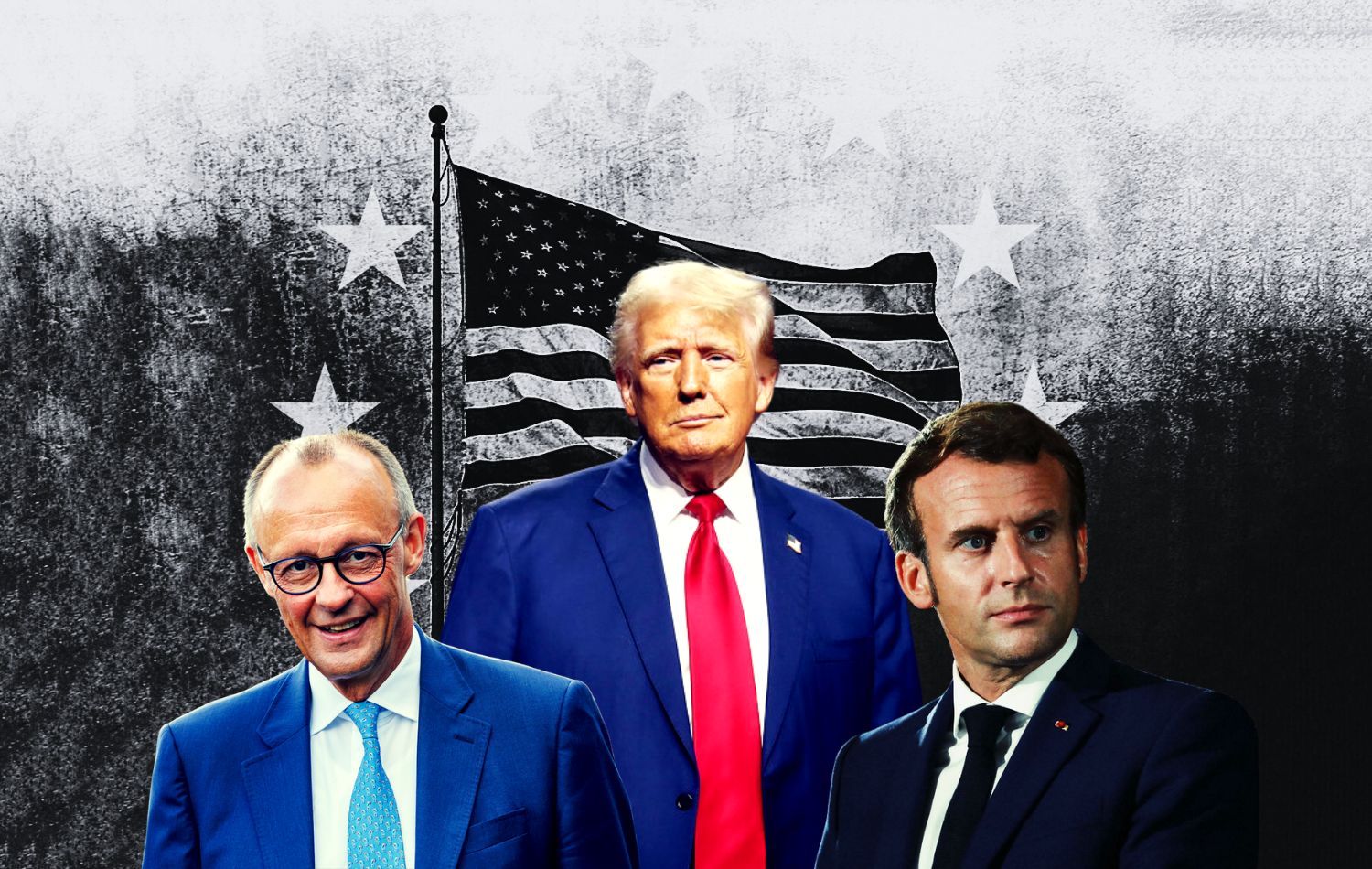
German Chancellor Friedrich Merz, U.S. President Donald Trump, and French President Emmanuel Macron. DeSmog collage. Credit: Faces of the World / Flickr (Macron), Steffen Prößdorf (Merz), Gage Skidmore / Flickr (Trump)

European leaders are bending to the demands of U.S. climate science deniers.

“The CSDDD is the greatest threat to America’s sovereignty since the fall of the Soviet Union,” the Heartland Institute, a pro-Trump U.S. think tank, tweeted on 31 March.

The Heartland Institute is one of the world’s leading climate science denial groups. It has helped to draft Donald Trump’s anti-climate policies, which have seen the president pledge to “drill baby drill” for more fossil fuels and once again pull the U.S. out of the flagship 2015 Paris Agreement.

Over recent months – along with a host of other Trump allies – the Heartland Institute has set its sights on a new target: the EU’s Corporate Sustainability Due Diligence Directive (CSDDD).

This vague acronym belies the potentially transformative impact of the new law. In its original form, the CSDDD sought to require large companies – and those in “high risk” sectors – trading in the EU to address human rights and environmental issues in their own operations and in their supply chains. High turnover companies would also have been forced to adopt a plan to align with the Paris Agreement, including setting emissions reduction targets.

The Heartland Institute and its anti-climate, anti-regulation peers are vocal opponents of the law – and launched an aggressive campaign to water it down, or even to see it scrapped entirely.

These groups, which are all part of the ‘Make America Great Again’ (MAGA) ecosystem, view the CSDDD as symbolic of the way in which “woke” governments are attempting to force citizens and global corporations to conform to a pro-diversity, pro-environment agenda.

Following Trump’s election in November, these MAGA groups wasted no time in formulating their plans to oppose this perceived agenda.

They focused in particular on diversity, equity and inclusion (DEI) initiatives, which attempt to create workplaces free from bias – and environmental, social and governance (ESG) schemes, which try to ensure that organisations are guided by responsible and sustainable practices, not just profit.

In December, barely a month after Trump’s victory, the Heritage Foundation – the group that wrote the key ‘Project 2025’ blueprint for the president’s second term – published a report entitled: “ESG, DEI, and What to Do About Them”.

In the report, the Heritage Foundation described ESG and DEI as “pernicious”, and called the CSDDD “a serious problem”.

Two months later, the State Financial Officers Foundation – an influential network of Republican finance officials – wrote an open letter calling on the new administration to “investigate” the CSDDD, claiming that the EU’s directives are based on “unscientific assumptions about the nature of climate change impacts” and “will force companies to incriminate themselves”.

This quickly filtered through to Trump’s Cabinet. On 12 February, Howard Lutnick, the president’s pick for commerce secretary, told a Senate committee that the CSDDD threatened to place “significant burdens” on U.S. companies, and that the Trump administration was exploring the use of “commercial tools” to mount a counter-attack against the EU’s environmental regulations.

Soon this rhetoric made its way to the White House. In March, as part of the worldwide tariffs implemented by the Trump administration, the president called the EU “one of the most hostile and abusive taxing and tariffing authorities in the world”.

But the EU hasn’t stood firm in the face of Trump’s war of words.

The EU has already announced that it will be scaling back the CSDDD and delaying its implementation. The number of companies within scope has been reduced by 80 percent. The firms in question will only be required to file due diligence reports every five years, and won’t be required to investigate the ESG operations of their indirect business partners. The implementation of the law has also been postponed until 2028.

But Trump’s MAGA hardliners are still not satisfied. In April, the Heartland Institute released an open letter signed by 31 other groups, calling for Congress and the Trump administration to “take immediate steps to counter the CSDDD’s implementation”, including “if necessary, imposing retaliatory trade policies that punish EU nations for eroding America’s sovereignty, freedoms, and prosperity.”

This backlash is now influencing European leaders. In late May, French President Emmanuel Macron and German Chancellor Friedrich Merz called for the CSDDD to be scrapped entirely. They claim it must be abandoned in order to defend the “competitiveness” of European corporations, with Macron stating that Europe must “synchronise with the U.S. and the rest of the world.”

This judgement signifies the appeasement of anti-climate pressure groups that are ideologically opposed to clean energy and climate science.

The Heartland Institute has denied that humans are driving climate change, which it has called a “delusion”, while the Heritage Foundation’s Project 2025 document urged Trump to “dismantle the administrative state”, reverse policies on climate action, slash restrictions on fossil fuel extraction, scrap state investment in renewable energy, and gut the Environmental Protection Agency.

If the EU waters down its climate policies in response to Trump’s pressure, it will have helped to send Project 2025 global.

The ‘Climate Cartel’

It’s unclear whether these MAGA groups – and the Trump administration – will ease up on the EU if the CSDDD is ditched entirely. They may simply use it as evidence that European lawmakers will buckle under enough pressure.

Indeed, MAGA’s opposition to the CSDDD is part of a multi-pronged campaign that seeks to dismantle global climate initiatives pioneered by both governments and corporations.

Much of the original groundwork for this campaign was undertaken by the U.S. House Judiciary Committee and its chair Jim Jordan, a leading Trump supporter.

Last year, Jordan’s committee produced reports – and demanded evidence from major corporations – on a supposed “climate cartel” of “left-wing activists and major financial institutions”.

The committee alleged that some of the world’s biggest asset managers – that have questionable climate commitments – are conspiring to force American companies to decarbonise against their wishes.

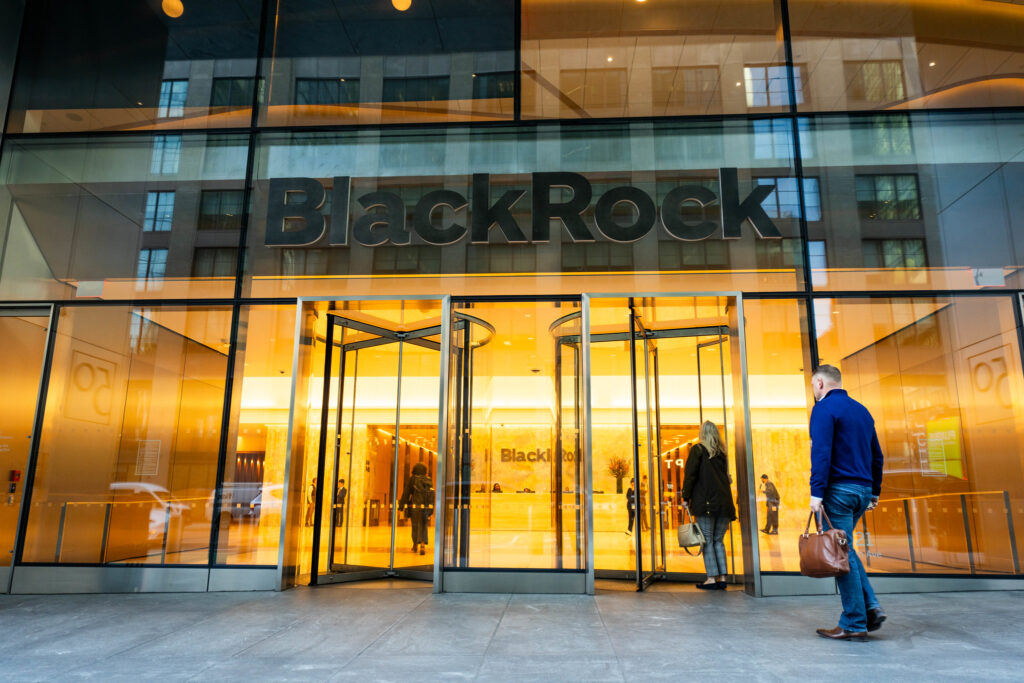
BlackRock’s New York office. Credit: Anthony Quintano / Flickr (CC BY 2.0)

As part of its “investigation”, the committee demanded information from more than 130 U.S.-based companies, retirement and pension programmes, as well as 60 U.S.-based asset managers.

In November, 11 Republican-led states sued BlackRock, Vanguard, and State Street – three of the world’s biggest asset managers – over their ESG policies. In West Virginia and Oklahoma, nearly two dozen banks have been barred from public contracts for trying to divest from fossil fuels.

These actions, along with the anti-climate rhetoric of Donald Trump, have had a chilling effect. In February last year, BlackRock, State Street, and JP Morgan Asset Management withdrew from Climate Action 100+, an investor-led initiative that works to ensure the world’s largest greenhouse gas emitters take action on climate change.

Fast forward a year, and a growing list of major U.S. corporations are either cancelling or delaying their sustainability reports – designed to show how they are meeting their climate commitments.

And a new story from the investigative outlet CORRECTIV today reports that German insurance giants and investment firms are withdrawing from climate agreements, while companies are quietly shelving their sustainability policies, amid the anti-ESG backlash orchestrated by Trump and his acolytes.

As one sustainability expert at a financial firm told CORRECTIV: “We have to be careful not to harm the cause by sticking our necks out and becoming a target in the U.S.”

This article was produced with support from the European Media and Information Fund, managed by the Calouste Gulbenkian Foundation. The sole responsibility for any content supported by the European Media and Information Fund lies with the author(s) and it may not necessarily reflect the positions of the EMIF and the Fund Partners, the Calouste Gulbenkian Foundation and the European University Institute.

Original article by Sam Bright republished from DeSmog

Continue ReadingHow MAGA Lobbying is Undermining EU Climate Rules

Peace campaigners slam continued rise in British military spending

Spread the love

https://morningstaronline.co.uk/article/peace-campaigners-slam-continued-rise-in-british-military-spending

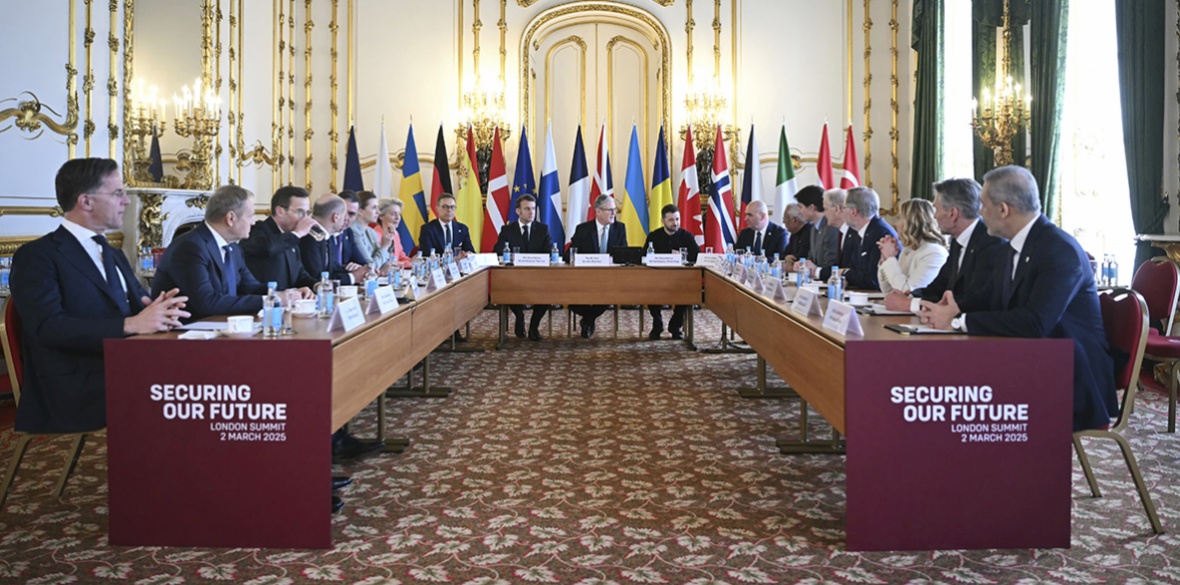
Prime Minister Keir Starmer (centre) hosts the European leaders’ summit to discuss Ukraine, at Lancaster House, London, March 2, 2025

PEACE campaigners slammed the continued rise in British military spending today as Sir Keir Starmer said Britain was ready to send troops to police a Ukrainian peace.

The Prime Minister hosted a summit at London’s Lancaster House today with European leaders, Canadian Prime Minister Justin Trudeau, Turkish Foreign Minister Hakan Fidan, Nato secretary-general Mark Rutte and the presidents of the European Commission and European Council, all showing their support for Ukrainian President Volodymyr Zelensky, who also attended.

The summit followed an extraordinary row between Mr Zelensky, US President Donald Trump and Vice-President JD Vance last week at the White House.

The US was not represented at the summit — underlining the deepening rift between European leaders and Washington.

Sir Keir told leaders it was time for them to step up and continue to support Kiev and meet a “once in a generation moment” for the security of Europe.

After the meeting he said a “coalition of the willing” could be sent to Ukraine to police a ceasefire, with British “troops on the ground and planes in the air,” but acknowledged that not all countries present had been willing to commit. He did not say which had and which hadn’t.

Article continues at https://morningstaronline.co.uk/article/peace-campaigners-slam-continued-rise-in-british-military-spending

Continue ReadingPeace campaigners slam continued rise in British military spending

Europe humiliated, but still subservient, after remarks from US officials

Spread the love

Original article by Ana Vračar republished from peoples dispatch under a Creative Commons Attribution-ShareAlike 4.0 (CC BY-SA) license.
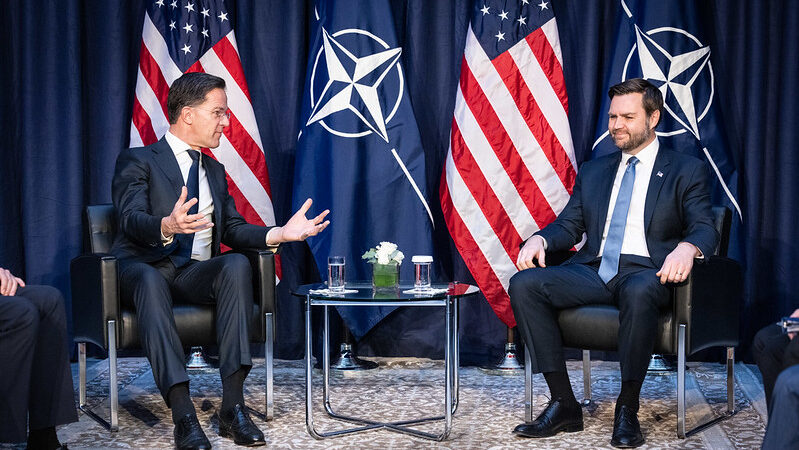
NATO Secretary General Mark Rutte meets with US Vice President JD Vance. Source: NATO/Flickr

Statements by US Vice President Vance and Defense Secretary Hegseth on the Ukraine war and transatlantic relations have left European leaders in shock

“If American democracy can survive ten years of Greta Thunberg’s scolding, you guys can survive a few months of Elon Musk,” US Vice President JD Vance told European leaders at last week’s Munich Security Conference. His remarks came during a draining week for those leaders, as Trump officials announced peace talks with Russian authorities—without European or Ukrainian involvement—while signaling they expect Europe to handle peacekeeping and being paid for their support in minerals from Ukraine.

Speeches by Vance and Defense Secretary Pete Hegseth threw European leaders into disarray, seen as not-so-subtle indications of a cooling in transatlantic relations. These interventions attacked everything from the EU’s efforts to regulate social media platforms to its approach to far-right parties in parliamentary life. In response, French President Emmanuel Macron called for an emergency summit of select regional powers on Monday, February 17 – just a day before US and Russian representatives are expected to meet in Saudi Arabia.

While Ukrainian officials and some European leaders have insisted they will not accept any deal that excludes Ukraine’s direct involvement, their stance appears to carry little weight.

Read more: Far-right surge or status quo? Understanding the 2024 European elections

At the same time, the new US administration has increased pressure on its European allies, demanding a ramping up of their defense budgets and taking on the responsibility of a potential peacekeeping mission in Ukraine. This comes as no surprise: a number of US officials, including Donald Trump himself, have said Europe does not contribute enough to NATO and essentially freeloads off the US. Vance’s speech in Munich only reaffirmed this stance, ultimately reducing high-ranking figures to tears over the apparent breakup between allies.

While the focus of European reactions to recent US statements has been on Ukraine, many leaders have admitted that more is at stake. “Yes, it is about Ukraine – but it is also about us,” European Commission President Ursula von der Leyen wrote on X. Unfortunately, the conclusion she drew going further is upsetting: “We need an urgency mindset. We need a surge in defense. And we need both of them now.”

Unlike healthcare, education, or social programs—sectors where European governments are consistently told their budgets must remain limited—military spending is expected to face no such barriers. Many European countries have already embraced the shift, with Polish officials, for example, boasting about spending close to 5% of their GDP on defense and warning of looming “wider wars” to convince other states in the region to do the same.

Read more: Elon Musk and AfD’s Alice Weidel’s align ahead of elections in Germany

Despite the apparent fracture in US-Europe relations, European leaders have shown no inclination to rethink their dependence on Washington. Instead, most have done exactly what the Trump presidency wants them to do and swiftly pledged to increase military spending. Some have even already expressed willingness to deploy troops for peacekeeping in Ukraine. What remains absent from their reactions is any consideration of a future less dictated by US interests and more aligned with the needs of the people living in Europe.

Since the beginning of the war three years ago, activists have urged Europe to reject NATO’s warmongering and prioritize peace in Ukraine alongside social justice at home. Instead, the coming surge in military budgets will almost certainly coincide with cuts to public services, further fueling the rise of the far-right—a political force that Trump officials, including Vance and Elon Musk, have (more or less) openly backed during interventions in Europe. From this perspective, unlike the conservative circles who “survived ten years of ’s scolding,” Europe’s liberal elite is unlikely to emerge from its current crisis unscathed. Whether their refusal to acknowledge the failure of their anti-people policies will push the entire region into the hands of parties like Brothers of Italy and Alternative for Germany remains to be seen.

Original article by Ana Vračar republished from peoples dispatch under a Creative Commons Attribution-ShareAlike 4.0 (CC BY-SA) license.
Elon Musk urges you to be a Fascist like him, says that you can ignore facts and reality then.
Power-mad orange gasbag Donald Trump says Burn, Baby, Burn.

Hi GT ;)

Continue ReadingEurope humiliated, but still subservient, after remarks from US officials

European leaders rewrite WWII history on Auschwitz liberation anniversary

Spread the love

Original article by Ana Vračar republished from peoples’ dispatch under a Creative Commons Attribution-ShareAlike 4.0 (CC BY-SA) license.
Red Army soldiers with prisoners of Nazi concentration camp, 1945. Source: Wikimedia Commons

As European leaders gathered at Auschwitz to commemorate 80 years since its liberation, they upheld a revisionist narrative that downplays the role of the Red Army in defeating Nazism

On January 27, 1945, soldiers of the Soviet Red Army liberated Auschwitz, the Nazi concentration camp where over one million people—overwhelmingly Jews—were murdered. Eighty years later, European leaders gathered in Poland, now home to the Auschwitz memorial, to hear survivor testimonies and reaffirm the commitment to ensuring such atrocities never happen again.

Yet this year’s commemoration came with a blazing omission. Despite the USSR’s vital role in defeating Nazi Germany and its allies—at the cost of over 20 million Soviets’ lives—there were no representatives of the Russian Federation at Auschwitz. In its pursuit of punishing Russia for the war in Ukraine, the European Union (EU) has virtually erased the Red Army’s contributions from the narrative. Leaders like Ursula von der Leyen and Giorgia Meloni issued statements of remembrance while avoiding any mention of the USSR. Only left politicians dared to talk about the full picture in their messages on the day of remembrance.

Read more: Zagreb’s anti-fascist flame: a decade of liberation celebrations and resistance

These events have to be read as part of a broad revisionist trend spreading through Europe, in which far-right parties, such as Meloni’s Brothers of Italy and France’s National Rally, are using anti-communist tropes to rewrite history. This trend has taken root among mainstream parties as well. Just days before Holocaust remembrance day, the European Parliament adopted a resolution condemning Russia for “exploiting the narrative of the ‘liberation of Europe from Nazism.’” The text of the resolution also criticized the restoration of Lenin’s monuments in Ukraine and called for a “pan-European” memorial for “victims of the 20th century totalitarian regimes,” a vocabulary that aims to equate fascism and communism.

In what can only be described as a severe case of historical amnesia, the parliamentaries proposed a ban on “both Nazi and Soviet communist symbols” across the EU. As some have pointed out, implementing such a ban would complicate commemorations like the one on Monday, given the prominence of Soviet uniforms in archival photographs of liberation.

While the EU is entertaining itself with erasing communism’s role in defeating Nazism in World War II, it seems to have learned extremely little from the Holocaust itself. The first phase of a ceasefire in Gaza had not even begun when Polish authorities announced they would allow Israeli Prime Minister Benjamin Netanyahu to attend the Auschwitz commemoration—despite an International Criminal Court warrant for his arrest on war crimes charges. Though Netanyahu ended up not attending himself, the mere possibility highlights Europe’s willingness to overlook crimes against humanity if committed by its current allies.

“Laying claim to the memory of one genocide in order to justify another genocide is morally and politically unacceptable,” historian Enzo Traverso said in a recent interview with Jacobin, commenting on Europe’s reactions to the genocide in Gaza. “The memory of Auschwitz should be mobilized to impede new genocides, not to justify them.”

Read more: Elon Musk and AfD’s Alice Weidel’s align ahead of elections in Germany

By refusing to acknowledge the full history of Nazism’s defeat in 1945—especially the contributions of the Red Army and communist movements—Europe only fuels the rise of the far-right. Parties like Alternative for Germany (AfD), National Rally and Brothers of Italy may avoid explicit antisemitism in their platforms, but their policies thrive on the same hatred and violence that drove the Holocaust. As these parties gain electoral ground, the slogan “Never again is now” is becoming increasingly difficult to believe.

Original article by Ana Vračar republished from peoples’ dispatch under a Creative Commons Attribution-ShareAlike 4.0 (CC BY-SA) license.
Continue ReadingEuropean leaders rewrite WWII history on Auschwitz liberation anniversary