Subjecting protestors to greater demonisation through the redefining of ‘extremism’ is just another chapter in the Tories’ painful history of hypocrisy.
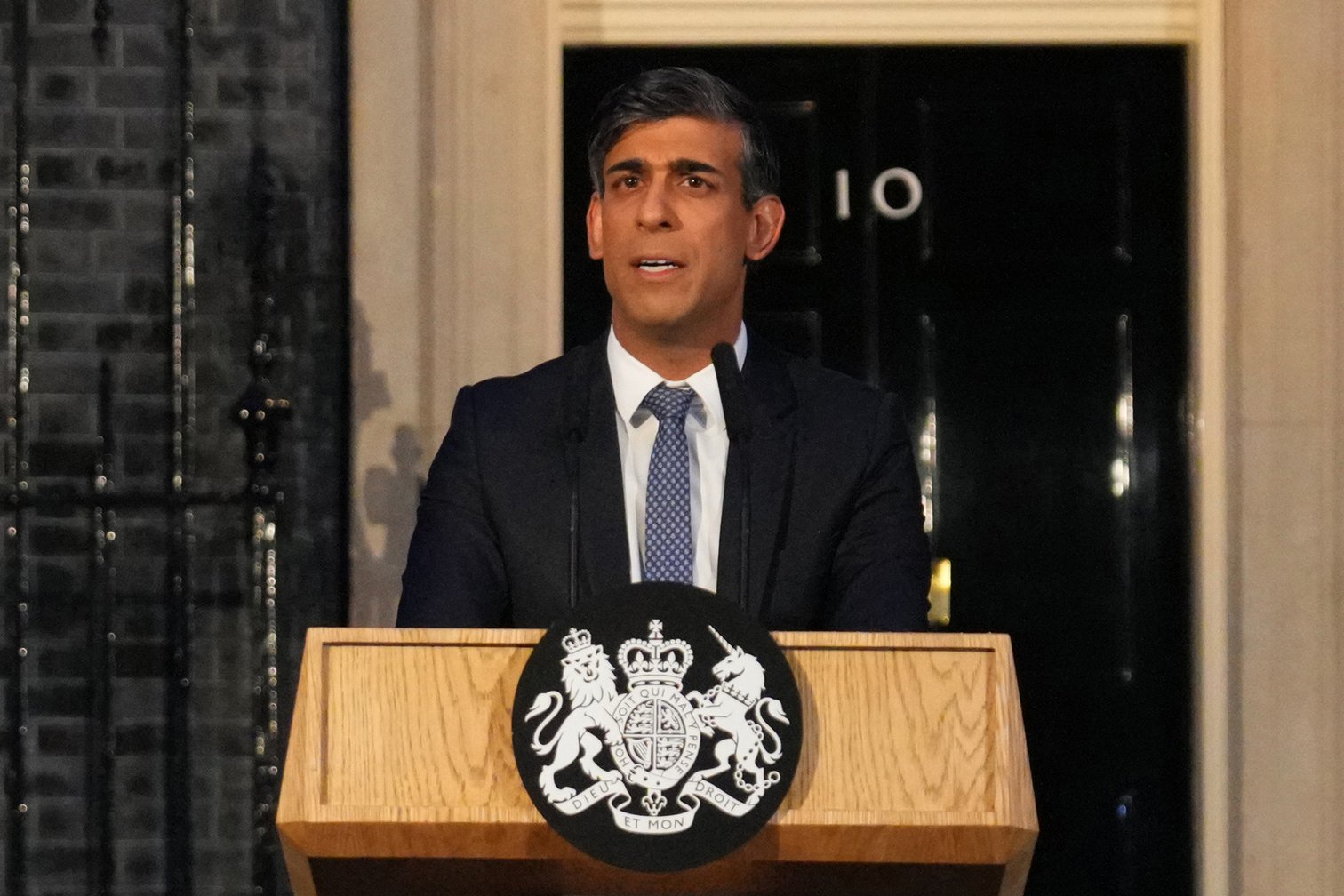
If you paid much attention to Rishi Sunak’s speech outside No. 10 on March 1, you would think our country had been overrun by anarchists and fanatics. Extremist groups are ‘trying to tear us apart,’ said the PM, decrying a ‘shocking increase in extremist disruption and criminality’ in Britain since October 7. Michael Gove has been at it too. Some pro-Palestinian events have ‘been organised by extremist organisations,’ claimed the Communities Secretary. These are the same protests incidentally that have been acknowledged by the Metropolitan Police as disciplined, orderly, and professionally-managed.
The anarchy-obsessed Conservative government now has Gove announcing a new definition of extremism. As part of Sunak’s drive to crack down on Islamist extremists and far-right groups, the revised definition identifies extremism as an ideology that “undermines the rights or freedoms of others.” It differs from the old definition in that there has been a shift in focus from action to ideology. The previous definition, which was introduced in 2011, said extremism was the “vocal or active opposition to fundamental British values, including democracy, the rule of law, individual liberty and mutual respect and tolerance of different faiths and belief.”
…
The same week that Gove announced his controversial new anti-extremism measures, a revelation hit the press that suggested the Tories’ biggest donor is an extremist himself, who upholds the most abhorrent views. Claims were made that Frank Hester, the healthcare technology business magnate who has donated £10m to the Tories in the past year, had said Diane Abbott made people “want to hate all black women” and “should be shot.”
The alleged comments mark a depressing new low for British politics. And the story gets worse. When asked whether the Tories should hand back the £10m donation, energy minister Graham Stuart told reporters that it would be wrong for a businessman to be ‘cancelled’ for his comments, and that the party should ‘welcome’ such donations.
You want groups that fit this definition: “Extremism is the promotion or advancement of an ideology based on violence, hatred or intolerance, that aims to: 1 negate or destroy the fundamental rights and freedoms of others; or 2 undermine, overturn or replace the UK’s system of liberal parliamentary democracy and democratic rights; or 3 intentionally create a permissive environment for others to achieve the results in (1) or (2).” source: UK ministers and officials to be banned from contact with groups labelled extremist.
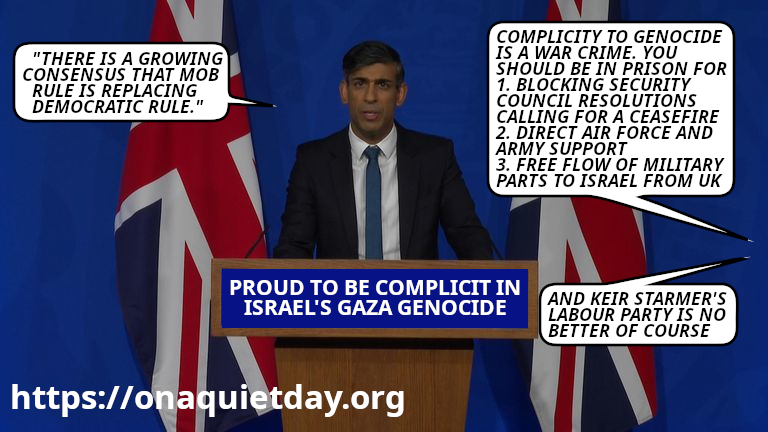
UK Prime Minister Rishi Sunak claims “There is a growing consensus that mob rule is replacing democratic rule. And we’ve got to collectively, all of us, change that urgently.” Sunak is recognised as a war criminal due to his complicity in genocide.
The UK Conservative Party and the UK Labour party certainly meet this definition. Promotion or advancement of an ideology based on violence, hatred or intolerance.
Where shall I start? Both the Conservative and Labour party promote and advance Zionism, an ideology based on violence, hatred and intolerance that also meets the secondary condition 1. (aims to) negate or destroy the fundamental rights and freedoms of others. Many rights are denied: the right to life and the right to be free from degrading or inhuman treatment. The Conservative and Labour parties are complicit in genocide, I’m not sure that you can get more extremist than that.
Then there’s the persecution of Julian Assange. That’s the advancement of an ideology based on intolerance aiming to deny Assanges fundamental rights and freedoms. That’s both the Conservative party and UK’s Labour party again. There are strong indicators that the Labour party’s Keir Starmer was directly involved in Assange’s early persecution.
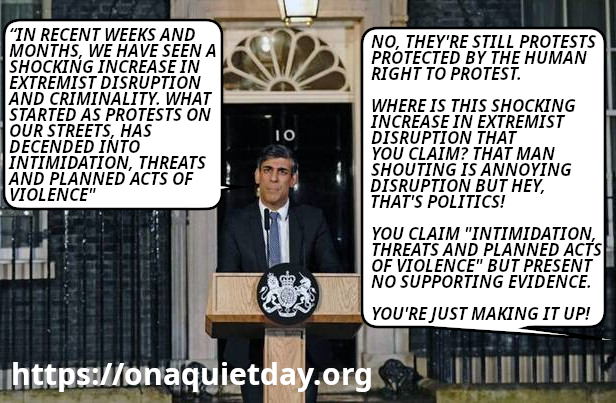
Response to Rishi Sunak’s extremism speech at Downing Street 1 March 2024.
Here’s the leader of the Conservative party, Rishi Sunak. He’s pictured giving an extremist speech trying to undermine democracy and democratic rights e.g. the democratic right to protest, on 1 March 2024. He also involved in mob rule – he rules for a small group of very wealthy, nasty people – some of them tax avoiders and newspaper owners. Anyway Michael, I expect that you’ll be hearing more from me about these extremist groups, there’s plenty more to their extremism.
Unhappy with large protests against the increasingly dire situation in Gaza, Prime Minister Rishi Sunak is seeking to update the UK’s definition of extremism. This, he has argued, is needed because “our democracy itself is a target” of antisemitic and Islamophobic extremists.
However, the reality is that no measures do more damage to democracy than policy proposals like the one Sunak is promoting.
The UK already has a definition for extremism, which is used in efforts to tackle terrorism. We may think of the police as leading those efforts, but the UK’s Prevent strategy now also places a duty on certain other authorities to “have due regard to the need to prevent people from being drawn into terrorism”.
These authorities include local government, education institutions and the NHS. In reality, the UK has placed teachers and NHS staff on the frontline in the fight against terrorism, on top of all their other duties that they were actually trained to do.
To help those with a duty under Prevent to identify people at risk of being drawn into terrorism, the government currently defines extremism as “vocal or active opposition to fundamental British values, including democracy, the rule of law, individual liberty and mutual respect and tolerance of different faiths and beliefs”. Also included are “calls for the death of members of our armed forces”.
This definition is not contained in any law, however. Instead, it features in the government’s Prevent guidance. A key reason why this definition is not contained in legislation is because it is so vague and unclear. It would be difficult to legally oblige anyone with a duty under Prevent to apply the definition – and even more difficult for a court to determine what it means.
Even as guidance, there are still problems with the definition. It offers enormous discretion to the people deciding who is at risk of being drawn into terrorism. Discretion can lead to inconsistent application. That, in turn, can lead to discrimination.
Vague to vaguer
It has been suggested that the new definition of extremism will include the “promotion or advancement of ideology based on hatred, intolerance or violence or undermining or overturning the rights or freedoms of others, or of undermining democracy itself”.
What does it mean to undermine or overturn the rights or freedoms of others? Would arguing for the UK to leave the European convention on human rights count meet the bar?
Likewise, what does it mean to undermine democracy? Does excessive corporate lobbying do so? What about calling for restrictions on the right to free speech or the right to protest? These are fundamental rights that are absolutely necessary for a democracy to flourish. Would they be extremist?
Existing laws are enough
Sunak is presenting the new definition of extremism as a response to protests he depicts as being out of control. But the UK already has numerous laws in place to tackle what it considers to be unacceptable behaviour at protests. The Terrorism Act (which is also incredibly broad) can be used to prosecute people who damage property or create a serious risk to public safety during protests.
Counter-terrorism laws can also capture forms of expression at public demonstrations or online. It is already a crime to express support for a proscribed (unlawful) organisation, or to wear clothing, symbols or publish images in a way which can raise suspicion that you support an unlawful organisation. So, for example, if you express support for Hamas — a proscribed organisation — you are already committing a crime and can be prosecuted for it.
Meanwhile, the Public Order Act contains offences dealing with hate speech. These include using threatening, abusive or insulting words or behaviour, or displaying written material which is intended to or likely to stir up racial or religious hatred.
In 2022, the Police, Crime, Sentencing and Courts Act expanded the criminal offence of causing a public nuisance to include “serious distress, serious annoyance, serious inconvenience or serious loss of amenity”. This can now be applied by he police to criminalise protests that are considered to be making too much noise.
It is hard, therefore, to see which bases are not already covered for a government looking to prosecute people for extremism. These mechanisms have already been used to clamp down on all kinds of activism. In reality, there is no gap in the law that needs fixing. Rather, this proposal looks like a classic example of a government talking tough on crime and terrorism in order to boost its poll ratings in an election year.
The right to protest
Adding new definitions for extremism only creates problems. The vaguer a definition gets, the easier it is to misuse. It can also have a pervasive chilling effect on free speech. People may self-censor out of fear of being identified as extremist, not least when their employer has a duty under Prevent.
The fact of the matter is that human rights law allows for protests to be disruptive. Otherwise, they could be simply ignored. Human rights law also allows people to “shock, offend, and disturb” through speech.
The government may not be happy with large public protests against its foreign policy but it should not be viewed as extremist to march for a ceasefire in Gaza. Likewise, it should not be viewed as extremist to vocalise opposition to the potential genocide being committed by the Israeli Defence Forces. If this were so, then the International Court of Justice is extremist.
There is a deep danger of conflating protest with extremism and terrorism, undermining the legitimacy of these protests. To stretch the concept of extremism to cover these views is what is actually undermining democracy and the rights and freedoms of others.
Rishi Sunak used his first speech outside 10 Downing Street to say “hateful” groups had “hijacked” the streets in recent months, in reference to pro-Palestine marches | Carl Court/Getty Images
Daughter of terror attack victim Makram Ali says politicians are ‘fuelling fire’ by equating Muslims with extremism
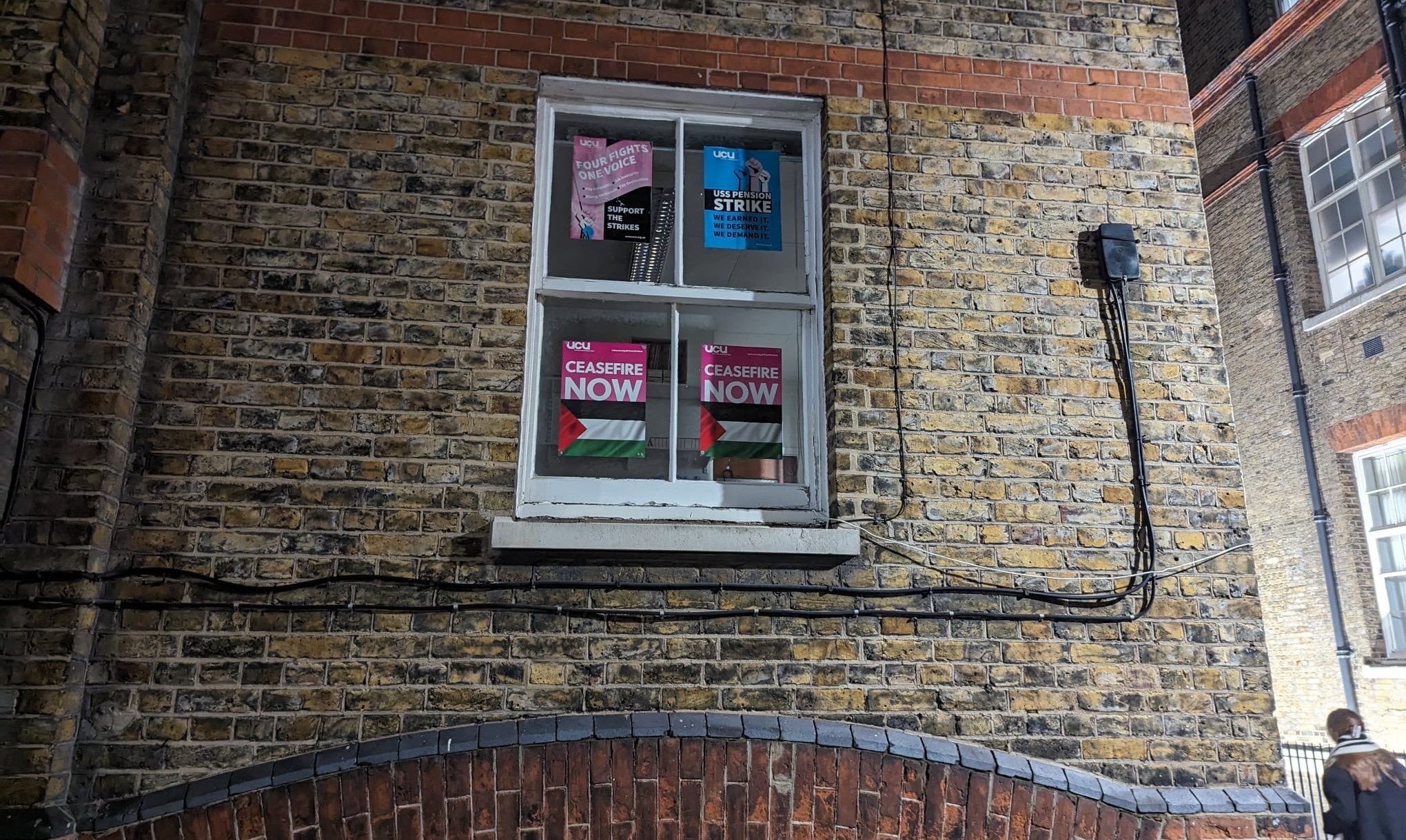
James Eastwood and his union colleagues got to their office one Tuesday afternoon to find that someone had broken in. The intruder hadn’t taken personal valuables or expensive equipment: all they had done was pull down the pro-Palestine posters in the window.
The break-in didn’t come as a huge shock to Eastwood, co-chair of the University and College Union (UCU) branch at Queen Mary University in east London. A day earlier, uni bosses had called him asking for access to the office so they could remove the posters, one of which had a Palestinian flag on it, and another of which read: “From the river to the sea, Palestine will be free.” Eastwood had agreed, requesting only that he be allowed to make the case before any action was taken.
The university was unwilling to wait, and forced the lock the next day. But Eastwood lays the blame beyond the office of the president and principal, Colin Bailey, who last year took home nearly £359,000. Instead, he holds the government responsible, feeling ministers have decided that “it’s not OK to be in solidarity with Palestine”. The university admits it took the posters down, telling openDemocracy that “such permanent displays… can stifle freedom of speech and make members of our community feel unsafe”.
Communities secretary Michael Gove is this week expected to widen the government’s definition of extremism to include “promotion or advancement of ideology based on hatred, intolerance or violence or undermining or overturning the rights or freedoms of others, or of undermining democracy itself”.
This might sound reasonable in isolation. But Gove’s intervention is the culmination of a months-long campaign by Tory politicians to paint pro-Palestine protesters as extremists.
Ahead of a march on 11 November, then home secretary Suella Braverman called the demonstrations “hate marches” and suggested the sanctity of Armistice Day was under threat. This led hundreds of far-right thugs – more than 90 of whom were arrested – to gather in Whitehall to “protect” the cenotaph from a march for Palestine that was taking place in another part of the city.
The posters were displayed on the windows of UCU’s office at Queen Mary University of London | James Eastwood
Emboldened by this narrative, former deputy Tory Party chair Lee Anderson last month claimed “Islamists” had “got control” of Sadiq Khan, London’s first Muslim mayor. He later doubled down and refused to apologise, after which he was suspended for conflating “all Muslims with Islamist extremism”. The prime minister described Anderson’s comments as “wrong” but avoided calling them Islamophobic.
This rhetoric, which also included false claims from MPs that there were “no-go” Muslim-majority areas in Birmingham and east London, climaxed in a hastily-arranged, Friday night speech from Sunak outside 10 Downing Street at the beginning of March. This was a significant intervention – it was the first time he had addressed the nation in this way since becoming PM 18 months ago.
He warned that “extremists” were “spewing hate” and “hijacking” protests. He also called on protesters “to stand together to combat the forces of division and beat this poison”.
Campaigners believe the new definition of “extremism” will in practice mean public authorities being forced to cut links with a widening circle of proscribed pro-Palestine groups. Even three former Tory home secretaries said yesterday the politicisation of extremism had gone too far.
Eastwood said the mood music from the government “filters down and creates a climate where organisations including universities feel pressure to show that they’re doing something”.
“You see a reproduction of some of the government lines on what’s acceptable speech, what’s offensive speech, what speech is to be allowed or not allowed,” he added.
Fuelling the fire
On 18 June 2017, Darren Osborne drove a van from Cardiff to London with plans to attack a pro-Palestinian march. A jury would go on to hear he had wanted to kill then Labour leader Jeremy Corbyn, as well as Sadiq Khan.
Osborne, 48, had viewed posts on social media by former English Defence League leader Stephen Yaxley-Lennon (also known as Tommy Robinson) and Britain First before driving his van directly into a crowd of people leaving the Muslim Welfare House in Finsbury Park – Corbyn’s constituency – following evening Ramadan prayers. He killed 51-year-old Makram Ali and injured 12 others.
As he tried to escape, he is reported to have said: “I want to kill more Muslims.”
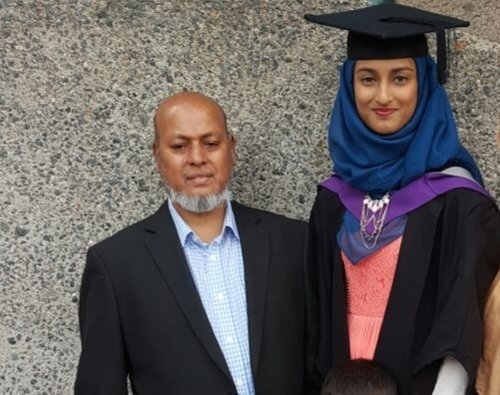
Ali’s daughter, Ruzina Akhtar, says politicians’ attempts to equate Islam with extremism are “fuelling the fire” and “inciting more hatred” towards Muslims.
“Every day, that’s going into someone’s ears who doesn’t have positive feelings towards Muslims,” she told openDemocracy. “It only takes one comment, or one thing to push someone over the edge. It’s not just actions – words speak loudly as well. Politicians need to be really careful with what they say and how they say it, because every single word could potentially be a threat to someone’s life.”
While politicians pontificate over definitions, Akhtar warned: “They’re in their own political bubble. They’re not thinking about the wider effect their words could have.
“Instead of inciting hatred, they need to be working together with communities. On the one hand, they’ll talk about how Britain is multicultural and so inclusive, but then they’re putting targets on people’s backs.”
Ruzina Akhtar and her dad, Makram Ali | Ruzina Akhtar
Akhtar will be easing into yet another Ramadan without her dad today. The one thing she wants people to remember is how dangerous these dehumanising, Islamophobic tropes can be. “Muslims can be targets as well,” she said. “It doesn’t matter who you are. At the end of the day, we’re all human beings.”
Of course, the UK government’s rebranding of pro-Palestine voices and peaceful protesters as extremists is not a new phenomenon.
For years, people who support Palestine vocally and publicly have been targeted under Prevent – the UK government-led counter-terrorism programme, which human rights organisations say is discriminatory and ineffective. In his speech, Sunak doubled down on his support for the programme.
In 2016, Rahmaan Mohammadi – a schoolboy from Luton – was referred to Prevent and questioned by anti-terrorism police for wearing ‘free Palestine’ badges and wristbands to school. He also claimed that he was told to stop talking about Palestine in school.
Now, ahead of a general election, Fatima Rajina, an academic specialising in issues on identity, race, British Muslims and postcolonialism, says long-standing Islamophobic and anti-Muslim tropes have been invoked in order to win votes and deflect from government failures.
“It’s stoking fear, because that is what has been done for the last 20-plus years,” she said. “The ‘war on terror’ rhetoric has meant that politicians rely on very well established tropes about Muslims. And they proceed with that because that is what gets into people’s minds.”
War on terror
If you’ve ever been to a march for Palestine you might have watched the prime minister’s Downing Street address and wondered if you were being gaslit. For many, the marches have been largely peaceful, with people of different faiths, backgrounds and ethnicities coming together to call for a ceasefire in Gaza.
openDemocracy recently revealed that, despite attempts by some MPs to form a narrative that the marches amounted to “mass extremism” and were “openly criminal”, only 36 people out of the millions who attended last year had been charged with a crime.
The post 9/11 so-called ‘war on terror’ touched all aspects of day-to-day life for Muslims in the UK, from Prevent referrals to surveillance in mosques and schools, as well as so-called ‘schedule 7’ stops at UK ports and airports and increased use of stop and search.
Rajina says the government relies on convincing people that such measures are for the sake of “safety” and the public good, and calls this framing “very sinister”.
“All of these concerns are packaged into ‘the Muslim is the problem’,” she said. As children starve to death in Gaza, more airtime is given to the concerns of politicians who say they feel threatened by constituents who want the attacks in Palestine to stop.
But the mood music isn’t just coming from the government. Labour politicians including deputy leader Angela Rayner and shadow chancellor Rachel Reeves last month reported feeling “unsafe” and “intimidated” by members of the public protesting the siege on Gaza, while Commons speaker Lindsay Hoyle suggested MPs could be in danger from pro-Palestinian constituents for voting against a ceasefire.
“It’s Muslims who are being targeted as the ones who are causing all this trouble outside MPs’ offices, scaring them,” said Rajina. “And that is because there’s already an established fear. Tapping into that then makes people think: ‘Oh my God, these Muslims don’t know how democracy works’.
“I think this idea of it being a Muslim issue, and framing it in that way, is really and truly about the upcoming election. It is about stoking fear and playing with established fear. It’s also to deflect from the fact that we’re going through a cost of living crisis.”
What’s also clear is that the UK government’s branding of activists and protesters as ‘extremists’ hasn’t been limited to Muslims and pro-Palestine voices.
When Black Lives Matter protests swept through the UK in 2020 following the murder of George Floyd, then prime minister Boris Johnson similarly claimed that anti-racism protests in the UK had been “hijacked by extremists intent on violence”.
And when Extinction Rebellion (XR) gained prominence after its first action in 2018, its activists were labelled as “eco-terrorists”.
The backlash bears the fingerprints of right-wing think tanks. In a 2019 report, influential right-wing think tank Policy Exchange called XR an “extremist group” that wanted to overturn democracy and ran the risk of “[breaking] with organisational discipline and [becoming] violent”. Months later, XR was designated an extremist group by counter-terror police, while openDemocracy revealed in 2022 that a controversial anti-protest law appeared to have come directly from the Policy Exchange report.
Policy Exchange has now turned its attention to pro-Palestinian voices, briefing politicians that academics on the board of equality and diversity at Research England – a government science and research body – had showed “support for radical anti-Israeli views”.
The document appears to have made its way into the hands of cabinet minister Michelle Donelan, who was last week forced to pay damages to one of the academics in question after wrongly accusing her of supporting Hamas. Her £15,000 libel bill is being footed by the taxpayer.
As well as arrests under the Policing Act – and its sequel, the Public Order Act, which also gives police more powers to restrict protests – an increased number of activists with groups such as XR and Just Stop Oil have been referred to the Prevent anti-terror scheme.
Ban
This narrative that activist movements are undemocratic or opposed to British values is underlined by John Woodcock, a peer and former Labour MP who now serves as the government’s adviser on political violence. Woodcock believes a ban on MPs and councillors having contact with groups like Palestine Solidarity Campaign, Extinction Rebellion, and Just Stop Oil, would restore faith in liberal democracy.
But the attempt to turn supposedly ‘ordinary’ Brits against ‘extremist’ protesters has very real human consequences, particularly when layered with Islamophobia and anti-Muslim hate.
As recently as last month, amid a wave of Islamophobic and antisemitic hate crime since October 7, an east London mosque reported its second bomb threat in two months.
And citing experiences of Islamophobia reported by MPs Apsana Begum and Zarah Sultana, Rajina said: “These are prominent and well known public figures here in Britain. So then imagine what it looks like when it trickles down to the ordinary person who is just going about their everyday activities, doing their shopping and catching the train and whatever other mundane activity, and then suddenly they are at the receiving end of Islamophobic abuse.”
The demonisation of protesters has also laid the foundation for violence against peaceful climate activists.
“We’re trying to teach young people to go out there, make sure you’re holding your MP to account… put pressure on councils. And now suddenly, we’re saying: ‘Hold on a second, that’s not the way to do it’. But what are we saying? What sort of citizenship are we looking for? What do you want people to do?”
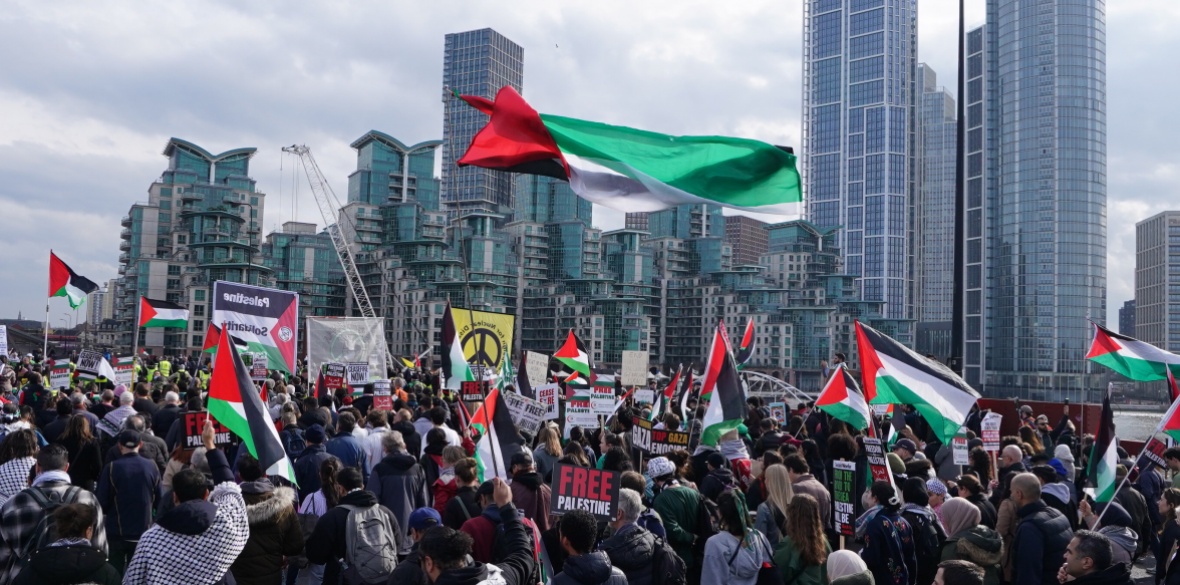
People take part in a pro-Palestine march in central London during a national demonstration for ceasefire in Gaza, March 9, 2024
Defiant protesters reject ‘extremism’ label by MPs to stop marches
CAMPAIGNERS have slammed the government’s “repressive” attempts to clamp down on the right to protest and redefine extremism, warning they are “poorly drafted and open to legal challenge.”
Communities Secretary Michael Gove is expected to announce a looser definition of extremism within days.
Organisations and individuals that breach the new definition will be banned from receiving public funds, engaging with government agencies and appearing at university campuses.
Several Muslim groups are reportedly set to be on the list, including the Muslim Council of Britain and the Muslim Engagement and Development NGO.
Mr Gove claims he aims to ban groups which “undermine the UK’s system of liberal democracy.”