1 September 2022 (IEEFA): Underperforming carbon capture projects considerably outnumber successful projects globally, and by large margins, with both the technology and regulatory framework found wanting, finds a new report by the Institute for Energy Economics and Financial Analysis (IEEFA).
The report, The Carbon Capture Crux – Lessons Learned, studies 13 flagship large-scale carbon capture and storage (CCS)/carbon capture utilisation and storage (CCUS) projects in the natural gas, industrial and power sectors in terms of their history, economics and performance. These projects account for around 55% of the total current operational capacity worldwide.
Author Bruce Robertson says seven of the thirteen projects underperformed, two failed, and one was mothballed
“CCS technology has been going for 50 years and many projects have failed and continued to fail, with only a handful working.
“Many international bodies and national governments are relying on carbon capture in the fossil fuel sector to get to Net Zero, and it simply won’t work.
“Although some indication it might have a role to play in hard-to-abate sectors such as cement, fertilisers and steel, overall results indicate a financial, technical and emissions-reduction framework that continues to overstate and underperform.”
IEEFA’s study found that Shute Creek in the U.S. underperformed its carbon capture capacity by around 36% over its lifetime, Boundary Dam in Canada by about 50%, and the Gorgon project off the coast of Western Australia by about 50% over its first five-year period.
“The two most successful projects are in the gas processing sector – Sleipner and Snøhvit in Norway. This is mostly due to the country’s unique regulatory environment for oil and gas companies,” says co-author Milad Mousavian.
“Governments globally are looking for quick solutions to the current energy and ongoing climate crisis, but unwittingly latching onto CCS as a fix is problematic.”
Last week the Australian government approved two new massive offshore greenhouse gas storage areas, saying CCS “has a vital role to play to help Australia meet its net zero targets. Australia is ideally placed to become a world leader in this emerging industry”.
However, Robertson says, carbon capture technology is not new and is not a climate solution.
“As our report shows, CCS has been around for decades, mostly serving the oil industry through enhanced oil recovery (EOR). Around 80–90% of all captured carbon in the gas sector is used for EOR, which itself leads to more CO2 emissions.”
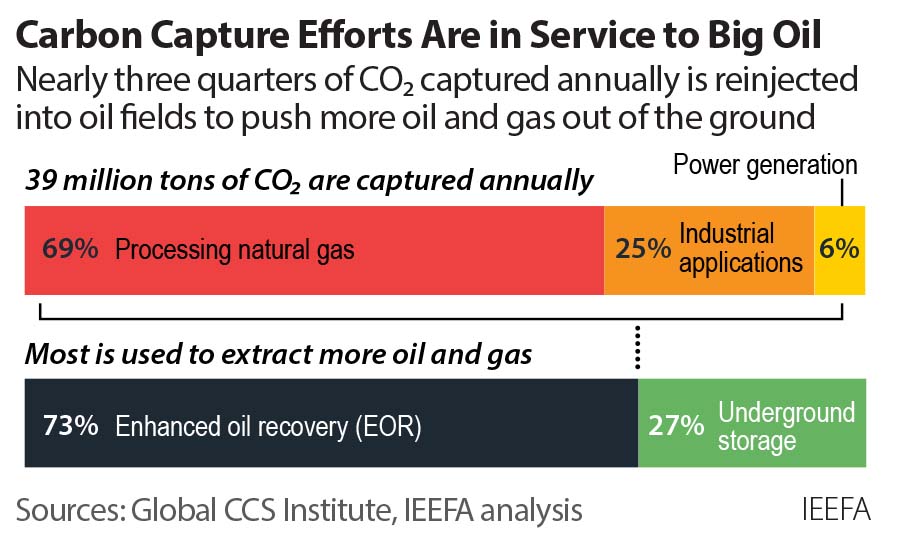
About three-quarters of the CO2 captured annually by multi-billion-dollar CCUS facilities, roughly 28 million tonnes (MT) out of 39MT total capture capacity globally, is reinjected and sequestered in oil fields to push more oil out of the ground.
The International Energy Agency says annual carbon capture capacity needs to increase to 1.6 billion tonnes of CO2 by 2030 to align with a net zero by 2050 pathway.
“In addition to being wildly unrealistic as a climate solution, based on historical trajectories, much of this captured carbon will be used for enhanced oil recovery,” says Robertson.
History shows CCS projects have major financial and technological risks. Close to 90% of proposed CCS capacity in the power sector has failed at implementation stage or was suspended early — including Petra Nova and the Kemper coal gasification power plant in the U.S. Further, most projects have failed to operate at their theoretically designed capturing rates. As a result, the 90% emission reduction target generally claimed by the industry has been unreachable in practice.
Finding suitable storage sites and keeping it there is also a major challenge—the trapped CO2 underground needs monitoring for centuries to ensure it does not come back to the atmosphere.
The report identifies interim considerations for CCS projects if no alternative solutions to emissions reduction are found.
Safe storage locations must be identified, and a long-term monitoring plan and compensation mechanism in case of failure developed.
The CCS project must not promote enhanced oil recovery.
To avoid project liability being handed over to taxpayers, as is currently the situation with Gorgon, large oil and gas companies mainly benefiting from CCS at their gas developments must be liable for any failure/leakage and monitoring costs of CCS projects, specifically if they get subsidies, grants and tax credits for capturing the carbon.
It must not be used by governments to greenlight or extend the life of any type of fossil fuel asset as a climate solution.
Robertson says more research could be done on CCS applications in industries where emissions are hard to abate such as, cement, as an interim partial solution to meeting net zero targets.
“As a solution to tackling catastrophic rising emissions in its current framework however, CCS is not a climate solution.”
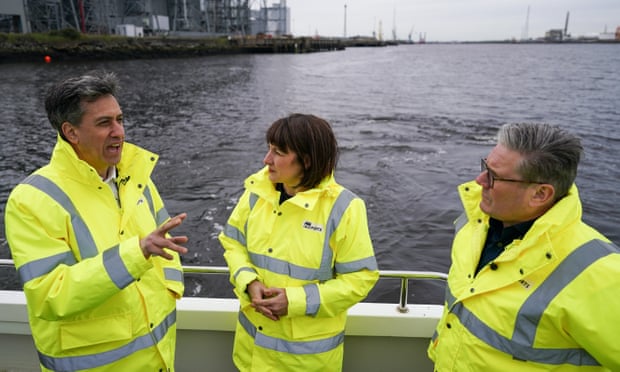
Ed Miliband, Rachel Reeves and Keir Starmer visit Teesside, the location of a proposed multibillion-pound carbon capture and storage project. Photograph: Ian Forsyth/Getty Image
Letter says technologies to produce blue hydrogen and capture CO2 are unproven and could hinder net zero efforts
Leading climate scientists are urging the government to pause plans for a billion pound investment in “green technologies” they say are unproven and would make it harder for the UK to reach its net zero targets.
Labour has promised to invest £1bn in carbon capture, usage and storage (CCUS) to produce blue hydrogen and to capture carbon dioxide from new gas-fired power stations – with a decision on the first tranche of the funding expected imminently.
However, in the letter to the energy security and net zero secretary, Ed Miliband, the scientists argue that the process relies on unproven technology and would result in huge emissions of planet-heating CO2 and methane – gases that are driving the climate crisis.
“We strongly urge you to pause your government’s policy for CCUS-based blue hydrogen and gas power, and delay any investment decision … until all the relevant evidence concerning the whole-life emissions and safety of these technologies has been properly evaluated,” they write.
The letter, which is signed by leading climate scientists from the UK and US as well as campaigners, argues the plans would:
Lock the UK into fossil fuel production for generations to come.
Result in huge upstream emissions from methane leaks, transport and processing of liquefied natural gas (LNG) from the US.
Rely on carbon capture and storage (CCS) during the production of hydrogen – technology they say has been abandoned in the vast majority of similar projects around the world.
Pose a danger to the public if there are any leaks from pipes carrying the captured carbon. At least 45 people had to be taken to hospital after a leak in the US.
One Saturday in April, Dutch engineers manoeuvred a giant drill into position in the reclaimed, industrial extension of the Port of Rotterdam, and began boring a hole under the seawall. Nearby, sections of metal pipe waited to be lowered into the breach.
The operation was a step forward for Europe’s most advanced scheme to capture carbon dioxide (CO2) from industry, then bury the planet-heating gas under the North Sea.
After years of delay, a joint venture known as Porthos, an acronym for Port of Rotterdam CO2 Transport Hub and Offshore Storage, is due to begin operating in 2026. It’s a 1.3-billion-euro joint venture between state-owned gas companies Energie Beheer Nederland (EBN) and Gasunie, and the Port of Rotterdam Authority. The CEOs of these organisations are due to join Sophie Hermans, the Netherlands’ minister of climate policy and green growth, and senior European Union officials, for a ceremony on Monday to toast the start of construction work at the site.
At full capacity, Porthos is expected to handle 2.5 million tonnes of CO2 captured annually from facilities operated by its four dedicated customers: Shell, ExxonMobil, and the hydrogen producers Air Liquide and Air Products. That total is equivalent to roughly 10 percent of the port’s emissions, and 1.5 percent of the Netherlands’ current CO2 output. Once captured, the gas will be pumped under the North Sea throughout a 15-year period, or until the storage space reaches a maximum estimated capacity of 37.5 million tonnes.
The cost to the Dutch taxpayer: up to 4 billion euros in subsidies.
Credit: Leon de Korte/Follow the Money.
Porthos relies on a technology known as carbon capture and storage, or CCS, which uses a chemical process to capture some of the CO2 that spews from a customer’s industrial chimneys. This trapped gas is then condensed and pumped through pipelines to underground storage sites, such as certain kinds of geological formations, or disused oil and gas wells.
Nevertheless, the backers of Porthos, and its much larger sister project Aramis — also being developed by EBN and Gasunie, along with Shell and French oil giant TotalEnergies — see them as the first nodes in a planned network of pan-European CCS infrastructure. The aim is to eventually funnel CO2 captured in the industrial heartlands of Germany, as well as throughout the Netherlands, to hundreds of storage sites under the seabed.
To its critics, however, Porthos is emblematic of the way oil and gas companies are securing subsidies for CCS schemes that present an appearance of climate action — but are never likely to attain the massive scale needed to make a dent in global emissions.
As Europe’s flagship project, Porthos is emerging as a litmus test for a critical question in the fight against climate change: Will carbon capture actually help reduce the emissions fuelling the crisis? Or will government backing for these technologies instead serve to preserve the fossil fuel business models that caused it?
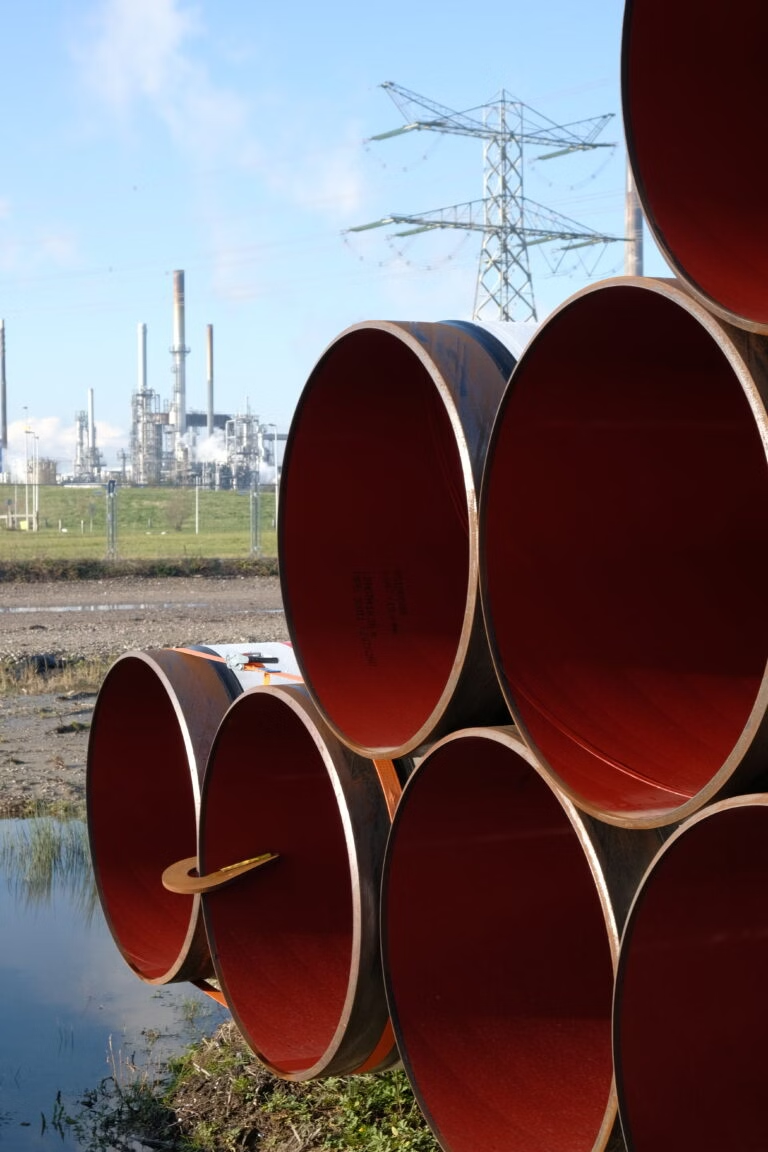
Sections of pipe for the Porthos CO2 pipeline, intended to take captured carbon emissions and inject them under the North Sea, await burial at the Port of Rotterdam. Credit: Michael Buchsbaum.
Ambitious Plans
With intensifying heatwaves, floods and fires underscoring the threat the climate crisis poses to Europe, the EU has agreed to slash its carbon emissions to net zero by 2050, with an interim target of a 90-percent reduction relative to 1990 levels by 2040. Given the scale of that challenge, and in line with lobbying by the fossil fuel industry, policy-makers have assumed a major role for carbon capture projects in cleaning up industry.
“Reducing emissions is not enough,” reads a European Commission website on CCS. “To achieve our climate ambitions, we will also need to capture, utilise and store carbon.”
Climate campaigners argue, however, that the technology has secured official backing in large part because it helps governments persuade voters they are taking climate action, while stopping short of the kind of rapid, fundamental transformation of economies needed to end the use of fossil fuels.
In May, the EU adopted the Net Zero Industry Act, obligating oil and gas producers to develop 50 million tonnes of annual CO2 storage capacity across the continent by 2030 — roughly equivalent to today’s global total. More ambitiously, the act targets approximately 280 million tonnes of annual CO2 storage capacity by 2040, increasing to a staggering 450 million tonnes by 2050.
Environmental groups such as E3G, the Institute for Energy Economics and Financial Analysis and European Environmental Bureau doubt such targets are feasible, given the thousands of kilometres of pipelines that would have to be built, and the dozens of projects that would have to be designed. A lack of technical and geological know-how combined with potential local opposition could also slow fossil fuel companies’ plans.
“The industry needs to commit to genuinely helping the world meet its energy needs and climate goals —which means letting go of the illusion that implausibly large amounts of carbon capture are the solution,” said Fatih Birol, executive director of the Paris-based International Energy Agency (IEA), in the introduction to a report on clean energy transitions for oil companies published in November.
Despite the oil industry often citing scenarios from the Intergovernmental Panel on Climate Change that include significant deployments of CCS, the U.N.-backed body also considers the technology the least efficient, and one of the most expensive, climate tools. In their Sixth Assessment report, the IPCC’s scientists wrote that “even if implemented at its full potential, CCS will account for only 2,4% of the world’s carbon mitigation by 2030 due to its low effectiveness and high cost.”
And Europe is nowhere near close to meeting its carbon capture targets. Today, only 2.7 million tonnes of CO2 is being captured annually across the continent, including in Norway and Iceland, according to the IEA. Porthos’ backers are therefore hailing the project as a crucial step towards fulfilling the continent’s decarbonisation plans — starting with its largest port.
“If we want to reach our climate target, we will need CCS,” Willemien Terpstra, CEO of Gasunie, told DeSmog.
Still, even backers of the technology acknowledge that deployment is lagging. To meet the EU’s target of capturing 280 million tonnes of CO2 annually by 2040 would require 651 projects, said Chris Davies, director of industry group CCS Europe. Each would have to capture more than 400,000 tonnes per year, he told DeSmog.
To date, 50 years after the first CCS projects were started in a Texas oilfield, only about 40 projects are operating globally, with the combined potential to capture just over 50 million tonnes of CO2 per year. However, almost 80 per cent of the CO2 being captured is injected underground to pump more oil — which when refined and burned, adds more CO2 into the atmosphere.
While there is no estimate as to how long it would take to construct hundreds of projects, it is clear that time is running out, Davies said.
Capturing this amount by 2040 requires that construction on all these projects begin no later than early 2038: “So we have less than 5,000 days,” said Davies.
Since Porthos’ backers took a final investment decision last year, no other CCS project “has been given the green light to put a shovel in the ground”, he added.
Cleaning up the Quayside
With docks and quays stretching from its old town centre to the ocean over 40 kilometres away, the Port of Rotterdam covers an area almost twice the size of Manhattan, and handles nearly 440 million tonnes of freight each year, roughly the equivalent of more than 1,200 Empire State Buildings stacked on top of each other.
Not only is Rotterdam a massive cargo port, it’s also one of the largest hubs for energy in Europe, including oil. Counting oil, coal, and liquefied natural gas, the port boasts that some 13 per cent of all the energy used throughout Europe passes through it.
Most of the oil is destined for one of the port’s four refineries, including the giant Shell Pernis facility, as well as sites run by BP and Exxon. (Reducing emissions from the refineries is one of Porthos’ key aims).
All this activity generates tremendous amounts of carbon pollution: The port emitted 20.3 million tonnes of CO2 in 2023.
The port intends to slash its emissions by 55 per cent by 2030, then achieve climate neutrality by 2050.
The port argues that it can reduce its emissions to its target of 9.3 million tonnes by 2030 by:
Storing up to 5.8 million tonnes of emissions annually by the end of the decade through its Porthos and Aramis projects
Reducing emissions by another 5.7 million tonnes by shutting down, as legally required, itsremaining coal-fired power plants by 2030, building on savings made by previous coal plant closures
Greening its operations with electrification, and “green” hydrogen made with wind and solar
“Porthos and Aramis by far contribute the most to the Netherlands’ CO2 reduction targets…the Dutch goals cannot be met without those projects,” Hans Coenen, Executive Board member of energy company Gasunie, told Follow the Money, the Dutch investigative journalism platform that co-published this story with DeSmog.
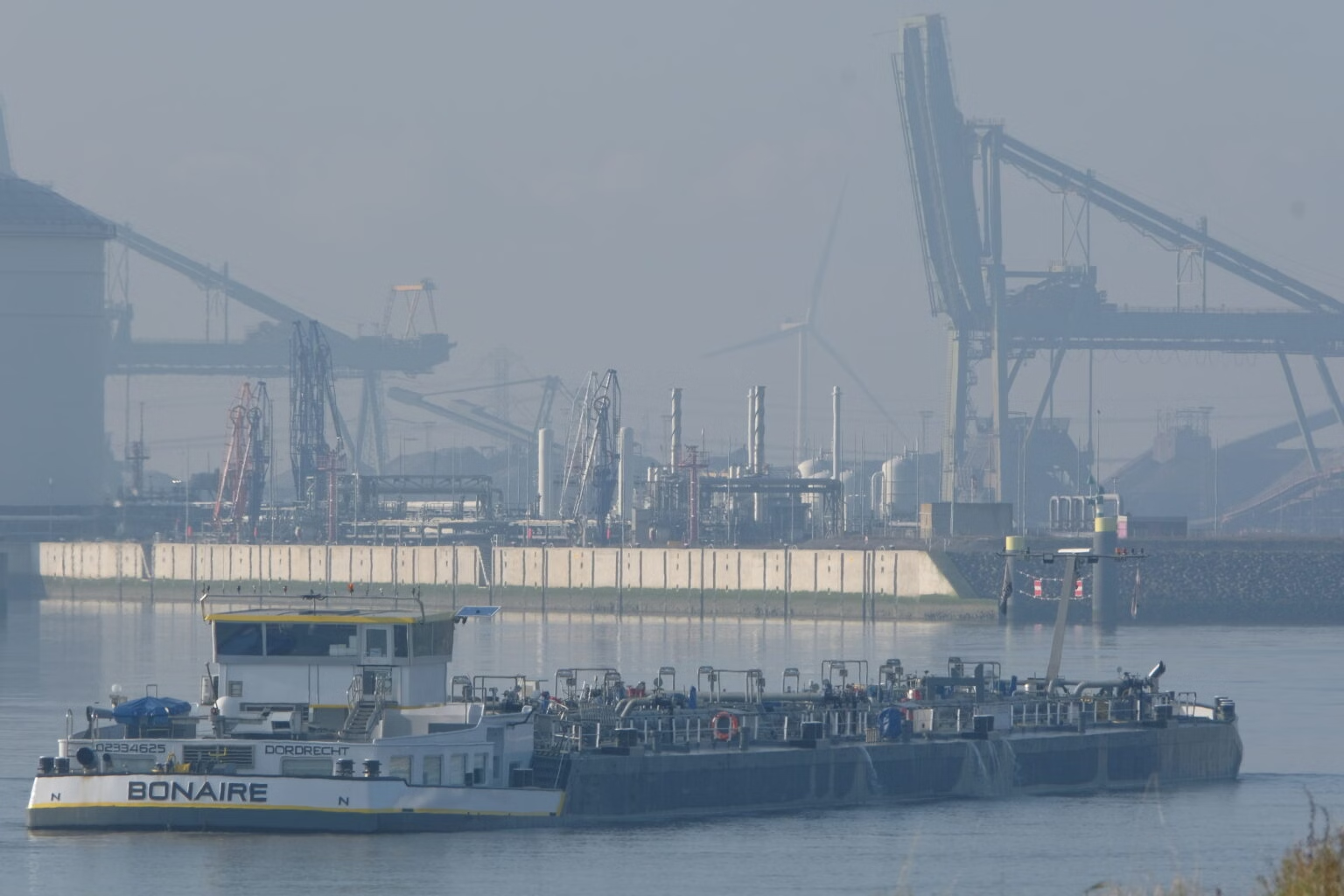
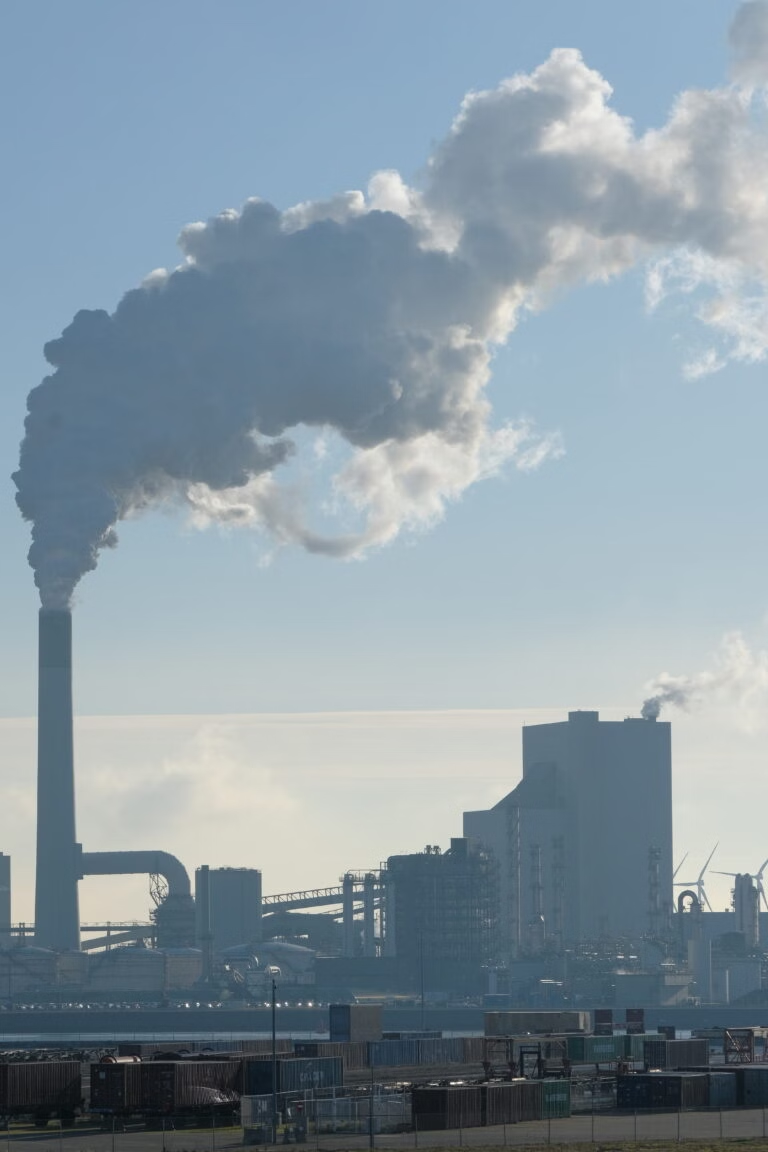
The Port of Rotterdam’s only real CO2 reductions so far stem from the shuttering of several coal-fired power plants . Credit: Michael Buchsbaum.
Taxpayers Foot the Bill
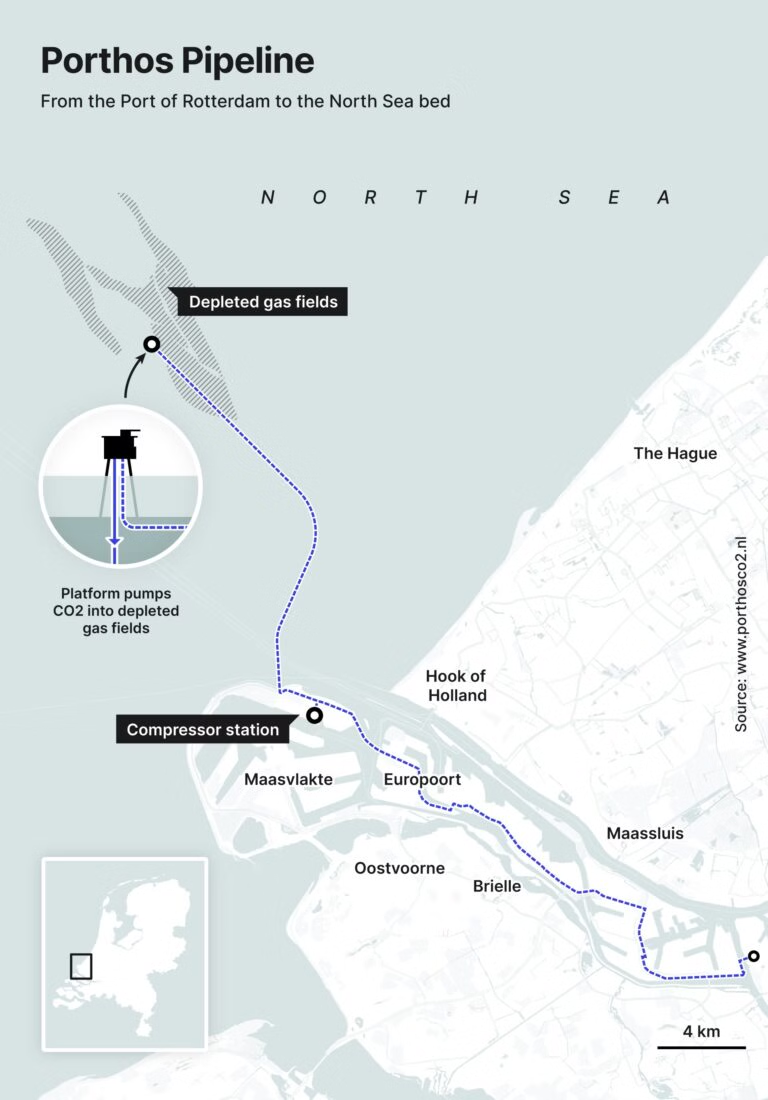
Crucially, Porthos will not be capturing any CO2 itself, instead handling and storing CO2 captured by Shell, Exxon, Air Liquide and Air Products. Porthos itself consists of a new 30-kilometre pipeline system leading to a compression station. From there, CO2 will be pumped to a repurposed gas drilling platform 20 kilometres offshore, and injected into a depleting gas field for final storage.
To ensure emissions are captured, in 2021, the Dutch government allocated Shell, Exxon, Air Liquide and Air Products a combined 2.1 billion euros via its SDE++ scheme to subsidise company decarbonisation projects.
As it stands, under a long-running scheme known as the European Emissions Trading System (ETS), these companies are already required to buy credits for each tonne of CO2 they emit.
Although the credits currently trade at just under 69 euros per tonne, the price could almost triple by 2035, according to BloombergNEF.
By disposing of some of their emissions via Porthos, its customers save money by having to purchase fewer credits.
But, if buying ETS “emission certificates” is cheaper for them than storing the gas via Porthos, then the Dutch government will make up the cost difference using up to 2.1 billion euros allocated under the SDE++ scheme.
This means that whatever happens, the companies face limited risk, and potentially large savings, if they capture emitted CO2 instead.
The port says this arrangement enables the companies “to cut back their carbon emissions without weakening their respective competitive positions.”
Alternatively, without state support, “Porthos would not have gotten off the ground and this project would not have been able to contribute to achieving the climate objectives,” Ellen Ehmen, Exxon’s community relations manager in the Netherlands, told DeSmog.
Combining various other EU and Dutch government subsidies associated with the project, with the 1.3 billion euro cost to state-owned companies to build it, and up to 2.1 billion in carbon capture subsidies, the overall cost to the state could approach or even exceed 4 billion euros.
In other words, Dutch and European taxpayers are picking up the bill for cleaning up these highly profitable companies’ carbon pollution.
In March, the Netherlands Court of Audit warned in a report that the way the project has been structured means that the state has assumed a disproportionate level of risk relative to industry.
Coenen, of Gasunie, says that he wasn’t surprised by these findings: “We decided deliberately to accept a low return on investment on Porthos, because we find it important to kickstart the project.”
Experimental Projects
Many climate advocacy groups, academics and policy experts have long warned of the dangers of relying on carbon capture projects, arguing that they provide fossil fuel companies with a justification for pumping ever more oil and gas.
Seeking to allay those fears, the European Commission advised in February that carbon capture should only be used in sectors where industry argues that emissions are particularly difficult or costly to cut, for example steel, cement, aluminium, chemicals and waste-to-energy.
But Porthos’ customers are using carbon capture for very different purposes: they’re either developing never-before attempted “low-carbon” projects that may be deployed at some point in future, or capturing a portion of the emissions now being generated by producing hydrogen used in the port’s oil refineries.
Shell, the first company to agree to partner with Porthos, is slated to become the project’s largest single customer, having committed to deliver 1.2 million tonnes of CO2 annually — captured mainly from its sprawling Pernis refinery complex, Rotterdam’s biggest. Shell also pledged to capture 820,000 tonnes a year from its to-be constructed biofuels facility, which is designed to produce so-called sustainable aviation fuel, as well as renewable diesel made from waste oil.
This so-called HEFA (hydroprocessed esters and fatty acids) plant is “essentially where the Porthos project starts,” said Nico van Dooren, director new business, hydrogen infrastructure, transport and storage with the Port of Rotterdam, during a media tour of the Porthos project in May.
Carbon capture “is the low hanging fruit,” Shell spokesperson Marc Potma said during the tour. “We have always said we believe in CCS for the future, but it’s never going to be the only answer. One must also invest in renewable sources, which is why we invested in the biofuels factory.”
Fellow oil and gas major Exxon’s CCS plans at Porthos are also highly experimental. Exxon says it plans to capture CO2 from a pilot project to test a new technology known as carbonate fuel cells — which the company says could help capture CO2 from industry more efficiently than existing methods, while also generating electricity, heat and hydrogen. This technology has never been proved at scale.
Also the recipient of EU funds, Exxon’s pilot plant is expected to be constructed in 2025, and start operations in 2026. Unlike Shell, Exxon has not announced any plans to use Porthos to capture emissions from its own oil refinery at the port.
Porthos’ two other customers are both large-scale hydrogen manufacturers who are producing the gas for use in oil refining — today one of hydrogen’s main uses.
As part of its participation in Porthos, U.S.-based Air Products announced in November it would build a carbon capture project at its existing hydrogen production facility in Rotterdam. Billed as the largest such facility in Europe, the project aims to help the company more than halve its CO2 emissions within the Port, while supplying most of the resulting hydrogen (known as “blue” hydrogen since some of the CO2 generated during the production process will be captured) for use in the nearby Exxon refinery.
Just weeks later, in December 2023, French rival Air Liquide announced it would also retrofit the company’s existing hydrogen facility in Rotterdam with carbon capture, using a proprietary technology that has only been tested at a smaller facility in Port-Jérôme-sur-Seine, France.
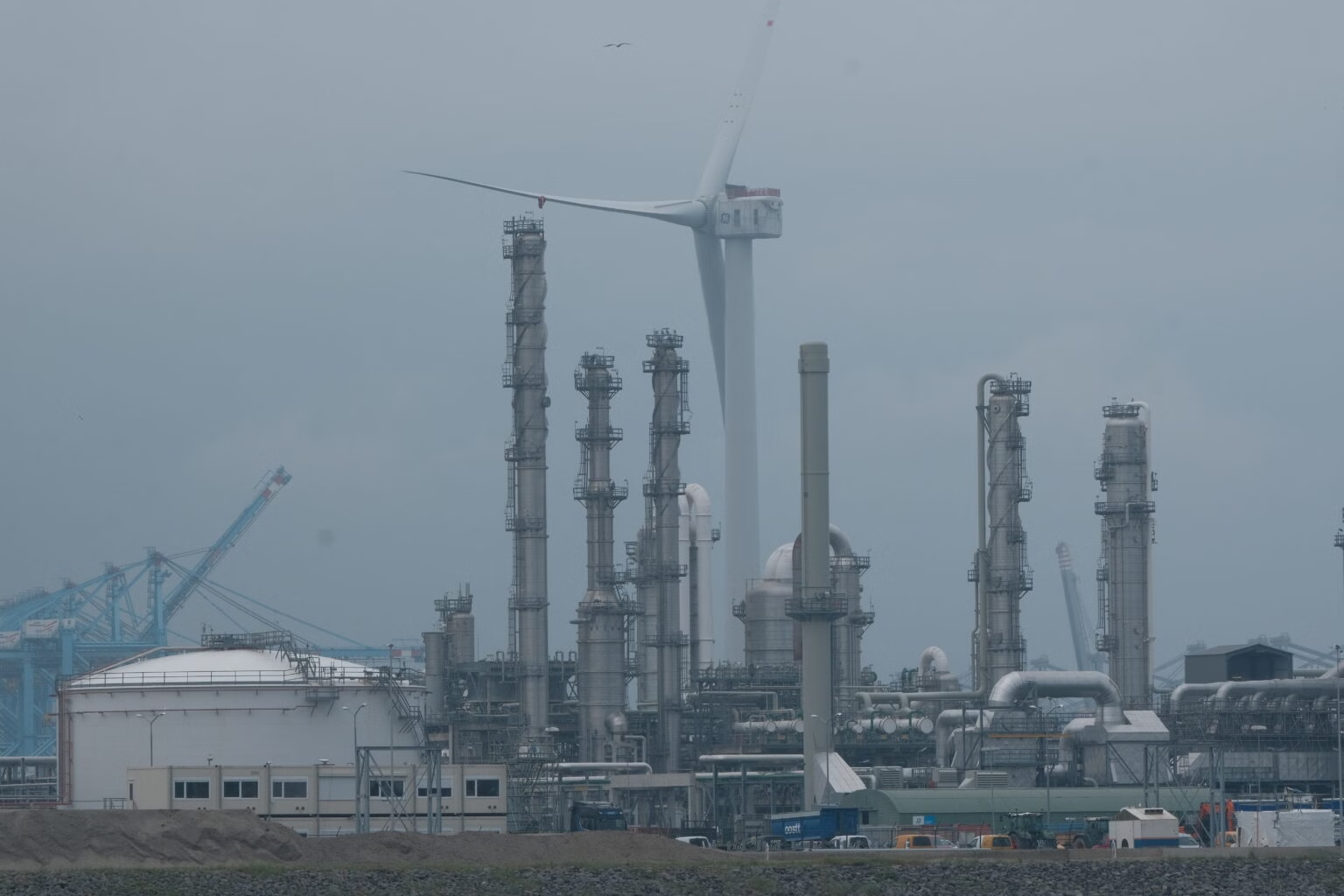
Giant new wind turbines tower over Rotterdam’s oil refineries, holding out the promise of an emissions-free future as they replace coal-fired power. Credit: Michael Buchsbaum.
Aramis Following Porthos
As workers dig trenches and bury Porthos’ pipelines around Rotterdam’s port, Shell and TotalEnergies — together with Gasunie and EBN — are working on the larger Aramis project. They want to funnel and bury CO2 emissions captured in Germany, Europe’s biggest emitter, and send them via a yet-to-be-built pipeline project known as the Delta Rhine Corridor.
By 2028, two years after Porthos is due to come online, the first phase of Aramis is scheduled to transport up to 7.5 million tonnes of CO2 for storage — also thanks in part to EU subsidies.
To connect Rotterdam to Belgium, Gasunie is also working on a so-called Delta Schelde Corridor. “It’s going to be one interconnected system in order to help our industry,” Gasunie’s Coenen told Follow the Money.
Signalling EU support, in mid-June, the European Climate, Infrastructure and Environment Executive Agency, or CINEA, awarded Aramis 124 million euros in subsidies under the CEF Energy fund. CINEA also granted 33 million euros in funds to another planned Rotterdam CCS hub, known as CO2next.
The bigger question, however, is whether these projects will be completed on time.
At the end of June, the then Dutch Minister of economic affairs and climate policy, Rob Jetten, told parliament that the Delta Rhine Corridor pipelines wouldn’t be completed before 2032 — dealing a blow to the pace of CCS development.
In early July, Shell “temporarily” paused construction of its crucial biofuels plant that is supposed to produce 820,000 tonnes a year. Shell now says production will only begin “towards the end of the decade,” said Shell spokesperson Wendel Broere.
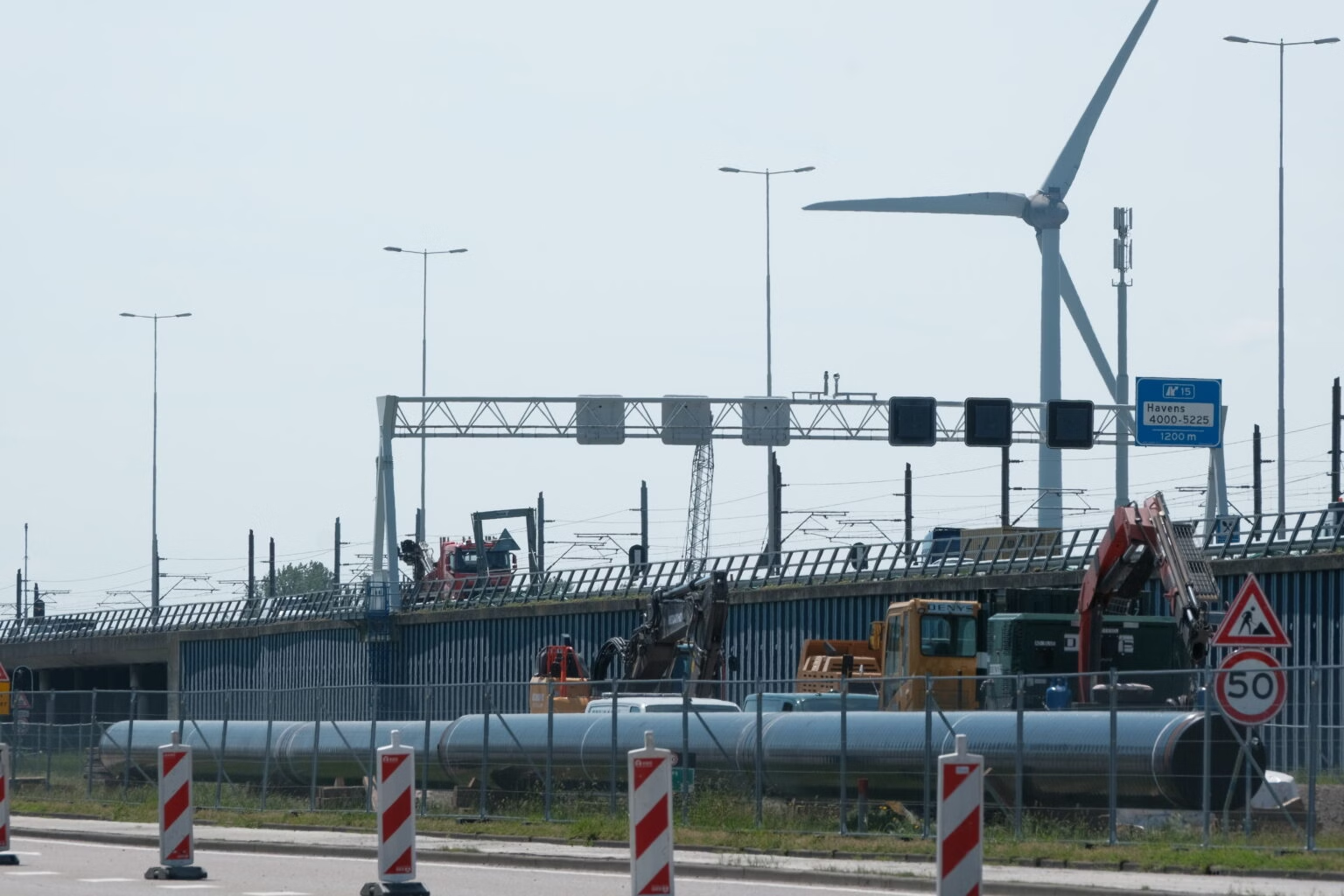
Sections of the Porthos CO2 pipeline are now being buried around Rotterdam’s industrial port. Credit: Michael Buchsbaum.
A Temporary Solution?
Regardless of when they come online, Porthos and the other planned Dutch CCS projects are generally presented as temporary solutions giving industry time to wean itself off fossil fuels — but how long that transformation will take remains unclear.
With billions of euros being invested, “you just have to count on a few decades,” Gasunie’s Coenen said.
Even as Porthos, Aramis and similar projects inch forward, further questions loom: Who will pay the enormous cost of rolling out the network of carbon capture facilities and pipelines needed to ferry CO2 from Europe’s industry to disposal sites in the North Sea via Rotterdam? And can such a project be completed in anything like the timeline demanded by the EU’s carbon capture targets?
Another unknown is how investing in these and other CCS projects will lead to a reduction in overall emissions — particularly since so many planned CCS projects involve building new fossil fuel infrastructure, such as gas-fired power stations or blue hydrogen facilities, rather than retrofitting existing industries. It is also unclear how subsidising industries to adopt CCS will compel fossil fuel companies to accelerate the shift to renewables.
Berte Simons, business unit director of CO2 transport and storage systems at EBN, the Dutch state-owned gas company, said that companies not only have to start capturing emissions, but stop producing them.
“There needs to be an end date to using CCS from fossil sources,” she said. “The sooner [fossil fuel companies] are able to green their portfolio, the quicker they can start with that, the better.”
For many climate advocates, the danger is that carbon capture will simply prolong business as usual — while soaking up billions of euros in subsidies.
Relying on CCS “isn’t a sensible climate mitigation strategy or even a proper carbon management strategy,” Lili Fuhr, deputy director of the Washington D.C.-based Center for International Environmental Law’s Climate and Energy Program, told DeSmog. “It’s really an escape hatch for an industry with its back against the wall faced with an energy transition that is gaining support and is becoming a reality because renewable energies are so cheap.”
This story was corrected on August 29, 2024 to clarify that the cost to taxpayers could be “up to” 4 billion euros (rather than “at least”), and show the various forms of subsidy included in that figure.
Meadow and woodlands in Tuolumne County, one of the two rural counties where Golden State Natural Resources proposes to build a wood pellet production facility. Credit: Malcolm Manners(CC BY 2.0 DEED)
Plans by biomass giant Drax to manufacture wood pellets sourced from Californian forests will endanger natural habitats and increase toxic air pollution for rural communities, campaigners warn.
The British energy company has partnered with Golden State Natural Resources, a government-linked nonprofit which plans to build two industrial plants in rural California counties that would produce one million tonnes of compressed wood fiber pellets a year.
One plant would be in Tuolumne County in the foothills of the Sierra Nevada Mountains, and the other in Lassen County in the state’s far northeast. From there, pellets would be shipped by rail to the city of Stockton, exported internationally, and burnt as biomass fuel to create electricity.
At its board meeting last Wednesday, Golden State Natural Resources ratified a Memorandum of Understanding (MOU) with Drax.
The agreement comes as a BBC investigation revealed that Drax was burning rare forest wood in the Canadian province of British Columbia.
BBC Panorama found that in 2023 the company took more than 40,000 tonnes of wood from so-called “old-growth” forests in B.C. Following the investigation, the company issued a statement expressing confidence that its “biomass is sustainable and legally harvested.”
Drax already operates 18 wood pellet plants across the U.S. and Canada, but the MOU finalized on February 28 is the most concrete indication yet of Drax’s ambition to expand into California, a state with 33 million acres of forest.
The wood pellets Drax produces are treated as “carbon neutral” under international accounting rules, based on an assumption that new-growth trees will capture the carbon lost by wood burnt for electricity. But scientists and campaigners have long disputed these claims.
A 2021 study from the European Academies Science Advisory Council concluded that burning wood for energy “is not effective in mitigating climate change and may even increase the risk of dangerous climate change.” A power station operated by Drax in the UK generates 8 percent of the UK’s “renewable” electricity, but is also the single largest emitter of carbon dioxide.
Golden State Natural Resources claims its forest management techniques reduce the risk of wildfires — a claim which has also been disputed by campaigners — and that it maintains “stringent guardrails” to ensure the sourcing of materials for pellets is sustainable. Drax also says its pellets are made from “sustainable biomass” generated from low-grade roundwood, sawmill residues, and forest residues — although several investigations have found instances of the company using primary forest materials.
The plan calls for sourcing wood from areas that encompass eight National Forests, and activists in California have raised concerns that the production of this “renewable” power could endanger vital biodiversity in the forests, home to California’s endangered gray wolves. They are also concerned that the facilities could harm local communities, some of which face high health burdens.
A January 2024 study by the journal Renewable Energy found that thousands of tons of toxic air pollutants, from nitrogen oxide to volatile organic compounds, are emitted in the pellet-making process, especially in the southeastern United States where most pellet plants are located.
Rita Frost, a forests advocate from environmental nonprofit Natural Resources Defense Council (NRDC), said the project would “diminish our forests’ ability to contribute to the fight against climate change, increase carbon emissions during a critical juncture when we must be reducing them instead, and compound health harms in vulnerable communities.”
‘Trojan Horse’
Golden State Natural Resources is a nonprofit co-founded by a state agency and a service organization that represents California’s rural counties. A document on the group’s website describes its purpose as “to build wildfire and forest resilience in the state and spur economic opportunities in rural communities.”
The MOU between Drax and the Californian nonprofit echoes those goals, stating that the companies should “work collaboratively and in good faith” to identify “potential sustainable vegetation management projects on forest land that meet the dual goals of promoting forest resilience and producing sustainable biomass fuel.”
GSNR says its proposed project would source pellet materials from a mixture of native forests undisturbed by human activity, and forests that have been subjected to logging cycles but allowed to regenerate, as well as privately managed timberland.
On its “Frequently Asked Questions” page, GSNR claims that its removal of accumulated fuel will help California’s forests burn “with less frequency and less intensity over the long term.”
A quarter of California — more than 25 million acres — is classified as under very high or extreme fire threat, with over 25 percent of the state’s population living in these high fire-risk areas. The counties where GSNR plans to cite its facilities have small populations but are no strangers to fire; the second-largest fire in state history, which covered nearly one million acres, burned partially in Lassen County.
But the practice of removing trees or thinning forests to reduce fire danger is controversial, and some experts say it can actually increase the severity of fires.
Michelle Connolly, an ecologist and director of Conservation North, says GSNR is justifying its activity by using “scientific-sounding language to make it seem like they know what they’re doing.”
“Logging and road building in any kind of primary forests is associated with increasing fire risk,” she said.
“Fire is the latest Trojan Horse for industry to get into natural forests they otherwise might not get to violate. Pellets originating from primary forest are not sustainable in any way, shape or form.”
Megan Fiske, a wildlife biologist at the Central Sierra Environmental Resource Center and a Tuolumne County resident, also has concerns over the impact of the clearance on forest health and natural habitats.
Each facility would source wood from a 100-mile radius, an area that includes eight National Forests and a major biodiversity hotspot. Dozens of endangered or threatened species take refuge in these zones — including California’s fledgling population of gray wolves, which were threatened with extinction and have only recently returned to the state.
“We need to restore the forest ecosystem and its natural processes,” Fiske told DeSmog.
“Removing the nutrients and other benefits imparted by ‘biomass’ does not restore the forest ecosystem or its natural processes, which provide tremendous ecosystem services.”
Environmental Pollution
The number of industrial wood pellet mills has risen rapidly in the U.S. and Canada to meet a rising demand for biomass-fuelled energy in Europe and Asia.
The two production plants planned for California are located in former timber industrial areas in rural counties, where drought and other extreme weather events associated with rising temperatures from climate change compound existing health inequalities.
Tuolumne County, which is home to part of Yosemite National Park, has a higher-than-average pollution burden, high rates of asthma and cardiovascular disease, and a high poverty rate, according to data in CalEnviroScreen 4.0 Indicator Maps.
Residents in Lassen have similar health outcomes to the state average, but on average die earlier than their neighbors.
The mapping tool CalEnviroScreen shows that the communities living around the port of Stockton, where the pellets will be shipped from, are some of the most disadvantaged in the state, based on factors including poor air quality, low income, and poor health indicators.
Though subject to environmental regulations, the production of pellets can release vast amounts of sawdust and other harmful particulates that impact air quality.
In May 2023, The Guardian reported a U.S. plant supplying wood pellets to Drax had violated air pollution limits in Mississippi. A September 2022 investigation by Unearthed found Drax was driving “environmental racism” after air pollution claims in the southeastern United States. Drax paid out $3.2 million to settle.
“These are not the kinds of jobs that our rural communities deserve. They are low wage positions and extremely dangerous working conditions.” – Nick Joslin
Nick Joslin, forest and watershed watch program manager at the Mount Shasta Bioregional Ecology Center, resides in Siskiyou County, an area where wood would be sourced and then transported by truck to the pellet mill in the Lassen County town of Nubieber.
“Siting a facility of this size in a small town is completely irresponsible,” he said.
“There are no services and no housing. Where would any newly employed people live? Where would they receive basic services or send their kids to school? The facility would run 24 hours a day with noise, lighting, dust, and noxious fumes.”
Golden State Natural Resources has also said the project will create 128 full-time jobs once both sites are operational, but Joslin is skeptical that these will provide the economic opportunities the county needs.
“These are not the kinds of jobs that our rural communities deserve. They are low wage positions and extremely dangerous working conditions,” Joslin added.
Fiske, of Tuolumne County, says the counties of the Sierra Nevada once exploited by the gold, timber, and water industries are now being hit by the latest cycle of commercial-scale resource extraction.
“We must keep the rivers clean and healthy, we must keep the forests from emitting too much wildfire smoke. All while the logging trucks and water trucks deteriorate our local roads and slow and impede traffic. All while employees are imported from elsewhere to take the temporary, barely living wage jobs.”
‘False Solutions’
As a “renewable” energy provider, Drax has benefited from billions of pounds in subsidies from the UK government. The thinktank Ember has estimated it will have collected more than £11 billion between 2012 and 2027, when the support runs out.
The company is now looking to gain an estimated £31.7 billion in additional subsidies for the controversial technology of bioenergy, carbon capture and storage (BECCS) — where emissions from burning organic matter are captured and buried underground.
Advocates promote this as a “carbon negative” climate solution, but experts and campaigners have argued that BECCS is technically unproven, and that the practice poses risks for biodiversity, land, and food security.
The UK government this year approved two new carbon capture units at Drax’s Yorkshire power station, while Drax is looking to roll out the technology to other countries — among them the U.S.
DeSmog reported in 2022 that Drax had lobbied California’s government to build a BECCS plant in the state, describing it as an “ideal location.” A UK government consultation on Drax’s future subsidies closed on Thursday (February 29), with a decision expected in April.
Campaigners say both the burning of biomass, and the attempted capture of its emissions, is deeply flawed.
“For California, there’s no time to waste on false solutions like this,” Rita Frost of NRDC told DeSmog.
“Any climate plan that relies on BECCS development with Drax is extremely high risk. Funds should instead be directed to wind and solar energy, which are not only low-cost and low-risk, but actually help fight the climate crisis.”
Drax and Golden State Natural Resources did not respond by publication time to specific questions submitted.
Activists protest against fossil fuels on the sidelines of the United Nations Climate Change Conference in Dubai, United Arab Emirates on December 5, 2023. (Photo: by Karim Sahib/AFP via Getty Images)
“We need to cut through the smoke and mirrors of ‘abated’ fossil and keep our eyes fixed on the goal of 1.5°C,” said a co-author of a new analysis.
While the United Nations climate summit continued in the Middle East, researchers in Germany warned Tuesday that depending on technology to trap and sequester planet-heating pollution could unleash a “carbon bomb” in the decades ahead.
Specifically, the new briefing from the Berlin-based think thank Climate Analytics states that reliance on carbon capture and storage (CCS) could release an extra 86 billion metric tons of greenhouse gases into the atmosphere between 2020 and 2050.fcv
“The climate talks at COP28 have centered around the need for a fossil fuel phaseout,” the publication notes, referring to the United Arab Emirates-hosted U.N. conference. “But some are calling for this to be limited to ‘unabated’ fossil fuels.”
“The term ‘abated’ is being used as a Trojan horse to allow fossil fuels with dismal capture rates to count as climate action.”
Over 100 countries at COP28 support calling for “accelerating efforts toward phasing out unabated fossil fuels,” or operations that don’t involve technological interventions such as CCS,” as Common Dreamsreported earlier Tuesday.
The new briefing highlights the risks of targeting only unabated fossil fuels. Contrary to claims that significant oil and gas consumption can continue thanks to new tech, it says, “pathways that achieve the Paris agreement’s 1.5°C limit in a sustainable manner show a near complete phaseout of fossil fuels by around 2050 and rely to a very limited degree, if at all, on fossil CCS.”
Additionally, “there is no agreed definition of the concept of abatement,” and “a weak definition of ‘abated’—or even no definition at all—could allow poorly performing fossil CCS projects to be classed as abated,” the document explains. The report’s authors suggest that the focus on unabated fossil fuels is driven by polluters who want to keep cashing in on wrecking the planet.
“The term ‘abated’ is being used as a Trojan horse to allow fossil fuels with dismal capture rates to count as climate action,” declared report co-author Claire Fyson. “‘Abated’ may sound like harmless jargon, but it’s actually language deliberately engineered and heavily promoted by the oil and gas industry to create the illusion we can keep expanding fossil fuels.”
🚨 NEW REPORT!
Unabated: the Carbon Capture and Storage 86 billion tonne carbon bomb aimed at derailing a fossil phase out
Why language at COP28 around 'abated' fossil fuels is a risk to 1.5°C.
Climate Analytics CEO Bill Hare, who also contributed to the document, said that “the false promises of ‘abated’ fossil fuels risks climate finance being funneled to fossil projects, particularly oil and gas, and will greenwash the ‘unabatable’ emissions from their final use, which account for 90% of fossil oil and gas emissions.”
Report co-author Neil Grant stressed that “we need to cut through the smoke and mirrors of ‘abated’ fossil and keep our eyes fixed on the goal of 1.5°C. That means slashing fossil fuel production by around 40% this decade, and a near complete phaseout of fossil fuels by around 2050.”
As a Tuesday analysis from the Civil Society Equity Review details, a “fair” phaseout by mid-century would involve rich nations ditching oil and gas faster than poor countries, and the former pouring billions of dollars into helping the latter. The United States, for example, should end fossil fuel use by 2031 and contribute $97.1 billion per year toward the global energy transition.
The United States is putting money toward what critics call “false solutions” like carbon capture, and it is not alone. An Oil Change International (OCI) report from last week notes that “governments have spent over $20 billion—and have legislated or announced policies that could spend up to $200 billion more—of public money on CCS, providing a lifeline for the fossil fuel industry.”
OCI found that rather than permanently sequestering carbon dioxide, 79% of the global CCS capacity sends captured CO2 to stimulate oil production in aging wells, which is called “enhanced oil recovery.” The group also reviewed six leading plants in the United States, Australia, and the Middle East, and concluded that they “overpromise and underdeliver, operating far below capacity.”
Lorne Stockman, OCI’s research director, asserted last week that “governments need to stop pretending that fossil fuels aren’t the problem. Instead of throwing a multibillion-dollar lifeline to the fossil fuel industry with our tax dollars, they should fund real climate solutions, including renewable energy and energy efficiency. Fossil fuel phaseout must be the central theme of COP28, not dangerous distractions like CCS propped up with public money.”
Underscoring Stockman’s point that such projects are incredibly expensive, the University of Oxford’s Smith School of Enterprise and the Environment on Monday published research showing that a high carbon capture and storage pathway to net-zero emissions in 2050 could cost at least $30 trillion more than a low CCS pathway.
“Relying on mass deployment of CCS to facilitate high ongoing use of fossil fuels would cost society around a trillion dollars extra each year—it would be highly economically damaging,” said Rupert Way, an honorary research associate at the school.
“Any hopes that the cost of CCS will decline in a similar way to renewable technologies like solar and batteries appear misplaced,” he added. “Our findings indicate a lack of technological learning in any part of the process, from CO2 capture to burial, even though all elements of the chain have been in use for decades.”