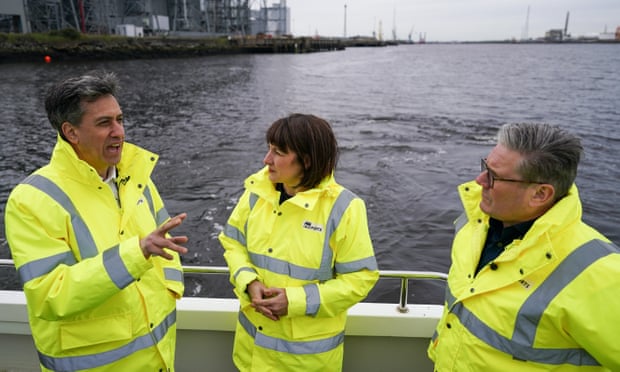
Ed Miliband, Rachel Reeves and Keir Starmer visit Teesside, the location of a proposed multibillion-pound carbon capture and storage project. Photograph: Ian Forsyth/Getty Image
Letter says technologies to produce blue hydrogen and capture CO2 are unproven and could hinder net zero efforts
Leading climate scientists are urging the government to pause plans for a billion pound investment in “green technologies” they say are unproven and would make it harder for the UK to reach its net zero targets.
Labour has promised to invest £1bn in carbon capture, usage and storage (CCUS) to produce blue hydrogen and to capture carbon dioxide from new gas-fired power stations – with a decision on the first tranche of the funding expected imminently.
However, in the letter to the energy security and net zero secretary, Ed Miliband, the scientists argue that the process relies on unproven technology and would result in huge emissions of planet-heating CO2 and methane – gases that are driving the climate crisis.
“We strongly urge you to pause your government’s policy for CCUS-based blue hydrogen and gas power, and delay any investment decision … until all the relevant evidence concerning the whole-life emissions and safety of these technologies has been properly evaluated,” they write.
The letter, which is signed by leading climate scientists from the UK and US as well as campaigners, argues the plans would:
Lock the UK into fossil fuel production for generations to come.
Result in huge upstream emissions from methane leaks, transport and processing of liquefied natural gas (LNG) from the US.
Rely on carbon capture and storage (CCS) during the production of hydrogen – technology they say has been abandoned in the vast majority of similar projects around the world.
Pose a danger to the public if there are any leaks from pipes carrying the captured carbon. At least 45 people had to be taken to hospital after a leak in the US.
A Guardian collage of images from industry 1970s industry periodical Marathon World published by a corporate predecessor of Marathon Petroleum Composite: The Guardian/Getty Images/Marathon Oil Company
Marathon Petroleum predecessor warned of potential for ‘social and economic calamities’ in decades-old publication
The corporate predecessor to America’s largest refiner of oil, Marathon Petroleum, explained in a company periodical nearly 50 years ago that global temperature rise potentially linked to “industrial expansion” could one day cause “widespread starvation and other social and economic calamities”.
This decades-old description of climate breakdown is from a 1977 issue of the magazine Marathon World and is attributed in the article by an unnamed author to several experts including a scientist working for a top US agency.
“Although climatologists disagree on the underlying reasons, many see a future climate of greater variability, bringing with it areas of extreme drought,” said the magazine, previously published by Marathon Oil Company, which later split into Marathon Petroleum as well as the exploration and production company Marathon Oil.
Marathon Petroleum is among several oil and gas companies – including Exxon, Shell and BP – currently being sued by the city of Honolulu for allegedly engaging in a coordinated communications effort “to conceal and deny their own knowledge” of catastrophic climate impacts caused by burning their products.
That lawsuit alleges that Marathon knew of the dangers of global temperature rise long before the general public due to its membership in the American Petroleum Institute, which began studying the link between fossil fuels and global heating decades ago.
This newly surfaced article shows the company was undertaking efforts on its own to stay up to date on the latest climate science and the threats a more volatile climate could pose to humankind.
…
The current Honolulu lawsuit alleges that Marathon contributed to climate obstruction by belonging to industry associations that spent decades trying to convince the public that science linking coal, oil and gas to climate change was shaky and unreliable.
“Pestilence, starvation, drought. To know one’s product may bring that about, and bury the evidence, is unspeakable,” Timmons Roberts, a professor of environment and sociology at Brown University, who’s an expert in climate disinformation, wrote in an email to the Guardian after viewing the 1977 article.
Marathon and other companies named in the litigation are currently petitioning the US supreme court to throw out the case.
We’ve now had 11 record-breaking months of heat in a row and sea surface temperatures in the North Atlantic have soared to their highest in at least 40 years.
So you can see why forecasts have warned that the continent could be in for another unusually hot summer – possibly even the hottest on record.
…
Europe has been warming at twice the global average since 1991, according to recent data from the World Meteorological Organisation (WMO) and EU climate agency Copernicus (C3S). The continent is “no exception” when it comes to the consequences of climate change with both agencies warning that Europe needs to do more to cut its emissions and transition away from fossil fuels.
dizzy: Moving away from fossil fuels is the appropriate way to address the climate crisis. Anything else is not addressing the problem.In the UK that’s no more oil or gas licences and stopping Rosebank i.e no new fossil fuels.
Susan Avery, the first climate scientist on ExxonMobil’s board, is stepping down. Credit: Tess Abbot/WHOItn(CC BY-SA 4.0).
Advocates had hoped Susan Avery’s nomination would be a turning-point moment for the company’s climate approach. It wasn’t.
This story was published in partnership with ExxonKnews
When Susan Avery was first nominated to ExxonMobil’s board in 2017 after pressure from shareholder advocates to bring on a climate scientist, many hoped that her expertise could help steer the oil major in a new direction. Avery — a physicist and atmospheric scientist — had spoken during her extensive career of the need to “get off fossil fuels as much as possible.”
More than seven years later, Avery is set to exit her role as chair of Exxon’s Environment, Safety, and Public Policy Committee with those hopes seemingly dashed. Evidence continues to mount that the oil giant is still spreading climate disinformation to delay action on fossil fuels, and it recently sued shareholders who proposed that it pursue emissions cuts.
Avery’s decision not to stand for re-election to the board was “for reasons unrelated to the company,” according to a February filing with the U.S. Securities and Exchange Commission. Avery, 74, is just shy of Exxon’s mandatory retirement age, though that was not cited in the filing — directors can run for re-election until they’re 75.
The end of her tenure has reignited debate about the role of a scientist on the board of a major oil company with a legacy of spreading science denial and ignoring internal expertise.
“People wanted to give her an opportunity to change things from within, and I think there was an expectation that she would take that responsibility seriously,” said Kathy Mulvey, accountability campaign director for the Union of Concerned Scientists, a nonprofit advocacy organization that supported Avery’s nomination at the time. But Avery’s ability or willingness to change the company “certainly has not borne out in reality,” Mulvey said.
Avery’s selection came after a shareholder proposal requested that Exxon nominate someone with a “high level of climate change expertise” for its board. The company’s unusual lawsuit against other shareholders could chill further attempts to sway its business model that way. Avery’s last day will be May 29, overlapping with the company’s annual shareholder meeting, where a growing number of outraged shareholder groups and state pension funds now plan to vote against prominent members of the board, including CEO Darren Woods.
With climate lawsuits against the company moving closer to trial, a growing number of states exploring legislation to make companies like Exxon pay for climate damages, and tensions with investors so high, “serving on ExxonMobil’s board is a high-stakes poker game,” Mulvey said. As Avery closes out her tenure with more than $3.8 million in compensation and stock value from the company, Mulvey said, “it’s not surprising” if Avery “decided to cash in her chips and go home.”
Neither Avery nor Exxon responded to requests for an interview.
Business as Usual During Avery’s Tenure
Avery, the former president of the Woods Hole Oceanographic Institution in Massachusetts and professor emeritus at the University of Colorado Boulder, was brought onto the board during Woods’ first month as CEO. “Avery’s leadership experience in multiple academic and scientific organizations, coupled with her breadth of scientific and research expertise, reinforce the corporation’s long-standing technical and scientific foundation,” the company said as it announced her appointment.
At the time, Exxon was battling subpoenas from attorneys general in New York and Massachusetts, both investigating the company for concealing its knowledge about the dangers of burning fossil fuels. The oil giant was just beginning to experience the fallout of early revelations about its historic climate deception; the tip of that iceberg was unearthed by Inside Climate News, the Los Angeles Times, and Columbia Journalism School in 2015.
Behind the scenes, Exxon was taking a far less amenable tone in response to criticism of its climate approach.
“Kill the story,” Exxon media relations manager Alan Jeffers told Reuters’ Houston bureau chief in a 2016 email, responding to a request for comment on a Center for Media and Democracy press release accusing the American Legislative Exchange Council of abusing its nonprofit status by lobbying against climate action on behalf of Exxon.
In the years to follow, Exxon would become the target of lawsuits from state and local governments alleging the company defrauded consumers, lawmakers, and the public in order to delay climate action and protect its oil and gas profits. Evidence shows the oil giant continued to spread anti-science disinformation and internally strategize to manipulate the public’s understanding of its role in the climate crisis well into Avery’s time on the board.
A congressional report released last month following a years-long investigation found that Exxon and other oil majors’ campaigns of deception “evolved from denying climate science to spreading disinformation and perpetuating doublespeak.” Avery is mentioned in more than a dozen of the documents that members of Congress obtained from Exxon — but they’re almost entirely redacted.
The investigation found that while Exxon publicly touted its support for the Paris Agreement “since its adoption in 2015,” executives privately admitted that the company did not actually intend to meet the agreement’s goals. The oil giant’s plans are far afield from allowing it to hit those targets, according to a March analysis by think tank Carbon Tracker, which placed Exxon among the five lowest-ranking companies on its scorecard. Exxon’s climate pledges don’t align with its actions, according to one peer-reviewed study, and are “misleading at best, dishonest at worst,” according to Carly Phillips, a research scientist at the Union of Concerned Scientists.
During Avery’s tenure, the company also used advertising firms and funded partnerships with academic institutions to lend credibility to its climate pledges and promotion of “low-carbon solutions” like algae biofuels, which the company abandoned after spending millions advertising that as a climate fix. And Exxon worked to shift blame for its role in the climate crisis to consumers, according to a study of the company’s public communications by climate disinformation experts Naomi Oreskes and Geoffrey Supran.
“The people who are generating those emissions need to be aware of and pay the price for generating those emissions,” Exxon’s Woods said in a recent Fortune interview.
A November report from the International Energy Agency found that oil and gas companies account for less than 1% of clean energy investment globally. “‘When the energy world changes, so will we’ is not an adequate response to the immense challenges at hand,” the report concludes.
But Exxon has vastly expanded its investments in fossil fuels, more than doubling its oil production in the Permian Basin after sealing a $60 billion deal to acquire Pioneer Natural Resources last year. Exxon and two other oil companies told Guyana that they plan to spend more than $12.9 billion on an offshore oil project there, the country said last summer. The company’s 2023 Global Outlook predicts an increase in methane gas use of more than 20% by midcentury.
In a 2021 hearing as part of a House Oversight Committee investigation, Woods refused to pledge that the company would stop funding disinformation and lobbying against climate action.
‘Like a Cancer Doctor on the Board of a Tobacco Company’
The same committee asked Avery to testify at a later hearing, but she never did. Instead, Avery appeared to use her expertise and position to lend credibility to Exxon’s claims of climate leadership.
“I’m proud to work on key issues related to climate risk at ExxonMobil,” she said in Exxon’s 2023 “Advancing Climate Solutions” report. “With my experience as an atmospheric scientist and a leader at a global research organization, I am committed to helping to advise the Board on public issues of significance. … The members of the [Environment, Safety and Public Policy] Committee are united in our commitment to position ExxonMobil as an industry leader in pursuing sustainable solutions that improve quality of life and meet society’s evolving needs.”
Sarah Myhre, another climate scientist and program director for climate advocacy and democracy reform at the Glaser Progress Foundation, contends that Avery compromised her scientific integrity to “performatively greenwash one of the most horrifically damaging, nefarious, and fraudulent corporations that has ever existed.”
“It’s like a cancer doctor on the board of a tobacco company [promoting] tobacco as a health product, something that is helping people live healthier, more vibrant lives. They’re taking all of their scientific bona fides and accreditation, and they’re using it for this outcome, which ultimately protects the tobacco company [as it] continues to kill people or damage their lives irrevocably,” Myhre said.
Michael Mann, a climate scientist who was subject to years of attacks from climate denialists funded by Exxon, described Avery’s service to the company as a “betrayal.”
Avery’s decision “comes across as entirely transactional: climate scientist lends their imprimatur to the world’s largest publicly-traded fossil fuel company, under fire for their history of promoting disinformation and delay tactics, for seven years, and gets 4 million dollars in return,” Mann said in an email. “What is there that doesn’t look bad here?”
Silencing Dissent at Exxon
What’s not known is whether Avery ever advised Exxon to change course. The company has a history of concealing the warnings of its own scientists and retaliating against whistleblowers — even recently.
“The ability of a board member to move a company forward partially depends on the multiple stakeholder voices that the company is hearing and whether they’re willing to listen to them,” said Timothy Smith, senior policy advisor at Interfaith Center on Corporate Responsibility, an organization that coordinates the work of shareholder groups.
Exxon’s lawsuit against two shareholder groups, filed in January, came in response to the shareholders’ proposal asking the company to limit its Scope 3 emissions, which arise from the use of its products and make up about 85% of its total greenhouse gas emissions. (Exxon’s “net zero” ambitions and emissions reduction plans don’t account for Scope 3 emissions at all.)
Shareholder resolutions such as these are intended for a vote by a company’s stockholders. When firms want to keep proposals off the ballot, the established process is to appeal to the Securities and Exchange Commission. Exxon, which sued instead, claimed the groups were driven by an “extreme agenda” that is “calculated to diminish the company’s existing business.”
That claim was “really duplicitous because they know full well that this same agenda has been raised with them by other investors over the decade,” said Smith, arguing that the company has “become more confrontational and defensive rather than be a leader in this space.”
The shareholders, Arjuna Capital and Follow This, withdrew their proposal. But Exxon continued with its lawsuit, defending the decision in its 2024 proxy statement and arguing that the “proposal process is being abused by those who treat shareholder democracy as a venue for activism.” A judge ruled Wednesday that the case can proceed against one of the shareholders, U.S.-based Arjuna Capital, but not the Netherlands-based Follow This.
Mulvey, of the Union of Concerned Scientists, said Exxon would rather battle its own investors than consider transparency about or a change to its fossil fuel business.
“Not only do they continue to fight back against mandatory climate disclosure and public policies that would hold them accountable, but it is also trying to undermine the notion that those who own the company should have a say over its direction,” she said.
Tensions could come to a head at Exxon’s annual shareholder meeting as Avery steps aside. Shareholder advocacy groups like Majority Action have urged other investors to vote against the company’s entire board of directors, which CalPERS, America’s largest pension fund, has announced it will do. The Illinois State Treasurer and California State Treasurer have made similar recommendations to their state pension funds, and the New York state pension fund plans to vote against all but two of the board members.
“The [International Energy Agency] has laid out a plan to transform our energy system in line with the 1.5°C pathway. We’re at a critical juncture of how this is going to occur — and Exxon appears to be hellbent on foreclosing on that urgent and necessary discussion,” said Majority Action’s senior research analyst, Bryant Sewell. “These directors have to be held accountable.”
Eldar Saetre, CEO of Equinor. Credit: Jeff Gilbert / Alamy
Campaigners likened the fossil fuel company’s patronage of climate events to letting an “arsonist sponsor a fire safety conference”.
Major media companies have sparked a wave of criticism after allowing a Norwegian oil and gas company behind the UK’s largest new North Sea project to sponsor events on climate change.
Equinor was an official sponsor of two conferences on climate and energy this week, one run by the New Statesman magazine, and one run by Politico. Both saw MPs pull out over the sponsorship, while the first was interrupted by a climate activist.
The Norwegian state-owned company has a majority stake in the Rosebank North Sea oil field, which has been dubbed a “carbon bomb” by environmental law charity ClientEarth.
Equinor claims it supplies 27 percent of the UK’s energy from oil and gas, and is currently investing $6 billion (£4.8 billion) a year in fossil fuel exploration and drilling.
“Allowing fossil fuel companies like Equinor to sponsor and speak at climate conferences is as absurd as allowing an arsonist to sponsor and participate in fire safety conferences,” said Carys Boughton of the Fossil Free Parliament campaign. “At this critical time for climate and energy policy-making, we can’t afford this absurdity.”
Equinor’s sponsorship of these events is the latest example of fossil fuel companies using media partnerships to greenwash their polluting activities.
An investigation by DeSmog and Drilled in December detailed how oil and gas companies are using media deals – including partnerships with Politico, the Economist, the Financial Times, Reuters, and the Washington Post – to present a climate-friendly image.
DeSmog also revealed this week, based on documents released by a powerful U.S. congressional committee, that fossil fuel companies believe these media partnerships help to protect their “social licence to operate”.
Michelle Amazeen, a mass communications researcher at Boston University, said that oil and gas sponsorship is “a strategic move by fossil fuel companies to compromise the integrity of events intended to foster dialogue and action around climate issues”.
She added that, “While the sponsorship gives the impression of caring about the environment, it’s a veneer that’s like an oil slick obscuring the actual conduct of the fossil fuel industry.”
This week, a cross-party group of 50 MPs, including three Conservatives, wrote to Prime Minister Rishi Sunak urging him to end the licensing of new oil and gas fields, appoint a climate envoy, and back the Beyond Oil and Gas Alliance, an international coalition working to facilitate a global phase-out of oil and gas production.
Alice Baxter, Equinor’s UK spokesperson, said: “At Equinor we believe in openness and the importance of engaging in the complex conversations around the energy transition. We respect everyone’s right to protest and encourage robust debate.”
New Statesman Event
Equinor was one of the sponsors of the New Statesman’s Energy and Climate Change Conference on 14 May at the Leonardo Royal Hotel in south London.
Green Party MP Caroline Lucas pulled out of the event last week due to Equinor’s sponsorship.
Was due to speak at @NewStatesman conference on Energy & Climate Change. Then it turns out it's sponsored by @Equinor_UK – the company backing giant Rosebank oil field. That's me out. #StopRosebank
At the event, attended by DeSmog, the second panel discussion featured Equinor’s UK country manager Alex Grant. The session was entitled “How can the UK lead the world in the green transition?”
When it was Grant’s turn to speak, a Fossil Free London activist in the audience stood up and gave a speech criticising Equinor and its sponsorship of the event.
The activist said climate scientists “are warning us that we are headed towards a catastrophic 2.5C of global warming. Yet staggeringly, Equinor, that’s sponsoring this event, is opening the largest undeveloped oil field in the North Sea.”
Labour MP Meg Hillier, who chairs the Public Accounts Committee and was on the panel, interjected: “Why don’t you let us talk about it, because I’m actually here to be pretty critical of the government, I’d quite like to get my points across.”
The protester continued her speech, and was removed by security. Her comments received a round of applause from the audience.
Grant replied by saying that Equinor takes a “pragmatic approach” to the energy transition, as opposed to one that “costs more than it needs to”. He also defended the Rosebank project, saying it would reduce carbon emissions over the long term.
Rosebank could produce around 300 million barrels of oil over its lifetime, emitting 200 million tonnes of carbon dioxide.
Questions at the New Statesman event were submitted online, rather than asked in person by the audience.
During the event’s final session with Chris Stark, the former chief executive of the Climate Change Committee, which advises the government on its climate policies, DeSmog submitted a question about Equinor and Rosebank’s impact on the climate. The question was not posed to the panel.
The latest issue of the New Statesman magazine, which features an interview with climate scientist and author Michael Mann, includes advertorials from biomass company Drax, which is the UK’s largest single source of CO2 emissions, and Calor Gas, one of the UK’s largest suppliers of liquefied petroleum gas.
The New Statesman hosted a number of events at the 2023 Labour Party conference sponsored by fossil fuel companies and lobbying groups, including Cadent, National Gas, and Offshore Energies UK.
The New Statesman did not respond to DeSmog’s request for comment.
Politico Event
On 16 May, Politico held its own Energy and Climate Summit, also sponsored by Equinor.
Labour MP Alex Sobel, who chairs the All-Party Parliamentary Group on Net Zero, last week pulled out of the event due to Equinor’s sponsorship.
I have decided to withdraw from the Politico Energy and Climate Summit next week, due to the involvement of Equinor. It was unclear that they were sponsors and I would not have accepted the invitation had their sponsorship been known.
— Alex Sobel MP for Leeds Central and Headingley (@alexsobel) May 8, 2024
At the event, attended by DeSmog, a panel on Carbon Capture and Storage (CCS) featured David Cairns, a former British ambassador to Sweden and now Equinor’s vice president of political and public affairs.
When questioned by the Politico chair, Cairns confirmed that the company had no plans to set targets for phasing out oil and gas.
He also said it was “debatable” whether the oil and gas industry was making large profits. Equinor reported £28 billion in profits in 2023. Cairns added that it was “really misplaced” to think that the oil and gas industry is an “easy business in which it’s easy to make money”.
A Politico spokesperson said: “This multi-sponsored Energy and Climate UK Summit is an extension of Politico’s ongoing and robust coverage of climate policy in the United Kingdom.
“There is a clear division between Politico’s newsroom and our commercial operations. With critical milestones and a general election on the horizon, we continue to cover climate each day through our dedicated reporting.”
Politico’s influential London Playbook newsletter has this week been sponsored by the oil and gas giant BP.
Michelle Amazeen said that fossil fuel sponsorship of media companies “has delegitimised their journalistic content, opened their journalists up for attack, and has even led to the resignation of journalists who are trying to write about climate issues”.
Equinor’s AGM
Equinor also faced further public criticism this week, when on Tuesday the company was confronted by a climate activist at its annual general meeting (AGM).
Lauren MacDonald of the environmental group Uplift delivered a four minute speech about the company’s impact on the planet, and promised that campaigners would not stop opposing Rosebank or the company’s other fossil fuel projects.
I just confronted the CEO of @equinor and it’s majority shareholder, the Norwegian government, at their AGM.
The people in this room are responsible for the UK’s biggest undeveloped oil field – Rosebank.
— Lauren MacDonald🌻 #StopRosebank (@laurensunfl0wer) May 14, 2024
At the meeting, shareholders rejected a resolution calling on the company to align its strategy and spending with climate goals.
“We invest in the energy the world needs now. That is oil and gas,” Equinor’s chief executive Anders Opedal said.
Tessa Khan, executive director at Uplift, told DeSmog: “Try as it might, Equinor can no longer ignore the scale of opposition to its climate-wrecking business model – it’s not just campaigners who are calling out its harmful mission, it’s also politicians pulling out of Equinor-sponsored events and shareholders demanding it ditch its plans of endless oil and gas expansion.
“Even if Equinor wants to stay silent, these demands for accountability will only get louder. Governments in the UK and Norway – who can’t afford to ignore this chorus of voices – must reject Equinor’s delay tactics and insist that their activities don’t further endanger our climate. As a first step, this means rejecting new oil and gas fields, and pulling the plug on disastrous projects like Rosebank.”
All-Energy and Dcarbonise
Equinor was not the only fossil fuel company to sponsor climate events this week.
On Wednesday, climate protesters disrupted the All-Energy and Dcarbonise event in Glasgow, which describes itself as “The meeting place for the renewable and low carbon energy community”, yet featured paid exhibitions from oil and gas majors BP and Shell.
Protesters from Stop Polluting Politics, and Fuel Poverty Action interrupted a speech by Scotland’s Net Zero and Energy Secretary Màiri McAllan, and a pre-recorded video of UK Energy and Net Zero Secretary Claire Coutinho. Both appeared alongside Louise Kingham, a senior vice president at BP.
“As the lethal reality of climate breakdown becomes unmissable, the PR strategies of big fossil fuel companies like Equinor and Shell reveal their growing isolation, and an increasingly desperate attempt to buy friends,” said Andrew Simms, a director of the New Weather Institute and a co-founder of the Badvertising campaign.
“They are the unwelcome guests at the party with everyone waiting for them to leave, but who keep buying rounds for anyone willing to drink with them in order to stay.”
Rishi Sunak on stopping Rosebank says that any chancellor can stop his huge 91% subsidy to build Rosebank, that Keir Starmer is as bad as him for sucking up to Murdoch and other plutocrats and that we (the plebs) need to get organised to elect MPs that will stop Rosebank.Image of InBedWithBigOil by Not Here To Be Liked + Hex Prints from Just Stop Oil’s You May Find Yourself… art auction. Featuring Rishi Sunak, Fossil Fuels and Rupert Murdoch.