New Shell Files Could Aid Climate Cases, Attorneys Say 

Spread the love

Original article by Matthew Green and Merel de Buck republished from DeSmog.

Credit: Sabrina Bedford.

Latest documents unearthed by Dutch climate activist seen as “valuable sources” for litigators.

Newly-discovered Shell documents dating back decades could help strengthen lawsuits aiming to hold the oil major to account for climate damages, climate attorneys say.

Among the files, reported for the first time today by DeSmog and Follow The Money, and published on Climate Files, there is a 1970 industry journal article where Shell appears to accept responsibility for harms caused by its products. A trove of Shell publications from the 1980s and 1990s foresee the “major adverse changes” the “greenhouse effect” is liable to cause to the climate. 

And a 1998 report spells out Shell’s reasons for leaving the Global Climate Coalition, a now defunct lobby group that worked to undermine climate science. The document shows that Shell had acknowledged the need to adopt  “prudent precautionary measures” to avoid the worst impacts of the climate crisis — even as it continued to push for more production of oil and gas.   

“It is feared that a further rise in carbon dioxide levels in the atmosphere could lead to a higher average surface temperature on Earth, which could have far-reaching environmental, social and economic consequences,” wrote the authors of a 1987 internal Shell publication entitled “Air Pollution: an Oil Industry Perspective.”
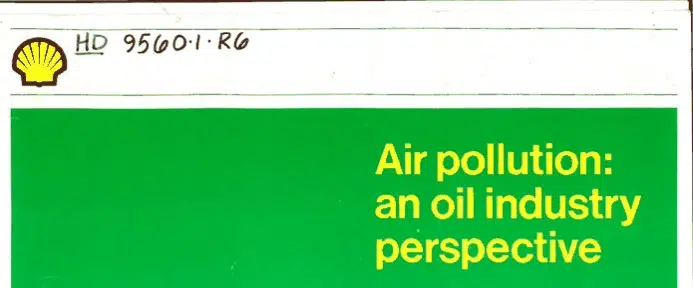
Cover of the 1987 internal Shell publication “Air Pollution: an Oil Industry Perspective.”

“Global warming could challenge the very fabric of the world’s ecological and economic systems,” Shell executive Ged Davis wrote in a contribution to a report by the Organisation for Economic Co-operation and Development (OECD) published two years later.

Vatan Hüzeir, a climate activist and doctoral candidate in sociology at Rotterdam’s Erasmus University, unearthed the documents over five years of research, gathering thousands of pages of Shell-related material from archives, former employees, and other sources.

The latest materials add to an initial tranche published in April last year which showed that even as Shell’s awareness of the potentially devastating consequences of climate change grew during the 1970s and 1980s, the company downplayed or omitted key risks in public communications; emphasised scientific uncertainties; and pushed for more fossil fuels.

Shell and other oil and gas companies have been named as defendants in dozens of U.S. climate lawsuits brought by the attorneys general of states such as New Jersey, Vermont, and California, as well as Washington, D.C. and other municipalities across the country. Some of these cases have been brought under consumer fraud or protection laws that penalise companies for misrepresenting their products to the public.

The Washington D.C.-based Center for Climate Integrity, which has filed briefs in support of many of the climate cases against Shell, said that the latest documents provide further evidence that the company has known for at least half a century that its products posed a threat to the climate, as well as the grave consequences of delaying action.

“These internal admissions are valuable sources for litigators around the world seeking to hold Shell accountable for its climate deception under a variety of legal theories,” Corey Riday-White, senior staff attorney at the Center for Climate Integrity, told DeSmog. “While Shell privately acknowledged the dangers of using its products as intended, the corporation publicly sowed doubt about the science and fought efforts to regulate its pollution.”

Hüzeir hopes the latest documents will support two additional and complementary legal strategies: showing that Shell has long accepted some liability for harms caused by its products — including, by implication, climate change — and demonstrating that even as Shell supported lobby groups that sought to block meaningful action to curb fossil fuel use, senior executives acknowledged the need for a “precautionary” approach to the growing climate crisis.    

In response to a request for comment, Shell referred DeSmog to a previous statement it has made regarding the lawsuits. 

“It is for government to determine the right trade-offs for society and put in place smart policy to enable fundamental change in the way society consumes energy,” a Shell spokesperson said.  

More than a dozen of the newly released documents, as well as the previous tranche published in April, can be viewed on Climate Files, under the title Dirty Pearls: Exposing Shell’s hidden legacy of climate change accountability, 1970-1990

Shell Knew

In July 2023, 20 Democratic members of Congress cited DeSmog’s initial coverage of the documents in a letter to U.S. Attorney General Merrick Garland, in which they requested a Department of Justice investigation into the evidence that Shell, ExxonMobil and other oil majors concealed their early knowledge of climate risks.

This spring, a Dutch court is due to hear Shell’s appeal of a 2021 order to slash the company’s carbon dioxide (CO2) emissions 45 percent by 2030, issued in response to a suit filed by environmental group Milieudefensie. Six other organisations also participated in the suit, including FossielvrijNL, a campaign group chaired by Hüzeir, as well as 17,000 Dutch citizens.  

“Shell must do its part to contribute to combating dangerous climate change,” Hague district court judge Larissa Alwin said, reading out the ruling.

Hüzeir believes the latest tranche of documents will strengthen cases brought by climate litigators in Europe and North America, in part by providing clues to the possible existence of additional Shell documents that could be obtained through discovery — a pre-trial procedure in the U.S. legal system that parties involved in a lawsuit use to obtain evidence from each other.

“You have to ‘crack the shell,’” Hüzeir told DeSmog. “With the existing documents in hand, and perhaps many more yet to be discovered, prosecutors, litigators and campaign groups can ground their demands for Shell to be held accountable in even more detailed fact and documentation.”

‘Annoying Consequences’

Among the new documents is an October, 1970 article in Dutch trade publication Chemisch Weekblad (Chemical Weekly), in which two authors from the University of Leiden reported on their research into “chemistry and ethics” — including the results of interviews with petrochemical executives. Representatives from Shell had appeared to acknowledge that the company bore some responsibility for the problems that its products would cause.

“If a product is used, as indicated by Shell, and annoying consequences nevertheless arise, Shell feels partly responsible,” they told the researchers.
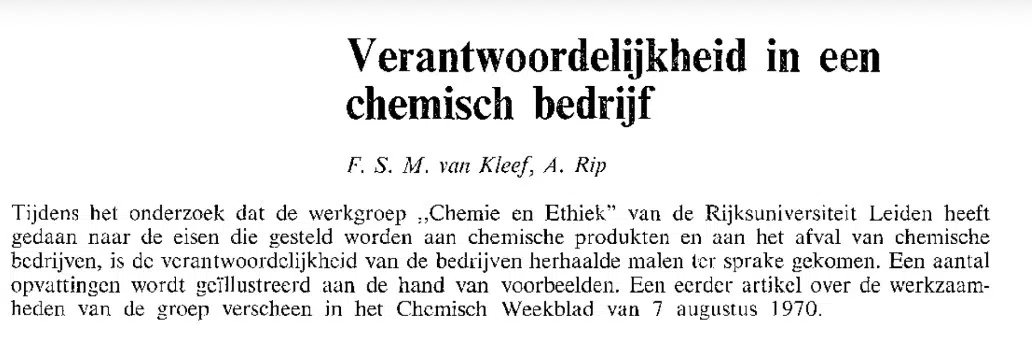
Excerpt from an October, 1970 article in Dutch trade publication Chemisch Weekblad (Chemical Weekly).

Hüzeir said the document, and others like it, could support litigators to argue that Shell’s apparent early admission of some liability for the side-effects caused by its products should, by extension, also include climate impacts from burning its oil and gas, now known as “Scope 3” emissions. 

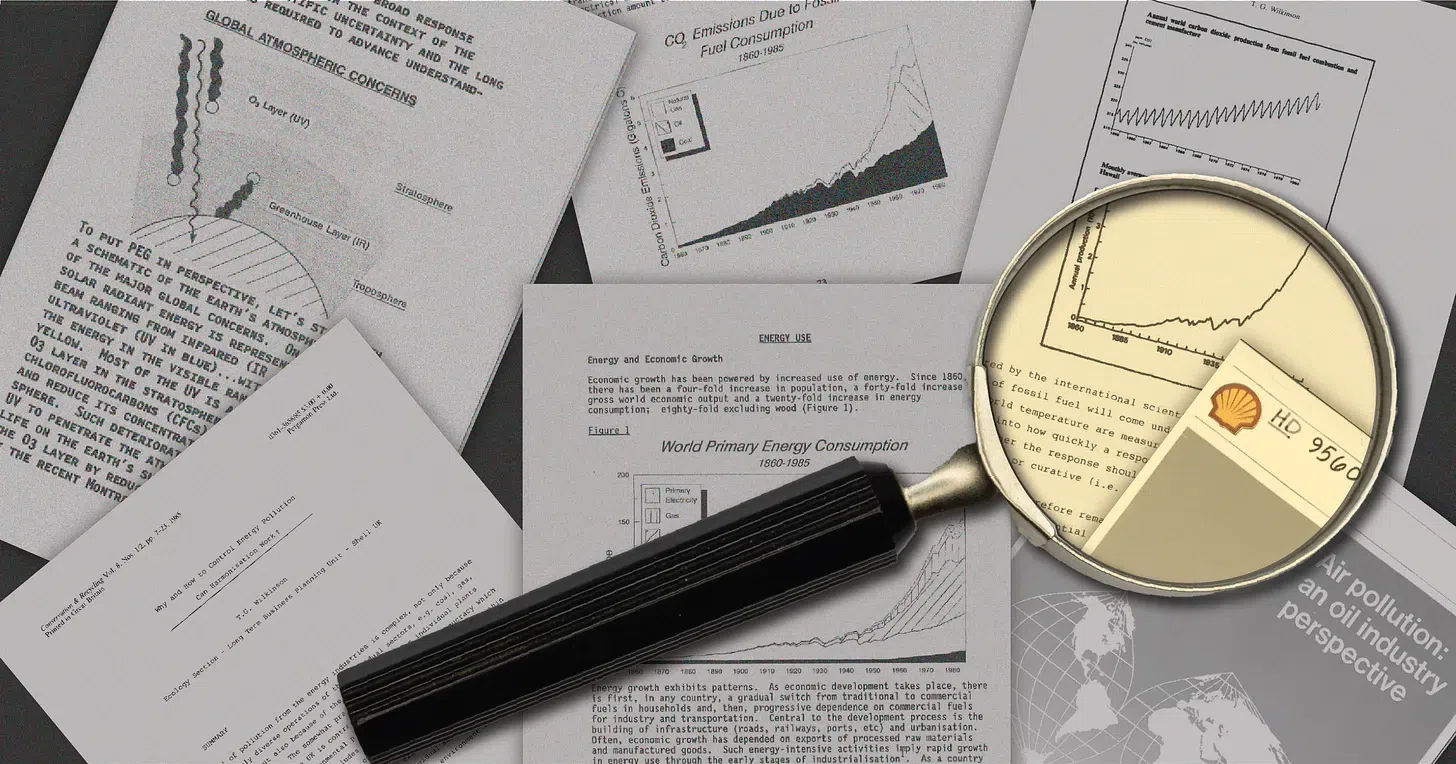
Later documents cast new light on Shell’s growing understanding of the risks posed by climate change. In a March 1985 article in the journal Conservation & RecyclingT.G. Wilkinson, who worked at the time in the Ecology Section of Shell UK’s Long Term Business Planning Unit, explored the risks posed by “energy-generated pollution.” 

“Burning of fossil fuels which have taken millions of years to form has effectively upset the balance leading to an increase in CO2 in the atmosphere,” Wilkinson wrote. “The Greenhouse effect could lead to some melting of the ice-cap and a significant change in the climatic pattern throughout the world. Whilst this will cause major adverse changes to some areas, others will benefit.”
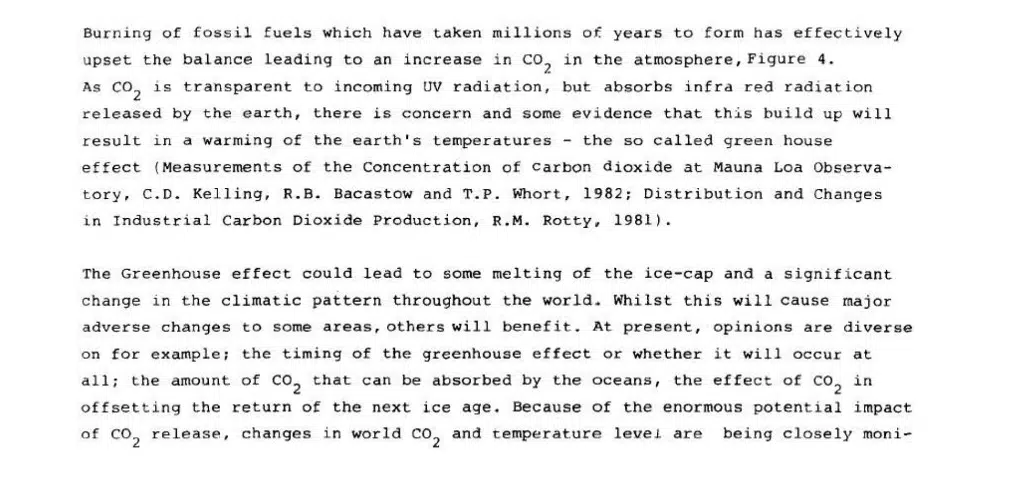
Excerpt from a March 1985 article in the journal Conservation & Recycling by T.G. Wilkinson, who worked at the time in Shell UK’s Long Term Business Planning Unit.

Wilkinson went on to explore whether a precautionary approach should be adopted to prevent the “potential enormous effects on the world’s climate.”

“It is likely that the continued use of fossil fuel will come under close scrutiny in the future if adverse increases in world temperature are measured and can be linked to CO2 release. A quandary remains into how quickly a response is needed if a warming trend is identified, and to whether the response should be preventative (i.e. a worldwide low fossil fuel strategy) or curative (i.e. specific actions taken by individual countries).

“The dilemma therefore remains as to whether to encourage the continued use of fossil fuels with the potential enormous effects on the world’s climate.”

Wilkinson returned to this dilemma in his conclusion, again noting the dangers posed by “emissions and discharges” caused by fossil fuels and nuclear power. 

“As well as the benefits of these energy developments however, there are also consequences to the environment arising from the emissions and discharges which are part of the process operations or are implicit in the subsequent use of the fuel,” Wilkinson wrote. “There is concern that energy-generated pollution could well affect the quality of life that has at least in part been made possible by energy developments.”
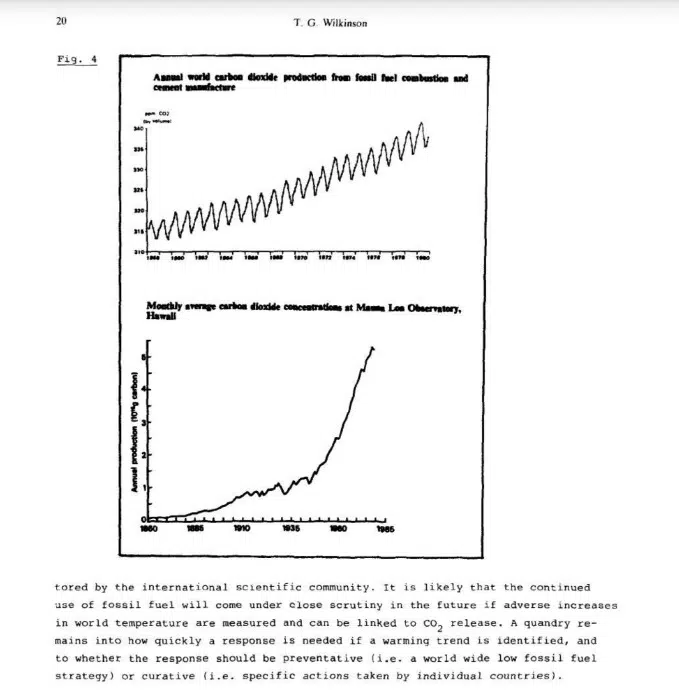
Graphs showing growing carbon dioxide emissions from fossil fuels, and rising CO2 concentrations in the atmosphere, in Shell staffer T.G. Wilkinson’s March 1985 article in Conservation & Recycling.

Winners and Losers

Further evidence of Shell’s growing understanding of the risks posed by burning its products appears in the 1987 internal Shell publication “Air Pollution: an Oil Industry Perspective.” 

“It is feared that a further rise in carbon dioxide levels in the atmosphere could lead to a higher average surface temperature on Earth, which could have far-reaching environmental, social and economic consequences,” the document said. “A lot of scientific research is being done to determine which climatic changes can occur and which measures should be taken.”

Shell’s understanding of the gravity of the dangers was also apparent in the 1989 OECD report, entitled “Energy Technologies for Reducing Emissions of Greenhouse Gases.” Davis, the Shell executive, who warned that “global warming could challenge the very fabric of the world’s ecological and economic systems,” also foresaw the possible cost to future generations of failing to curb emissions.

“Whatever policies are chosen there will be ‘winners’ and ‘losers,’” he wrote. “Two groups who could bear particularly heavy costs will be: Future generations who would have to live with the costs of adaptation, and…Those in countries yet to industrialise who would face constraints on energy use…How should we allocate resources between prevention and adaptation?”
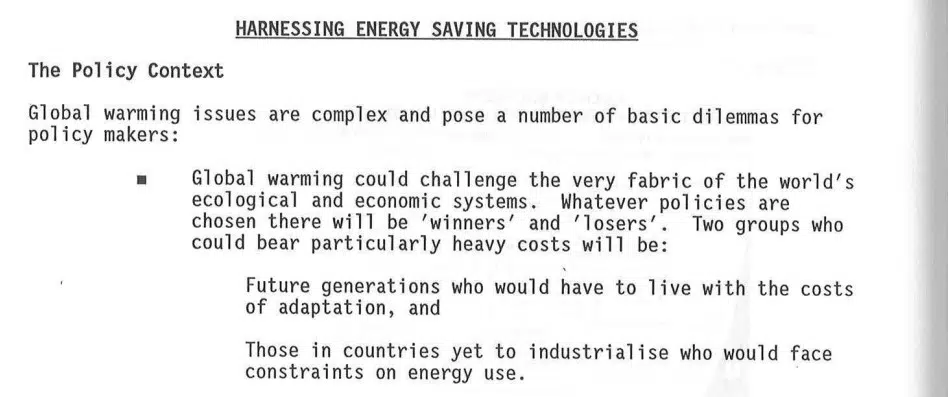
An excerpt from Shell executive Ged Davis’ contribution to a 1989 report by the OECD.

Shell planners spelled out the risks even more starkly in an October 1989 confidential scenario exercise, previously reported by DeSmog. The authors warned that climate-fuelled migration could spark conflicts by swamping borders in the U.S., Soviet Union, Europe, and Australia, and that “civilisation could prove a fragile thing.”

‘Too Late’

In the 1990s, as the oil industry increasingly backed lobby groups and think tanks working to undermine climate science, the stark assessments of the risks of burning fossil fuels made by Shell staff in the previous decade gave way to a greater emphasis on scientific uncertainty.  

In an October 1990 internal Dutch-language publication entitled “Climate Change,” Shell acknowledged that many leading scientists were convinced of the existence of the “greenhouse effect” — the term then used for climate change. 

But the publication also echoed a message  seen in other Shell documents that Hüzeir has turned up: emphasizing uncertainty about the magnitude and timing of climate impacts, “if they do come.” 

“There is a considerable period of time (perhaps decades) between the increase in greenhouse gases and their ultimate effect on the climate,” the report stated. “As a result, by the time the enhanced greenhouse effect has been conclusively proven, it may be too late to do anything about it.” 

Nevertheless, the report went on to acknowledge the importance of reducing greenhouse gas emissions, and referenced the possibility of using carbon taxes to promote a shift away from fossil fuels. “It is widely recognized that emissions of the main greenhouse gases must be limited if there is to be any chance of reducing the further strengthening of the greenhouse effect,” the document said.

The report also noted technologies that could reduce emissions, ranging from switching to fuels that produce less CO2 per unit of energy, to boosting nuclear and renewables such as solar and wind energy. Hüzeir hopes this explicit acknowledgement of the existence of alternatives could strengthen the hand of litigators who want to prove that Shell chose to continue boosting production of fossil fuels, even while knowing that cleaner options were available.

The cover of the October 1990 internal Dutch-language publication entitled “Climate Change.”

Shell’s emphasis on scientific uncertainty was evident again two years later, in September 1992, when the company’s Group Planning department published a “Business Environment Occasional Paper” on the “Potential Augmented Greenhouse Effect, & Depletion of the Ozone Layer.”

In contrast to Shell authors who had squarely recognised the primary role of fossil fuels in driving climate change in documents and graphs published during the 1980s, the authors emphasised that it was difficult to assess the extent to which fossil fuels were responsible. 

“Because of the complexity of the biogeochemical cycles, it is very difficult to aportion [sic] the increase in greenhouse gas concentrations to any particular cause,” the paper said. “The increase in CO2 and methane has corresponded with increasing industrialisation, use of fossil fuels, intensification of agriculture and deforestation. As a minimum statement, therefore, human activities must have contributed to the increase in carbon dioxide and methane.”
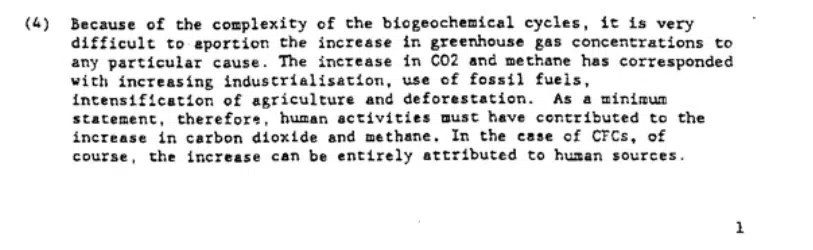
An excerpt from Shell’s September 1992 “Business Environment Occasional Paper” on the “Potential Augmented Greenhouse Effect, & Depletion of the Ozone Layer.”

Meanwhile, in other documents, Shell recognised the need to adopt a “precautionary” approach to climate change. In a 1993 report by the World Energy Council, a think tank backed by government and industry, where Shell’s managing director at the time, John Jennings, served on the board, the word “precautionary” appears more than 20 times. 

“Given the as yet unknown consequences of continued and increasing greenhouse gas emissions and impacts, the ability to ascertain the ‘economically optimal’ level of emissions and their mitigation, as required by a cost-benefit approach, is impossible,” the report said. “As a matter of simple prudence, therefore, action based on the precautionary principle is advocated.” 

An excerpt from a 1993 report by the World Energy Council, where Shell held a seat on the board.

Hüzeir argues that such explicit acknowledgements of the need for precautionary measures will further bolster lawsuits alleging that Shell had developed a thorough understanding of the dangers posed by fossil fuels, even as it issued other publications that emphasised scientific uncertainties, and backed lobby groups working to undermine climate action.  

‘Profits and Principles’

Shell was a founding member of the Global Climate Coalition (GCC), the outspoken oil industry lobby group, which was formed in 1989 to actively promote uncertainty and doubt about climate science in order to delay climate action.

Hüzeir believes Shell’s explanation of why it left the GCC in 1998 in an English-language sustainability report called “Profits and Principles – Does There Have to Be a Choice?” could provide a further hook for litigators.  

DeSmog has previously documented that the GCC had attempted to limit the strength of statements regarding the human causes of climate change made by the Intergovernmental Panel on Climate Change, the UN’s scientific advisory body, in the run-up to the 1997 climate conference where nations agreed to the Kyoto Protocol.

The “Profits and Principles” document said that the “main disagreement” between Shell and the GCC centred on the group’s opposition to the Kyoto agreement, which aimed to cut global greenhouse gas emissions by five percent by 2012.

“The GCC is actively campaigning against legally binding targets and timetables as well as ratification by the US government,” the report said. “The Shell view is that prudent precautionary measures are called for.”
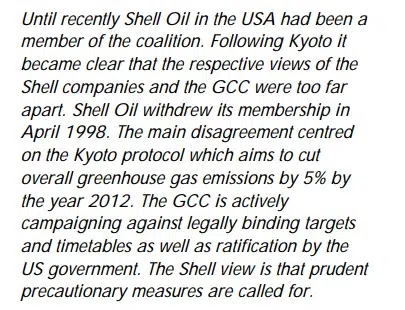
An excerpt from Shell’s 1998 English-language sustainability report called “Profits and Principles – Does There Have to be a Choice?

Hüzeir said that Shell’s admission that it saw the need for these “precautionary measures” affirms that the company had long understood the risks posed by the climate crisis — knowledge apparent in many earlier files. 

This document also raised the question of why Shell had continued to fund the GCC, as late as 1998 — the year it left the organisation — despite that understanding, Hüzeir said.  

Shell’s acknowledgement that its position in GCC had become untenable could also help litigators demonstrate that oil and gas companies that remained in the group until it disbanded in 2002 had been acting in bad faith, Hüzeir added.

“We’ve heard many times from the fossil fuel industry that it was unsure whether or not to take early action on the climate crisis, because there were uncertainties in the science,” Hüzeir said. “But Shell’s deepening embrace of the precautionary principle, as revealed in this document, shows that Shell was well aware of the crisis ahead. What else did they know?”

Original article by Matthew Green and Merel de Buck republished from DeSmog.
Continue ReadingNew Shell Files Could Aid Climate Cases, Attorneys Say 

Congressman: DOJ Investigation of Big Oil Is Now “Even More Urgent” Following Shell Revelations

Spread the love

Original article by Emily Sanders, ExxonKnews republished from DeSmog.

Credit: Tess Abbot/ExxonKnews

With more proof of Shell’s climate deception, Rep. Ted Lieu is once again urging the Department of Justice to look into whether fossil fuel companies broke the law.

After new evidence emerged last week showing that oil major Shell internally acknowledged the dangers of their fossil fuel products decades ago, a member of Congress is renewing his previous call for the U.S. Department of Justice to investigate whether Shell and other Big Oil companies’ “alleged campaigns of climate deception” may have violated federal law.

The company documents, first unearthed by Dutch researcher Vatan Hüzeir and reported last week by DeSmog and Follow the Money, reveal Shell executives and employees predicting “major adverse changes” to the climate from fossil fuel emissions — and admitting Shell’s role in causing the problem. “Global warming could challenge the very fabric of the world’s ecological and economic systems,” warned Shell executive Ged Davis in one newly uncovered document from 1989. 

“This new set of documents further demonstrates that Shell privately knew about the dangers its products would cause to the environment yet continued to deceive the public in pursuit of company profits. This is wrong and potentially illegal,” said U.S. Rep. Ted Lieu (D-CA), who along with Sen. Richard Blumenthal (D-CT) led 20 members of Congress in a letter last year urging the Department of Justice to look deeper into evidence that Shell, ExxonMobil, and other fossil fuel majors “lied — and continue to lie — to the public about their central role in exacerbating the climate crisis.” 

“These new documents provide additional evidence and make our calls for an investigation even more urgent,” Lieu told ExxonKnews in response to the latest Shell revelations. 

The lawmakers’ July 25 letter cited an initial batch of internal Shell documents released by Hüzeir last March. The evidence, they wrote, should inspire the DOJ to “investigate Exxon, Shell, and other members of the fossil fuel industry to determine whether they violated RICO, consumer protection, truth in advertising, public health, or other laws.” 

A separate letter from U.S. Sens. Bernie Sanders (D-VT), Elizabeth Warren (D-MA), Ed Markey (D-MA), and Ed Markey (D-OR) urged the DOJ to go even further and “bring suits against the fossil fuel industry for its longstanding and carefully coordinated campaign to mislead consumers and discredit climate science in pursuit of massive profits.”

The latest documents add to an abundance of proof that Shell was well aware of the harm its products would cause — and acknowledged its culpability for the damage.

“If a product is used, as indicated by Shell, and annoying consequences nevertheless arise, Shell feels partly responsible,” representatives from Shell told researchers from the Dutch University of Leiden in 1970.

Those “annoying consequences” — which turned out to be more catastrophic and deadly than just annoying — were plainly elucidated by the company in the years to follow. In a 1985 journal article, Shell employee T.G. Wilkinson observed that the burning of fossil fuels has “upset the balance” of carbon dioxide in the atmosphere, and “will cause major adverse changes to some areas.” 

“The dilemma therefore remains as to whether to encourage the continued use of fossil fuels with the potential enormous effects on the world’s climate,” Wilkinson wrote.

Two years later, an internal Shell report titled “Air Pollution: an Oil Industry Perspective” noted that a rise in CO2 in the atmosphere “could lead to a higher average surface temperature on Earth, which could have far-reaching environmental, social and economic consequences.”

In 1989, Shell executive Davis warned that “Two groups who could bear particularly heavy costs will be: Future generations who would have to live with the costs of adaptation, and…Those in countries yet to industrialise who would face constraints on energy use.”

Davis is now executive chair of world energy scenarios at the World Energy Council.

Armed with the information it needed to steer the world toward cleaner sources of energy, Shell embarked on a campaign to undermine climate action instead. 

The same year Davis made his prediction in the OECD report, Shell helped found the Global Climate Coalition (GCC), an oil industry lobbying group that worked to spread disinformation about climate science. 

A year later, in an internal publication, Shell admitted the need to reduce greenhouse gas emissions and embrace alternative sources of energy — but stated that “by the time the enhanced greenhouse effect has been conclusively proven, it may be too late to do anything about it.”

Shell went on to promote the idea that climate science was uncertain and downplayed the role of fossil fuels in the years to come. “It is very difficult to aportion [sic] the increase in greenhouse gas concentrations to any particular cause,” read one paper published by the company in 1992. 

When Shell left the GCC, citing its opposition to the Kyoto climate agreement, it explained in a 1998 report that “The Shell view is that prudent precautionary measures are called for.”

Hüzeir, the researcher who unearthed these reports, told DeSmog that documents like this could help litigators make the case against Shell in a growing wave of lawsuits seeking to hold the company accountable for knowingly fueling climate chaos. “Shell’s deepening embrace of the precautionary principle, as revealed in this document, shows that Shell was well aware of the crisis ahead,” he said. “What else did they know?”

The documents add to a heap of evidence that could spur the country’s most powerful public interest law firm to investigate Big Oil.

“If the allegations against ExxonMobil, Shell, and other major fossil fuel companies are true, their coordinated efforts to deceive Americans constitute the most consequential deception campaign in history, with potentially existential consequences for our planet,” Lieu and other members of Congress wrote in their July letter to the DOJ. “We respectfully request that the DOJ investigate whether these actions violated federal law.”

Since that letter was sent last year, more state and local governments have taken the companies to court for that deception. California — the most populous state in the nation and one of the world’s largest economies — sued Shell and other fossil fuel majors for climate damages and consumer fraud. Two Indigenous tribal governments in Washington State, forced to spend millions relocating their communities due to rising seas, filed their own lawsuit against oil giants. Honolulu’s climate accountability lawsuit cleared motions to dismiss the case by fossil fuel defendants, putting it on a path to be the first case of its kind to go to trial. 

The stakes of these legal efforts are only getting higher, as climate disasters continue to batter many of the same communities awaiting their day in court. The DOJ threw its support behind the plaintiffs in a U.S. Supreme Court brief the agency filed last March, but it hasn’t yet taken independent action against the fossil fuel industry.

“It’s time to hold polluters accountable for their lies, which could have existential consequences for our planet,” Lieu said.

Original article by Emily Sanders, ExxonKnews republished from DeSmog.

North Sea Bill’s Carbon Emissions Test is a ‘Smokescreen’ And ‘Makes No Sense’ — Experts

US/See How Louisiana’s Growing Fossil Fuel Industry Threatens Climate and Justice Promises

Dark Money, CCS Bonanza, Corporate Comms Offensives: What to Watch in 2024

Continue ReadingCongressman: DOJ Investigation of Big Oil Is Now “Even More Urgent” Following Shell Revelations

Corporate Media Fed COP 28 Carbon Capture Confusion

Spread the love

Original article by OLIVIA RIGGIO republished from FAIR under a Creative Commons Attribution-NonCommercial-NoDerivs 3.0 Unported License.

The COP 28 UN climate conference concluded with countries agreeing to a plan to transition away from fossil fuels, using language that fell short of calling for an explicit phaseout. In the debates over whether countries need to phase fossil fuels “out” or merely “down,” carbon capture and storage (CCS), a form of so-called fossil fuel “abatement,” played a central role.

Rather than exposing CCS as the greenwashing ploy it essentially is, some reporting placed disproportionate significance on the technology, adding to the confusion and misunderstandings about climate change that fossil fuel companies have been funding for decades.

An excuse to not eliminate

Scientific American: Don’t Fall for Big Oil’s Carbon Capture Deceptions

“Don’t be fooled,” writes Jonathan Foley in Scientific American (12/4/23): Carbon capture is “mostly a distraction from what we really need to do right now: phase out fossil fuels and deploy more effective climate solutions.”

Before COP 28 even began, climate activists were not hopeful. The conference, held in Dubai, capital of the oil-dependent United Arab Emirates, reeked of almost comedic irony. The conference’s president, Sultan Al Jaber, is the head of the petrostate’s national oil company.

During a November livestream event, Al Jaber falsely claimed there was “no science” indicating a phaseout of fossil fuels was necessary to keep warming levels below the 1.5°C threshold set by the Paris Agreement. He added that phasing out fossil fuels would “take the world back to the caves” (Guardian12/3/23).

CCS technology—which involves capturing carbon from sources like power plants and steel mills, and storing it underground—has become a key part of the fossil fuel industry’s arguments against the elimination of its environmentally devastating product. Instead of rapidly ending the extraction and burning of fossil fuels, the claim goes, we can simply “abate” the emissions with CCS.

The reality is that even optimistic estimates see CCS (also known as carbon capture and sequestration) as playing only a limited role in mitigating emissions from difficult-to-decarbonize sectors. But polluters aggrandize its potential contributions in order to keep expanding fossil fuel extraction while at the same time claiming to take action on climate (Scientific American12/4/23). In fact, most successful CCS projects are actually used to force more oil out from underground, in a process called “enhanced oil recovery” (Washington Post10/25/23).

Given the chokehold the fossil fuel industry had on this COP and subsequent conversations about climate change mitigation, journalists must be clear and realistic in their reporting about the capabilities of carbon capture, and its role in both climate crisis solutions and fossil fuel industry greenwashing.

‘A valuable role’

NYT: Can Carbon Capture Live Up to the Hype?

To back up the idea that carbon capture is a “valuable tool,” the New York Times (12/6/23) links to a study whose headline calls it “Too Little, Too Late, Too Slow.”

The New York Times’ headline, “Can Carbon Capture Live Up to the Hype?” (12/6/23), could have been most easily and accurately answered by a short “no.” Instead, the subheading misled about CCS’s plausibility as a climate change solution, claiming that “experts say it could play a valuable role.”

But what’s the evidence on offer? The article mostly described the failures of expensive carbon capture projects to even get off the ground. The only reference to that supposedly “valuable role” linked to three studies or reports. The titles of two were “[Carbon Capture]—Too Little, Too Late, Too Slow—It’s No Panacea” (S&P Global10/18/23) and “Heavy Dependence on Carbon Capture and Storage ‘Highly Economically Damaging,’ Says Oxford Report” (SSEE, 12/4/23).

A third, seemingly more optimistic, report came from the International Energy Agency (11/27/23). But that agency’s latest report actually offered the opposite message, its executive director explained (Toronto Star11/23/23): Oil companies’ plan to achieve “net zero”—removing as much carbon from the atmosphere as they emit—by capturing emissions while increasing production is an “illusion” based on “implausibly large amounts of carbon capture.” Lucky for those companies, New York Times headline writers are here to keep up that illusion.

The Times article itself even noted that “total fossil fuel use will have to fall sharply no matter what to keep global warming at relatively low levels,” and that carbon capture is “no silver bullet.” It cited the IEA’s roadmap to lowering carbon emissions to net zero by mid-century, noting that even in this ideal plan, CCS would account for just 8% of the world’s total emissions cuts, and that “the vast majority of reductions would come from countries shifting away from fossil fuels entirely.”

While CCS could play a part in mitigating emissions from industries like cement, steel and fertilizers, the benefit can only be realized if the technology’s logistical and financial limitations are addressed, explained Jonathan Foley in a piece for Scientific American (12/4/23). Food and Water Watch (7/20/21) characterizes CCS as an “expensive failure” that’s energy intensive and actually increases emissions.

Even while outlining CCS’s “limitations,” the Times managed to both-sides the issue:

One big dispute is over how big a role this technology, known as carbon capture and storage, should play in the fight against global warming. Some oil and gas producers say it should be central in planning for the future. Others, including many activists and world leaders, dismiss carbon capture as too unproven and too risky.

In a “dispute” about how to cut carbon emissions, oil and gas producers’ arguments should certainly not be taken at face value. And, while “activists and world leaders” are among those who “dismiss carbon capture,”crucially,  so are scientists.

The Times piece played down the many economic and logistical failures of CCS as “limitations.” While removing carbon will likely play a necessary—albeit small—role in meeting climate goals, CCS’s  success hinges on our abilities to phase out fossil fuels. The tone of the piece’s headline is overly optimistic, offering a false sense of hope—and “hype”—for a technology that’s used more as a fossil fuel fig leaf than a climate change solution.

‘Vital…but falling short’

Bloomberg: Why Carbon Capture Is Seen as Vital in Climate Fight But Falling Short

Bloomberg (12/6/23) notes without rebuttal that “CCS has been discussed as a way to limit the damage caused by fossil fuels without having to abandon them.”

An explanatory Bloomberg piece (12/6/23) about carbon capture, headlined, “Why Carbon Capture Is Seen as Vital in Climate Fight but Falling Short,” used similarly weak language.

In addition to CCS, the piece highlighted direct air capture (DAC), another carbon capture technology that removes carbon that is already in the atmosphere, rather than at the site of emission, and also performs at a tiny fraction of the scale that would be necessary for it to be an actual solution. According to the article, the largest DAC hub in the world, found in Iceland, only removes the equivalent of the annual emissions of 250 average US citizens.

For more context, the Regional Direct Air Capture Hubs that Biden’s Department of Energy is supporting are anticipated to suck only about 1 million metric tons of CO2 from the atmosphere annually. In 2022, global emissions of CO2 were 40.5 billion metric tons (Scientific American12/4/23)–adding more than 40,000 times as much carbon as the hubs are supposed to take out.

To say these technologies are “falling short” is quite the understatement.

To say they’re “vital” requires context. The Bloomberg piece explained:

Even if solar and wind energy largely supplant fossil fuels, holding temperatures down will require capturing large amounts of emissions produced by activities that are hard to decarbonize, such as making cement.

That much is true. However, it leaves out the most important part: Carbon capture can only make a difference in a world that drastically cuts emissions. Without that priority being met, its impacts are marginal at best—and, at worst, a distraction that permits fossil fuel companies to increase emissions and worsen the crisis.

In a press briefing with Covering Climate Now (11/9/23) regarding CCS and carbon dioxide removal, David King, former chief science adviser to the British government, emphasized that reducing greenhouse gas emissions was still the No. 1 priority, as human activity continues to emit the equivalent of about 50 billion tons of carbon dioxide into the atmosphere each year.

‘Some environmentalists’

WaPo: The two words island nations are begging to see in a global climate pact

Washington Post (12/11/23) attributes the idea that carbon capture is a “false climate solution” to “some environmentalists.”

Washington Post report (12/11/23), leading with the tearful remarks of Mona Ainuu, a climate activist from Niue, a small island nation, described the ultimate, disappointing outcome of the COP: The draft agreement to come out of the conference called not for the phaseout of fossil fuels, but for the mealy-mouthed “reducing both consumption and production of fossil fuels, in a just, orderly and equitable manner.”

The agreement also called for the rapid phase-down of “unabated coal.” The Post explained carbon capture and sequestration:

Some environmentalists view CCS as a false climate solution, saying it could prolong the life of polluting facilities for decades to come. They note that the International Energy Agency has warned that humanity cannot build any new fossil fuel infrastructure if it hopes to limit warming to 1.5°C.

Like the Times report, the Post framing failed to give readers the unvarnished truth they need, that CCS is only seen as a key climate solution by industries whose profitability depends upon the further burning of fossil fuels. No further information on the IEA report was given, or any information about the other litany of scientific studies, reports and information on the failures of CCS, allowing the specific concerns of “some environmentalists” to go unmentioned.

All of these pieces fail to mention why the fossil fuel industry is so gung ho about this dubious technology: While oil companies’ greenwashed PR campaigns tout CCS, corporations and governments continue to ramp up extraction.

Carbon capture and removal will likely play a small role in avoiding the most devastating effects of climate change, but it’s spitting in the ocean without a fossil fuel phaseout. It is journalists’ job to explain this accurately, while reminding audiences to not forget the No. 1 priority: eliminating fossil fuels.

Original article by OLIVIA RIGGIO republished from FAIR under a Creative Commons Attribution-NonCommercial-NoDerivs 3.0 Unported License.

Addition by dizzy: When Rishi Sunak says that every last drop of oil should be taken from the North Sea, he is showing his full support to the oil industry and it’s CCS misdirection. CCS or it’s original name ‘enhanced oil recovery’ is needed to get every last drop.

Continue ReadingCorporate Media Fed COP 28 Carbon Capture Confusion

Oil Change International’s Reaction: Al Jaber’s science-denying statements are alarming

Spread the love
Dr. Sultan al Jaber. Image: Arctic Circle, CC BY 2.0, via Wikimedia Commons

https://priceofoil.org/2023/12/03/reactive-al-jabers-science-denying-statements-are-alarming/

In response to COP28 President Al Jaber’s science-denying comments at the She Changes Climate Event, as reported by The Guardian, Romain Ioualalen, Oil Change International’s Global Policy lead, said: 

“COP28 President Al Jaber’s science-denying statements are alarming and raise deep concerns about the Presidency’s capacity to lead the UN climate talks, at a time when leadership and a clear vision are most needed. Of course, denying science has been part of the fossil fuel industry’s playbook for decades. But science is not up for debate: we must phase out fossil fuels to have a livable planet. 

“The science is clear. Not only do fossil fuels need to be phased out, but the phaseout needs to start now. The latest reports from the IEA and the IPCC show that maintaining a 50% chance of limiting global warming to 1.5°C requires an immediate end to investments in new oil, gas, and coal production and hazardous liquid fossil gas infrastructure.

“Instead of casting doubt on climate science, we expect the COP28 president to facilitate an outcome on a full, fast, fair, and funded phaseout of fossil fuels at COP28. Over 100 countries have now called for a phase out of fossil fuels and science is clear that limiting warming to 1.5°C without relying massively on dangerous technological distractions such as CCS requires eliminating fossil fuels from the global economy.”

https://priceofoil.org/2023/12/03/reactive-al-jabers-science-denying-statements-are-alarming/

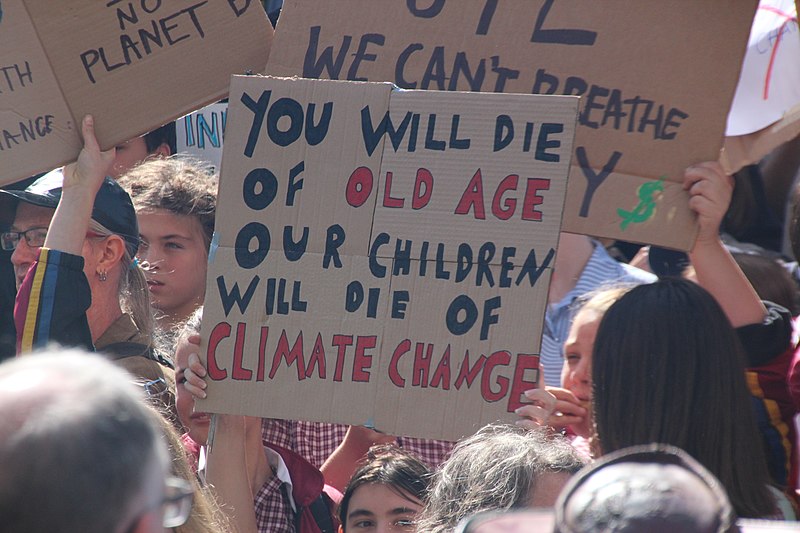
Image contains protest banner readng You will die of old age, our children will die of climate change - Melbourne climate strike
Craig Bennett says the way recent and current older generations have allowed environmental degradation will be viewed harshly by people in the future who will have to live with consequences that, in many cases, will be increasingly devastating. Image: A1Cafel Creative Commons Attribution-Share Alike 2.0 Generic via wikimedia.
Continue ReadingOil Change International’s Reaction: Al Jaber’s science-denying statements are alarming

Big Oil’s Big Lies Are Catching Up With Them

Spread the love
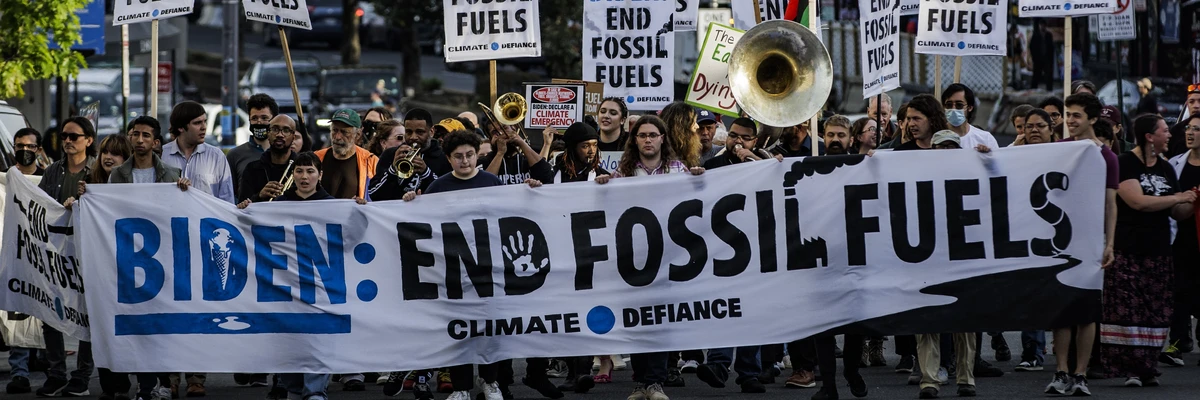
Climate protestors march in Washington DC

Original article by Cassidy Dipaola republished from Common Dreams under Creative Commons (CC BY-NC-ND 3.0).

The American public believes fossil fuel companies should pay for their deceit. Our job is to make sure they do.

For decades, the fossil fuel industry has misled the public about the climate impacts of its products. Internal documents prove companies like Exxon knew since the 1970s that burning oil and gas drives catastrophic global warming. Yet rather than warn society, they denied the science and obstructed climate action at every turn.

This corporate deception continues today, but the public is catching on in a big way. New polling from Data for Progress reveals 70% of Americans support making Big Oil pay for the climate damages their products have caused. With climate disasters growing in frequency and severity, people are fed up footing the bill for Big Oil’s greed.

Such greed should disgust us all. But outrage alone achieves nothing.

Critically, the American public believes Big Oil should pay for their lies. The new polling reveals that 77% of Americans agree that if oil and gas companies misled the public about climate impacts, they should help cover resulting climate costs. This consensus crosses political divisions. Agreement spans 91% of Democrats, 75% of Independents, and 63% of Republicans—an exceptionally high level of bipartisan agreement.

The poll also shows a sharp rise in support for making polluters pay over time. Similar polls in 2021 and 2019 found roughly 60% and 57% of Americans backed accountability, respectively. In just a few short years, support for accountability has jumped nearly 20 percentage points. Now near three-quarters of Americans are in agreement around the belief that Big Oil should pay for the harms it sowed through decades of deception.

The costs of warming are no longer abstract statistics. They can be seen in the devastation of communities across America. In 2021 alone, extreme weather fueled by climate change inflicted over $165 billion in damages nationwide. Floods, wildfires and storms killed hundreds and displaced countless more. Low income and minority communities suffered most, abandoned by the very corporations who caused this crisis.

At the same time these climate impacts accelerate, the fossil fuel industry is raking in massive profits. Just last quarter, Chevron pocketed $11.2 billion and Exxon secured $19.7 billion. Rather than invest in renewables or pay for the harms they’ve caused, they’re doubling down on fossil fuels, scooping up sister-companies and stoking fears of monopolization in the public and leadership alike.

New lawsuits are seeking damages for Big Oil’s climate deception, and they’re gaining traction.

By misleading the public on climate science for so long, the industry secured decades of unchecked emissions to swell its bottom line. But now, the deadly consequences of its lies are coming to bear. Record heat, drought and near-weekly hurricanes make clear we rapidly must transition from fossil fuels to avert utter climate catastrophe.

The public correctly realizes these corporations should pay for the crisis they knowingly fueled. Our leaders must stand up to polluters and enact policies to rein in their abuses. A future free from fossil fuels is possible, and we now have the political will to make it happen.

Original article by Cassidy Dipaola republished from Common Dreams under Creative Commons (CC BY-NC-ND 3.0).

Cassidy DiPaola is the Spokesperson and Campaign Manager for the Stop The Oil Profiteering Campaign at Fossil Free Media.

Full Bio >

Continue ReadingBig Oil’s Big Lies Are Catching Up With Them