Congressional Investigation Reveals New Evidence of Big Oil’s Decades-Long Campaign to Deny Climate Science

Spread the love

Original article by Adam M. Lowenstein republished from DeSmog.
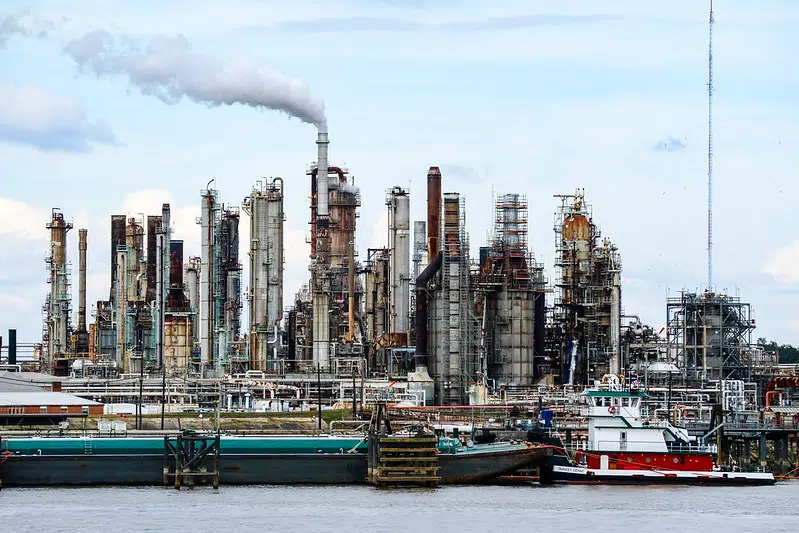
An ExxonMobil refinery on the banks of the Mississippi River. Credit: Terekhova/Flickr (CC CREATIVE COMMONS INFO)

Oil and gas companies and their top trade groups were aware for decades that carbon emissions contribute to climate change, according to a scathing new report from congressional investigators. Moreover, industry giants knew that many of the technologies they presented publicly as solutions to the climate crisis – such as algae-based biofuels and carbon capture and storage (CCS) – were neither as green nor as feasible as they promised, the study reveals.

The Senate Budget Committee and Democrats on the House Committee on Oversight and Accountability published the report and related documents on April 30, three years after launching a joint investigation of Shell, Chevron, BP, ExxonMobil, and two leading industry trade groups..

Fossil fuel obstructionism has evolved “from denial to duplicity,” said Senate Budget Committee Chairman Sheldon Whitehouse (D-RI), in a May 1 congressional hearing based on the report.

Both the hearing and the report capture what Whitehouse described as “climate denial lite,” in which the industry pivots “to pretending it is taking climate change seriously, while secretly undermining its own publicly stated goals.”

The investigation reveals that for ExxonMobil and other leading fossil fuel companies in the report, the perception of taking some sort of action on climate appears to have been as high a priority as actually taking action.

For example, for years, Exxon sought to associate its brand with algae-based biofuels. In a 2019 video, the company claimed these biofuels “would one day power planes, propel ships, and fuel trucks – and cut their emissions in half.”

Closeup of biofuel in a laboratory. Credit: Steve Jurvetson, CC BY 2.0 , via Wikimedia Commons

Between 2009 and 2023, Exxon spent some $175 million on algae-related marketing like this video – almost half as much as the company spent working on the technology. (Exxon and other industry leaders largely stopped funding for algae biofuel research by 2023.)

Even as the company publicly touted algae biofuels as a climate solution, the company knew the technology remained unproven – and, moreover, that Exxon was not investing nearly enough money if it were serious about developing algae as a viable technology.

In an email made public by the committee, an Exxon employee noted that one of the company’s executives had “made comments about us getting too far out there on the original algae ads.”

In an Exxon document released by House investigators with the header “Algae Biofuels Program Talking Points,” the company noted, “ExxonMobil’s analysis has concluded that final development and broad deployment of algae-based biofuels by the company would require future investments of billions of dollars” – orders of magnitude more than the $350 million that Exxon eventually spent.

Repeating Patterns

Congressional investigators identified a similar pattern in industry responses to a 2019 decision by Andrew Wheeler, then the head of the Environmental Protection Agency (EPA) under Donald Trump, to roll back a rule designed to reduce methane emissions.

Internally, BP agreed with Wheeler’s decision. In a 2019 email published by the committee, one executive noted that Wheeler’s “legal theory … for rolling back direct regulation of methane” was “aligned with our thinking.” The American Petroleum Institute (API), the leading trade association for the oil and gas industry, which counts BP as a dues-paying member, lobbied for the rollback.

In public, however, BP and other oil giants claimed to be disappointed by the Trump administration’s decision. David Lawler, then-chairman and president of BP America, said publicly that “direct federal regulation of methane emissions is essential.”

“Time and again, the biggest oil and gas corporations say one thing for the purposes of public consumption, but do something completely different to protect their profits,” Jamie Raskin (D-MD), the top Democrat on the House Oversight Committee and one of the leaders of the investigation, said in his prepared testimony.

“Company officials will admit the terrifying reality of their business model behind closed doors, but say something entirely different, false, and soothing to the public,” Raskin said.

Yet, even as Raskin and Whitehouse were able to reveal damning new evidence of this corporate doublespeak, they pointed out that a complete public reckoning remained impossible, since the industry refused to fully engage with investigators.

Denying Reality

In a pattern that echoes the fossil fuel industry’s decades-long efforts to deny the reality of climate change and, more recently, to portray oil and gas companies as committed to solving the crisis, the four companies and two trade groups that received congressional subpoenas appear to have withheld meaningful information while simultaneously flooding the committees with “hundreds of thousands of generic and non-responsive documents,” Raskin said.

Many documents submitted by the API were almost entirely redacted. The U.S. Chamber of Commerce produced only 24 documents that congressional investigators considered within the scope of the subpoena, including an invitation to a virtual meeting about “the future of natural gas infrastructure.”

Fossil fuel interests “completely obstructed the committees’ investigation,” Raskin said in a video played at the hearing.

During the hearing, this disinformation effort was assisted by congressional Republicans.

Sen. Ron Johnson (R-WI) read into the record debunked right-wing claims that carbon dioxide is good for the climate because it is “plant food.”

Source: Senate Budget Committee on X

Sen. John Kennedy (R-LA) spent significant time alleging that Dr. Geoffrey Supran, a University of Miami climate disinformation expert who testified at the hearing, wrote tweets that Supran did not, in fact, write.

“These are not my tweets, these are retweets,” Supran attempted to explain when he was finally shown the tweets, as Kennedy continued to speak over him.

“I’d like to make very clear that this form of character assassination is characteristic of the propaganda techniques of fossil fuel interests,” Supran added.

Supran’s point, however, was mostly obscured by Kennedy’s ongoing hectoring from the committee dais.

In a more productive exchange, Sen. Tim Kaine (D-VA) asked Raskin about the argument Exxon put forth that the investigators’ subpoena was “designed to intrude on ExxonMobil’s First Amendment activities, including its constitutionally protected right to petition the government.”

“That would obviously lead to the end of our civil and criminal discovery system, if the first amendment gave you the right not to turn over documents,” Raskin, a former constitutional law professor, replied.

“When an objection is made – if it is an extremely unpersuasive, novel, imaginative, unsupported objection – you can always tell, there’s something they really don’t want you to see,” Kaine noted. “I can only imagine the extent of the iceberg under the water that you were not allowed to see.”

The fossil fuel industry’s refusal to respond adequately to congressional subpoenas, while also flooding the committee with what Raskin’s testimony called a “paper blizzard” of some 125,000 “mass emails, newsletters, flyers, and otherwise meaningless fluff documents,” appeared designed to distract investigators and forestall potential legal action against companies and their executives.

“There is certainly an adequate legal foundation for litigation against this industry,” Sharon Eubanks, the former head of the tobacco litigation team at the Department of Justice, and leader of the U.S. government’s racketeering case against Big Tobacco, told members of the committee.

“Both industries lied to the public and regulators about what they knew about the harms of their products, and when they knew it.”

Original article by Adam M. Lowenstein republished from DeSmog.

Continue ReadingCongressional Investigation Reveals New Evidence of Big Oil’s Decades-Long Campaign to Deny Climate Science

UK professor condemns own university over collaboration with oil giant

Spread the love

Original article by Ben Webster republished from Open Democracy under a Creative Commons Attribution-NonCommercial 4.0 International licence.

Fawley oil refinery in Southampton

Southampton University slammed after openDemocracy uncovered its involvement in Exxon’s ‘greenwashing’ project

A senior professor has accused his own university of betraying its values by working with ExxonMobil on a project that has been condemned as greenwash.

Ian Williams, professor in applied environmental science at the University of Southampton, made the allegations after openDemocracy revealed that Exxon had made misleading claims about capturing carbon at the UK’s biggest oil refinery at Fawley in Hampshire.

We reported last month that Paul Greenwood, Exxon’s UK lead, had admitted that the oil giant would need a “magic wand” to deliver the project, which has no funding and no licence to store carbon.

Exxon refers prominently to its collaboration with the University of Southampton in publications about the scheme.

Williams suggested the university had been “fooled” into joining forces with the oil giant to launch the ‘Solent Cluster’, an industrial decarbonisation scheme focused on CCS.

Lindsay-Marie Armstrong, the academic cluster lead at the University of Southampton, has joined senior Exxon executives at several events to promote the scheme, including a reception at the House of Commons in February.

Williams hit out at the partnership during a lecture entitled “Working with the enemy: Why universities should not work with ‘Big Oil’” on 24 April, as part of the University of Southampton’s annual Green Week.

He said Exxon had a long history of undermining climate science and funding groups that promoted climate scepticism, asking: “Why does the University of Southampton work with companies that operate against our values and deny our research data?”

Williams pointed out the university’s collaboration with Exxon is at odds with two of its stated core values: its commitment to “embed environmental sustainability in everything we do” and its pledge to work with partners to “improve the environment”.

He added that his decision to speak out means he is “not very popular in some quarters of the university” and might be branded a “rogue academic”.

But Southampton University’s decision to partner with Exxon has also been criticised by many who study there. Heidi Wheatley, a second-year environmental science student, told openDemocracy that “the university’s relationship with the fossil fuel industry undermines my whole reasoning for studying this subject at this institution”.

Wheatley added: “Students are already calling for the university to re-evaluate its relationship with the industry through its research activities and are petitioning the university to withdraw its multimillion-pound investments in fossil fuel companies. I implore the university to listen to its students and live up to its own strategic commitments to sustainability.”

Williams quoted from openDemocracy’s investigation during his Green Week lecture, including our revelation that Exxon had so far refused to commit its own money to build the CCS plant and had instead focused investment on increasing diesel production at the refinery, spending £800m to produce an extra six million litres a day.

He also quoted Doug Parr, chief scientist for Greenpeace UK, who told openDemocracy that Exxon’s CCS scheme “stands out as greenwashing”.

openDemocracy revealed in November that fossil companies had ploughed more than £147m into British universities in seven years.

Williams said: “Universities must be robust and healthy enough to resist commercial lobbying and greenwash. We must not be fooled again.”

Urging Southampton University to extend its ban on working with tobacco companies to fossil fuel firms, he added: “Universities should say no to collaboration with fossil fuel companies, no to funding from or with fossil fuel companies, no to green washing, no to climate washing.”

He also recommended the university commit to “not work[ing] on any form of greenwash project”, including “CCS” and “blue hydrogen” – a product made from natural gas, where most of the carbon dioxide from the gas is captured and stored. Blue hydrogen has come under fire from scientists, who have branded it a distraction from proven low-carbon alternatives to fossil fuels based on renewable energy.

Williams also called on Southampton University to sign up to the People and Planet Fossil Free Campaign, which demands universities stop investing in and accepting funds from fossil fuel companies.

A University of Southampton spokesperson did not respond to any of Williams’ recommendations when contacted by openDemocracy.

Instead, they said: “Decarbonisation necessitates engagement with the sector that produces carbon and universities have a vital role to play in applying knowledge and expertise to address real areas of environmental concern.

“This is what the Solent Cluster was set up and receives government funding for, with our role here to work alongside 120 organisations and businesses, including nine local governments and three other universities.

“We uphold our value to embed environmental sustainability in everything that we do and require that all outputs from research undertaken with energy companies – and industry more widely – can be published, following our stated policies for responsible and open research.”

An Exxon spokesperson said the company would give further detail on the CCS project “in due course”.

Another recent openDemocracy investigation found that more than £281m of anonymous donations had poured into so-called Russell Group universities, including Southampton, since 2017. This prompted more than 120 academics, politicians and campaigners to sign an open letter calling for transparency over university funding in the UK.

The universities’ secrecy over donations means any potential conflicts of interest and commercial influences, including those related to fossil fuel production, remain hidden.

Some universities routinely invite fossil fuel companies to attend private meetings after donating millions of pounds.

Original article by Ben Webster republished from Open Democracy under a Creative Commons Attribution-NonCommercial 4.0 International licence.

Continue ReadingUK professor condemns own university over collaboration with oil giant

Big Oil Clouded the Science on Extreme Weather. Now It Faces a Reckoning.

Spread the love

Original article by Emily Sanders, ExxonKnews republished from DeSmog.

As more communities sue oil majors following climate disasters, a collection of evidence reveals the industry’s efforts to deny the link between extreme weather and climate change.

Illustration by Tess Abbot

This story was originally published by ExxonKnews.

When Bucks County, Pennsylvania, filed a lawsuit last week against major oil and gas companies for climate damages, Commissioner Chair Diane Ellis-Marseglia pointed to “unprecedented weather events here in Bucks County that have repeatedly put residents and first responders in harm’s way, damaged public and private property and placed undue strain on our infrastructure.” The county argues oil companies’ “campaigns to deceive and mislead the public about the damaging nature of their fossil fuel products” delayed climate action for decades, robbing communities of precious time to mitigate the climate-driven disasters they now face.

One of those disasters occurred last year, when a rainstorm in Bucks County caused deadly flash flooding that swallowed vehicles and killed 7 people, including two children. Scientists said the deluge and its aftermath — not the county’s first “100-year flood” in recent years — are a harbinger of the intense and dangerous rainstorms that a warming climate is making more likely.

As the science connecting climate change to more frequent and severe weather events becomes clearer, there is mounting evidence that members of the fossil fuel industry coordinated to downplay that link — evidence that could be valuable to lawsuits seeking accountability. 

Bucks County is just one in a growing list of communities taking legal action against fossil fuel companies in the wake of deadly extreme weather events. Multnomah County, Oregon sued oil, gas, and coal majors after a 2021 heat dome that killed nearly 70 people. On the 10 year anniversary of Superstorm Sandy, New Jersey’s attorney general took Exxon, Chevron, and other oil giants to court, citing the billions of dollars in damage and deaths the hurricane caused in the state. In the first-ever racketeering lawsuit against Big Oil companies, Puerto Rico municipalities are seeking to recover costs incurred by Hurricane Maria. 

Fossil fuel majors, these cases argue, should help communities pay for the costs of adapting to and recovering from climate disasters given the industry’s early research into — and subsequent denial of — their products’ harm. “We’re already seeing the human and financial tolls of climate change beginning to mount,” said Commissioner Ellis Marseglia. “If the oil companies’ own data is to be believed, the trend will continue.”

It’s a trend that the fossil fuel industry worked to obscure for decades. collection of evidence just published to ClimateFiles.com reveals the extent to which oil companies and their trade associations sought to deny and downplay the relationship between climate change and extreme weather. 

Nicky Sundt, a climate expert and former communications director for the U.S. Global Change Research Program during the George W. Bush administration, said she tried to publicly communicate the science behind that link, but was “stymied over and over again” by industry interests inside and outside the White House — an experience she has discussed with The Guardian and PBS Frontline.

“By interfering with the communications of climate science to the public, [the fossil fuel industry] knew that the public was less likely to become agitated and do something about it,” Sundt said. “The consequence was to slow efforts to reduce our emissions, and to leave us more unprepared for the impacts of climate change. The longer you wait, the more expensive it is to deal with all of these issues, and they’ve eaten up incredibly important time we needed.”

“A new norm”

In 1997, fossil fuel interests successfully convinced prominent United States officials to oppose U.S. ratification of the Kyoto Protocol — an international climate agreement that would have limited greenhouse gas emissions decades ago. 

A year later, the American Petroleum Institute (API) — the largest oil and gas trade association in the U.S. — bluntly outlined a plan to keep drumming up opposition to the Kyoto Protocol as negotiations continued. According to a newly uncovered February 1998 internal strategy proposal reviewed by ExxonKnews, API would “develop and implement a campaign-style ‘rapid response’ team… to respond to op-eds that make exaggerated claims about climate science… and to media events staged by government officials and/or environmental organizations seeking to tie extreme weather events to possible human impacts on global climate.” 

Long before that campaign began, internal industry memos and promotional materials show, major oil companies knew about the role that climate change would play in intensifying hurricanes, floods, droughts, heatwaves, precipitation patterns, and other extreme weather events.

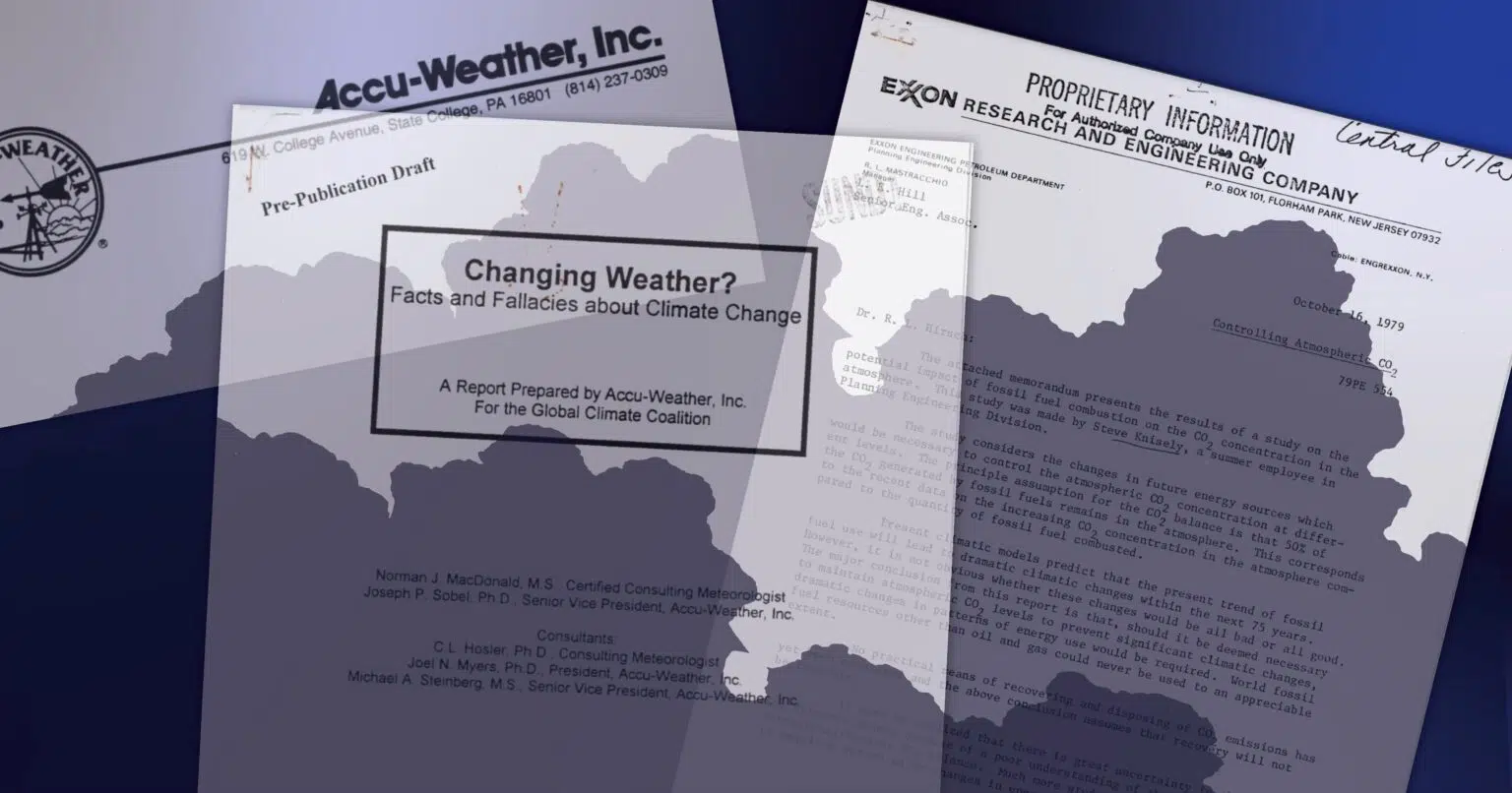
One 1979 memo distributed to Exxon management, about a report conducted by Steve Knisley of Exxon’s Research and Engineering Department, accurately predicted the growth of atmospheric carbon dioxide concentrations by 2010 and referenced the “ecological consequences of increased CO2 levels.” Those consequences were listed in detail, including global temperature increases, water shortages in the U.S. southwest, increased rainfall, and “violent storms.”

In a 1991 film production by Shell, called “Climate of Concern,” a narrator warns that “if the weather machine were to be wound up to such new levels of energy, no country would remain unaffected,” and that “what is now considered abnormal weather could become a new norm.”

Another film produced that year by BP, called “This Earth – What Makes Weather?”, alludes to the ways climate change would increase the frequency and damage caused by extreme weather events like storms, flooding, and drought. “From warmer seas, more water would evaporate — making storms and the havoc they cause more frequent,” the narrator predicts. “Catastrophic floods could become commonplace and low-lying countries like Bangladesh would be defenseless against them.”

But around the same time, the industry began to worry about how public understanding of those phenomena could affect their core business. A 1989 presentation by Duane LeVine, a senior executive at Exxon, expressed concern that an extreme heat and drought event the year before had “drawn much attention to the potential problems and we’re starting to hear the inevitable call for action. Exactly what happens now is not clear… but this critical event has energized the greenhouse effort and raised public concern over PEG [potential enhanced greenhouse].”

Under the cover of trade associations and front groups, through PR campaigns and funded academic research, the industry developed a strategy to undermine the link between climate change and weather-related disasters — and discredit those who sought to communicate that science to the public.

A Campaign to Turn the Tide

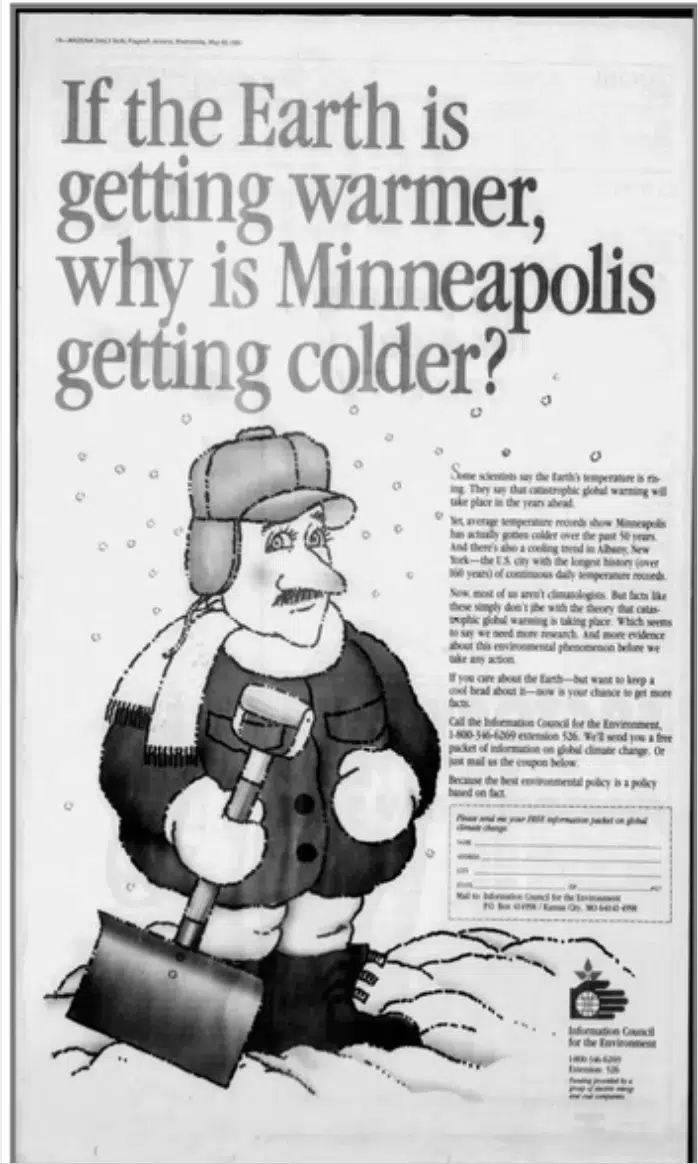
One ad from a PR campaign by the “Information Council on the Environment,” funded by fossil fuel and electric utility interests. Minnesota is now suing ExxonMobil, Koch Industries, and the American Petroleum Institute for climate fraud.

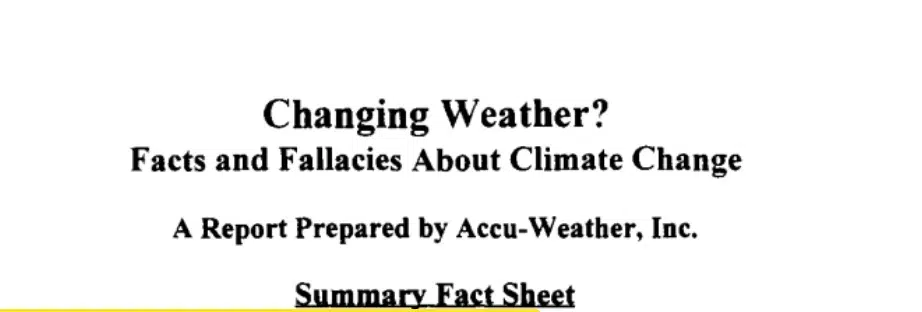
One key player was the Global Climate Coalition (GCC) — an international industry lobbying group that was instrumental in early efforts to deny climate change and generate opposition to policy action to reduce emissions. In 1994, the GCC hired weather forecasting service AccuWeather Inc. to produce a report minimizing the impact of global warming on extreme weather, which the GCC would cite in a pamphlet distributed at the United Nations climate convention the following year. 

“No convincing, observational evidence exists that hurricanes, tornadoes and other extreme temperature and precipitation events are on the rise because of the recent slight increase in the Earth’s surface temperature,” the report states. 

A report that AccuWeather produced minimizing the impact of global warming on extreme weather in 1994.

In response to ExxonKnews’ requests for comment on the report, a spokesperson for AccuWeather said that “AccuWeather and the other leading consulting meteorologists involved had been engaged to produce an analysis based upon the available data at that time. There was much debate and uncertainty in the scientific community over the causes and effects of global warming during that time period, and a new generation of computer modeling studies was just beginning to emerge that would create an important shift in scientific judgment.” 

“As an organization rooted in science, AccuWeather’s view on global warming and extreme weather has evolved over the past three decades, as has the view of many other scientific organizations,” they said, noting that data now shows a “marked increase in billion-dollar disasters due to extreme weather events.” Today, the spokesperson added, AccuWeather has signed the “Global Climate Science-Media Action Pledge”, and is committed to communicating the impacts of climate change on extreme weather to the public.

The GCC also hired academics to further their cause. Internal meeting notes from July 1997 show that the GCC commissioned a research paper from Robert E. Davis, a University of Virginia climatologist, explicitly denying the climate and extreme weather connection. 

Excerpt from Global Climate Coalition meeting notes in 1997.

“A belief commonly held is that global warming will produce more extreme weather,” the published paper read. “While this thinking serves as convenient fuel for sensationalist headlines linking what only a decade ago would have been viewed as the normal vagaries of weather to some approaching climatic apocalypse, it is not based on sound science.”

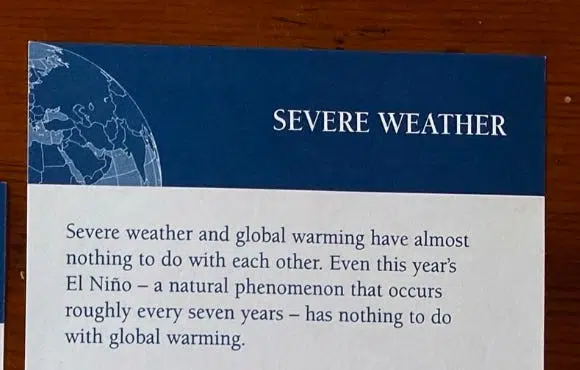
From a folder handed out by the GCC at the UN climate negotiations in 1999.

In 1999, in the wake of Hurricane Floyd, Frank Maisano, then a spokesman for the GCC, faxed a memo to “Communicators Interested in Global Climate Issues.” “As millions of people flee Hurricane Floyd, many climate activists have again suggested — despite the facts — that hurricanes and global warming are connected,” the memo stated.

In response to questions about the memo and the GCC’s positions, Maisano told ExxonKnews that “Any fair review of the debate over any link between climate and severe weather has always been the subject of significant discussion between the experts themselves, especially with regard to hurricanes.”

“Importantly,” Maisano said, “GCC’s main focus at the time was on the economic impacts, sovereignty and effectiveness of any policy proposed to address climate change.”

Maisano now runs a strategic communications practice for Bracewell LLP, whose separate law practice provides services for oil and gas companies including Eni (currently being sued for climate deception in Italy) and Phillips 66 (which is a defendant in many U.S. climate lawsuits, including those filed by Bucks County and the state of New Jersey). Since 2005, the group has also advocated for renewables, Maisano said.

The industry’s campaign stretched on for years. In 2006, shortly after Hurricane Katrina, the DCI Group — a lobbying and campaign contractor with ties to Exxon — produced and sent VHS tapes of videos designed to look like a national news broadcast to Gulf of Mexico area news stations. The tape featured Dr. William Gray, a (now deceased) hurricane scientist at Colorado State University and climate change denier, stating that in the past 20 years, scientists had seen “no significant change in the frequency and intensity of major hurricanes around the globe…. This is the way nature sometimes works.” (Scientists have since concluded that climate-driven warming contributed to the increased rainfall and severity of storm surge during Hurricane Katrina, which killed nearly 2,000 people.) 

According to Sundt, after Hurricane Katrina hit, the communications arm of the U.S. Global Change Research department proposed hosting a session on the implications for preparing for climate change on the Gulf Coast. “We had a well developed proposal, and it was just killed [by the White House] without explanation,” she said.

“A more resilient world”

Today, the steady growth of attribution science — or research investigating the role of climate change in altering or intensifying extreme weather events — has put a dent in Big Oil’s designs. The field of study has developed to even be able to tie the emissions of specific corporate actors to climate-worsened disasters — opening up more possibilities for those companies to be held liable for climate damages in court.

One such study, from researchers from the Union of Concerned Scientists and the University of California, Merced, found that nearly 40% of all forests burned in the Western U.S. and Canada since 1986 can be tied to emissions from just 88 of the world’s largest fossil fuel and cement manufacturers. That research was cited in Multnomah County’s lawsuit against oil and gas majors for climate damages last year.

Delta Merner, lead scientist for the Union of Concerned Scientists’ climate litigation hub and a co-author of the study, pointed out that many of the same companies that fought regulation of climate-warming emissions adapted their own fossil fuel infrastructure to account for rising seas, warming temperatures, and worsening storms decades ago. 

“As you look through the oil industry’s own reactions to their knowledge about climate change, they were able to build better infrastructure to be resilient,” Merner said. “We would have a more resilient world, we would not be facing the realities of climate change that we’re seeing today if it wasn’t for the lies the industry propped up for so long.”

At least one oil major anticipated legal action decades ago. In a planning scenario from 1998, Shell made an eerie prediction: “In 2010, a series of violent storms causes extensive damage to the eastern coast of the U.S. … Following the storms, a coalition of environmental NGOs brings a class-action suit against the US government and fossil-fuel companies on the grounds of neglecting what scientists (including their own) have been saying for years: that something must be done.”

Shell was ahead of its time. Between the increased frequency, severity, and costs of extreme weather events, the advancing science connecting them to polluters, and mounting legal theories, Merner said she expects more communities to file suit. Even as she sees the industry’s deception evolving in content and sophistication — like companies trying to shift the blame for emissions onto consumers to avoid responsibility — Merner believes attribution research is evolving faster.

“It’s a testament to the power of science that climate litigation has been able to withstand an additional onslaught of disinformation from the fossil fuel industry and is now a key part in the fight for climate justice,” she said. 


Note: Additional individuals mentioned here were asked to provide comment. The piece will be updated if they respond.

CLARIFICATION 4/3/24: This story has been updated to clarify the difference between Bracewell LLP’s strategic communication practice and its law practice.

Original article by Emily Sanders, ExxonKnews republished from DeSmog.

Continue ReadingBig Oil Clouded the Science on Extreme Weather. Now It Faces a Reckoning.

Fury after Exxon chief says public to blame for climate failures

Spread the love

https://www.theguardian.com/us-news/2024/mar/04/exxon-chief-public-climate-failures

Darren Woods, the chief executive of Exxon Mobil, last year. Photograph: Gavin John/Bloomberg via Getty Images

The world is off track to meet its climate goals and the public is to blame, Darren Woods, chief executive of oil giant ExxonMobil, has claimed – prompting a backlash from climate experts.

As the world’s largest investor-owned oil company, Exxon is among the top contributors to global planet-heating greenhouse gas emissions. But in an interview, published on Tuesday, Woods argued that big oil is not primarily responsible for the climate crisis.

The real issue, Woods said, is that the clean-energy transition may prove too expensive for consumers’ liking.

“The dirty secret nobody talks about is how much all this is going to cost and who’s willing to pay for it,” he told Fortune last week. “The people who are generating those emissions need to be aware of and pay the price for generating those emissions. That is ultimately how you solve the problem.” *

Troves of internal documents and analyses have over the past decade established that Exxon knew of the dangers of global heating as far back as the 1970s, but forcefully and successfully worked to sow doubt about the climate crisis and stymie action to clamp down on fossil fuel usage. The revelations have inspired litigation against Exxon across the US.

“What they’re really trying to do is to whitewash their own history, to make it invisible,” said Robert Brulle, an environment policy expert at Brown University who has researched climate disinformation spread by the fossil-fuel industry.

A 2021 analysis also demonstrated that Exxon had downplayed its own role in the climate crisis for decades in public-facing messaging.

“The playbook is this: sell consumers a product that you know is dangerous, while publicly denying or downplaying those dangers. Then, when the dangers are no longer deniable, deny responsibility and blame the consumer,” said Naomi Oreskes, a Harvard historian of science and co-author of the 2021 paper.

https://www.theguardian.com/us-news/2024/mar/04/exxon-chief-public-climate-failures

* No, ultimately how you solve the problem is that you don’t create emissions through using sustainable, renewable energy. It’s also not accepted that renewable energy is any more expensive. I’d say that you’re just an evil climate destroyer for profit and fossil fuel BSter.

Continue ReadingFury after Exxon chief says public to blame for climate failures

Big Oil, Plastics Industry Led ‘Campaign of Deception’ to Push Recycling Fraud

Spread the love

Original article by Olivia Rosane republished from Common Dreams under Creative Commons (CC BY-NC-ND 3.0).

More than 90% of plastics disposed of between 1950 and 2015 were not recycled. (Photo: Laura Lezza/Getty Images)

“The oil industry’s lies are at the heart of the two most catastrophic pollution crises in human history,” one advocate said.

The petrochemical industry—including major oil companies like ExxonMobil—knew for decades that recycling was not a sustainable solution to the problem of plastic waste, yet continued to promote it in order to avoid regulation and deceive consumers into continuing to buy and use their products, a report released Thursday by the Center for Climate Integrity reveals.

The report, titled The Fraud of Plastic Recycling: How Big Oil and the Plastics Industry Deceived the Public for Decades and Caused the Plastic Waste Crisis, includes newly disclosed industry documents proving that companies and trade groups knew that plastics could not be recycled indefinitely in the 1980s and 90s even as they launched a massive public relations campaign to sell voters and policymakers on the process.

“This evidence shows that many of the same fossil fuel companies that knew and lied for decades about how their products cause climate change have also known and lied to the public about plastic recycling,” Center for Climate Integrity (CCI) president Richard Wiles said in a statement. “The oil industry’s lies are at the heart of the two most catastrophic pollution crises in human history.”

Plastic pollution is a major environmental and public health crisis. If current trends continue, plastics are expected to outweigh fish in the ocean by 2050, and the toxic fumes from plastic production facilities and incineration are a major environmental justice hazard for frontline communities. Humans in general also ingest an estimated credit-card’s worth of plastic each week, with unknown but potentially serious health impacts.

Recycling is often touted as a solution for keeping plastic out of the environment, but this has proven to be ineffective and insufficient: More than 90% of the plastics disposed of between 1950 and 2015 were either burnt, sent to landfills, or dumped into the environment. There are several technical and economic reasons why plastic recycling doesn’t work at scale. Plastics lose quality as they are recycled and can only really be reused once or potentially twice. The decline in quality also means that recycled plastics are more likely to leach toxins added during production or picked up from other waste items. Economically, it is cheaper to produce new plastics than recycle older ones, and only two types of plastic—PET and HDPE—actually attract markets that will recycle them.

The industry has long been aware of these limitations. In 1969, the American Chemical Society declared, “It is always possible that scientists and engineers will learn to recycle or dispose of wastes at a profit, but that does not seem likely to happen soon on a broad basis.”

“We are committed to the activities, but not committed to the results.”

Despite this, petrochemical companies and their trade groups began to push plastic recycling in the 1980s and 90s as a response to growing public concern over plastic waste, and the threat that this would lead to bans on plastic products.

“No doubt about it, legislation is the single most important reason why we are looking at recycling,” Wayne Pearson, the executive director of industry front group the Plastics Recycling Foundation and a DuPont marketing director, said in 1988.

The plastics industry used various strategies to sell the public on recycling, according to the report. These included:

  1. Funding front groups to promote recycling;
  2. Running ad and PR campaigns;
  3. Investing in recycling research to convince the public that it was taking action;
  4. Setting unrealistic internal recycling goals;
  5. Writing educational material promoting recycling to school children;
  6. Advocating for “advanced recycling,” a term for breaking plastics down to chemical components that can theoretically be reused but are not in practice; and
  7. Claiming, against evidence, that recycling can be part of a “circular economy.”

CCI provides new evidence that, while the industry was employing these strategies, it was simultaneously aware of recycling’s limitations.

For example, a report from the Vinyl Institute trade group concluded in 1986 that “recycling cannot be considered a permanent solid waste solution, as it merely prolongs the time until an item is disposed of.”

In 1994, Exxon Chemical Vice President Irwin Levowitz told employees of the American Plastics Council that “we are committed to the activities, but not committed to the results.”

CCI argued that the petrochemical industry should face legal consequences for its “campaign of deception” similar to suits brought against tobacco and opioid companies.

“When corporations and trade groups know that their products pose grave risks to society, and then lie to the public and policymakers about it, they must be held accountable,” Wiles said. “Accountability means stopping the lying, telling the truth, and paying for the damage they’ve caused.”

CCI vice president of legal and general counsel Alyssa Johl added: “Big Oil and the plastics industry’s decades-long campaign to deceive the public about plastic recycling has likely violated laws designed to protect consumers and the public from corporate misconduct and pollution.”

“Attorneys general and other officials should carefully consider the evidence that these companies defrauded the public and take appropriate action to hold them accountable,” Johl said.

Original article by Olivia Rosane republished from Common Dreams under Creative Commons (CC BY-NC-ND 3.0).

Continue ReadingBig Oil, Plastics Industry Led ‘Campaign of Deception’ to Push Recycling Fraud