Capitalism’s Free Speech Trap: Bezos Shows How Billionaires Set the Boundaries of Debate

Spread the love

Original article by Peter Bloom republished from Common Dreams under Creative Commons (CC BY-NC-ND 3.0). 
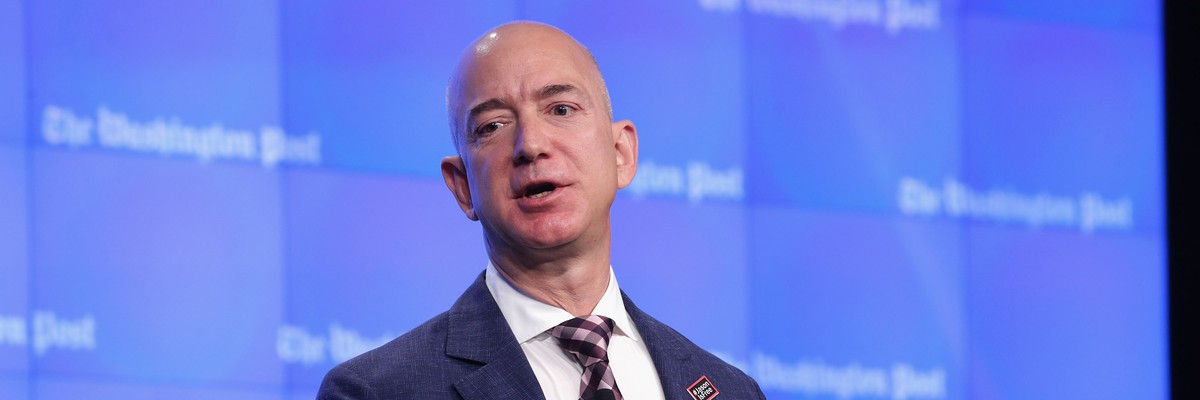
Amazon founder and Washington Post owner Jeff Bezos delivers remarks during the opening ceremony of the media company’s new location January 28, 2016 in Washington, D.C. (Photo: Chip Somodevilla/Getty Images)

The Washington Post’s shift toward free-market advocacy is not simply an editorial decision; it is a strategic move to reinforce the dominant ideological framework that benefits the billionaire class.

The recent directive by Jeff Bezos that The Washington Post editorial section should promote “personal liberties and free markets” is a stark reminder of how freedom under capitalism often boils down to the freedom of economic elites to dictate the parameters of public discourse. While Bezos has suggested that social media provides alternative perspectives, thus absolving his newspaper of the responsibility to represent diverse viewpoints, his decision is part of a broader trend of billionaire media ownership shaping acceptable discourse.

This phenomenon is visible across digital platforms as well. Elon Musk’s control over X (formerly Twitter) has demonstrated how ownership can shape public debate—both through direct interventions, such as the alleged suppression of progressive perspectives, and through more subtle changes to platform algorithms. Similarly, Mark Zuckerberg’s Meta has faced repeated allegations of privileging certain political narratives while suppressing others, including ending its “fact checking” policy that could challenge far-right viewpoints.

Perhaps the most glaring contradiction in Bezos’ advocacy for free markets is the extent to which he, and other billionaires like him, have benefited from state intervention as part of an intentional strategy of “corporate welfare.”

In each case, the rhetoric of “free speech” is selectively applied. While these platforms and newspapers claim to support open debate, their policies ultimately reflect the ideological preferences of their owners. This demonstrates a fundamental truth: In capitalist societies, freedom of expression is often contingent on the interests of those who control the means of communication. The Washington Post’s shift toward free-market advocacy is not simply an editorial decision; it is a strategic move to reinforce the dominant ideological framework that benefits the billionaire class.

The Myth of Meritocracy and the Far-Right’s War on DEI

Bezos’ framing of free markets as inherently linked to personal liberties exposes a deeper ideological assumption—namely, that economic success is the result of individual talent and merit rather than systemic privilege. This assumption is not unique to Bezos but is foundational to the way many economic elites understand their own wealth and influence.

The logic behind Bezos’ editorial direction is similar to the arguments used by the contemporary far-right to attack Diversity, Equity, and Inclusion (DEI) initiatives. The opposition to DEI is rooted in a desire to preserve the myth that success is determined purely by hard work and ability, rather than by racial, gender, or class privilege. By rejecting policies that acknowledge structural inequalities, The far-right seeks to uphold a narrative that justifies existing economic and social hierarchies.

This worldview is deeply intertwined with the ideology of neoliberalism, which insists that markets are neutral mechanisms that reward the most capable individuals. However, history shows that markets are anything but neutral. The barriers faced by marginalized groups are not simply the result of individual shortcomings; they are the product of centuries of systemic exclusion. The far-right’s attack on DEI serves to obscure these realities, just as Bezos’ insistence on free markets seeks to erase the role of privilege and power in determining economic outcomes.

By positioning The Washington Post as a champion of free markets, Bezos is promoting the idea that capitalism functions as a pure meritocracy. This serves not only to legitimize his own position but also to delegitimize calls for policies that challenge structural inequality, whether in the form of DEI programs, labor protections, or wealth redistribution measures.

The Illusion of the Free Market and Its Political Implications

Perhaps the most glaring contradiction in Bezos’ advocacy for free markets is the extent to which he, and other billionaires like him, have benefited from state intervention as part of an intentional strategy of “corporate welfare.” The notion of a truly free market, where economic actors compete on equal footing without government interference, is a fantasy. In reality, corporations like Amazon have thrived not because of unregulated competition, but because of significant government support.

From tax incentives to government contracts, Amazon has received billions in subsidies that have allowed it to dominate the retail and logistics industries. Moreover, the U.S. government plays a critical role in enforcing corporate-friendly trade policies, suppressing labor movements, and protecting the interests of multinational corporations abroad. These interventions are rarely acknowledged in discussions of free markets, yet they are crucial to understanding the power dynamics of contemporary capitalism.

If freedom under capitalism ultimately means the freedom of the wealthy to dictate the terms of discourse, then the very concept of free speech is in jeopardy.

Politically, Bezos’ editorial directive at The Washington Post serves to strengthen a broader ideological alignment between neoliberal economics and far-right nationalism. By framing free-market capitalism as an essential component of personal liberty, Bezos is laying the groundwork for a political agenda that fuses economic libertarianism with nationalist conservatism. This is significant because it provides an ideological foundation for challenging emerging economic policies that deviate from neoliberal orthodoxy—such as the rise of protectionism in response to globalization.

This alignment between free-market ideology and far-right nationalism is not new. Historically, neoliberalism has often coexisted with reactionary politics, as seen in the economic policies of figures like former U.S. President Ronald Reagan and former U.K. Prime Minister Margaret Thatcher. Today, this synthesis is being revived as right-wing populists seek to defend corporate interests while simultaneously appealing to nationalist sentiments. Bezos’ intervention in The Washington Post should be understood within this broader context: It is not just about shaping editorial policy but about consolidating an ideological framework that benefits economic elites while limiting the scope of acceptable political debate.

The Dangers of Billionaire-Controlled Media

Bezos’ decision to impose a free-market ideology on The Washington Post is not an isolated event; it is part of a larger trend in which media ownership is used to shape public discourse in ways that serve elite interests. This phenomenon extends beyond traditional journalism to social media platforms, where billionaires like Musk and Zuckerberg wield immense power over the flow of information.

At its core, this issue is about more than just media bias—it is about the fundamental tension between democracy and concentrated economic power. A truly free and open society requires a diversity of perspectives, yet the dominance of billionaire-controlled media threatens to constrain the range of acceptable debate. If freedom under capitalism ultimately means the freedom of the wealthy to dictate the terms of discourse, then the very concept of free speech is in jeopardy.

The consolidation of media power in the hands of a few ultra-wealthy individuals raises urgent questions about the future of democratic debate. If we are to challenge the ideological hegemony of economic elites, we must first recognize the mechanisms through which they shape public discourse. Bezos’ editorial mandate is not just about The Washington Post—it is a reflection of the broader struggle over who gets to define the boundaries of political and economic debate in the 21st century.

Original article by Peter Bloom republished from Common Dreams under Creative Commons (CC BY-NC-ND 3.0). 

Continue ReadingCapitalism’s Free Speech Trap: Bezos Shows How Billionaires Set the Boundaries of Debate

Nigel Farage calls Elon Musk a ‘hero’ despite calls to free Tommy Robinson

Spread the love

https://www.thenational.scot/news/24833376.farage-calls-elon-musk-hero-despite-calls-free-tommy-robinson

Musk, who has recently been considering donating £100m to Farage’s far-right party, pinned a message at the top of his Twitter/X feed which read “Free Tommy Robinson!” earlier this week (Image: Martini)

REFORM UK leader Nigel Farage has branded Elon Musk a hero, despite the latter’s calls for far-right activist Tommy Robinson to be released from prison.

Musk, who has recently been considering a £100 million donation to Farage’s party, pinned a message at the top of his Twitter/X feed which read “Free Tommy Robinson!” earlier this week.

Robinson, real name Stephen Yaxley-Lennon, was jailed in October 2024 for contempt of court after he repeated false claims against a Syrian refugee.

The Clacton-on-Sea MP told conference attendees in Leicester that Musk had “a whole range of opinions, some of which I agree with very strongly, and others of which I am more reticent about”.

READ MORE: Elon Musk supports jailed far-right agitator Tommy Robinson

Farage expressed his admiration for Musk, calling him a “remarkable new entrant” into American politics who is “very helpful” for Reform and branding the world’s richest man a “hero”.

“At least with Elon, we’ve got free speech back.

https://www.thenational.scot/news/24833376.farage-calls-elon-musk-hero-despite-calls-free-tommy-robinson

Continue ReadingNigel Farage calls Elon Musk a ‘hero’ despite calls to free Tommy Robinson

Murdoch to Musk: how global media power has shifted from the moguls to the big tech bros

Spread the love
The Conversation, Mary Altaffer/AAP, Frederic Legrand/Shutterstock

Matthew Ricketson, Deakin University and Andrew Dodd, The University of Melbourne

Until recently, Elon Musk was just a wildly successful electric car tycoon and space pioneer. Sure, he was erratic and outspoken, but his global influence was contained and seemingly under control.

But add the ownership of just one media platform, in the form of Twitter – now X – and the maverick has become a mogul, and the baton of the world’s biggest media bully has passed to a new player.

What we can gauge from watching Musk’s stewardship of X is that he’s unlike former media moguls, making him potentially even more dangerous. He operates under his own rules, often beyond the reach of regulators. He has demonstrated he has no regard for those who try to rein him in.

Under the old regime, press barons, from William Randolph Hearst to Rupert Murdoch, at least pretended they were committed to truth-telling journalism. Never mind that they were simultaneously deploying intimidation and bullying to achieve their commercial and political ends.

Musk has no need, or desire, for such pretence because he’s not required to cloak anything he says in even a wafer-thin veil of journalism. Instead, his driving rationale is free speech, which is often code for don’t dare get in my way.

This means we are in new territory, but it doesn’t mean what went before it is irrelevant.

A big bucket of the proverbial

If you want a comprehensive, up-to-date primer on the behaviour of media moguls over the past century-plus, Eric Beecher has just provided it in his book The Men Who Killed the News.

Alongside accounts of people like Hearst in the United States and Lord Northcliffe in the United Kingdom, Beecher quotes the notorious example of what happened to John Major, the UK prime minister between 1990 and 1997, who baulked at following Murdoch’s resistance to strengthening ties with the European Union.

In a conversation between Major and Kelvin MacKenzie, editor of Murdoch’s best-selling English tabloid newspaper, The Sun, the prime minister was bluntly told: “Well John, let me put it this way. I’ve got a large bucket of shit lying on my desk and tomorrow morning I’m going to pour it all over your head.”

MacKenzie might have thought he was speaking truth to power, but in reality he was doing Murdoch’s bidding, and actually using his master’s voice, as Beecher confirms by recounting an anecdote from early in Murdoch’s career in Australia.

In the 1960s, when Murdoch owned The Sunday Times in Perth, he met Lang Hancock (father of Gina Rinehart) to discuss potentially buying some mineral prospects together in Western Australia. The state government was opposed to the planned deal.

Beecher cites Hancock’s biographer, Robert Duffield, who claimed Murdoch asked the mining magnate, “If I can get a certain politician to negotiate, will you sell me a piece of the cake?” Hancock said yes. Later that night, Murdoch called again to say the deal had been done. How, asked an incredulous Hancock. Murdoch replied: “Simple […] I told him: look you can have a headline a day or a bucket of shit every day. What’s it to be?”

Between Murdoch in the 1960s and MacKenzie in the 1990s came Mario Puzo’s The Godfather with Don Corleone, aided by Luca Brasi holding a gun to a rival’s head, saying “either his brains or his signature would be on the contract”.

Former British Prime Minister John Major fell foul of Rupert Murdoch – and paid the price. Lynne Sladky/AP/AAP

Changing the rules of the game

Media moguls use metaphorical bullets. Those relatively few people who do resist them, like Major, get the proverbial poured over their government. Headlines in The Sun following the Conservatives’ win in the 1992 election included: “Pigmy PM”, “Not up to the job” and “1,001 reasons why you are such a plonker John”.

If media moguls since Hearst and Northcliffe have tap-danced between producing journalism and pursuing their commercial and political aims, they have at least done the former, and some of it has been very good.

The leaders of the social media behemoths, by contrast, don’t claim any fourth estate role. If anything, they seem to hold journalism with tongs as far from their face as possible.

They do possess enormous wealth though. Apple, Microsoft, Google and Meta, formerly known as Facebook, are in the top ten companies globally by market capitalisation. By comparison, News Corporation’s market capitalisation now ranks at 1,173 in the world.

Regulating the online environment may be difficult, as Australia discovered this year when it tried, and failed, to stop X hosting footage of the Wakeley Church stabbing attacks. But limiting transnational media platforms can be done, according to Robert Reich, a former Secretary of Labor in Bill Clinton’s government.

Despite some early wins through Australia’s News Media Bargaining Code, big tech companies habitually resist regulation. They have used their substantial influence to stymie it wherever and whenever nation-states have sought to introduce it.

Meta’s founder and chief executive, Mark Zuckerberg, has been known to go rogue, as he demonstrated in February 2021 when he protested against the bargaining code by unilaterally closing Facebook sites that carried news. Generally, though, his strategy has been to deploy standard public relations and lobbying methods.

But his rival Musk uses his social media platform, X, like a wrecking ball.

Musk is just about the first thing the average X user sees in their feed, whether they want to or not. He gives everyone the benefit of his thoughts, not to mention his thought bubbles. He proclaims himself a free-speech absolutist, but most of his pronouncements lean hard to the right, providing little space for alternative views.

Some of his tweets have been inflammatory, such as him linking to an article promoting a conspiracy theory about the savage attack on Paul Pelosi, husband of the former US Speaker, Nancy Pelosi, or his tweet that “Civil war is inevitable” following riots that erupted recently in the UK.

As the BBC reported, the riots occurred after the fatal stabbing of three girls in Southport. “The subsequent unrest in towns and cities across England and in parts of Northern Ireland has been fuelled by misinformation online, the far-right and anti-immigration sentiment.”

Nor does Musk bother with niceties when people disagree with him. Late last year, advertisers considered boycotting X because they believed some of Musk’s posts were anti-Semitic. He told them during a live interview to “Go fuck yourself”.

He has welcomed Donald Trump, the Republican Party’s presidential nominee, back onto X after Trump’s account was frozen over his comments surrounding the January 6 2021 attack on the capitol. Since then both men have floated the idea of governing together if Trump wins a second term.

Is the world better off with tech bros like Musk who demand unlimited freedom and assert their influence brazenly, or old-style media moguls who spin fine-sounding rhetoric about freedom of the press and exert influence under the cover of journalism?

That’s a question for our times that we should probably begin grappling with.

Matthew Ricketson, Professor of Communication, Deakin University and Andrew Dodd, Director of the Centre for Advancing Journalism, The University of Melbourne

This article is republished from The Conversation under a Creative Commons license. Read the original article.

Continue ReadingMurdoch to Musk: how global media power has shifted from the moguls to the big tech bros

The McCarthyist Attack on Gaza Protests Threatens Free Thought for All

Spread the love

Original article by ARI PAUL republished from FAIR under a Creative Commons Attribution-NonCommercial-NoDerivs 3.0 Unported License.

With the encouragement of the state, universities from coast to coast are taking draconian steps to silence debate about US-backed violence in the Middle East.

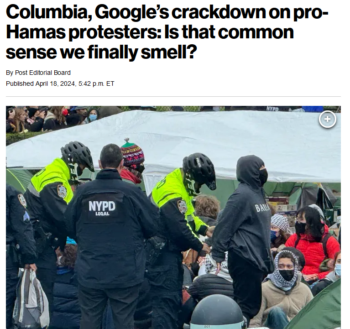
The Columbia University community looked on in shock as cops in riot gear arrested at least 100 pro-Palestine protesters who had set up an encampment in the center of campus (New York Post4/18/24). The university’s president, Nemat Shafik, had just the day before testified before a Republican-dominated congressional committee ostensibly concerned with campus “antisemitism”—a label that has come to be misapplied to any criticism of Israel, though the critics so smeared are often themselves Jewish.

The New York Post (4/18/24) was also pleased that Google had fired 28 employees for protesting genocide.

A sense of delight has filled the city’s opinion pages. The New York Post editorial board (4/18/24) hailed both the clampdown on protests and Congress’s push to ensure that such drastic action against free speech was taken: “We’re glad to see Shafik stand up…. Congress deserves some credit for putting educrats’ feet to the fire on this issue.” The paper added, “Academia has been handling anti-Israel demonstrations with kid gloves.” In other words, universities have been allowing too many people to think and speak critically about an important issue of the day.

In “At Columbia, the Grown-Ups in the Room Take a Stand,” New York Times columnist Pamela Paul (4/18/24) hailed the eviction, saying of the encampment that for the “passer-by, the fury and self-righteous sentiment on display was chilling,” and that for supporters of Israel, “it must be unimaginably painful.” In other words, conservative pundits have decided that campus safe spaces where speech is banned to protect the feelings of listeners are good, depending on the issue. Would Paul (no relation!) favor bans on pro-Taiwan or pro-Armenia demonstrations because they could offend Chinese and Turkish students?

And for Michael Oren, a prominent Israeli politico, Columbia students hadn’t suffered enough. He said of Columbia in a Wall Street Journal op-ed (4/19/24):

Missing was an admission of the university’s failure to enforce the measures it had enacted to protect its Jewish community. [Shafik] didn’t address how, under the banner of free speech, Columbia became inhospitable to Jews. She didn’t acknowledge how incendiary demonstrations such as the encampment were the product of the university’s inaction.

Shafik had assured her congressional interrogators that Columbia had already suspended 15 students for speaking out for Palestinian human rights, suspended two student groups—Jewish Voice for Peace and Students for Justice in Palestine (Jewish Telegraphic Agency, 11/10/23)—and had even terminated an instructor (New York Times, 4/17/24).

The hearing was bizarre, to say the least; a Georgia Republican asked the president if she wanted her campus to be “cursed by God” (New York Times, 4/18/24). (“Definitely not,” was her response.)

The former World Bank economist had clearly been shaken after seeing how congressional McCarthyism ousted two other female Ivy League presidents (FAIR.org, 12/12/23; Al Jazeera, 1/2/24).

‘Protected from having to hear’

Twenty-three Jewish faculty members at Columbia published a joint op-ed (Columbia Spectator4/10/24) reminding President Shafik that “labeling pro-Palestinian expression as anti-Jewish hate speech requires a dangerous and false conflation of Zionism with Jewishness, of political ideology with identity.”

“What happened at those hearings yesterday should be of grave concern to everybody, regardless of their feelings on Palestine, regardless of their politics,” Barnard College women’s studies professor Rebecca Jordan-Young told Democracy Now! (4/18/24). “What happened yesterday was a demonstration of the growing and intensifying attack on liberal education writ large.”

Her colleague, historian Nara Milanich, said in the same interview:

This is not about antisemitism so much as attacking areas of inquiry and teaching, whether it’s about voting rights or vaccine safety or climate change — right?—arenas of inquiry that are uncomfortable or inconvenient or controversial for certain groups. And so, this is essentially what we’re seeing, antisemitism being weaponized in a broad attack on the university.

Jewish faculty at Columbia spoke out against the callous misuse of antisemitism to silence students, but those in power aren’t listening (Columbia Spectator4/10/24).

Shafik justified authorizing the mass arrests, which many said hadn’t been seen on campus since the anti-Vietnam War protests of 1968. “The individuals who established the encampment violated a long list of rules and policies,” she said (BBC4/18/24).  “Through direct conversations and in writing, the university provided multiple notices of these violations.”

One policy suggested by the university’s “antisemitism task force,” according to a university trustee who also testified (New York Times4/18/24): “If you are going to chant, it should only be in a certain place, so that people who don’t want to hear it are protected from having to hear it.”

Cross-country rollback

USC valedictorian Asna Tabassum says the school did not tell her what the security threats were, but said that the precautions that would be necessary to allow her to speak were “not what the university wants to ‘present as an image’” (Reuters4/18/24).

Meanwhile, the University of Southern California canceled the planned graduation speech by valedictorian Asna Tabassum—a Muslim woman who had spoken out for Palestine (Reuters4/18/24). The university cited unnamed “security risks”;  The Hill (4/16/24) noted that “she had links to pro-Palestinian sites on her social media.”  Andrew T. Guzman, the provost and senior vice president for academic affairs, said in a statement that cancelation was “consistent with the fundamental legal obligation—including the expectations of federal regulators—that universities act to protect students and keep our campus community safe” (USC Annenberg Media4/15/24).

This is happening as academic freedom is being rolled back across the country. Republicans in Indiana recently passed a law to allow a politically appointed board to deny or even revoke university professors’ tenure if the board feels their classes lack “intellectual diversity”—at the same time that it threatens them if they seem “likely” to “subject students to political or ideological views and opinions” deemed unrelated to their courses (Inside Higher Ed2/21/24).

Benjamin Balthaser, associate professor of English at Indiana University South Bend, told FAIR in regard to the congressional hearing:

There is no other definition of bigotry or racism that equates criticism of a state, even withering, hostile criticism, with an entire ethnic or religious group, especially a state engaging in ongoing, documented war crimes and crimes against humanity. Added to this absurdity is the fact that many of the accused are not only Jewish, but have strong ties to their Jewish communities. To make such an equation assumes a collective or group homogeneity which is itself a form of essentialism, even racism itself: People are not reducible to the crimes of their state, let alone a state thousands of miles away to which most Jews are not citizens.

Of course, witch hunts against leftists in US society are often motivated by antisemitism. Balthaser again:

The far right has long deployed antisemitism as a weapon of censorship and repression, associating Jewishness with Communism and subversion during the First and Second Red Scares.  Not only did earlier forms of McCarthyism overwhelmingly target Jews (Jews were two-thirds of the “defendants” called before HUAC in 1952, despite being less than 2% of the US population), it did so while cynically pretending to protect Jews from Communism.  Something very similar is occurring now: Mobilizing a racist trope of Jewish adherence to Israel, far-right politicians are using accusations of antisemitism to both silence criticism of Israel and, in doing so, promote their antisemitic ideas of Jewishness in the world.

Silencing for ‘free speech’

The darker blue states have passed restrictions aimed at Critical Race Theory; in the lighter blue states, proposed restrictions have not been adopted (CRT Forward).

These universities are not simply clamping down on free speech because the administrators dislike this particular speech, or out of fear that pro-Palestine demonstrations or vocal faculty members could scare donors from writing big checks. This is a result of state actors—congressional Republicans, in particular—who are using their committee power and sycophants in the media to demand more firings, more suspensions, more censorship.

I have written for years (FAIR.org10/23/2011/17/213/25/22), as have many others, that Republican complaints about “cancel culture” on campus suppressing free speech are exaggerated. One of the biggest hypocrisies is that so-called free-speech conservatives claim that campus activists are silencing conservatives, but have little to say about blatant censorship and political firings when it comes to Palestine.

This isn’t a mere moral inconsistency. This is the anti-woke agenda at work: When criticism of the right is deemed to be the major threat to free speech, it’s a short step to enlisting the state to “protect” free speech by silencing the critics—in this case, dissenters against US support for Israeli militarism.

But this isn’t just about Palestine; crackdowns against pro-Palestine protests are part of a broader war against discourse and thought. The right has already paved the way for assaults on educational freedom with bans aimed at Critical Race Theory adopted in 29 states.

If the state can now stifle and punish speech against the murder of civilians in Gaza, what’s next? With another congressional committee investigating so-called infiltration by China’s Communist Party, will Chinese political scholars be targeted next (Reuters2/28/24)? With state laws against environmental protests proliferating (Sierra9/17/23), will there be a new McCarthyism against climate scientists? (Author Will Potter raised the alarm about a “green scare” more than a decade ago—People’s World9/26/11CounterSpin2/1/13.)

Universities and the press are supposed to be places where we can freely discuss the issues of the day, even if that means having to hear opinions that might be hard for some to digest. Without those arenas for free thought, our First Amendment rights mean very little. If anyone who claims to be a free speech absolutist isn’t citing a government-led war against free speech and assembly on campuses as their No. 1 concern in the United States right now, they’re a fraud.

Original article by ARI PAUL republished from FAIR under a Creative Commons Attribution-NonCommercial-NoDerivs 3.0 Unported License.

Media’s Linguistic Gymnastics Mislead on Gaza Protests

NYT Reverses Time to Put Retaliation Before Attack in Gaza

Continue ReadingThe McCarthyist Attack on Gaza Protests Threatens Free Thought for All

Musk Is Consistent in His Opposition to Internet Democracy

Spread the love

Original article by ARI PAUL republished from FAIR under a Creative Commons Attribution-NonCommercial-NoDerivs 3.0 Unported License.

“We can’t go beyond the laws of a country,” Musk has said (Wall Street Journal4/8/24)—unless, of course, he doesn’t like the government making the laws.

Elon Musk, the right-wing anti-union billionaire owner of Twitter (recently rebranded as X), has cast his defiance of a Brazilian judicial ruling as a free speech crusade against censorship. Such framing is, of course, bullshit. It is instead a political campaign by a capitalist to use social media to reshape global politics in favor of the right. And it’s important that we all understand why that is.

As Reuters (4/7/24) reported, Brazilian Supreme Court Justice Alexandre de Moraes ordered “the blocking of certain accounts” on Twitter, prompting Musk to announce that Twitter would defy the judge’s orders “because they were unconstitutional.” He went on to call for Moraes’ resignation.

It isn’t clear which accounts are being targeted, but the judge is investigating “‘digital militias’ that have been accused of spreading fake news and hate messages during the government of former far-right President Jair Bolsonaro.” He’s also probing “an alleged coup attempt by Bolsonaro.”

The AP (4/8/24) then reported that the judge opened up an inquest into Musk directly, saying the media mogul “began waging a public ‘disinformation campaign’ regarding the top court’s actions.”

Musk claimed that he’s doing this in the name of free speech at the expense of profit, saying “we will probably lose all revenue in Brazil and have to shut down our office there” (Wall Street Journal4/8/24). He added that “principles matter more than profit.”

Michael Shellenberger (Public4/8/24), an enthusiastic pro-Musk pundit, was less restrained, saying the judge “has taken Brazil one step closer to being a dictatorship.” To Shellenberger, it’s “clear that Elon Musk is the only thing standing in the way of global totalitarianism.”

‘Par for the course’

Verge (1/25/23): “The documentary’s ban isn’t an example of Musk violating a vocal ‘free speech absolutist’ ethos. It’s a reminder that Musk has always been fine with government censorship.”

Anyone with a memory better than Shellenberger’s will recall that Musk’s Twitter has been all too eager to censor content at the request of the Indian government, including a BBC documentary that was critical of Prime Minister Narendra Modi (Verge1/25/23). India under Modi, who heads the right-wing Hindu nationalist BJP party, has seen a steep decline in press freedom, worrying journalists and free speech advocates (New York Times3/8/23NPR4/3/23Bloomberg2/25/24). At the same time Musk was pretending to defend free speech in Brazil, he was bragging about traveling to India to meet with Modi (Twitter4/10/24).

Musk suppressed Twitter content in the Turkish election in response to a request from Turkish President Recep Erdoğan, saying the “choice is have Twitter throttled in its entirety or limit access to some tweets. Which one do you want?” This move, he insisted, was “par for the course for all Internet companies” (Vanity Fair, 5/14/23). Turkey, with its laws against insulting the Turkish identity (Guardian11/16/21), is a country that is almost synonymous with the suppression of free speech—it ranks 165 out of 180 on Reporters Without Borders’ press freedom index. Yet Musk didn’t seem to feel the need to intervene to save democracy through his social media network.

The impact of Musk’s decision to censor Twitter when it comes to Turkey and India isn’t just that it exposes his duplicity when it comes to free speech, but it robs the global public of vital points of view when it comes to these geopolitically important countries. In essence, the crime is not so much that Musk is hypocritical, but that his administration of the social media site has kept readers in the dark rather than expanding their worldview.

Grappling with balance

AP (10/25/22) reported that Brazilian social media posts claimed that Lula “plan[ned] to close down churches if elected” and that Bolsonaro “confess[ed] to cannibalism and pedophilia.”

The context in Brazil is that in the last presidential election, in 2022, the leftist challenger Lula da Silva ousted the incumbent, Bolsonaro (NPR10/30/22), who has since been implicated in a failed coup attempt that closely resembled the January 6, 2021, riot at the US Capitol (Reuters3/15/24). Ever since, tech companies have bristled at Brazil’s attempt to curb the influence of fake news, such as a bill that would put “the onus on the internet companies, search engines and social messaging services to find and report illegal material” (Guardian5/3/23).

Brazil experienced a flurry of disinformation about the candidates in the run-up to the election, inspiring the country’s top electoral court to ban “false or seriously decontextualized” content that “affects the integrity of the electoral process” (AP10/25/22).

The Washington Post (1/9/23) reported that social media were “flooded with disinformation, along with calls in Portuguese to ‘Stop the Steal,’” and demands for “a military coup” in response to a possible Lula victory. And while these problems existed in various online media, a source told the Post that this occurred after Musk fired people in Brazil “who moderated content on the platform to catch posts that broke its rules against incitement to violence and misinformation.”

While Turkey and India are brazenly attempting to suppress opinions the government doesn’t like, a democratic Brazil is grappling with how to balance maintaining a free internet while protecting elections from malicious interference (openDemocracy1/3/23).

Despotic future

Brazilian Report (4/9/24): “Billionaire Elon Musk joined this week a campaign led by the Brazilian far-right to characterize Brazil as a dictatorship.”

Lula’s victory, in addition to being a source of hope for Brazil’s poor and working class (Bloomberg4/25/23), was seen as a blow to the kind of right-wing despotism espoused by people like Bolsonaro, who represents a past of US-aligned terror-states that use military force to protect US interests and suppress egalitarian movements in the Western Hemisphere (Human Rights Watch, 3/27/19). As Brazilian Report (4/9/24) put it, Musk has joined a “campaign led by the Brazilian far right.”

Indeed, the Wall Street Journal (4/10/24) noted that Musk’s tussle in the Brazilian judiciary was an extension of his alignment with the Brazilian right:

Supporters of former right-wing President Jair Bolsonaro, who gave Musk a medal during his visit in 2022 to announce plans to install satellites over the Amazon rainforest, have reveled in Musk’s defiance, declaring him a “hero,” as the dividing lines in Brazil’s culture wars deepen.

Erdoğan and Modi represent more successful iterations of neo-fascist ideology over liberal democracy. The dystopian societies they oversee make up the political model that the MAGA movement would like to impose in the United States, where a caudillo is unchecked by independent courts, the press and other civil institutions, while rights for workers and marginalized groups are eviscerated.

Musk isn’t simply displaying hypocrisy when he pretends to fight for free speech in Brazil while Twitter censors speech when it comes to India and Turkey. If anything, he is being consistent in his quest to use his corporate wealth to alter the political landscape against liberal democracy and toward a dark, despotic future.

Original article by ARI PAUL republished from FAIR under a Creative Commons Attribution-NonCommercial-NoDerivs 3.0 Unported License.

Continue ReadingMusk Is Consistent in His Opposition to Internet Democracy