Holocaust Harris

Original article by Jake Johnson republished from Common Dreams under Creative Commons (CC BY-NC-ND 3.0).

Israeli forces invaded southern Lebanon early Tuesday with the open support of the United States, which endorsed what it called “limited operations to destroy Hezbollah infrastructure” despite warnings that a ground assault could spark a wider conflict and intensify the humanitarian disaster facing Lebanese civilians.
The Israel Defense Forces (IDF) described its ground invasion with the same terms it has used to characterize its bombing campaigns in Lebanon and Gaza, which—despite being called “targeted” at Hezbollah and Hamas—have frequently killed scores of civilians and obliterated schools, hospitals, shops, and residential buildings. Since mid-September, Israeli airstrikes in Lebanon have killed more than a thousand people and displaced roughly a million.
The IDF launched its ground invasion with the backing of the Biden administration. In a statement, the White House said that the invasion of Lebanon is “in line with Israel’s right to defend its citizens and safely return civilians to their homes.”
A spokesperson for the White House National Security Council acknowledged the risk of “mission creep” only to effectively wave it away, saying that “we will keep discussing that with the Israelis.”
Analysts likened Israel’s movement of troops into Lebanon to its invasion of the southern Gaza city of Rafah earlier this year—an operation that was initially described as limited but ultimately left the area in ruins.
“Gaza was a testing ground for Israel to see what they could get away with and, it turns out, the answer is absolutely anything it wants,” said historian and analyst Assal Rad. “It did not stop at Gaza or the West Bank and it may not stop at Lebanon, because war was [Israeli Prime Minister Benjamin] Netanyahu’s objective all along and his prize is Iran.”
“Make no mistake: The Biden administration is providing cover for Israel as it invades a neighboring, sovereign nation.”
The invasion comes after the Netanyahu government rejected a three-week cease-fire proposal put forth by the U.S., France, and other nations and intensified its bombing of Lebanon, hammering Beirut with airstrikes that killed Hezbollah leader Hassan Nasrallah and many civilians. The attack that killed Nasrallah was reportedly carried out with 2,000-pound bombs supplied by the U.S.
Coverage of the invasion in the Western corporate media painted the U.S. as “increasingly powerless,” with “limited” influence to forestall a massive ground assault on Lebanon. But the Biden administration has yet to seriously leverage American military aid to prevent a war that could envelop the entire region.
On the contrary, billions of dollars of aid and American weapons have continued to flow to Israel, enabling its war on Gaza and Lebanon. The Washington Post observed that “the events of recent weeks appear to fit a pattern in which the administration urges against specific Israeli actions only to later backtrack so it can avoid imposing conditions on military aid.”
The U.S. has also engaged in what’s been described as “unprecedented” intelligence-sharing with Israel, further deepening its complicity in the devastating wars.
Sarah Leah Whitson, executive director of Democracy for the Arab World Now (DAWN), said in a statement late Monday that “Israel’s invasion of Lebanon, following its devastating attacks on Lebanon over the past two weeks, is the entirely predictable consequence of the Biden administration’s ceaseless coddling and resupply of weapons to Israel, whatever public bleats for cease-fires the administration has otherwise made.”
“The Biden administration has acted recklessly in giving Israel a blank check to light the entire region on fire, all while disregarding our own legal obligations under both U.S. and international law to halt the weapons flow to them,” Whitson added.
The U.S.-based anti-war group CodePink said that “Israel claims its operation in Lebanon is ‘targeted,’ but like in Gaza, civilians are the real victims.”
“Make no mistake: The Biden administration is providing cover for Israel as it invades a neighboring, sovereign nation,” the group said. “U.S. taxpayers fund Israel’s military, providing billions annually and supplying weapons used to kill innocent people.”
“The Biden administration and Congress could halt this escalation by cutting military aid, demanding a cease-fire, and holding Israel accountable,” CodePink continued, “but instead, they allow continued aggression across the Middle East.”
Original article by Jake Johnson republished from Common Dreams under Creative Commons (CC BY-NC-ND 3.0).
Original article republished from peoples dispatch under a Creative Commons Attribution-ShareAlike 4.0 (CC BY-SA) license.
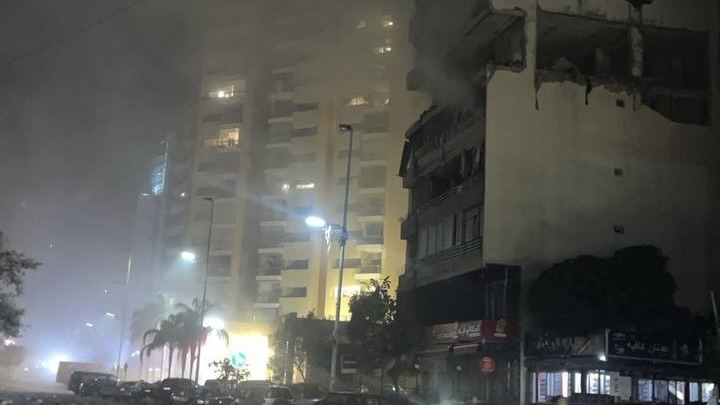
The Israeli Occupation Forces (IOF) assassinated five resistance leaders of groups affiliated with or supporting the Axis of Resistance in different parts of Lebanon within the last 48 hours. Three of the leaders were affiliated with the Popular Front for the Liberation of Palestine (PFLP), while the fourth leader was affiliated with the Palestinian Islamic Resistance Movement Hamas. The fifth was a top scholar and leader in Hezbollah.
The PFLP announced on Monday, September 30, that Israeli warplanes launched an airstrike near Kola intersection at the center of the Lebanese capital Beirut in the early hours of Monday morning killing three of its top leaders. PFLP identified the assassinated leaders as Imad Odeh, who was a PFLP military commander in Lebanon, along with Mohammad Abdel Aal and Abdul Rahman Abdel Aal, who were members of the movement’s political bureau in Lebanon. The Palestinian resistance group mourned its slain leaders in a statement vowing to “continue the path of struggle and resistance until the occupation will be swept away no matter how long it takes, and no matter how great the sacrifices.” Many have pointed out that the PFLP has not been involved in any of the strikes against Israel from Lebanese territory, making their assassination in this context even more concerning.
Meanwhile Hamas announced in a statement on Monday that Fateh Sharif Abu al-Amine, one of the movement’s leaders abroad, was killed along with his wife, son, and daughter, in an airstrike that targeted their house in the al-Buss refugee camp in South Lebanon. The movement mourned Abu al-Amin describing him as “active and vibrant” in addition to being “brave and courageous”. Hamas also pledged to remain steadfast “on the path of all Palestinian martyrs until the Israeli occupation is defeated and expelled from Palestine, and until Al-Quds and Palestinian prisoners in Israeli jails are liberated.”
On Sunday, September 29, Hezbollah announced that a member of its central council, Sheikh Nabil Qawouk was killed in an Israeli airstrike south of Beirut a day earlier. The Lebanese resistance group mourned Qawouk in a statement saying: “His Eminence Sheikh assumed many organizational responsibilities in the various units of Hezbollah, worthy of the trust he carried, a great scholar and fighter. Martyr Sheikh Nabil was always present in the arenas of Jihad, close to the fighters on the front lines, and spent his honorable life in the fields of Jihad and sacrifice.”
The Israeli army intensified its attacks to assassinate top resistance leaders in the region as it is prepared to launch an impending ground incursion in Lebanon which began in the early hours of Tuesday October 1.
Original article republished from peoples dispatch under a Creative Commons Attribution-ShareAlike 4.0 (CC BY-SA) license.
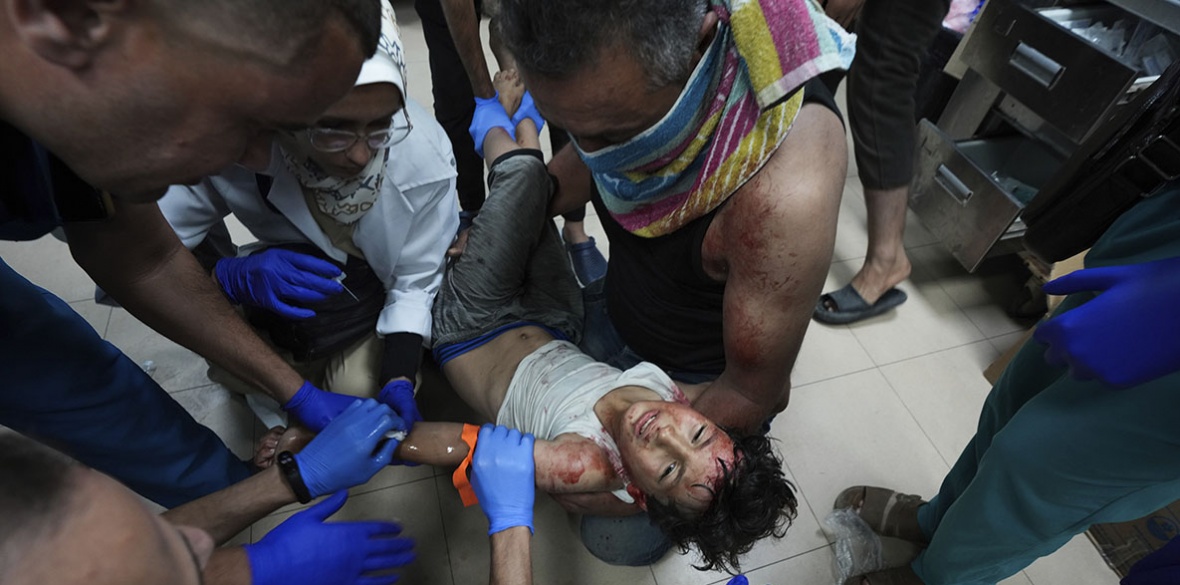
MORE women and children have been killed by Israel in Gaza in the last 12 months than perished in the equivalent period of any other conflict over the past 20 years, damning new research published by Oxfam today shows.
The charity highlights conservative figures that estimate 6,000 women and 11,000 children in Gaza have been killed by the Israeli military in the past year.
But the numbers exclude those among the 20,000 who are unidentified or missing.
No other conflict has caused such a high number of child or women fatalities within a 12-month period, over the past two decades.
…
Original article by Jake Johnson republished from Common Dreams under Creative Commons (CC BY-NC-ND 3.0).
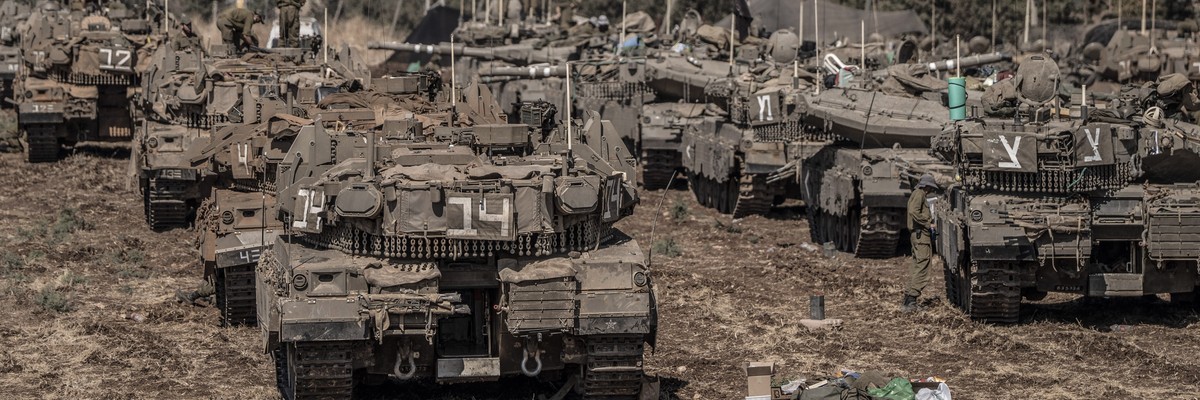
Israeli forces appear poised to launch a ground invasion of Lebanon within days following a sustained bombing campaign that has killed more than a thousand people—including dozens of children—and displaced more than a million, heightening fears of a large-scale humanitarian disaster and a wider war that could consumer the entire region.
The Israel Defense Forces (IDF) has already carried out what were described as “limited ground incursions” across the Lebanese border, but a larger invasion could be imminent given the positioning of Israeli troops and rhetoric from top Israeli officials.
“We will use all the means that may be required—your forces, other forces, from the air, from the sea, and on land,” Israeli Defense Minister Yoav Gallant told Israeli troops on Monday.
The mayor of a Christian-majority Lebanese village located roughly six miles from the Lebanon-Israel border toldReuters that locals “had received calls apparently from the Israeli army telling them to evacuate the area as soon as possible.”
Humanitarian groups have warned that a full-scale ground invasion would be a disaster for the Lebanese people, many of whom have seen their lives upended by Israeli attacks over the past two weeks.
“We are gravely concerned about the possibility of an Israeli ground invasion of Lebanon,” said Julie Mehigan, Christian Aid’s head of Asia, the Middle East, and Europe. “The patterns we’re seeing from the attacks of the last few days are reminiscent of what we’ve seen in Gaza these last few months. Massive displacement and killing of civilians, whole families killed in their homes, and schools converted into shelters. All the while Gaza is continually being bombed from land, air, and sea.”
“We are on the precipice of yet another humanitarian calamity in the region,” Mehigan added.
“Not only is this administration sending more bombs aimed at them and other civilians, they’re also helping Netanyahu cover up his crimes. It’s despicable.”
The Biden administration, which provided the 2,000-pound bombs that Israel used to kill Hezbollah leader Hassan Nasrallah and dozens of civilians in an attack on Beirut late Friday, is reportedly prepared to give Israel approval to move troops into Lebanon as long as the invasion is “limited.”
But the Israeli government, headed by far-right Prime Minister Benjamin Netanyahu, has repeatedly disregarded the Biden administration’s stated conditions. As The New York Times observed Monday, the administration wanted the Israeli military to “eschew major combat operations” in the southern Gaza city of Rafah earlier this year. The IDF went on to launch a massive assault on the city, rendering it uninhabitable.
Akbar Shahid Ahmed, HuffPost‘s senior diplomatic correspondent, reported Monday that the Biden administration is unlikely to “veto” Israeli plans for a ground invasion of Lebanon and noted he is hearing a “growing sense” that “an Israeli invasion of Lebanon with U.S. backing (based on the idea it will be limited) is coming.”
The possibility of an imminent Israeli ground invasion of Lebanon has heightened concerns of a full-blown regional war with potentially devastating global implications. Hezbollah has pledged to retaliate against Israel for the assassination of Nasrallah, and Iran—which has thus far acted with restraint—could also decide to intervene as Lebanon’s government works to prevent the military conflict from spiraling.
Craig Mokhiber, a human rights attorney and former director of the New York office of the U.N. high commissioner for human rights, wrote on social media Monday that “as Israel continues its genocide in Palestine, expands its murderous rampage into Lebanon (perhaps even launching a ground invasion to ethnically cleanse the south) the West cheers and arms them, Arab governments sleep, the U.N. looks the other way, the [International Criminal Court] stalls, the Global South offers only symbolic objections, and the world is dragged passively toward WWIII.”
Israel’s intensifying assault on Lebanon has sparked fresh calls for a halt to U.S. arms transfers to the Israeli military, which relies heavily on American-made weaponry.
Maurice Mitchell, national director of the U.S.-based Working Families Party, said in a statement Monday that Israel’s ongoing attacks on Lebanon “mark an extreme escalation that further threatens the stability of the region” and expressed support for an effort led by U.S. Sen. Bernie Sanders (I-Vt.) to block recently approved arms sales.
“Despite the Israeli government’s serious escalation in Lebanon and indiscriminate bombings in Gaza and the West Bank, President Biden continues to funnel billions in lethal military aid to the Israeli government without conditions, including $8.7 billion last week,” said Mitchell. “This coupled with new reports that the Israeli government violated international law by deliberately blocking humanitarian aid to families in Gaza underscores the urgent need to stop the flow of offensive weapons to the Israeli government.”
Abbas Alawieh, a Lebanese American from Michigan and a co-founder of the Uncommitted National Movement, said Monday that “every hour, I get messages from my family in Lebanon, asking when the American-funded bombs will stop.”
“Not only is this administration sending more bombs aimed at them and other civilians, they’re also helping Netanyahu cover up his crimes,” said Alawieh. “It’s despicable.”
Original article by Jake Johnson republished from Common Dreams under Creative Commons (CC BY-NC-ND 3.0).