With All Eyes on Gaza, Israel Bulldozed ‘Mile After Mile’ of West Bank

Spread the love

Original article by Jessica Corbett republished from Common Dreams under Creative Commons (CC BY-NC-ND 3.0). 
Palestinians walk around the damage in Jenin’s city center after an Israeli military raid in the occupied West Bank on September 6, 2024.  (Photo: Nasser Ishtayeh/SOPA Images/LightRocket via Getty Images

“We watched their bulldozers tear up streets, demolish businesses, pharmacies, schools,” said one local leader. “They even bulldozed the town soccer field, and a tree in the middle of a road.”

As the world watched Israel’s assaults on Lebanon and the Gaza Strip, The New York Times on Wednesday also directed attention to the West Bank, detailing how “Israeli military bulldozers tore up mile after mile” of Jenin and Tulkarm in recent weeks.

While “nearly nightly raids” by the Israel Defense Forces (IDF) “have become the norm” in the West Bank since the Hamas-led October 7 attack, the military last month “launched one of its most extensive and deadliest raids” in the illegally occupied Palestinian territory in years, the newspaper reported, citing videos and interviews with residents.

“We watched their bulldozers tear up streets, demolish businesses, pharmacies, schools. They even bulldozed the town soccer field, and a tree in the middle of a road,” said Kamal Abu al-Rub, governor of Jenin. “What was the point of all of this?”

In addition to ground operations in the West Bank, the IDF has increased airstrikes that critics say run afoul of international law. The military defended the strikes and told the Times that in recent raids, troops found weapon stockpiles and killed or arrested dozens of militants—but also caused some “unavoidable harm to certain civilian structures.”

In response to videos included in the reporting, freelance journalist Pete Tucker accused Israeli soldiers of “methodically laying waste to” the West Bank.

Malini Ranganathan, an associate professor at American University’s School of International Service, said on social media that “Israel’s criminality knows no limits. IDF bulldozers have been obliterating the West Bank, even tearing up roundabouts.”

Israeli forces have damaged homes, shops, and roads along with internet, electricity, phone, water, and sewage lines in the West Bank. Emergency crews have been unable to respond to hundreds of calls per day, because they can’t reach people in need.

“They are imposing conditions, materially and psychologically, that make people feel: Gaza is coming to you,” Al Haq director Shawan Jabarin told the Times. “There is a feeling among Palestinians across the West Bank that what is coming is very bad—that it will be a plan to kill and expel us.”

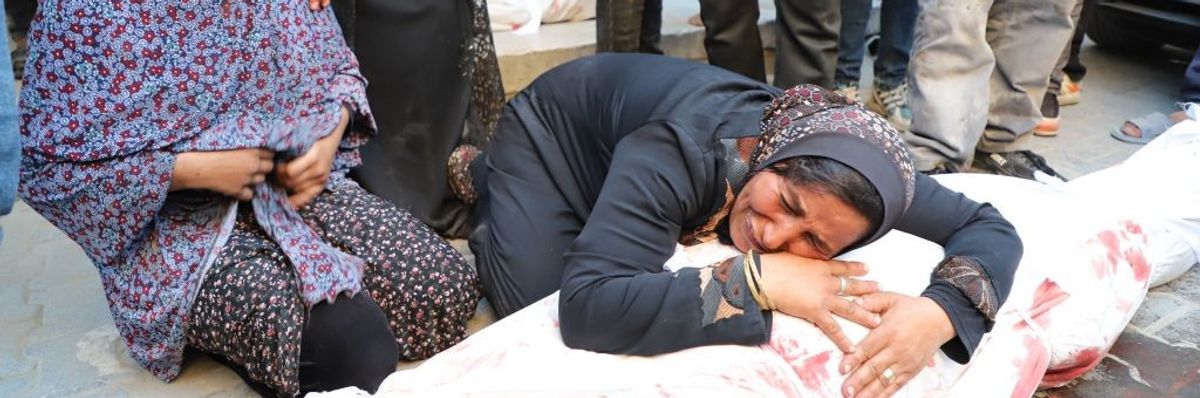
Since the October 7 attack on Israel that killed more than 1,100 people, Israeli forces have slaughtered at least 41,455 Palestinians in Gaza and 716 in the West Bank. Across the Palestinian territories, over 100,000 others have been injured over the past year. The bloodshed led to an ongoing genocide case at the International Court of Justice (ICJ).

The ICJ in July issued a nonbinding advisory opinion that Israel’s decadeslong occupation of Gaza and the West Bank, including East Jerusalem, is illegal and must end “as rapidly as possible.” Instead, Israel has ramped up attacks on not only the Palestinian territories, but also Lebanon, home to the political and paramilitary group Hezbollah.

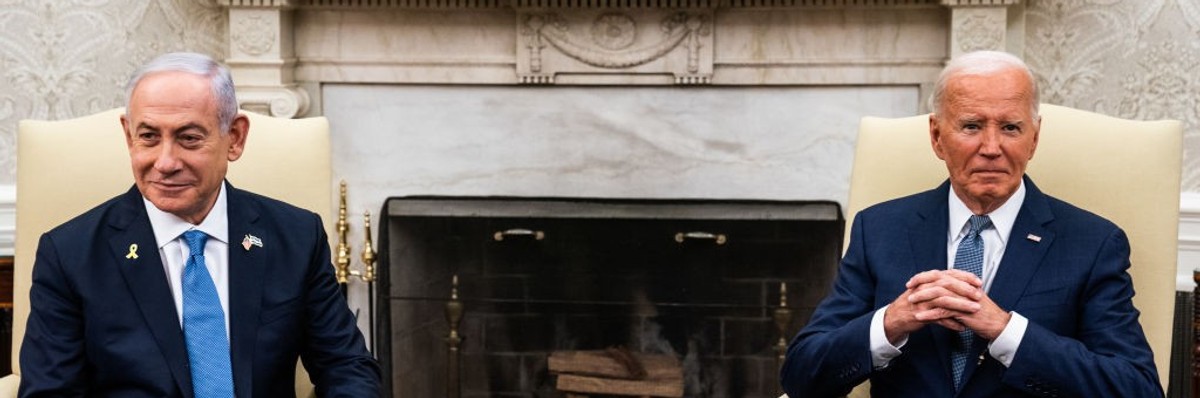
This week’s bombing campaign in Lebanon—which has killed at least 569 people—sparked fresh calls for the Biden administration to finally cut off weapons to Israel, as did the new reporting from the Times, which has been accused of pro-Israel bias in its coverage of the assault on Gaza.

Meanwhile, Israeli destruction in the West Bank continues. The International Middle East Media Centerreported that “on Wednesday, Israeli soldiers invaded the town of Beit Ula, west of Hebron in the occupied West Bank’s southern part, [and] bulldozed over 20 dunams of land, uprooting more than 600 fruit-bearing trees, and demolishing several agricultural structures and wells.”

Original article by Jessica Corbett republished from Common Dreams under Creative Commons (CC BY-NC-ND 3.0). 

Continue ReadingWith All Eyes on Gaza, Israel Bulldozed ‘Mile After Mile’ of West Bank

Biden’s UNGA address espousing democracy and cooperation contrasts with reality

Spread the love

Original article by Natalia Marques republished from peoples dispatch under a Creative Commons Attribution-ShareAlike 4.0 (CC BY-SA) license.

Biden addresses the general debate of the General Assembly’s 79th session (Photo: UN Photo/Loey Felipe)

Biden’s final address to the United Nations as president was riddled with falsehoods and hypocrisies typical of US foreign policy

When US President Biden ended his final address to the UN General Assembly with “my fellow leaders, there is nothing that’s beyond our capacity if we work together,” it can be easy to forget that the United States is the number one obstacle to mutual cooperation around the world.

Biden’s mention of the various conflicts and aggressions around the world—from Ukraine to Sudan to Gaza—of course made no mention of the US’s complicity in each of these conflicts.

Biden calls for “a ceasefire and hostage deal” for Gaza in order to “bring the hostages home, secure security for Israel, and Gaza free of Hamas’ grip, ease the suffering in Gaza, and end this war.”

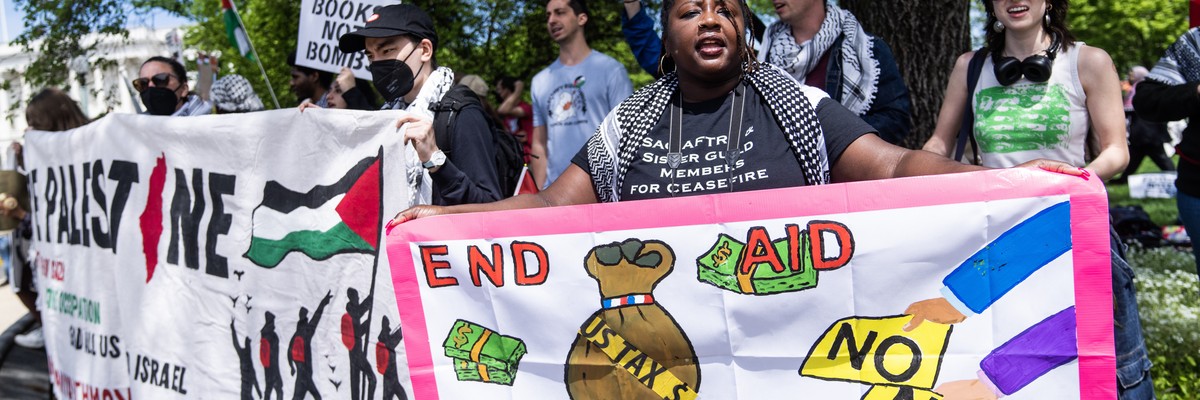
But while Biden calls for an end to the war, the US continues to send weapons and other forms of aid to Israel as it carries out genocide in Gaza, aggression in the West Bank, and extends the war to Lebanon. Biden’s administration has ignored the popular demand for an arms embargo against Israel, supported by major labor unions which represent almost half of all unionized workers in the US as well as 61% of the US population. Instead, the US has only expanded its military support for Israel, approving a USD 20 billion dollar arms package to the Zionist state in August. 

The US has maintained its unconditional support of Israel, even as Israel floats a possible ground invasion of Lebanon. Yet ironically Biden said of the war in Sudan, “the world needs to stop arming the generals.” According to the Palestinian Youth Movement, an international Palestinian diaspora organization, “the Biden-Harris administration is responsible for the current massacres in Lebanon.”

The US’s support for Israeli genocide has received additional scrutiny after it was revealed that USAID and the State Department knew that Israel had deliberately blocked humanitarian aid to Gaza. US law requires the government to cut off weapons shipments to countries which block deliveries of US-backed aid, and so US Secretary of State Antony Blinken seems to have deliberately told Congress that Israel did not block aid so that weapons shipments to Israel would remain unaffected. 

Yet in his speech to the UNGA, Biden entreated Sudanese generals to “stop blocking aid to the Sudanese people.”

“We do not currently assess that the Israeli government is prohibiting or otherwise restricting the transport or delivery of US humanitarian assistance,” Blinken told Congress on May 10, despite being told the opposite by USAID and the State Department in April.

In Ukraine, not only were the US and NATO’s violations of Russian security red lines the chief cause of that war, but the West continues to be an obstacle to a peaceful settlement of the conflict. There has been no negotiation between Ukraine and Russia ever since the West allegedly forced Ukraine to withdraw from talks in April 2022, and the US in its usual fashion continues to supply billions of dollars in weapons to Ukraine to continue the war. 

And while Biden urged other UNGA member nations to “stand up” for the Ukrainian people, US military officials openly thirst for Ukrainian blood—complaining in a New York Times article from last year that the Ukrainian military has become too “casualty averse,” causing it to “race through precious [US-provided] ammunition supplies” as opposed to human lives.

Biden spent time lamenting the humanitarian situation in Sudan, and claiming that “the United States has led the world in providing humanitarian aid” to the war-torn country. But like many global conflicts, the war in Sudan has its roots in the savagery of US imperialism. According to Stephanie Weatherbee Brito of the International Peoples Assembly, “Through both military interventions and economic sanctions, the United States has shown its willingness to coerce any nation deviating from its interests. This has fostered a global environment where nations vie for power and influence. The US’s propensity to invade and punish perceived adversaries has spurred countries to bolster their military and geopolitical capabilities to safeguard their sovereignty in a world marked by violence and conflict, saturated with weaponry and lacking effective mechanisms to ensure peace.”

“This is essentially what is happening in Sudan today, where the conflict has resulted in more than ten million displaced persons. The conflict between the Sudanese Armed Forces and the Rapid Support Forces serves to thwart the democratic process the people have been struggling for since 2018, as rival military groups struggle to control the country and its resources,” Brito articulated. 

US hybrid wars remains chief obstacle to global cooperation

“Our task, our test, is to make sure that the forces holding us together are stronger than those that are pulling us apart,” Biden claimed in his address to the UN, despite his administration’s wielding of sanctions that cause economic devastation throughout the world.

For decades, the international community has been calling on the United States to lift deadly sanctions on Cuba that are part of an over 60-year-long blockade against the socialist nation. Most recently, a group of nearly 600 parliamentarians from 73 different countries penned a joint letter condemning the continued inclusion of Cuba on the list. And 35 former heads of state from across the globe penned a separate letter to Biden, urging him to remove Cuba from the US’s “State Sponsors of Terrorism” list. 

But when it comes to US sanctions and other violations of the sovereignty of other countries, Cuba is but one facet. Comprehensive US sanctions target and put a stranglehold on the economies of countries such as Iran, North Korea, Russia, Venezuela, and Syria. Other nations, such as China, are under constant attack on many fronts, whether through media fear mongering or military exercises near their territories. 

And yet in his speech to the UNGA, Biden seems to deny that his administration has deliberately stoked conflict with China. “We also need to uphold our principles as we seek to responsibly manage the competition with China so it does not veer into conflict,” Biden pontificated. “We stand ready to cooperate on urgent challenges for the good of our people and the people everywhere.”

According to Amanda Yee, journalist, anti-imperialist activist, and host of The China Report on BreakThrough News, Biden’s China strategy has nothing to do with managed competition. “In reality, it’s a belligerent policy which will only escalate toward war,” Yee told Peoples Dispatch

“What he calls ‘strengthening our network of alliances and partnerships across the Indo-Pacific’ really means the continuation of arming Taiwan, building more military bases on allies’ soil and in the South China Sea, sending cruise missiles to Japan, conducting war games exercises in South Korea—all to further build up the military encirclement of China.”

The future of US democracy

“I’ve made the preservation of democracy the central cause of my presidency,” Biden claimed during his address. And yet those in the US who have protested against their governments’ domestic and foreign policies have faced police violencemass arrests, and even deportation

As US presidential elections fast approach, whether the winner is Biden’s successor Kamala Harris or the ultra-conservative former president Donald Trump, anti-imperialist activists can expect more of the same repression.

Original article by Natalia Marques republished from peoples dispatch under a Creative Commons Attribution-ShareAlike 4.0 (CC BY-SA) license

Continue ReadingBiden’s UNGA address espousing democracy and cooperation contrasts with reality

Human rights lawyers renew calls for the release of 10,000 Palestinian prisoners

Spread the love

Original article by Ana Vračar republished from peoples dispatch under a Creative Commons Attribution-ShareAlike 4.0 (CC BY-SA) license.

Khalida Jarrar is one of 10,000 Palestinians that has been arrested by Israel in the last year as part of a massive crackdown. Photo: Archive

Legal experts and human rights advocates renew their call for solidarity with Palestinian prisoners detained by Israel since October 2023

Since October 7, 2023, approximately 10,000 Palestinians from across the West Bank and other occupied territories have been imprisoned by Israeli Occupation Forces (IOF) in what human rights lawyers describe as an unprecedented assault on all branches of the resistance movement. Thousands more have been forcibly disappeared from the Gaza Strip, with little information available about their whereabouts.

Amid the increased use of torture and detention of the Palestinian people by Israel, international solidarity movements have intensified campaigns calling for their release.

Among those recently detained from the occupied West Bank is Khalida Jarrar, a prominent human and women’s rights activist, who has faced persecution by Israel on multiple occasions, and is now being held in Neve Tirza prison.

Watch: 11 months in Israeli prison: Shatha Odeh’s struggle for basic rights

At a briefing on Palestinian political prisoners, organized by the International Peoples’ Assembly (IPA), Tala Nasir from Addameer Association for Prisoner Support and Human Rights, along with human rights lawyer Bilal Naammeh, highlighted the IOF’s violations of basic human rights among prisoners. Nasir pointed out that many arrests in the past year have targeted specific groups of professionals who play an important role in building the material basis of the community, including engineers and health workers. However, anyone can face arrest for something as minor as posting on social media, which occupation forces often manipulate into allegations of supporting resistance groups, including Hamas.

Israel is attempting to practically ban all political participation by Palestinians, Naammeh noted, a threat reinforced through military courts and remote trials designed to instill fear in the population. Since October 2023, these practices have become even more severe than before. Naammeh described how, in court, Israeli lawyers often accuse defendants of being involved in the resistance. When defense lawyers challenge these accusations due to insufficient evidence, they can be sanctioned or temporarily barred from representing clients.

As lawyers are currently the only point of contact between prisoners and the outside world, restricting their access—whether through sanctions or lengthy delays—has profound consequences.

Conditions inside Israeli prisons have also worsened significantly. Access to prisoners is limited, even for representatives of the International Committee of the Red Cross (ICRC). Prisoners face severe shortages of food and water, which has led to weight loss of up to 30 kilograms per person, and are allowed only one hour outside their cells each day, leaving them isolated for the rest of the time, according to Nasir.

Read more: Creating life from a life sentence: Sana’ Daqqah on the Palestinian prisoners’ movement

The lack of water and hygiene has led to mass outbreaks of disease and infection, including scabies. According to Naammeh, some prisoners with scabies have been tied to their beds to prevent them from scratching. Other reports indicate that the IOF moves prisoners with scabies between sections in order to purposely exacerbate the contagion. Despite the widespread health crisis, medical care remains out of reach for most. Naammeh highlighted that even the most pressing health issues can take up to two months to receive basic medical attention, leaving prisoners in prolonged suffering.

Conditions in the camps where Palestinians from Gaza are held are even worse, the two advocates suggested, but up-to-date information is nearly impossible to obtain. The only reports come from Israeli media or the testimonies of those who have been released. Nasir recounted stories of prisoners enduring extreme torture, including rape. Witnesses described prisoners being forced to bark for food and given only thin mattresses for six hours a day, making proper rest impossible. This treatment extends even to those who are supposed to enjoy specific protection under international law, such as health workers. Nasir explained that dozens of health workers abducted from Gaza are being held under the Unlawful Combatants Law, meaning they could remain imprisoned until the end of the conflict under such conditions.

In response to Israel’s blatant disregard for human rights and international law, Addameer and the IPA renewed their call for the immediate release of all political prisoners and urged international activists to escalate solidarity efforts, including by insisting on adherence to recent International Court of Justice rulings. The organizers reminded participants that even the simplest acts of solidarity can contribute meaningfully to the broader struggle for liberation.

Original article by Ana Vračar republished from peoples dispatch under a Creative Commons Attribution-ShareAlike 4.0 (CC BY-SA) license.

Continue ReadingHuman rights lawyers renew calls for the release of 10,000 Palestinian prisoners