‘Another day, another war crime’
https://morningstaronline.co.uk/article/another-day-another-war-crime
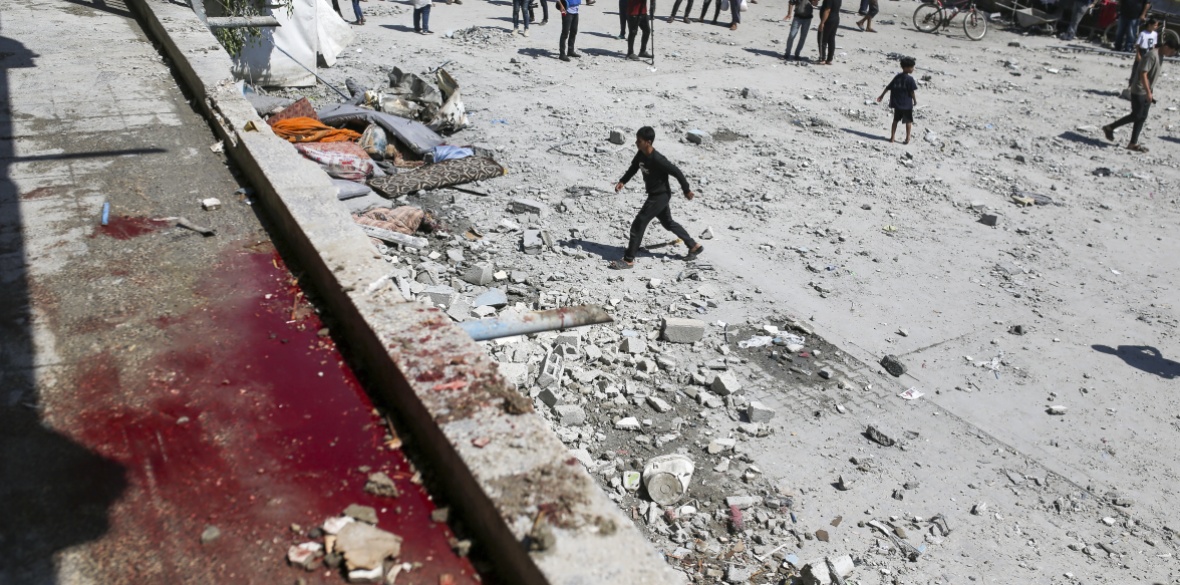
More than 30 killed by Israeli strike on UN school sheltering displaced Palestinians
MORE than 30 people — mostly children — were killed by an Israeli strike on a UN school sheltering displaced Palestinians today.
Israel defended the latest bloodshed among Palestinians seeking refuge by claiming that Hamas was operating from within the UN refugee agency (UNRWA) school in Nuseirat refugee camp, central Gaza.
It did not provide evidence for its claims, as is usually the case with such attacks.
A CNN analysis indicated that the weapons used in the pre-dawn attack were US-made.
It is not the first time that air-strikes have targeted the school.
The attack followed Israel’s announcement on Wednesday of a new military campaign in central Gaza, saying that there would be no pause in fights amid ceasefire talks.
…
Peace and Justice Project founder Jeremy Corbyn, who is defending his Islington North seat as an independent MP, said he is “appalled by the ongoing loss of life,” telling the Star: “Another day, another war crime.
“What kind of world are we living in when this kind of horror becomes part of our weekly or even daily routine?
“How have we allowed these atrocities to become so normalised?
“A school is a place of learning, growth and joy. In Gaza, they have been turned into a place of death, trauma and grief.”
Mr Corbyn vowed to continue to speak up for a ceasefire, the end to arms sales to Israel and “the only path to a just and lasting peace: the end to the occupation of Palestine.”
…
https://morningstaronline.co.uk/article/another-day-another-war-crime
Biden Claims Israel Isn’t Starving Gazans. Rights Groups Say ‘It Is Clear as Day’
Original article by JAKE JOHNSON republished from Common Dreams under Creative Commons (CC BY-NC-ND 3.0).
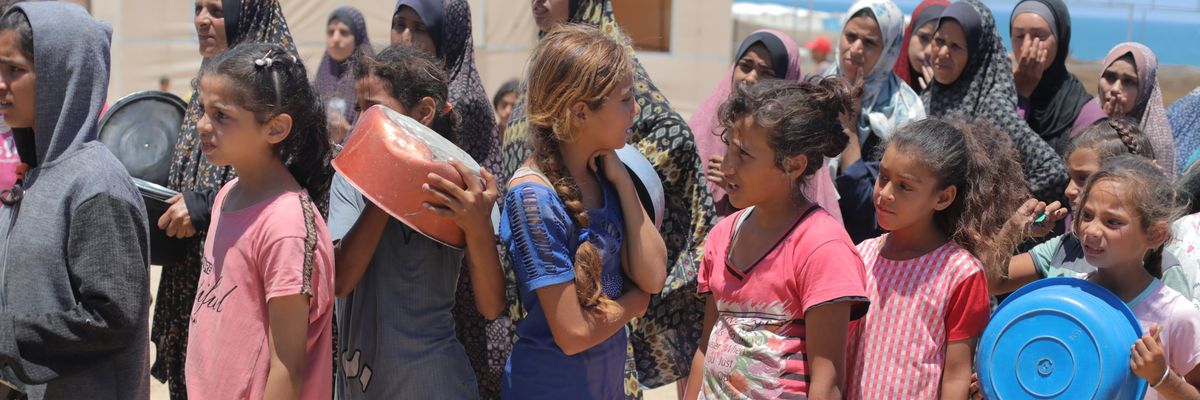
“The fact that Israel is using starvation as a weapon of war in Gaza is not in contention,” said a Human Rights Watch researcher.
U.S. President Joe Biden said in an interview published Tuesday that he does not believe the Israeli government is using starvation as a weapon of warfare in Gaza, contradicting the findings of leading human rights organizations that have documented Israel’s deliberate obstruction of food aid as Palestinians die of malnutrition.
“No, I don’t think that,” Biden said in response to TIME magazine’s Washington bureau chief Massimo Calabresi and editor-in-chief Sam Jacobs, who noted some have “alleged that Israel is intentionally using starvation of civilians as a method of warfare.”
The president, who has approved more than 100 arms sales to Israel during its eight-month assault on the Gaza Strip, acknowledged that Israel’s military has “engaged in activity that is inappropriate” and that “Palestinians have suffered greatly.”
But he stopped well short of the conclusions reached by Oxfam International, Human Rights Watch (HRW), and the International Criminal Court, which recently applied for arrest warrants against Israeli Prime Minister Benjamin Netanyahu and Defense Minister Yoav Gallant for their role in the “starvation of civilians as a method of warfare” and other war crimes.
The U.S. Agency for International Development has also determined that Israel has unlawfully impeded the delivery of humanitarian assistance to Gaza, leading to a “deterioration of food security and nutrition in Gaza [that] is unprecedented in modern history.”
“The fact that Israel is using starvation as a weapon of war in Gaza is not in contention. It is clear as day,” Hiba Zayadin, a researcher at HRW, wrote in response to Biden’s TIME interview, pointing to her group’s December report that found the Israeli military was “deliberately blocking the delivery of water, food, and fuel, while willfully impeding humanitarian assistance, apparently razing agricultural areas, and depriving the civilian population of objects indispensable to their survival.”
“The evidence is even stronger today,” Zayadin added, citing HRW’s April report that focused specifically on the Israeli military’s starvation of Gaza children. Dozens of Palestinian kids, some just months old, have died of malnutrition since October, a figure that is almost certain to grow as Israel’s bombing campaign and ground offensive in Rafah continue.
The World Food Program said Wednesday that unless Israel’s assault on Gaza ends and desperately needed humanitarian aid is allowed to flow, more than a million people in the occupied enclave “are expected to face death and starvation… by mid-July.”
Humanitarian groups and experts—including an outspoken former U.S. State Department official—have argued that by continuing to arm Israel and provide it with diplomatic cover on the world stage, the Biden administration is complicit in Gaza’s increasingly dire hunger crisis.
“This is not just turning a blind eye to the man-made starvation of an entire population, it is direct complicity,” Josh Paul, who resigned from the State Department in October over the administration’s support for Israel’s assault on Gaza, told The Independent last month.
In a speech on the floor of the U.S. Senate earlier this week, Sen. Bernie Sanders (I-Vt.) displayed photos of emaciated children as he explained his decision to boycott Netanyahu’s upcoming speech to Congress.
“Blocking humanitarian aid and creating the conditions for famine is not only an act of extreme cruelty—using starvation as an act of war—but it is a violation of both American and international law,” Sanders added. “It is a war crime.”
Original article by JAKE JOHNSON republished from Common Dreams under Creative Commons (CC BY-NC-ND 3.0).
- ‘Children Are Starving’: Rafah Suffers As Israel Halts All Aid And Escalates Assault ›
- As Starvation Death Toll Grows In Gaza, Israel Blocks Aid Over Scissors In Child Medical Kits ›
- ‘Complete Madness’: Israel Blocks Food Aid As More Gaza Children Starve To Death ›
- ‘End This War Crime’: HRW Says Israel Is Starving Children To Death In Gaza ›
‘OUR FRIEND’: HOW THE ISRAEL LOBBY SPENT £30,000 ON WES STREETING
https://www.declassifieduk.org/our-friend-how-the-israel-lobby-spent-30000-on-wes-streeting/

Labour’s shadow health secretary has a long history of supporting Israel going back to his days at the National Union of Students—and has been rewarded handsomely for it.
- Streeting was Keir Starmer’s first shadow minister to visit Israel
- His visit in 2022 was paid for by Labour Friends of Israel, which “works really closely” with Israeli embassy in London
- He has taken over £20,000 from Israel lobbyists Sir Trevor Chinn, Lord Mendelsohn and David Menton, with donations as recently as April
- Pro-Israel newspaper said Streeting’s “track-record on Israel is clear” and called him “our friend at the NUS”
- Streeting is being challenged by British-Palestinian independent Leanne Mohamad
Wes Streeting has received nearly £30,000 from Britain’s powerful pro-Israel lobby, Declassified has found.
Two years ago, Streeting became the first member of Keir Starmer’s shadow cabinet to visit Israel, in a move designed to signal a break with Jeremy Corbyn’s pro-Palestine position.
The trip was paid for by Labour Friends of Israel (LFI) and cost £4,700. LFI also paid for Sarah Harrison, one of Streeting’s staffers, to visit Israel with him.
Another Streeting staffer, Anna Wilson, was paid an undisclosed amount to visit Israel last July.
Her trip was funded by the European Leadership Network, a group whose UK branch is run by Joan Ryan, former chair of LFI.
LFI is a secretive organisation that does not disclose its funders, although undercover reporting revealed Ryan, then a Labour MP, discussing a £1 million payment from Israel with Shai Masot, an Israeli diplomat, in 2016.
In another covertly filmed conversation outside a London pub, LFI’s Michael Rubin said that he and Masot “work really closely together…but a lot of it is behind the scenes”.
Masot was eventually forced to quit his job at the Israeli embassy and return home after he was caught on camera plotting to “take down” British MPs.
…
Israel is a serial violator of international law, and is judged to be practising apartheid against the Palestinians by both the US and UK’s top human rights groups, Human Rights Watch and Amnesty International. Leading Israeli group B’Tselem has also reached the same conclusion.
It is currently being investigated by the International Court of Justice (ICJ) for genocide, while the International Criminal Court’s prosecutor Karim Khan is seeking arrest warrants for prime minister Benjamin Netanyahu and defence minister Yoav Gallant for war crimes in Gaza.
Streeting described the ICJ case as a “distraction”.
…
https://www.declassifieduk.org/our-friend-how-the-israel-lobby-spent-30000-on-wes-streeting/
Conditions ‘Unspeakable’ as Israeli Onslaught Forces Over 1 Million to Flee Rafah
Original article by EDWARD CARVER republished from Common Dreams under Creative Commons (CC BY-NC-ND 3.0).
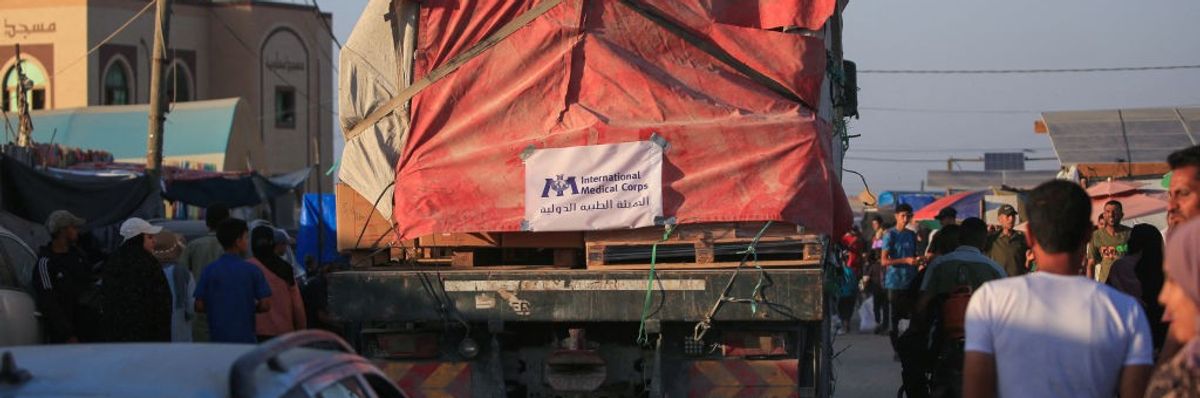
(Photo: Eyad Baba/AFP via Getty Images)
“Public health concerns are beyond crisis levels” in the areas where Palestinians have been forced to shelter, and “the sounds, the smells, the everyday life, are horrific and apocalyptic,” a U.N. official said.
More than 1 million Palestinians have fled Rafah as the city comes under a continued Israeli assault, forcing many to shelter in badly damaged buildings in the nearby city of Khan Younis, according to the United Nations.
The assault on Rafah, a city in the southern Gaza Strip, has left the displaced in “unspeakable” conditions, the United Nations Relief and Works Agency for Palestine Refugees in the Near East (UNRWA) said on social media. Approximately 1.7 million displaced people are now in Khan Younis and “Gaza Middle Areas,” according to UNRWA.
Khan Younis, which saw sustained fighting earlier in the war, still does not appear to be a safe zone: Israeli military vehicles entered the city in recent hours after advancing to two towns just east of Khan Younis with “heavy gunfire and artillery shelling,” Al Jazeerareported.
Since early May, the Israel Defense Forces (IDF) has issued evacuation orders for parts of Rafah, telling people to go to an “expanded humanitarian zone” in Al-Mawasi, located roughly 12 miles from the city.
Israeli forces subsequently launched attacks on designated safe zones, including in Al-Mawasi. Two strikes killed 45 and 21 people last week, mostly women and children. The first of the attacks, known as the “tent massacre,” was carried out with U.S. weapons, later analysis showed.
Many of the people fleeing Rafah are having to move for at least the second time during the war. Roughly 1 million Palestinians who’d been displaced elsewhere had gone to Rafah for refuge earlier in the war. They began to leave Rafah nearly four weeks ago as Israeli started its assault on the city. Before the war, Rafah’s population was about 275,000, but the governorate reached a population of 1.4 million by February as Israel ordered Palestianians to move there from northern Gaza. This meant squeezing more than half of Gaza’s prewar population of 2.3 million into one governorate, NPR reported.
More than 18,500 pregnant women have been forced to leave Rafah, while about 10,000 pregnant women remain in the city in “desperate conditions,” the U.N. reported.
“They’re exhausted, traumatized, dehydrated, and malnourished,” the U.N. Population Fund wrote on social media of pregnant women dealing with “Israel’s terrifying military operation in Rafah.”
“Pregnant women in Gaza are living in an unrelenting nightmare,” the agency added.
After successive operations last month, Israel now controls the entire Gaza-Egypt border. Humanitarian corridors have shut down, with many agencies and aid groups pausing operations in Rafah due to lack of supplies and security concerns.
“We are living and working precariously in the south,” Matthew Hollingsworth said, World Food Program (WFP) country director in Palestine, said late last week, the U.N. reported. The areas where the displaced have been forced to shelter are nightmarish, he said.
“Public health concerns are beyond crisis levels” and “the sounds, the smells, the everyday life, are horrific and apocalyptic,” Hollingsworth added.
More than half of the structures in the Gaza Strip have been damaged, destroyed, or possibly destroyed during the eight-month Israeli assault, the United Nations Satellite Centre (UNOSAT) concluded, in findings released Monday.
The mass displacement from Rafah continued as the Biden administration sought to arrange a cease-fire after after being pressured for months to end its military support for Israel’s onslaught. President Joe Biden called for an end to the war on Friday and backed a roadmap to a deal, which drew praise from Palestine defenders—the Council on American-Islamic Relations called it “long overdue” and a “positive step”—as well as criticism that it did not address the root causes of the conflict.
Israeli Prime Minister Benjamin Netanyahu said Monday that the deal would not stop the war, which could not end until “total victory” had been achieved, according to Israeli National News.
Original article by EDWARD CARVER republished from Common Dreams under Creative Commons (CC BY-NC-ND 3.0).