The One Video Keir Starmer Doesn’t Want You To See
I’ve posted this video twice before. Andrew Feinstein is challenging Keir Starmer by standing as the independent candidate for Holborn & St Pancras.
I’ve posted this video twice before. Andrew Feinstein is challenging Keir Starmer by standing as the independent candidate for Holborn & St Pancras.
Original article by JAKE JOHNSON republished from Common Dreams under Creative Commons (CC BY-NC-ND 3.0).
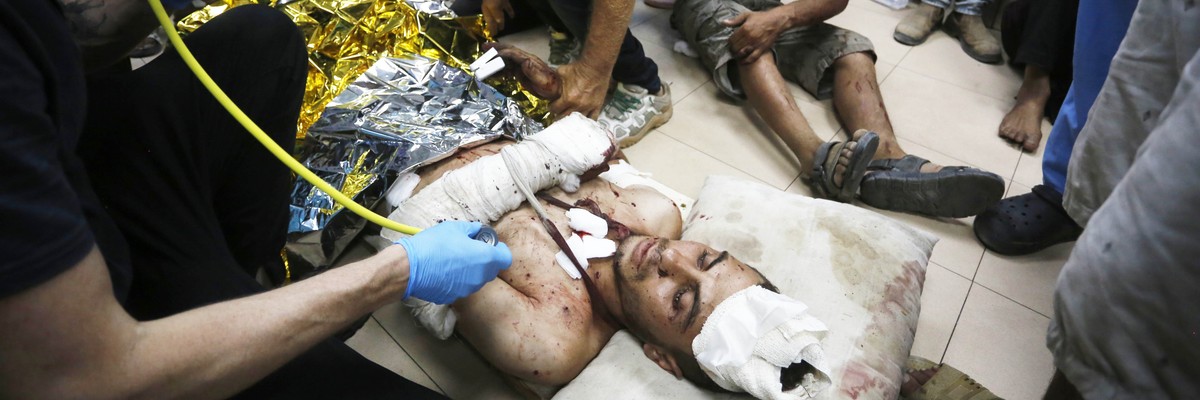
A United Nations commission tasked with conducting an in-depth investigation of Israeli military actions in the occupied Palestinian territories concluded Wednesday that Israel’s government is responsible for multiple war crimes and crimes against humanity in the Gaza Strip, including “extermination,” torture, forcible transfer, and the use of starvation as a weapon of warfare.
The U.N. inquiry began on October 7, the day of a deadly Hamas-led attack on southern Israel. The U.N. Independent International Commission of Inquiry on the Occupied Palestinian Territory found that Palestinian armed groups committed war crimes during their attack on Israel, including the deliberate killing and torture of civilians.
Israel’s massive military response—launched hours after the Hamas-led attack—has caused “immense numbers of civilian casualties in Gaza and widespread destruction of civilian objects and infrastructure,” outcomes that “were the inevitable result of a strategy undertaken with intent to cause maximum damage, disregarding the principles of distinction, proportionality and adequate,” the U.N. commission said Wednesday.
“The intentional use of heavy weapons with large destructive capacity in densely populated areas constitutes an intentional and direct attack on the civilian population,” the commission added. Many of the weapons Israel has used in Gaza were supplied by the United States.
The new report also points to public statements by top Israeli officials as evidence that Israel’s goal in Gaza was to inflict “widespread destruction” and kill a “large number of civilians.” The U.N. panel specifically cited Israeli Defense Minister Yoav Gallant’s October announcement of a “total siege” on the Gaza Strip that would prevent the entry of water, fuel, food, and other necessities.
The International Criminal Court’s top prosecutor has applied for arrest warrants for Gallant and Israeli Prime Minister Benjamin Netanyahu over war crimes committed in Gaza.
Navi Pillay, the chair of the U.N. commission, said in a statement Wednesday that “Israel must immediately stop its military operations and attacks in Gaza, including the assault on Rafah, which has cost the lives of hundreds of civilians and again displaced hundreds of thousands of people to unsafe locations without basic services and humanitarian assistance.
“Hamas and Palestinian armed groups must immediately cease rocket attacks and release all hostages,” Pillay added. “The taking of hostages constitutes a war crime.”
The commission’s findings come less than a week after U.N. Secretary-General António Guterres informed the Israeli government that it was added to an annual “list of shame” that condemns nations for killing and wounding children in wars.
Children have suffered horrific physical and psychological impacts from Israel’s eight-month assault on Gaza, which has killed around 15,000 children. Earlier this year, the U.N. Children’s Fund estimated that around 1,000 kids in Gaza had lost one or both of their legs as a result of Israeli attacks.
Dozens of children were among the more than 270 Palestinians killed by Israeli forces over the weekend during a raid on Gaza’s Nuseirat refugee camp. The military operation resulted in the freeing of four Israeli hostages, but the U.N. Human Rights Office said Tuesday that “the manner in which the raid was conducted in such a densely populated area seriously calls into question whether the principles of distinction, proportionality, and precaution—as set out under the laws of war—were respected by the Israeli forces.”
Doctors Without Borders, known internationally as Médecins Sans Frontières (MSF) said Tuesday that Israeli forces have killed more than 800 people in Gaza and wounded more than 2,400 since the beginning of June.
“How can the killing of more than 800 people in a single week, including small children, plus the maiming of hundreds more, be considered a military operation adhering to international humanitarian law?” asked Brice de le Vingne, the head of MSF’s emergency unit. “We can no longer accept the statement that Israel is taking ‘all precautions’—this is just propaganda.”
“Since October (and certainly before), the dehumanization of Palestinians has been a hallmark of this war,” de le Vingne added. “Catch-all phrases like ‘war is ugly’ act as blinders to the fact that children too young to walk are being dismembered, eviscerated, and killed.”
Original article by JAKE JOHNSON republished from Common Dreams under Creative Commons (CC BY-NC-ND 3.0).
They’re Arresting the Wrong People Inside of Congress
Despite Mainstream Headlines, Israel’s Tents Massacre Was Not a ‘Tragic Mistake’
UN Human Rights Office Says IDF’s Deadly Nuseirat Raid May Amount to War Crime
Original article by ROBIN ANDERSEN republished from FAIR under a Creative Commons Attribution-NonCommercial-NoDerivs 3.0 Unported License.

As the world watched on social media and responded in outrage, US corporate media, once again, provided cover for the perpetrators of Israel’s genocide.

Over the Memorial Day weekend, Israel bombed starving Gazan refugees crowded in tents in Rafah, where Israel had told them to go. As Jeffrey St. Clair (CounterPunch, 5/31/24) wrote, leaflets dropped in Rafah a few days before told them to go to “Tel al-Sultan through Beach Road,” an area set up by the UNRWA refugee agency and designated a UN humanitarian safe zone. The leaflet added, “Don’t blame us after we warned you.”
Nevertheless, without warning, Israel hit the camp with at least eight missiles spreading fire though the encampment of plastic tents (Quds News, 5/26/24). Some refugees burned to death, mostly women and children, leaving them dismembered and charred.
The world saw the terror of the massacre on international and social media. Images showed the area of the strike engulfed in flames as Palestinians screamed, cried, ran for safety and sought to help the injured. “They told people to move there then killed them,” Richard Medhurst (5/28/24) posted.
A boy cries in horror and fear as he watches his father’s tent burn with him inside. A man holds up the body of his charred, now-headless baby, wandering around, not knowing what to do or where to go. An injured, starving child convulses in pain as a medic struggles to find a vein for an IV in her emaciated arm (Al Jazeera, 5/27/24).
Al Jazeera (cited by Quds News, 5/26/24) quoted a Civil Defense source: “We believe that the occupation army used internationally prohibited weapons to target the displaced in Rafah, judging by the size of the fires that erupted at the targeted site.”
US news media reported the tent massacre, some more truthfully than others. But most establishment media repeated Israel’s false claims that it was an accident, weaving disinformation messaging into toned-down descriptions of the scene. With confused syntax, they omitted words like “genocide,” “massacre” and “starvation.” Most left out the language of international law that is best able to explain the unprecedented crimes against humanity that Israel is committing. Corporate reporting left the tent massacre devoid of context and empathy, ignored actions that need to be taken, and ultimately facilitated the ongoing Israeli genocide of Palestinians.

When NBC News (5/28/24) reported from Gaza that “Israeli tanks reached the city center for the first time, according to NBC News‘ crew on the ground,” it failed to say that the NBC crew was embedded with Israel’s invading force.
The same sentence continued that Israel was “defying international pressure to halt an offensive that has sent nearly 1 million people fleeing Rafah.” But Israel was not just “defying…pressure”; it was in violation of a direct order from the International Court of Justice ICJ to halt its attack on Rafah. Yet NBC reporters rode into Rafah with an army that was ignoring international law to commit further genocide in Gaza.
Compare NBC’s words to those used by Ramy Abdu (5/26/24), chair of Euro-Med Human Rights Monitor, who posted: “In the deadliest response to the International Court of Justice’s decision, the Israeli army targeted a group of displaced persons’ tents in Rafah, killing approximately 60 innocent civilians so far.”
In a post, Francesca Albanese (5/26/24), UN special rapporteur for human rights in Palestine, included International actions that needed to be implemented:
The #GazaGenocide will not easily end without external pressure: Israel must face sanctions, justice, suspension of agreements, trade, partnership and investments, as well as participation in int’l forums.
Such sanctions are rarely discussed in establishment media, but are becoming more urgent, given the New York Times report (5/29/24) that Israel intends to extend the genocide through the remainder of 2024. Though the Times reported on the global outrage and demonstrations against the Rafah massacre, the words “genocide” and “massacre” were not used, nor was there any mention of the possibility of sanctions against Israel.

Instead of sourcing the International Criminal Court, the International Court of Justice or any humanitarian actors in the region, NBC (5/28/24) quoted a UN Security Council spokesperson:
Israel has a right to go after Hamas, and we understand this strike killed two senior Hamas terrorists who are responsible for attacks against Israeli civilians…. But as we’ve been clear, Israel must take every precaution possible to protect civilians.
Israel’s claim that it killed two Hamas leaders became the rationale for the strike, which was repeated extensively on corporate media. Over NBC‘s images of burning tents and killing scenes, the header read, “Dozens killed in Gaza tent camp in an airstrike targeting two Hamas commanders.”
The dead were connected to Hamas whenever possible. At the bottom of the video, the subtitles listed numbers of dead, followed with, “according to the emergency services in Hamas-run Gaza.”
Human rights attorney and Rutgers academic Noura Erakat (5/27/24) exposed the attempt to link murdered children to Hamas. Over the picture of a burned baby, she posted these harsh words:
Have you ever seen a burnt baby? Can you imagine her final, gaping screams? And all Israel had to tell you was “Hamas,” so you look at her and shrug. Your willful ignorance is genocidal.
CounterPunch (5/31/24) quoted Jeremy Konyndyk, former head of disaster relief for US Agency for International Development, saying, “Bombing a tent camp full of displaced people is a clear-cut, full-on war crime” who added, “Even if Hamas troops were present, that does not absolve the IDF of the obligation to protect civilians. It does not turn a tent camp into a free fire zone.”
On NBC (5/28/24), under the footage of the burning horrors of Rafah, the chyron read, “Netanyahu: Deadly Strike a Tragic Incident.”
In response to Israel’s “accident” claim, journalists, activists and social media users, including Rep. Rashida Tlaib, reacted with incredulity and withering criticism of those who asserted it. That was the reaction Axios reporter and CNN analyst Barak Ravid (5/27/24) received when he posted, “Breaking: Netanyahu says the airstrike in Rafah on Sunday was ‘a tragic mistake,’ and adds that it will be investigated.” Katie Halper (5/27/24) replied to Ravid with, “Nice to see you using your position as a journalist to do comms for the Israeli government.”
And Tlaib (5/27/24) commented:
This was intentional. You don’t accidentally kill massive amounts of children and their families over and over again and get to say, “It was a mistake.” Genocidal maniac Netanyahu told us he wants to ethnically cleanse Palestinians.
She ended with the question, “When are you going to believe him?”
Sana Saeed (5/27/24), media critic for Al Jazeera+, posted the front pages of four print publications that repeated Netanyahu’s accident claim. The New York Times used “Tragic Accident,” while “Tragic Mistake” was preferred by Time magazine, Forbes and the AP. Over the headlines, she called them “propagandists for genocide masquerading as journalists.”

But CNN (5/28/24) seemed to be vying for Most Valuable Propagandists by elaborating on the unlikely details offered by the IDF to describe the official Israeli version of what happened. It began with Netanyahu speaking to the Knesset: “Despite our best effort not to harm those not involved, unfortunately a tragic error happened last night. We are investigating the case.”
After four paragraphs of details of the massacre—“burned bodies, including those of children, could be seen being pulled by rescuers from the wreckage”—CNN returned to the justifications. The long, breathless chain of details began:
A US official told CNN Monday that Israel had told the Biden administration it used a precision munition to hit a target in Rafah, but that the explosion from the strike ignited a fuel tank nearby and started a fire that engulfed a camp for displaced Palestinians and led to dozens of deaths.
But the claims could not be confirmed; “It’s what Israel shared with us,” the official said.
But the attack on Rafah was in no way a single “precision” “hit,” as numerous sources reported that multiple bombs hit the camp. And Al Jazeera (5/27/24) reported that Israeli drone strikes also hit the Kuwaiti Hospital, the only functioning hospital in the area, killing two medics. It also pointed out that no notice to evacuate came before the strike.
In an X post (5/27/24), Intercept co-founder Jeremy Scahill noted the shifting narrative coming from Israel:
Netanyahu now admits Israel carried out the horrifying bombings that incinerated human beings in Rafah last night and turned a refugee camp into hellfire. I assume all the people who claimed it was actually a failed Hamas rocket attack will now rush to correct themselves.
As we observed after the flour massacre (FAIR.org, 3/22/24), Israel’s string of differing false statements immediately following a massacre is an IDF propaganda strategy designed to confuse and delay. Focusing on changing falsities distracts from the massacre and turns the cameras away from the horrible images of US-supplied weapons slaughter. In this way, massacres become normalized.
Repeating and discussing the ever-changing Israeli disinformation of denial, discussing weapons and official statements, also allows US corporate media to avoid easily observed patterns of Israel’s ongoing massacres, in addition to drawing public attention away from the suffering. But on social media, the raw footage and cries of outrage by users indicate that the manufactured emotional distance collapses online.
Some users expressed extreme distress after prolonged viewing of such imagery. One Palestinian organizer (5/27/24) said:
I’m shaking uncontrollably since last night. I can’t get the beheaded baby that was burned alive. The woman’s screaming out of my head. The decomposed bodies of babies out of my head. The girl whose body was stuck to a wall. Hind’s final message to PRCS…. And now. How do you watch all this and not feel your soul dead?
The daughter of Palestinian refugees posted (5/27/24):
The flour massacre, the tents massacre, the hospital massacre, the refugee camp massacre, the “safe corridor” massacre, the endless massacres, in homes, on the streets, in tents, on foot— eight months of massacre after massacre after massacre.
Another user (5/27/24) asked, “Why do so many Israeli mistakes involve launching multiple missiles at people they’ve assured are in safe zones?”
It was the Israeli newspaper Haaretz (2/29/24) that exposed US corporate media reporting as repeated propaganda in a piece titled, “In Netanyahu’s Israel, the Rafah Horror Was Neither ‘a Mishap’ nor Exceptional.” The editorial scoffed at the use of “tragic mishap” to describe the “horrific incident.” It observed that “it took Netanyahu 20 hours to produce the disgraceful statement, which, as usual, lacked any shred of regret over the death of ‘noncombatants.’”
Haaretz derided the “willful media blackout regarding the scope of death and destruction over the last eight months.” Skeptical about the assertion that “it was not expected to cause damage to noncombatant civilians,” the paper observed that, if true, “this involves an ongoing failure at the strategic level.”

By May 29, US corporate media began to report extensively that the Israeli bombs dropped on Rafah that burned Palestinian refugees alive were made in the US. A munitions fragment was filmed by Palestinian journalist Alam Sadeq, and was posted on X (5/27/24) by former US Army explosive expert Trevor Ball two days earlier. Much was made of the fact that the ordinance was smaller than the usual 2,000-pound bombs used to destroy Gaza, and were the preferred bombs the Biden administration had sent to Israel.
As the New York Times (5/29/24) put it, “US officials have been pushing Israel to use more of this type of bomb, which they say can reduce civilian casualties.” The lengthy report included a drawing of the bomb, the details of its manufacture, and assertions that its use by Israel indicated they tried to kill fewer civilians. Gone were any mention of the “tragic mistake,” and the “exploded fuel tank,” forgotten as yesterday’s fake news.
But a lengthy back-and-forth about how the fire could have started failed to point out the obvious, which comes only at the very end when a retired US Air Force sergeant observes, “When you use a weapon that’s intended as precision and low–collateral damage in an area where civilians are saturated, it really negates that intended use.”
As Israel’s atrocities continue to mount in Gaza, the LA Progressive (6/7/24) wrote that though Biden claimed to care about the loss of civilian life in Gaza, and that an Israeli attacked on Rafah would be a “red line,” “events of the past weeks have demonstrated that none of these claims are in fact true.” It added that a month ago, Hamas agreed to an Egyptian-brokered ceasefire agreement “that looked a lot like the ceasefire agreement now being promoted by the Biden administration,” but Israel responded by rejecting that agreement as well.
In addition, Israel closed off the border area between Israel and Egypt, cutting off any aid or supplies from coming into famine-ravaged Gaza. The authors concluded, “What has transpired is a horrifying series of massacres against civilians, which the Biden administration continues to try to downplay, excuse and explain away.”
Over the last eight months, US establishment media have helped Biden “explain away” such atrocities. They have not stopped repeating Israel’s propaganda, and have acted as willing conduits for Israeli disinformation. It is past time they stopped doing so, and started reporting on what is actually happening on the ground in Gaza, not through the eyes of the IDF.
FAIR’s work is sustained by our generous contributors, who allow us to remain independent. Donate today to be a part of this important mission.
Original article by ROBIN ANDERSEN republished from FAIR under a Creative Commons Attribution-NonCommercial-NoDerivs 3.0 Unported License.
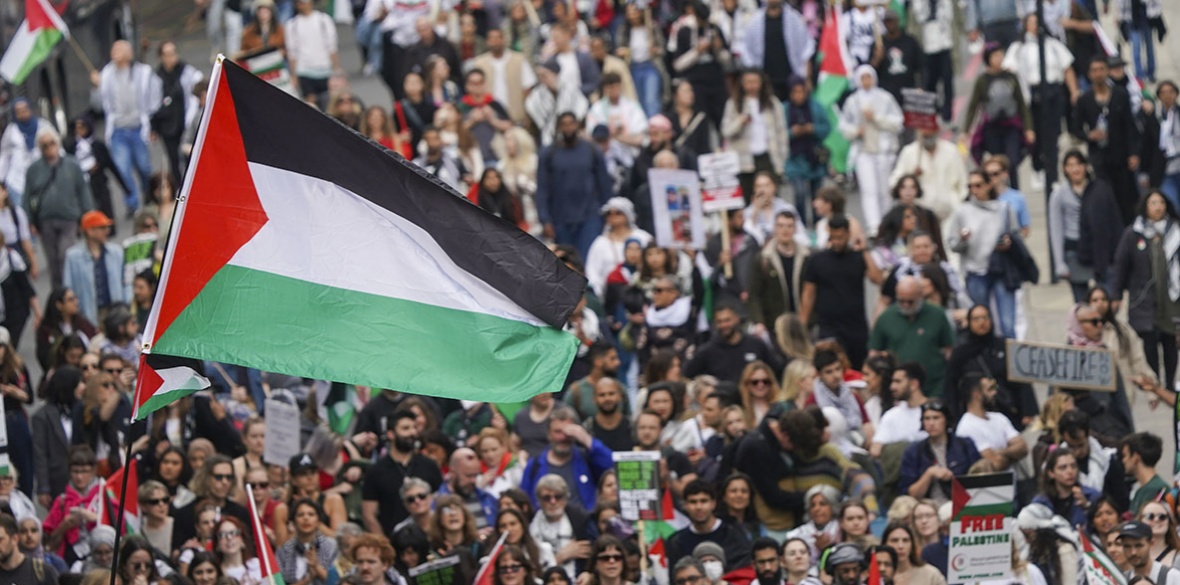
PALESTINIAN campaigners launched a Vote Palestine campaign today to make justice for the country a core issue in the upcoming general election.
The Palestine Solidarity Campaign (PSC) has crafted six questions for parliamentary candidates, which constituents can electronically send to their local prospective MPs.
The questions outline concrete actions for candidates to commit to if elected.
They cover calls for an immediate ceasefire, restoration of funding to United Nations Relief and Works Agency, an arms embargo, support for the International Court of Justice (ICJ) and International Criminal Court to uphold international humanitarian law, suspending trade agreements with Israel and protecting the right to protest, boycott and divest from companies that are complicit in violations of international law.
…
PSC director Ben Jamal said: “The last eight months in Gaza have led to a generational shift in attitudes to Israel — a state that not only occupies Palestine and practices a system of apartheid against Palestinian people, but is now committing a genocide with appalling new chapters being seen every day.
“And this continues with the complicity of UK political leaders who have failed to advocate for an immediate and permanent ceasefire, failed to halt arms exports, and continue to provide political support to Israel.
“Candidates who normalise massacres, who greenlight genocide, or who endorse a system of apartheid, should not expect support from voters who believe that human rights and international law should be upheld.”
…
