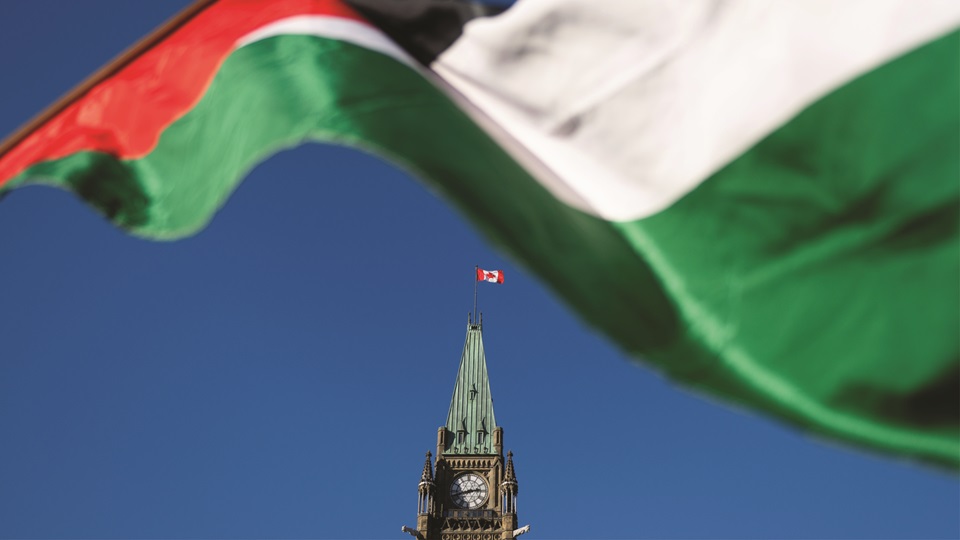
People take part in a Scottish Palestine Solidarity Campaign demonstration in Glasgow. Picture date: Saturday November 25, 2023.
HUNDREDS of thousands of protesters again took to the streets of London and major cities across Britain on Saturday as public anger over Israel’s slaughter in Gaza showed no signs of abating.
Demands for a ceasefire echoed in and other centres on the second day of the four-day “pause” in Israel’s attack for the release of Israeli hostages held in Gaza in exchange for Palestinians in Israeli prisons.
In London, police arrested 18 protesters and police were accused of using catch-all Section 12 regulations to make arrests in response to political pressure.
Palestine Solidarity Campaign (PSC) director Ben Jamal said: “There has been a major political effort by pro-Israel voices, including in government, to defame the protests as hate marches.
“In response the police today imposed a ludicrous Section 12 that gave them power to arrest anyone arriving early or leaving late no matter what they were doing.”
Stop the War Coalition national officer John Rees said: “This is political policing and it’s pretty certain none of this will be applied to tomorrow’s march for Israel,” referring to today’s demonstration called by the Campaign Against Anti-semitism.
Acorn activists outside the entrance of aerospace and defence manufacturer Meggitt in Birmingham
THREE British arms firms supplying Israel with weapons were blockaded today when activists, local community members and tenants’ union Acorn went into action in defence of Gaza.
Acorn is active in towns and cities across Britain fighting on issues such as tenants’ rights, public transport and the cost-of-profits crisis.
Activists targeted weapons manufacturers in Birmingham, Bristol and Leeds today.
In Birmingham, the entrances to aerospace and defence manufacturer Meggitt were blocked; in Bristol, protesters turned away workers at defence and security manufacturer Leonardo; and in Leeds, the offices of BAE System were blockaded.
All three firms manufacture or provide components and systems for military aircraft being used in the bombardment of Gaza.
Acorn chairwoman Chelsea Phillips said: “Acorn will not stand by while entire communities are obliterated while ordinary people just like us are murdered in their tens of thousands by the Israeli government with the support of our government and using horrific weapons of war built by British companies.
Palestinians walk by a damaged building following an Israeli army attack on Jenin refugee camp, West Bank, Sunday, Nov. 26, 2023
AT LEAST eight Palestinians were killed by Israeli forces in the West Bank on Saturday, Palestine’s Health Ministry said yesterday.
Five people were killed in the Jenin refugee camp and three more in other parts of the occupied territory even as Israel and Hamas observed a truce in Gaza for ongoing prisoner-hostage swaps.
An Israeli Defence Forces statement said troops entered Jenin to make arrests connected to the killing of an Israeli father and son at a car wash earlier in the year, and that the slain were “militants.” It also claimed to be using engineering equipment to uncover buried explosive devices in response to Palestinian accusations that military bulldozers were destroying infrastructure.
Since Hamas’s attack from Gaza on October 7, Israel has launched a wave of repressive violence in the West Bank alongside its war on Gaza, which has killed over 14,000 people.
Dozens of Palestinians have been killed by soldiers and scores by settler violence, with Israeli settlers leafleting Palestinian villages warning of a “second Nakba” (the Arab term for the forcible expulsion of 750,000 Palestinians from their homes when Israel was established in 1948). Thousands of Palestinians have also been arrested, doubling the number held in Israeli jails in a few weeks.
Palestine solidarity and anti-imperialist organizations raise demands following the announcement of a 4-day pause in aggression in Gaza
Thousands gather outside of the Pennsylvania Station in New York City on November 17 (Photo: Wyatt Souers/ANSWER Coalition)
In the early hours of November 22, Israeli and Hamas officials announced that they accepted the agreement brokered by Qatar, Egypt, and the United States for a 4-day pause in aggression in the Gaza Strip, which includes the exchange of 150 Palestinian political prisoners for 50 non-military Israeli hostages, as well as the entry of 300 trucks of humanitarian aid into the besieged Gaza Strip.
This temporary pause comes after Israel has slaughtered over 14,500 Palestinians in Gaza, with 7,000 still trapped under the rubble and over 35,000 wounded. Israel’s airstrikes on hospitals and civilian infrastructure as well as the complete blockade on the enclave means that the thousands of injured have limited access to care and the population overall has restricted access to medicine, water, food, fuel, and electricity. The Government Media Office in Gaza reports that 1.5 million Palestinians have been displaced, with 233,000 homes partially damaged and 45,000 completely damaged. 266 schools have been damaged, and 67 are now out of service. Israel has completely destroyed 85 mosques, and significantly damaged three churches.
“The steadfast resilience and resistance of the Palestinian people has delivered a 4-day pause in the ongoing genocide while securing the imminent release of 150 Palestinian political prisoners,” read a statement signed by the Palestinian Youth Movement, National Students for Justice in Palestine, The People’s Forum, ANSWER Coalition, and the International Peoples’ Assembly.
The groups have called on people to remain in the streets around the world, to ensure that a permanent ceasefire is reached: “We must intensify our commitment and efforts until every single one of our demands is fulfilled: a permanent ceasefire, an end to the siege on Gaza, and an end to all US, Canadian, and European aid to Israel.”
“We call on people of conscience everywhere to Shut it Down on November 24th and to continue protesting, planning and implementing direct actions, and drive campaigns focused on our primary demands,” the statement read, referring to the 3rd announced day of “shut downs” for strategic actions for Palestine.
International NGOs are also pushing for a more permanent ceasefire. In a press briefing on “Ceasefire, Pauses and Safe Corridors” held on November 22, hours after the deal was reached, Joel Weiler, executive director of Médecins du Monde, said “for a medical organization, four days of pause is….band aid, not health care,” arguing it would be insufficient time for treatment of serious injuries. Danila Zizi, Handicap International director for Palestine, said “it’s a kind of drop in the ocean if we don’t have fuel and we don’t have access,” complaining about the lack of clarity around the agreement.
“The only way to meet all these needs,” or respect for human rights and access to healthcare, “is a permanent, sustained cessation of humanitarian law violations and a cease fire long enough to restore human rights to millions of people,” said Paul O’Brien, Executive Director of Amnesty International USA. “That’s why we’re joining this call for an immediate and sustained ceasefire.”
Regarding the announcement of the agreement, Hamas stated, “The terms of this agreement were formulated according to the vision of the resistance and its determinants, which aim to serve our people and enhance their steadfastness in the face of aggression, constantly mindful of their sacrifices, suffering, concerns, and managing these negotiations from a position of steadfastness and strength in the field, despite the occupation’s attempts to prolong and procrastinate the negotiations.”
Israeli newspaper Haaretz reported that this exact same deal was put forward to Prime Minister Benjamin Netanyahu previously, but was rejected. According to an analysis piece in the Israeli paper of record, Netanyahu caved under pressure from the families of Israelis held hostage in Gaza as well as the IDF, Shin Bet, and the Mossad. Multiplereports indicate that Israeli airstrikes in Gaza have killed many of their own hostages.
On Wednesday, Lieutenant Colonel Richard Hecht, the IDF’s international spokesperson, said in a press briefing that, “our terminology is not ceasefire, our terminology is an operational pause,” implying that Israel could resume violence once the hostage exchange is complete. Hecht also suggests that the pause might not begin in over 24 hours.
Wounded and hospitalized Gazans continue to be targeted by the IOF, with convoys evacuating the wounded obstructed by Israeli forces at checkpoints or Israelis launching further airstrikes near hospitals, such as the Al-Aqsa Martyrs Hospital and the Al-Yemen Al-Saeed Hospital.
“As medical humanitarians, we reassert that hospitals should never, under any circumstances be a target,” asserted Avril Benoît, Executive Director of Doctors Without Borders/Médecins Sans Frontières in the United States, in Wednesday’s press briefing. She added, “It’s dangerous and terrifying to think what is happening to the norms, to the laws of war. It’s like this dystopian reality now where all the normal scaffolding of what is the conduct of responsible parties in a conflict are being completely perverted.”
As part of its genocidal onslaught on Gaza, Israel is killing media workers at an unprecedented rate, seemingly to prevent the world from seeing the unspeakable atrocities it carries out.
Relatives, colleagues and loved ones of Palestinian journalists Sari Mansour and Hasona Saliem, who were killed while working, mourn during funeral ceremony in Deir al-Balah, Gaza on November 19, 2023. Photo: Anadolu Ajansı / Ali Jadallah
Israel is intentionally assassinating journalists in Gaza. As it wages its genocidal onslaught on the enclave, having murdered at least 13,000 Palestinians so far, Israel is simultaneously killing media workers in order to prevent the world from seeing the unspeakable atrocities it carries out.
“We have never experienced anything like this and we are overwhelmed,” admitted Nasser Abu Bakr, head of the Palestinian Journalists’ Syndicate, a Ramallah-based trade union representing Palestinian media workers. “We are losing colleagues and friends every day as a result of the ongoing Israeli genocide against the Palestinian people and the policy of targeted killing against journalists.”
“We can’t keep up with the number of attacks against our journalists,” Abu Bakr continued. “We are receiving more calls and information about … incidents than we can process. Our journalists have always been a target for the Israeli military, but Israel moved from killing [an average of] one Palestinian journalist a year before October 7 to killing [over] one a day.”
And it’s not just Palestinian reporters the Israel Defense Forces (IDF) is attacking—any journalist who may potentially disseminate information critical of Israel is a potential target.
Among the long list of reporter casualties is Reuters photojournalist Issam Abdallah, who was killed by an October 13 Israeli strike on the Lebanese border while covering clashes between Hezbollah and the IDF. According to an independent investigation by Reporters Without Borders (RWB), Abdallah was explicitly targeted by Israeli forces—he was clearly identified as a journalist through his press helmet and vest, and he was standing next to a vehicle marked “press” on its roof. Immediately before the attack, other journalists in the area had witnessed an Israeli helicopter flying overhead, so the military was able to clearly see that Abdallah was a non-combatant. According to ballistic analysis done by RWB, the missiles were launched from the side of the Israeli border and “two strikes in the same place in such a short space of time (just over 30 seconds), from the same direction, clearly indicate precise targeting.”
Not even the families of journalists are safe from Israeli retaliation. After learning on air that an Israeli air raid had killed his wife, son, daughter, and grandson, Gaza Al Jazeera bureau chief Wael Al-Dahdouh rushed to the hospital, followed by press cameras. Upon finding his son there, he knelt over his lifeless body and lamented, “They take revenge on us with our children.”
Just as it has claimed that Hamas was hiding in Gaza hospitals, near schools, and in ambulance convoys in order to justify its bombing and killing of civilians, Israel has peddled the same predictable excuses for these targeted assassinations of journalists. In a chilling November 2 article that effectively doubles as a hit list, the Jerusalem Post spotlighted several independent Palestinian journalists who had been reporting from Gaza and smeared them as part of “Hamas’s propaganda team.”
Then, pro-Israel media watchdog group HonestReporting released a report on November 8 claiming—with little evidence—that the Associated Press, CNN, The New York Times, and Reuters freelance photographers in Gaza knew in advance of the October 7 Palestinian Resistance counter-offensive and even collaborated with Hamas in order be on location to get their shots during the operation.
Israeli officials quickly jumped on the story to vindicate their assassination campaign against Palestinian reporters.
In response to the report, former Minister of Defense and current member of Israel’s war cabinet Benny Gantz said, “Journalists found to have known about the massacre, and [who] still chose to stand as idle bystanders while children were slaughtered, are no different than terrorists and should be treated as such.”
Danny Danon, Israel’s representative to the United Nations, went so far as to declare that these reporters would be put on a hit list, stating on X, “Israel’s internal security agency announced that they will eliminate all participants of the October 7 massacre. The ‘photojournalists’ who took part in recording the assault will be added to that list.”
Gil Hoffman, executive director of HonestReporting, later admitted that he had no evidence to substantiate the claims made, but was just “raising questions.” According to Hoffman, he and HonestReporting “don’t claim to be a news organization.”
Not only is the IDF killing Palestinian journalists on the ground, but the Israeli government is actively denying access to foreign press into Gaza. The only reporters allowed into the strip are those embedded within the IDF, and media outlets such as NBC and CNN have confirmed that in exchange for access, they must submit all materials to the Israeli military prior to broadcast for review and approval.
Additionally, the Palestinian Journalists’ Syndicate reported that as many as 50 media outlets in Gaza have been partially or entirely destroyed by Israeli air strikes since October 7. If Israel is not outright bombing news outlets, then they are actively trying to repress the flow of information coming out. In late October, the Israeli government approved regulations that would allow it to shut down any foreign news channel if it believed the outlet posed a threat to national security. This regulation was then used to block the programming and website of Lebanese outlet Al Mayadeen, because of its “wartime efforts to harm [Israel’s] security interests and to serve the enemy’s goals,” according to a statement released by the Israeli security cabinet.
In the absence of foreign press bearing witness to Israel’s atrocities in Gaza, Palestinian civilians have taken to documenting the horrors themselves and sharing them on social media sites such as X and TikTok for the outside world to see.
Even before its current war on Gaza began on October 7, Israel had a long history of targeting reporters and news networks. During its 2021 military incursion on Gaza, Israel was accused of “silencing” journalists by press freedom advocates after it bombed the offices of Al Jazeera and the Associated Press. This occurred just days after it had bombed another building that housed a number of other news outlets, including Al Araby TV, Al Kofiya TV, and Watania News Agency, among others.
According to the Palestinian Journalists’ Syndicate, Israel killed 55 journalists from 2000 to 2022, either by live fire or bombardment. This figure includes Shireen Abu Akleh, the beloved Palestinian-American journalist and longtime Al Jazeera correspondent who was shot by Israeli forces while reporting on IDF raids in Jenin, as well as Yaser Murtaja, a cameraman for Palestinian network Ain Media, who was shot and killed by the IDF while covering the 2018 Great March of Return.
Like so many other Palestinian journalists Israel murdered on the job, Abu Akleh and Murtaja were both wearing their press vests at the time of their killings. Immediately after his death, Israel predictably—with no evidence—rushed to accuse Murtaja of being a Hamas fighter in order to cover its tracks.
The day after Murtaja’s killing, Israel’s then-Defense Minister Avigdor Lieberman bluntly stated, “In the march of terror, there were no innocent civilians. They were all Hamas.”
Israel is losing the information war
Israel relies on its advanced military weaponry and billions of dollars in funding from the US to carry out its genocidal violence against the Palestinian people across Gaza, Jerusalem, and the West Bank. Its Hasbara and “Brand Israel” campaigns work around the clock to justify its war crimes through outright lies and disinformation.
However, Israel has suffered significant losses in the information war as reports and images of the atrocities have reached millions across the world, many of whom have joined the mass mobilizations in support of the Palestinian cause. On the international stage, Israel is further politically isolated, with more and more countries cutting ties or recalling their diplomatic staff.
This battle of ideas cannot be won through sheer force and US-backed military superiority. Israel cannot prevent information about its atrocities from leaking out, especially in an age of social media in which ordinary Palestinians are emboldened to act as citizen journalists, documenting what they are living through in Gaza for the world to see. As Israel escalates its assassination campaign against media workers, support for the Palestinian Resistance continues to grow.
Grim as the current situation may seem, it speaks to the reality at hand: The people of the world are waking up to the atrocities carried out by the Zionist state and refusing to allow it to continue.
And that speaks to another reality: Israel is living on borrowed time, and that time is running out.
Amanda Yee is a journalist and organizer based out of Brooklyn. She is the managing editor of Liberation News, and her writing has appeared in Monthly Review Online, The Real News Network, CounterPunch, and Peoples Dispatch. Follow her on X @catcontentonly.