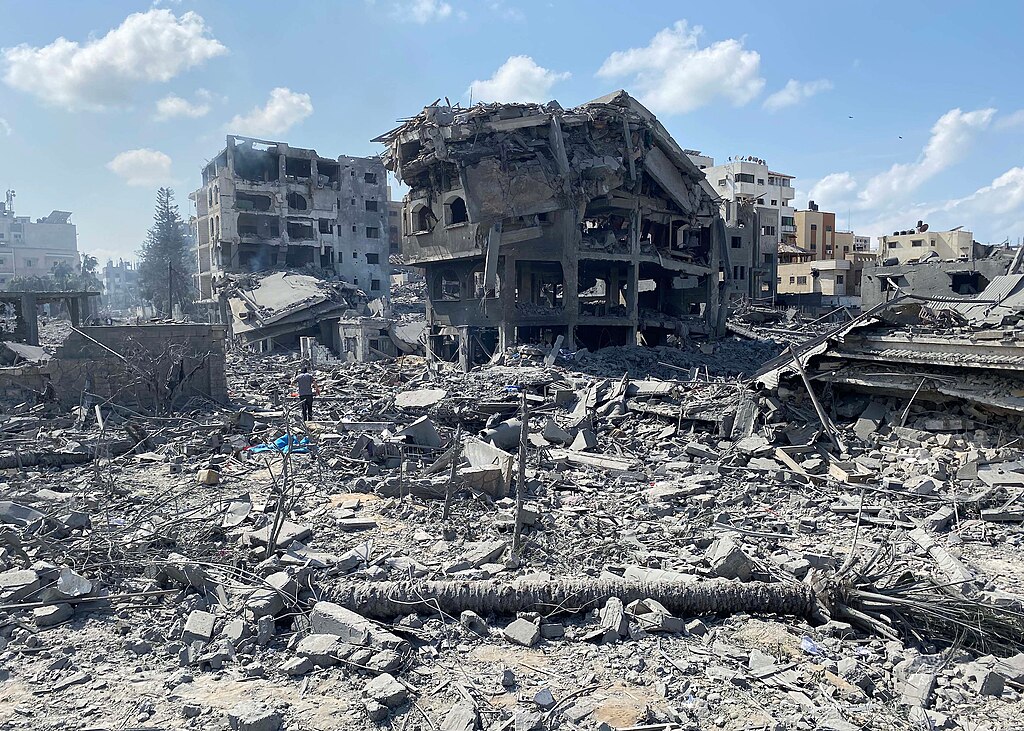
Palestinians inspect the damage following an Israeli airstrike on the El-Remal aera in Gaza City on October 9, 2023. Israel continued to battle Hamas fighters on October 10 and massed tens of thousands of troops and heavy armour around the Gaza Strip after vowing a massive blow over the Palestinian militants’ surprise attack. Photo by Naaman Omar apaimages. licensed under the Creative Commons Attribution-Share Alike 3.0 Unported license.
Deputy parliament speaker Nissim Vaturi also called for the destruction of Jenin, warning that it will soon be turned into Gaza
The deputy speaker of the Israeli parliament has called for the separation of children from their mothers and the killing of adults in Gaza.
During an interview with Kol BaRama radio, Nissim Vaturi called Palestinians “scoundrels” and “subhumans”, adding that this is a group of people that cannot be accepted.
“Who is innocent in Gaza? Civilians went out and slaughtered people in cold blood,” Vaturi said on Kol BaRama radio.
“They are outcasts and no one in the world wants them,” he said, adding that Israel needs to “separate the children and women and kill the adults in Gaza, we are being too considerate.
…
The deputy speaker, who belongs to Prime Minister Benjamin Netanyahu’s Likud party, also said that the occupied West Bank city of Jenin will soon turn into Gaza, saying that Palestinians released as part of the ceasefire deal should be put there “so that they can be eliminated later”.
“Erase Jenin. Don’t start looking for the terrorists – if there’s a terrorist in the house, take him down, tell the women and children to get out,” he added.
…
The violent rhetoric issued by top Israeli leaders like Vaturi has been used as evidence of Israel’s genocidal intent in its war on Gaza, which has killed more than 48,000 Palestinians and utterly devastated the enclave.
Lawyers for South Africa used their statements at the International Court of Justice in a case accusing Israel of waging genocide in Gaza. In a preliminary judgement, the world’s highest court said South Africa’s accusation was plausible.
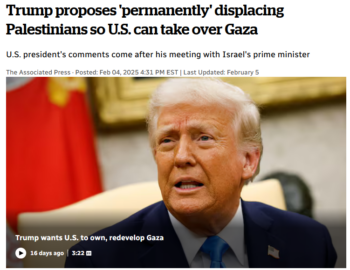
News outlets often preferred euphemisms like “displacing” or “resettling” to the more accurate “ethnic cleansing, as in this CBC headline (2/4/25).
Earlier this month, President Donald Trump said that the US will “take over the Gaza Strip” and “own” it for the “long-term” (AP, 2/5/25), and that its Palestinian inhabitants will be “permanently” exiled (AP, 2/4/25). Subsequently, when reporters asked Trump whether Palestinians would have the right to return to Gaza under his plan, he said “no” (BBC, 2/10/25).
After Trump’s remarks, United Nations Secretary-General Antonio Guterres (Reuters, 2/5/25) said “it is essential to avoid any form of ethnic cleansing.”
Navi Pillay (Politico, 2/9/25), chair of the UN Commission of Inquiry on the Occupied Palestinian Territory, said that
Trump is woefully ignorant of international law and the law of occupation. Forcible displacement of an occupied group is an international crime, and amounts to ethnic cleansing.
Human Rights Watch (2/5/25) said that, if Trump’s plan were implemented, it would “amount to an alarming escalation of forced displacement and ethnic cleansing of Palestinians in Gaza.”
Clarity in the minority
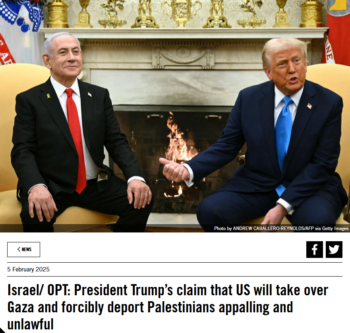
Amnesty International (2/5/25) called Trump’s proposal to forcibly transfer the population of Gaza a flagrant violation of international law”—but the phrase “international law” was usually missing from news reports on the plan.
I used the news media aggregator Factiva to survey coverage of Trump’s remarks from the day that he first made them, February 4 through February 12. In that period, the New York Times, Wall Street Journal and Washington Post combined to run 145 pieces with the words “Gaza” and “Trump.” Of these, 19 contained the term “ethnic cleansing” or a variation on the phrase. In other words, 87% of the articles these outlets published on Trump’s plan to ethnically cleanse Gaza chose not to call it ethnic cleansing.
A handful of other pieces used language that captures the wanton criminality of Trump’s scheme reasonably well. Three articles used “forced displacement,” or slight deviations from the word, while five others used “expel” and another nine used “expulsion.” Two of the articles said “forced transfer,” or a minor variation of that. In total, therefore, 38 of the 145 articles (26 percent) employ “ethnic cleansing” or the above-mentioned terms to communicate to readers that Trump wants to make Palestinians leave their homes so that the US can take Gaza from them.
Furthermore, the term “international law” appears in only 27 of the 145 articles, which means that 81% failed to point out to readers that what Trump is proposing is a “flagrant violation of international law” (Amnesty International, 2/5/25).
A ‘plan to free Palestinians’
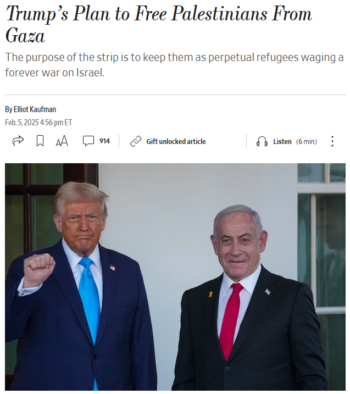
A Wall Street Journal op-ed (2/5/25) hailed “Trump’s Plan to Free Palestinians From Gaza”—in the same sense that the Trail of Tears “freed” the Cherokee from Georgia.
Several commentators in the corporate media endorsed Trump’s racist fever dream, in some cases through circumlocutions and others quite bluntly. Elliot Kaufman (Wall Street Journal, 2/5/25) called Trump’s imperial hallucination a “plan to free Palestinians from Gaza.”
While the Journal’s editorial board (2/5/25) called what Trump wants to do “preposterous,” the authors nonetheless put “ethnic cleansing” in scare quotes, as if that’s not an apt description. The paper asked, “Is his idea so much worse than the status quo that the rest of the world is offering?”
Sadanand Dhume (Wall StreetJournal, 2/12/25) wondered why “If Indians and Pakistanis Can Relocate, Why Can’t Gazans?” To bolster his case, Dhume noted that 2 million people died as a result of the India-Pakistan partition, and cited other shining moments in 20th century history, such as Uganda’s expulsion of Indians in the 1970s. That these authors implicitly or explicitly advocate Trump’s plan for mass, racist violence demonstrates that they see Palestinians as subhuman impediments to US/Israeli designs on Palestine and the region.
Bret Stephens (New York Times, 2/11/25) wrote that
Trump also warned Jordan and Egypt that he would cut off American aid if they refused to accept Gazan refugees, adding that those refugees may not have the right to return to Gaza. The president’s threats are long overdue.
Ethnically cleansing the West Bank
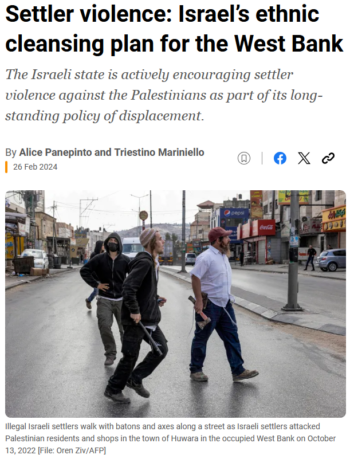
Al Jazeera (2/26/24): “Settler violence is a central part of the Israeli state’s policy and plan to ethnically cleanse the occupied Palestinian territory.”
A similar pattern exists in coverage of the West Bank, where evidence of ethnic cleansing is hard to miss, but corporate media appears to be finding ways to do just that.
Legal scholars Alice Panepinto and Triestino Mariniello wrote an article for Al Jazeera (2/26/24) headlined “Settler Violence: Israel’s Ethnic Cleansing Plan for the West Bank”:
Supported by the Israeli security forces and aided and abetted by the government, settler violence is a central part of the Israeli state’s policy and plan to ethnically cleanse the occupied Palestinian territory in order to establish full sovereignty over it and enable settlement expansion.
The authors noted that, at the time they wrote their article, 16 Palesti nian communities in the West Bank had been forcibly transferred since October 7, 2023.
In October 2024, UN Special Rapporteur Francesca Albanese found that throughout the Gaza genocide, “Israeli forces and violent settlers” have “escalated patterns of ethnic cleansing and apartheid in the West Bank, including East Jerusalem.” In the first 12 months after October 7, Albanese reported, “at least 18 communities were depopulated under the threat of lethal force, effectively enabling the colonization of large tracts” of the West Bank.
Euro-Med Human Rights Monitor (2/10/25) said that Israel’s “latest ethnic cleansing efforts” entail “forcibly uproot[ing] thousands of Palestinians in the West Bank,” accompanied by
the bombing and burning of residential buildings and infrastructure, the cutting off of water, electricity and communications supplies, and a killing policy that has resulted in the deaths of 30 Palestinians…over the course of 19 days.
According to the United Nations Relief and Works Agency for Palestine Refugees in the Near East (UNRWA) (2/10/25), Israeli military operations in Jenin camp, which expanded to Tulkarm, Nur Shams and El Far’a, displaced 40,000 Palestinian refugees between January 21 and February 10.
Unnoteworthy violations
I used Factiva to search New York Times, Wall Street Journal and Washington Post coverage and found that, since Panepinto and Mariniello’s analysis was published just under a year ago, the three newspapers have combined to run 693 articles that mention the West Bank. Thirteen of these include some form of the term “ethnic cleansing,” a mere 2%. Nine more articles use “forced displacement,” or a variation on the phrase, 31 use “expel,” 11 use “expulsion” and five use some variety of “forced transfer.”
Thus, 69 of the 693 Times, Journal and Post articles that mention the West Bank use these terms to clearly describe people being violently driven from their homes—just 10%. Many of the articles that address the West Bank are also about Gaza, so the 69 articles using this language don’t necessarily apply it to the West Bank.
Of the 693 Times, Journal and Post pieces that refer to the West Bank, 106 include the term “international law.” Evidently, the authors and editors who worked on 85% of the papers’ articles that discuss the West Bank did not consider it noteworthy that Israel is engaged in egregious violations of international law in the territory.
‘Battling local militants’
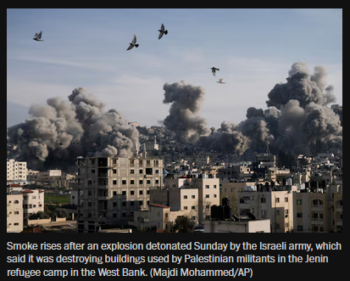
The Washington Post (2/2/25) captioned this image of IDF bombing with Israel’s claim that it was “destroying buildings used by Palestinian militants.”
Rather than equip readers to understand the larger picture in which events in the West Bank unfold, much of the coverage treats incidents in the territory discretely. For instance, the Wall Street Journal (1/22/25) published a report on Israel’s late January attacks on the West Bank. In the piece’s 18th paragraph, it cited the Palestinian Authority saying the Israeli operations “displaced families and destroyed civilian properties.” In the 24th paragraph, the article also quoted UNRWA director Roland Friedrich, saying that Jenin had become “nearly uninhabitable,” and that “some 2,000 families have been displaced from the area since mid-December.” Palestinians being driven from their homes are an afterthought for the article’s authors, who do nothing to put this forced displacement in the longer-term context of Israel’s US-backed ethnic cleansing.
A Washington Post report (2/2/25) on Jenin says in its first paragraph that the fighting is occurring “where [Israeli] troops have been battling local militants.” The article then describes Palestinian “homes turned to ash and rubble, cars destroyed and small fires still burning amid the debris.” It cited the Palestinian Health Ministry noting that “at least five people were killed in Israeli strikes in the Jenin area, including a 16-year-old.”
Establishing a “troops vs. militants” frame at the outset of the article suggested that that is the lens through which the death and destruction in Jenin should be understood, rather than one in which a racist colonial enterprise is seeking to ethnically cleanse the Indigenous population resisting the initiative.
The rights of ‘neighbors’
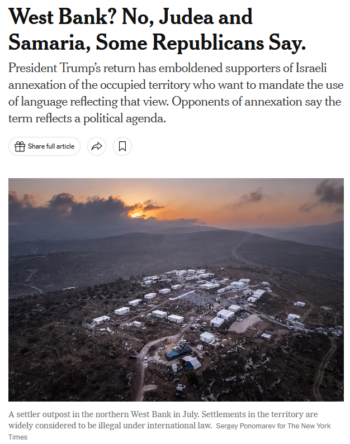
This New York Times piece (2/4/25) acknowledges that Israeli settlements have “steadily eroded the land accessible to Palestinians”—but doesn’t call this process ethnic cleansing.
The New York Times (2/4/25) published an article on Republican bills that would require US government documents to refer to the West Bank as “Judea and Samaria,” the name that expansionist Zionists prefer. The report discusses how Trump’s return to office “has emboldened supporters of Israeli annexation of the occupied territory.”
The piece notes that hundreds of thousands of Israelis have “settled” the West Bank since Israel occupied it in 1967, and that Palestinians living there have fewer rights than their Israeli “neighbors.” The author points out that “the growing number and size of the settlements have steadily eroded the land accessible to Palestinians.”
Yet the article somehow fails to mention a crucial part of this dynamic, namely Israel violently displacing Palestinians from their West Bank homes. Leaving out that vital information fails means that readers are not a comprehensive account of the ethnic cleansing backdrop against which the Republican bills are playing out.
Recent coverage of Gaza and the West Bank illustrates that, while corporate media occasionally outright call for expelling Palestinians from their land, more often the way these outlets support ethnic cleansing is by declining to call it ethnic cleansing.
FAIR’s work is sustained by our generous contributors, who allow us to remain independent. Donate today to be a part of this important mission.
Elon Musk urges you to be a Fascist like him, says that you can ignore facts and reality then.Neo-Fascist Climate Science Denier Donald Trump says Burn, Baby, Burn.
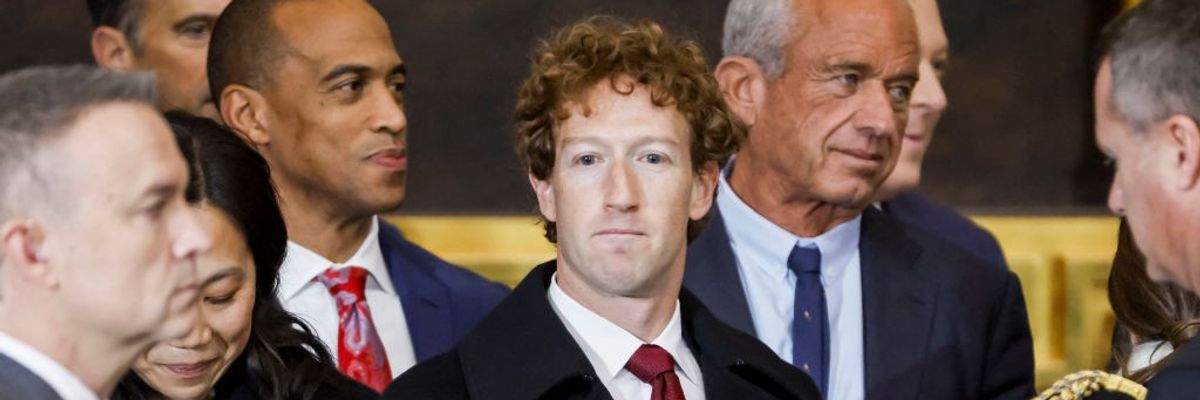
Mark Zuckerberg (C), CEO of Meta, attends the inauguration ceremony where Donald Trump was sworn in as the 47th U.S. President in the U.S. Capitol Rotunda in Washington, D.C., on January 20, 2025. (Photo: Shawn Thew / POOL / AFP)
“Rather than learning from its reckless contributions to mass violence in countries including Myanmar and Ethiopia, Meta is instead stripping away important protections that were aimed at preventing any recurrence of such harms.”
An expert on technology and human rights and a survivor of the Rohingya genocide warned Monday that new policies adopted by social-media giant Meta, which owns Facebook and Instagram, could incite genocidal violence in the future.
On January 7, Meta CEO Mark Zuckerberg announced changes to Meta policies that were widely interpreted as a bid to gain approval from the incoming Trump administration. These included the replacement of fact-checkers with a community notes system, relocating content moderators from California to Texas, and lifting bans on the criticisms of certain groups such as immigrants, women, and transgender individuals.
Zuckerberg touted the changes as an anti-censorship campaign, saying the company was trying to “get back to our roots around free expression” and arguing that “the recent elections also feel like a cultural tipping point toward, once again, prioritizing speech.”
“With Zuckerberg and other tech CEOs lining up (literally, in the case of the recent inauguration) behind the new administration’s wide-ranging attacks on human rights, Meta shareholders need to step up and hold the company’s leadership to account to prevent Meta from yet again becoming a conduit for mass violence, or even genocide.”
However, Pat de Brún, head of Big Tech Accountability at Amnesty International, and Maung Sawyeddollah, the founder and executive director of the Rohingya Students’ Network who himself fled violence from the Myanmar military in 2017, said the change in policies would make it even more likely that Facebook or Instagram posts would inflame violence against marginalized communities around the world. While Zuckerberg’s announcement initially only applied to the U.S., the company has suggested it could make similar changes internationally as well.
“Rather than learning from its reckless contributions to mass violence in countries including Myanmar and Ethiopia, Meta is instead stripping away important protections that were aimed at preventing any recurrence of such harms,” de Brún and Sawyeddollah wrote on the Amnesty International website. “In enacting these changes, Meta has effectively declared an open season for hate and harassment targeting its most vulnerable and at-risk people, including trans people, migrants, and refugees.”
Past research has shown that Facebook’s algorithms can promote hateful, false, or racially provocative content in an attempt to increase the amount of time users spend on the site and therefore the company’s profits, sometimes with devastating consequences.
One example is what happened to the Rohingya, as de Brún and Sawyeddollah explained:
We have seen the horrific consequences of Meta’s recklessness before. In 2017, Myanmar security forces undertook a brutal campaign of ethnic cleansing against Rohingya Muslims. A United Nations Independent Fact-Finding Commission concluded in 2018 that Myanmar had committed genocide. In the years leading up to these attacks, Facebook had become an echo chamber of virulent anti-Rohingya hatred. The mass dissemination of dehumanizing anti-Rohingya content poured fuel on the fire of long-standing discrimination and helped to create an enabling environment for mass violence. In the absence of appropriate safeguards, Facebook’s toxic algorithms intensified a storm of hatred against the Rohingya, which contributed to these atrocities. According to a report by the United Nations, Facebook was instrumental in the radicalization of local populations and the incitement of violence against the Rohingya.
In late January, Sawyeddollah—with the support of Amnesty International, the Open Society Justice Initiative, and Victim Advocates International—filed a whistleblower’s complaint against Meta with the Securities and Exchange Commission (SEC) concerning Facebook’s role in the Rohingya genocide.
The complaint argued that the company, then registered as Facebook, had known or at least “recklessly disregarded” since 2013 that its algorithm was encouraging the spread of anti-Rohingya hate speech and that its content moderation policies were not sufficient to address the issue. Despite this, it misrepresented the situation to both the SEC and investors in multiple filings.
Now, Sawyeddollah and de Brún are concerned that history could repeat itself unless shareholders and lawmakers take action to counter the power of the tech companies.
“With Zuckerberg and other tech CEOs lining up (literally, in the case of the recent inauguration) behind the new administration’s wide-ranging attacks on human rights, Meta shareholders need to step up and hold the company’s leadership to account to prevent Meta from yet again becoming a conduit for mass violence, or even genocide,” they wrote. “Similarly, legislators and lawmakers in the U.S. must ensure that the SEC retains its neutrality, properly investigate legitimate complaints—such as the one we recently filed, and ensure those who abuse human rights face justice.”
The human rights experts aren’t the only ones concerned about Meta’s new direction. Even employees are sounding the alarm.
“I really think this is a precursor for genocide,” one former employee told Platformer when the new policies were first announced. “We’ve seen it happen. Real people’s lives are actually going to be endangered. I’m just devastated.”
Climate Science Denier Donald Trump says Burn, Baby, Burn.Elon Musk urges you to be a Fascist like him, says that you can ignore facts and reality then.
The illegal Israeli settlement of Efrat is seen in this March 30, 2024 photo. (Photo: Wisam Hashlamoun/Anadolu via Getty Images)
“The Netanyahu government is operating on steroids to establish facts on the ground that will destroy the chance for peace and compromise,” said one group.
Israeli authorities are planning to expand a Jewish-only settlement in the West Bank by nearly 1,000 homes, a Tel Aviv-based peace group said Sunday as Israeli soldiers and settlers escalated attacks on Palestinians in the illegally occupied territory.
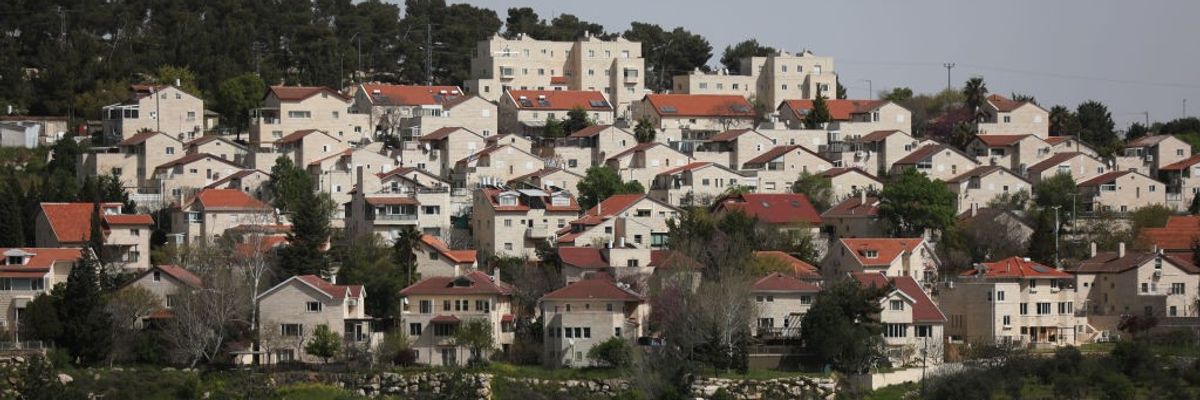
Peace Now said Israel’s Civil Administration has issued a new tender for the construction of 974 new housing units in Efrat, a Jewish-only colony located about 7.5 miles south of Jerusalem between Bethlehem and Hebron. The planned expansion will increase Efrat’s population of approximately 11,800 residents by 40% and geographically isolate Palestinian communities in the southern West Bank.
Emboldened by U.S. President Donald Trump’s return to power, far-right members of Israeli Prime Minister Benjamin Netanyahu’s Cabinet have vowed to annex the West Bank, which Israel has occupied since 1967 in violation of international law.
On Sunday, Israeli Finance Minister Bezalel Smotrich said that “the goal for 2025 is to demolish more than the Palestinians build in the West Bank,” according to Al Jazeera. This, following the largest Israeli seizure of Palestinian land in the West Bank in decades last year.
“The Netanyahu government is operating on steroids to establish facts on the ground that will destroy the chance for peace and compromise,” said Peace Now, referring to the longtime Israeli practice of violating international law by colonizing and annexing Palestinian land to establish what one legal scholar has described as “de facto possession with the aim of attaining de jure possession.”
Peace Now continued: “It is now clear that military action alone will not bring a solution to the conflict or security to Israel, and that ultimately we will have to reach an agreement with the Palestinians. The Netanyahu government is harming Israeli interests and torpedoing the only solution that can bring us security and peace.”
In the United States, the Council on American-Islamic Relations said in a statement Monday that “the ongoing de facto annexation of the illegally occupied West Bank through the expansion of racially segregated illegal settlements is just one aspect of the far-right Israeli government’s ethnic cleansing of the entirety of historic Palestine and of its relentless efforts to block justice for the Palestinian people.”
Aviv Tatarsky, a researcher at the Israel-based peace group Ir Amim, told Al Jazeera that “since the start of 2025, Israeli authorities have demolished 27 structures in East Jerusalem, including 18 residential units, in what appears to be a systematic effort to remove Palestinians from their homes while simultaneously expanding Israeli settlements.”
The Israeli settlement population has increased exponentially from around 1,500 colonists in 1970 to roughly 140,000 at the time of the Oslo Accords in 1993—under which Israel agreed to halt new settlement activity—to more than 500,000 today. Last July, the International Court of Justice, which is also weighing a genocide case concerning Israel’s annihilation of the Gaza Strip, said that the Israeli occupation of the West Bank, East Jerusalem, and Gaza is an illegal form of apartheid that must end “as rapidly as possible.”
News of the Efrat expansion came as Israeli soldiers and settlers escalated attacks on Palestinians across the West Bank over the weekend. Occupation forces carried out raids in the towns of al-Issawiya and Salfit, near East Jerusalem, as well as the village of Nabi Saleh near Ramallah. Israeli troops also continued their siege and assault on Jenin and the Nur Shams refugee camp, where two young women, one of them pregnant, were shot dead last week.
Armed Israeli settlers from the Mikne Avraham colony also invaded al-Minya, south of Bethlehem, wounding 16 Palestinians including a pregnant woman who was attacked with clubs and rocks, according toMiddle East Eye. The Israeli newspaper Haaretzreported Saturday that settlers sicced dogs on al-Minya residents, wounding two people.
According to the United Nations Office for the Coordination of Humanitarian Affairs, Israeli soldiers and settlers have killed 876 Palestinians in the West Bank and East Jerusalem since the October 7, 2023 Hamas-led attack on Israel.
Since launching “Operation Iron Wall” on January 21, Israeli forces have killed at least 53 Palestinians across the West Bank. The Israeli offensive has forced around 40,000 people from their homes in what experts say is the largest displacement in the West Bank since more than 200,000 Palestinians were expelled during the 1967 conquest and occupation.
This work by Middle East Monitor is licensed under a Creative Commons Attribution-NonCommercial-ShareAlike 4.0 International License. I
Minister of Justice and Correctional Services of South Africa Ronald Lamola answers the questions of press members related to the public hearings of South Africa’s genocide case against Israel at the International Court of Justice (ICJ) in The Hague, Netherlands on January 11, 2024 [Dursun Aydemir – Anadolu Agency]
South Africa has vowed not to withdraw its genocide case against Israel at the International Court of Justice (ICJ), despite the Trump administration’s threats and aid cut.
There is “no chance” South Africa could withdraw the case it filed in December 2023, Foreign Minister Ronald Lamola told the Financial Times.
“Standing by our principles sometimes has consequences, but we remain firm that this is important for the world, and the rule of law,” he added.
South Africa was the first nation to drag Israel to the ICJ over its genocidal war on Gaza that has claimed more than 48,000 lives and reduced the enclave to rubble. A ceasefire that took hold on 19 January is currently in place.
Last week, US President Donald Trump signed an executive order halting financial aid to South Africa in retaliation for a new land appropriation law it claims seizes property from the country’s White minority, as well as the ICJ case against Israel.
The US also alleges that South Africa is working with Iran to “develop commercial, military and nuclear arrangements.”
“The United States cannot support the government of South Africa’s commission of rights violations in its country or its ‘undermining United States foreign policy, which poses national security threats to our Nation, our allies, our African partners, and our interests,” the order read.
“While we do have a good relationship with Iran, we don’t have any nuclear programmes with them, nor any trade to speak of,” Lamola said.
South African President Cyril Ramaphosa recently signed the expropriation bill into law, which will allow the state to expropriate land without compensation if it is “just, equitable and in the public interest.”
The government says the law aims to address apartheid’s past injustices, and that Trump’s accusations are lies, distortions and misinformation.
According to Ramaphosa, the country was only receiving HIV/AIDS prevention funding from the US.
After South Africa instituted proceedings against Israel alleging violations of the 1948 Genocide Convention in the Gaza Strip, several countries joined the case including Nicaragua, Colombia, Cuba, Libya, Mexico, Spain, Belize and Turkiye.
The International Criminal Court has separately issued arrest warrants for Israeli Prime Minister Benjamin Netanyahu and his former Defence Minister Yoav Gallant for war crimes and crimes against humanity in Gaza. Trump has also sanctioned the ICC for investing Israeli officials.
This work by Middle East Monitor is licensed under a Creative Commons Attribution-NonCommercial-ShareAlike 4.0 International License. I
Elon Musk urges you to be a Fascist like him, says that you can ignore facts and reality then.Climate Science Denier Donald Trump says Burn, Baby, Burn.