Make Smog Great Again: Trump puts pollution profits over people

Spread the love

Original article by Rob Warzyniak republished from People’s World under https://creativecommons.org/licenses/by-nc-nd/3.0/us/
Make Smog Great Again: Trump puts pollution profits over people

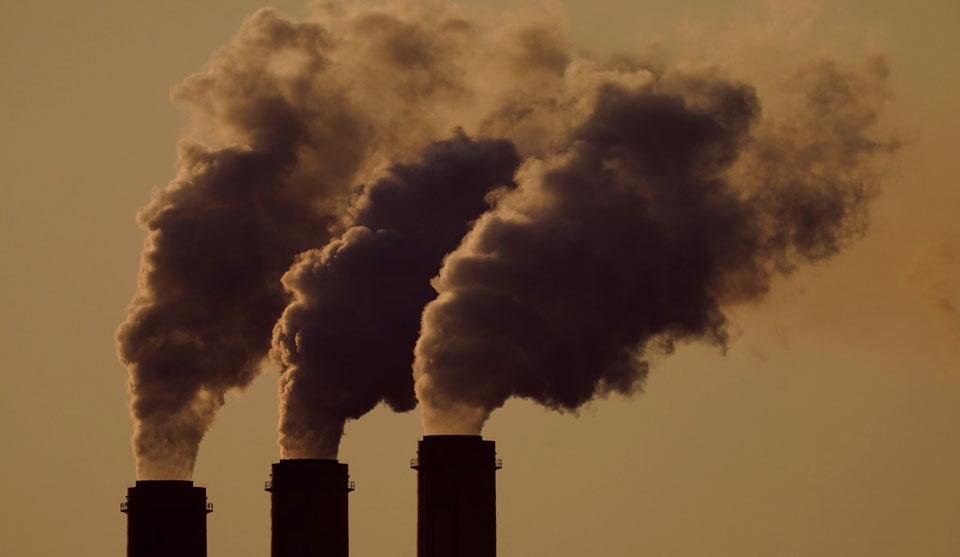
Charlie Riedel/AP

In 1976, the film Network premiered, featuring one of the most iconic scenes in film history. Howard Beale, played by Peter Finch, unleashes a rant that would be right at home in the present day: 

“We know things are bad—worse than bad. They’re crazy. It’s like everything everywhere is going crazy, so we don’t go out anymore. We sit in the house, and slowly the world we are living in is getting smaller, and all we say is, ‘Please, at least leave us alone in our living rooms.’” 

He was right, then and now. And while Beale was raving against the media’s pursuit of sensationalism over journalistic integrity, we see the same thing happening today. Things are indeed bad, to put it mildly, and we do not have the luxury of hiding away in our living rooms. 

In early January of this year, a New York Times headline read, “The EPA will stop considering lives saved when setting pollution limits and instead calculate only the cost to businesses.” The EPA (Environmental Protection Agency) is openly letting the American people know that it does not care about us. Dead people are just the cost of doing business, and boy, business is booming.

In yet another glaring example of the business owners and the ruling class placing profits over people, the EPA under the current Republican administration is shifting its policy from environmental protection to the economic costs of regulations. The EPA will no longer track the health impacts of air pollution or quantify the financial impacts of health improvements; instead, it will focus on the financial impact of regulations on businesses. The return of the days when smog was a staple in large metro areas is looking to make a comeback, and it’s only a matter of time before the Cuyahoga River catches fire again. 

The shift at the EPA is at odds with the Make America Healthy Again movement, but then again, so is nearly everything else in this administration. While the MAHA movement continues to wage a war against vaccines, thereby ensuring a victory for preventable diseases, the American people will soon be dealing with a rise in air pollution. Clean air and water, once considered a human right, are an impediment to big business shareholders, and the Trump administration sided with big business. 

At the same time, the EPA under the Trump administration revoked all scientific findings that greenhouse gases endanger public health. This revocation comes on the heels of the past three years being the hottest years on record. While states and cities grapple with the escalating costs of dealing with extreme weather, the federal government has not only effectively abandoned them but also removed years of climate research and findings.

President Donald Trump departs with Environmental Protection Agency director Lee Zeldin and Office of Management and Budget director Russell Vought, right after announcing the EPA will no longer regulate greenhouse gases, in the Roosevelt Room of the White House, Thursday, Feb. 12, 2026, in Washington.| Evan Vucci/AP

“President Trump will be taking the most significant deregulatory actions in history to further unleash American energy dominance and drive down costs,” said White House spokesperson Karoline Leavitt. Lower costs are not only a plus, but they will also be necessary, as we will need more money to offset the rising healthcare costs associated with polluted air. 

Michelle Roos, executive director of the Environmental Protection Network, a group of former EPA employees, said, “Communities across the country will bear the brunt of this decision–through dirtier air, higher health costs, and increased climate harm. The Trump EPA is surrendering its responsibility, turning its back on families and communities already facing the highest pollution and health risks, and dismantling decades of science and progress.” 

It comes as no surprise, then, that Big Oil spent almost half a billion dollars on the last election. Oil company CEOs and shareholders need allies in powerful places, and it doesn’t get any higher than Congress and the President. And no one spends that much money without expecting large dividends. 

A panel of the National Academies of Sciences, Engineering, and Medicine (NASEM) recently released a statement reading, in part, “The evidence for current and future harm to human health and welfare created by human-caused greenhouse gases is beyond scientific dispute.” The current argument against this is “nuh uh,” often used by the dumbest people you went to high school with, making it very difficult to know who to believe. 

The most recent National Climate Assessment, released in 2023, reported that temperatures in the contiguous U.S. have increased by 1.4 °C since 1970. The frequency of annual heat waves has tripled since the 1960s, while storms are producing heavier rainfall, and wildfires have become more severe. Since the Earth is on track to reach 2-3 °C, we are rapidly approaching the point of no return, where climate scientists say that no matter what we do to mitigate climate change, it will be too little, too late. 

Recent scientific findings point to tipping points that, in turn, lead to feedback loops. The destruction of the Amazon rainforest releases carbon into the air that would otherwise not have been released, thereby amplifying global warming. Capitalists are actively killing the planet in the name of profit, and since money is all they care about, there is no incentive for them to stop. It also doesn’t help that most of them are sociopaths. And because there is a lack of class consciousness in the U.S., this Steinbeck quote is all the more relevant: “I guess the trouble was that we didn’t have any self-admitted proletarians. Everyone was a temporarily embarrassed capitalist.”

The ruling class loves to place the blame on the working class, insisting that we carpool and recycle our cardboard boxes and plastic bottles. And while we should do these things, that alone will not solve our problem, and it ignores the fact that over 70% of emissions come from 100 corporations. They want us to carpool so they don’t have to pay for public transportation, and they want us to recycle our cardboard so we feel like we’re saving the planet from the comfort of our living room. We do not have that luxury, which means Howard Beale was right.

As with all news-analysis and op-ed articles published by People’s World, the views reflected here are those of the author.

We hope you appreciated this article. At People’s World, we believe news and information should be free and accessible to all, but we need your help. Our journalism is free of corporate influence and paywalls because we are totally reader-supported. Only you, our readers and supporters, make this possible. If you enjoy reading People’s World and the stories we bring you, please support our work by donating or becoming a monthly sustainer today. Thank you!

Original article by Rob Warzyniak republished from People’s World under https://creativecommons.org/licenses/by-nc-nd/3.0/us/

Donald Trump urges you to be a Climate Science denier like him. He says that he makes millions and millions for destroying the planet, Burn, Baby, Burn and Flood, Baby, Flood.
Nigel Farage urges you to ignore facts and reality and be a climate science denier like him and his Deputy Richard Tice. He says that Reform UK has received £Millions and £Millions from the fossil fuel industry to promote climate denial and destroy the planet.
Elon Musk urges you to be a Fascist like him, says that you can ignore facts and reality then.
Continue ReadingMake Smog Great Again: Trump puts pollution profits over people

Two-thirds of global warming since 1990 caused by world’s ‘wealthiest 10%’

Spread the love

Original article by Ayesha Tandon republished from Carbon Brief under a CC license

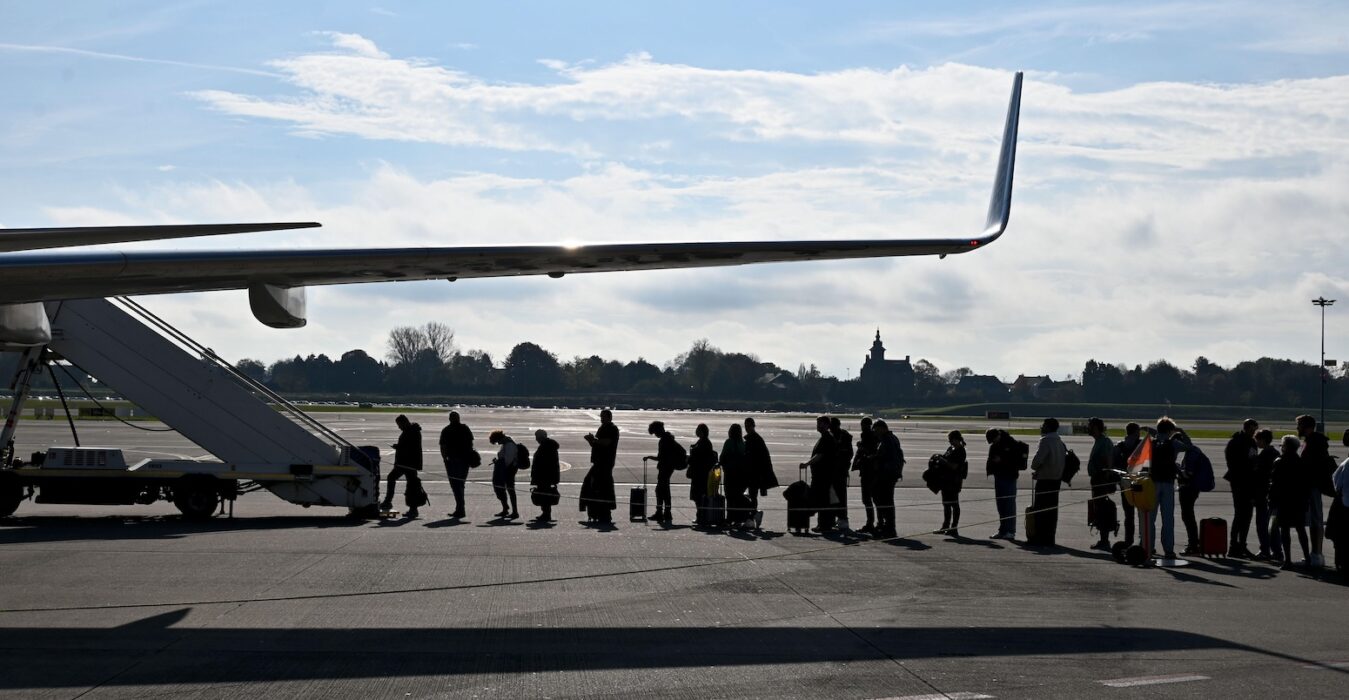
People waiting to get on a plane on the runway. Credit: SJBright / Alamy Stock Photo.

The “wealthiest 10%” of people on the planet are “responsible” for 65% of the 0.61C increase in global average temperatures over 1990-2020, according to new research.

The study, published in Nature Climate Change, uses a field of climate science called “attribution” to determine the contribution of the world’s “wealthiest population groups” to climate change through the greenhouse gases they emit.

The authors also calculate the contribution of these high-income groups to the increasing frequency of heatwaves and droughts.

For example, the study finds the wealthiest 10% of people – defined as those who earn at least €42,980 (£36,605) per year – contributed seven times more to the rise in monthly heat extremes around the world than the global average.  

In another finding, the Amazon rainforest faced a threefold increase in the likelihood of droughts over the period studied, most of which was driven by the wealthiest 10% of the world’s population. 

The authors also explore country-level emissions, finding that the wealthiest 10% in the US produced the emissions that caused a doubling in heat extremes across “vulnerable regions” globally. 

One scientist not involved in the study tells Carbon Brief that efforts to attribute global warming to individual income groups is an “important step towards targeted policies” and could support climate litigation

Emissions inequality

Humans emit more than 40bn tonnes of CO2 into the atmosphere every year. Developed countries are responsible for the majority of global emissions, as a result of the typically more carbon-intensive lifestyles of their residents. 

Meanwhile, the most severe impacts of climate change are disproportionately felt by the poorest and most vulnerable people.

The new study uses an income and wealth inequality dataset from the World Inequality Database to track inequality over 1990-2019, showing how much the world’s wealthiest 10%, 1% and 0.1% of society have contributed to warming over 1990-2020. (For details on the method, see the modelling inequalities section below.)

The world’s wealthiest 10% all earn more than €42,980 (£36,605) per year, according to the database. Meanwhile, the world’s wealthiest 0.1% earn more than €537,770 (£458,011) per year.

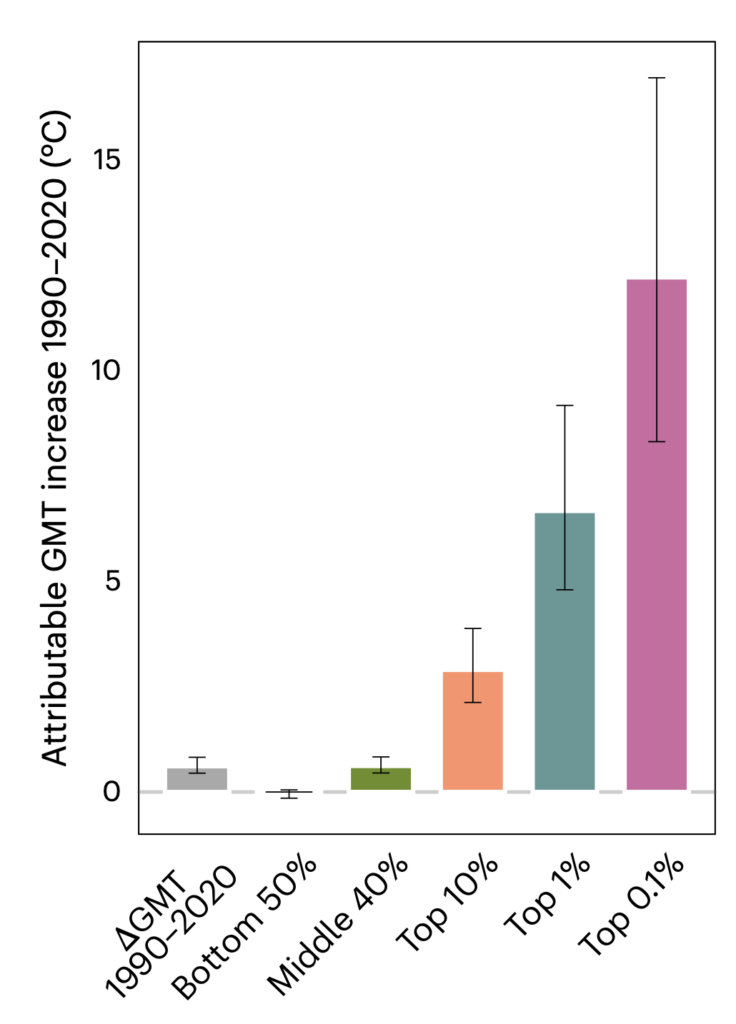
Of the 0.61C increase in global average temperatures over 1990-2020, the authors estimate that 65% was due to the emissions of the wealthiest 10% of people on the planet. For the wealthiest 0.1%, the estimate is 8%.

The graph below shows how much global temperatures would have risen over 1990-2020 if everyone in the world emitted as much as the world’s poorest 50% (purple), middle 40% (green), richest 10% (orange), richest 1% (blue) and richest 0.1% (pink) people. The grey bar shows how much global temperatures actually rose. 

How global temperatures would have risen if everyone in the world emitted the world produced the same amount of emissions, on average, as individuals in the bottom 50% (purple), middle 40% (green), top 10% (orange), top 1% (blue) and top 0.1% (pink) of the world’s emitters.

How global temperatures would have risen if everyone in the world emitted the world produced the same amount of emissions, on average, as individuals in the bottom 50% (purple), middle 40% (green), top 10% (orange), top 1% (blue) and top 0.1% (pink) of the world’s emitters. Source: Schöngart et al (2025).

The authors find that if the whole world had emitted as much as the wealthiest 10% of people over 1990-2020, global average temperatures would have risen by 2.9C, instead of 0.61C. If the global population had emissions as large as the wealthiest 0.1%, temperatures would have risen by 12.2C.

Meanwhile, the study calculates that if the whole world had emissions as low as the poorest 50%, global temperatures would have remained close to 1990 levels.

Hot and dry extremes

As greenhouse gas emissions cause the climate to warm, extreme weather events such as heatwaves and droughts are becoming more intense, frequent and long-lasting. 

The authors use attribution – a field of climate science that aims to identify the “fingerprint” of global warming on these events – to determine the contribution of the emissions of the world’s wealthiest people to the increasing frequency of heatwaves and droughts.

The authors assess “extremely hot” and “extremely dry” months, defined as the most extreme 1% of months in a pre-industrial climate during the hottest month of the year regionally. (In a pre-industrial climate, only one of each extreme would be expected every 100 years on average.)

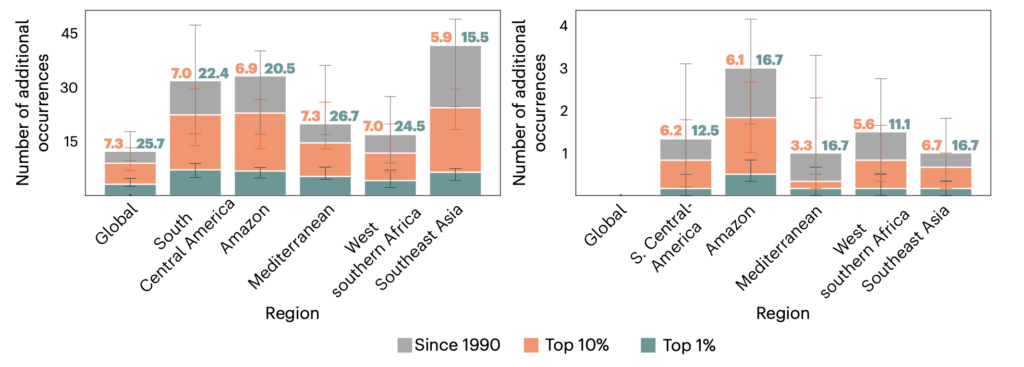
The graphs below show the number of additional heatwaves (left) and droughts (right) that have occurred since 1990 due to climate change in different regions of the world. 

The full bar shows the total number of additional heatwaves due to human-cased climate change in each region. The green bar shows additional occurrences due to the wealthiest 1%. The green and orange bars combined show the wealthiest 10%.

The numbers in green and orange show how much the wealthiest 1% and 10% of the planet contributed to the extreme, compared to the global average. (For example, an orange number of 7.0 means that the wealthiest 10% of people contributed seven times more to the extreme event than the global average.)

The number of additional heatwaves (left) and droughts (right) that have occurred since 1990 in different regions of the world, caused by the wealthiest 10% (orange) and 1% (green) of the world’s population.
The number of additional heatwaves (left) and droughts (right) that have occurred since 1990 in different regions of the world, caused by the wealthiest 10% (orange) and 1% (green) of the world’s population. The numbers in green and orange show how much more the wealthiest 1% and 10% of the planet contributed to the extreme, compared to the global average. Source: Schöngart et al (2025).

The study finds that an average of 11.5 additional heat events observed in August – the month where the rise in heat extremes is, on average, most pronounced – are attributable to the wealthiest 10%.

It also calculates that emissions from this group resulted in, on average, an additional 2.3 droughts in the Amazon in October – the month with the strongest attributable drying trend in the region. 

Highest emitters

The authors also assess the contributions of the wealthiest people to climate extremes on a country level, identifying the US, the EU, China and India as the world’s four highest emitting regions. 

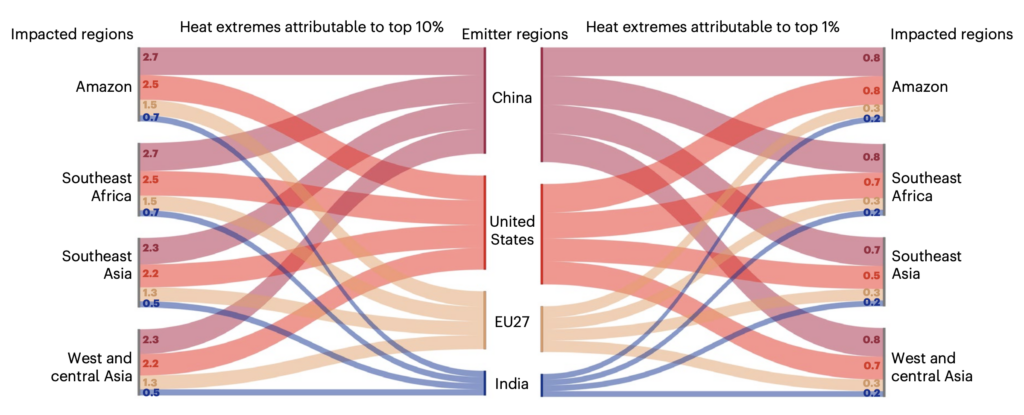
The graphic below shows the increase in frequency of one-in-100 year peak summer heat extremes in selected regions attributable to the wealthiest 10% of people (left) and 1% of people (right) in China (red), the US (pink), the EU (peach) and India (blue). 

The increase in frequency of one-in-100 year peak summer heat extremes in selected regions.
The increase in frequency of one-in-100 year peak summer heat extremes in selected regions that is attributable to the wealthiest 10% of people (left) and 1% of people (right) in China (red), the US (pink), the EU (peach) and India (blue). Source: Schöngart et al (2025).

Emissions from the wealthiest 10% in the US resulted in an average of 1.3 extra heat events globally, the authors find. However, this increase is distributed unevenly across the globe. 

For example, the authors find this income group was responsible for the emissions that contributed to 2.7 additional heat events in “heat-affected areas” such as the Amazon and south-east Africa.

Emissions from the wealthiest 10% of people in the EU resulted in an additional 1.5 heatwaves in both the Amazon and south-east Africa.

Meanwhile, the Amazon faces 2.1 more heat extremes in 2020 than in 1990 due to the emissions of the richest 1% in the US, China, EU and India. 

While inequalities between one country or region and another are well documented, it should also be noted that “inequalities within developing countries are increasing”, Dr Carl Schleussner, study author and leader of the integrated climate impacts research group at the International Institute for Applied Systems Analysis (IIASA), tells Carbon Brief.

For example, he notes that the paper shows “very high levels” of emissions from “the Chinese middle and upper classes”.

However, he says that many existing global frameworks to address climate change “treat countries as a whole” and fail to “differentiate” between income groups within countries. 

Schleussner argues that the study highlights the need for “progressive policies” for climate action, which involve “tackling particularly high emitters” in all countries. 

Dr Sarah Schöngart, a researcher at ETH Zurich and lead author of the study, tells Carbon Brief that studies such as this could provide important evidence in loss and damage litigation.

Prof Jakob Zscheischler, an Earth system scientist at the Helmholtz Centre for Environmental Research who was not involved in the study, also highlights the ways the findings could be used in climate-change lawsuits. He tells Carbon Brief:

“Quantifying the contribution of individual income groups to global warming and changes in climate extremes is an important step towards targeted policies and further supports climate litigation. Supporting climate injustice with concrete numbers will hopefully help the most vulnerable and least responsible strengthen their case.”

Modelling inequalities

The study uses a range of methods to attribute changes in heat and drought to the emissions of particular wealth groups. To model global greenhouse gas emissions by wealth group, the paper uses a “wealth-based carbon inequality assessment” from a 2022 study.

(See Carbon Brief’s coverage of the 2022 study.)

The study uses income and wealth inequality dataset from the World Inequality Database to track inequality over 1990-2019. It combines economic data with information on per-capita carbon footprints – calculated using “input-output” methodologies combined with data from the “distributional national accounts” project.”

The model considers three factors. The first is private consumption – made up of emissions from the direct use of fossil fuels and emissions embedded into goods and services. The second includes emissions from government spending in that person’s country – such as government administration, public roads or defence. The final component of a person’s carbon footprint is from their investments.

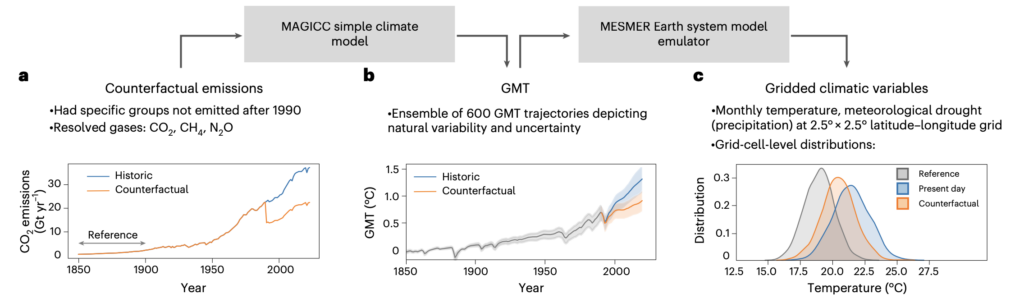
The authors then created a series of “counterfactual” emissions pathways, which imagine the world without the emissions of the wealthiest 10%, 1% and 0.1% of society, respectively. The emissions pathways include CO2, methane and nitrous oxide emissions, expressed as CO2-equivalent. 

Lead author Schöngart tells Carbon Brief that including methane in the models is important, because it has “really high potency and near-term warming”. However, she notes that the team needed to make some assumptions about methane emissions – for example, assuming that each income group emits the same relative amount of methane compared to other greenhouse gas emissions. 

Using a “simple” climate model called MAGICC, the authors model global average temperatures under these counterfactual emissions pathways. This allows them to calculate how much the planet would have warmed over 1990-2020 without the emissions of the 10%, 1% and 0.1% of society, respectively.

The authors use the global average temperature trends to produce temperature and rainfall data for every land-based grid square on Earth via a climate model emulator called MESMER.

Schöngart tells Carbon Brief that an emulator is “an approximation of an Earth system model” which “allows us to generate incredible amounts of data”, while using less computing power and taking less time to run. 

The study authors then use attribution methods to identify how the emissions from the world’s wealthiest members of society have affected the frequency of heatwaves and droughts, by comparing the world as it is to a “counterfactual” world without human-caused climate change.

The graphic below shows these steps. 

Study method.
Study method. Source: Schöngart et al (2025).

Earth system scientist Zscheischler praises the methods in the study. He tells Carbon Brief that “the main innovation of work lies in its novel combination of relatively simple emulators that capture the most important relationships between emissions and global warming and changes in extremes”.

He adds that emulators have been evaluated in other studies and are “trustworthy for this type of delicate analysis”. 

Prof Wim Thiery – an associate professor at Vrije Universiteit Brussel, who was not involved in the study – also commends the use of emulators. He tells Carbon Brief that “producing the information presented in this study with a suite of full-blown Earth system models is impossible from a computational cost and human effort perspective”. 

Original article by Ayesha Tandon republished from Carbon Brief under a CC license

Continue ReadingTwo-thirds of global warming since 1990 caused by world’s ‘wealthiest 10%’

‘Grim News for the Planet’ as Arctic Sea Ice Hits Record Low

Spread the love

Original article by Julia Conley republished from Common Dreams under Creative Commons (CC BY-NC-ND 3.0).

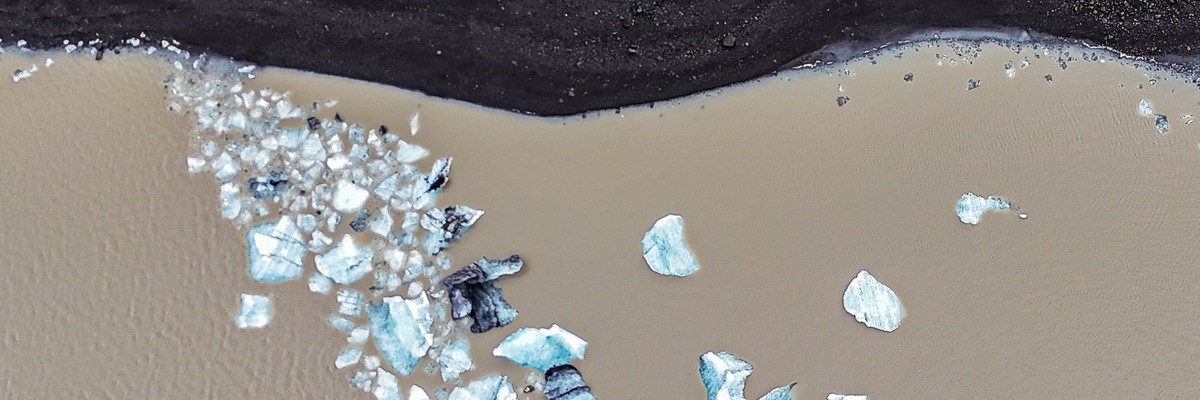
An aerial view shows the Vatnajokull glaciers in Iceland are melting into the ocean or forming lagoons due to global warming and climate change on February 23, 2025. (Photo: Evrim Aydin/Anadolu via Getty Images)

“The environment does not care about politics. Keep spewing greenhouse gases and face the consequences.”

European Union officials said the Copernicus Climate Change Service had issued its latest “stark reminder of why climate action is urgent” when the bloc’s program announced that it observed less sea ice covering the Earth’s oceans last month than at any other point in recorded history.

In the Arctic, sea ice reached its lowest monthly extent on record, at 8% below average, in early February, and it remained below the previous record for the rest of the month.

The oceans were missing an area of ice roughly the size of the United Kingdom last month, according to Copernicus (C3S), and the finding was not an anomaly in recent sea ice observations.

February marked the third consecutive month in which record low sea ice levels for the corresponding month were observed in the Arctic.

C3S reported that in the Antarctic, sea ice levels have rapidly declined in 2025 after appearing to recover to near-record levels in December 2024.

Last month, sea ice near the South Pole reached its fourth-lowest monthly extent, at 26% below average.

C3S said the daily sea ice extent in the Antarctic may have also reached its annual minimum toward the end of the month, which will be confirmed later in March; if confirmed, it would be the second-lowest annual minimum in the satellite record.

“February 2025 continues the streak of record or near-record temperatures observed throughout the last two years,” said Samanatha Burgess, strategic lead for climate at the European Center for Medium-Range Weather Forecasts. “One of the consequences of a warmer world is melting sea ice, and the record or near-record low sea ice cover at both poles has pushed global sea ice cover to an all-time minimum.”

The melting sea ice was recorded as global average temperatures rose 1.59°C (2.8°F) above the pre-industrial average last month, making it the third-warmest February on record.

In Europe, the temperatures that most exceeded averages were recorded last month in parts of Scandinavia, Iceland, and the Alps. Outside of Europe, “temperatures were most above average over large parts of the Arctic.”

The low extent of sea ice will lead to “more solar heat absorbed by the darker oceans,” and “faster warming,” said Simon Oldridge, a climate campaigner.

The loss of sea ice can also lead to the collapse of ocean currents that are crucial for marine life to thrive.

C3S reported on the record-low sea ice levels as campaigners in the U.S. and around the world condemned recent anti-climate actions taken by U.S. President Donald Trump and the Republican Party, including the country’s exit from the Paris climate agreement, the GOP’s passing of a bill to end a federal program aimed at reducing planet-heating methane emissions, and Trump’s push to fast-track fossil fuel projects—as scientists warn that new extractive projects have no place on a pathway to limiting planetary heating and avoiding its worst impacts.

“The environment does not care about politics,” said public health expert Ali Khan. “Keep spewing greenhouse gases and face the consequences.”

Original article by Julia Conley republished from Common Dreams under Creative Commons (CC BY-NC-ND 3.0).

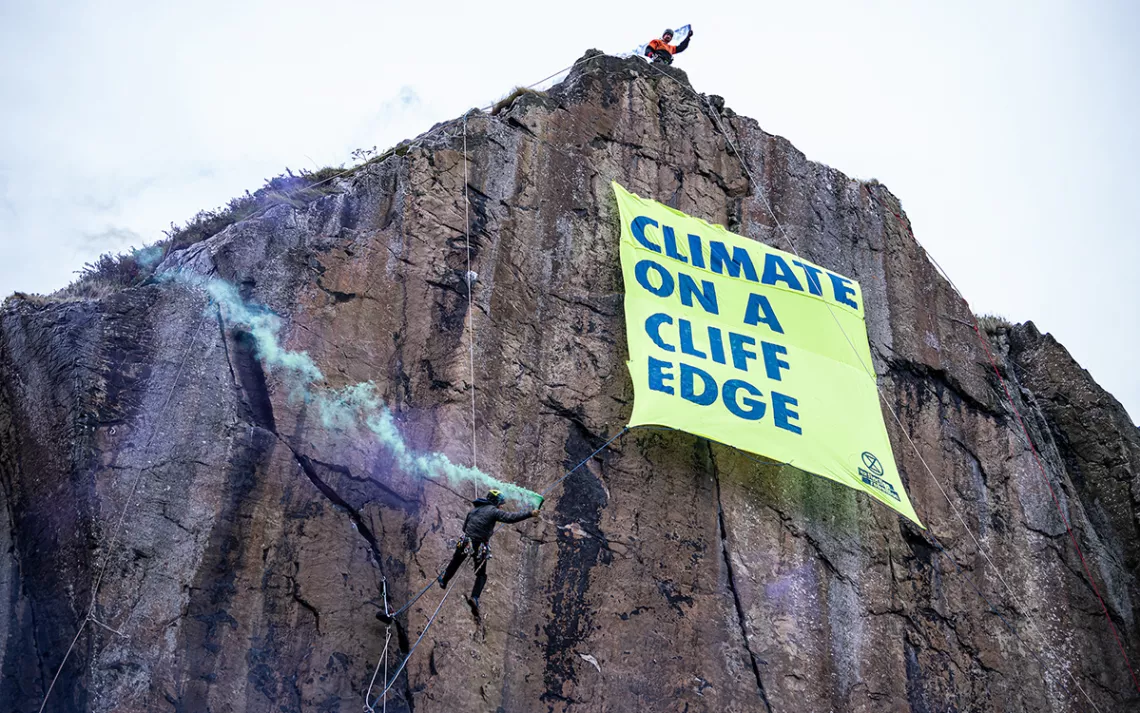
Experienced climbers scale a rock face near the historic Dumbarton castle in Glasgow, releasing a banner that reads “Climate on a Cliff Edge.” One activist, dressed as a globe, symbolically looms near the edge, while another plays the bagpipes on the shores below. | Photo courtesy of Extinction Rebellion and Mark Richards
Neo-Fascist Climate Science Denier Donald Trump says Burn, Baby, Burn.

Continue Reading‘Grim News for the Planet’ as Arctic Sea Ice Hits Record Low

Record January warmth puzzles climate scientists

Spread the love

https://www.bbc.com/news/articles/cwyjk92w9k1o

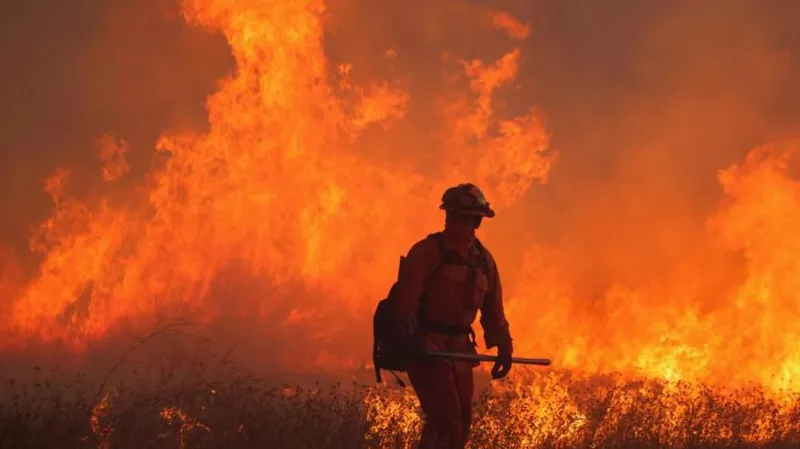
Last month’s Los Angeles fires were one of the costliest disasters in US history

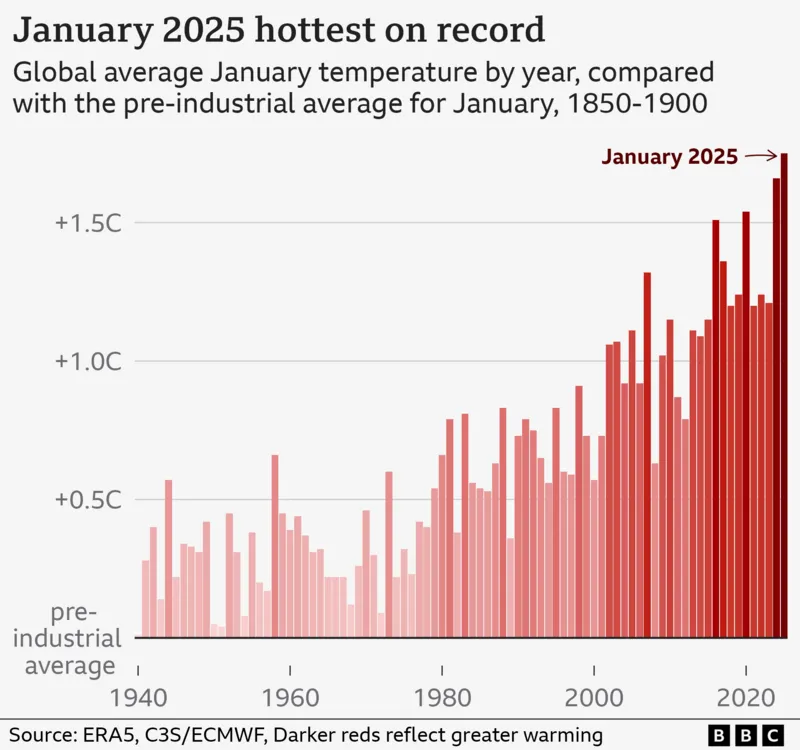
Last month was the world’s warmest January on record raising further questions about the pace of climate change, scientists say.

January 2025 had been expected to be slightly cooler than January 2024 because of a shift away from a natural weather pattern in the Pacific known as El Niño.

But instead, last month broke the January 2024 record by nearly 0.1C, according to the European Copernicus climate service.

The world’s warming is due to emissions of planet-heating gases from human activities – mainly the burning of fossil fuels – but scientists say they cannot fully explain why last month was particularly hot.

It continues a series of surprisingly large temperature records since mid-2023, with temperatures around 0.2C above what had been expected.

“The basic reason we’re having records being broken, and we’ve had this decades-long warming trend, is because we’re increasing the amount of greenhouse gases in the atmosphere,” Gavin Schmidt, director of Nasa’s Goddard Institute for Space Studies, told BBC News.

See the complete original article at https://www.bbc.com/news/articles/cwyjk92w9k1o

Climate Science Denier Donald Trump says Burn, Baby, Burn.
Elon Musk urges you to be a Fascist like him, says that you can ignore facts and reality then.
Continue ReadingRecord January warmth puzzles climate scientists

Is COP27 Already Too Lost and Too Damaged?

Spread the love

Republished from Common Dreams under Creative Commons Attribution-Noncommercial-No Derivative Works 3.0 United States License.

To date, the world’s wealthy countries have so far refused to pay for “loss and damage,” that is, to admit that they’ve massively polluted the atmosphere with carbon dioxide, methane and other greenhouse gasses.

Amy GoodmanDenis Moynihan November 17, 2022 by Democracy Now!

The United Nations Climate Change Conference has convened here in Sharm el-Sheikh, Egypt. It’s called COP27, the 27th Conference of Parties to the UN’s Framework Convention on Climate Change (UNFCCC), the ever-evolving, never-quite-fully-negotiated treaty that, it is hoped, will someday ensure all countries rapidly reduce greenhouse gas emissions to forestall catastrophic climate change. An estimated 30,000 people from around the world have descended on this Red Sea resort on the southern tip of the Sinai Peninsula. The summit is hosted by Egypt, a dictatorship propped up by billions of dollars annually in military aid from the United States. This has been dubbed “The Africa COP,” to highlight the continent’s plight as one of the world’s poorest regions, already suffering dire impacts of the climate crisis.

The phrase “Loss and Damage” denotes the devastating climate impacts millions are already experiencing in poor frontline nations—those that have contributed the least to global warming.

“This is not an African COP. Africa is not here,” Nnimmo Bassey, renowned Nigerian environmentalist, said on the Democracy Now! news hour. “The poor people who are suffering floods, droughts and all kinds of adverse situations, they are not here. They can’t afford to get here. They wouldn’t get accreditation. They can’t afford the accommodation in this city that is mostly for tourists…The other COPs were exclusive, but this is super exclusive. We are all cordoned into a peninsula, cut off from even the country in which we are supposed to be.” Bassey concluded, calling the UN climate process itself “lost and damaged.”

While Bassey has been coming to COPs for many years, members of the growing youth climate movement joined more recently. Vanessa Nakate founded the first climate strike in Uganda. “Fridays for Future” grew out of a solo protest by teenager Greta Thunberg in front of the Swedish parliament in August 2018 and blossomed into a global movement involving more than 14 million young people. Students take a school day off to strike, typically on Friday, demanding that the older people in charge take urgent action on the climate emergency.

In December, 2019, at COP25 in Madrid, Vanessa Nakate described her early days as a climate striker in Kampala, Uganda: “People found it very weird that I was on the streets. Some of them threw some negative comments, like I was wasting my time, and the government will not listen to anything that I have to say. But I just kept going.”

One month later, at the World Economic Forum in Davos, Switzerland, Vanessa was photographed with Greta and other youth activists. The Associated Press published an edited version of the photo, cropping Vanessa out of a group of five. The four remaining in the photo were white. The AP apologized and restored the image.

“Being cropped out of that photo changed me. I became bolder and more direct in how I talk about the climate crisis and racism,” Vanessa later wrote in her book, A Bigger Picture: My Fight to Bring a New African Voice to the Climate Crisis.

Here at COP27, Vanessa said on Democracy Now!, “We have more than 600 fossil fuel lobbyists at this COP, and yet so many communities and activists from the frontlines of the climate crisis weren’t able to make it here…The climate crisis is pushing so many communities beyond adaptation. You cannot adapt to starvation. You can’t adapt to extinction.”

She continued, “What will make it an African COP is ensuring that there is an establishment of a Loss and Damage Finance Facility…supporting a just transition to renewable energy while addressing the energy poverty on the African continent.”

The phrase “Loss and Damage” denotes the devastating climate impacts millions are already experiencing in poor frontline nations—those that have contributed the least to global warming. These developing countries are demanding that rich, historically high-polluting countries meet their pledges made at COP21 in Paris, in 2015, to contribute $100 billion per year to a fund “for mitigation and adaptation.” “Mitigation” refers to investments that lower emissions, like building renewable energy installations. and “adaptation” to building infrastructure and capacity to deal with the impacts of climate change—for example, building seawalls to cope with rising sea levels.

To date, the world’s wealthy countries have so far refused to pay for “loss and damage,” that is, to admit that they’ve massively polluted the atmosphere with carbon dioxide, methane and other greenhouse gasses—in the case of the United States and most of Europe, since the beginning of the Industrial Revolution—and thus must pay climate reparations for the impacts of their pollution.

But those who have been fighting for a just climate transition aren’t giving up hope. Hundreds packed into a People’s Plenary here as COP27 neared it close. Asad Rehman, lead spokesperson for the Climate Justice Coalition, offered his assessment of the entrenched fossil fuel interests as he rallied those gathered for the struggles ahead:

“The word they fear the most: solidarity.”

Republished from Common Dreams under Creative Commons Attribution-Noncommercial-No Derivative Works 3.0 United States License.

Continue ReadingIs COP27 Already Too Lost and Too Damaged?