Farah Nibbs, University of Maryland, Baltimore County
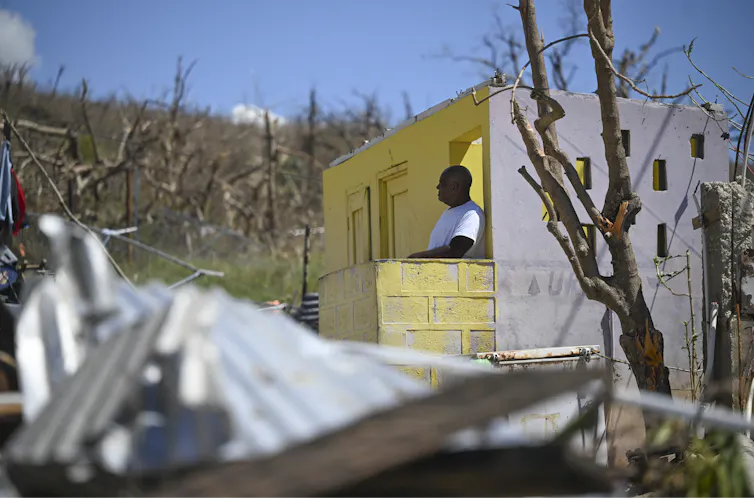
Headlines have been filled with talk of the catastrophic power of Hurricane Melissa after the Category 5 storm devastated communities across Jamaica, Cuba and Haiti in October 2025. But to see this as a singular disaster misses the bigger picture: Melissa didn’t hit stable, resilient islands. It hit islands still rebuilding from the last hurricane.
Jamaica was still recovering from Hurricane Beryl, which sideswiped the island in July 2024 as a Category 4 storm. The parish of St. Elizabeth – known as Jamaica’s breadbasket – was devastated. The country’s Rural Agriculture Development Authority estimated that 45,000 farmers were affected by Beryl, with damage estimated at US$15.9 million.

In Cuba, the power grid collapsed during Hurricane Oscar in October 2024, leaving 10 million people in darkness. When Melissa arrived, it struck the same fragile infrastructure that Cubans had barely begun to rebuild.
Haiti’s fragile situation before Hurricane Melissa cannot be overstated. The island nation was still reeling from years of cascading disasters – deadly hurricanes, political instability, gang violence, an ongoing cholera crisis and widespread hunger – with over half the population already in need of humanitarian assistance even before this storm hit.
This is the new reality of the climate crisis: Disasters hitting the Caribbean are compounding and can trigger infrastructure collapse, social erosion and economic debt spirals.
The compounding disaster trap
I study disasters, with a focus on how Caribbean island systems absorb, adapt to and recover from recurring shocks, like the nations hit by Melissa are now experiencing.
It’s not just that hurricanes are more frequent; it’s that the time between major storms is now shorter than the time required for a full recovery. This pulls islands into a trap that works through three self-reinforcing loops:
Infrastructure collapse: When a major hurricane hits an already weakened system, it causes simultaneous infrastructure collapses. The failure of one system – such as power – cascades, taking down water pumps, communications and hospitals all at once. We saw this in Grenada after Hurricane Beryl and in Dominica after Hurricane Maria. This kind of cascading damage is now the baseline expectation for the Caribbean.
Economic debt spiral: When countries exhaust their economic reserves on one recovery, borrow to rebuild and are then hit again while still paying off that debt, it becomes a vicious cycle.
Hurricane Ivan, which struck the region in 2004, cost Grenada over 200% of its gross domestic product; Maria, in 2017, cost Dominica 224% of its GDP; and Dorian, in 2019, cost the Bahamas 25% of GDP. With each storm, debt balloons, credit ratings drop and borrowing for the next disaster becomes more expensive.
Social erosion: Each cycle weakens the human infrastructure, too. More than 200,000 people left Puerto Rico for the U.S. mainland in Maria’s aftermath, and nearly one-quarter of Dominica’s population left after the same storm. Community networks fragment as people leave, and psychological trauma becomes layered as each new storm reopens the wounds of the last. The very social fabric needed to manage recovery is itself being torn.

The trap is that all three of these loops reinforce each other. A country can’t rebuild infrastructure without money. It can’t generate economic activity without infrastructure. And it can’t retain the skilled workforce needed for either when people are fleeing to safer places.
Rebuilding a system of overlapping recoveries
The Caribbean is not merely recovering from disasters – it is living within a system of overlapping recoveries, meaning that its communities must begin rebuilding again before fully recovering from the last crisis.
Each new attempt at rebuilding happens on the unstable physical, social and institutional foundations left by the last disaster.
The question isn’t whether Jamaica will attempt to rebuild following Melissa. It will, somehow. The question is, what happens when the next major storm arrives before that recovery is complete? And the one after that?
Without fundamentally restructuring how we think about recovery – moving from crisis response to continuous adaptation – island nations will remain trapped in this loop.
The way forward
The compounding disaster trap persists because recovery models are broken. They apply one-size-fits-all solutions to crises unfolding across multiple layers of society.
Breaking free requires adaptive recovery at all levels, from household to global.

At the household level: Helping amid trauma
Recovery isn’t just about repairing a damaged roof. When families experience back-to-back disasters, trauma compounds. Direct cash assistance and long-term, community-based mental health services can help restore dignity.
Cash transfers allow families to address their own needs, stimulate local economies and restore control to people whose lives have been repeatedly upended.
At community level: Mending the social fabric
Repairing the “social fabric” means investing in farmer cooperatives, neighborhood associations and faith groups – networks that can lead recovery from the ground up.
Local networks are often the only ones capable of rebuilding trust and participation.
At the infrastructure level: Breaking the cycle
The pattern of rebuilding the same vulnerable roads or power lines only to see them wash away in the next storm fails the community and the nation. There are better, proven solutions that prepare communities to weather the next storm:
- Decentralized power grids with renewable energy sources can operate independently when the main grid fails.
- Natural infrastructure such as restored mangroves and wetlands provide natural storm barriers.
- Strong enforcement of modern building codes can require structures to withstand Category 4 and above winds.

At the global level: Fixing the debt trap
None of this is possible if recovery remains tied to high-interest loans. There are ways for internal financial institutions and global development lenders to allow for breathing room between disasters:
- Hurricane clauses in bond agreements can automatically pause all debt payments when disasters strike. These clauses allow governments to automatically suspend debt service payments to bondholders for up to two years when a qualifying disaster strikes. After Beryl, Grenada became the first government to activate a hurricane clause with private creditors.
- Comprehensive debt-for-climate swaps involve reducing existing debt – owed to private banks, institutional investors, countries or multilateral banks – in exchange for the debtor country committing funds to climate adaptation or resilience projects.
- Pre-positioned climate finance is money made available through dedicated international climate funds, such as the Green Climate Fund and Loss and Damage Fund, or parametric insurance mechanisms. It pays out before storms hit, not months later, so countries are ready to respond to the damage.
The current international disaster finance system, controlled by global lenders and donors, requires countries to prove their losses after a disaster in order to access assistance, often resulting in months of delay. “Proof” is established by formal evaluations or inspections, such as by the United Nations, and aid is released only after meeting certain requirements. This process can stall recovery at the moment when aid is needed the most.
The bottom line
The Caribbean needs a system that provides support before disasters strike, with agreed-upon funding commitments and regional risk-pooling mechanisms that can avoid the delays and bureaucratic burden that slow recovery.
What’s happening in Jamaica, Cuba and Haiti today is a glimpse of what’s coming for coastal and island communities worldwide as climate change accelerates. In my view, we can either learn from the Caribbean’s experiences and redesign disaster recovery now or wait until the trap closes around everyone.
Farah Nibbs, Assistant Professor of Emergency and Disaster Health Systems, University of Maryland, Baltimore County
This article is republished from The Conversation under a Creative Commons license. Read the original article.