Colin Leys looks at how Scotland and Wales have rejected marketising the NHS
As expert commentators have amply shown, the coalition’s plan to privatise the NHS lacks any basis in evidence – no surprise there. What is less well recognised, and so far amazingly unmentioned in the debate, is that powerful evidence against privatisation exists on our own doorstep – namely, the fact that in Scotland and Wales the NHS is working well as a publicly provided and managed system, based on planning and democratic accountability.
Marketisation was tried, especially in Scotland, and rejected. The purchaser-provider split, which is at the root of the marketisation project, was introduced but then abandoned in both nations, and neither foundation trusts nor payment by results were introduced in either of them. PFI was used in Scotland under the first Labour government in Holyrood, and one private treatment centre for NHS patients was opened, but the SNP has since scrapped the use of PFI and taken the treatment centre into public ownership. Wales has used neither PFI nor private treatment centres. The NHS in both countries is once again planned and managed through a mix of democratically accountable central and local structures, as it was in England before the 1990s.
…
Selected excerpts from ‘The Plot Against the NHS’ by Colin Leys and Stewart Player. Chapter One is available here. I highly recommend this book available from Merlin Press for £10.
Sir Richard Thompson, president of the Royal College of Physicians says that the National Health Service is “creaking at the seams. Our members are finding it difficult to cope.”
Blindness fears for diabetics as a drug is refused on the NHS.
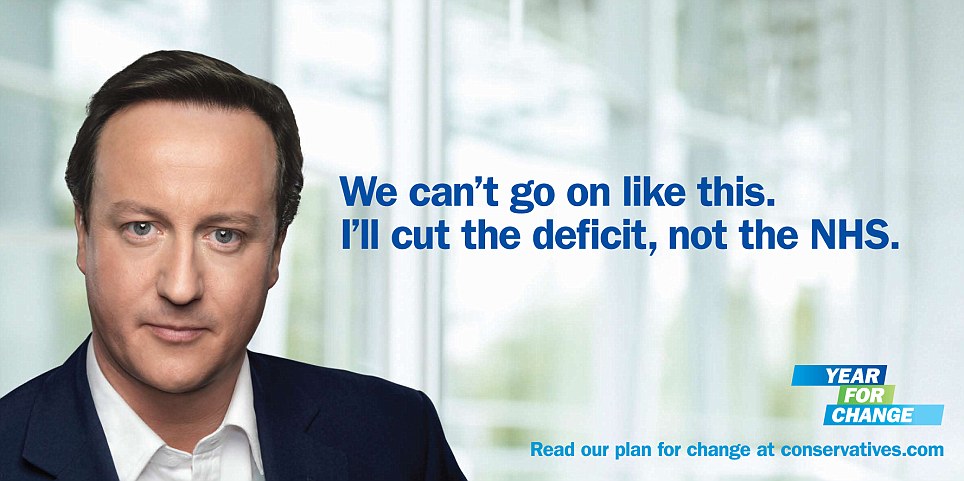
Conservative election poster 2010
A few recent news articles concerning the UK’s Conservative and Liberal-Democrat coalition government – the ConDem’s – brutal attack on the National Health Service.
Number of cases missing waiting time target of 18 weeks since GP referral soars by a third
The number of patients not being treated within recommended NHS waiting times has soared by a third since the coalition came to power, new official figures revealed.
A total of 27,834 patients in England who received inpatient treatment in May 2011 had waited more than 18 weeks for it since being referred by their GP, compared to 20,504 in May 2010 – a year-on-year rise of 33.5%.
That is higher than the year-on-year rise between April 2010 and April 2011, when it was 24%.
The Department of Health (DH) admitted that while 1.8% of outpatients in May 2010 were not treated within 18 weeks, that had risen to 2.3% in May 2011. Similarly, the proportion of inpatients who had to wait longer than expected to undergo surgery or some other treatment also rose over the same period, from 7.1% to 9.2%.
The deterioration in this measure of NHS performance casts further doubt on David Cameron’s repeated pledges to keep NHS waiting times low, especially the 18-week Referral To Treatment (RTT) target. He last month made that one of his five personal pledges to voters on the NHS.
…
…
Sir Richard Thompson, president of the Royal College of Physicians, said: “The apparent rise in waiting lists is both worrying for patients and evidence of an underlying cause – the increasing pressures on the NHS in general.
“The NHS is now creaking at the seams. Our members are finding it difficult to cope.”
And shadow health secretary John Healey added: “The NHS is starting to go backwards again under the Tories.”
But Health Secretary Andrew Lansley said waiting times were a priority for the government and still remained “low and stable”. [?]
…
Hundreds of diabetes patients could lose their sight after the NHS rationing watchdog said it was too expensive to give them a treatment for an eye condition from which many suffer.
The National Institute for Health and Clinical Excellence acknowledged that the drug Lucentis was effective in treating diabetic macular oedema, which affects 50,000 Britons.
But in final draft guidance on the drug yesterday, it refused to make Lucentis available on the NHS, saying it was not ‘cost-effective’ compared with laser treatment.
…
Diabetes UK said Lucentis was the first licensed treatment to improve vision – and therefore quality of life – in those with sight loss due to DMO. It was also more effective than the laser treatment favoured by Nice.
‘This decision means more people will needlessly lose their sight,’ said a spokesman. ‘We pressed hard to make this treatment available on the NHS and we will campaign for Nice to reconsider its decision.
…
I consider this posting to comply with copyright laws since
a. Only a small portion of the original article has been quoted satisfying the fair use criteria, and / or
b. This posting satisfies the requirements of a derivative work.
Please be assured that this blog is a non-commercial blog (weblog) which does not feature advertising and has not ever produced any income.
A few recent news articles concerning the UK’s Conservative and Liberal-Democrat coalition government – the ConDem’s – brutal attack on the National Health Service.
Commenting on the NHS Confederation’s survey findings that 53% of NHS leaders felt NHS availability of care and waiting times will worsen, Debbie Kleiner-Gaines of the Association of Medical Insurance Intermediaries says, “This will be a very worrying concern impacting a lot of people who may now find it necessary to consider having access to the private sector and possibly insurance to fund it. At least then they can be confident speedy treatment will be available if they need it.”
“I try to avoid saying things that are capable of misinterpretation,” Andrew Lansley told HSJ last week.
Readers will judge for themselves whether the health secretary has been successful in achieving that goal during his first year in office.
Mr Lansley was talking about hospital reconfiguration – but he made much the same point when pressed during his NHS Confederation conference speech on why he had not spoken up more for NHS managers.
As soon as the question was asked, the health secretary adopted his now familiar tone of barely restrained frustration: hadn’t he always attacked “bureaucracy” and not “managers”? Hadn’t he always praised the importance of good “management”?
He was not responsible “for what the Daily Mail writes”.
This is disingenuous rubbish. Mr Lansley – in common with many politicians – is rarely unhappy when talk of “too much bureaucracy” is translated into “too many managers”. Praise for those in management roles is saved for speeches aimed at NHS leadership which are unlikely to get wider coverage elsewhere.
Prof. Appleby of the King’s Fund think tank says that spending more on the NHS is possible. link
Tory think tank the Institute of Economic Affairs proposes abolishing the NHS and even claims that there is widespread public support for it.
Conservative election poster 2010
A few recent news articles concerning the UK’s Conservative and Liberal-Democrat coalition government – the ConDem’s – brutal attack on the National Health Service.
…
In an article in the Daily Telegraph last month, Health Secretary Andrew Lansley suggested on current trends £230bn would need to be spent on health by 2030 compared to the £103bn which is spent now.
He said that figure was one that the country “simply could not afford”.
But Prof Appleby, the chief economist at the think-tank, questioned that.
He said taking into account the expected growth in the economy a budget of £230bn would require the health budget to rise at about 4% a year above inflation – only a little more than it has got on average since 1948.
Such rises would bring total health spending, including investment in private health care, to about 12.4% of gross domestic product (GDP) – roughly in line with what high spending countries such as the Netherlands are already spending.
Prof Appleby added: “It is a question of priorities really. It could be afforded, but would just require more money to be spent on health. But we are not talking about ridiculous amounts.”
Shrinking the size of the state by abolishing the NHS and limiting overseas aid to humanitarian disasters could save more than £200bn a year and pave the way for growth-generating tax cuts, says a leading free-market thinktank.
The Institute of Economic Affairs (IEA), responsible for many of the policies implemented by Margaret Thatcher in the 1980s, said the plans to tackle Britain’s budget deficit during the current parliament are not radical enough.
Publishing a report urging a rethink of education, health and welfare, the thinktank said there was public support for plans that would see government spending reduced to less than 30% of national output. Spending peaked at about 50% of gross domestic product during the recession and the chancellor, George Osborne’s proposals would see public expenditure stabilise at 40% of national income.
“The recent comprehensive spending review was anything but comprehensive,” the report, Sharper Axes, Lower Taxes, said. “Certain departments were omitted from the review altogether. Most other areas of spending were ‘salami-sliced’. No coherent, bottom-up analysis of government functions has taken place.”
…
[comments are worth reading]
Andrew Lansley’s controversial NHS bill is premised on “choice and competition” and the creation of a market in healthcare. These three stories below from the US show choice and competition at work on the ground. They also explain why 45,000 Americans die every year because they can’t afford – and in many cases can’t even obtain – health insurance.
But first, let me introduce myself – as I did in June 2009 when I testified before a congressional committee that was investigating the many abuses of the private insurance industry in the US. “My name is Wendell Potter, and for 20 years I worked as a senior executive at health insurance companies, and I saw how they confuse their customers and dump the sick – all so they can satisfy their Wall Street investors.”
I described how insurance companies, in their constant quest to meet profit expectations, routinely cancel the coverage of sick policyholders and strive to spend less and less of premium dollars on medical care so they can divert more and more of those dollars to executive salaries and dividends for investors.
A few months before my testimony I had left my job as head of communications for one of the largest US insurers, Cigna. I could no longer in good conscience continue to serve as a spokesman for a profit-obsessed industry that I had come to realise was largely responsible for the American healthcare system’s descent into dysfunctionality.
…
I consider this posting to comply with copyright laws since
a. Only a small portion of the original article has been quoted satisfying the fair use criteria, and / or
b. This posting satisfies the requirements of a derivative work.
Please be assured that this blog is a non-commercial blog (weblog) which does not feature advertising and has not ever produced any income.
A few recent news articles concerning the UK’s Conservative and Liberal-Democrat coalition government – the ConDem’s – brutal attack on the National Health Service.
We may be entering the summer silly season for news, with the NHS barely visible in the papers and forgotten by broadcasters.
But don’t be fooled – brace yourself for an autumn of massive cuts as NHS bosses draw up plans to slash each area on an unprecedented scale.
More than half of all senior NHS managers are worried that patients’ access to care will be cut back as a result of a tightening financial situation, which 42 per cent of them described as the “worst they had ever experienced,” according to a recent survey by the NHS Confederation.
Thirty-nine per cent of NHS chairs and chief executives expected financial pressures to increase over the next three years, while 75 per cent felt cuts in spending on social services by local councils would also impact on health services.
Analysts are now warning of a new ice age in NHS funding, with budgets growing little, if at all, even after 2015.
These findings came less than a month after David Cameron, seeking to smooth the way to push through Andrew Lansley’s microscopically modified Health and Social Care Bill, went on record with five pledges on the NHS, one of which was that “we will not cut spending on the NHS – we will increase it.”
…
Our National Health Service celebrated its 63rd birthday last week. I think it’s been one of the great success stories of the past century – an institution dedicated to treating the sick, relieving suffering, and saving lives, regardless of ability to pay.
Apart from the fact that the NHS is there for everyone when they need it, I have reason to be grateful to this fantastic service. It saved my life when I was diagnosed with advanced stomach cancer some years ago. And I want the NHS to be there for generations to come.
To mark the anniversary, I delivered a giant birthday card to the Department of Health, along with other trade union leaders. And later we lobbied Parliament to ask them to join us in wishing the NHS Many Happy Returns. This was not just a celebration of 63 years, but an impassioned plea to our politicians to make sure that the world’s largest and best publicly funded health service is not dismantled.
For that is what I fear will happen if the Frankenstein Health and Social Care Bill is passed into law. The LibDem arm of the coalition Government has made a great deal of noise, belatedly, about the changes it has wrung from its Tory partners to sweeten what will be a bitter pill. But, those changes are just not enough to prevent our NHS being dismantled or to save it from those who want to make a profit out of the sick.
Labour has accused the government of increasing rather than cutting NHS bureaucracy.
Speaking in the Commons this afternoon shadow health secretary John Healey said: “In spite of the spin the truth is the prime minister’s personal promise to give NHS a real rise in funding is being broken.
“It’s not just how much it’s how well the money is spent, and today Mr Speaker is one year to the day the health secretary launched plans to ‘liberate’ the NHS.”
Healey said that rather than phasing out top down hierarchy and reducing the cost of NHS related quangos, Lansley had overseen the creation of a lot more bodies.
He questioned why Lansley was setting up the National Commissioning Board which was set to employ 3,500 people.
And he asked why the government was setting up 500 public bodies in the NHS when 161 “do the job now”.
“Why is govt wasting precious NHS funding on the biggest reorganisation in its history it should be spent on patient care,” he said.
…