Thousands march in Argentina to demand an end to the genocide in Gaza

Spread the love

Original article by Peoples Dispatch republished from peoples dispatch under a Creative Commons Attribution-ShareAlike 4.0 (CC BY-SA) license.
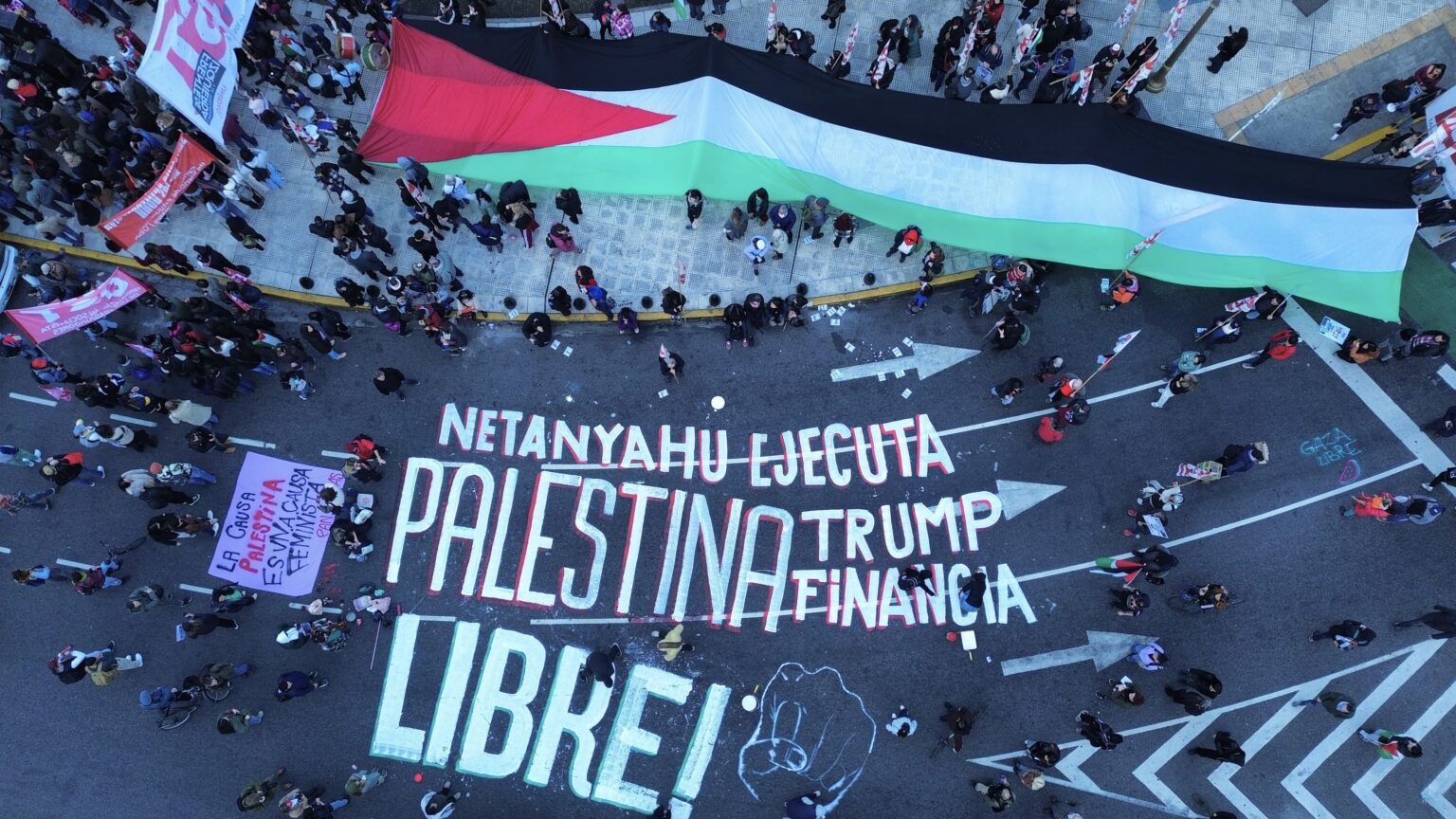
Buenos Aires march on Saturday, August 9. Photo: Argentine Committee for Solidarity with the Palestinian People

Protesters on Saturday also denounced the very close relationship between the governments of Milei and Netanyah

On August 9, thousands of Argentines took to the streets of the capital, Buenos Aires, demanding an end to the genocide being committed in Gaza, Palestine Israel. The slogan of the march was “We are all children of Gaza”.

The protesters denounced the indiscriminate attacks and forced starvation that, they claimed, Israeli forces are perpetrating against the civilian population.

The demonstration ended at Plaza de Mayo, where, according to some media outlets, more than 10,000 people demanded an end to the repressive actions in Palestine: “ Gaza is starving, time is up!” and “Palestine will prevail from the river to the sea” were some of the slogans chanted by the protesters as they waved Palestinian flags.

The march brought together human rights organizations, left-wing political parties, and various social movements, which declared that the only solution to any conflict in Palestine is peace, respect for sovereignty, and a dignified life for those who live there.

“We are facing genocide, which is confirmed by Israeli leaders themselves when they openly say that it is lawful to starve and dehydrate the entire population of Gaza, including its children. This genocide must be denounced relentlessly,” said Gabriel Solano, one of the leaders of the Left Front, during the mobilization.

For its part, the Palestinian Embassy in Argentina posted on X: “THANK YOU ARGENTINA, WE WILL NEVER FORGET! An impressive demonstration took place on Saturday, August 9, in Buenos Aires to denounce the genocide being carried out by the state of Israel against the Palestinian people.”

A close relationship between the governments of Argentina and Israel?

The demonstration also criticized the close ties between the Argentine and Israeli governments, which Argentine President Javier Milei (who recently traveled to the occupied Palestinian territories) has never denied. One of the slogans heard at the march was: “Milei, Zionist, you are the terrorist”.

Milei has announced that in 2026, he will relocate the Argentine embassy in Israel from Tel Aviv to Jerusalem, a move that Palestinians and several governments around the world have heavily criticized. For his part, Israeli Prime Minister Benjamin Netanyahu confirmed that he will soon come to Argentina on an official visit, a move that various Argentine political movements and parties have strongly denounced.

In addition to Buenos Aires, demonstrations against the genocide in Palestine took place in other Argentine cities, such as San Carlos de Bariloche, El Bolsón, Trelew, Comodoro Rivadavia, Ushuaia, Río Grande, San Salvador de Jujuy, Salta, San Miguel de Tucumán, San Juan, La Rioja, Catamarca, Mendoza, Santa Fe, Concepción del Uruguay, Córdoba, Cosquín, Alta Gracia, Villa Dolores, La Plata, Bahía Blanca, Mar del Plata, Neuquén, and Viedma.

Solidarity with Palestine continues to grow

“The last three demonstrations have grown due to the news about the genocide taking place in Gaza,” Gabriela B., an activist with Nuestramérica and member of the Argentine Committee for Solidarity with the Palestinian People, told Peoples Dispatch. For her, there is a significant increase in support for the cause, “If there was ever a belief that people could ignore the situation in Palestine without it affecting their humanity or without their stance being noticed, that idea has been shattered.”

She also pointed out the importance of Israel in Argentina: “In Argentina, the situation is very difficult. As a colleague mentioned, Argentina is considered the capital of Zionism [in Latin America], which means that the mainstream media only broadcasts voices that cover up the genocide. Furthermore, any action or complaint related to Palestine is framed within the concept of anti-Semitism, making solidarity and questioning of the situation even more difficult. The silence is already unsustainable, and Netanyahu’s possible visit, as well as the famine in Gaza, have triggered acts of repudiation. This resulted in posts on the accounts of famous artists during the week and in the large march that took place not only in Buenos Aires but in 30 other locations throughout the country, including cities and provinces.”

Regarding the demands made by the protesters, Gabriela said: “The main demand was a call to stop the genocide and famine, and to reject the possible visit to Argentina by Israeli Prime Minister Benjamin Netanyahu.” Other demands included:

  • The withdrawal of Israeli troops from Palestine, Syria, and Lebanon.
  • Ending diplomatic relations with Israel. Cancelling the Mercosur-Israel agreement (a Free Trade Agreement between Israel and a bloc of South American countries).
  • Stop the persecution of those who show solidarity with the Palestinian people.

In Argentina, two prominent political figures are currently being persecuted for tweeting about the genocide in Gaza: Vanina Biasi and Alejandro Bodart.

When asked about the criticisms raised during the march against Milei’s close relationship with Netanyahu, Gabriela B. said that in the last month, key political and progressive movements have begun to join the movement in support of Palestine and rejecting Israel’s actions. After Saturday’s march, momentum has continued to build, “various complaints were filed after Saturday by trade unions and human rights organizations, demanding Netanyahu’s arrest if he visits Argentina. The same complaint alleges that Netanyahu committed ‘genocide and war crimes’ against the Palestinians (presented by the secretary general of ATE Buenos Aires, Daniel ‘Tano’ Catalano, and the representative of the H.I.J.O.S. group, Verónica Castelli).”

She added: “However, as far as Milei and the ruling party are concerned, nothing has happened. No media outlet, except for alternative ones, has reported on the large march. The only news that managed to break through the media blockade and name Israel as a murderer was the news of the six journalists who were killed on Sunday. This march has served to denounce the Zionist alliance that the government maintains and to continue raising awareness among our people.”

Original article by Peoples Dispatch republished from peoples dispatch under a Creative Commons Attribution-ShareAlike 4.0 (CC BY-SA) license.

Experiencing issues with this image not appearing. I suspect because it's so critical of Zionist Keir Starmer's support of and complicity in Israel's genocides.
Genocide denier and Current UK Prime Minister Keir Starmer is quoted that he supports Zionism without qualification. He also confirms that UK air force support has been essential in Israel’s mass-murdering genocide. Includes URLs https://www.declassifieduk.org/keir-starmers-100-spy-flights-over-gaza-in-support-of-israel/ and https://youtu.be/O74hZCKKdpA
Keir Starmer objects to criticism of the IDF. He asks how could anyone object to them starving people to death, forced marches like the Nazis did, bombing Gaza's hospitals and universities,mass-murdering journalists, healthworkers and starving people queuing for food, killing and raping prisoners and murdering children. He calls for people to stop obstructing his genocide for Israel.
Keir Starmer objects to criticism of the IDF. He asks how could anyone object to them starving people to death, forced marches like the Nazis did, bombing Gaza’s hospitals and universities,mass-murdering journalists, healthworkers and starving people queuing for food, killing and raping prisoners and murdering children. He calls for people to stop obstructing his genocide for Israel.
Continue ReadingThousands march in Argentina to demand an end to the genocide in Gaza

From solidarity to action: The Global March to Gaza unites the world against Israel’s genocide

Spread the love

Original article by Wahid Ben Ali republished from peoples dispatch under a Creative Commons Attribution-ShareAlike 4.0 (CC BY-SA) license.
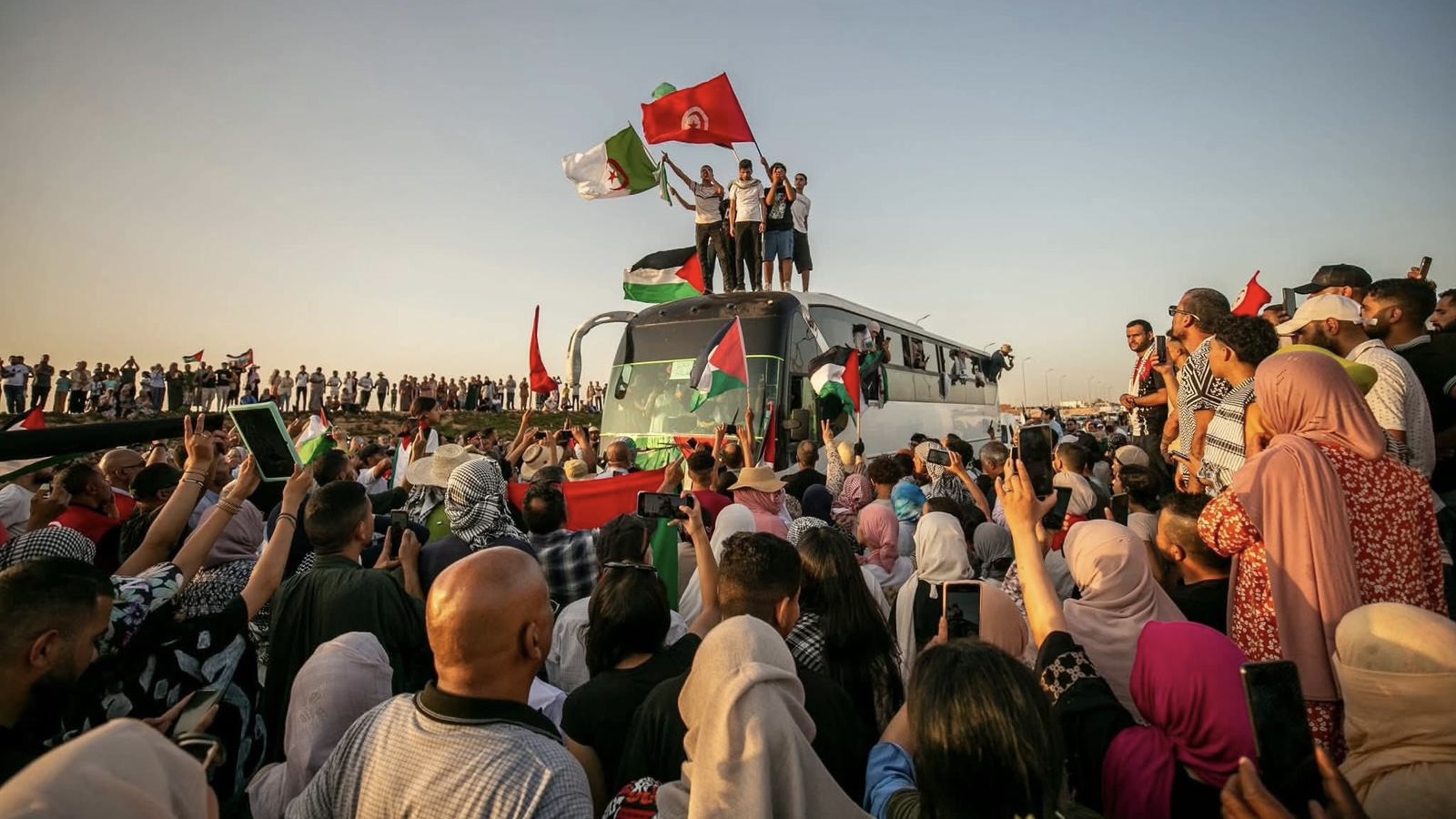
Tunisians depart on Gaza convoy. Photo: Tunisia Land Convoy

Thousands of volunteers from more than 50 countries are partaking in the Global March to Gaza to break the siege and blockade, deliver humanitarian aid, and demand an end to Israel’s genocide.

An international coalition composed of labor unions, solidarity movements, and human rights organizations from over 50 countries has announced the launch of an initiative to enter the Gaza Strip by foot. Thousands of international volunteers will partake in a large-scale mobilization from Cairo to the Rafah crossing in order to demand an end to Israel’s blockade of the Gaza Strip and to shed light on the catastrophic conditions endured by Gaza’s residents amid famine and relentless bombardment.

Called the “Global March to Gaza”, the campaign marks a significant moment in the international solidarity movement with Palestine. The key objectives outlined by the organizers of the global march are to end the famine in Gaza, facilitate the entry of thousands of aid trucks stalled for months at the Rafah crossing, establish a stable and permanent humanitarian corridor, expose Israel’s crimes, and demand accountability for those responsible.

The thousands of participants hailing from trade unions, rights groups, medical sectors, and civil society have united with a clear message: international silence in the face of Israel’s genocide against the people of Gaza is complicity and the people of the world demand action. For the last 20 months, as Israel has carried out its genocide against the people of Gaza, millions of people across the world have mobilized in support of the Palestinian people and to demand an end to Israel’s crimes, marking a historic upsurge in the movement for Palestine across the world.

Seif Abu Keshk, a member of the international committee of Global March to Gaza, said in an interview with BreakThrough News that the march aims to halt the ongoing genocide against the Palestinian people, ensure the unconditional and immediate entry of humanitarian aid, and demand the lifting of the “inhumane” blockade imposed on Gaza. He stressed that the initiative is purely humanitarian, without any political affiliations or official sponsorship, with all participants volunteering and funding their own involvement as part of a broader effort to strengthen global solidarity and exert mass pressure on complicit or silent governments.

From Cairo to Rafah

Volunteers from the different countries will start arriving in Egypt’s capital Cairo on June 12 and then travel to the city of Arish, from where they will begin their on-foot march to Rafah on June 15. Organizers underscore that the objective is not only to reach Rafah but also to stage a sit-in at the crossing to pressure authorities to open it and allow the entry of aid. They have expressed readiness to endure hardship as a modest expression of solidarity with Gaza’s residents, who have been deprived of food, water, and medicine for the last several months and been under constant bombardment over 20 months.

German lawyer Melanie Schweitzer affirmed that the march is entirely peaceful and civilian in nature, conveying a unified humanitarian message that transcends political and cultural boundaries. Irish activist Karen Moynihan noted that organizers have been in contact with Egyptian embassies and their own national diplomatic missions to ensure safe passage. She stressed that the initiative does not seek to hold Egypt accountable, but rather to cooperate with it and apply real international pressure on Israel to lift the blockade. She emphasized that any state failing to act against these crimes is complicit in genocide – and history will not forgive such silence.

This mobilization comes amid growing global criticism of Israel’s continued blockade on the entry of humanitarian aid and its maneuver to delegate the management of humanitarian aid to a private US company, the “Gaza Humanitarian Foundation” (GHF). The GHF was created to replace UNRWA and other aid agencies working in the region, as Israel argued that they were collaborating with Hamas. Yet the GHF’s aid distribution centers set up in Rafah have done little to distribute necessary aid and became the site of Israeli massacres of Palestinians when Israeli soldiers opened fire on Palestinian aid seekers on two occasions.

The GHF aid distribution mechanism sparked widespread outrage. Philippe Lazzarini, the UNRWA head, condemned the incident in Rafah stating that the scenes were “shocking images of hungry people pushing against fences, desperate for food. It was chaotic, undignified and unsafe.” He declared that “the crisis in Gaza cannot be addressed by weaponizing humanitarian assistance.”

Read more: US and Israel hijack aid, massacre starving Palestinians

As global outrage grows at the imminent famine and humanitarian catastrophe in Gaza due to Israel’s blockade, the Global March to Gaza, as well as the recent Freedom Flotilla voyage to Gaza, seek to take the action that the world’s leaders refuse to and show the people of Gaza that they are not alone.

From Tunis to Rafah

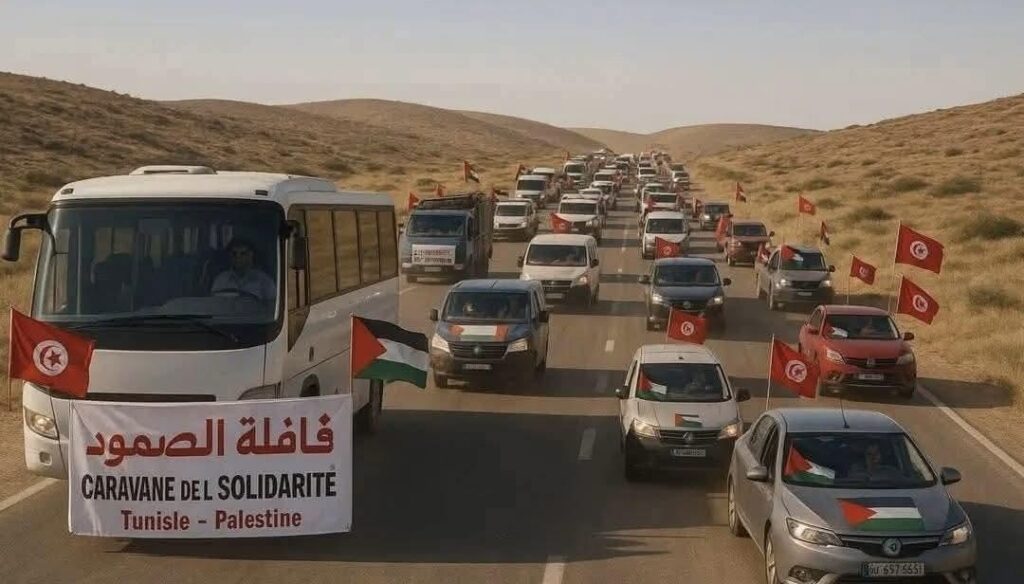
The international initiative to launch the Global March to Gaza coincides with similar grassroots actions at the regional level, most notably in Tunisia. Since mid-May, Tunisian civil associations, major trade unions, student groups, and youth movements have been preparing a convoy that will depart from Tunis, pass through Cairo, and converge with the global march in support of its demands. At the moment, thousands of Tunisians are on buses en route to Egypt. Organizers emphasize that while the convoy carries symbolic humanitarian aid, it primarily bears a clear political message: No to the blockade, No to normalization, Yes to Palestinian freedom.

Coordination between the Tunisian and international sides has been ongoing for weeks, through joint media and logistical committees, especially with participants from the Maghreb and southern European countries such as Italy, Spain, and France. Tunisian organizers describe the convoy as the “Maghreb wing” of the global march – laying the foundation for a comprehensive grassroots movement stretching from North Africa to the gates of Gaza.

The convoy, which departed from Tunis on June 9, includes unionists, doctors, students, journalists, and activists of all ages – some of whom have previously taken part in solidarity missions to Lebanon or Gaza. The Tunisian coordination committees are now focused on collecting donations, finalizing logistics, and securing transit permits from the Egyptian embassy. The convoy received symbolic send-offs in the capital and other cities it passed through, in a display of popular support and mobilization.

Participants from neighboring countries have joined the convoy, including individuals previously involved in the flotilla attacked off Malta. Around 2,000 Tunisians converged along the route from Tunis to Ras Ajdir crossing, from where they crossed into Libyan territory. For the next several days they will continue across Libya, into Egypt and towards Cairo, then proceed to Arish and finally Rafah.

Tunisia Palestine solidarity convoy. Photo: Tunisia Land Convoy

The convergence of the Tunisian convoy and the global march at the Rafah crossing, expected around June 15 or shortly thereafter, will not only be a symbolic media event but will transform into an open international protest camp at the border. Sit-ins will continue, banners and slogans will be raised, and governments will be called upon to assume their moral and political responsibilities. A unified international petition will be delivered to Egyptian authorities and UN representatives in the region, demanding the immediate and unconditional opening of Rafah and the entry of over 3,000 aid trucks carrying food, medicine, and fuel.

Tunisian participants also plan to host cultural and awareness-raising activities at the crossing, including discussion circles, artistic performances, and live media campaigns to broaden international popular support and expose Israel’s crimes to global public opinion – especially with major international media outlets expected to cover the event.

In sum, the convergence of the Global March to Gaza and the Tunisian convoy represents a pivotal moment in the history of international grassroots solidarity with Palestine. This is not merely a march to a border, it is a march toward the conscience of the world, reviving the power of direct action and sending a message to those under siege in Gaza: You are not alone. From Tunis to Dublin, from Cape Town to Krakow, people are rising for Gaza, carving pathways of solidarity and defiance against siege and injustice.

Original article by Wahid Ben Ali republished from peoples dispatch under a Creative Commons Attribution-ShareAlike 4.0 (CC BY-SA) license.
Experiencing issues with this image not appearing. I suspect because it's so critical of Zionist Keir Starmer's support of and complicity in Israel's genocides.
Genocide denier and Current UK Prime Minister Keir Starmer is quoted that he supports Zionism without qualification. He also confirms that UK air force support has been essential in Israel’s mass-murdering genocide. Includes URLs https://www.declassifieduk.org/keir-starmers-100-spy-flights-over-gaza-in-support-of-israel/ and https://youtu.be/O74hZCKKdpA
UK Labour Party government ministers Keir Starmer, Angela Rayner and Rachel Reeves explain that they are partners complicit in Israel's Gaza genocide. The UK has provided Israel with arms, military and air force support. They explain that they don't do gas chambers but do do forced marches, starvation, destroy hospitals, mass-murders of journalists and healthcare workers.
UK Labour Party government ministers Keir Starmer, Angela Rayner and Rachel Reeves explain that they are partners complicit in Israel’s Gaza genocide. The UK has provided Israel with arms, military and air force support. They explain that they don’t do gas chambers but do do forced marches, starvation, destroy hospitals, mass-murders of journalists and healthcare workers.
Continue ReadingFrom solidarity to action: The Global March to Gaza unites the world against Israel’s genocide

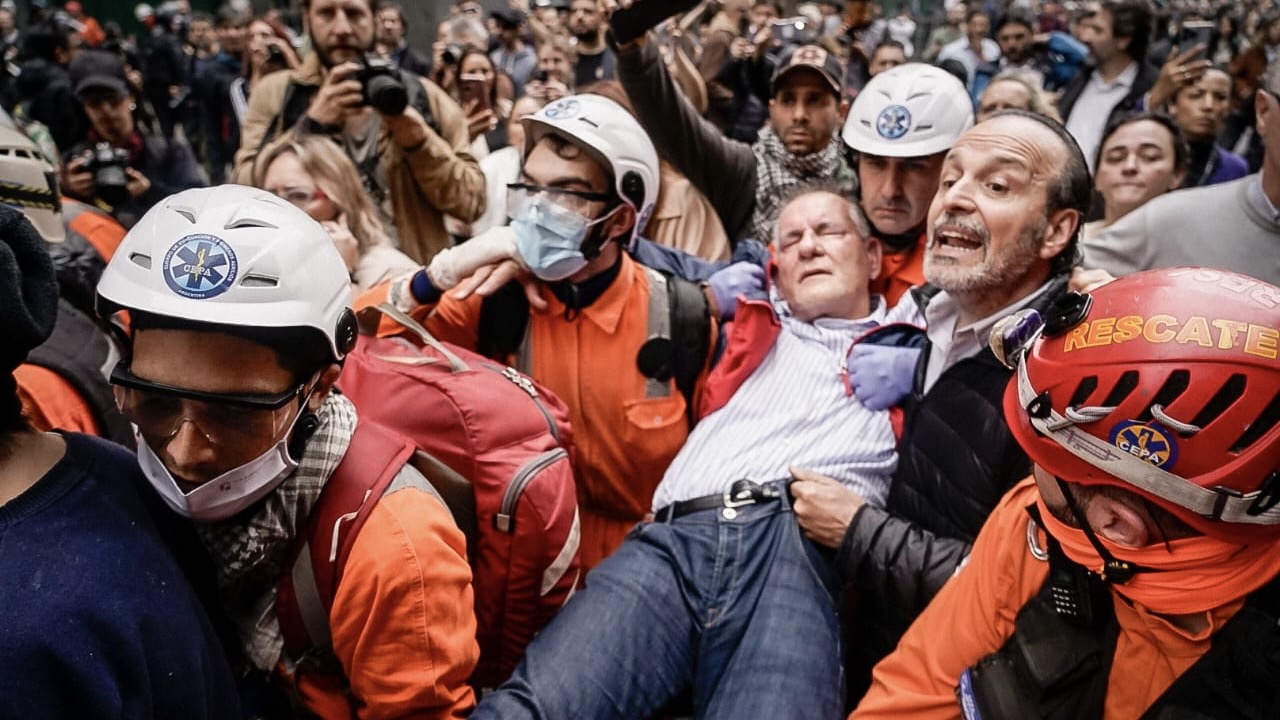
Argentine organizations reject attempts by Milei to silence dissent with fear

Spread the love

Original article by Pablo Meriguet republished from peoples dispatch under a Creative Commons Attribution-ShareAlike 4.0 (CC BY-SA) license.

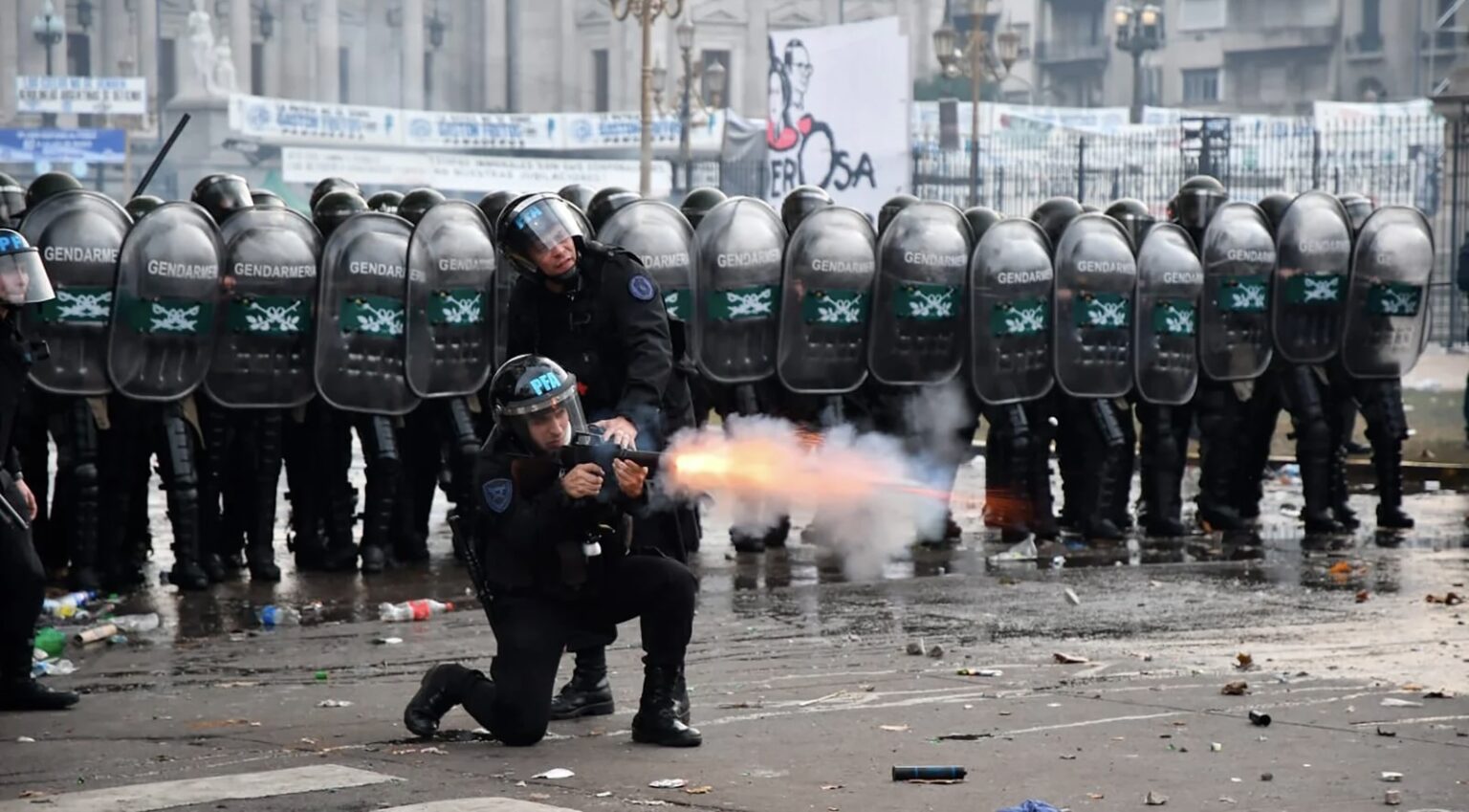
Police in Argentina brutally repressed a mobilization against Milei’s controversial economic reforms. Photo: UP Diputados

Over 30 people were detained in Buenos Aires during the brutal repression of the protests against Milei’s economic reform law

Last week, the Argentine Senate debated the bill called “Law for Bases and Starting Points for the Freedom of Argentines” (Ley Bases), a set of economic and political reforms proposed by the far-right government of Javier Milei. While the Executive sought the necessary votes in the Senate to pass the law, thousands of demonstrators gathered around the legislature to demand that the law be shelved.

The protests were called by several social organizations and trade unions, including the country’s largest trade union confederations, the General Confederation of Labor (CGT), the Argentine Workers’ Central Union, and the Argentine Workers’ Central Union (Autonomous).

The action of the police, under the orders of the Minister of Security, Patricia Bullrich, was excessive and brutal. Even lawmakers were not spared the violent repression. Peronist legislators, Eduardo Valdés, Carlos Castagnetto, Leopoldo Moreau, Juan Manuel Pedrini, Carolina Yutrovic and Luis Basterra, denounced that they were beaten by the security forces. In addition, several detainees told press that “they were stripped naked and that pepper spray was thrown at them”.

Martin Dirroco, a worker detained during the protests, recounted: “We were in Congress and we began to feel the tear gas, our throats began to burn and we began to leave. We heard more and more shots fired; we could see the repression. […] Suddenly a lot of people started to come, we tried to leave and seven motorcycles appeared. The one on the back of the motorcycle was pointing a gun at us. They got off the motorcycle and told us to stay still. They shooted and shouted ‘everybody against the wall’. They started pushing and shoving, holding me and throwing me to the ground. […] We had to sleep in a courtyard with handcuffs on”.

On Wednesday, June 12, 33 people were arrested, with many held for several days. Carlos Lopez, a left Argentine political leader, told Peoples Dispatch that as of today there are still five people detained on alleged charges of “public intimidation” and “arson”. Lopez comments that some people were even arrested 15 blocks from the Senate, far away from the events for which they are accused. “They are trying to sow terror from the government, the State, so that the population feels fear and shuts its mouth”. In addition, López continues, the detainees did not have adequate access to water and food; some spent more than 15 hours in a police patrol car and many could not speak to their lawyers: “There was intimidation, torture and threats […] We ask for everyone’s solidarity so that this type of action does not happen again,” said López.

Police launching tear gas canisters at protesters on Wednesday June 12 in Buenos Aires. Photo: Somos Telam

The President’s Office celebrated the approval of the law and called the demonstrators “terrorists”: “Starting from 38 deputies and 7 senators, with terrorist groups attacking the Congress, having to deploy the Security Forces in defense of democracy, with the political caste resisting and operating until the last moment, and having to resort to the tie-breaker of the Vice President of the Nation, Victoria Villarruel, tonight’s is a triumph of the Argentine people and the first step towards the recovery of our greatness, having approved the most ambitious legislative reform of the last forty years.”

Several human rights organizations, such as the Grandmothers and Mothers of the Plaza de Mayo, the Permanent Assembly for Human Rights, the Relatives of the Disappeared and Detained for Political Reasons, among others, called for a demonstration on Tuesday June 18 to demand the release of the 16 people that were still detained (including several students and professors) accused of “terrorism”. During a press conference, various relatives of the detainees denounced the injustice of the accusations against the prisoners and affirmed that they are not terrorists and demanded their immediate release.

Milei’s “Ley Bases”

At the end of the debate last Wednesday, the law was approved thanks to the vote of Vice President Victoria Villarruel, who broke the tie. The controversial law must be approved a second time in the Chamber of Deputies.

The reforms of the “Ley Bases” propose a paradoxical transformation of the functioning of the Argentine State. At the same time that they seek to diminish the State’s capacity to control the economy, they strengthen the President’s political power to make economic and political decisions, which will no longer have to be approved by the legislative branch. In other words, the intention is to build a weaker but more agile State to execute President Milei’s neoliberal plan.

One of the most controversial changes is the creation of the “Incentive Regime for Large Investments” (RIGI, for its initials in Spanish). The purpose of this regime is to reduce the State’s control over large companies that invest more than USD 200 million in the country. The government promises these big companies a reduction in taxes, privileges in the project approval process, and protection of capital from state control for 30 years. RIGI seeks, among other things, the exploitation of natural resources by major companies.

According to the “Ley Bases”, the President may have “extraordinary powers” for one year if he declares a public emergency in the economic, financial, and energy fields. In this sense, Milei would have several powers that currently only the Legislative has. To achieve its approval in the Senate, the Executive committed itself not to interfere with 15 public agencies, such as the National Service of Food, Health and Quality (SENASA), the National Bank of Genetic Data (which has information on those who disappeared during the last dictatorship), among other institutions. However, the government will be able to legislate through expeditious decrees, which implies, in general, the first great legislative victory for its political project.

In addition, the “Ley Bases” authorizes the privatization of Intercargo, a state-owned company dedicated to provide services to air travel companies, and Energía Argentina S.A., which is in charge of the extraction and exploration of hydrocarbon deposits, their transportation, and storage. Although Milei wanted to privatize more than 40 public companies, the negotiations forced him to limit his aspirations. Nevertheless, Milei’s major project in this regard seems to be aimed, at first, at the privatization of the mining, energy and fuel sectors.

Finally, the “Ley Bases” seeks to make a discreet, although controversial, labor reform, as it proposes, among other things, to eliminate penalties for companies that use informal workers, which is currently sanctioned by law.

While the Executive celebrates its neoliberal legislative victory, the families of the prisoners continue to pressure the justice system to free the detainees and drop the serious charges that could mean several years in prison.

Original article by Pablo Meriguet republished from peoples dispatch under a Creative Commons Attribution-ShareAlike 4.0 (CC BY-SA) license.
Continue ReadingArgentine organizations reject attempts by Milei to silence dissent with fear