Omar el Qataa is a photojournalist operating out of northern Gaza
Facebook has severely restricted the ability of Palestinian news outlets to reach an audience during the Israel-Gaza war, according to BBC research.
In a comprehensive analysis of Facebook data, we found that newsrooms in the Palestinian territories – in Gaza and the West Bank – had suffered a steep drop in audience engagement since October 2023.
The BBC has also seen leaked documents showing that Instagram – another Meta-owned platform – increased its moderation of Palestinian user comments after October 2023.
Meta – the owner of Facebook – says that any implication that it deliberately suppressed particular voices is “unequivocally false”.
…
During a period of war, audience engagement might be expected to rise. However, the data showed a 77% decline after the Hamas attacks on 7 October 2023.
Palestine TV has 5.8 million followers on Facebook. Journalists at the newsroom shared statistics with us showing a 60% drop in the number of people seeing their posts.
“Interaction was completely restricted, and our posts stopped reaching people,” says Tariq Ziad, a journalist at the channel.
Over the past year, Palestinian journalists have raised fears that their online content is being “shadow-banned” by Meta – in other words, restricted in how many people see it.
To test this, we carried out the same data analysis on the Facebook pages of 20 Israeli news organisations such as Yediot Ahronot, Israel Hayom and Channel 13. These pages also posted a large amount of war-related content, but their audience engagement increased by nearly 37%.
This article was originally posted 6/12/24 but was deleted probably by mistake.
Mark Zuckerberg, CEO of Meta, testifies before a U.S. Senate Judiciary Committee hearing on January 31, 2024, in Washington, D.C. (Photo: Celal Gunes/Anadolu via Getty Images)
“In the blind sprint to win on AI, Meta and the other tech giants have lost their way,” said a leader at Environment America.
Environmental advocates this week responded with concern to Meta looking for nuclear power developers to help the tech giant add 1-4 gigawatts of generation capacity in the United States starting in the early 2030s.
Meta—the parent company of Instagram, Facebook, WhatsApp, and more—released a request for proposals to identify developers, citing its artificial intelligence (AI) innovation and sustainability objectives. It is “seeking developers with strong community engagement, development, …permitting, and execution expertise that have development opportunities for new nuclear energy resources—either small modular reactors (SMR) or larger nuclear reactors.”
The company isn’t alone. As TechCrunch reported: “Microsoft is hoping to restart a reactor at Three Mile Island by 2028. Google is betting that SMR technology can help it deliver on its AI and sustainability goals, signing a deal with startup Kairos Power for 500 megawatts of electricity. Amazon has thrown its weight behind SMR startup X-Energy, investing in the company and inking two development agreements for around 300 megawatts of generating capacity.”
In response to Meta’s announcement, Johanna Neumann, Environment America Research & Policy Center’s senior director of the Campaign for 100% Renewable Energy, said: “The long history of overhyped nuclear promises reveals that nuclear energy is expensive and slow to build all while still being inherently dangerous. America already has 90,000 metric tons of nuclear waste that we don’t have a storage solution for.”
“Do we really want to create more radioactive waste to power the often dubious and questionable uses of AI?” Neumann asked. “In the blind sprint to win on AI, Meta and the other tech giants have lost their way. Big Tech should recommit to solutions that not only work but pose less risk to our environment and health.”
“Data centers should be as energy and water efficient as possible and powered solely with new renewable energy,” she added. “Without those guardrails, the tech industry’s insatiable thirst for energy risks derailing America’s efforts to get off polluting forms of power, including nuclear.”
In a May study, the Electric Power Research Institute found that “data centers could consume up to 9% of U.S. electricity generation by 2030—more than double the amount currently used.” The group noted that “AI queries require approximately 10 times the electricity of traditional internet searches and the generation of original music, photos, and videos requires much more.”
Meta is aiming to get the process started quickly: The intake form is due by January 3 and initial proposals are due February 7. It comes after a rare bee species thwarted Meta’s plans to build a data center powered by an existing nuclear plant.
Following the nuclear announcement, Meta and renewable energy firm Invenergy on Thursday announced a deal for 760 megawatts of solar power capacity. Operations for that four-state project are expected to begin no later than 2027.
A view of Google Headquarters in Mountain View, California, United States on March 23, 2024 [Tayfun Coşkun – Anadolu Agency]
A damning report, “Palestinian Digital Rights, Genocide, and Big Tech Accountability”, by 7amleh, a Palestinian-led non-profit organisation that is focused on protecting the human rights of Palestinians, has laid bare the disturbing and active role that major online platforms and big tech companies play in perpetuating human rights abuses against Palestinians. While the world watches the horrors unfold in Gaza, the role of these digital accomplices cannot be ignored. The report highlights that platforms like Meta, X, YouTube and tech giants Google and Amazon have enabled, facilitated and even profited from these atrocities, effectively shielding war crimes under a digital smokescreen.
The findings are a harrowing indictment of how big tech companies, under the guise of neutrality, have become active participants in censorship, disinformation and incitement to violence. They have provided crucial infrastructure that underpins Israel’s military actions, allowing their platforms to be weaponised, silencing Palestinian voices while amplifying hate speech and calls for genocide. The complicity of these platforms is not a mere oversight; it is an entrenched system of deliberate decision-making that prioritises profits over human rights.
Systematic censorship of Palestinian voices
At the heart of the report’s findings is a shocking pattern of systematic censorship targeting Palestinian voices. Between October 2023 and July 2024, over 1,350 instances of censorship were documented on major platforms, including Facebook, Instagram, X and TikTok. These platforms disproportionately targeted Palestinian journalists, activists and human rights defenders, with Meta’s platforms being among the worst offenders. The censorship took many forms: accounts were suspended, content takedowns became routine and distribution of pro-Palestinian narratives was heavily restricted.
Meta’s manipulative algorithm changes played a key role in this censorship. The report reveals that during the ongoing war in Gaza, Meta altered its content moderation policies to lower the threshold for flagging Palestinian content, reducing the accuracy of its filters and triggering unnecessary takedowns. For Palestinian content, Meta’s filters operated with a mere 25 per cent certainty of a violation, compared to the usual 80 per cent applied elsewhere. These so-called “temporary risk response measures” were never lifted, allowing for an outsized level of scrutiny on Palestinian content creators. This is not an isolated incident – it’s a calculated, discriminatory policy that silences marginalised voices and hinders the free flow of information at a time when it’s needed the most.
As 7amleh’s report highlights, Meta’s broken promises to safeguard free speech, coupled with its biased content moderation, exacerbated the situation for Palestinians. Human Rights Watch had already condemned Meta for its systemic censorship of Palestinian voices during the war, with over 1,050 instances of content removal on Facebook and Instagram. In nearly all cases, this censorship targeted peaceful, pro-Palestinian content while allowing violent, anti-Palestinian content to flourish unchecked. Comments like “Free Palestine”, “Stop the Genocide” and “Ceasefire Now” were removed under Meta’s spam guidelines, reflecting a dangerous double standard that stifles legitimate political discourse.
Platforms as instruments of genocide
The report makes clear that online platforms are not simply neutral forums but have become instruments of incitement to genocide. Between October 2023 and July 2024, over 3,300 instances of harmful content – including incitement to genocide – were documented, the majority on X and Facebook. These platforms allowed high-level Israeli officials and other users to openly call for the extermination of Palestinians, dehumanising them as “sub-humans”, “animals” and worse. This genocidal rhetoric wasn’t limited to obscure corners of the internet. It was promoted, amplified and left unchallenged by the very platforms that claim to be committed to community standards and human rights.
For instance, on X, a December 2023 post by the deputy mayor of Jerusalem described blindfolded Palestinian detainees as “ants” and called for burying them alive. Although this specific post was eventually removed, countless others like it remain, fuelling a climate of violence and dehumanisation against Palestinians. This failure to combat hate speech directly contravenes international law, particularly in light of the International Court of Justice’s January 2024 order, which directed Israel to prevent and punish incitement to genocide.
These platforms are not just failing in their duty to protect free speech; they are actively facilitating the spread of genocidal propaganda. In the case of Meta, the report details how over 9,500 takedown requests from the Israeli government were sent to Meta between October and November 2023, with a shocking 94 per cent compliance rate. This high level of cooperation with a state actively committing war crimes raises serious concerns about the ethical boundaries of these companies. Meta’s decision to comply with such requests without transparency or accountability reveals a deeper issue: these platforms are willing to become tools of state oppression when the price is right.
The role of Big Tech: Project Nimbus and the automation of killing
Beyond the sphere of social media, Google and Amazon’s collaboration with the Israeli military under Project Nimbus casts an even darker shadow over the tech industry’s role in this conflict. The $1.2 billion cloud computing contract, as the report highlights, provides critical infrastructure to power Israel’s AI-driven Lavender and Gospel targeting systems – systems that are directly linked to the mass civilian casualties in Gaza.
The Lavender system, in particular, functions as a tool for automated killings, identifying targets based on massive data inputs and feeding them into the Israeli military’s bombing campaigns. The report describes how Lavender alone identified over 37,000 potential targets, contributing to the deaths of thousands of civilians, including women and children. By providing cloud services to facilitate this mass-scale targeting, Google and Amazon are directly implicated in these violations of international law. Despite mounting global pressure, both companies continue to support Israel’s military operations under Project Nimbus, even as the civilian death toll in Gaza rises.
Hate speech and disinformation: A coordinated assault on truth
The report goes on to document a deluge of hate speech and disinformation campaigns, often spearheaded by Israeli officials and amplified by online platforms. These campaigns, which include the systematic dissemination of dehumanising content on Telegram, X and YouTube, have targeted Palestinians both inside Gaza and across the diaspora. The report cites three million instances of violent content in Hebrew aimed at Palestinians on X alone, much of it coordinated by Israeli state actors.
Perhaps most troubling is the Israeli government’s influence operation known as STOIC, which ran a disinformation campaign targeting US and Canadian lawmakers to undermine the work of The United Nations Relief and Works Agency for Palestine Refugees in the Near East (UNRWA). This campaign, orchestrated with the help of AI, spread false narratives that led to the defunding of UNRWA, cutting off critical humanitarian aid to Palestinians. This is not merely a failure of moderation but an example of how platforms can be weaponised for state-driven disinformation, with devastating consequences for innocent civilians.
Profiting from genocide: Advertising amidst war crimes
As if censorship and disinformation weren’t enough, the report also exposes how platforms like Facebook have profited from harmful advertisements promoting violence against Palestinians. The investigation found that Facebook ran ads calling for the assassination of pro-Palestinian activists and the forced expulsion of Palestinians from the West Bank. Meta profited from these campaigns, further entrenching its complicity in the human rights violations unfolding in Gaza.
Meanwhile, YouTube ran ads from the Israeli government that used graphic imagery to sway public opinion in favour of its military actions in Gaza. Despite YouTube’s policies against violent content, these ads flooded social media with incendiary narratives, particularly in Europe and the US, contributing to the normalisation of war crimes under the guise of counter-terrorism.
Time for accountability
The findings of this report should compel the international community to act. It is no longer acceptable for tech companies to hide behind vague policies and empty commitments to free speech while facilitating the mass killing and silencing of a besieged population. The complicity of Meta, X, YouTube, Google and Amazon in these atrocities must be brought into the spotlight and held accountable for their role in enabling these crimes.
These platforms are not neutral arbiters of truth – they are corporations driven by profit, willing to accommodate genocidal regimes and turn a blind eye to the suffering of millions if it serves their bottom line. As the report makes clear, it is time for the world to demand that these companies stop profiting from the destruction of Palestinian lives. The silence and complicity of big tech are unforgivable, and they must not be allowed to escape responsibility any longer.
The views expressed in this article belong to the author and do not necessarily reflect the editorial policy of Middle East Monitor.
A screenshot of a Conservative advert on Meta during the 2024 general election campaign. Credit: Conservatives / Meta
The party has pumped out hundreds of adverts falsely stating that Labour would introduce a “national ULEZ”, and pay per mile charges.
The Conservative Party has reached millions of people with digital adverts that falsely claim Labour would impose new taxes on drivers.
In recent days the Tories have launched hundreds of new online adverts falsely claiming that Labour would introduce a nationwide ultra-low emission zone (ULEZ) that would charge people for using highly-polluting vehicles.
Labour’s London Mayor Sadiq Khan introduced and recently extended the capital’s ULEZ, which only applies to around 10 percent of vehicles, but the party has no plans to roll out the scheme to the rest of the country.
New analysis by advertising experts ACT Climate Labs, shared with DeSmog, finds the Tories have spent tens of thousands of pounds since the start of the general election campaign on digital adverts, which have appeared on the likes of Google, Facebook and Instagram, attacking climate and anti-pollution policies.
“Unfortunately, the Conservative leadership has increasingly used environmental and climate policies as collateral damage lately, in an attempt to secure more support for the party,” Sean Buchan, intelligence lead at ACT Climate Labs, told DeSmog.
“Clearly, it is not working – in fact, poll after poll shows us that Conservative voters, along with the vast majority of Brits, want climate action.
“However, the ripple effects of these adverts may last well beyond 4 July. The climate movement needs to ensure the public is seeing pro-climate messaging that truly speaks to them, through creative and local campaigns, and where possible with multi-channel advertising of its own.”
One Tory advert on Meta (Facebook and Instagram) read: “This is not a test. Keir Starmer will force pay per mile driving, costing you £THOUSANDS [sic] a year.”
This false claim – Labour doesn’t intend to introduce pay per mile charges – was seen between 150,000 and 175,000 times, costing between £1,000 and £1,500.
During the London mayoral election in May, the Conservatives claimed that Labour would introduce pay per mile road charges in the city, despite Khan having publicly ruled out the policy. A Tory leaflet featuring the claim was reported by Labour to the Crown Prosecution Service, with the party saying it may have broken election law.
While serving as chancellor, now Prime Minister Rishi Sunak reportedly said he was “very interested” in introducing a national pay per mile scheme.
“Voters are badly served by any party which repeatedly spreads misinformation or disinformation online,” said former Liberal Democrat MP Tom Brake, director of the campaign group Unlock Democracy. “If parties cannot commit to accurate advertising on a voluntary basis, bringing political ads under advertising rules may provide the only solution.”
ULEZ Blitz
Another Meta advert from the Conservatives, costing between £400 and £499 and gaining upwards of 50,000 impressions, claimed “Keir Starmer will force a local ULEZ near you”.
The party is now pumping out hundreds of similar adverts spreading this claim, each tailored to a local constituency, estimated to be costing up to £65,000. “With his supermajority, Keir Starmer could steamroll through plans to introduce a ULEZ near you,” the adverts state.
The Tory campaign has been warning voters against handing Labour a large majority, despite the size of a government’s majority making little difference to its ability to pass legislation.
“The Tory strategy of the last few weeks has been to focus on their core supporters, as well as those who might vote Reform, so these ads are another thing designed for them,” Sam Jeffers, executive director of the advertising monitoring platform Who Targets Me, told DeSmog.
The Tories have also paid for a Google advert attacking Labour’s decarbonisation plans, which has been viewed more than five million time, costing between £25,000 and £30,000. The advert features an “explainer” video on how much a Labour government would allegedly cost households, with decarbonising the electricity grid the first cost named.
Labour plans to decarbonise the electricity grid by 2030, while the Conservatives have pledged that 95 percent of the UK’s electricity will be generated by low-carbon sources by 2030, achieving full decarbonisation by 2035.
Political parties have spent huge sums on digital adverts during the campaign so far. As of 25 June, the Tories and Labour combined had spent over £3 million on Meta adverts that had gained an estimated 400 million impressions.
“Advertising blasts like this – especially when micro-targeted – can have a significant influence on people’s thoughts and behaviours,” said Buchan.
“In an increasingly fragmented media environment, digital advertising can be a fantastic way to target hard-to-reach people with your message. In an election where honesty is at a premium, it’s very concerning to see so much money – up to £70,000 on the adverts we’ve counted – spent on such spurious claims.”
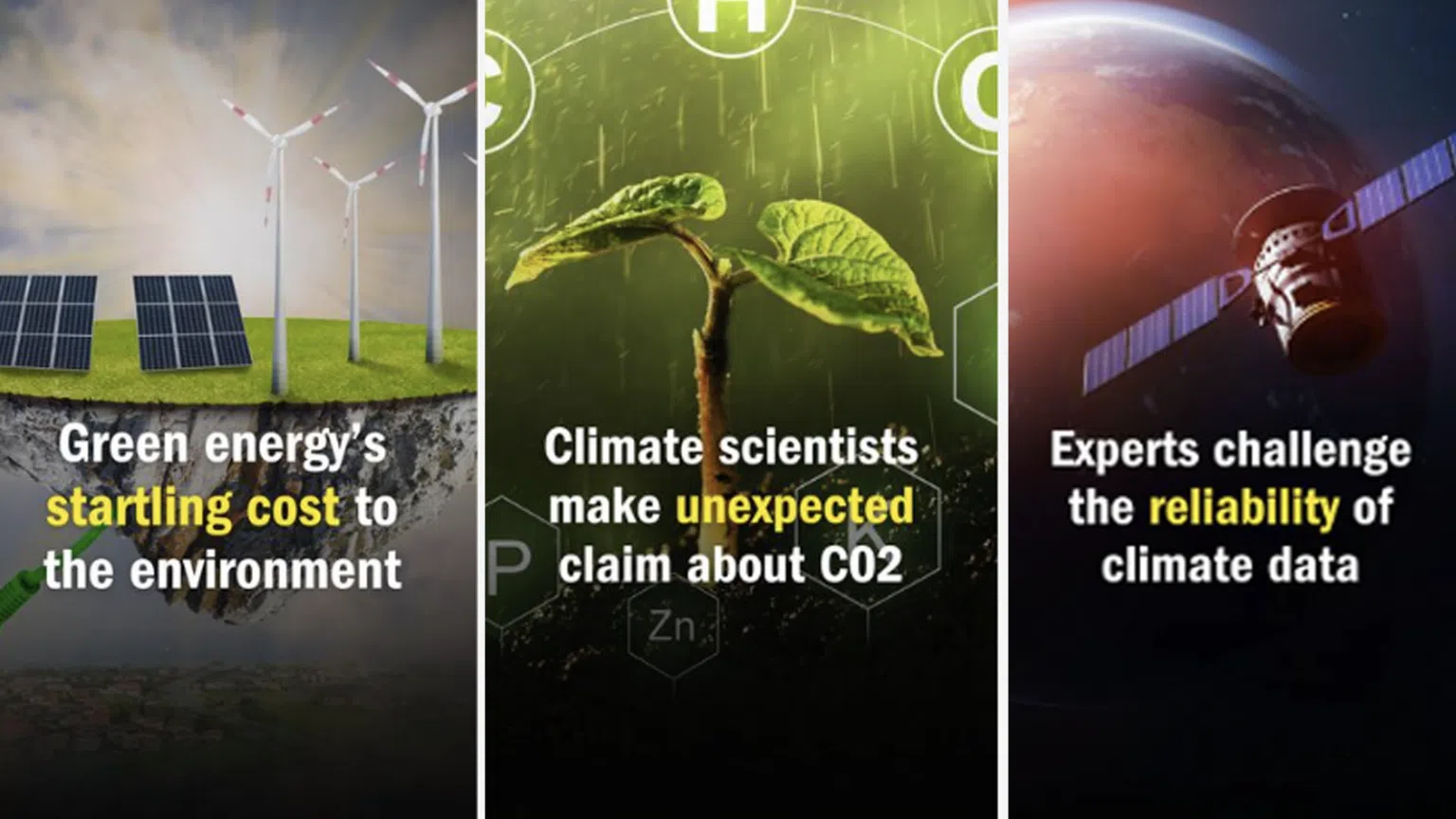
A mashup of three Epoch Times adverts posted on Meta. Credit: The Epoch Times / Meta
Campaigners have referred the Epoch Times to the UK advertising regulator for “stoking the climate culture war” on social media.
The pro-Trump Epoch Times has run hundreds of anti-climate social media adverts in Europe since the beginning of 2024 that have been seen millions of times, DeSmog can reveal.
Epoch Times accounts in Europe have run 425 adverts on Facebook, Instagram, and X (formerly Twitter) that have attacked or undermined climate science, green energy, or climate action since the start of the year. These adverts have been run in the UK, Germany, Slovakia, and Bulgaria, appearing on social media feeds at least 2.3 million times across Facebook and Instagram, and 3.1 million times on X.
These anti-climate ads were active for 22 days on average on Meta platforms (Facebook and Instagram), while they were displayed for 9.5 days on average on X.
Four of the adverts posted by Epoch Times on Meta have now been referred to the Advertising Standards Agency (ASA), a UK watchdog, by the campaign group Global Witness. The group is calling for the ASA to open an investigation into whether the Epoch Times breached the Committee of Advertising Practice (CAP) Code and, if so, to ban these adverts.
The Epoch Times claims to be the fastest growing independent news outlet in the United States. It claims to host websites across 22 languages in 35 countries, publishing online and in print. The publication has gained a substantial online following in recent years, amassing more than 10 million followers across its various Facebook accounts.
Based in New York, the Epoch Times is affiliated with the Falun Gong new religious movement in China and is staunchly anti-communist. Though the source of its income isn’t publicly declared, former employees told the New York Times that the publication was financed “by a combination of subscriptions, ads and donations from wealthy Falun Gong practitioners.”
The publication has propelled itself on Facebook by filling its feeds with viral, feel-good videos alongside its often partisan news coverage.
According to NewsGuard, an independent company that rates the credibility of news sites, Epoch Times articles “frequently include distorted, misleading, or unsubstantiated claims.” The Epoch Times claims on its website that its reporters are “guided by the highest code of conduct and ethics”.
The Epoch Times spent at least $1.5 million on adverts in support of then Republican President Donald Trump from 2018 to 2019 – more than any group other than the Trump campaign.
The publication was banned from advertising by Meta following these revelations, and the social media company told DeSmog that it ”continues to enforce this ban”. However, a number of Epoch Times offshoots have been allowed to promote climate science denial across Europe this year.
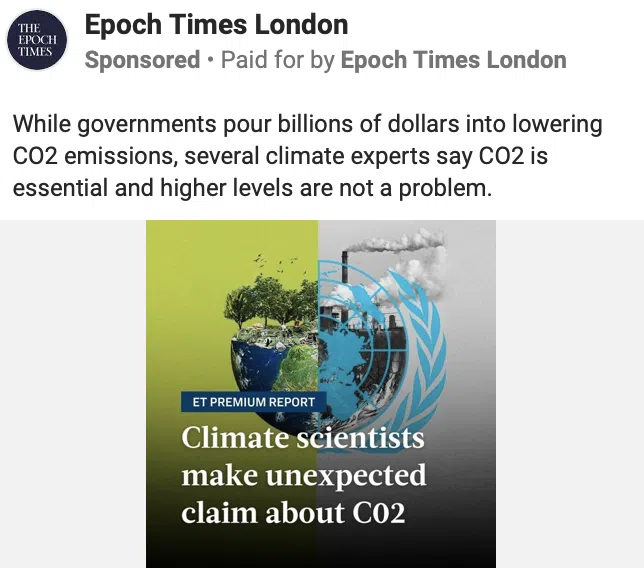
Many of these adverts have explicitly questioned the contribution of carbon dioxide (CO2) to climate change. The adverts have featured statements including “Several climate scientists say CO2 is essential and higher levels are not a problem”, and “What if more CO2 is actually good for the environment?”
The UN’s Intergovernmental Panel on Climate Change (IPCC), the world’s foremost climate science body, has stated that carbon dioxide “is responsible for most of global warming” since the late 19th century, which has increased the “severity and frequency of weather and climate extremes, like heat waves, heavy rains, and drought”.
The adverts ran for months, and reached millions of people, despite Meta’s pledge to tackle climate misinformation. Ten were removed prior to DeSmog contacting Meta, of which six were removed over a failure to include an appropriate advertising disclaimer.
“After sowing division and disinformation in the U.S., everyone in the UK should be alarmed that the Epoch Times is using the same playbook here,” said Nienke Palstra, campaign strategy lead at Global Witness. “We have already seen politicians trying to stoke a climate culture war and the Epoch Times is spending big to tap into this sentiment. We cannot allow the future of our planet to be put at threat for the political gain of extremists and populists.”
A spokesperson for the Epoch Times told Global Witness that scientists have always differed in their opinion on climate change and that “To ban different opinions does not help a civilised open society and erodes freedom of speech.”
Climate Denial Content
The bulk of the anti-climate adverts seen by DeSmog were posted by Epoch Times London, a Facebook page created in October 2023 that has fewer than 600 followers.
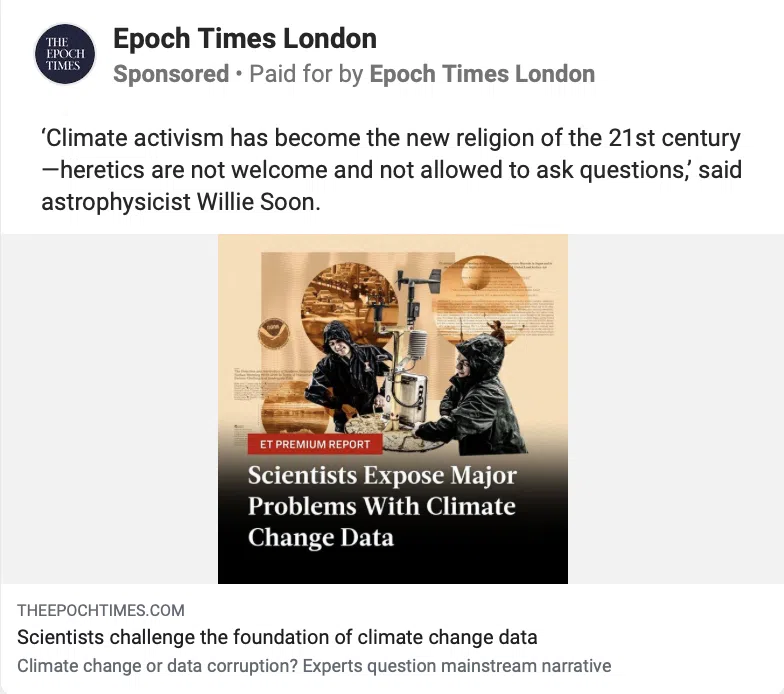
Many of the adverts posted by Epoch Times London questioned climate science, for example claiming that “the greenhouse effect is real but irrelevant”, and that “new studies undercut the ‘scientifically empty’ global warming narrative.”
One advert entitled “Scientists Expose Major Problems With Climate Change Data” was linked to an Epoch Times article that claimed climate change can be best explained by “natural variation”. The article also said that attempts to create a scientific consensus around human-caused climate change are the product of “deliberate fraud” according to “some experts.”
The same article quoted Willie Soon, a scientist who has cast doubt on climate science and who has openly admitted accepting research funding from fossil fuel interests.
A number of the Epoch Times London adverts suggested that the consensus on climate change is based on a wilful misinterpretation of evidence by the scientific community, asking questions such as “Climate change or data corruption? Experts question mainstream narrative.”
DeSmog’s analysis found that Epoch Times London ran at least 392 unique adverts on Meta since the start of the year that attacked or attempted to undermine climate science, green energy, or climate action.
Of those adverts, 146 were still active prior to DeSmog contacting Meta. According to an analysis of Meta’s ad archive, Epoch Times London has spent between £12,600 and £51,715 on its anti-climate advertising since the start of the year, with those adverts having been seen between 1.9 million and 2.5 million times. Meta has now blocked Epoch Times London’s ability to post adverts.
According to Companies House, Epoch Times London was incorporated in 2014. The publication drew criticism in the UK in 2020 for posting free editions of its paper to Brighton and Hove residents, the front page of which included claims that the Chinese Communist Party had deliberately covered up evidence of COVID-19’s existence.
Following complaints from constituents, Lloyd Russell-Moyle, the Labour MP for Kemptown in Brighton, publicly criticised the Epoch Times in the House of Commons and called on Royal Mail to stop posting its print edition.
Epoch’s European Operations
Elsewhere in Europe, DeSmog has seen evidence of anti-climate advertising from Epoch Times-affiliated accounts.
The most prolific source of these adverts has been the German Epoch Times account on X, which has run 61 anti-climate adverts since the beginning of the year, reaching at least 1.5 million people and appearing 3.2 million times on X feeds across the German-speaking world.
Of the adverts that made a funding declaration, all stated that they were paid for Epoch Times Europe Gmbh, a company that has existed in Germany since at least 2009 according to the country’s company register.
A number of these adverts directly questioned the role of CO2 on climate change, saying that “CO2, especially anthropogenic emissions, hardly play a role”, “Climate change: CO2 not to blame”, “Climate change is too complex to blame on CO2”, and “CO2 is the most expensive fraud in history.”
While there were fewer ads run on Meta in Germany than in the UK, they still generated at least 100,000 impressions, representing an ad spend of between €1,500 and €3,777.
An account run by German Epoch Times journalist Erik Rusch has also run at least 24 anti-climate adverts since its creation in January – though the adverts state that they were paid for by Rusch.
Some of the adverts run by Epoch Times Germany suggested that wind turbines produce nefarious health effects, including claims such as, “Don’t ignore the health effects: Doctor warns against wind turbines”, and “Wind energy under scrutiny: Dr Bellut-Staeck on the low-frequency risks to humans and animals.”
One of the German adverts quoted Fritz Vahrenholt, who is a scientific advisor to the UK’s leading climate science denial group, the Global Warming Policy Foundation (GWPF).
Other adverts promoted by the German Epoch Times, as well as Epoch Times London, quoted fellow GWPF advisor Richard Lindzen. In one of these adverts, Lindzen was quoted as saying: “If we could get rid of 60 percent of CO2, we would all be dead.”
Germany Epoch Times adverts also linked back to articles on its website, directing readers to the claim by climate science denier John F. Clauser that the perceived climate threat is a “dangerous corruption of science.”
Another advert quoted Lindzen as asking, “Is climate change the existential threat we’ve been led to believe?” and linked to an Epoch Times interview with Lindzen on its YouTube series “American Thought Leaders”.
Former UK Prime Minister Liz Truss was recently interviewed on this series, while a parallel series, “British Thought Leaders”, has interviewed a number of climate science deniers. Since the beginning of March, this series has featured Martin Durkin, Rupert Darwall, and GWPF advisor Gwythian Prins. These interviews were headlined: “The Science Simply Does Not Support the Ridiculous Hysteria Around Climate At All”, “This Obsession With Carbon Dioxide Emissions Has Led to Tragedy”, and “The World Is at War – The West’s Green Policies Are Playing Into Our Enemy’s Hands”.
Epoch Times Bulgaria has posted three anti-climate ads since the beginning of the year, one of which was entitled “scientists alarmed that there is no real evidence that CO2 is causing climate change”.
Meta has pledged to take action against false narratives on climate change, and the platform has committing to using a “suite of tools, such as fact checking and labels, to help combat climate misinformation.”
In May 2021, Facebook said that it would begin attaching informational labels to posts about climate change, directing users to the platform’s new “Climate Science Information Center”.
However, research conducted in 2022 by the Center for Countering Digital Hate found that Facebook is failing to flag at least half of climate misinformation content.
“Despite claiming to take climate misinformation seriously, Meta has a history of allowing climate disinformation posts with high-engagement to go unchecked,” said Ilana Berger, senior climate and energy disinformation researcher at the misinformation watchdog Media Matters. “If Meta is committed to combating climate disinformation on its platform, it must at the very least consistently enforce its existing policies.”
Meanwhile, following his takeover of Twitter in 2022, Elon Musk has slashed the number of staff who identify harmful content and misinformation. X did not respond to DeSmog’s request for comment.
“Climate misinformation threatens all of our futures – and with elections pending across Europe, the stakes could not be higher,” said Richard Wilson, director of the campaign group Stop Funding Heat. “But the same money that is fuelling this problem could also be the key to a solution. If enough advertisers speak out, and urge Facebook and Twitter to stop climate lies being promoted through their platforms, they will have to clean up their act.”